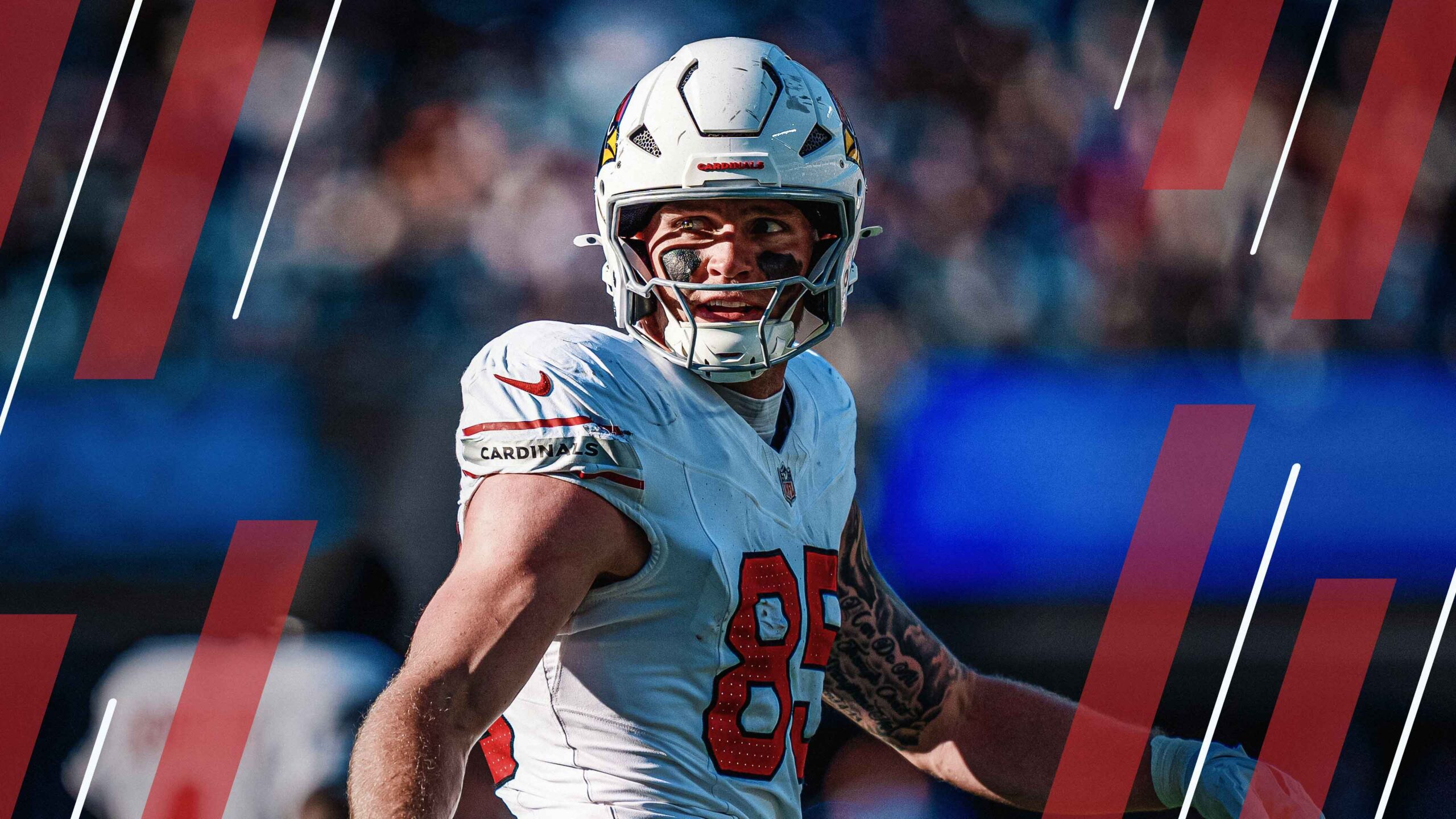
- Trey McBride has been incredibly consistent: McBride finished as a top-six fantasy tight end for over 50% of his games last season.
- Will the rookie trend continue?: Tyler Warren and Colston Loveland look to follow in Bowers and Sam LaPorta’s footsteps as elite fantasy options in their rookie seasons.
- Subscribe to PFF+: It’s quick and easy. You’ll unlock industry-leading rankings, unlimited Fantasy Mock Draft Simulator use, Live Draft Assistant and weekly our Start/Sit Optimizer. It’s time to win.
Estimated reading time: 8 minutes

With the 2025 NFL season approaching, now is the time to prepare for your fantasy drafts with the most accurate redraft PPR rankings for tight ends available. These rankings reflect current depth charts, projected roles, and coaching tendencies to identify the players most likely to deliver early and sustained fantasy value. All rankings are curated by Nathan Jahnke, one of the most accurate fantasy football rankers in the industry, with multiple top-five finishes in the FantasyPros Accuracy Competition. Every player listed with a paragraph is linked to a full fantasy football profile, providing deeper context, stats, and outlooks to help you make smarter draft-day decisions.
Last updated: Thursday, August 28
1. Trey McBride, Arizona Cardinals
McBride became the Cardinals' primary tight end in the middle of the 2023 season, and he’s been an elite fantasy option at the position ever since. He averaged at least 15 PPR points in both seasons once he became the starter. McBride led the league in both receptions per game (6.9) and receptions per route (0.21) last season. His yards per game (71.6) and targets per game (8.7) were both second-best. The Cardinals kept the coaching staff and players on the offense essentially the same as last season, making it easier to expect more of the same from McBride. If anything, we can expect a few more touchdowns after his low touchdown total from last season.
2. George Kittle, San Francisco 49ers
George Kittle has been arguably the best tight end in the NFL during his career. His run blocking has been the best, and his numbers are better than Travis Kelce on a per-play basis. However, the 49ers' run-first philosophy mixed with Kittle’s injury history has left Kittle running fewer routes than other elite tight ends. He’s made up for it in recent seasons with Brock Purdy, whose ability to find Kittle down the field led to more big plays from Kittle than any other tight end in recent seasons. This makes him a clear top-three fantasy tight end, but his age, mixed with a chance his average depth of target decreasing, makes him the clear third option between him, Brock Bowers and Trey McBride.
3. Brock Bowers, Las Vegas Raiders
Bowers joined the Raiders and immediately became the league’s top fantasy tight end. He led all tight ends in receptions and receiving yards as a rookie, resulting in the most fantasy points. Both Trey McBride and George Kittle missed games, and both finished slightly ahead of him in fantasy points per game. His 88.4 receiving grade also finished third among tight ends, behind Kittle and McBride. Bowers is expected to leap over the two tight ends with general improvements to the Raiders' offense, leading to more accurate passes thrown his way and more touchdowns. However, the coaching staff has a history of tight end committees, and the Raiders have better run-blocking tight ends on the roster, which could lead to Bowers getting used on fewer snaps this season than last.
4. T.J. Hockenson, Minnesota Vikings
Hockenson was a top-six fantasy tight end in points per game from 2020 to 2023, including a tie for the top overall spot in 2023. He tore his ACL and MCL at the end of 2023. He returned faster than the average player with a similar injury, and understandably didn’t play as much and wasn’t as effective. He will be much further removed from his injury for the 2025 season, but some players never return to the player they were before that injury. Luckily, even if he doesn’t have the same speed, he’s still strong on contested catches, but that won’t command the same target share as he’s had in the past.
5. Sam LaPorta, Detroit Lions
Sam LaPorta was the top fantasy tight end of the 2023 season as a rookie in the Lions’ high-scoring offense. His fantasy production wasn’t as consistent in 2024. Part of this was likely due to multiple injuries early in the season. However, this was also likely due to other players stepping up in the passing game, including Jameson Williams and David Montgomery. The Lions lost offensive coordinator Ben Johnson and added John Morton, who doesn’t necessarily have a great history targeting tight ends in the passing game. While LaPorta’s talent should help him remain a typical fantasy starter, there’s a chance he won’t be as big of a priority in the offense as other skill players, which would prevent him from being an elite fantasy tight end.
6. Tucker Kraft, Green Bay Packers
Tucker Kraft was the Packers' clear top tight end in 2024. He was excellent with the ball in his hands, leading the league in yards after the catch per catch and avoided tackle rate. However, his target rate was among the lowest for a starting tight end. This resulted in Kraft not averaging enough points to be a consistent fantasy starter, but he also wasn’t too far behind the top 12. The Packers' coaches have made it a point to talk about wanting to get him the ball more often. If they follow through, it will make Kraft a top-12 option at the position.
7. Tyler Warren, Indianapolis Colts
Warren posted one of the best seasons by a Power-Five tight end in the PFF era. His PFF offensive grade was among the top 10 for those with at least 500 offensive snaps during the regular season. His 974 receiving yards in the regular season were the most for any Power-Five tight end since 2014. Warren landed with the Indianapolis Colts, where he should play a high percentage of snaps. While the Colts haven’t had an every-down tight end in recent seasons, head coach Shane Steichen utilized a feature tight end at both the Los Angeles Chargers and Philadelphia Eagles. The primary concern is at quarterback, where Anthony Richardson Sr. has the lowest accuracy rate on short targets among quarterbacks.
8. Travis Kelce, Kansas City Chiefs
Travis Kelce consistently finished first or second in fantasy points per game for nearly a decade, but his quality of play and fantasy production have declined in recent seasons. His avoided tackle rate sharply declined last season, as did his yards after the catch per reception. Kelce will be 36 years old by the end of the season, making it unlikely these numbers bounce back in a significant way. The Chiefs also have several young wide receivers who are healthy together, which could also cut into Kelce’s production. Kelce is at risk of falling outside the top-10 fantasy tight ends, but if the team is scoring more points and Kelce is doubled in the red zone less often, that should lead to Kelce’s touchdown totals bouncing back.
9. David Njoku, Cleveland Browns
David Njoku has been a top-eight fantasy tight end for the past three seasons thanks to his limited competition for targets and a coaching staff that trusts him, even though his receiving grades haven’t been the highest. The Browns didn’t make many significant changes to their receiving room, so Njoku’s floor should remain high this season as long as he doesn’t have a significant dropoff in play. However, the Browns invested in two running backs in the draft, which will likely lead them to run the ball more often this season than last. The unsettled quarterback situation, wide receiver room and offensive line could lead the offense to be low scoring, which all limit Njoku’s upside. He has one of the highest floors for all tight ends, but he is unlikely to finish among the top-five fantasy tight ends again this season.
10. Mark Andrews, Baltimore Ravens
Mark Andrews finished as a top-five fantasy tight end in points per game each year from 2019 to 2023. His fantasy value took a step back in 2024 for a multitude of reasons. The Ravens added Derrick Henry, leading the team to be more run-heavy. Isaiah Likely and Charlie Kolar were both playing well, leading Andrews to be mostly restricted to most of the 11 personnel snaps and nearly all of the 12 personnel snaps, but he wasn’t in 21 personnel very often and very rarely in 22. This led him to finish 14th among tight ends in receptions despite not missing a game. Luckily, the quality of his play didn’t take a step back, as he led all tight ends in touchdowns. His touchdown total will likely regress, but ideally, his talent can lead him to more opportunities. He’s a risky pick, but should remain a fantasy starter for another season.
11. Dalton Kincaid, Buffalo Bills
Dalton Kincaid showed promise as a rookie, putting together a stretch of games in the middle of the season with 14 PPR points per game and two games of 80 or more yards to end the regular season. However, he had an entirely forgettable second season, scoring only two touchdowns and never exceeding 55 receiving yards. He ran only 21 routes per game and saw the third-most uncatchable targets at the position. Kincaid dealt with injuries for most of the 2024 season, which likely contributed to his reduced playing time and lack of chemistry with quarterback Josh Allen. While the Bills will likely be winning a lot of games in 2025, leading to a lot of rushing attempts, and still have Dawson Knox, it’s reasonable to expect significant improvement from Kincaid this season.
12. Colston Loveland, Chicago Bears
Loveland’s 88.5 receiving grade over the last five seasons ranks eighth-best among Power-Five tight ends, behind Brock Bowers, Dalton Kincaid, Charlie Kolar, Michael Mayer, Tyler Warren, Maliq Carr and Sam LaPorta. At least part of the reason he’s lower is volume, as his 2.22 yards per route run is fourth-best and better than fellow potential first-round tight end Warren. Loveland landed with the Chicago Bears under head coach Ben Johnson. Loveland looks to follow LaPorta’s footsteps and become an elite fantasy option in his first season.
13. Evan Engram, Denver Broncos
Evan Engram has spent his career among the league leaders in routes run per game. With the Jacksonville Jaguars, he parlayed that workload into being a consistent fantasy starter. In his final season with the team, Engram had only one game as a top-six fantasy tight end, with injuries costing him half the campaign and potentially impacting his quality of play in the other half. He signed a two-year contract with the Denver Broncos, who have thrown the fewest passes to tight ends over the past two seasons. That should change in 2025, but head coach Sean Payton has a long history of rotating his skill players. He brought in Jeremy Shockey and Jared Cook near the end of their careers, and both averaged 21 to 24 routes per game. While Engram should help the Broncos and provide a missing element to their offense, he will have trouble reaching the volume he's used to. He might be able to remain a borderline top-12 fantasy tight end if things are going well, but he could easily fall to the TE2 range.
14. Dallas Goedert, Philadelphia Eagles
Dallas Goedert has spent his entire career with the Philadelphia Eagles, and after a contract restructure, he will spend at least one more season in Philadelphia. He’s consistently been among the league’s highest-graded tight ends, although he’s fallen to the 10-15 range among tight ends the last two seasons. The Eagles have a lot of star power on offense, which is limiting Goedert’s touches, but defenses are so focused on everyone else that it’s making Goedert’s life easier when he is targeted. Goedert has been a low-end TE1 in fantasy points per game throughout his career, which should continue to be the case. Goedert has missed games every season since his rookie season, including a career-high seven games last season. Anyone drafting Goedert should have a second option at the position in case Goedert is injured, or sees further declines in his target rate or quality of play.
15. Chig Okonkwo, Tennessee Titans
Chig Okonkwo, the Tennessee Titans‘ speedy tight end, has shown flashes of top-tier fantasy potential, particularly toward the end of last season, when his 43.9 fantasy points during the fantasy playoffs ranked fourth among tight ends despite not scoring a touchdown. While his early career saw limited routes behind other tight ends, his per-play efficiency was undeniable, highlighted by his 2.62 yards per route run, which tied for the most in the last three seasons. Okonkwo has minimal competition for targets, and Cameron Ward is his new quarterback. If Okonkwo can keep his high snap rate from the end of last season and become one of Ward’s favorite targets, he has the potential to finish among the top-12 fantasy tight ends.
16. Jake Ferguson, Dallas Cowboys
Jake Ferguson impressed on a small sample size as a rookie, leading him to become a fantasy starter in his second season. Expectations were high for 2024, but he dealt with multiple injuries, and then Dak Prescott missed the second half of the season. There was a stretch of games from Weeks 3 to 9 when Ferguson was a top-12 fantasy tight end, which was the only stretch both Ferguson and Prescott were healthy. While both players should ideally be in a good position to start the 2025 season, the Cowboys traded for George Pickens. This will push Ferguson from second to third in terms of target pecking order in the offense. Prescott didn’t play as well in 2024 when he was healthy compared to 2023. If Prescott plays how he played in 2024, it will be difficult for him to have two fantasy-relevant receivers, let alone three.
17. Brenton Strange, Jacksonville Jaguars
Brenton Strange enters the 2025 season as the clear lead tight end for the Jacksonville Jaguars after showing flashes in 2024 when filling in for Evan Engram. He averaged 8.3 fantasy points per game as a starter, ranking 19th among tight ends. While he didn't establish himself as a consistent fantasy starter and faces more competition for targets after the addition of Travis Hunter, he did have a very high single coverage open target rate of 50.6%, highlighting his potential. There was minimal movement at tight end this off-season, leaving very few high-upside sleeper options. Strange is one of the few veterans who could make a significant step forward this season if he simply plays well enough.
18. Isaiah Likely, Baltimore Ravens
Isaiah Likely‘s fantasy football value is heavily tied to his upside and potential to emerge as the primary tight end for the Baltimore Ravens. While he has shown flashes, particularly with a 13.9 PPR points per game average during the last six regular-season games of his second season, his role has been inconsistent due to Mark Andrews. Likely's 13% touchdown per reception rate over the last three seasons is the highest among tight ends, and his 0.31 avoided tacklers per reception is the best over the last two seasons, indicating his efficiency. The up-and-coming Likely would need to overtake the soon-to-be-30 Andrews as the primary receiving tight end either by overtaking him on the depth chart, an injury or an Andrews trade to become a fantasy starter. If that happens, he would be a weekly fantasy starter.
19. Hunter Henry, New England Patriots
Hunter Henry has shown flashes of fantasy relevance over his decade in the NFL, offering production that's made him a viable option in deeper leagues, even finishing 16th in fantasy points per game in both 2023 and 2024. However, consistency has been an issue, as he’s finished outside the top-18 fantasy tight ends in at least 50% of his games in each of the last three seasons. Given his age and the increased competition for targets in New England with additions like Stefon Diggs, it’s hard to project him as anything more than a bye week fill-in or a late-round tight end starter option in 14-16 team leagues.
20. Kyle Pitts Sr., Atlanta Falcons
Kyle Pitts was drafted earlier than any other tight end in NFL history in 2021. After a promising rookie season, Pitts has failed to finish among the top 12 fantasy tight ends in over 40% of his games in any of the last three seasons. Last season, he was playing three-quarters of Atlanta’s offensive snaps during the first half of the season, but that fell to half of the offensive snaps over the second half of the season, as the Falcons chose to utilize Charlie Woerner more frequently for his run-blocking ability. Pitts shouldn’t be trusted to be a fantasy starter this season, but if he can earn the trust of his coaches and new quarterback Michael Penix Jr., there is room for him to earn more playing time and a higher target rate, which could be enough to be a fantasy starter again.
21. Jonnu Smith, Pittsburgh Steelers
Jonnu Smith is the rare eighth-year breakout player after stints with the Tennessee Titans, New England Patriots and Atlanta Falcons. He finished with the fourth most fantasy points in his lone season with the Miami Dolphins. He was traded to the Pittsburgh Steelers at the end of June to reunite him with Arthur Smith, his tight end coach and offensive coordinator with Tennessee, and his offensive coordinator in Atlanta. Arthur Smith uses a heavy tight end rotation, where Jonnu Smith has consistently failed to reach the top-15 fantasy tight ends. He will be competing for snaps with Pat Freiermuth and Darnell Washington, which will make it difficult for Jonnu Smith to have much consistency this season, even if he has a few excellent weeks.
22. Zach Ertz, Washington Commanders
23. Mason Taylor, New York Jets
Taylor spent the last three seasons as LSU’s lead tight end. He competed for targets with top-end wide receivers but eventually received a larger role in his final season, which led to an increase in receiving yards and receiving grades. Taylor will be a sleeper option at tight end this season. There are 32 lead-receiving tight ends in the NFL, and a lot of them won’t be fantasy starters this year based on their history. Taylor is one of the few unknowns. He probably won’t see enough volume in the passing game to be a fantasy starter as a rookie, but in the right leagues, he’s worth a shot.
24. Mike Gesicki, Cincinnati Bengals
25. Darren Waller, Miami Dolphins
26. Ja'Tavion Sanders, Carolina Panthers
27. Cade Otton, Tampa Bay Buccaneers
28. Tyler Conklin, Los Angeles Chargers
29. Theo Johnson, New York Giants
30. Juwan Johnson, New Orleans Saints
31. Pat Freiermuth, Pittsburgh Steelers
32. Elijah Arroyo, Seattle Seahawks
Arroyo spent most of his collegiate career injured but averaged 1.6 yards per route run over the last three seasons. He joins a Seattle Seahawks team where he will compete with second-year tight end AJ Barner for the starting job. Barner is expected to be more of a blocker, so the receiving job should be Arroyo's for the taking. The Seahawks also changed head coach and quarterback, making the offense even less predictable. There is a chance Arroyo is the starter and one of the more essential parts of the passing game. This could lead him to be a sleeper.

 © 2026 PFF - all rights reserved.