
- Isiah Pacheco is the Kansas City Chiefs‘ clear top running back: While Kansas City brought in several new running backs this offseason, preseason usage has suggested they are no threat to Pacheco’s playing time.
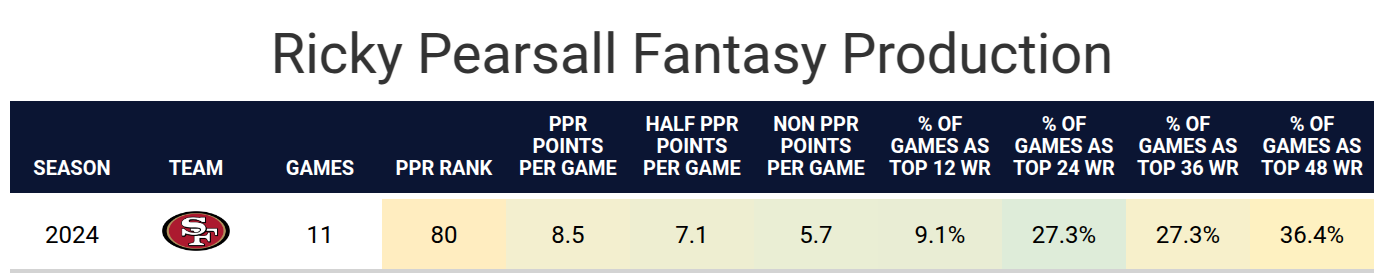
- Ricky Pearsall is the San Francisco 49ers‘ lone healthy wideout: The 49ers‘ wide receiver room has dealt with several injuries, and Pearsall has played well during the preseason.
- Subscribe to PFF+: It’s quick and easy. You’ll unlock industry-leading rankings, unlimited Fantasy Mock Draft Simulator use, our Live Draft Assistant and the weekly Start/Sit Optimizer. It’s time to win.
Estimated Reading Time: 25 minutes

Editor's note: Enjoy this PFF+ article and explore others free until Aug. 29
For fantasy football managers looking for an edge, understanding the shifting landscape of average draft positions is crucial.
This article dives into five players whose draft stocks are currently on the rise, offering a detailed analysis of the factors contributing to their increasing value. We'll uncover insights about their recent performance, team situations and projected fantasy impact, all to help you make informed decisions on whom to target in your upcoming drafts.
The average draft position listed is from a consensus between ESPN, Sleeper and Yahoo! for where the player is picked on average in a 12-team redraft league.
Last Updated: Thursday, Aug. 21
RB Isiah Pacheco, Kansas City Chiefs (ADP: 6.06)
Pacheco was a seventh-round pick in 2022 but managed to earn the Chiefs' starting running back job by Week 7 of his rookie season. He received double-digit carries in most weeks but was rarely used at the goal line, while Jerick McKinnon was the receiving back and primary backup, leading McKinnon to record the 12th-most points per game from Week 7 on, compared to the 38th-most for Pacheco.
Pacheco’s role expanded in his second season. His attempts increased slightly, and his efficiency in finding the first-down marker improved. His routes per game doubled, as did his targets per game, leading to more receptions and receiving yards. Pacheco jumped all the way to 14th in fantasy points per game, while McKinnon fell to RB49.
Expectations grew for Pacheco from a fantasy perspective in 2024 after the Chiefs didn’t re-sign McKinnon, as there was talk of Pacheco playing on third downs. However, the Chiefs added Samaje Perine shortly before the season, and he took the third-down role.
Pacheco played during the first two weeks of the 2024 campaign, logging at least two-thirds of the Chiefs' offensive snaps. He finished 16th in fantasy points. However, he suffered a fibula fracture, which cost him half the season. The Chiefs brought in Kareem Hunt to be their new primary running back. Pacheco returned but wasn’t nearly as effective. He averaged 3.6 yards per carry or less in each of his final six games, including the playoffs.
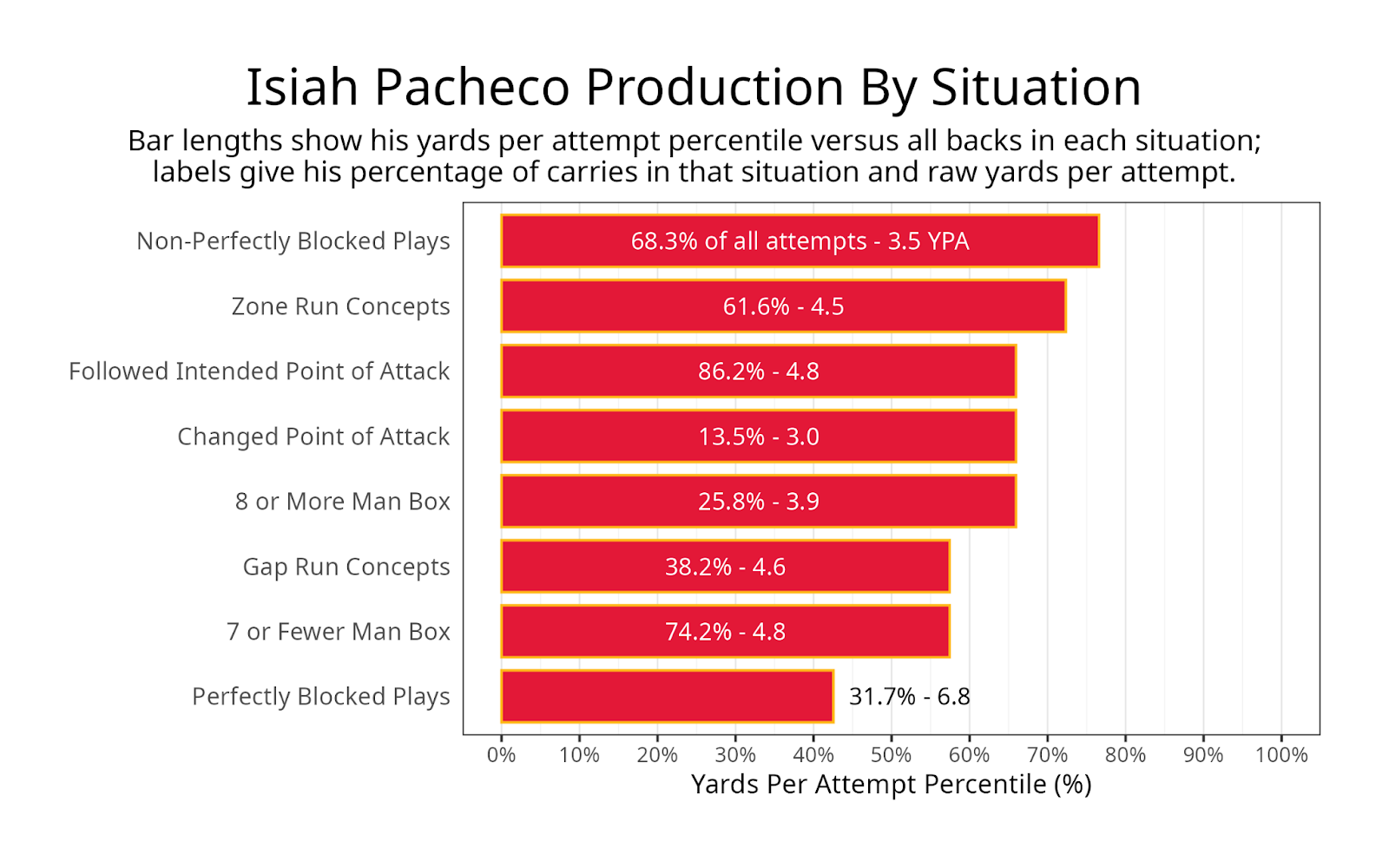
Pacheco’s biggest strength is his ability to make the most out of poor blocking, averaging 3.5 yards per carry on non-perfectly blocked plays during his career. However, he’s been below average when the blocking has gone his way, averaging just 6.8 yards per carry. These running backs generally have a high first-down rate but a low breakout run rate. That archetype isn't ideal for fantasy, unless the player converts a high number of touchdowns.
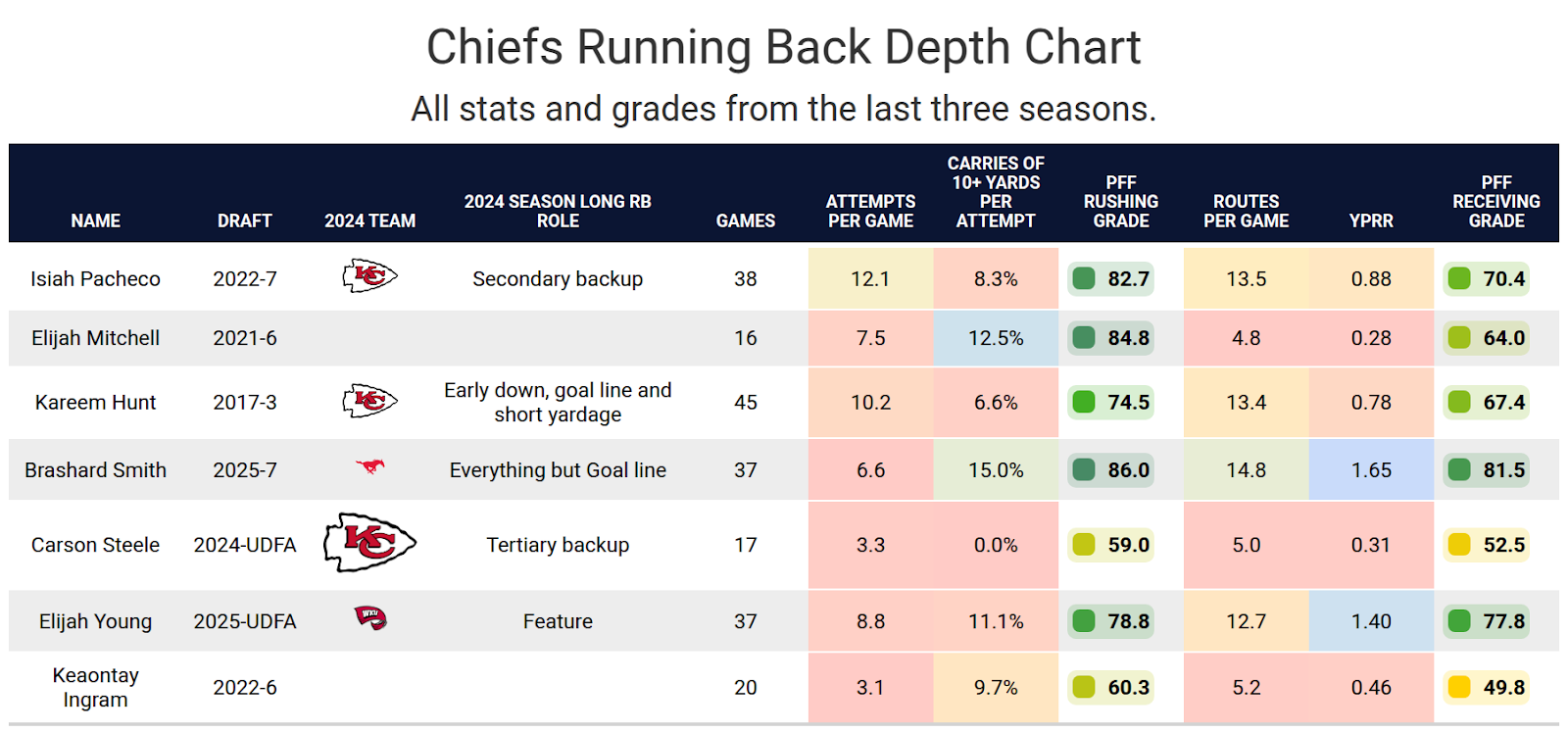
The Chiefs brought back Kareem Hunt and fullback/halfback hybrid Carson Steele, in addition to more competition for Pacheco in free-agent Elijah Mitchell and seventh-round rookie Brashard Smith. However, the two have yet to make a dent in the Chiefs' depth chart. In each of the first two preseason games, Pacheco started and Steele received his first offensive snaps at halfback before Mitchell or Smith saw the field. The fact that Kansas City still trusts Steele, a player the team rarely used at halfback once the regular season started last year, over Mitchell and Smith is telling of their chances of being involved on offense this season.
This means Pacheco’s only significant source of competition for early down carries is Hunt, who has averaged 3.4 yards per carry over the past two seasons. As long as Pacheco can return to being the player he was in 2023, or at least somewhat close, he should be the clear early-down back for the Chiefs. The positive preseason usage around Pacheco, mixed with the usage for Mitchell and Smith, has elevated Pacheco’s ADP.
It’s also worth noting that Perine is no longer on the team, so Kansas City doesn’t currently have a clear third-down back. Throughout the preseason, the Chiefs have rotated running backs by drive rather than by situation, so every running back who has played has gotten opportunities on third downs. Pacheco could receive more chances on third down this year.
Pacheco’s health will be key to his fantasy value. There’s a chance he will get back to his 2023 form, scoring more touchdowns, but there is also a chance he will be in an ugly three-man backfield that changes from one week to the next, making it impossible to know if or when you can start him. There are plenty of scenarios in between, making him a fine gamble outside of the top 24 running backs.
WR Ricky Pearsall, San Francisco 49ers (ADP: 9.07)
During the 2024 offseason, the San Francisco 49ers knew they weren’t going to be able to pay all of their top players. Both Brandon Aiyuk and Deebo Samuel were about to have massive cap hits in 2025, so to prepare for life without one of them, the team selected Ricky Pearsall with the 31st pick in the 2024 NFL Draft. While there were rumors that one would get traded before the season, San Francisco re-signed Aiyuk to a longer-term deal and kept Samuel for one more year with the hope of another Super Bowl run.
Not much was expected of Pearsall in his rookie season. He missed the first six weeks of the campaign while recovering from being shot in a robbery attempt. And upon his return, the 49ers needed him immediately, as Jauan Jennings missed Weeks 7 and 8 and Aiyuk suffered a season-ending injury in Week 7. When Jennings returned, he took Aiyuk’s spot rather than returning to the slot. This meant Pearsall was the 49ers' primary slot receiver for the rest of the season.
Pearsall got off to a promising start, with 11 receptions for 131 yards and a touchdown in the first three weeks, along with a 39-yard run. However, he followed that up with three games without a reception, and two games with one reception each. While it was understandable that Samuel, Jennings and tight end George Kittle received most of the targets, it would have been good to see Pearsall be a little more involved in the offense.
He started to bounce back in Week 16, with four receptions for 37 yards. In Week 17, he had his best game of the season, securing eight receptions for 141 yards and a touchdown against the Detroit Lions in a surprisingly competitive game. The 49ers opted to rest some starters and pull other starters early in Week 18 to give other players opportunities. This allowed Pearsall to be an every-down player for one game. He caught six passes for 69 yards and a touchdown.
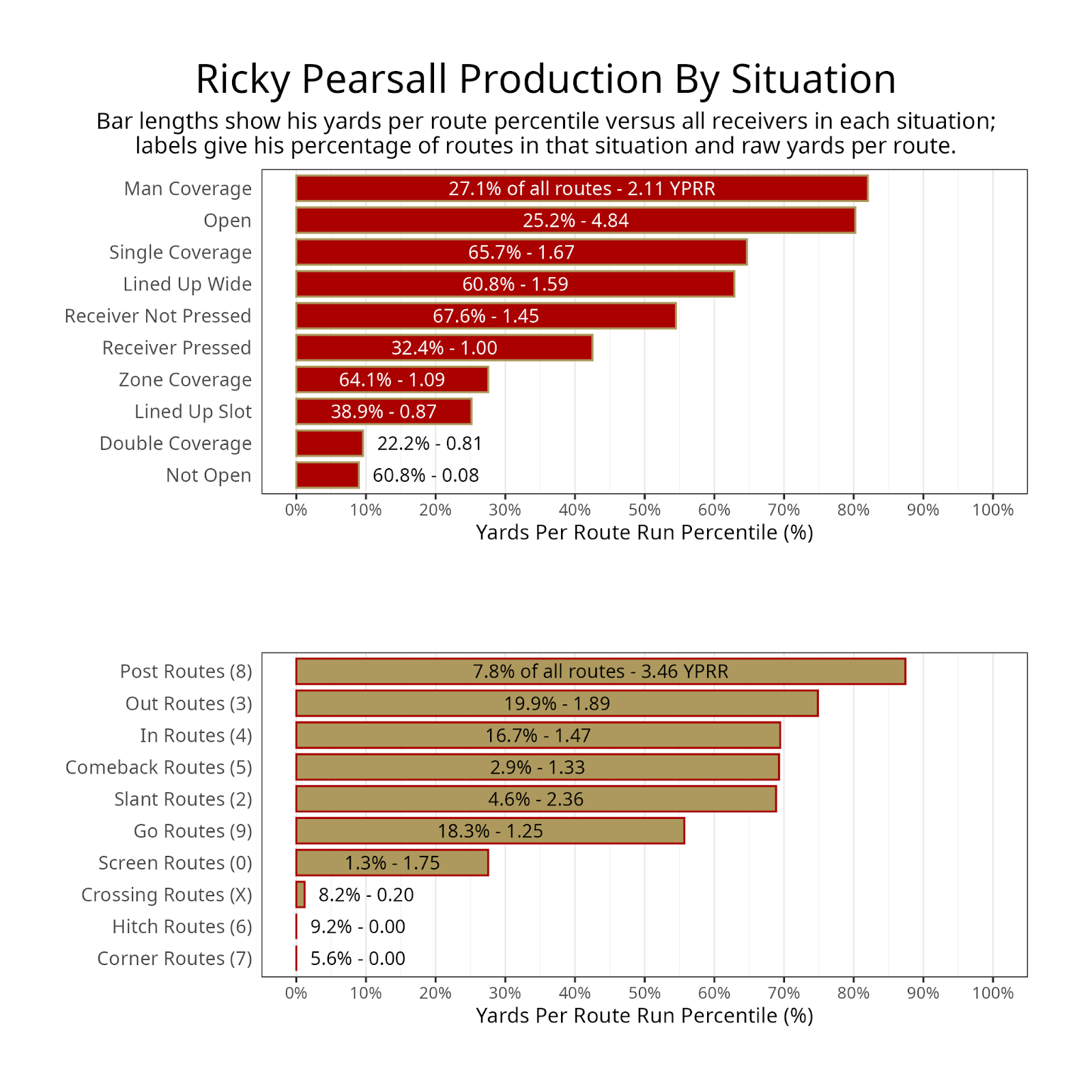
While his role was primarily the third receiver in three-receiver sets, Pearsall played notably better when lined up out wide, finishing with 1.59 yards per route run out wide, compared to 0.87 in the slot. Most slot receivers generally play better against zone coverage than man, but Pearsall was a clear exception. He averaged 2.11 yards per route run against man, compared to 1.09 against zone.
The 49ers traded Samuel to the Washington Commanders this offseason. This ensures that Pearsall will at least be among the top three wide receivers on the team's depth chart in 2025. There is no guarantee that Aiyuk will be ready for the season, either, as he recovers from injury. When everyone is healthy, Aiyuk is expected to be the X receiver, Jennings the Z and Pearsall the slot. The 49ers signed Demarcus Robinson in free agency, and he could take the X spot until Aiyuk is ready. The other possibility is that Jennings could play X while Pearsall is the Z in base while Aiyuk is out. Pearsall and Jennings could also swap in three-receiver sets.
Pearsall will need to consistently play in two-receiver sets to have a shot at returning fantasy value this season. From Weeks 7-17 last year, Jennings played 71% of San Francisco's offensive snaps in two-receiver sets, while Samuel played 66%, Pearsall played 28% and Chris Conley played 24%. Pearsall should be able to beat out Robinson for those base snaps, but surpassing Aiyuk or Jennings will be more difficult.
As we’ve gotten closer to the season, it’s become more likely that Pearsall will see time as an every-down receiver. Jennings remains out due to an injury and is also looking for a new contract. Recent reports suggest he and the team are not close on a contract extension. Aiyuk remains on the physically unable to perform list, and head coach Kyle Shanahan recently suggested he could return around Week 6.
On top of that, fifth-round rookie wide receiver Jordan Watkins suffered a high ankle sprain and will miss a month. Backup wide receiver Jacob Cowing missed the first week of the preseason but recently returned to practice. Aiyuk's and Jennings' situations have led Pearsall’s ADP to rise.
Pearsall played on the first drive of the 49ers' second preseason game in an every-down role. He’s expected to be a slot receiver in three-receiver sets when everyone is healthy, a role he handled for most of last season. Even when the team used three-receiver sets, Pearsall was lining up on the outside rather than playing in the slot. Robinson was the other outside receiver with the starters, while Russell Gage played in three-receiver sets.
After the first drive, Brock Purdy, Kyle Juszczyk, Pearsall and Kittle stopped playing, suggesting Pearsall is already on the same level as the 49ers' starters. He caught three of four targets for 42 yards on his one drive.
Even then, the 49ers have George Kittle and Christian McCaffrey, who will take a high percentage of those targets. They have been the rare team in recent seasons to have four fantasy-starting skill players. It’s practically impossible to have five, so beating out either Aiyuk or Jennings is an absolute necessity for Pearsall.

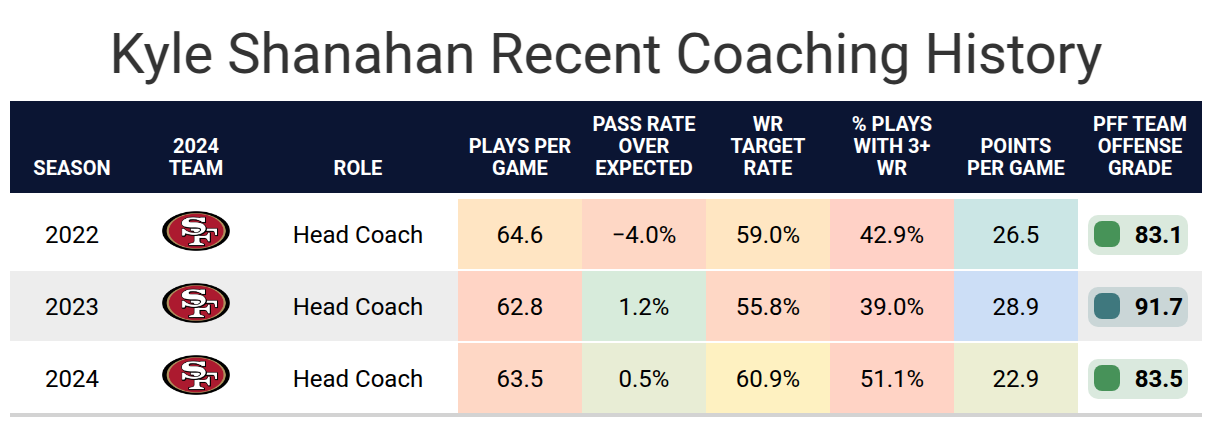
San Francisco ranks consistently near the bottom of the league in 11-personnel usage, which is why it’s so important for Pearsall to play significantly in two-receiver sets. The offense also doesn’t throw as much to wide receivers due to Kittle and McCaffrey.
Luckily, the 49ers have become more pass-heavy since Purdy emerged as the team’s starting quarterback. Purdy has graded relatively well in the offense, displaying good accuracy, and his work in Shanahan’s system has produced one of the best offenses in the league. That combination is why Pearsall is worth considering, despite the significant competition for touches, over other second-year wide receivers who similarly didn’t become fantasy starters during their rookie seasons.
Pearsall is a lottery ticket at wide receiver. The most likely scenario is you won’t be able to trust starting him, but if he works his way up the depth chart, there is a path to him becoming a top-20 fantasy wide receiver.
RB TreVeyon Henderson, New England Patriots (ADP: 6.05)
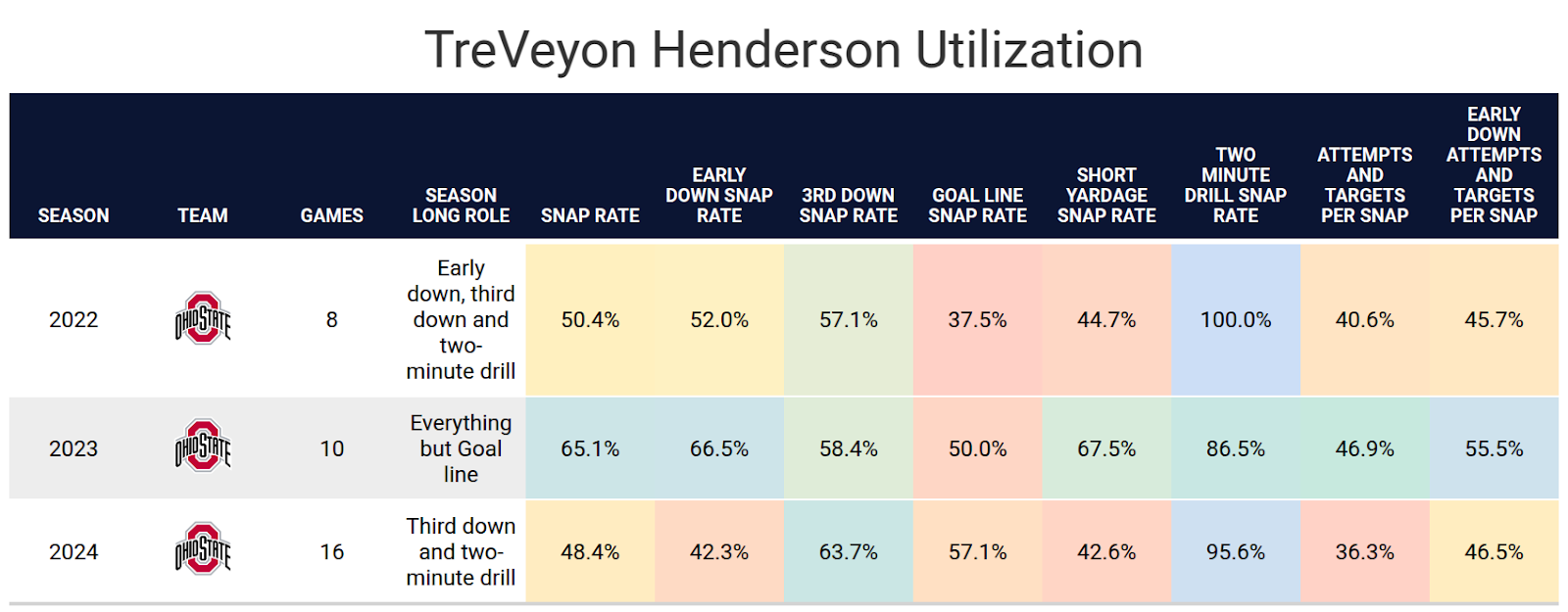
Henderson spent the past four seasons as Ohio State‘s lead running back. He paced the backfield in snaps in three of four years, with the only exception being 2022, when he played 10 fewer snaps than Miyan Williams, who graded better than Henderson early in their careers. However, injuries cost Williams most of 2023, allowing Henderson to take a big step forward in his career. While Henderson seemed destined for an even more significant role in 2024, Quinshon Judkins‘ transfer to Ohio State formed a championship-winning, shared backfield.
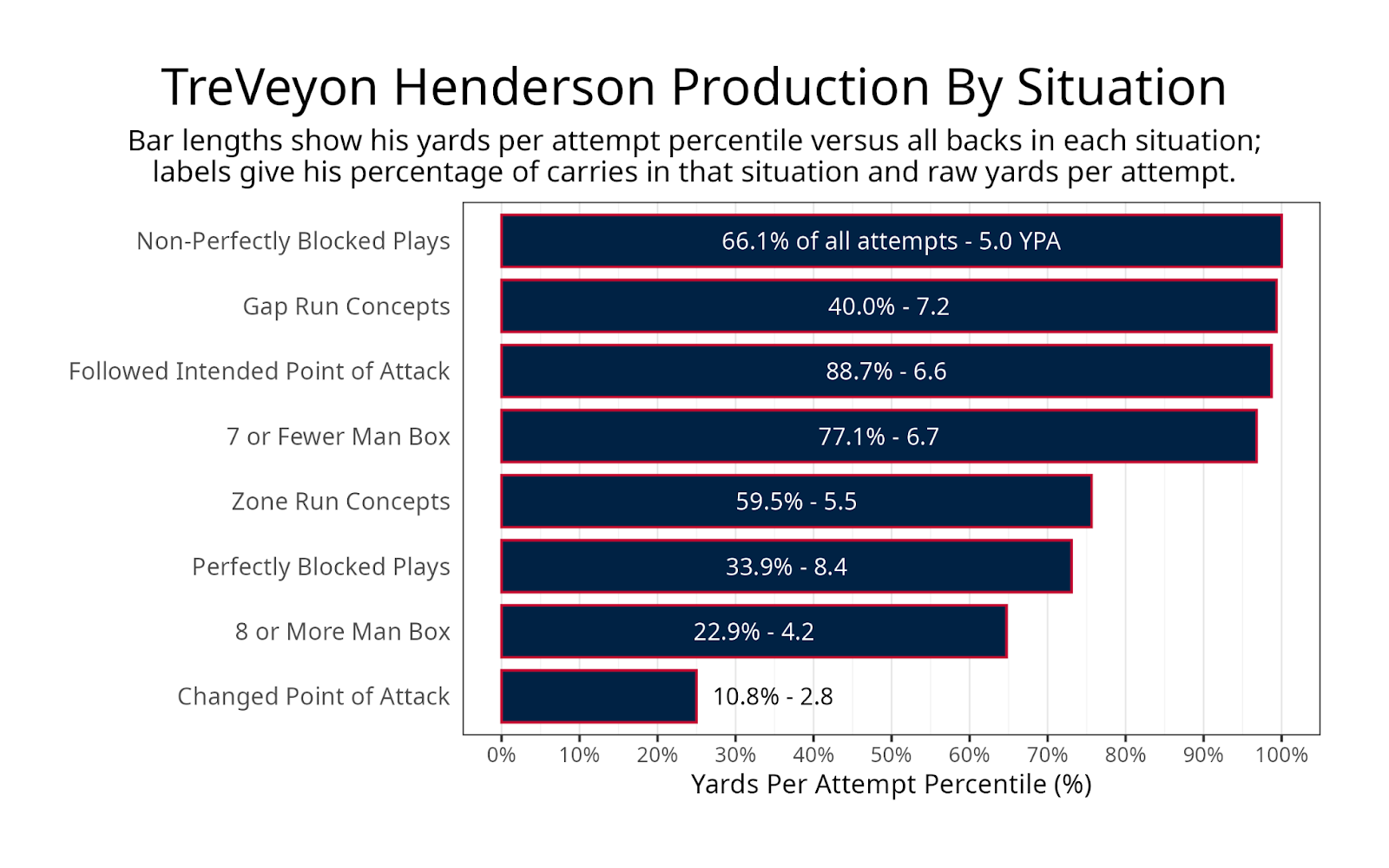
Henderson was an elite runner when the situation was in his favor. He ranks among the 20 fastest running backs in the FBS from the past eight seasons, according to PFF's tracking data. There is a significant gap in how much better he plays on gap runs compared to zone, finishing with a 96.3 career PFF rushing grade on gap plays compared to an 85.7 mark against zone. His speed also helped him record an excellent rate of breakout runs in his final season.
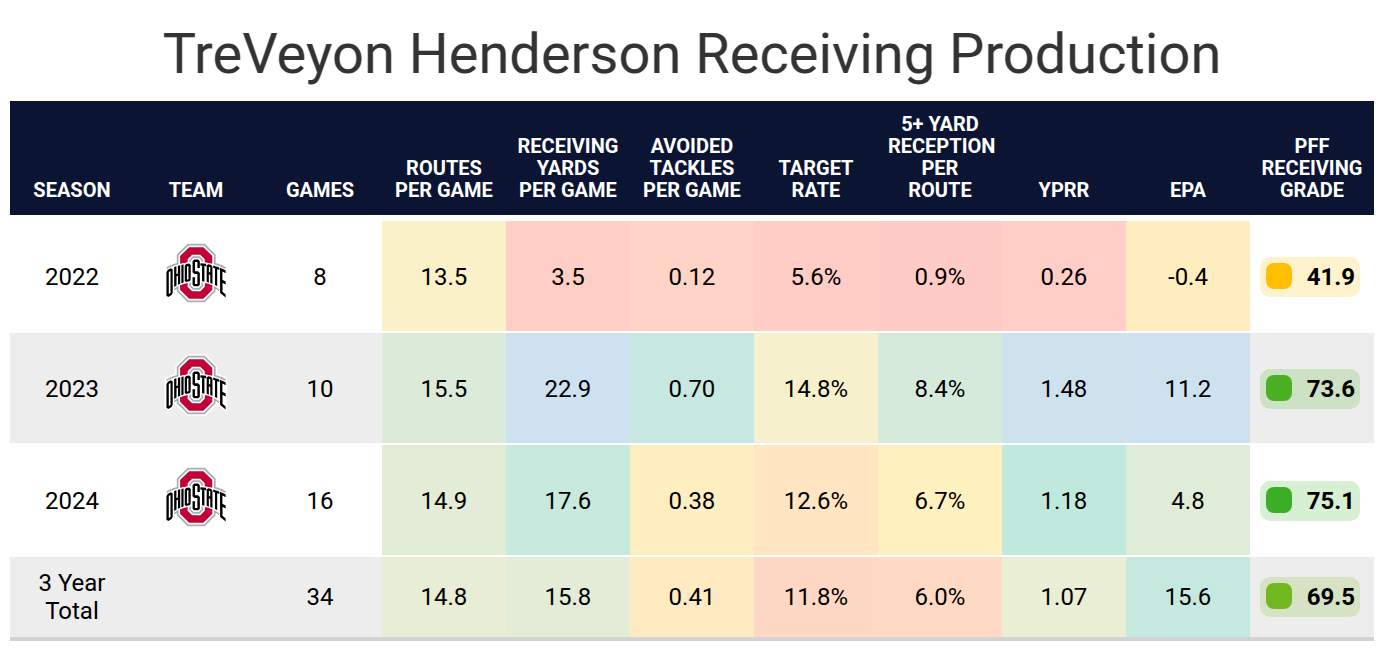
While a few other running backs in the class have more experience as a receiver, Henderson has shown more flashes than most. He graded well the past two seasons despite relatively low target shares while competing for targets with future NFL wide receivers.
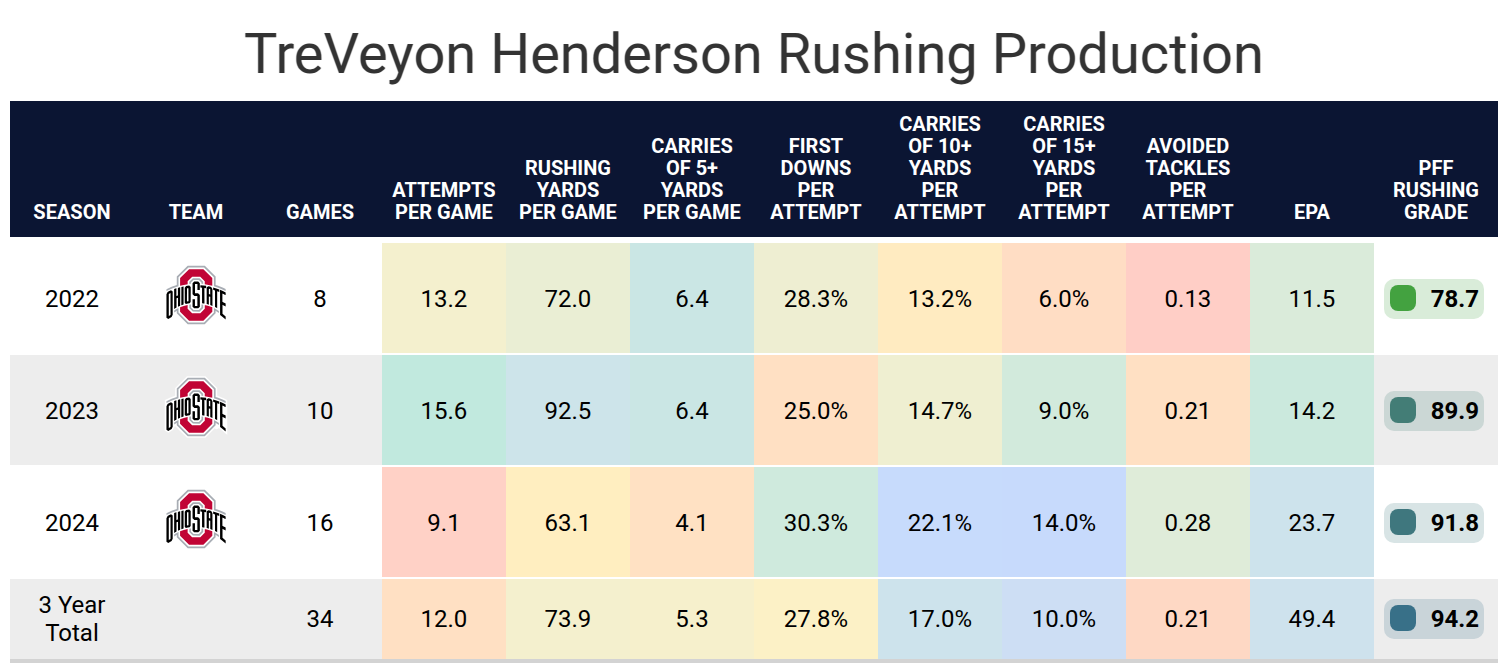
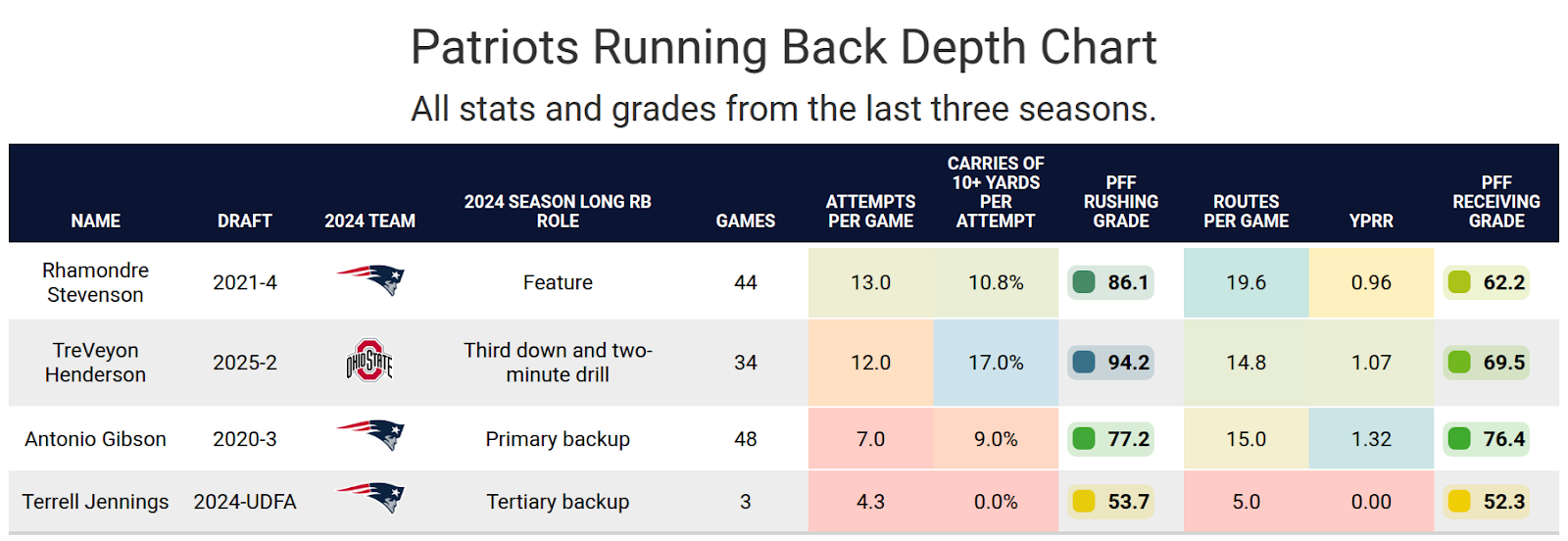
Henderson finds himself in a crowded Patriots backfield that struggled to produce last season, in part due to the offensive line. New England's runners averaged 0.7 yards before contact per carry, which was the lowest average in the NFL.
Rhamondre Stevenson is the incumbent starter who has had issues with ball security and pass protection. He is unlikely to play in passing situations going forward with Henderson and Antonio Gibson on the roster. Stevenson didn’t have a problem with fumbles in the first three years of his career, and most of his fumbles last season occurred across the first four weeks. Those turnovers aren’t consistent from one season to the next, so that shouldn’t be a major problem this season.
Gibson has similarly been a well-rounded running back in the NFL. He earned a career-high PFF rushing grade and a career-low PFF receiving grade last season. He could still have a role in the offense, but the Patriots may not have drafted Henderson had they been happy with both of their backs.
Henderson was always projected to be a receiving back first, and he is likely to play on third downs almost immediately. How many touches he sees on early downs will depend on the coaching staff and how well Stevenson is playing. One area where we shouldn’t expect to see Henderson is at the goal line. He didn't handle many goal-line touches at Ohio State, even before Judkins arrived. Stevenson is one of the bigger backs in the league and will likely receive most of the goal-line opportunities.
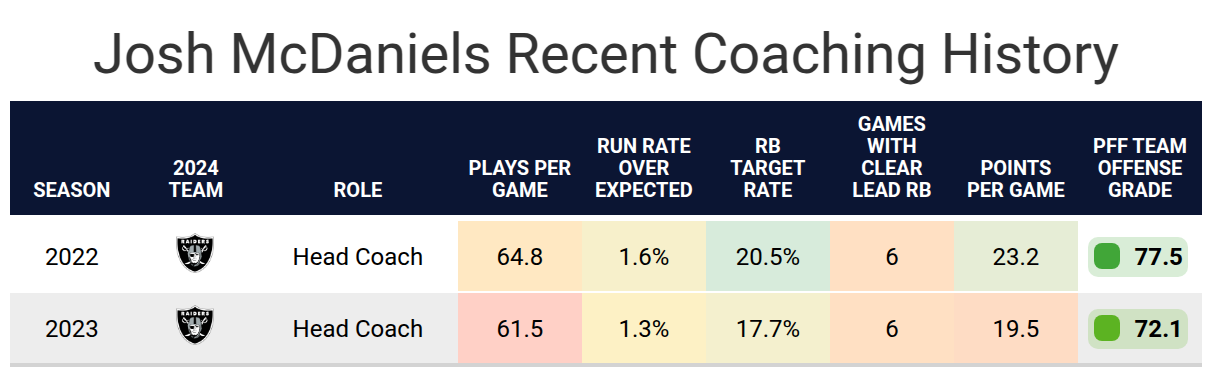
Josh McDaniels spent more than a decade as the Patriots' offensive coordinator under Bill Belichick and rejoined the team in the role for 2025. Throughout McDaniels’ coaching career, he has consistently utilized a committee at running back.
In 18 years as a head coach or offensive coordinator, there has only been one season where the back leading the team in carries was also the back receiving the most third-down snaps. The exception was in 2011 with three-time Pro Bowl running back Steven Jackson. His most recent running back was Josh Jacobs, who received more third-down snaps before McDaniels arrived and after McDaniels left than with him in the fold.
McDaniels has often turned to three-back committees. His last year with the Patriots was 2021, when Stevenson and Damien Harris were used on early downs and Brandon Bolden was deployed on third downs. His third-down backs have, at times, been fantasy-relevant, including James White in 2018 and Shane Vereen in 2014. Still, those teams were Super Bowl champions that had Tom Brady at quarterback throwing to Rob Gronkowski and Julian Edelman.
Given McDaniels' history, we seem destined for a three-back committee in New England that could feature a lot of big plays from Henderson but not enough touches. Henderson fits best as the team’s third-down back while Stevenson plays on clear run situations and Gibson plays on other early downs. The one bright side with McDaniels is that his offenses have been extreme with how little they use zone concepts, which should help Henderson when he’s running.
Based on the first two weeks of the preseason, New England will likely use a two-back committee to start. Henderson has consistently played on third downs and been a part of 43% of early-down snaps. This suggests he will be the running back in New England to draft, but also that his touch workload won't be consistent enough for fantasy purposes. However, he’s the highest-graded running back in the first half of preseason games among those with 15 or more touches, and that doesn’t include his kick return for a touchdown. His usage has led him to climb up my rankings, but his quality of play has moved him up two rounds by ADP in the last week.
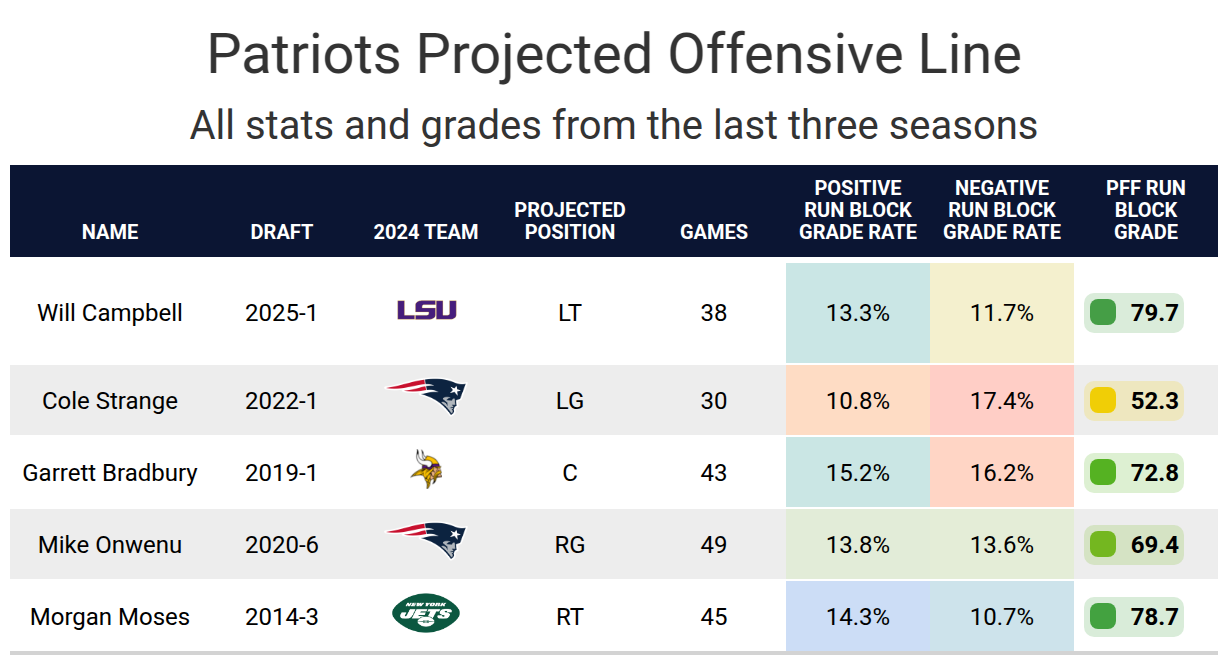
While the Patriots earned the lowest team PFF run-blocking grade last season, they’ve taken some steps to improve. The front office added Will Campbell with the fourth overall pick and signed veterans Morgan Moses and Garrett Bradbury. Both Moses and Mike Onwenu had down years last season, so while it seems unlikely the line will be average in 2025, there is hope that New England won't rank last in PFF run-blocking grade. Henderson was generally good at Ohio State even when the offensive line didn't excel, anyway.
Henderson is arguably one of the most talented rookie running backs. Still, Josh McDaniels will need to change a decades-old philosophy at running back for him to see enough touches to be relied on.
RB Quinshon Judkins, Cleveland Browns (ADP: 9.01)
Judkins started his career as Ole Miss’ featured running back, averaging more than 120 yards per game in his first season. After two years, he opted to transfer to Ohio State in pursuit of a national championship. He accomplished that goal but had to split the backfield with fellow NFL prospect TreVeyon Henderson. While Judkins' volume stats changed throughout his three-year college career, his efficiency measures stayed roughly the same, which included his PFF rushing grade hovering between 87.1 and 90.7.
Judkins was excellent with his ball security, in college as he fumbled just three times across three seasons. He did not stand out in any particular situation, ranking generally above average regardless. PFF's draft board said he lacked creativity in running and essentially took what the offensive line gave him.
Judkins did not grade well as a pass blocker, although PFF's draft board noted he has “high pass-blocking potential.” He wasn’t used much as a receiver throughout his college career, managing around 10 yards per game. In his one season at Ohio State, he ran fewer routes but became more efficient and generally graded well.
Judkins was arrested July 14 on domestic violence charges. He has not signed his rookie contract and isn’t reporting to training camp to focus on his legal situation. This led to an ADP free-fall, with the possibility that he might not play at all this season. It was recently announced that he now won’t face charges. While the NFL could still suspend Judkins, it has recently become more likely that he will be fantasy-relevant this season. His ADP has rebounded as a result.

Last season, Jerome Ford was the Browns' primary back, while Pierre Strong Jr., Kareem Hunt, Nick Chubb and D’Onta Foreman mixed in. Cleveland moved on from Chubb and Foreman this offseason and invested in two running back in the draft: Judkins in the second round and Tennessee‘s Dylan Sampson in the fourth round.
Cleveland's backfield will be very difficult to predict heading into the 2025 season. While Judkins was penciled in as the starter after the draft, his legal situation will open the door for others to have a larger role. He might be eased into action once he is available.
Ford has primarily been used as a receiving back, but he’s graded better on early downs. Sampson has the least experience as a receiver but also averagedthe most yards per route run and garnered the highest PFF receiving grade. While Sampson was drafted a complete two rounds after Judkins, PFF had Sampson ranked slightly higher.
At a minimum, we should expect Judkins to eventually earn the primary early-down back role. Cleveland clearly wanted a change after spending two of their first six picks on running backs. The Browns also clearly view Judkins ahead of Sampson since they drafted Judkins first. His strength is the run game, so that leaves him as the top rusher.
Judkins gained experience as a third-down back at Ole Miss, so he could be used in a featured role. Sampson could also overtake Judkins at some point in time. There is a lot of uncertainty between them, but a baseline of Judkins receiving the most carries at some point this season is a strong starting point.

The Browns consistently rank highly in the number of plays per game they run, regardless of the quality of their offense. They are also fine playing to their offense's strength, and based on their investment at running back, the strength should be in the run game this year.
However, the Browns have very rarely utilized a featured back. Ford handled that role for a few games early in the 2024 season, but that occurred when both Chubb and Strong were dealing with injuries.
The biggest concern for Judkins and the rest of the Browns' running backs is the offensive line. At its peak, it was arguably the best line in the league. Cleveland has stuck mainly with the same players, and they have progressively declined. Joel Bitonio, Wyatt Teller and Jack Conklin all logged PFF run-blocking grades above 85.0 just a few years ago, but each finished below 62.0 last season and will be at least 31 years old by the end of the season.
Ethan Pocic’s PFF run-blocking grades never reached those heights, and he has graded below 70.0 in the run game each of the past two seasons. He will also be 30 years old before the start of the season. That leaves Dawand Jones as the only offensive lineman under 30 years old, and he’s never reached a 60.0 PFF run-blocking grade in a season.
Cleveland added guard Teven Jenkins and tackle Cornelius Lucas in free agency, and although they were paid like backups, it wouldn’t be surprising to see either crack the starting lineup this season. The Browns didn’t spend any draft picks on rookie offensive linemen, so Judkins' entire offensive line two years from now could consist of five players who aren’t currently on the roster.

The Browns spent a lot of draft capital on Judkins, making it likely he will be one of the 32 running backs to lead their teams in carries once he’s available. His value will be higher than some other running backs in committees. He could be a top-15 running back during the second half of the season, depending on his role, but his legal situation, offensive line and lack of receiving production will likely hold him back from being an elite back in the short term.
TE Tyler Warren, Indianapolis Colts (ADP: 10.01)
Warren is the top tight end of the 2025 draft class because of his all-around ability.
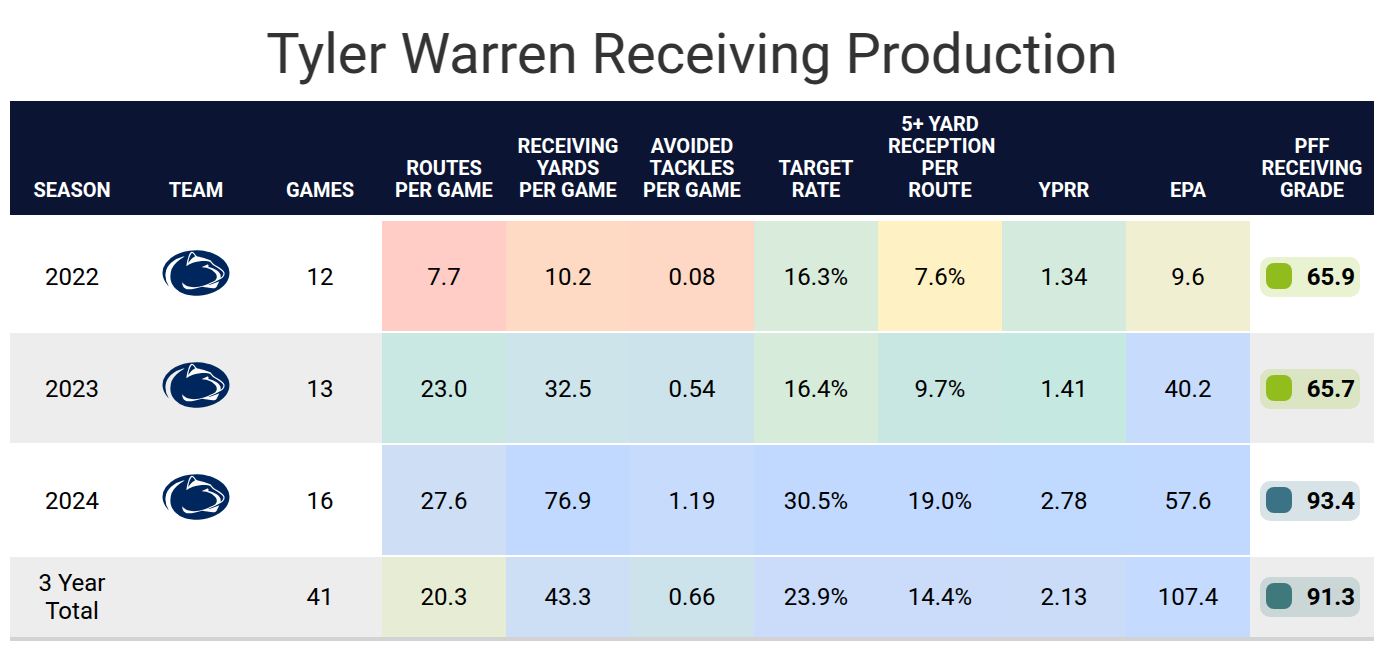
From 2020 to 2022, he was buried on Penn State’s depth chart behind Pat Freiermuth, Brenton Strange and Theo Johnson, all projected NFL starters in 2025. Warren and Johnson often shared the field in 2023, whereas Warren ran more routes and sustained more blocks. Warren showed signs of greatness in 2023 as one of four Power-Five tight ends with a positive grade on at least 10% of his routes across more than 300 routes run.
However, a high drop rate dragged down his PFF grade. His 14.6% drop rate was the highest among the same subset of tight ends. His separation rate ranked in the 88th percentile among tight ends, but it was also the second-lowest clip of the expected Day 1 and Day 2 tight end draft prospects.
Penn State made Warren its clear lead tight end in 2024 in a way we haven’t seen since early in James Franklin's tenure. He posted one of the best seasons by a Power-Five tight end in the PFF era. His PFF overall grade ranked in the top 10 among those with at least 500 offensive snaps during the regular season. His 974 receiving yards in the regular season were the most for any Power-Five tight end since 2014. He cut his drops in half despite seeing nearly triple the targets. His yards per route run mark ranked second best in the PFF era, behind Brock Bowers in 2021.
Warren’s college experience should put him in a position to be an NFL starter from day one who can immediately contribute.
Warren joins an Indianapolis Colts team that consistently utilizes three or four tight ends in a rotation. In 2024, that included Mo Alie-Cox, Drew Ogletree, Kylen Granson, who left for the Philadelphia Eagles in free agency, and, at times, Will Mallory. Jelani Woods showed some promise as a rookie in 2022 but has missed the past two seasons due to injury.
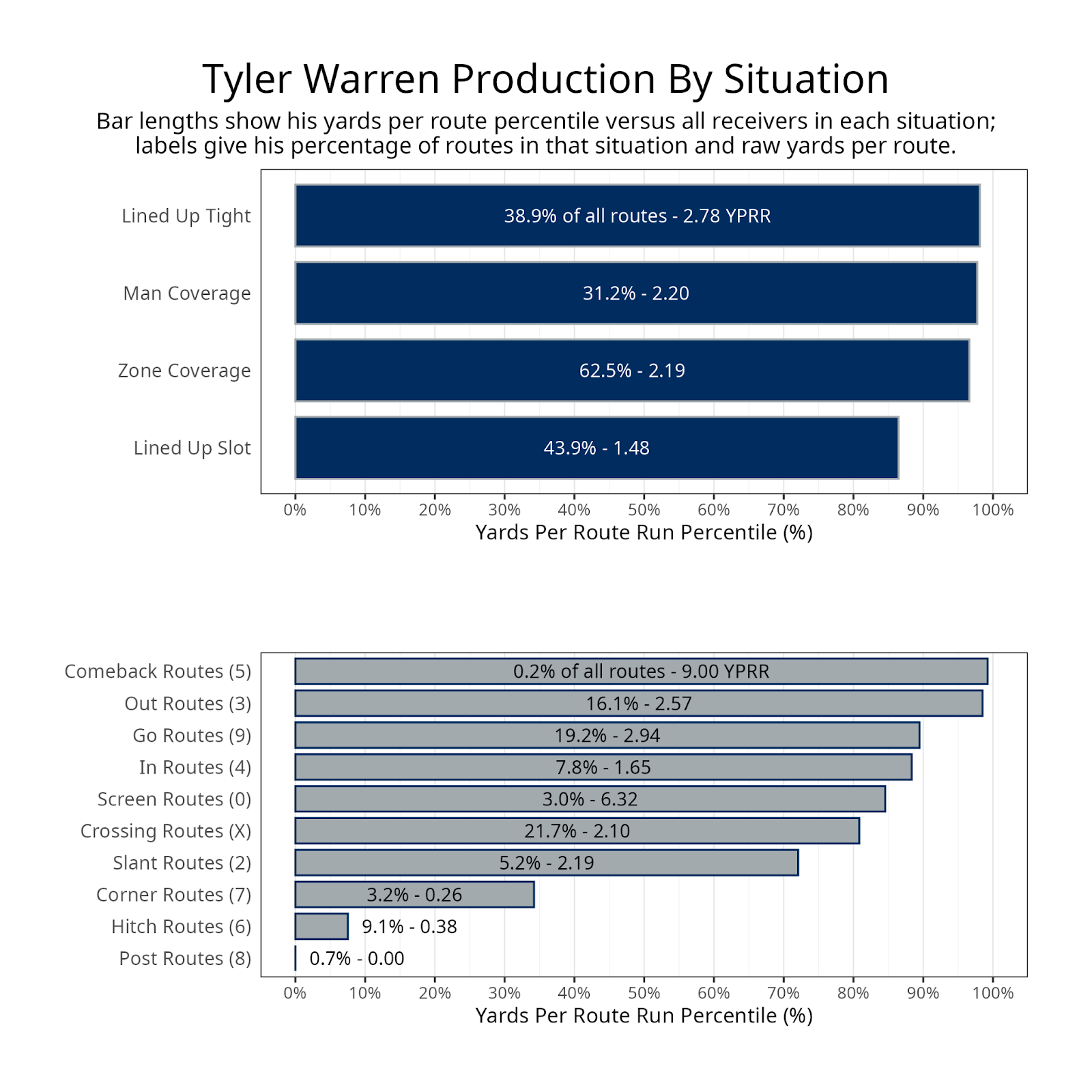
None of the tight ends on the field will stop Warren from taking as many snaps as he can handle. He has extensive experience lining up in a traditional tight end position, which isn’t always true for an NFL rookie. Warren played more than 500 snaps from the slot, more than 200 out wide and more than 150 out of the backfield in 2024. He can handle an 80% snap rate as a rookie, which isn’t all that common for NFL tight ends. His diverse skill set should make him a scheme fit for any team. Alie-Cox, in particular, has been one of the best blocking tight ends in the NFL and will likely join Warren in two-tight end sets.
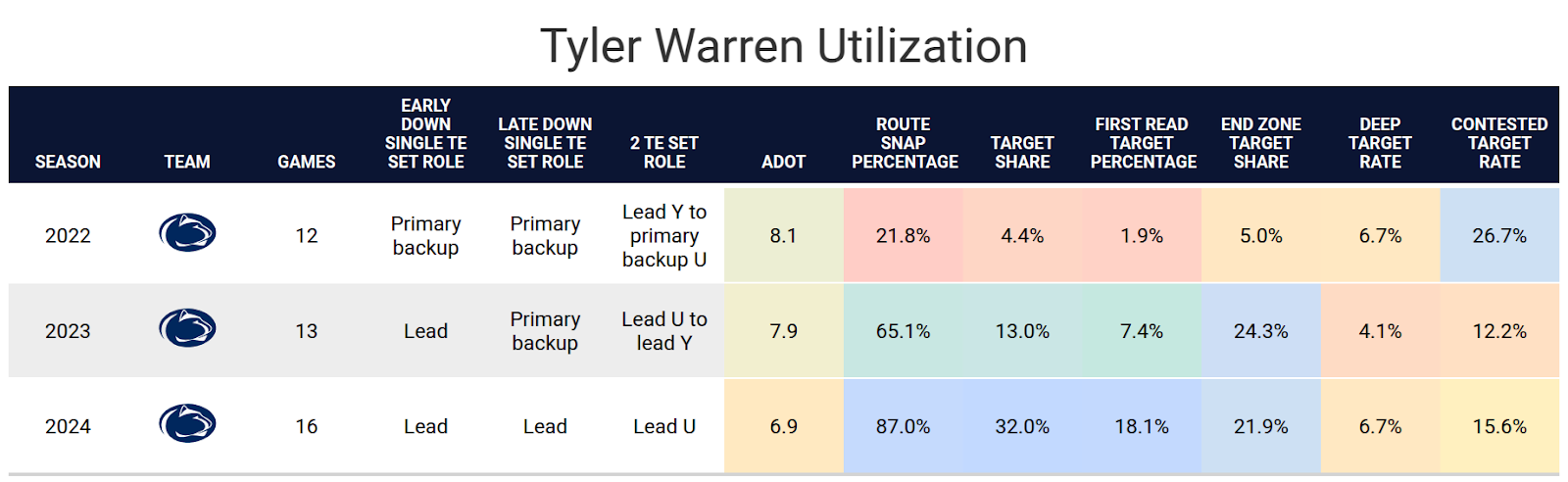
This preseason, Warren has played 34 of 35 plays with the starters over the first two games and has received multiple targets. His solid usage in the preseason, combined with more questionable usage by players like Dalton Kincaid and Colston Loveland, has led to his ADP rise.
At 260 pounds, Warren is larger than the typical fantasy starting tight end. The top nine consensus tight ends for 2025 all weigh 250 pounds or less. Tucker Kraft, Hunter Henry, Dallas Goedert and Pat Freiermuth all finished last season with at least 650 yards while weighing more than 250 pounds. He posted an OK average depth of target and deep target rate throughout his time at Penn State, but he won’t be a tight end who can be a fantasy starter through big plays and low volume.
However, Trey McBride posted a 3.6% deep target rate last season with a 6.5-yard average depth of target, and he’s a top-two fantasy tight end heading into 2025 due to his talent and volume. In recent seasons, Jonnu Smith, David Njoku, Evan Engram and Travis Kelce also fit the category of fantasy starters despite average-to-low deep target rates and average depth of targets.
The Colts' wide receiver room includes Michael Pittman Jr., Alec Pierce, Josh Downs and Adonai Mitchell. All play roles in the offense, but the room ranks as a bottom-tier unit due to a lack of top-end talent. This means Warren should be able to reach a relatively high target rate.
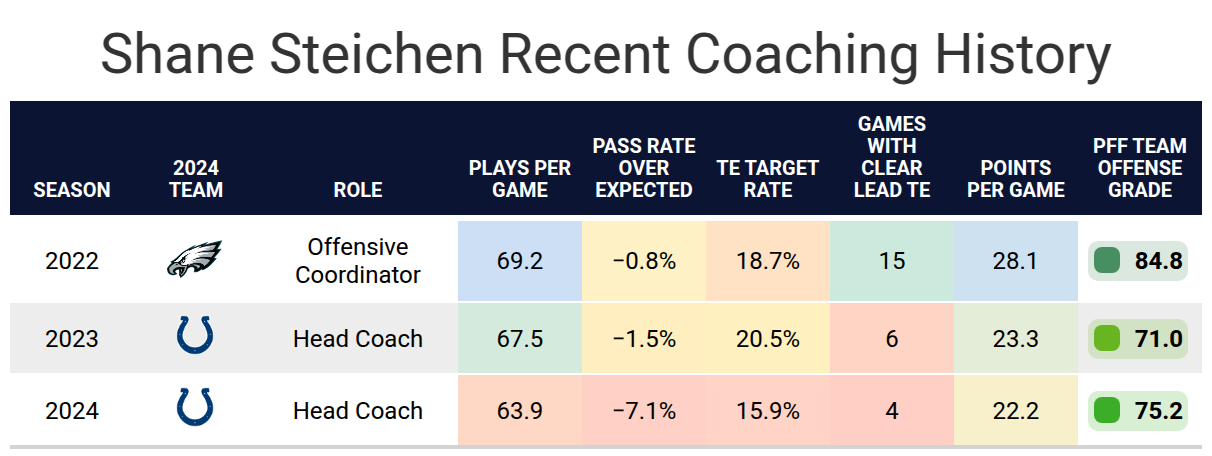
Colts head coach Shane Steichen hasn’t had a clear top tight end since joining the team, but he gained experience with featured tight ends when he was an offensive coordinator. In 2020, Hunter Henry played 87.3% of the Los Angeles Chargers‘ offensive snaps. And in 2021 and 2022, Dallas Goedert played 78.6% and 90.0%, respectively, with the Philadelphia Eagles, excluding games missed due to injury. The Colts' previous rotation at tight end should be of no concern for Warren’s potential snap share.
It is fair to be concerned about the Colts' offense in general. Typically, the quarterback doesn’t matter much for a low-average-depth-of-target tight end. Daniel Jones won the Colts' starting job, and his accuracy is more in line with the league average than Anthony Richardson Sr.'s. He also has more experience throwing shorter passes. Darren Waller’s time with the Giants was short-lived, and Jones was injured for half of it, but Waller did post an eight-catch, 86-yard game and a six-catch, 76-yard game during their five outings together.
Warren has the talent to be a high-volume, fantasy-starting tight end. He will likely have the necessary playing time and the support of his head coach. The immediate questions are at quarterback and whether Jones builds enough chemistry with Warren for the rookie to become a reliable fantasy starter.

 © 2026 PFF - all rights reserved.