
- The Indianapolis Colts‘ perfect season continues: Jonathan Taylor scored three times and helped Indianapolis to a convincing road victory, even though they punted the ball for the first time.
- Minnesota Vikings dominate without J.J. McCarthy and Aaron Jones: Running back Jordan Mason and cornerback Isaiah Rodgers found the end zone twice each for a decisive Vikings victory.
- Unlock your edge with PFF+: Access Premium Stats, dominate fantasy with in-season tools and projections and make smarter bets with the new PFF Player Prop Tool.
Estimated reading time: 50 minutes

PFF's fantasy football recap focuses on player usage and stats, breaking down all the vital information you need to achieve fantasy success in 2025.
Atlanta Falcons @ Carolina Panthers
Panthers shake up wide receiver room: Xavier Legette was inactive due to injury, but that wasn’t the only change the Panthers made.
Xavier Legette started the preseason in a competition for the Z-receiver role with Jalen Coker, who started the season on injured reserve, giving the job to Legette. In the first two games, he caught four passes for eight yards. Legette suffered a hamstring injury last week. He was limited in practice all week and officially designatied as questionable. It wasn’t until inactives were announced 90 minutes before the game that we found out Legette wasn’t playing.
The Panthers simply had David Moore fully replace Legette’s snaps. Moore and Legette were the Panthers' primary outside receivers last season, and both played as the X and Z receiver, so he was the logical replacement.
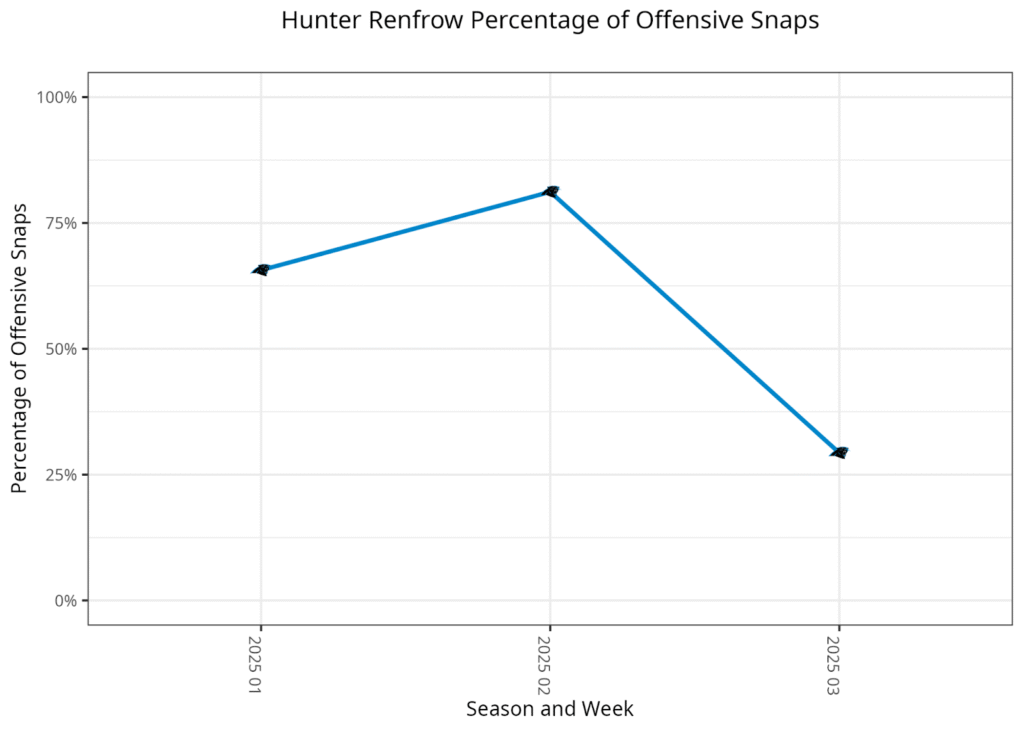
However, Carolina also made a change in the slot. Hunter Renfrow had played 90.9% of the snaps out of 11 personnel the first two weeks. He was a bright spot of the Panthers offense, catching seven passes for 48 yards and two touchdowns. However, this week, he was in a rotation with Brycen Tremayne, and the two played near-even snaps in three-receiver sets, both primarily playing out of the slot.
None of this mattered much for this game, as Tetairoa McMillan was the only Panthers player with more than 20 receiving yards. Jalen Coker is eligible to return from injured reserve after Week 4. Once he’s back, he could replace Renfrow and Tremayne in the slot, Legette out wide, or both. He should become the offense's second option once he’s healthy.
Monitor Ja’Tavion Sanders’ health: Sanders suffered an ankle injury early in the fourth quarter and didn’t return.
Sanders spent the first two weeks of the season playing 64% of his team's offensive snaps, playing the majority of 11 personnel snaps over Tommy Tremble and splitting snaps with Mitchell Evans across from Tremble in 12 personnel. This rotation, along with the tight ends having a lower target rate, has made this a situation to avoid in fantasy.
The Panthers started this game using a very similar rotation, as Sanders stayed in for two-tight-end sets a little more often. After the injury, Tremble was almost always on the field. The Panthers had a large lead, so Carolina typically stayed in 12 personnel. However, last season, whenever Sanders or Tremble was injured, the other would play significantly more snaps. If Sanders’ injury is serious, there is a chance Tremble can emerge as a more reliable option in the offense.
Tremble is not someone I would pick up in most leagues; however, in leagues with 14 or more players where most starting tight ends are on fantasy rosters, Tremble is a waiver-wire target.
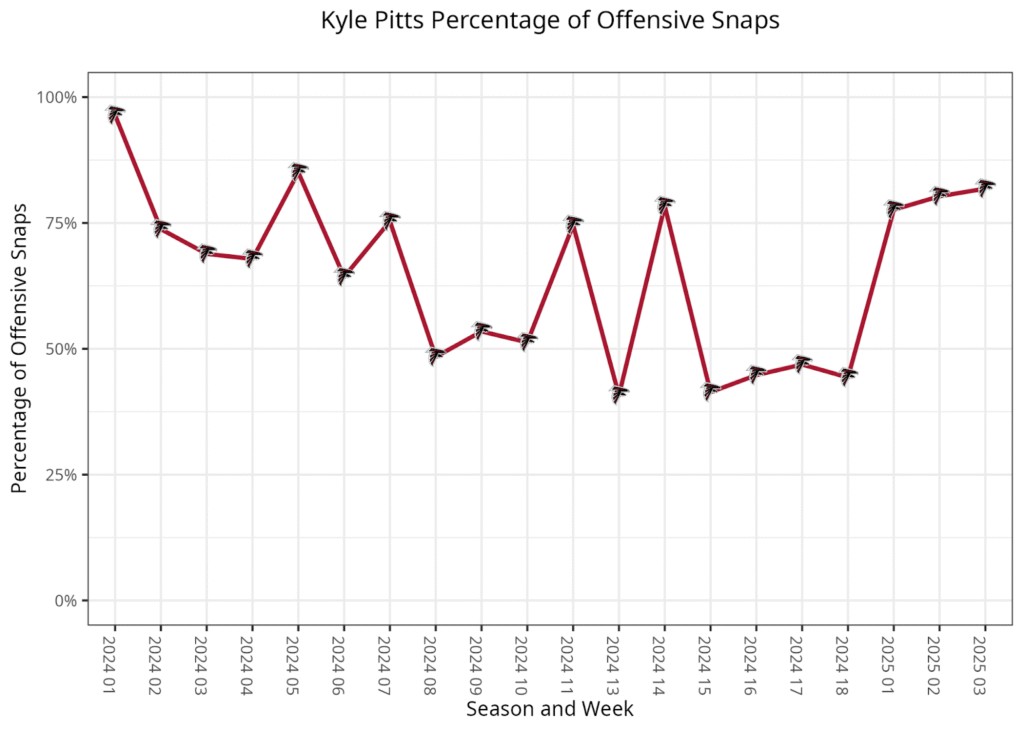
Kyle Pitts Sr.’s ascension continues: Pitts' playing time has been increasing for Atlanta.
Pitts spent the second half of last season rotating with Charlie Woerner in 11 personnel. The Falcons played more 11 personnel than any other team, so this left Pitts with a very limited role. In Week 1, Pitts was playing two-thirds of the 11 personnel snaps on early downs and 94% on third downs, leaving him with a 77.6% snap rate. The Falcons used two-tight-end sets for 58 of 66 snaps in Week 2, leading both Pitts and Woerner to play a high percentage of snaps.
This week, the Falcons were back to playing nearly all of their snaps in 11 personnel. However, Pitts' 11 personnel snap rate on early downs was up to 73.2%, despite not playing garbage time. Pitts was playing 91.5% of Atlanta's offensive snaps before garbage time, but that dropped to 81.8% at the end of the game. Pitts only caught four passes for 39 yards in a quiet day by the Falcons offense, but this game was a good sign that Pitts can more reliably be set in fantasy starting lineups going forward.
Miscellaneous notes
- The Panthers' running back rotation was nearly identical to the first two weeks combined. Chuba Hubbard played 71.2% of the early-down snaps in the first two weeks, and that dropped to 71.1% in this game. Similarly, Rico Dowdle dropped from 31.8% to 31.6% on early downs.
- The Falcons signed Parker Romo from their practice squad to be their kicker over the rest of the season while releasing Younghoe Koo, who was their kicker from 2019-2024 but only made 73.5% of his field goals last season and missed what would have been a game-tying field goal to end Week 1. Romo replaced him last week and made all five of his field goals.
- Both Falcons receivers, Casey Washington (concussion) and Jamal Agnew (groin), missed their second-straight games due to injury.
- Bijan Robinson played more snaps than usual and Tyler Allgeier played less, which is typical for a game where Atlanta is playing from behind.
- Atlanta played its backups for the final seven snaps of the game, skewing the playing time for all of their players. Those seven snaps included quarterback Kirk Cousins, running back Nathan Carter, wide receivers Darnell Mooney, Ray-Ray McCloud III and David Sills V, and tight end Teagan Quitoriano.
Green Bay Packers @ Cleveland Browns
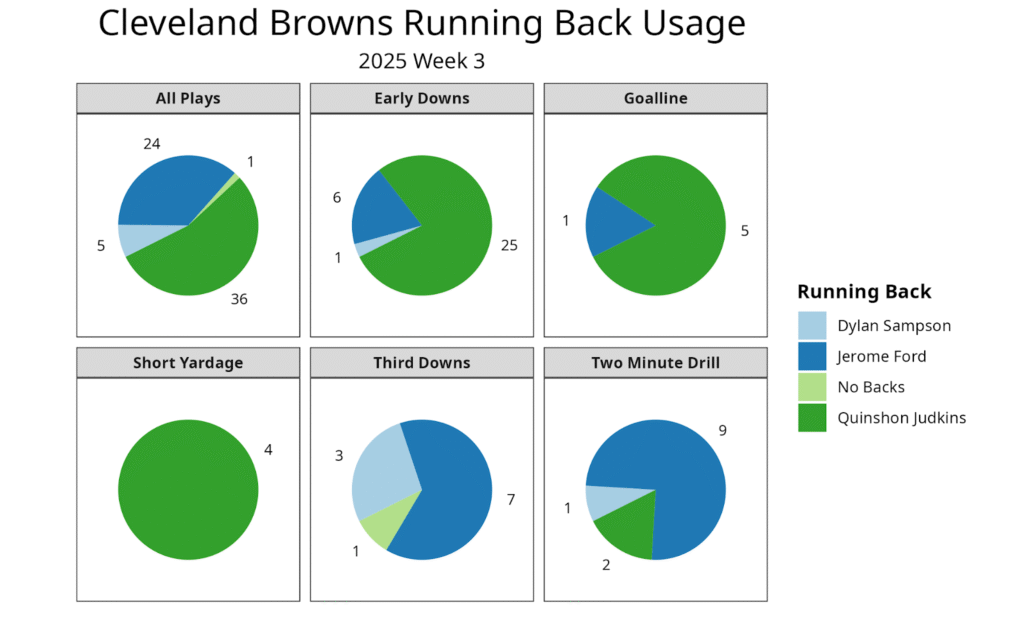
Quinshon Judkins takes a stronger hold of the Browns' backfield: Judkins took the vast majority of early-down and short-yardage snaps, unlike last week.
Judkins made his NFL debut last week, playing 19 of a possible 73 snaps. While he led the Browns’ three running backs in early-down snaps, it was close to a 33-33-33 split. In short yardage situations, snaps were evenly distributed between Judkins, Jerome Ford and Dylan Sampson.
This week, it was a very different story. Judkins took nearly all of the early-down and short-yardage snaps in addition to most of the goal-line snaps. Ford remained the primary third-down back, as he’s done all season. This left Sampson barely playing on offense. Judkins ended the game with 18 carries for 94 yards and a touchdown, while catching a pass for one yard.
This change makes Judkins at least a low-end RB2 over the rest of the season. His fantasy value will largely depend on the Browns’ opponent. If the Browns can keep games close, Judkins can be a viable option; however, the more teams score against Cleveland, the more we can expect Ford to be on the field. Based on how well the Browns defense played in this game, they should be able to keep most games close.
Judkins is likely still being investigated by the NFL, but there has been no news on the investigation in the last week and a half. As long as this is ongoing, Sampson should remain on fantasy rosters. If Judkins is suspended for any part of this season or suffers an injury, this would lead Sampson to be the Browns' primary running back.
Harold Fannin Jr. pulls closer to David Njoku: While Njoku led the Browns in receiving yards, the gap in playing time between Fannin and Njoku was closer than in previous weeks.
Fannin was a top waiver-wire target in Week 1, as it’s rare for a rookie tight end to catch seven passes in their debut. His situation is unique, as he’s the Browns' No. 2 tight end, and it’s exceptionally rare for a team to have two fantasy-relevant tight ends. The Browns managed this over the first two weeks because they played a high rate of 12 personnel.
This week, the Browns were playing from behind. While they still used 12 personnel on 26 snaps, they used 11 personnel on 39 snaps. This meant both tight ends didn’t play as much as usual. However, Fannin played 32% of the 11 personnel snaps on early downs, up from 28% over the first two weeks combined. Similarly, on third downs, he split snaps with Njoku 50-50. Over the first two weeks, Fannin played 36% of the snaps in these situations.
While we’re not at a point where Fannin is ahead of Njoku on the depth chart, we are getting closer to a point where Fannin could run more routes than Njoku. Until then, both Njoku and Fannin are borderline fantasy starting tight ends.

Isaiah Bond becomes a name to watch: Bond’s playing time has climbed each week.
Bond was projected to be drafted, but sexual assault allegations left him undrafted and unsigned after the draft. Charges against him were dropped, leading him to sign with the Browns in mid-August. He quickly became the fourth wide receiver on the depth chart. He was the primary backup in 12 and 13 personnel, and the primary wide receiver in one-wide-receiver sets over the first two weeks.
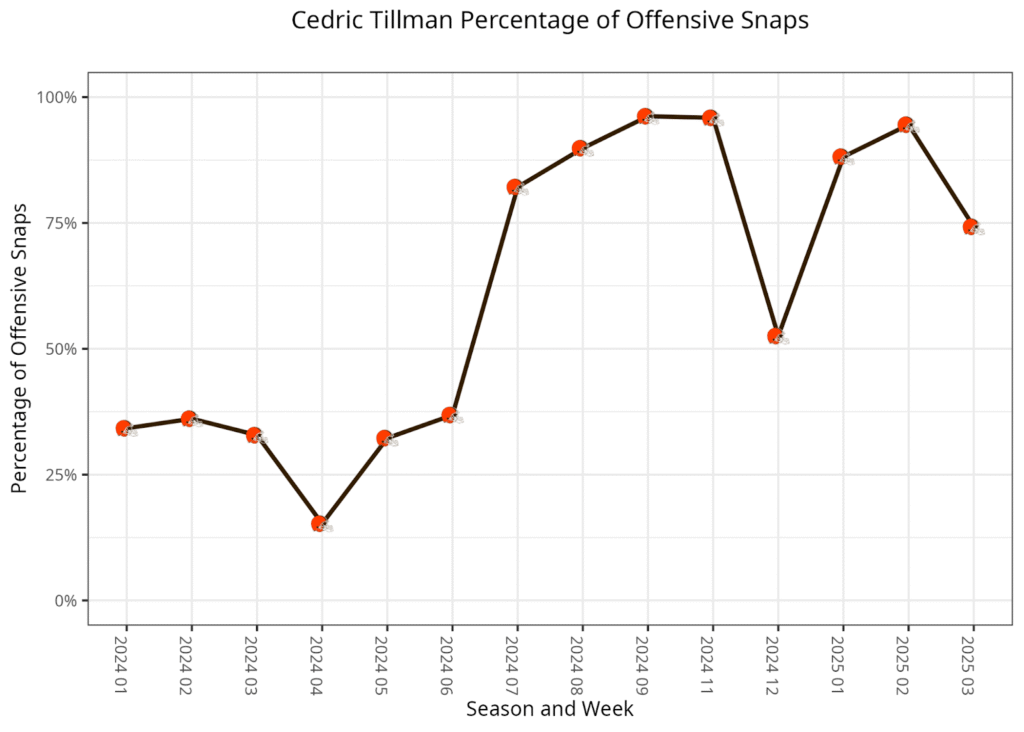
This week, he more than doubled Jamari Thrash‘s playing time in 11 personnel, making it clear he’s the third wide receiver on the depth chart. He also cut into Jerry Jeudy and Cedric Tillman‘s playing time by making 12 personnel snaps a three-man rotation, where any two of the three receivers were on the field on any given snap. He continued to be the primary wide receiver in one-receiver sets.
He still doesn’t play enough or have enough targets to be fantasy-viable, but his emergence could make it more difficult for Tillman to remain fantasy viable. Tillman caught five passes for 52 yards and a touchdown but could be a strong sell-high candidate, as Bond may overtake Tillman in snaps at some point this season.
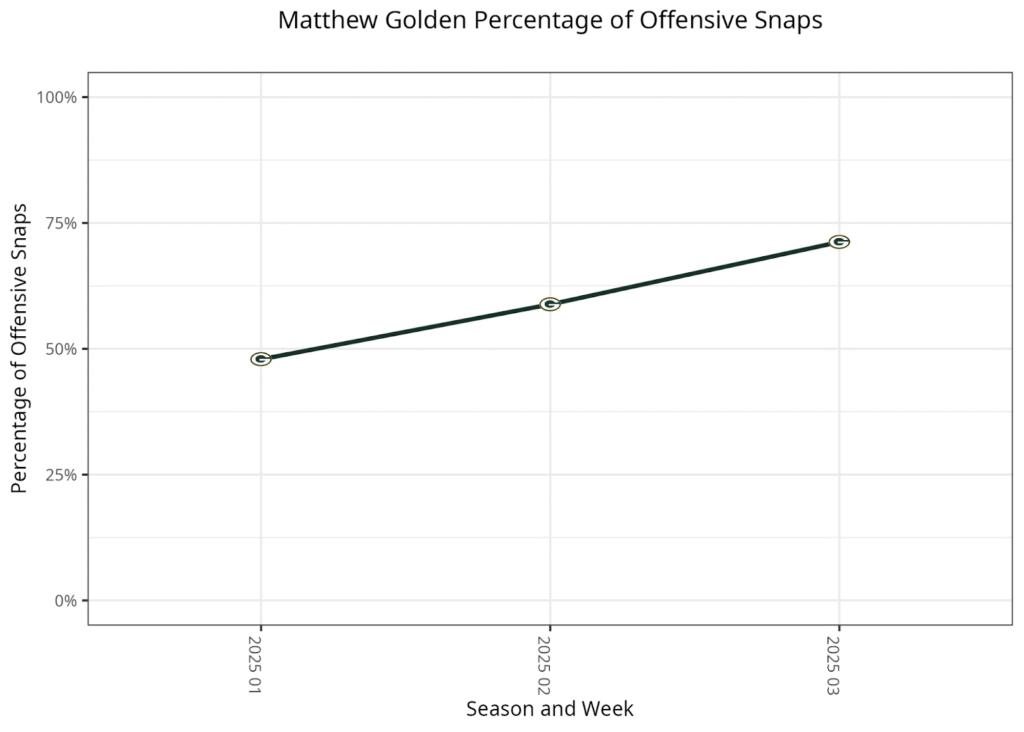
Matthew Golden steps up without Jayden Reed: Golden led the Packers in receiving yards at 52 while catching all four of his targets.
Reed landed on injured reserve due to a foot and shoulder injury, which is expected to keep him out until at least November. Green Bay started the season with Romeo Doubs as one outside receiver, Golden and Dontayvion Wicks rotating as the other outside receiver, and Reed playing in the slot in three-receiver sets. When Reed left last week due to injury, Wicks moved into the slot, and Golden played more on the outside.
This week, the Packers followed the same plan. The difference this week is that not only did Golden play more snaps in three-receiver sets, but he also played a higher percentage of the snaps in two-receiver sets over Wicks. His target rate per target also increased, leading to a better game. While he might not be at the point where you want him in your starting lineup, he is closer to becoming a fantasy starter.
Miscellaneous notes
- Packers tight end Tucker Kraft was questionable due to a knee injury he suffered in practice. He was active, and his playing time was only slightly impacted. He played 91% of the snaps over the first two weeks compared to 86% of the snaps in this game.
- Chris Brooks was the Packers' primary backup in the first two weeks with 22 snaps compared to Emanuel Wilson‘s seven. This included Brooks playing over half of the third-down snaps. This week, Wilson played 16 snaps to Brooks' eight. This included Wilson playing more snaps than Brooks on both early and third downs.
- Browns backup wide receiver and returner DeAndre Carter was questionable for this game due to a concussion. Kaden Davis was elevated from the practice squad.
Houston Texans @ Jacksonville Jaguars
Christian Kirk makes his Texans’ debut: Kirk had missed the first two weeks of the season due to a hamstring injury.
The Texans had some reinforcements at wide receiver, as Kirk and Braxton Berrios made their season debuts. Both dealt with hamstring injuries over the first two weeks of the season but were not given an injury game status for this game. However, the Texans weren’t at full strength after placing Justin Watson on injured reserve on Wednesday due to a calf and Achilles injury. Despite Berrios practicing all week, he was a healthy inactive.
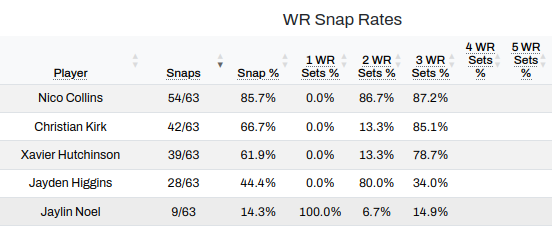
The wide receiver rotation was very similar to the first two weeks, but Kirk played in the slot in three-receiver sets instead of Watson. Nico Collins and Xavier Hutchinson were the primary outside receivers in two-receiver sets, while Collins and Jayden Higgins were the primary receivers in two-receiver sets.
Kirk has the potential to be fantasy-relevant this season, but he likely needs the Texans offense to start playing better, as well as an increase in snaps in 12 personnel. Given how strong the tendency has been to play Higgins in 12 personnel, it’s questionable if Kirk ever sees that increase this season. On the bright side, Kirk received the second-most targets on the team, but it only led to three receptions for 25 yards.
If you drafted Kirk, it’s worth holding onto him for another two to three weeks to see if his playing time increases or if the Texans start playing better. If neither of those happens, it would be fine to move on from Kirk.
The Texans simplify their running back rotation: The Texans' long-time third-down back, Dare Ogunbowale, did not play a snap on offense.
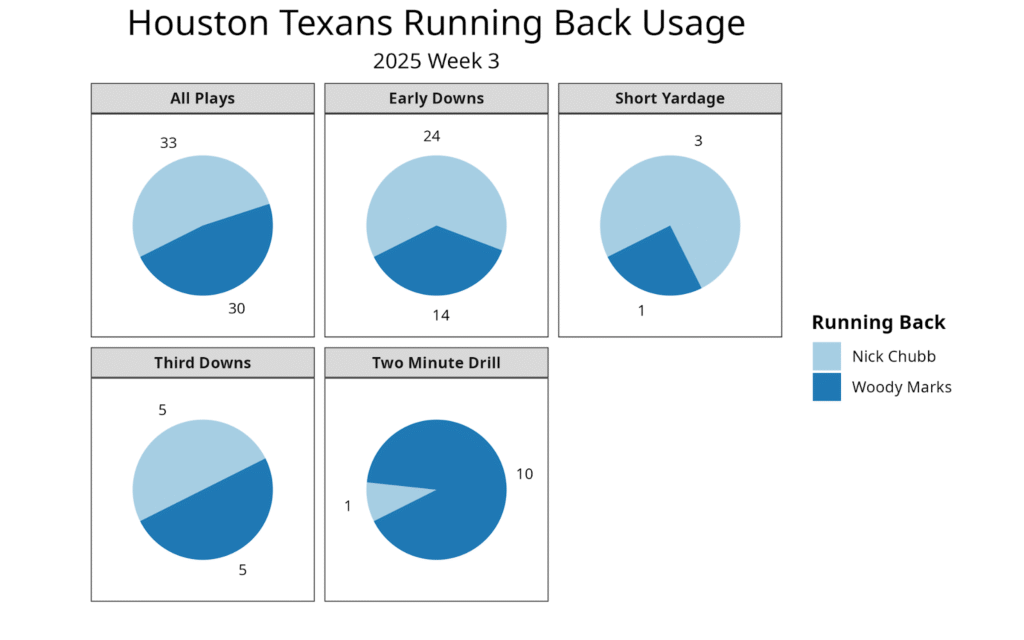
Ogunbowale joined the Texans in 2022. In 2023, he split third downs with Devin Singletary, and in 2024, he was the clear third-down and two-minute drill running back. He played 86.5% of the third downs and 85.2% of two-minute drill snaps over the entire season, which were both top-eight rates among running backs. Ogunbowale continued in a similar role over the first two weeks of this season, playing 100% of the third-down snaps and 60% of the two-minute drill snaps.
However, this week, the Texans used more of a two-man rotation. Nick Chubb played 19 of the first 28 snaps, while Woody Marks took the other nine. Over the rest of the game, Marks played 21 of 35 snaps, compared to Chubb’s 14. Chubb tended to play more in run situations while Marks played more in passing situations, but the two split third downs.
This is good news for the Chubb and Marks' fantasy value. In the short term, it means more playing time for both running backs. In the long run, this should give Marks more opportunities to show he should be the starting running back. For the second straight week, Marks averaged more rushing yards per carry while also having more receiving production. Marks should be among the week's top waiver-wire targets, as there is a chance he could be an every-down running back at some point this season.
Monitor Dyami Brown’s health: Brown suffered a shoulder injury and didn’t return.
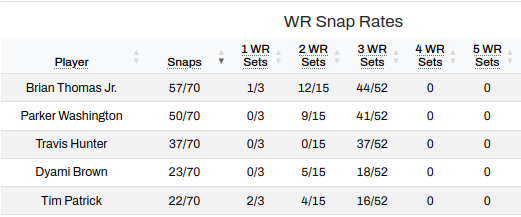
Brown has been an every-down wide receiver for Jacksonville when healthy. He had played 79.4% of both the two- and three-receiver sets over the first two weeks. Brian Thomas Jr. has joined Brown in both two- and three-receiver sets, while Travis Hunter played exclusively in 11 personnel when he’s on offense.
The Jaguars followed a similar pattern this week before Brown’s injury. After the injury, Parker Washington took over as the every-down receiver. Hunter continued to only play in 11 personnel. This also left Tim Patrick rotating in more often. Washington led the team in targets but only caught four passes for 34 yards. If Brown misses time, Washington would be worth considering off the waiver wire, considering how much Brown was targeted in previous weeks and how much Washington was targeted this week.
Hunter only caught one of two targets for 21 yards. He played 95.5% of the 11 personnel snaps in Week 1, 79.2% in Week 2 and 71.2% in Week 3. Last week, he played more on defense due to an injury to Jarrian Jones, who wasn’t given an injury designation this week. Nonetheless, Hunter remained ahead of Jones on the depth chart. Hunter played 43 of the 63 snaps on defense. He’s consistently lined up at left cornerback on defense. This is the second straight week Hunter has played over 80 offensive snaps.
Hunter can be fantasy-relevant in this role but needs a much higher target rate. Until then, Hunter should remain on fantasy benches.
Miscellaneous notes
- The Texans signed tight end Brenden Bates off the Cleveland Browns‘ practice squad on Wednesday, giving them a third tight end for their roster. They have been short tight ends with Cade Stover, Brevin Jordan and Irv Smith Jr. all on injured reserve.
- Texans running back Dameon Pierce was a healthy inactive for the second straight week.
- Houston signed fullback Jakob Johnson to the 53-man roster on Saturday, giving the Texans six running backs on the 53-man roster.
- Both Travis Etienne Jr. and Bhayshul Tuten played fewer offensive snaps this week than last. LeQuint Allen Jr. took the two-minute drill snaps, unlike the last two weeks, and the Jaguars had fewer snaps with two wide receivers on the field at the same time. It’s relatively common for teams to sometimes use their third-down back during the two-minute drill while using their main running back at other times, so this probably doesn’t mean much going forward.
Cincinnati Bengals @ Minnesota Vikings
Jordan Mason leads the Vikings' backfield: Minnesota didn’t use as much of a running back rotation with Aaron Jones Sr. on injured reserve.
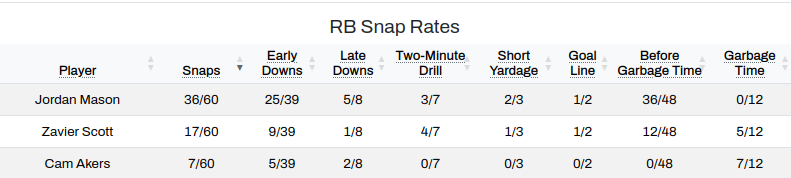
The Vikings placed Jones on injured reserve earlier in the week due to a hamstring injury. The Vikings' third-string running back, Ty Chandler, was placed on injured reserve a week and a half ago due to a knee injury. This left Minnesota with Mason and Zavier Scott. Minnesota already had Xazavian Valladay on the practice squad, but the Vikings chose to bring back Cam Akers to the practice squad and then elevate him to the active roster on Saturday. This marks the third consecutive season Akers wasn’t part of the team during training camp or the start of the season but joined the team in the first half of the year.
Instead of keeping with a 50-50 split like we saw with Mason and Jones, Mason simply became the primary running back. This included playing the vast majority of early downs as well as all of the third downs. He played 75% of the snaps before garbage time, which was better than most of Jones' games from last season. Akers didn’t play a snap on offense until garbage time, and if anything, he would cut into Scott’s work if he plays more. Part of Mason’s success was the game script, the injury to J.J. McCarthy leading to more reliance on the running back, and the opponent. Regardless, Mason should be in fantasy starting lineups for as long as Jones is out. If Mason keeps playing this well, he will remain someone who needs to start even when Jones is back.
T.J. Hockenson’s return: Hockenson’s stat line – five receptions for 49 yards and a touchdown – was great to see, as was his playing time.
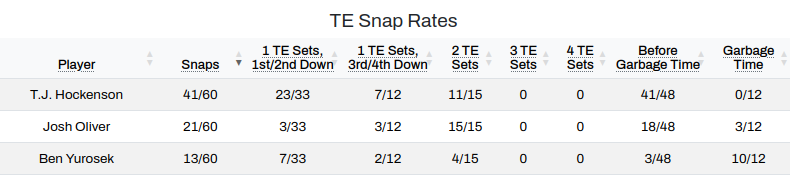
Hockenson spent 2020-2023 as one of the best fantasy tight ends, but a torn ACL and MCL forced him to miss half of 2024 and not play as effectively over the rest of 2024. Those drafting Hockenson for 2025 had to take a leap of faith that he would return to being the same player he once was. His stat line was far from impressive the first two weeks, combining for four receptions for 27 yards. He was playing 77% of Minnesota's offensive snaps, which was better than his 61% average from 2024, but not as good as 2021 and 2022 when he was consistently over 80% of snaps.
This week, he played 85.4% of the offensive snaps before garbage time, which was his best in a game since before the ACL/MCL injury. This included 30 of the 34 snaps in 11 personnel and 11 of the 14 in 12 personnel. However, the Vikings were winning by too much, and Hockenson didn’t play in the 12 snaps of garbage time, so he ended the day with his worst snap rate since the middle of last season. Obviously, his snap rate before garbage time is much more important going forward than what Minnesota did during garbage time.
Those with Hockenson on their roster can leave him in their fantasy starting lineups with more confidence than earlier in the season.
Monitor Samaje Perine’s health: Perine suffered a wrist injury in the second quarter and didn’t return.
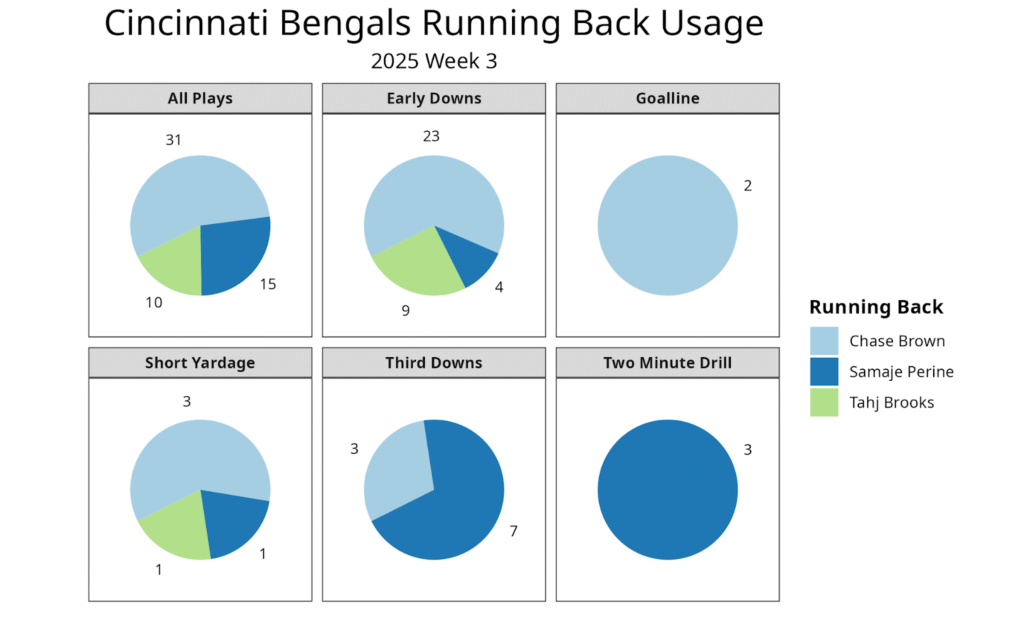
The Bengals started the game with the same running back rotation as the first two weeks. Chase Brown played 18 of the 23 snaps on normal early-down and short-yardage situations, while Perine took the other five snaps, all seven third downs and the three two-minute drill snaps.
In the second half, Brown took over as the third-down back, which is a role he had for Cincinnati to end last season. Fifth-round rookie Tahj Brooks became the Bengals' new primary backup. As the game progressed and Cincinnati fell further behind, Brooks rotated in more often. If Perine were to miss time, we should expect Brown and Brooks' playing time to increase.
It’s at least possible that Brooks starts to play more even if Perine is healthy. Brown was held under 3.0 yards per carry in each of the first two games and to three yards on 10 carries in this game. Brooks ran five times for 17 yards and a 3.4-yard average. Brown needs to stay in fantasy starting lineups for now due to his volume, but there is no guarantee he will keep seeing the same volume if he remains ineffective.
Monitor Noah Fant’s health: Fant suffered a concussion late in the third quarter and didn’t return.
The Bengals have used a three-man rotation this season. Drew Sample has been the primary early-down tight end, while Sample and Fant have been the tight ends in two-tight-end sets, and Mike Gesicki has been the third-down tight end. Fant maintained an exceptionally high targets per route rate during these first three games, which included catching all five passes for 26 yards in this game.
When Fant left, the Bengals simply gave Fant’s snaps to Cam Grandy. Even though Fant has seen significant targets, we shouldn’t trust anyone in this rotation because there are three players involved. If Fant misses time, we shouldn’t expect much of any increase in opportunities for Gesicki.
Miscellaneous notes
- Bengals quarterback Joe Burrow was placed on injured reserve on Tuesday and had toe surgery, which will cost him at least three months. Jake Browning took over as the starter, and Brett Rypien was signed off the practice squad to be the new backup, while Sean Clifford and Mike White were signed to the practice squad.
- With J.J. McCarthy out due to an ankle injury, the Vikings signed Desmond Ridder to their roster.
- This game concluded wide receiver Jordan Addison’s three-game suspension. He is eligible to return to the team for Week 4.
- Jalen Nailor remains clearly ahead of Adam Thielen in 12 personnel snaps. However, we can expect Addison to overtake Nailor in 12 personnel. We will likely see Nailor and Thielen split 11 personnel snaps going forward. Neither needs to remain on fantasy rosters as long as Addison returns to his usual every-down role.
- Garbage time impacted Nailor and Justin Jefferson‘s playing time. Jefferson played 100% of the snaps before garbage time and 0% during garbage time, while Nailor only played two snaps during garbage time.
Pittsburgh Steelers @ New England Patriots
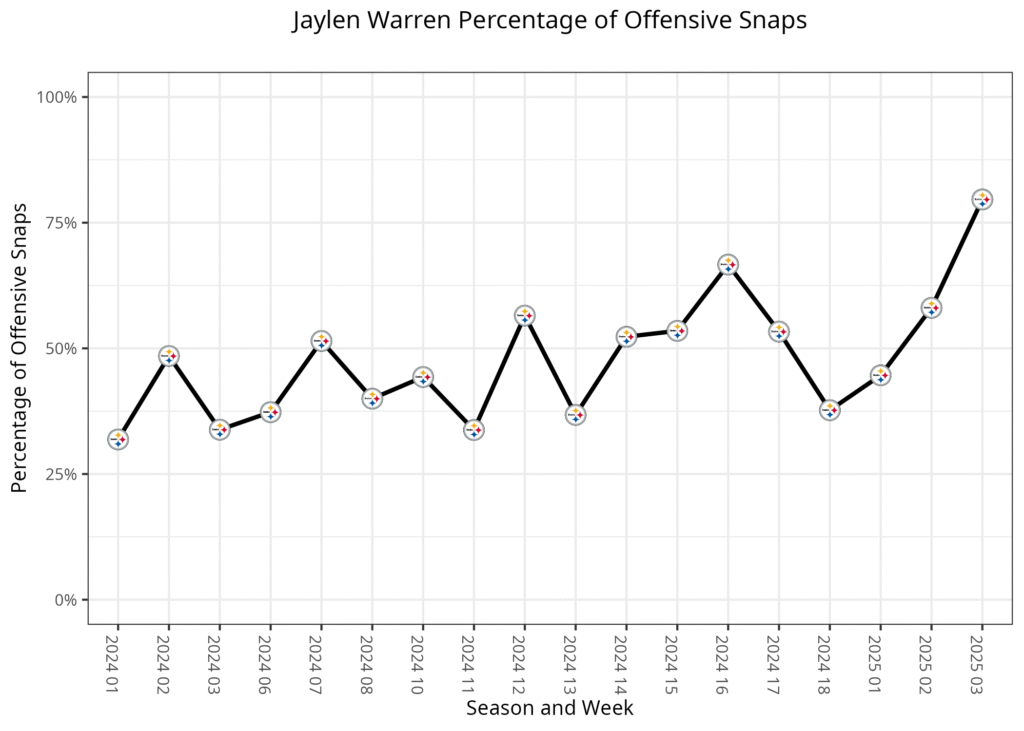
Jaylen Warren reaches excellent utilization: Warren played in a career high 79.6% of Pittsburgh's offensive snaps, which is 10% more than his previous high.
The Steelers utilized a two-man rotation with Warren and Kenneth Gainwell in the first two weeks. Warren had a slight lead in snaps overall. Gainwell was the clear passing-down back in Week 1, but the Steelers didn’t have a clear passing-down back in Week 2.
This week, Warren was the primary running back in all situations. This included the majority of early-down snaps and the overwhelming majority of snaps in all other situations. His 79.6% snap rate was the fourth-best for running backs among the first 10 games of the week, behind Saquon Barkley, Tony Pollard and Bijan Robinson. Warren’s 18 carries were three more than his previous career high, and he also led the team in targets, receptions and was tied for the lead in receiving yards. Ideally, he would have averaged more than 2.6 yards per carry. He also missed out on one goal-line snap, and that was the snap where Gainwell scored a touchdown.
Warren’s utilization makes him a clear buy-low option. While it’s fine to wait and see if this usage continues before you consider him a must-start option, he is closer to being a must-start this week than he was last week.
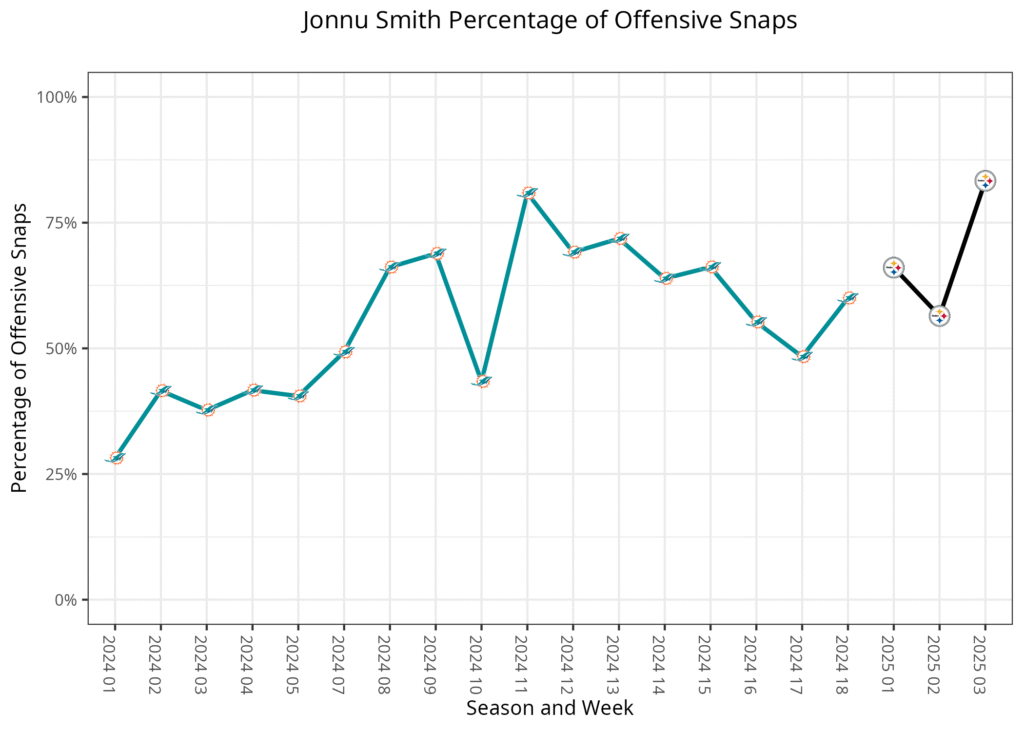
A return to the Arthur Smith offense: The Steelers' tight end usage better resembled past Smith teams this week compared to the first two weeks.
Smith is known for using more two and three-tight-end sets than any other offensive playcaller. That made him an awkward fit for Aaron Rodgers, who traditionally is used to three wide receivers on the field. Over the first two weeks, we saw a compromise between the two offenses. The Steelers had 51 plays in one-tight-end sets, 60 plays in two-tight-end sets, six plays with three tight ends and one play with four.
This week, the Steelers were up to 13 plays with three-tight-end sets, typically with Jonnu Smith, Pat Freiermuth and Darnell Washington all on the field at the same time. This left wide receivers Roman Wilson, Scotty Miller and Ben Skowronek all with single-digit snaps. Pittsburgh used two-tight-end sets for 24 plays and a single tight end for 17 plays. Rather than all three tight ends playing more snaps, it was just Smith and Freiermuth. They took snaps away from Washington in one- and two-tight-end sets, but he made up for it in three-tight-end sets.
This didn’t leave much fantasy value for either tight end this week, but if this playing time continues, we could see Smith or Freiermuth becoming more fantasy viable this season.
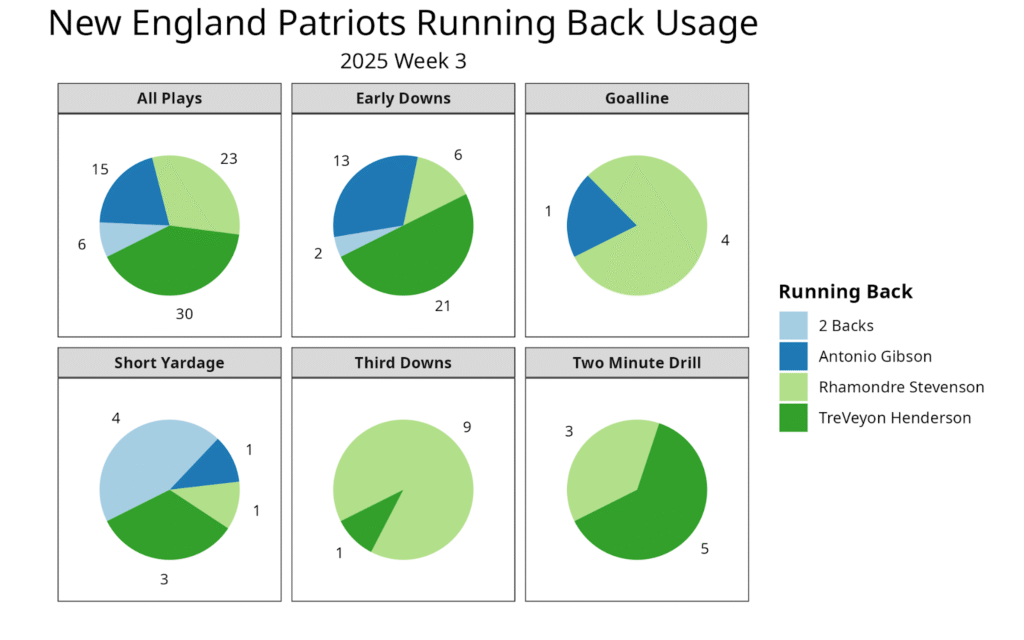
TreVeyon Henderson leads Patriots backfield thanks to ball security: Rhamondre Stevenson lost two fumbles while Antonio Gibson lost one, leading to Henderson taking over for New England.
Henderson was one of the most hyped rookies heading into the season, thanks to his play in college and the preseason. However, he only played 44 of 131 snaps in the first two games, with a lot of the snaps last week occurring in two-back sets.
Stevenson played all four snaps on the Patriots’ first drive but lost a fumble to end the drive. New England leaned primarily on Henderson on the second drive, but all three running backs played some. Over the next two drives, the Patriots relied on Gibson as their primary runner, but Stevenson remained the passing-down back. Stevenson played 20 of the 38 snaps in the first half, while Gibson played 13, and Henderson played eight snaps.
Stevenson played the first two snaps of the second half but fumbled on that second play. He ended up playing five more snaps over the rest of the game, but that was his last carry. Gibson played all three snaps on the following drive, but then he lost a fumble. The Patriots played three long drives in the fourth quarter, where Henderson played 26 of 31 snaps, while Stevenson played five, and Gibson played three. Henderson was the only running back with a carry in the fourth quarter.
It will be difficult to trust any Patriots running back next week without very clear comments from the coaches. Typically, if a coach is punishing a player for fumbling too much, it’s either for one game or there is a permanent change in how playing time is distributed. We might not know what will happen to Stevenson or Gibson until after Week 4.
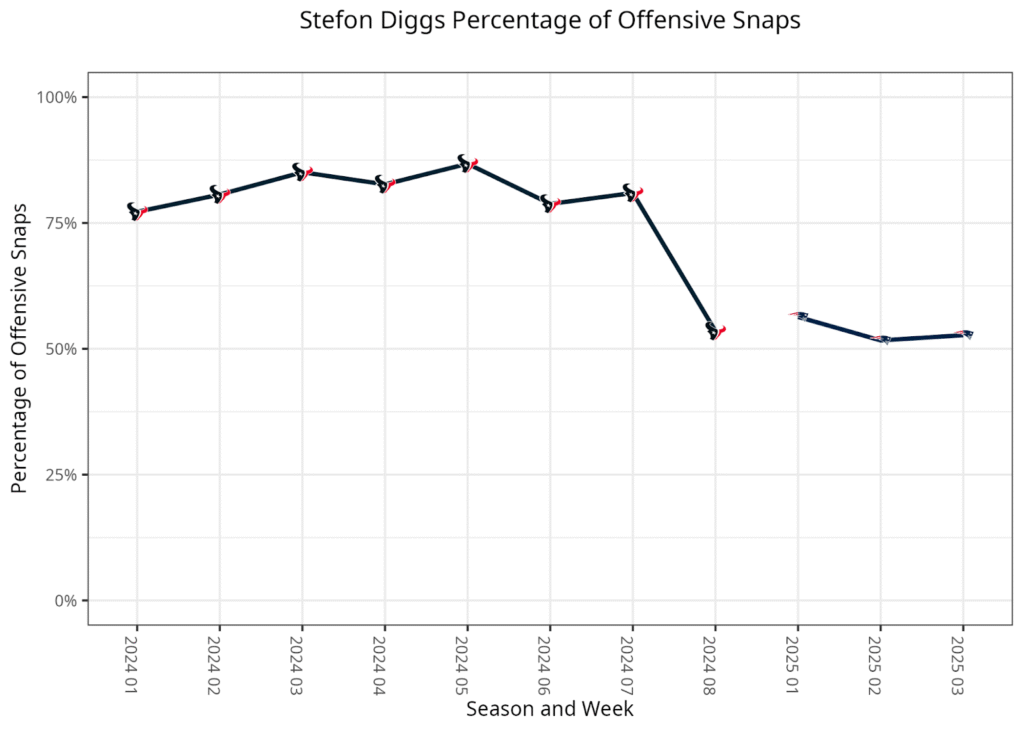
The Patriots continue an ugly wide receiver rotation: All of the Patriots' wide receivers were held under 76% of the team's offensive snaps.
Heading into the season, we expected Stefon Diggs to take one wide receiver spot, a rotation of players in the second spot, and DeMario Douglas to take the slot. The Patriots have used a rotation, but that included Diggs and Douglas also being rotational players.
Both last week and this week, Kayshon Boutte, Mack Hollins, Diggs and Douglas played 50% or more of New England's offensive snaps in 11 personnel. In 12 personnel, Boutte and Hollins were the primary players, while Diggs played between 40-45% of the snaps. Now that we’ve seen this rotation in back-to-back games, it’s safer to expect this to continue going forward.
In that case, Boutte is the only one who has a chance to be fantasy relevant. He is the only one to play over 65% of the snaps in any game, and he’s done it in all three games. Douglas can be dropped in most leagues. In 10-team leagues, it’s OK to start considering dropping Diggs. He’s averaged 37 yards per game, and it doesn’t seem like his role is expanding. If you don’t plan on starting him during bye weeks, it could make sense to pivot to a different high upside option or pick up someone who can help your team during bye weeks.
Miscellaneous notes
- The Steelers activated Trey Sermon off the practice squad to be the team’s third running back. Kaleb Johnson notably didn’t recover a kickoff, allowing the other team to score. This led some to assume Johnson would be a healthy inactive, but instead, they kept all four running backs on the gameday roster. While it’s fine to hold onto him in deeper leagues where all rookie running backs on NFL rosters are on fantasy rosters, he can be cut in most other redraft leagues.
- Patriots tight end Hunter Henry left in the third quarter due to injury but was able to return and play out the rest of the game.
Los Angeles Rams @ Philadelphia Eagles
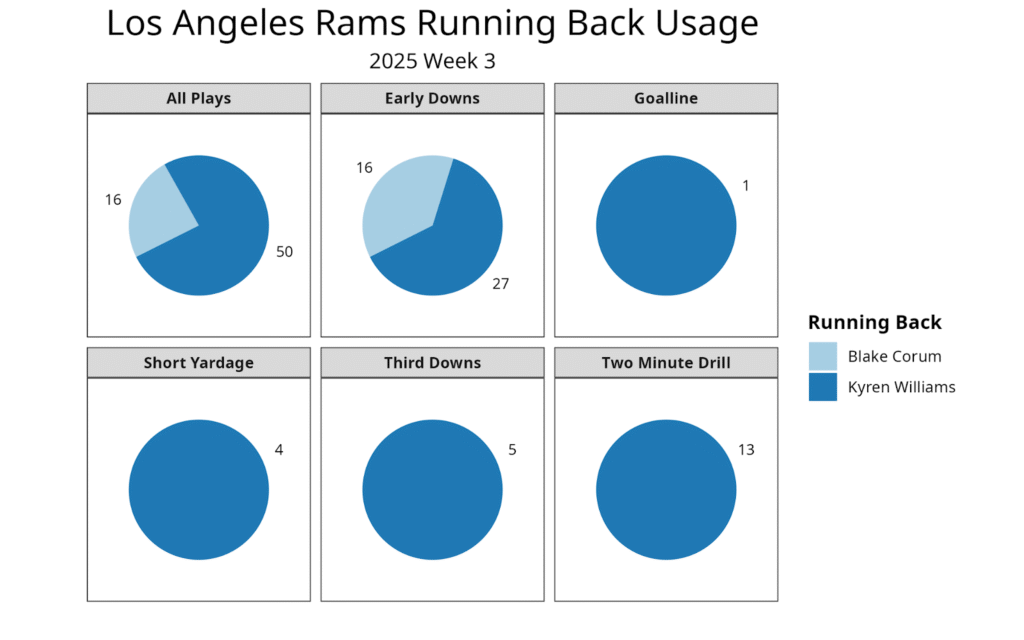
Blake Corum runs well in a limited role: Corum ran eight times for 53 yards, but Williams was back to dominating snaps.
The Rams have used a running back rotation by drive in all three games this season. Last week, Williams played his fewest offensive snaps in some time because the drives Corum was on the field for tended to be longer drives.
This week, Corum was the primary running back on the third and 10th drives, which meant fewer drives than last week. He also played on the second and fourth drives, but those were longer drives where Williams needed more breaks.
Corum averaged 6.6 yards per carry this week and has averaged 7.1% on the season. He’s gained a first down on 57.1% of his runs and at least 10 yards on 35.7% of his runs. Williams hasn’t played poorly, but hasn’t been as dominant as Corum. Despite Corum being the better runner on a small sample size, there has been no indication that Corum is cutting into Williams' playing time any further. If anything, this week suggested the opposite was true.
The Eagles' wide receivers bounce back: Philadelphia was finally in a game script where it needed its wide receivers.
A.J. Brown caught six passes for 35 yards and DeVonta Smith hauled in seven passes for 69 yards over the first two games, while no one on the Eagles had a receiving touchdown. In Week 1, the Eagles faced man coverage all game, leading them to throw to their tight ends and running backs. In Week 2, the Eagles focused largely on their run game.
This week, the Eagles were down 26-7 early in the third quarter. This left the team passing more often than usual in the second half. Brown caught six passes for 109 yards and a touchdown, while Smith caught eight passes for 60 yards and a touchdown. This also led Saquon Barkley, Brown, Smith and Dallas Goedert to all play over 80% of Philadelphia's offensive snaps, while Jahan Dotson played 77.6% of the snaps. Usually, all five players are rotated out a little more often.
Brown and Smith will remain frustrating players from a fantasy perspective, but they will often need to stay in fantasy lineups because both players are capable of games like this.
Miscellaneous notes
- Jordan Whittington played more than Tutu Atwell in both two- and three-receiver sets for the second straight week.
- Rams backup tight end Colby Parkinson was questionable due to a shoulder injury, which also led him to miss Week 2. This left second-round rookie tight end Terrance Ferguson as a healthy inactive, as he was in Week 1. The Rams continued a three-man rotation with Tyler Higbee as the primary tight end in 11 personnel, and Davis Allen and Parkinson playing in 12 personnel. This remains a tight end situation to avoid.
- Eagles backup running back Will Shipley missed his second straight game due to an oblique injury.
New York Jets @ Tampa Bay Buccaneers
Monitor Mike Evans’ health: Evans suffered a hamstring injury in the fourth quarter and didn’t return.
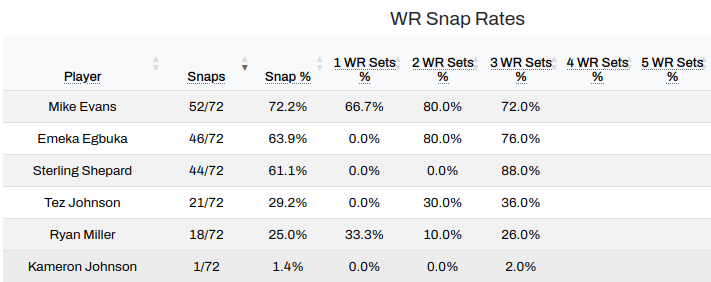
The Buccaneers entered this week with three of their top four wide receivers hurting. Jalen McMillan is expected to miss at least one more month due to a neck injury. Chris Godwin Jr. missed his third straight game due to an ankle injury. He’s been a limited participant in practice for five of the last six practices. There is a strong chance he returns next week. Emeka Egbuka was questionable this week due to a hip and groin injury but ended up playing through the injury. Evans was the only healthy wide receiver of the four.
The Buccaneers started the game with a similar wide receiver rotation as usual. Evans and Egbuka were the primary receivers and Sterling Shepard joined them for three-receiver sets. While Egbuka was a primary receiver, he wasn’t playing as much as usual. He maintained a 92.8% snap rate in the first two weeks of the season, but that dropped to 63.9% for this game. It was primarily rookie Tez Johnson taking Egbuka’s place when he needed a break. Once Evans left, Johnson stepped up more often than not, even though Ryan Miller had been Evans' primary backup for the first two weeks of the season.
If Evans and Godwin play next week, we should see Evans and Egbuka in two-receiver sets, and Godwin joining them in three-receiver sets at least on a limited basis. If Godwin is the only one who can’t play, it should be business as usual. If Godwin returns but Evans can’t play, we should see Egbuka as an every-down receiver, while Shepard is consistently on the field in three-receiver sets, and Godwin plays as much as he can while rotating with Johnson and/or Miller. Egbuka has played significantly more snaps as an X receiver in both the preseason and regular season, and we would see Egbuka play more in Evans' role. If both Evans and Godwin can’t play, then it will be a lot of Egbuka, Shepard in the slot, and Johnson and Miller rotating on every down for the final spot.
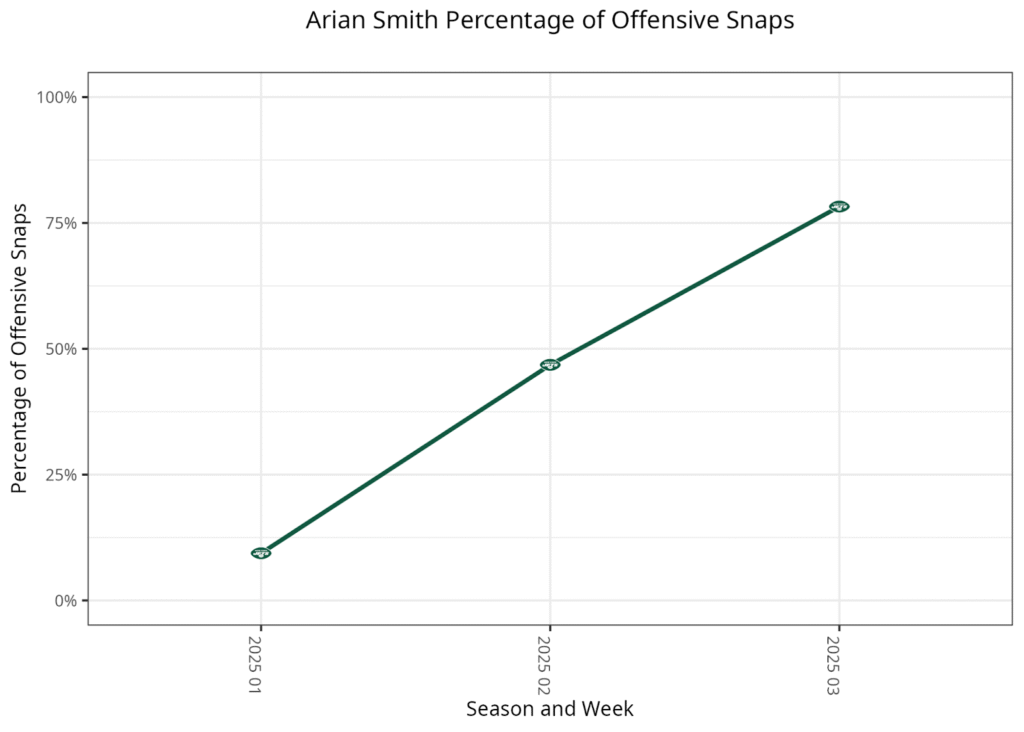
Arian Smith wins a starting job: The Jets’ fourth-round rookie played the majority of snaps in both two- and three-receiver sets.
The Jets started the season with Josh Reynolds as their X receiver, Garrett Wilson as their Z, and Tyler Johnson as the slot receiver in three-receiver sets. Smith was the fourth wide receiver, taking some snaps from Johnson out of the slot. Reynolds suffered a hamstring injury, which caused him to miss both last week and this game. The Jets responded to the injury last week with Johnson becoming a full-time receiver, while Smith split snaps with Allen Lazard in three-receiver sets. The Jets rotated where players lined up rather than having a clear X receiver.
This week, Smith was clearly ahead of Johnson in two-receiver sets and ahead of Lazard in three-receiver sets. Similar to last week, there weren’t overwhelming tendencies, but Smith played the most snaps in the slot. Once Reynolds is back, we should expect Smith to at least be a top-three receiver. It’s likely Reynolds will at least initially be one of the primary receivers in two-receiver sets, but that might not be the case over the entire season.
Smith probably isn’t someone to pick up except for deeper leagues, as no Jets wide receiver has had any fantasy value in any week outside of Wilson. However, he is a name to monitor if the Jets’ passing game improves and can support a second fantasy-relevant receiver.
Miscellaneous notes
- The Jets' running back rotation was similar to the first two weeks, but all three backs were a little closer together than in the first two games. Breece Hall played between 55-65% of New York's offensive snaps, Braelon Allen was the backup on early downs, and Isaiah Davis was the primary third-down back. Allen averaged 5.0 yards per carry compared to Hall's 2.3, which likely contributed to Hall playing a little less while Allen played a little more than usual.
- Jets returner Kene Nwangwu missed his second straight game due to a hamstring injury.
- Justin Fields was also inactive due to a concussion. Brady Cook was a practice squad elevation to take the backup job.
- The Buccaneers' running back rotation has remained stable. Bucky Irving played 73.2% of Tampa Bay's offensive snaps over the first two weeks and 73.6% of the snaps in Week 3.
Indianapolis Colts @ Tennessee Titans
Monitor Alec Pierce’s health: Pierce suffered a concussion in the third quarter and didn’t return.
The Colts' wide receiver rotation has been very consistent the last two seasons. Pierce has been the X receiver, Michael Pittman Jr. has been the Z, and Josh Downs has been the slot in three-receiver sets. Pierce has an exceptionally high average depth of target relative to the other receivers. While it seemed like the change from Anthony Richardson Sr. to Daniel Jones would hurt his fantasy value, given the two quarterbacks' styles, Pierce has put together back-to-back good games. He caught four passes for 68 yards last week and four receptions for 67 yards this week.
Once Pierce left with an injury, Adonai Mitchell took over as the new X receiver. If Pierce misses time, we can expect Mitchell to be a full-time receiver. The Colts play the Los Angeles Rams next week, and Los Angeles has allowed the top-two wide receivers on their last two opponents' depth charts to gain at least 50 receiving yards. This gives Mitchell some short-term fantasy value.
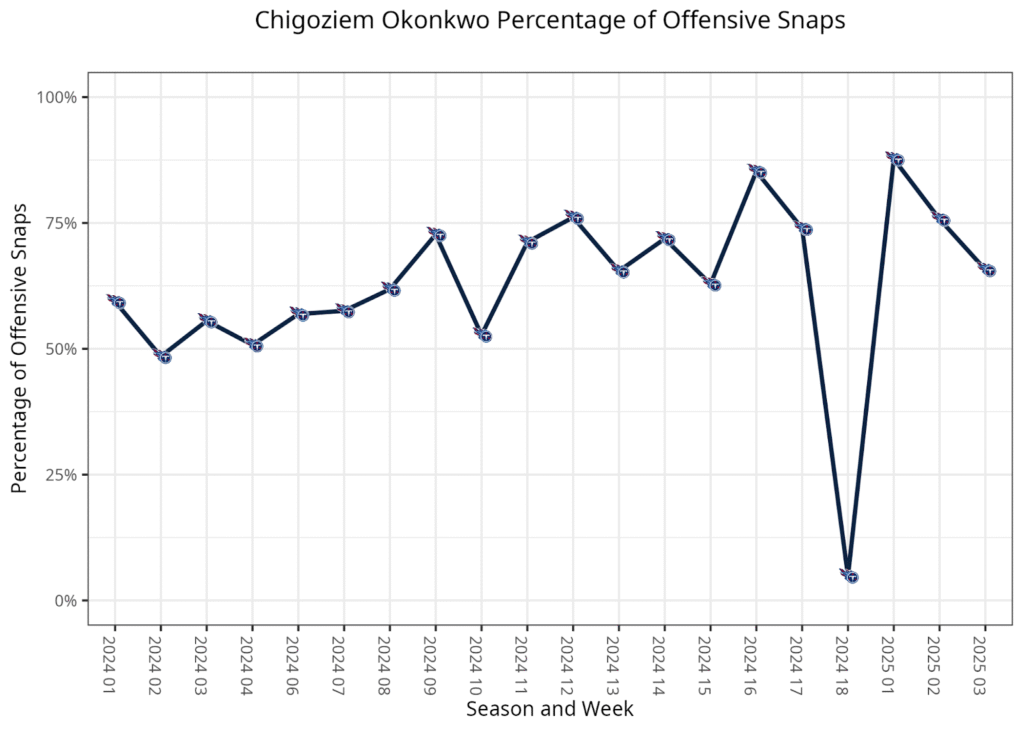
Chig Okonkwo leads the Titans receivers: Okonkwo caught five passes for 66 yards, leading the team in both receptions and receiving yards.
Okonkwo was among the top fantasy tight ends at the end of last season. He’s been a borderline fantasy starter so far this season given his receptions and receiving yards, as he's finished with at least three receptions each week. While it appears his playing time could be declining, his percentage of the offensive snaps has been a product of the game script and the number of plays the Titans have run. Okonkwo has played 46-50 snaps each week, but the Titans have fallen behind faster each week, and they’ve also run fewer two-tight-end sets each week.
Given Okonkwo’s current role, he is a high-end TE2. He is a perfect bye week replacement, but he’s also worth monitoring if the Titans offense starts to improve. Okonkwo has produced this year with multiple short plays, but he was known as a rookie for his big plays. If he can mix in some big plays with his current consistent production, he could be a top-10 fantasy tight end over the rest of the season.
Miscellaneous notes
- Colts star rookie tight end Tyler Warren was questionable for the week due to a toe injury. The Colts limited his playing time throughout the game. He played 83% of Indianapolis' offensive snaps over the first two games and 68% this week. The decrease in snaps occurred throughout all situations.
- Indianapolis backup running back Tyler Goodson made his season debut. He was dealing with an elbow injury but was a full participant in practice all week and wasn’t given an injury designation. He played a few early-down snaps, but D.J. Giddens remained ahead of him on the depth chart.
- Tyler Lockett has split playing time with rookie Chimere Dike for slot snaps in three-receiver sets for a second-straight week
- Titans third-string wide receiver Kalel Mullings was questionable due to an ankle injury. He also missed last week.
- Titans' sixth wide receiver, Bryce Oliver missed this week due to a knee injury.
Las Vegas Raiders @ Washington Commanders
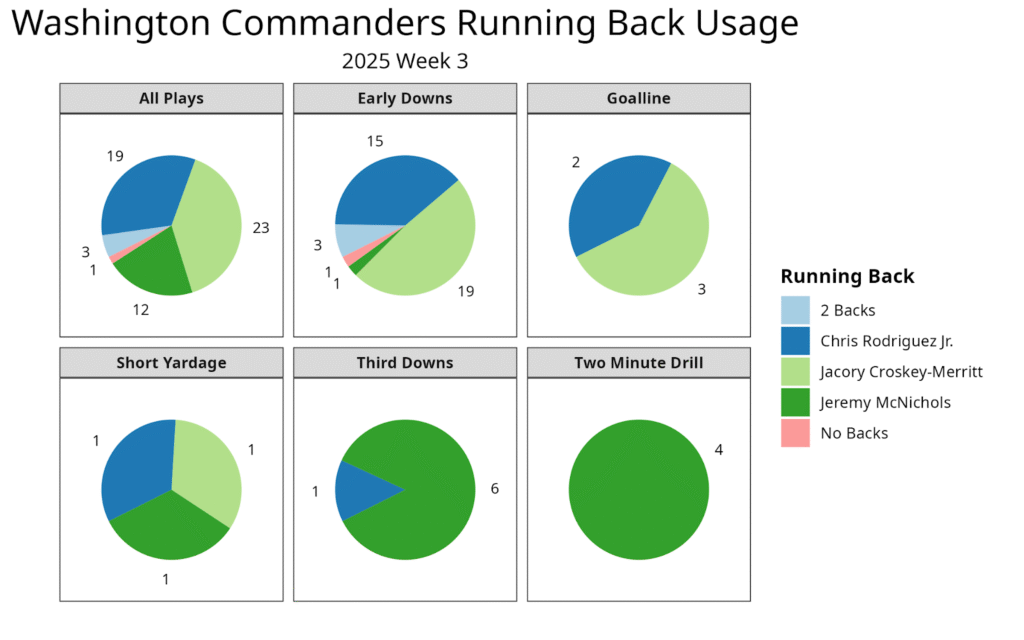
A committee replaces Austin Ekeler: The Commanders had three different running backs playing between 15-23 offensive snaps.
Ekeler was placed on injured reserve on Monday due to a torn Achilles tendon that will knock him out for the season. Chris Rodriguez Jr. was a healthy inactive each of the first two weeks but was active this week. The Commanders had used Ekeler as the third-down back and primary running back on the first two drives, while Jacory Croskey-Merritt took over as the primary running back over the rest of the game.
Many expected a larger role out of Croskey-Merritt, but that didn’t end up being the case. Rodriguez took Ekeler’s role as the early-down back to start the game and primary backup over the rest of the game. Rodriguez took every snap on the first two drives. For whatever reason, the Commanders haven’t used Croskey-Merritt on the first two drives of any game. Like every other week, Croskey-Merritt took the majority of early-down snaps for the rest of the game. Rodriguez should be a waiver-wire target this week after running the ball 11 times. However, as long as Croskey-Merritt and Rodriguez are splitting the early-down role, it will be hard to trust either in fantasy starting lineups.
Jeremy McNichols took over as the third-down back and two-minute drill back, as expected. McNichols was the clear third option in other situations. While he ran four times for 78 yards and a touchdown, we should not expect his role to lead to fantasy relevance going forward.
Monitor Terry McLaurin’s health: McLaurin suffered a quad injury in the third quarter and didn’t return.
The Commanders were already down one wide receiver heading into the game, as Noah Brown was inactive due to groin and knee injuries. Washington signed Chris Moore off the practice squad to replace Ekeler’s roster spot. The Commanders used Moore as the third receiver in three-receiver sets rather than using either of their young wide receivers to replace Brown.
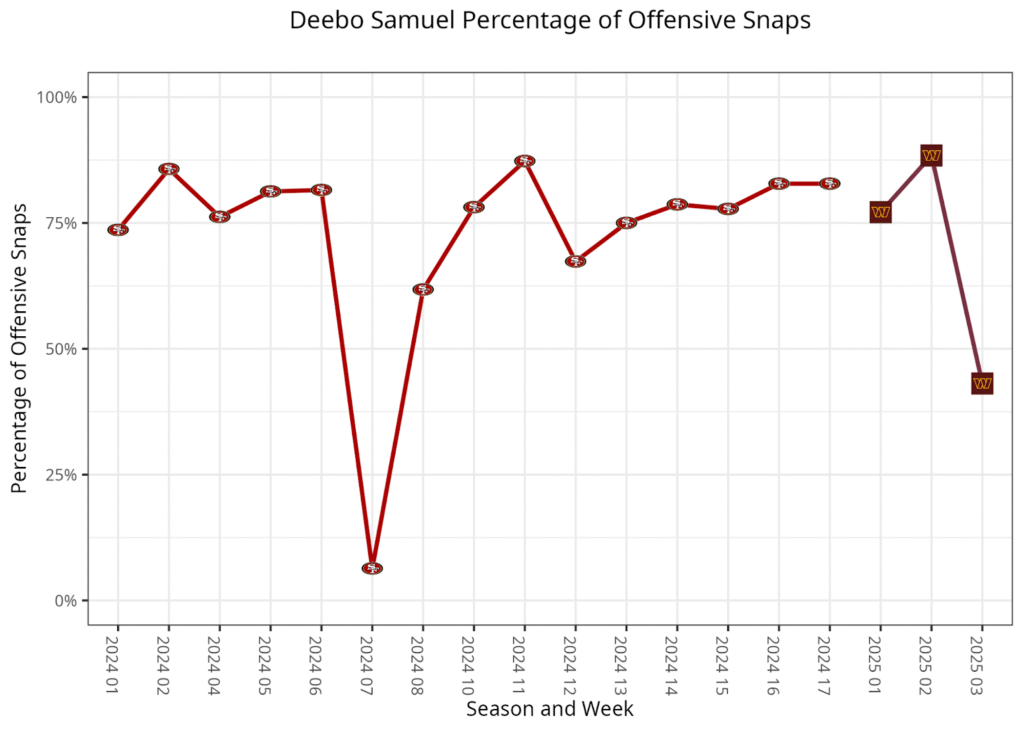
The team also limited Deebo Samuel in this game. Samuel had played 45% of the snaps in two-receiver sets and 93% in three-receiver sets over the first two games. In the first three quarters, that dropped to 33% of the snaps in two-receiver sets and 78% in three-receiver sets. McLaurin’s injury kept him out for all of the fourth quarter. The Commanders were up 34-10 at the start of the quarter, so they also opted to take out Samuel for the rest of the game.
The Commanders used Luke McCaffrey and Jaylin Lane as their primary replacements over the rest of the game. McCaffrey had the second-highest slot rate, while Lane was a closer replacement to McLaurin, but McCaffrey played more time in two-receiver sets. If McLaurin misses time, Washington would likely use some kind of rotation to replace him. In the short term, it will be harder to trust any wide receiver for fantasy purposes, given McLaurin and Brown’s injury and Samuel’s surprising decrease in playing time.
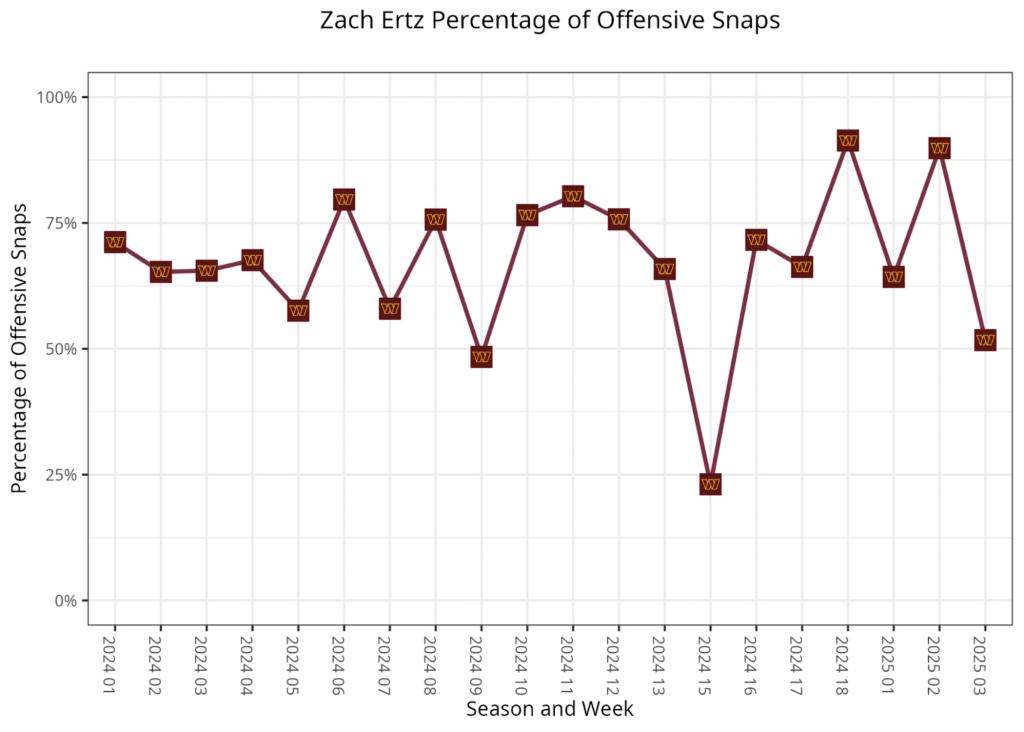
Zach Ertz sees a decreased role: The Commanders didn’t have second-string tight end John Bates due to a groin injury, but that led the team to use Ertz less rather than more.
Last season, Ertz played 67% of Washington’s offensive snaps. This included 71% of the early-down snaps out of 11 personnel, 86% out of 11 personnel on third downs and 46.5% of the snaps in two-tight-end sets. Bates and Ben Sinnott were the primary two-tight-end set players. During the first two weeks, Ertz played more snaps across the board, finishing with 74%, 97% and 69% in the same three situations, respectively. With Bates out, it seemed like Ertz could play an even higher rate of the snaps, particularly in two-tight-end sets.
Instead, Ertz only played in 22% of two-tight-end sets, while Colson Yankoff took over as the other tight end in those formations. This is something that happened throughout the game and wasn’t related to the game script. He also played fewer snaps on early downs on 11 personnel, finishing with a 65% snap rate.
Ertz was already hard to trust for fantasy purposes due to his playing time. It will be even harder to trust him after this week.
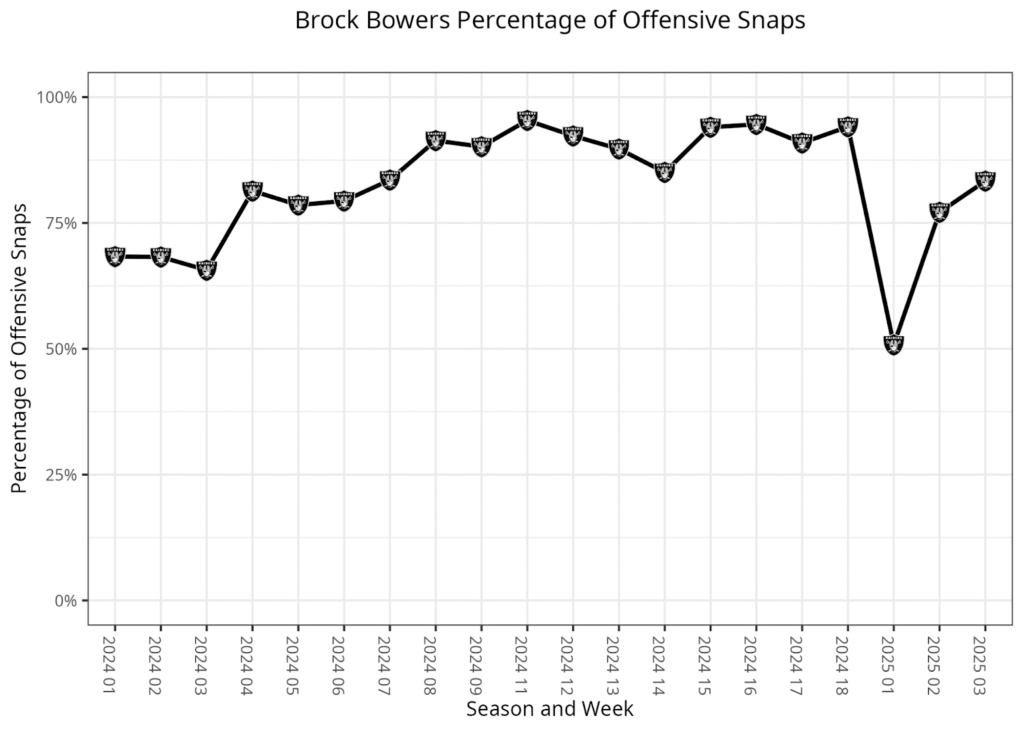
Monitor Michael Mayer’s health: The Raiders' starting tight end suffered a head injury making a tackle on a punt return to end the first quarter and didn’t return.
Las Vegas started the game rotating Brock Bowers and Mayer, similar to the first two weeks of the season. Bowers played six of 10 snaps. and Mayer played five of 10. They split 11 personnel snaps with four each, but Bowers played both 12 personnel snaps, while Ian Thomas replaced Mayer for one of those two snaps.
Once Mayer left, Bowers went back to being an every-down tight end, very similar to last season. He played 47 of the 54 snaps over the rest of the game. That included 36 of the 43 snaps in 11 personnel, while Thomas took the other seven snaps. Bowers and Thomas shared the field for 11 snaps in 12 personnel. If Mayer misses time, Bowers has a better shot at an excellent game thanks to the increased snap rate. However, once Mayer is back, there remains a reason for concern around Bowers' target total.
Miscellaneous notes
- Commanders quarterback Jayden Daniels was inactive due to a knee injury.
- The Commanders signed Chase Edmonds to the practice squad with Ekeler on injured reserve. It is unlikely he will make the 53-man roster unless there is another injury to a running back.
- Raiders running back Ashton Jeanty played 85.7% of Las Vegas' offensive snaps in Week 1 and 55.7% of the snaps in Week 2, losing late-down, two-minute drill and short-yardage snaps. This week, his rate increased slightly to 60.6% of the snaps, largely thanks to an increase in snaps in normal early-down situations and fewer snaps in other situations.
- Tre Tucker had an excellent game with eight receptions for 145 yards and three touchdowns. His role in the offense has remained unchanged all season, playing over 90% of the offensive snaps each week as the Raiders’ Z receiver.
- The Raiders activated wide receiver Alex Bachman off the practice squad.
Denver Broncos @ Los Angeles Chargers
Monitor Najee Harris’ health: Harris suffered a potentially season-ending Achilles injury.
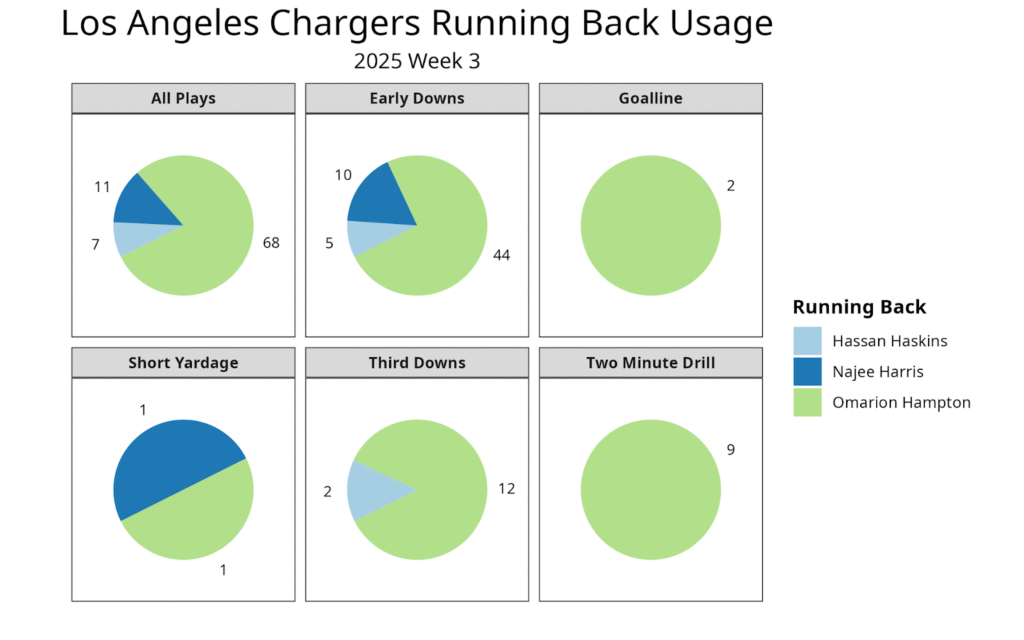
Harris spent the first two weeks of the season as Omarion Hampton’s backup, playing 26% of Los Angeles' offensive snaps. The Chargers used a very similar running back rotation over the first five drives, as Hampton played 29 snaps compared to Harris' 11. Harris had been looking like the more effective runner the last two weeks, leading the Chargers to run the ball when Harris was on the field, and either run or pass when Hampton was playing.
Harris’ injury was on a non-contact play. Hampton played 39 of the 46 snaps over the rest of the game, while Hassan Haskins played the other seven. Haskins was only used in passing situations, while Hampton ran 12 times during that time. Hampton started the season as a must-start player, but there was some hesitation heading into this week. With Harris out, Hampton has top-10 potential if he improves over the course of the season, as we would expect from any rookie.
Haskins will remain the backup on passing downs. We should expect Los Angeles to sign Kimani Vidal from the practice squad to the 53-man roster, and he should be the backup on early downs. It’s not entirely out of the question for the Chargers to look elsewhere for another running back. If the Chargers make a trade, this could complicate Hampton’s fantasy value.
The Chargers adjust without Will Dissly: The Chargers’ versatile tight end was inactive due to a knee injury.
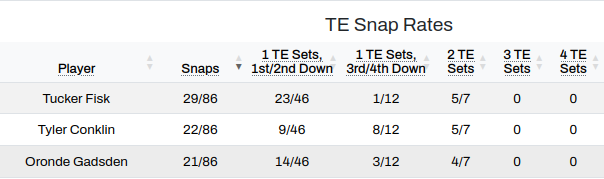
The Chargers spent the first two weeks of the season using a two-man tight end rotation between Dissly and Tyler Conklin. In Week 1, Dissly was the early-down tight, and Conklin was the receiver. In Week 2, those roles flipped. This suggested Los Angeles was unsettled in how it was using its tight ends. Fifth-round rookie Oronde Gadsden and Tucker Fisk were healthy inactives the first two weeks of the season.
With Dissly out, both Gadsden and Fisk were active. Fisk was the primary tight end on early downs, similar to his role over the second half of last season. Conklin went back to being the primary tight end on third downs, similar to Week 1. Gadsden was the primary backup in both situations. All three played significantly in two-tight-end sets. This left all three players playing less than 35% of the offensive snaps.
While this would ordinarily be a large situation to avoid, it’s worth noting that Gadsden caught five of seven passes for 46 yards in his limited playing time. Conklin, Dissly and Fisk have caught a combined four passes over the first three weeks of the season. Based on Gadsden’s play relative to the other tight ends, it would not be surprising to see Gadsden play more. Receiving tight ends in Greg Roman’s offenses have had significant value in the past, even if their playing time isn’t ideal. This makes Gadsden a good waiver-wire target in deeper leagues and a player to monitor in all other leagues.
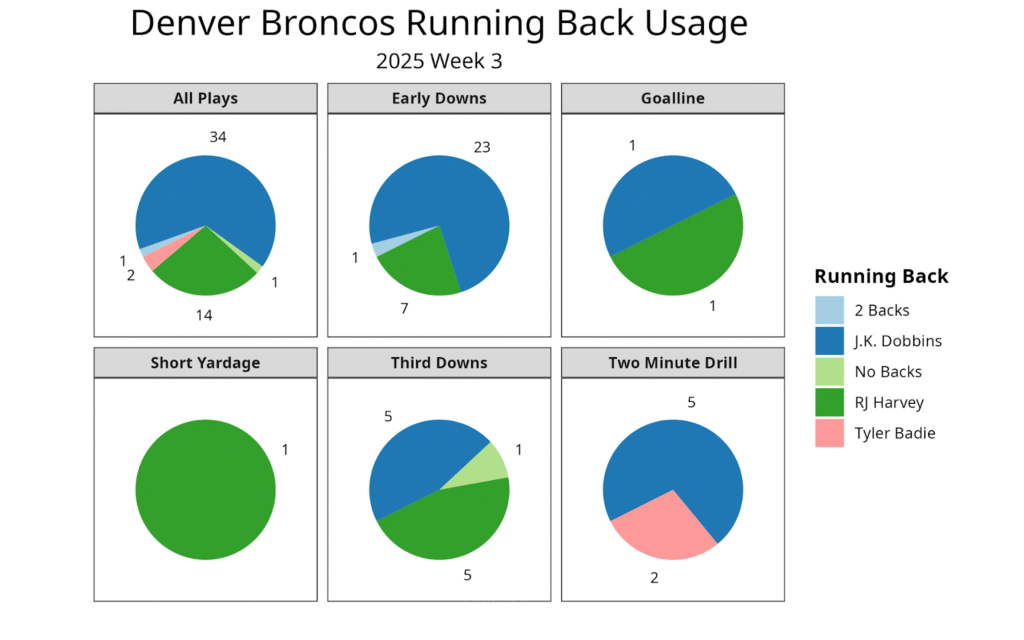
The Broncos become a two-man backfield: Denver stopped using Tyler Badie as their passing-down running back, leading to more playing time for J.K. Dobbins.
Badie played 61% of the third downs and 75% of the two-minute drill snaps over the first two weeks, giving the Broncos a three-man committee. Dobbins played 50% of the snaps while R.J. Harvey played 30% of the snaps over the first two weeks. Dobbins led the way on early downs and dominated snaps in short-yardage and goal-line situations.
This week, Badie only played two offensive snaps, both during a two-minute drill. Dobbins benefited. Dobbins and Harvey split third-down snaps, while Dobbins took the rest of the snaps in two-minute drills. While Harvey became more involved in short-yardage situations, Dobbins took a higher percentage of the snaps on early downs away from Harvey.
Dobbins looked great as a runner, gaining 83 yards on 11 carries and a touchdown. Harvey ran the ball twice for two yards. Harvey also caught three passes for 14 yards, while Dobbins caught one pass for no gain. This should make it safer to put Dobbins in fantasy starting lineups going forward. It should also open the door for Harvey to get more involved, particularly in games where the Broncos have a lead. However, the Broncos have also significantly changed their running back rotation each week, which was also the case last season. It’s also possible Badie is more involved again next week.
Miscellaneous notes
- Chargers fifth-round rookie wide receiver KeAndre Lambert-Smith did not play an offensive snap after playing 20 snaps over the first two weeks. All of those snaps went to Tre Harris, who played 24 snaps this week after playing 23 snaps the first two weeks combined. He played five snaps in single-receiver snaps and 15 snaps in four-receiver sets. Harris’ increase this week had no impact on Ladd McConkey, Quentin Johnston or Keenan Allen.
- The Broncos wide receiver rotation was similar to last week. Courtland Sutton and Troy Franklin were the primary wide receivers, while Marvin Mims Jr. and Trent Sherfield Sr. rotated for the third-receiver spot. However, the Broncos rotated their wide receivers a little more often in two-receiver sets.
- Broncos tight end Evan Engram was inactive with a back injury. Luckily, Nate Adkins, who missed the first two weeks of the season due to an ankle injury, made his season debut. He was a full participant in practice all week and wasn’t given an injury designation. Lucas Krull played Engram’s role as the receiving tight end, while Adkins took some of Krull’s blocking responsibilities. Adkins' return will make Engram’s role even more complicated once he’s able to return.
New Orleans Saints @ Seattle Seahawks
Kenneth Walker III leads with Zach Charbonnet out: Charbonnet was inactive this week due to a foot injury.
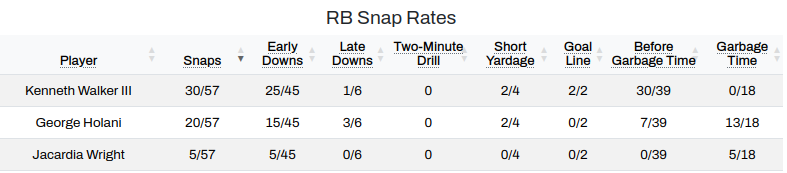
Walker and Charbonnet split snaps over the first two weeks, and Walker played particularly effectively last week. He seemed like someone who would receive more playing time based on his play, but that ended up happening anyway due to Charbonnet’s injury.
Walker was the clear starter in this game, playing 30 of a possible 39 snaps before garbage time. George Holani was the backup. Seattle had two running backs on the practice squad, so the Seahawks chose to elevate Jacardia Wright as the third running back and release seventh-round rookie Damien Martinez. Walker only averaged 2.4 yards per carry, but that was partially due to 0.3 yards before contact per play from their offensive line. Anyone who started Walker was rewarded with two early rushing touchdowns. Walker didn’t play at all during garbage time, but the Seahawks continued to focus on the run game.
Walker is a must-start option as long as Charbonnet is out. Even when Charbonnet is back, they could ease him back into action. Once Charbonnet is back to 100%, the decision to start Walker or not could depend on the opponent.
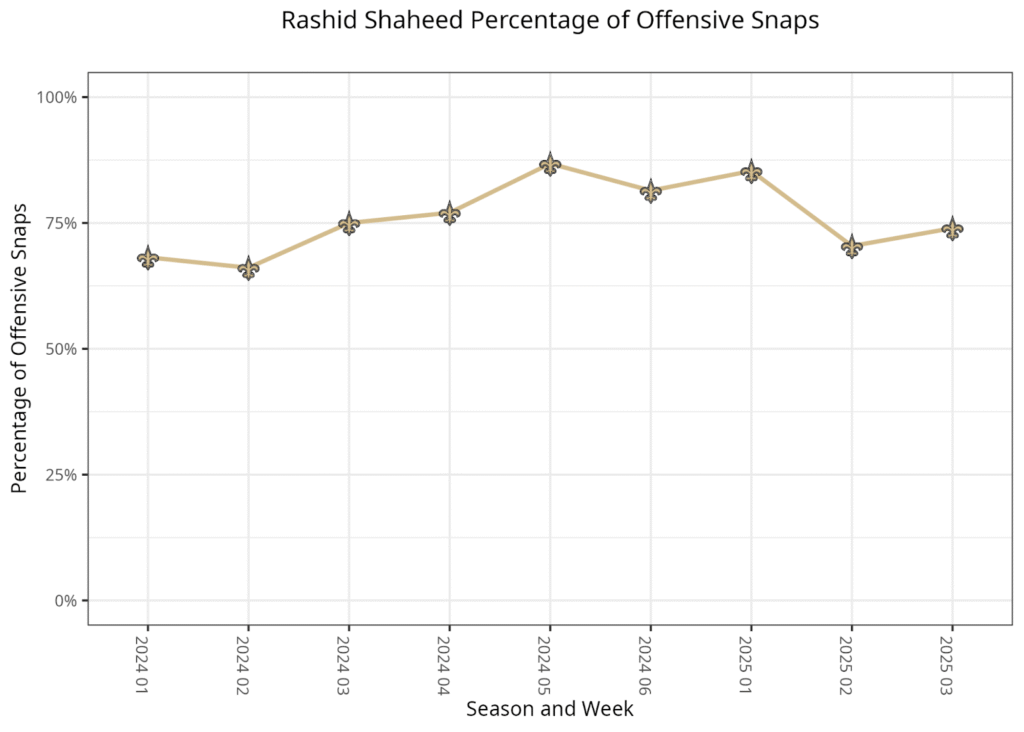
Rashid Shaheed’s playing time was limited despite other injuries: Shaheed rotated more than fantasy managers preferred last week, and that didn’t improve this week.
Last week, Chris Olave, Shaheed and Brandin Cooks were the main wide receivers in three-receiver sets, but Olave and Devaughn Vele took half of the 12 personnel snaps. Shaheed and Olave took eight of 18 snaps together, while Olave joined Cooks for one 12 personnel play. Vele (hip) and Trey Palmer (hamstring) were both inactive for this game. Vele showed up on the injury report mid-week, while Palmer has missed the first two games. New Orleans signed Kevin Austin to the 53-man roster. The Saints are one of five teams to keep seven wide receivers on their 53-man roster.
Rather than Shaheed going back to playing in the majority of two-receiver sets, both Austin and Mason Tipton played more in two-receiver sets than Shaheed. The Saints ran so much 11 personnel that Shaheed still played more snaps than usual. However, at some point this season, the Saints will likely start using more 12 personnel. Foster Moreau started the season on the PUP list. He’s eligible to return after Week 4, although there is no clear timeline for when he will be ready to play. When he’s back, the Saints will likely use more 12 personnel, which would mean fewer snaps for Shaheed, who has also been held under 55 receiving yards each of the first three weeks after gaining at least 70 yards in four of his six games last season.
Anyone rostering Shaheed in a 10-person league can likely move on from him, and those in 12-person leagues can at least consider it if there is an attractive option on the waiver wire.
Miscellaneous notes
- The Seahawks played backups on offense for 18 of 57 snaps, making it important to ignore most snap count numbers from this game. Seattle used Drew Lock, George Holani, Jake Bobo, Dareke Young, Elijah Arroyo and Eric Saubert as the primary players during that time, while Jacardia Wright and Tory Horton also mixed in.
- Seahawks wide receiver Jaxon Smith-Njigba was added to the injury report on Saturday due to an illness. His playing time was normal over the first several drives, but the Seahawks started giving Smith-Njigba more breaks earlier than the rest of their starters.
- The Saints stuck with most of their starters throughout the game despite the blowout. They only used clear backups for the last few plays of the game, so their snap counts weren’t heavily impacted.
- The Saints made rookie running back Devin Neal a healthy inactive. He was active but didn’t play a snap on offense or special teams last week.
- The Saints activated Treyton Welch off the practice squad to be their third tight end and waived Moliki Matavao, who had served that role.
Dallas Cowboys @ Chicago Bears
Monitor CeeDee Lamb’s health: Lamb suffered an ankle injury while lining up in the backfield.
The Cowboys started the game with their usual wide receiver rotation. Lamb and George Pickens were the primary wide receivers, while Jalen Tolbert was the third receiver. Lamb suffered his injury early on the second drive. He tried to return for one snap on the third drive but left after that play. Luckily, initial reports are that he avoided major injury, but avoiding major injury could still mean some missed time for Lamb.
This left Pickens and Tolbert as the primary wide receivers, while KaVontae Turpin joins them for three receiver sets and mixes in with Tolbert in two-receiver sets. Ryan Flournoy was the fifth wide receiver on the roster heading into the game and was the primary backup to each receiver in three-receiver sets. Pickens remained the X receiver, as he’s been all season, and Turpin remained primarily a slot receiver. Tolbert saw the biggest role change, as he also primarily played in the slot early in the season. He took over as the Z receiver, which had been Lamb’s primary role to start the season.
While those were the receivers to play more, this largely meant the Cowboys focused the passing game on Jake Ferguson and George Pickens, who combined for 18 receptions. If Lamb misses time, it will be much easier to put Pickens and Ferguson into fantasy starting lineups.
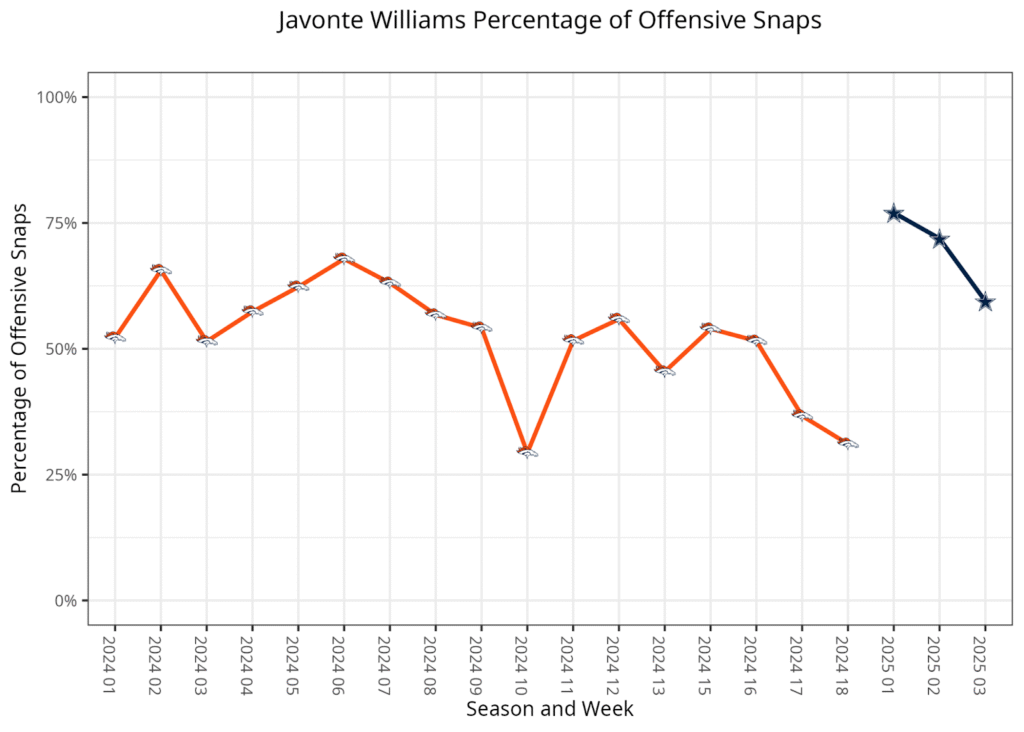
The Cowboys use more of a two-man rotation at running back: Javonte Williams has seen his playing time decrease each week, while Miles Sanders’ time has been on the rise.
Williams played 74% of Dallas' offensive snaps over the first two weeks compared to Sanders' 21%. Williams has played more in both short-yardage situations and two-minute drills, while the snap shares were a little closer on early and third downs.
The Cowboys' running back rotation was very similar over the first half, as Williams played 24 snaps to Sanders' seven. This is when Williams received almost all of his rushing work. In the second half, Sanders played 20 snaps to Williams' 19. The two were closer in snaps for most of the half and then Sanders dominated snaps on the final drive.
As long as the game remains close, we should expect Williams to finish closer to 70-75% of the offensive snaps. The more the Cowboys have a big lead or fall behind, we can expect Sanders to get more involved. It should remain safe to start Williams, and he could be a buy-low option after this game.
Monitor Colston Loveland’s health: Loveland suffered a hip injury after only six offensive snaps and didn’t return.
Loveland has started his career as the clear second tight end in Chicago. Cole Kmet has played 90% of Chicago's offensive snaps in the first two weeks, while Loveland played 55% of the snaps thanks to a high snap rate in two- and three-tight-end sets. Chicago started this game with the same tight end rotation. Loveland caught a 31-yard pass before his injury.
Loveland’s injury had a minimal impact on Kmet’s playing time, as he played in 93% of the snaps this week. The Bears simply used Durham Smythe more often in two-tight-end sets. Even if Loveland misses time, Kmet can be left on the waiver wire. He’s only played four targets in the first three weeks, and the injury shouldn’t have any impact on his target total. Loveland’s receiving numbers per route have been better than Kmet’s, and it’s at least possible that Loveland will cut into Kmet’s playing time when healthy, given his big play in this game.
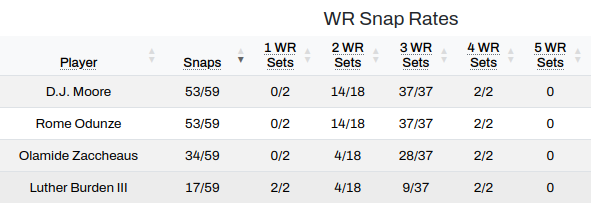
Luther Burden III shines despite limited playing time: Burden caught three passes for 101 yards and a touchdown to lead Chicago’s receiving room.
Burden has been the Bears’ fourth wide receiver on the depth chart. In the first two weeks, he played all of the snaps in four-receiver sets and half of the snaps in single-receiver sets. He’s played 14 snaps in three-receiver sets compared to Olamide Zaccheaus’ 55 but has outsnapped Zaccheaus in two-receiver sets nine to one.
His role in the offense was identical this week. He played slightly more this week, finishing with a 62.5% snap rate in single-receiver sets. The team also ran more four-receiver sets, likely due to the Loveland injury. However, he has not cut into Zaccheaus’ playing time. Despite his limited role, he made multiple big plays.
While Burden’s playing time hasn’t increased yet, it’s certainly possible that Burden starts playing more thanks to his good play. It won’t be enough to put Burden in fantasy starting lineups this week, but it’s a positive sign that he could have fantasy value at some point this season.
Miscellaneous notes
- Cowboys rookie running back Jaydon Blue has been a healthy inactive every week this season.
- Bears starting running back D’Andre Swift was questionable due to a quadriceps injury. Swift’s playing time dropped from 68.9% over the first two weeks to 61.0% in this game, likely due to the injury.
- Roschon Johnson was active for the second straight game but didn’t play an offensive snap, making it even clearer that Kyle Monangai is the second running back.
Arizona Cardinals @ San Francisco 49ers
Monitor James Conner’s health: Conner suffered an ankle injury that required him to get carted off the field. Initial fears are that the injury is going to end Conner’s season.
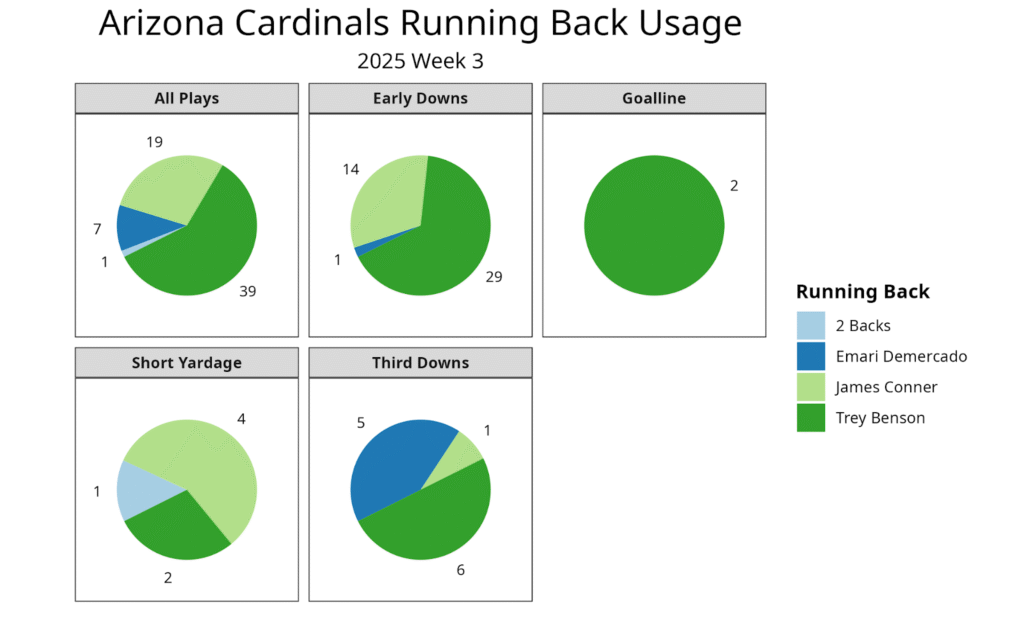
The Cardinals changed their running back rotation this season. Trey Benson took over as the late-down back and two-minute drill back. Last season, Emari Demercado was the third-down back, while he and Conner shared the two-minute drill. Benson also cut into Conner’s playing time a little bit on early downs, but Conner was still ahead 60-40.
This week, Arizona already adjusted more in Benson’s favor. Conner played 13 of the 25 snaps on early-down on the first five drives, compared to Benson's 12 snaps. This included four runs for both players. Benson led the team in snaps during this time thanks to his third-down snaps.
Conner’s injury occurred early in the third quarter. This left Benson as the primary running back over the rest of the game, taking 21 snaps to Demercado’s seven. Demercado primarily took over as the third-down back, similar to his role from last season. Benson lost those third-down snaps but took over as the clear early-down and short-yardage back.
If Conner’s injury is as serious as it appears, then Benson would have the role Conner had all of last season, while Demercado would go back to his third-down role. Bam Knight has been a healthy inactive for the first three weeks of the season. He will likely take over as the backup on early downs but not have a significant role in the offense. Michael Carter is on the practice squad and has played nine games with the Cardianls in 2023 and 2024. It’s at least possible he is brought to the 53-man roster and gets involved.
In the 10-team leagues where Benson is available, he is a must-add, using most, if not all, of your FAAB. Benson should be in fantasy starting lineups more often than not over the rest of the season.
The 49ers continue to adjust for wide receiver injuries: The 49ers didn’t have Jauan Jennings this week due to ankle and shoulder injuries.
The 49ers have been playing without Brandon Aiyuk, who is still on the PUP list, and Demarcus Robinson, who is suspended. They’ve also dealt with multiple injuries lower on the depth chart, which has led to several veteran additions.
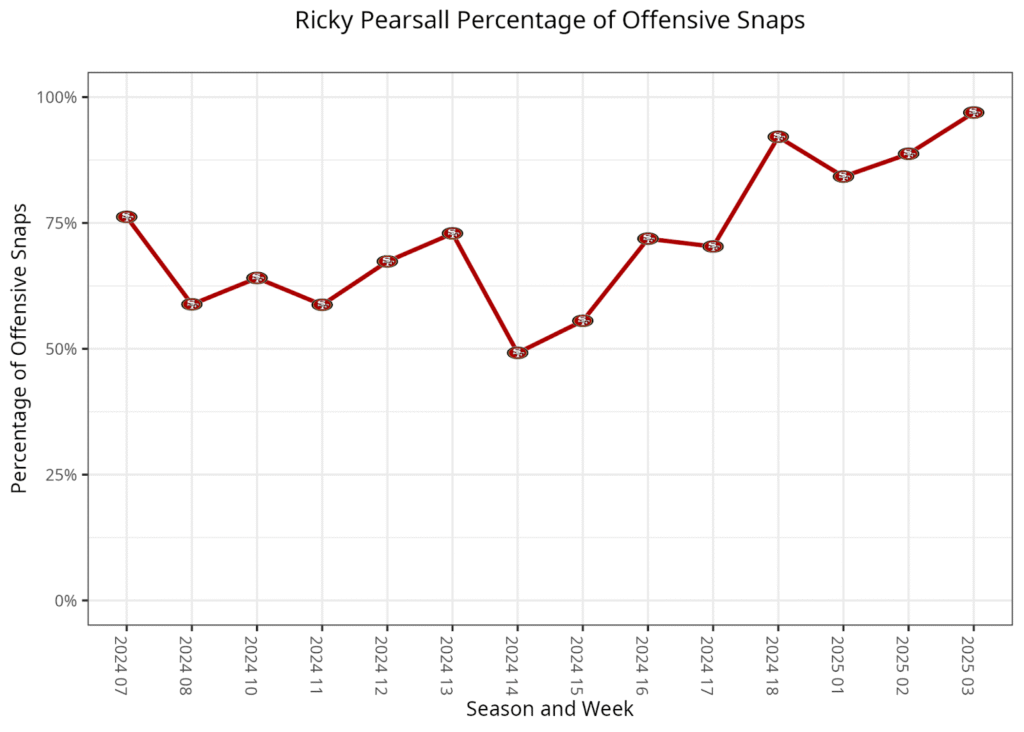
Ricky Pearsall has been the clear top receiver on the depth chart this year, and he played 97% of the 49ers' offensive snaps as their Z receiver. He caught eight passes for 117 yards to help the 49ers stay undefeated. Kendrick Bourne was the team’s primary slot receiver last week, but he started playing the majority of snaps in two-receiver sets with Jennings out, and he was the primary X receiver. Marquez Valdes-Scantling had been Jennings' primary backup, and this week, he was simply Bourne's primary backup. This left Skyy Moore taking the slot snaps in three-receiver sets.
Ideally, the 49ers will at least have Robinson back next week. He would likely be the X receiver, moving Bourne back to the slot. If Jennings is also back, it will be interesting to see who plays the X role and who plays in the slot. Regardless of who is and isn’t healthy, it appears Pearsall should be a significant part of the 49ers' offense the rest of the year.
Miscellaneous notes
- Cardinals backup tight end Tip Reiman was questionable due to a foot injury. He also missed last week. However, he played and took 50% of the offensive snaps, almost all from two-tight-end sets.
- Michael Wilson only played 53.8% of the snaps in two-receiver sets over the first two weeks. That increased to 78.3% of those snaps this week.
- Christian McCaffrey played over 90% of the 49ers' offensive snaps, the first time he’s accomplished this since Week 11 of last season.
- With tight end George Kittle on injured reserve, the 49ers added Brayden Willis to the 53-man roster rather than continuing to call him up from the practice squad.
- 49ers rookie wide receiver Jordan Watkins was inactive for the third consecutive week. He missed Week 1 due to an ankle injury, was a healthy inactive in Week 2 and was added to the injury report on Thursday with a calf injury.
- Brock Purdy was questionable this week due to left shoulder and toe injuries. He was limited in practice all week and also missed last week. Adrian Martinez was elevated from the practice squad to take his place.
- The 49ers signed Malik Turner off the practice squad this week. He was the team’s fifth wide receiver, playing one offensive snap.
Kansas City Chiefs @ New York Giants
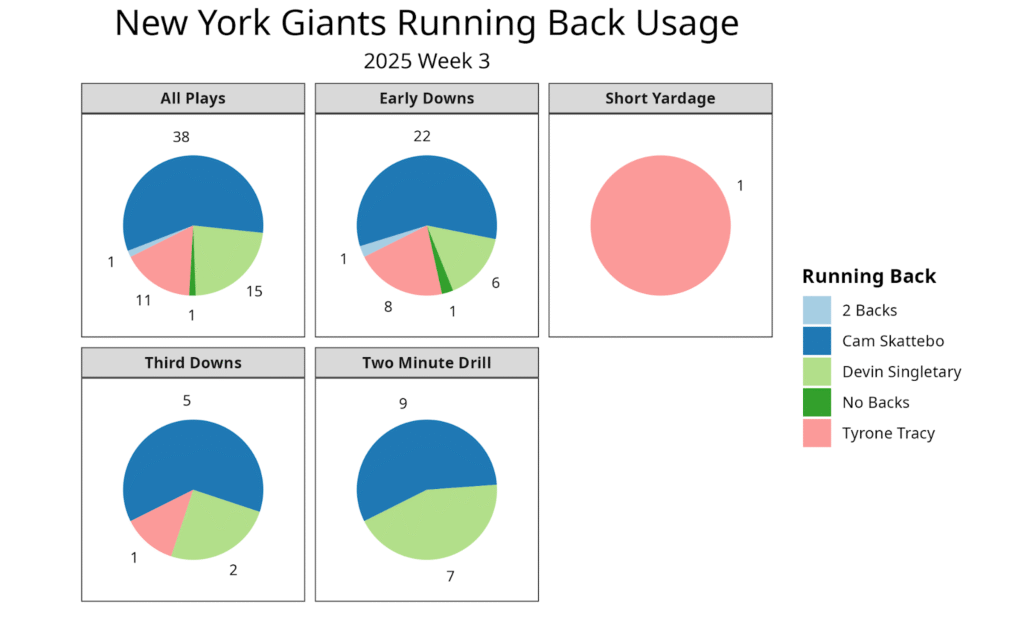
Monitor Tyrone Tracy Jr.’s health: Tracy suffered a shoulder injury on the Giants' second drive and didn’t return.
Tracy played 73.5% of snaps in Week 1, but his role dropped to 41.8% in Week 2 as Cam Skattebo began to emerge. Despite reports that the Giants wanted to expand Skattebo’s role, Tracy opened Week 3 by taking 11 of the team’s first 15 snaps, totaling 29 rushing yards and two catches for 7 yards. However, Skattebo took over the backfield afterward and was again the more effective player, rushing efficiently and adding six receptions for 61 yards.
If Tracy misses time, Skattebo is a borderline fantasy starter. Even if Tracy plays, Skattebo appears on track to take over the lead role and should be considered for lineups depending on matchup strength.
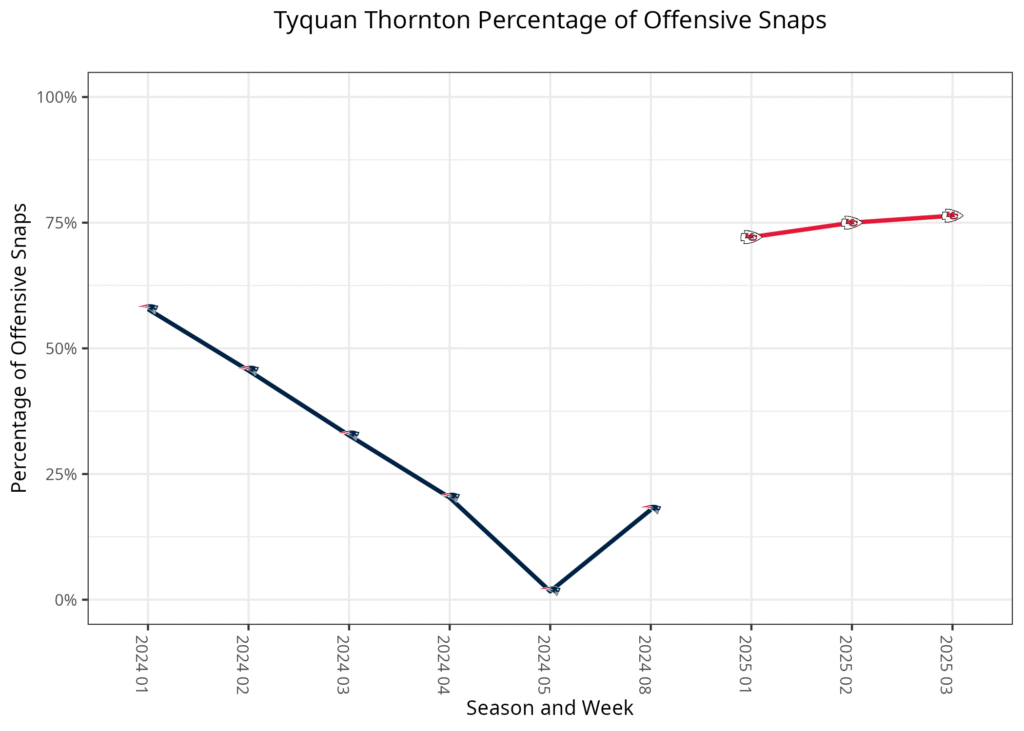
Tyquan Thornton leads the Chiefs' wide receiver room: Thornton caught five passes for 71 yards and a touchdown.
The Chiefs were once again without their top two receivers in Week 3, with Rashee Rice serving the third game of his six-game suspension and Xavier Worthy inactive due to a shoulder injury. As a result, Hollywood Brown operated primarily from the slot, while Tyquan Thornton and JuJu Smith-Schuster lined up outside.
Kansas City’s expected top trio appears to be Rice (slot), with Worthy and Brown on the perimeter. While Brown has historically been used as a deep threat, he’s caught just one of eight deep targets over the past two seasons. Thornton, meanwhile, has already secured three of 11 deep targets this year for 120 yards.
Worthy is expected to return soon and will likely cut into Smith-Schuster’s snaps. Thornton may get a limited window—likely the next three games—to solidify a role as the team’s primary vertical option. Until we see how targets and snaps shake out with Worthy back, Thornton remains a risky fantasy play.
Miscellaneous notes
- New York had signed Xavier Gipson from the New York Jets two weeks ago, but opted to release him on Saturday.
- Jalen Royals was questionable with a knee injury. He missed the first two weeks of the season. He was ultimately active but didn’t play on offense.
- Travis Kelce has been held to four receptions or fewer in five consecutive games, including last season’s playoffs. However, it’s worth noting Kelce also had a slow start last season, tallying eight receptions for 69 yards over his first three games.
- Giants returner Gunner Olszewski was questionable with a back injury.
Table notes
- Snaps include plays called back due to penalties, including offensive holding or defensive pass interference. The other three stats have these plays removed.
- Targets may differ from official NFL sources. The most likely discrepancy would be from a clear thrown-away pass, where the NFL may give the target to the nearest receiver, while this data will not.
- Carries are only on designed plays. Quarterback scrambles won’t count for the total number of carries in the game.

 © 2026 PFF - all rights reserved.