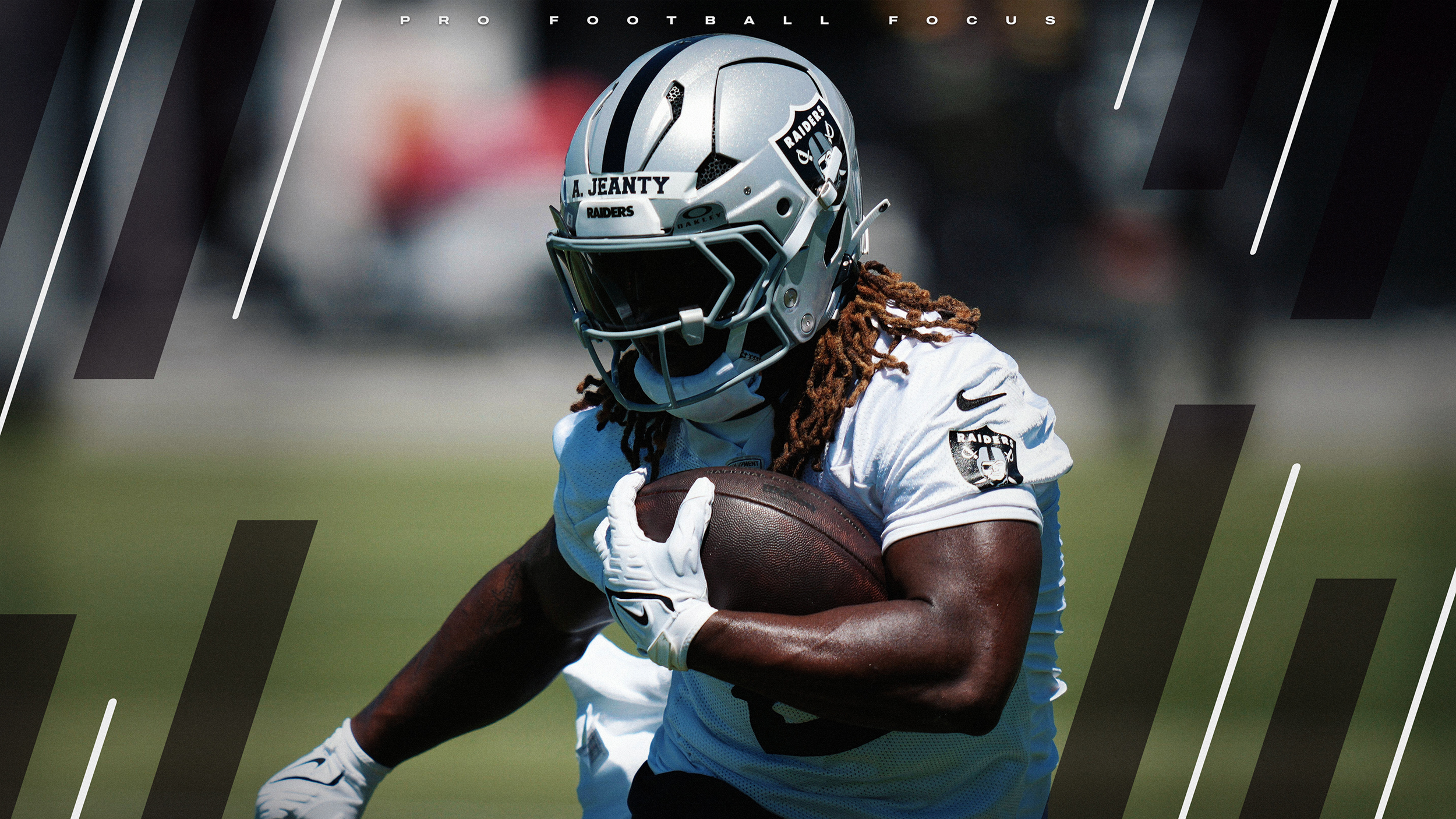
- Ashton Jeanty has a legitimate shot to finish as RB1 in his rookie year: Jeanty's talent and opportunity in Year 1 are an ideal combination to project for an RB1 season.
- The 2023 rookie draft class takes over the top two spots: Bijan Robinson and Jahmyr Gibbs have been all they were cracked up to be heading into the NFL through two seasons, and more of the same is expected in 2025.
- Subscribe to PFF+: It’s quick and easy. You’ll unlock industry-leading rankings, unlimited Fantasy Mock Draft Simulator use, PFF's Live Draft Assistant and our weekly Start/Sit Optimizer. It’s time to win.
Estimated Reading Time: 5 minutes

Breaking fantasy football rankings down into tiers helps fantasy managers better understand what separates each group and how to value each player at the position for this coming season.
TIER 1: The Fantastic Four
| RANK | PLAYER | TEAM |
| 1 | Bijan Robinson | ATL |
| 2 | Jahmyr Gibbs | DET |
| 3 | Saquon Barkley | PHI |
| 4 | Ashton Jeanty | LV |
This top tier at the position consists of four players expected to perform at an elite level on the best workloads in the league for their positions.
Bijan Robinson leads the way heading into this season after finishing as the overall RB3 in 2024, and there are plenty of reasons for optimism that he can not only repeat but exceed those expectations in 2025. Starting with his overall workload, Robinson operated as the clear top option in the run game for Atlanta, seeing ideal opportunities on early downs, passing downs, two-minute drills and around the goal line. This resulted in an elite 21.3 opportunities (carries plus targets) per game while delivering top-five grades for his position both as a runner and a receiver. The expectation shouldn’t be any lower for Robinson in 2025, which should have him in contention as the top fantasy player at his position.
Read More: ADP Battle: Saquon Barkley versus Bijan Robinson
While Saquon Barkley was the RB1 in 2024, there’s reason to expect at least some regression in 2025, which puts his overall expectation for fantasy finish slightly lower than last season, though not too much, as he should still be very good. Barkley's potential to repeat a 2,000-rushing-yard season would be an achievement never before done in NFL history. When considering his competition for rushing touchdowns around the goal line (Jalen Hurts), it’s only fair to slightly lower expectations for him heading into 2025. He remains in this top tier because he still performs at a high level and his overall workload should be among the best in the league after leading the position with 24.0 opportunities per game last season.
Jahmyr Gibbs is firmly in the overall RB1 conversation after continuously making the most of his opportunities as one of the league’s most efficient running backs. Gibbs, without David Montgomery last season, delivered at an elite pace, ranking as the overall RB1 in the three games that Montgomery missed at the end of last season. Expecting a larger workload for Gibbs as he’s proven to be more effective than Montgomery in key situations that Montgomery previously dominated (short yardage, goal-to-go) is a big part of his RB2 ranking heading into 2025.
The expectations that Ashton Jeanty brings with him coming out of the 2025 NFL Draft are nothing short of this RB4 overall ranking after being the clear 1.01 in rookie drafts. Even landing on a below-average offense like the Las Vegas Raiders, nothing is standing in Jeanty’s way of performing at an elite level with as ideal of a workload out of the backfield as any player is set up for heading into 2025. As one of the best running back prospects in recent years, there aren’t any concerning weaknesses in Jeanty’s game to say that he can’t continue to operate at a top-tier level even in the NFL, immediately thrusting him into this RB1 conversation.
Read More: ADP Battle: Jahmyr Gibbs versus Ashton Jeanty
TIER 2: The veterans and youth with overall RB1 upside
| RANK | PLAYER | TEAM |
| 5 | De'Von Achane | MIA |
| 6 | Bucky Irving | TB |
| 7 | Christian McCaffrey | SF |
| 8 | Derrick Henry | BLT |
This tier presents fantasy drafters with a couple of different options depending on how they want to approach the position. There are the established veterans with a history of elite production, like Derrick Henry or Christian McCaffrey. And for those who might want to avoid possible decline from those backs and target youth and upside, Bucky Irving and De’Von Achane are the best young options going outside the top tier.
Achane arguably offers more upside than any other player at his position as a receiver. He’s coming off a season where he led the position in receiver alignment snaps (178) — 120 in the slot and 58 out wide. Following the Jonnu Smith trade, Achane’s potential to improve on his receiving usage in 2025 has only increased to the point where he is a great bet to lead all running backs in targets this season after finishing just behind Alvin Kamara last year.
Achane paced the position in receiving yards (592) and tied for the league lead in receiving touchdowns (six) in 2024, and he could widen the gap in that regard this season. If Miami’s offense can bounce back, then Achane will be a prime beneficiary.
Read More: ADP Battle: Christian McCaffrey versus Derrick Henry
McCaffrey still offers elite upside if he’s able to get healthy and resume his high-end workload that allowed him to finish no worse than the overall RB2 four times in his NFL career. However, that question of health becomes greater as he gets older and the team might want to scale back that workload to ensure he’s healthy for a playoff run as well. Still, a healthy McCaffrey's upside offers an ideal fantasy profile that would allow him to push for weekly RB1 finishes consistently as long as he’s in the lineup. Even with a lighter workload coming off injury, there’s room for McCaffrey to compile a ton of carries and targets in Kyle Shanahan’s offense and keep him firmly in RB1 territory.
Bucky Irving joins the RB1 conversation with the expectation that he takes on a larger workload in Year 2 and continues to play as well as he did as a rookie, if not better. Irving owned a top-10 rushing grade for his position last season as he took over the Tampa Bay Buccaneers backfield and increased his opportunities per game from 11.9 through the first nine weeks of the season to 18.9 in the latter half. Even as a smaller back, that usage translated to his work around the goal line, where he took 20 carries on the year and converted eight rushing touchdowns in those situations. Projecting Irving’s workload from the second half of last season across all of 2025 should result in his best fantasy season so far as a legitimate RB1 contender.
TIER 3: High-end workloads to consider for RB1
| RANK | PLAYER | TEAM |
| 9 | Kyren Williams | LA |
| 10 | Josh Jacobs | GB |
| 11 | Kenneth Walker III | SEA |
| 12 | Jonathan Taylor | IND |
Each of the backs in this tier averaged no worse than 18.6 opportunities per game last season (Walker), while the other three all average more than 20 per game. Heading into 2025, expectations shouldn’t vary too much for this group and allow them to push for RB1 production.
With Kenneth Walker, specifically, he missed time in 2024 due to injury but that didn’t stop him from delivering a career year in terms of PFF rushing grade (91.3) – the fourth-best mark – as well as a new career high in missed tackles forced per attempt (0.40), the best mark in the league (min. 40 carries). Walker also took on a much larger role as a receiver last season, which he had previously ceded to Zach Charbonnet in 2023, resulting in a career high in total targets (52) as well. With Walker healthy and firmly atop the Seattle Seahawks depth chart, including on passing downs, he has the opportunity to push for his first-ever top-12 fantasy finish.
Jonathan Taylor comes in ranked lower than the consensus, as the concerns with his injury history remain a constant concern. Taylor has finished outside of the top-12 fantasy running backs in each of the past three seasons since finishing as the overall RB1 in 2021, in large part due to missed time. Even coming off a 300-plus-carry season in 2024, many of Taylor’s rushing metrics hit career lows, including rushing grade (64.1), yards after contact per attempt (2.68) and missed tackles forced per attempt (0.12). Taylor still has a chance to push for RB1 thanks to his workload and lesser competition out of the backfield, but the risk of injury and below-average play have tempered RB1 expectations for 2025.
TIER 4: RB2 territory
| RANK | PLAYER | TEAM |
| 13 | Omarion Hampton | LAC |
| 14 | Chase Brown | CIN |
| 15 | James Cook | BUF |
| 16 | Alvin Kamara | NO |
| 17 | Chuba Hubbard | CAR |
| 18 | RJ Harvey | DEN |
| 19 | James Conner | ARZ |
| 20 | D'Andre Swift | CHI |
| 21 | Isiah Pacheco | KC |
| 22 | TreVeyon Henderson | NE |
| 23 | Tony Pollard | TEN |
| 24 | Aaron Jones | MIN |
Several strong options at running back within this tier can potentially operate as a fantasy manager’s RB1 if they were waiting on the position and are no worse than reliable starting options as the best RB2 candidates this season.
Omarion Hampton holds the potential to deliver an RB1 season as a rookie as the lead back in Greg Roman’s offense. The Chargers are primed to be a run-heavy offense in 2025 after ranking in the top 10 in run rate last season. They could even run the ball at a higher rate.
With Najee Harris dealing with an eye injury and his availability for the start of the season in question, Hampton will open the campaign with a stranglehold on the backfield. If he’s able to deliver on his first-round investment, he won’t give up that workhorse role easily once Harris is healthy.
Read More: ADP Battle: Breece Hall versus James Cook
The Chicago Bears are set up to find high-end success in the run game with significant upgrades along the offensive line and Ben Johnson taking over as head coach. As a result, the Bears were expected to address the running back position early in the NFL draft, though they waited until the seventh round to select their first back, making D’Andre Swift one of the biggest veteran winners coming out of the NFL draft. Swift has experience as a high-volume runner these past two seasons, and while he has not been the most efficient back, he’s still the favorite to lead the backfield in Chicago this season, which should allow him to operate as a weekly fantasy starter as long as that’s the case.
Breece Hall’s lower ranking is fueled by concerns of a more shared workload as this new coaching staff comes in looking to maximize the potential out of this backfield. Hall has not quite been able to bounce back to his pre-injury rookie form, and that includes this past season, where he delivered just a 68.7 rushing grade on the year. With Braelon Allen looking better on his limited opportunities as a rookie, it would not be a surprise to see this former Detroit Lions coaching staff show similar tendencies to the Gibbs and Montgomery deployment of these past two seasons. With Allen being a more effective runner overall last year and in goal-to-go and short-yardage situations, Hall losing out on those touches could ultimately limit his RB1 potential.
TIER 5: Starting running back candidates with tempered expectations
| RANK | PLAYER | TEAM |
| 25 | Jacory Croskey-Merritt | WAS |
| 26 | David Montgomery | DET |
| 27 | Jaylen Warren | PIT |
| 28 | Kaleb Johnson | PIT |
| 29 | Rhamondre Stevenson | NE |
| 30 | Travis Etienne Jr. | JAX |
| 31 | Jordan Mason | MIN |
| 32 | Breece Hall | NYJ |
| 33 | Cam Skattebo | NYG |
| 34 | Tyrone Tracy | NYG |
| 35 | J.K. Dobbins | DEN |
| 36 | Javonte Williams | DAL |
Each of the backs within this tier has a legitimate shot to lead their respective team’s backfield in touches, though not necessarily at a high enough rate to push them into weekly RB1-2 territory.
Seventh-round rookie Jacory Croskey-Merritt showcased strong play this offseason and made Brian Robinson expendable in Washington, opening up a significant opportunity in Year 1. Croskey-Merritt will still likely compete with Chris Rodriguez Jr. for early-down work, but the expectation will be that the rookie earns a larger snap share if he continues to excel. He is a great sleeper target, and one who should be available at no worse than an RB3 price tag.
Concerns about a potential shared workload with a new coaching staff are fueling Breece Hall’s lower ranking. Hall has not quite been able to bounce back to his pre-injury rookie form, and that includes this past season, when he delivered just a 68.7 PFF rushing grade. With Braelon Allen looking better on his limited opportunities as a rookie, it would not be a surprise to see this former Detroit Lions coaching staff show similar tendencies to how it deployed Jahmyr Gibbs and David Montgomery over the past two seasons. Allen was a more effective runner last year overall and in goal-to-go and short-yardage situations. If Hall loses out on those touches, it could ultimately limit his RB1 potential.
The Pittsburgh Steelers offer an intriguing duo for fantasy, as they are expected to be one of the more run-heavy offenses in the league, so one of either Jaylen Warren or Kaleb Johnson emerging with the bulk of the carries could result in a much better fantasy season than this ranking would suggest. However, it’s looking more likely that there will be a split between the two, while Warren earns more looks on passing downs, which ultimately served as the tie-breaker between the two. With Aaron Rodgers stepping in at quarterback, this is significant as he has typically been among the league leaders in running back targets, including his past two full seasons where he’s ranked no worse than fourth in that regard, which would allow for a boost in Warren’s value should that continue to hold true.
The New England Patriots present a similar situation with a rookie running back and an established veteran who may have to share time, though in this case, the opportunity for early-down carries being in Rhamondre Stevenson’s favor gives him the likely edge over TreVeyon Henderson in 2025. In an offense run by Josh McDaniels, which has primarily split work on early downs and passing downs between two backs, Stevenson is in a better position to touch the ball, especially around the goal line, which he’s led the team in each of the past three seasons. Even with Henderson's second-round capital, there’s also a four-year contract investment in Stevenson to contend with that isn’t likely to relegate him to a small role in 2025.
TIER 6: Backups with a path to snaps
| RANK | PLAYER | TEAM |
| 37 | Nick Chubb | HST |
| 38 | Braelon Allen | NYJ |
| 39 | Dylan Sampson | CLV |
| 40 | Zach Charbonnet | SEA |
| 41 | Quinshon Judkins | CLV |
| 42 | Joe Mixon | HST |
| 43 | Tank Bigsby | JAX |
| 44 | Bhayshul Tuten | JAX |
| 45 | Trey Benson | ARZ |
| 46 | Rico Dowdle | CAR |
| 47 | Austin Ekeler | WAS |
| 48 | Chris Rodriguez Jr. | WAS |
| 49 | Tyler Allgeier | ATL |
| 50 | Rachaad White | TB |
| 51 | Brian Robinson | SF |
| 52 | Najee Harris | LAC |
| 53 | Dameon Pierce | HST |
| 54 | Ray Davis | BUF |
| 55 | Blake Corum | LA |
| 56 | MarShawn Lloyd | GB |
| 57 | Kendre Miller | NO |
| 58 | Tahj Brooks | CIN |
| 59 | Kareem Hunt | KC |
| 60 | DJ Giddens | IND |
| 61 | Ollie Gordon II | MIA |
| 62 | Isaiah Davis | NYJ |
| 63 | Jerome Ford | CLV |
| 64 | Tyjae Spears | TEN |
None of the running backs within this tier are expected to be year-long starters or Week 1 starters, but they act as handcuffs to our clear starters. Some also have the potential to take over as the top back in certain situations for their respective teams but not enough of a role that they’ll be in weekly starter conversations.
Injury concerns have dropped Joe Mixon far down the rankings. He’ll miss at least the first four weeks of the season, and potentially more. As a result, Nick Chubb becomes a more valuable option to start the year, though it’s not a guarantee that he will perform like his former self or hold the Texans‘ RB1 role all season long — both due to Mixon’s potential return and Chubb’s worrying ineffectiveness last season coming off a major injury. He’ll still be worth drafting late due to potential volume in the early portion of the year.
Braelon Allen’s sleeper potential is based on his opportunity to take on more early-down and short-yardage work from Breece Hall. The Jets‘ new coaching staff will likely carry over its backfield philosophy from Detroit, where David Montgomery operated mostly on early downs and Jahmyr Gibbs largely handled the passing-down duties. If Allen can cement himself into that early-down and short-yardage role by playing as well as he did as a rookie, he’s a great bet to outperform his current draft stock and back up this higher ranking.
Bhayshul Tuten is an intriguing rookie in this range as a new regime takes over in Jacksonville, where Travis Etienne and Tank Bigsby weren’t overly effective last season, though Bigsby was at least better than Etienne. However, this new regime spent an early Day 3 pick on Tuten, who comes out of college with a strong profile for the position, which includes a 93.3 career rushing grade and 0.36 career forced missed tackles per attempt. After Liam Coen made a star out of fourth-rounder Bucky Irving last season, there is reason for optimism that he can find similar success with Tuten in Jacksonville.
TIER 7: Active on gameday but with limited opportunities
| RANK | PLAYER | TEAM |
| 65 | Miles Sanders | DAL |
| 66 | Jaydon Blue | DAL |
| 67 | Keaton Mitchell | BLT |
| 68 | Will Shipley | PHI |
| 69 | Raheem Mostert | LV |
| 70 | Justice Hill | BLT |
| 71 | Jaylen Wright | MIA |
| 72 | Devin Singletary | NYG |
| 73 | Kyle Monangai | CHI |
| 74 | Roschon Johnson | CHI |
| 75 | AJ Dillon | PHI |
| 76 | Sean Tucker | TB |
| 77 | Woody Marks | HST |
| 78 | Devin Neal | NO |
| 79 | Jaleel McLaughlin | DEN |
| 80 | Jarquez Hunter | LAR |
| 81 | Antonio Gibson | NE |
| 82 | Isaac Guerendo | SF |
| 83 | Elijah Mitchell | KC |
| 84 | Ty Johnson | BUF |
| 85 | Pierre Strong Jr. | CLV |

 © 2026 PFF - all rights reserved.