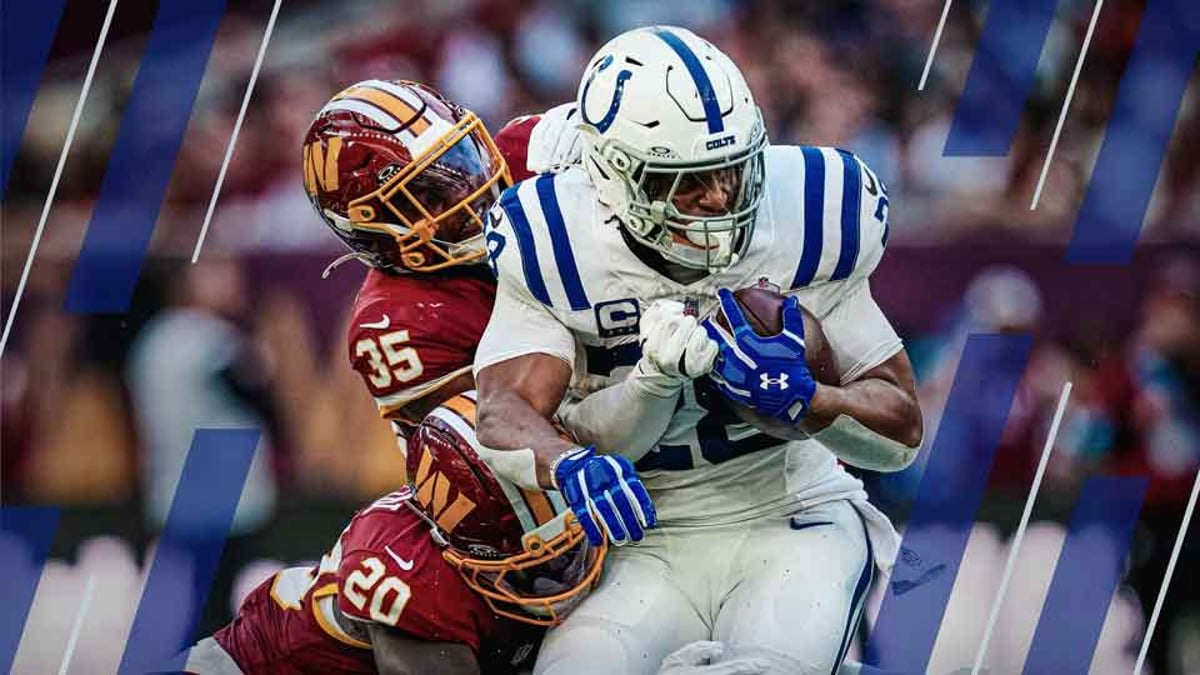
- The Washington Commanders and Indianapolis Colts adjust to wide receiver injuries: Terry McLaurin and Keenan Allen were inactive, forcing receivers further down the depth chart to step up.
- Austin Ekeler returns for Washington: With Rachaad White out injured, Ekeler became Washington's leading rusher despite being on the team for less than a week.
- PFF+ is now just $9.99 a month, down from $24.99: That's 60% off the old monthly price for the same subscription, including premium articles and analysis, fantasy football tools, NFL and College grades, betting tools, access to the mock draft simulator and Guru AI football chatbot insights. Click here to subscribe.

PFF's fantasy football recap focuses on player usage and stats, breaking down the key information you need to achieve fantasy success in 2026.
For fantasy players looking for additional data and tools, PFF+ provides access to fantasy and betting resources, the Mock Draft Simulator and more for $9.99 per month or $99.99 per year. Those who want to dive even deeper can sign up for PFF Pro, which comes with an upgraded Premium Stats Pro experience, revamped player and team pages, enhanced data and visualizations and programmatic data access for modeling.
Indianapolis Colts @ Washington Commanders
Commanders adjust without Rachaad White: Washington’s receiving back was inactive with a shoulder injury.
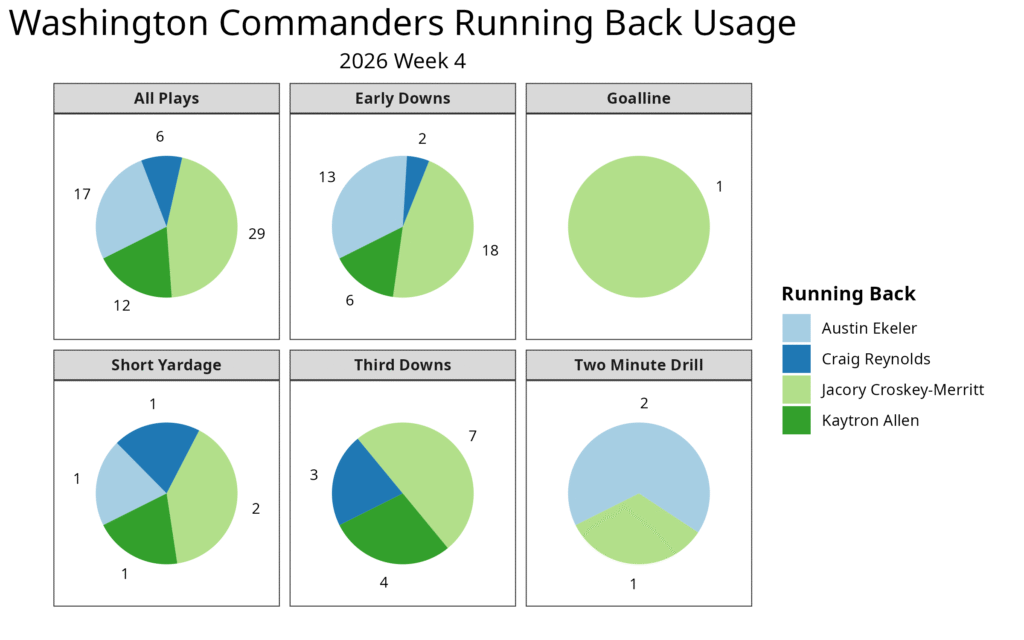
The Commanders have used a traditional two-man rotation to start the season, with Jacory Croskey-Merritt handling most of the early-down work and White playing primarily on passing downs. The two have split short-yardage opportunities, although White has dominated the goal-line work. Kaytron Allen has been the only other running back to get playing time this season, but he has logged just 13 snaps.
White didn’t practice all week because of a shoulder injury, prompting Washington to bring back Austin Ekeler, who served as the team’s receiving back last season before suffering a torn Achilles. The Commanders also elevated Craig Reynolds from the practice squad, leaving all four healthy running backs active for this game.
Croskey-Merritt's initial usage was extremely promising. He played nine of the first 10 snaps and handled all three third-down snaps across Washington’s first two drives. That suggested a feature role, which would make him a must-start option as long as White remained sidelined.
That didn’t last. Croskey-Merritt was ineffective as a runner, and the rotation became much more chaotic for the remainder of the first half as Washington moved away from its typical early-down/passing-down split. Ekeler operated as the primary back at times, while Reynolds also mixed in.
Washington settled into a clearer rotation in the second half, with Croskey-Merritt and Ekeler splitting early-down snaps. Croskey-Merritt, Allen and Reynolds all saw opportunities on third downs.
This performance makes Croskey-Merritt much harder to trust going forward. Ekeler becomes a waiver-wire target, as he could emerge as Washington’s top running back option. The second-half rotation also suggests the Commanders could use a three-man backfield even after White returns, with Croskey-Merritt and Ekeler handling early-down work and White taking most of the passing-down snaps.
It’s also bad news for Allen. He appeared to be one injury away from a significant role, but both Ekeler and Reynolds played ahead of him with White sidelined. That makes it difficult to envision Allen holding meaningful fantasy value anytime soon.
Commanders turn to a four-man wide receiver rotation: Washington needed to adjust without its top wide receiver, Terry McLaurin.
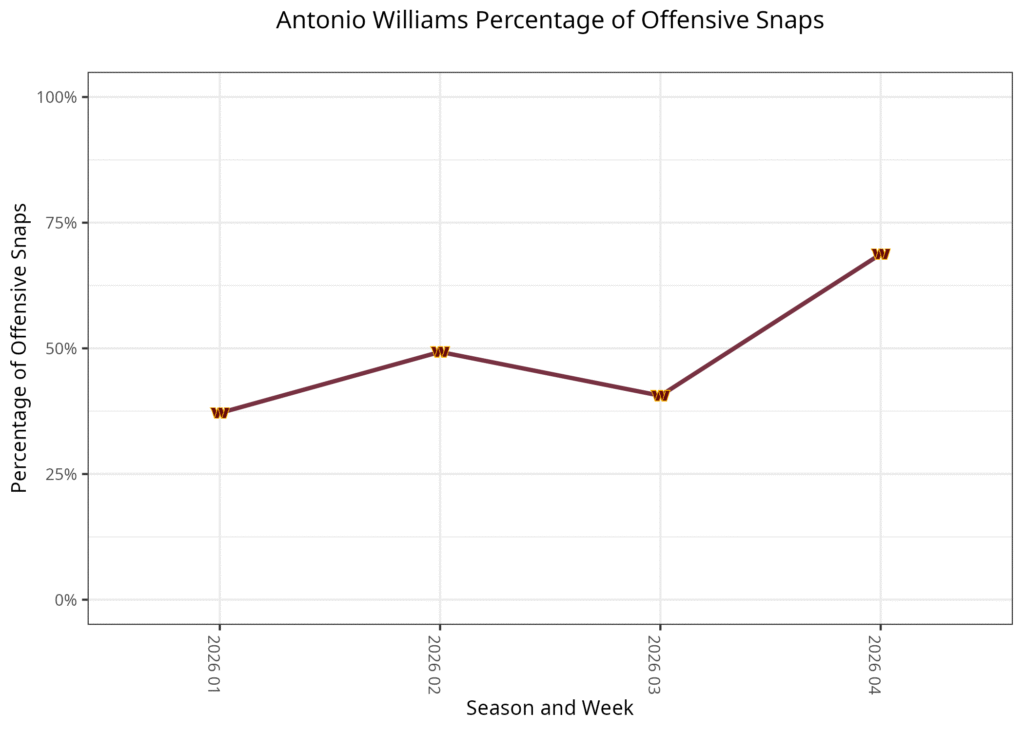
McLaurin has been Washington’s clear leader at wide receiver in terms of playing time this season, although he has played only 77.6% of the Commanders’ offensive snaps. Stefon Diggs, Dyami Brown and Antonio Williams have each played between 40% and 60% of the snaps, while Treylon Burks and Jaylin Lane have also mixed in. Burks’ role has increased as the season has progressed. McLaurin was officially questionable for this game with a hamstring injury but ultimately did not play.
Without McLaurin, Washington leaned on a four-man rotation of Diggs, Brown, Williams and Burks. Brown and Burks were the most likely receivers to play in 12 personnel, while Diggs and Williams were consistently joined by one of the two in 11 personnel. Based on where he lined up, Brown served as the most direct replacement for McLaurin.
None of the wide receivers had particularly strong games with Washington down to its third-string quarterback, although Diggs emerged as Athan Kaliakmanis’ favorite target. Kaliakmanis connected on a few nice deep throws later in the game, leading to big catches by Brown and Burks.
Ultimately, this level of rotation — even with Washington’s top wide receiver sidelined — makes it difficult for any member of the group to develop consistent fantasy value.
Chig Okonkwo returns to Washington: The Commanders’ newest tight end returned to the role he held early in Week 1, at least for the first half.
Washington signed Chig Okonkwo in free agency this offseason. He was the Commanders’ clear lead tight end in Week 1, playing 39 of 48 snaps over the first 10 drives before suffering a hamstring injury that sidelined him for the next two weeks. He ran a route on 85% of Washington’s pass plays over those drives, an elite rate for a tight end. Last season, Trey McBride and Sam LaPorta were the only tight ends to exceed an 85% route participation rate. Okonkwo was limited in practice all week but entered the game without an injury designation.
Okonkwo returned to a significant role, playing in most 11 personnel situations as well as 13 personnel. Washington used 13 personnel frequently early in the game, typically with Okonkwo functioning as the second receiving option. Most of his time off the field came in 12 personnel on running plays.
He ran a route on 14 of 17 first-half pass plays, another excellent participation rate for a tight end. His playing time declined in the second half, with John Bates seeing more work, particularly as a pass blocker. Washington may simply have wanted additional help in pass protection, although it’s also possible Okonkwo wasn’t quite 100% in his first game back.
Okonkwo didn’t produce much statistically, but the circumstances weren’t particularly favorable. Washington was down to its third-string quarterback and didn’t fall behind until later in the game, which allowed the offense to stay relatively committed to the run.
The route participation is far more encouraging for his fantasy outlook. Okonkwo is worth targeting on the waiver wire, especially if Jayden Daniels or Marcus Mariota eventually return at quarterback. If the route participation he showed early in Week 1 and again in the first half of this game carries over to full games, he could become a useful fantasy option.
Colts adjust down multiple wide receivers: Two of Indianapolis’ top three receivers from the start of the season were unavailable.
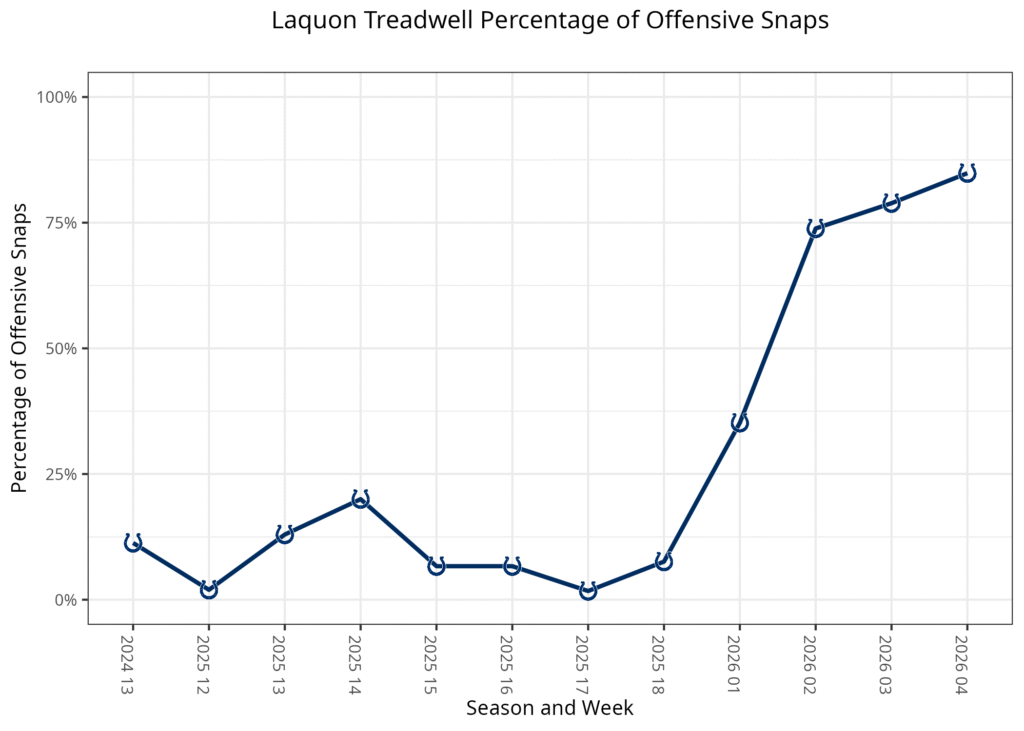
The Colts opened the season with Alec Pierce as their X receiver and Josh Downs playing Z in 12 personnel before moving into the slot in 11 personnel. Keenan Allen has primarily played Z in 11 personnel. Pierce is currently on injured reserve, allowing Laquon Treadwell to take over at X. Allen also got an expanded role last week, which initially looked promising for his fantasy value, but he suffered a groin injury mid-week and was inactive for this game.
Indianapolis had several options to replace Allen. The Colts recently signed Darius Slayton, while Ashton Dulin returned after missing two games with an ankle injury. Younger receivers Deion Burks and Anthony Gould were also active, along with practice squad call-up Nick Westbrook-Ikhine. Slayton, however, was a healthy inactive for the second straight week.
Dulin stepped into Allen’s role as the Colts’ primary Z receiver in 11 personnel. Burks backed up both Downs and Dulin, while Westbrook-Ikhine was primarily used as the lone wide receiver in short-yardage packages featuring either three tight ends or two tight ends and a sixth offensive lineman.
Dulin’s usage is particularly noteworthy because Allen could face a suspension at some point this season following his drunk-driving arrest earlier in the year. That could give Dulin some fantasy value in deeper leagues. Still, it’s difficult to get excited about any Indianapolis receiver outside of Downs until Slayton gets into the lineup and we see how the Colts intend to use him.
Miscellaneous Notes
- Jayden Daniels missed his second straight game with a left elbow injury, leaving Marcus Mariota to start. Mariota then suffered a knee injury midway through the first quarter, forcing Washington to turn to seventh-round rookie Athan Kaliakmanis for the remainder of the game. Mariota was officially ruled out at halftime.
- Commanders wide receiver Luke McCaffrey was a healthy inactive. He has appeared in only one game this season, playing exclusively on special teams in Week 3.
- Backup wide receiver Jaylin Lane suffered an ankle injury on a return and was carted off before quickly being ruled out. If the injury is as serious as it appeared, Lane could miss significant time, and McCaffrey could move up the depth chart in his absence.
- The Colts continued to dress only two running backs, with DJ Giddens again a healthy inactive.
- Backup running back Seth McGowan received more playing time than usual. He has typically mixed in early in the second quarter, but this week, he handled the entire drive to open the period.
Tennessee Titans @ Baltimore Ravens
Ravens' evolving wide receiver room: The Ravens had three wide receivers seeing notably more time than usual and another two with less.
Baltimore started the season with Zay Flowers and Rashod Bateman as its top two receivers, with Ja’Kobi Lane joining them in three receiver sets. That quickly unraveled with Lane landing on injured reserve after Week 1, and Flowers was out for Week 2 with a hamstring injury. Devontez Walker seemed to be the next man up, but he started the season dealing with an injury. This led Bateman, Chris Moore and LaJohntay Wester to be the primary receivers as Walker was eased in. Fourth-round rookie Elijah Sarratt was buried on the depth chart. Flowers was back last week, but was being eased into action.
Flowers had a larger role this week, playing 93.5% of snaps in 11 personnel. He was rotated out for a few plays in 12 personnel, with most of his time missed being in 13 personnel. This led Wester to barely have a role on offense. While every fantasy manager who had Flowers likely started him this week, he can safely be put back in fantasy starting lineups.
Moore couldn't play this week due to an ankle injury. He was limited in practice all week and was ruled questionable on Friday, but ultimately couldn’t go. This meant Walker was forced to move up to third on the depth chart, while Sarratt was active this week as the fourth receiver.
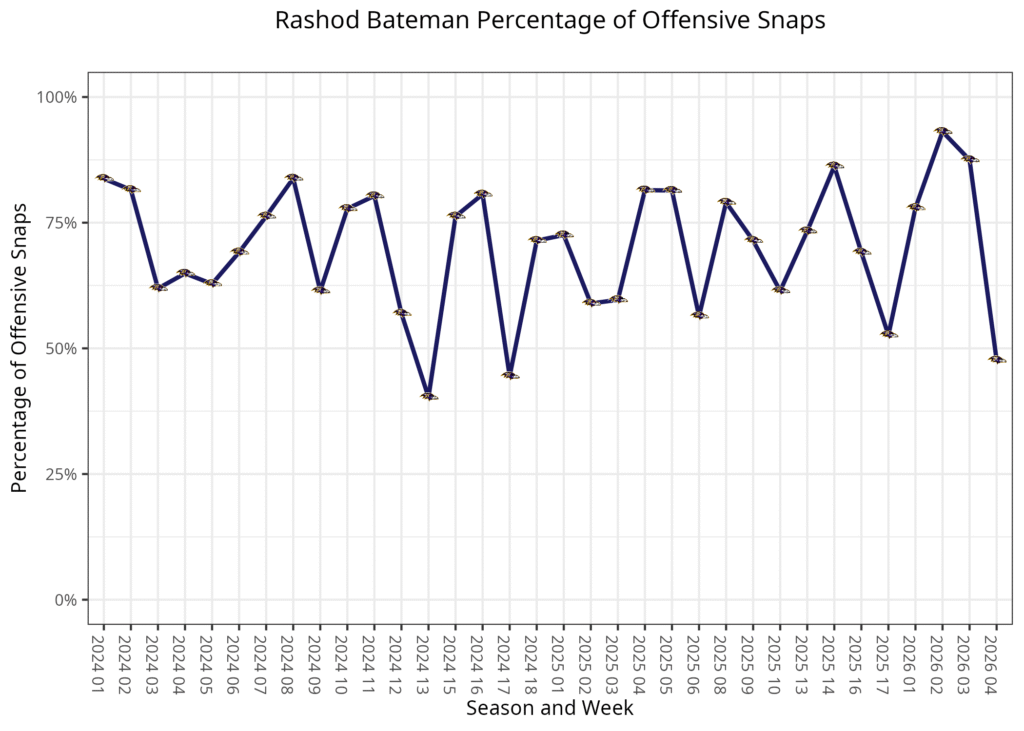
Surprisingly, Bateman’s role was reduced this week. Bateman had played 85.8% of snaps over the first three weeks, with 98.8% of snaps in 11 personnel and 83.9% in 12. Walker was ahead of Bateman in 11, 12 and 13 personnel, leading Bateman’s playing time to drop to 47.6%. Sarratt also rotated in significantly in 11 personnel. This makes Bateman a player to drop in most leagues where he is still rostered.
Ravens turn to their rookie tight ends: Matt Hibner and Josh Cuevas both received career highs in snap rate.
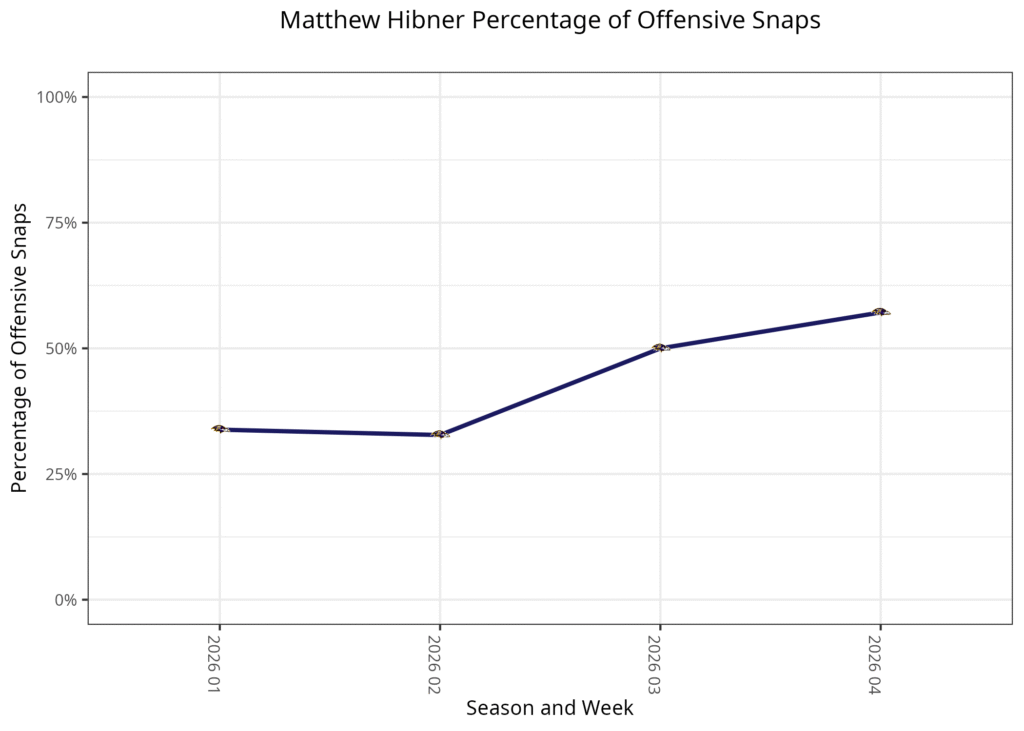
The Ravens lost Isaiah Likely and Charlie Kolar in free agency, leading them to draft Hibner and Cuevas and add Durham Smythe in free agency. During the first two weeks, Andrews played 71.4% of snaps, playing all of the third-down snaps, two-thirds of the 12 personnel snaps and over half of the 11 personnel snaps on early downs. Smythe was the backup, seeing 83.7% of 12 personnel snaps and a significant amount of 11 personnel on early downs. The Ravens ran 24 plays out of 13 personnel over the first two weeks, with Hibner taking all 24 of those snaps. Hibner and Cuevas received one snap each in 11 personnel over the first two weeks.
The Ravens had a notable shift last week. In 11 personnel on early downs, Hibner took eight snaps compared to seven by Mark Andrews and three each by Smythe and Cuevas. Andrews remained the clear tight end for third downs, but Cuevas was also rotated in more often in 12 and 13 personnel.
This week, the rookies became even more involved. Cuevas and Hibner combined for three of the seven snaps on third downs, which was a notable change compared to the first three weeks. Hibner’s playing time in 12 personnel jumped from 41.8% over the first three weeks to 84.2% this week, taking time away from both Andrews and Smythe. In all situations, Cuevas' playing time took minor leaps compared to his averages from the first three weeks, leading to a career-high 27.0% snap rate.
This probably isn’t enough to make either rookie fantasy-valuable yet, but it could be enough to ruin Andrews' fantasy value. His route participation rate remained steady this week, but if the rookies continue to trend in the right direction, then Andrews' playing time may dip below 50% sometime in the next month. Andrews scored a touchdown in this game, making him a potential sell-high option.
Gunnar Helm sees a reduced role: The Titans began rotating their tight ends more this week than in the first three.
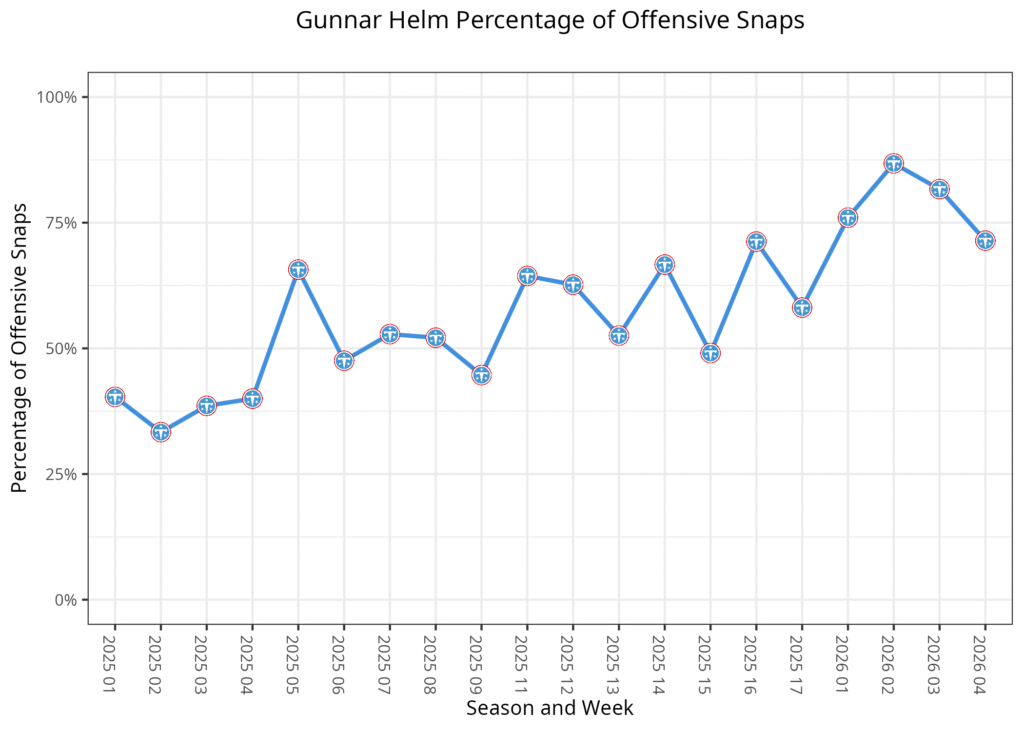
The Titans have primarily used Helm, followed by free-agent addition Daniel Bellinger at tight end this season. David Martin-Robinson has been their third tight end, but he has mostly played in 13 personnel. Helm had played over 80% of snaps in 11 personnel on both early downs and third downs over the first three weeks, giving Helm an 81.6% snap rate compared to 38.0% by Bellinger. Helm had ranked third on the team in route participation rate at 63.6%, behind Carnell Tate and Wan’Dale Robinson.
Helm hasn’t been all that productive at tight end, with three or fewer receptions each game and only 55 yards over three weeks. This led Bellinger to rotate in more this week than the last three. Helm played 61.5% of 11 personnel snaps on early downs and 66.7% on third downs. This yielded only one target, where he caught a five-yard pass.
While Helm was considered a sleeper option heading into the season, but he appears further away from breaking out than he did a month ago.
Miscellaneous Notes
- The Ravens had several players limited in practice early in the week but active, including quarterback Lamar Jackson (back), Zay Flowers (hamstring) and tight end Durham Smythe (heel).
- Lamar Jackson left the game at halftime with an ankle injury and didn’t return, leading to Tyler Huntley taking over for the rest of the game. He is believed to be day to day, and there was some talk of Jackson returning to the game.
- Titans running back Tyjae Spears didn't practice on Wednesday and was limited in practice on Thursday with an ankle injury. While he was listed as questionable, he was ultimately active.
- The Titans signed running back Michael Carter off their own practice squad on Tuesday, but he was a healthy inactive.
New England Patriots @ Buffalo Bills
Monitor DJ Moore’s health: Moore continues to deal with shoulder injuries, which cost him the second half of this game.
The Bills have generally used a four-man wide receiver rotation this season. Moore and Keon Coleman have been the primary players in 12 personnel, seeing roughly two-thirds of snaps, while Khalil Shakir and Joshua Palmer have played the other third. All four have been on the field for at least 50% of snaps in 11 personnel this season, with Shakir seeing a 98.4% rate and the other three rotating in the final two spots.
Moore missed some time in practice this week with a shoulder injury. Coleman (ankle) also didn't practice in full. This led to Buffalo continuing its rotation throughout the first half, with Shakir leading the wide receiver room in snaps despite mostly playing in 11 personnel. Moore left the game with 1:48 left in the second quarter, presumably due to the same shoulder that’s been hurting him.
This left all three remaining wide receivers with more playing time in the second half. The Bills mostly stayed in 11 personnel with the game script, leading all three to play at least 21 of the 26 snaps. Greg Dortch was the only other active wide receiver, and he played one offensive snap in the second half.
Coleman has shown some flashes this season, and he caught seven passes for 81 yards in this game. Five of his receptions gained at least five yards, and he gained 56 yards after the catch. He would be the waiver-wire target if Moore starts to miss some time. Even if Moore is back next week, Coleman is a fine speculative add.
Monitor Mack Hollins‘ health: The Patriots' dependable wide receiver left in the third quarter with a calf injury and didn’t return.
Hollins played 72.5% of snaps over the first three weeks, leading Patriots wide receivers. Romeo Doubs and DeMario Douglas have typically joined him in 11 personnel. The team used a significant rotation across from Hollins in 12 and 21 personnel, with Kyle Williams also mixing in. Efton Chism III also rotated in to 11 and 12 personnel at times, although he was primarily used in single-wide receiver sets.
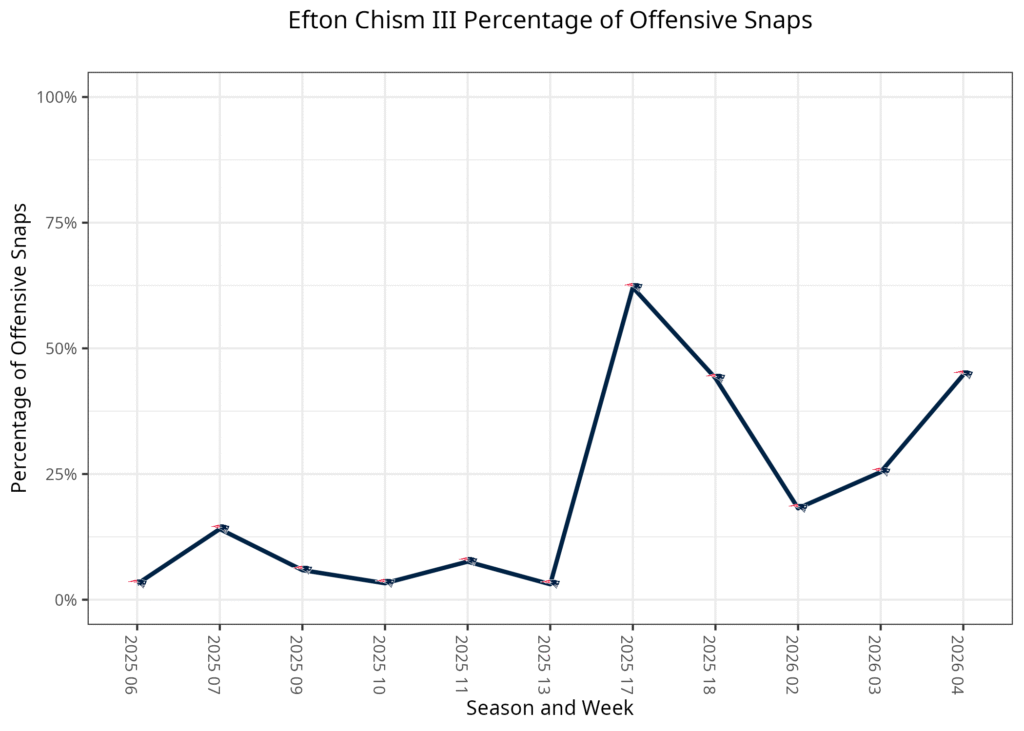
The rotation was largely the same in the first half of this game, although Chism notably played three of the six snaps in 12 personnel. His injury occurred at 10:14 mark of the third quarter. In his absence, Chism completely took over Hollins' role. Chism played 27 of a possible 40 snaps in the second half on snaps without Hollins, leading all Patriots wide receivers. Doubs, Douglas and Williams did not see a change in playing time due to Hollins' injury. This allowed Chism to score the game-winning touchdown for New England.
If we find out the Hollins injury is serious, Chism is a fine player to consider off the waiver wire. Hollins had been the second player in snaps for New England even early in Week 1 when A.J. Brown was healthy. Even though Brown will likely return in Week 6, Chism could maintain a significant role. Until we know more about the injury, Chism is fine to pick up in deeper leagues.
Eli Raridon returns for the Patriots: The third-round rookie tight end missed last week with a thigh injury.
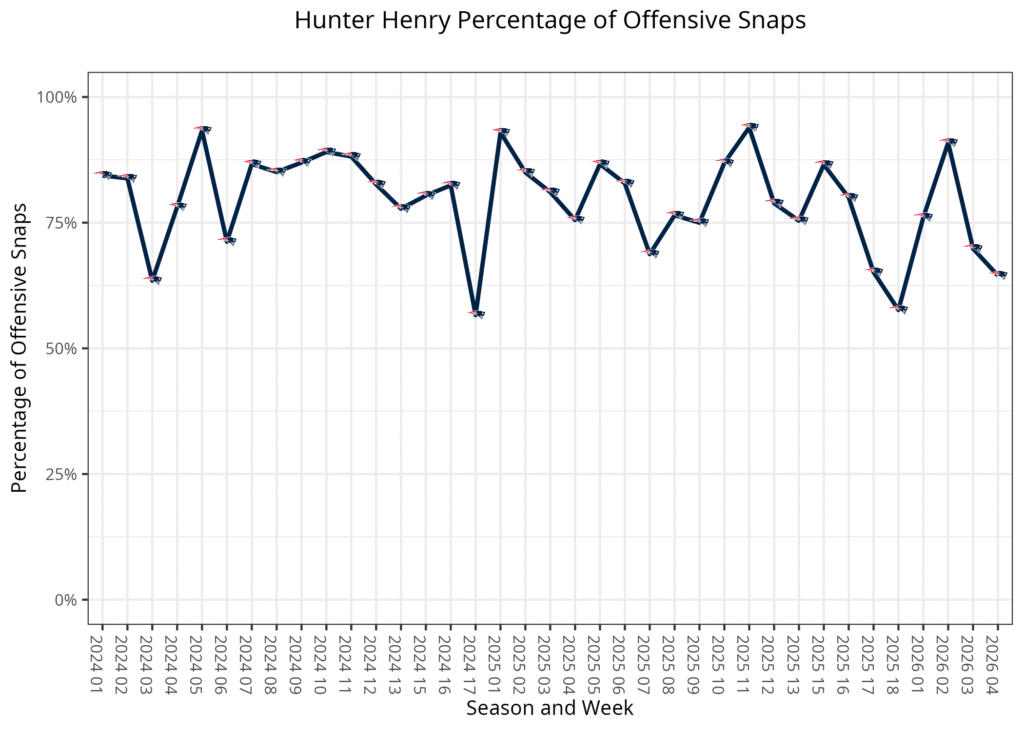
Raridon replaced Austin Hooper as the Patriots' backup tight end behind Hunter Henry this season. In Week 1, Henry only played 54.5% of early-down snaps out of 11 personnel, with the rest going to Raridon. Raridon suffered his thigh injury early in Week 2, leading him to be out in Week 3. Tanner Arkin was the No. 1 backup last week, followed by Cameron Latu.
This week, Raridon played 22 snaps in single-tight end sets on early downs compared to 19 by Henry. Henry still dominated 11 personnel snaps on third downs, giving Henry more fantasy value.
However, it’s notable Henry only has a 61.9% route participation rate in the two games where Raridon has stayed healthy compared to 68.3% in games where Raridon has mostly missed. Henry has been a borderline fantasy starting tight end, but this kind of dip in route participation rate could be the difference between rostering and not rostering Henry. This split will be worth monitoring going forward, as it’s possible Raridon will see more playing time as the season progresses.
Miscellaneous Notes
- Rhamondre Stevenson suffered a right knee injury with a minute left in the game. He walked off the field. Because the injury was so late in the game, it’s difficult to tell how serious the injury may be.
- Before Stevenson’s injury, the Patriots‘ running back rotation was very similar to last week, with the two splitting early-down situations. Stevenson dominated playing time on third downs, the two-minute drill, short-yardage and goal-line snaps.
- Buffalo running back James Cook played a season-low 59.3% of snaps. This was because the Bills were in clear passing situations for a higher percentage of plays than the first three games. He had played 26.7% of two-minute drill snaps over the first three weeks, but Ty Johnson took all of those snaps this week.
- Bills tight end Dalton Kincaid’s playing time by situation hasn’t changed much over the season, but the Bills ran more plays out of 11 personnel than usual because of the game script, leading to a decrease in playing time by all of their tight ends. His targets per route have decreased significantly, which is why his fantasy value has dropped off. Kincaid was at 30% or better during the first two weeks, but was only at 10% this week.
- Bills wide receiver Skyler Bell was a healthy inactive, his fourth straight absence.
New York Jets @ Chicago Bears
New York adjusts without Breece Hall: The Jets' usual lead running back was inactive with a quadriceps injury.
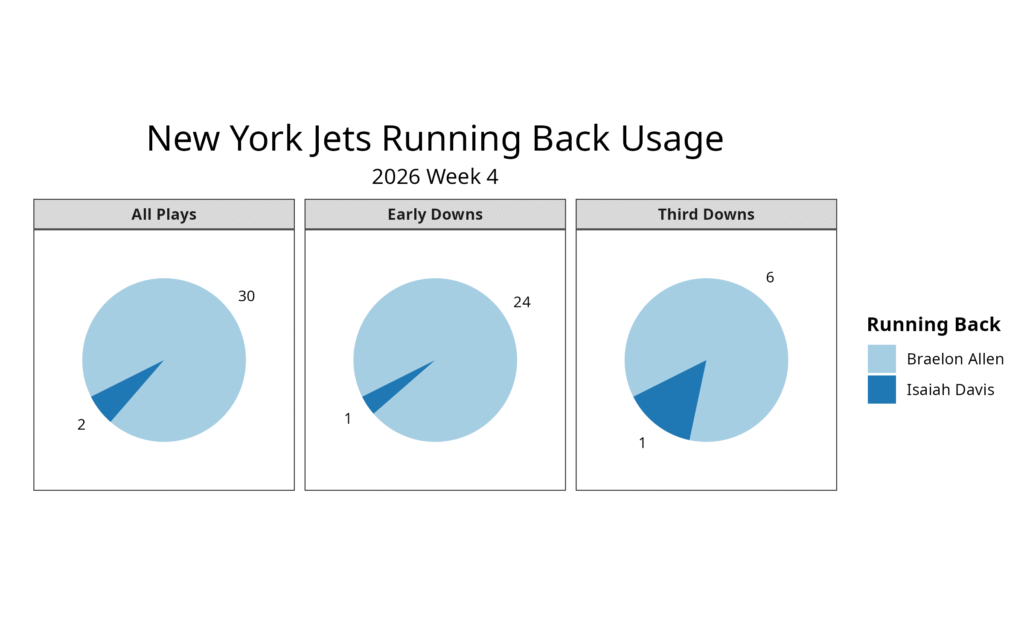
The Jets have only used two running backs this season, with Hall as their lead back and Braelon Allen as the backup and receiving back. Isaiah Davis was the backup last season but has only played on special teams over the first three weeks. Hall suffered a quad injury last week, leading him to miss this week, and he’s expected to be out for another two games.
Allen ended up playing 30 of a possible 32 snaps for the Jets. Chicago dominated time of possession, significantly impacting playing time for both teams. New York only had one drive lasting more than five plays, which was early in the third quarter. That possession was seven plays, and that was the drive where Davis took two snaps for Allen.
Allen took all 14 carries and caught two passes. While this wasn’t his best game, the usage was extremely promising and gives Allen a higher ceiling for the next few weeks than Hall had over the first three weeks. The Jets' matchup against the Cleveland Browns isn’t great, but Allen can be in fantasy starting lineups in Week 6 against the New England Patriots, and potentially Week 7 against the Miami Dolphins if Hall isn’t back yet.
Kenyon Sadiq’s playing time takes a step forward: The first-round rookie was held without a catch, but his usage was more promising than last week.
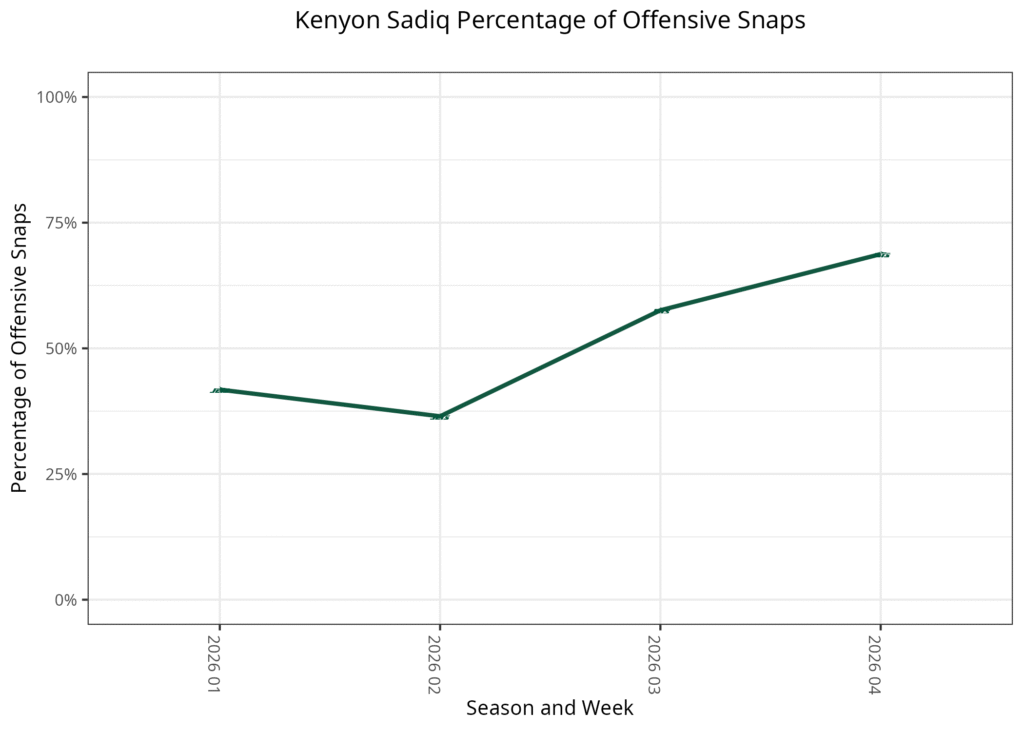
The Jets started the season with a four-man rotation at tight end between Sadiq, Mason Taylor, Jeremy Ruckert and Jelani Woods. Taylor was inactive last week with a thumb injury, allowing Sadiq to see more playing time. He took advantage of the opportunity, catching seven passes for 105 yards and a touchdown.
Taylor also missed this week, but the Jets' other tight ends weren’t 100%. Sadiq (back) and Ruckert (knee) were limited in practice all week. Despite this, Sadiq’s snap rate was up. On early downs, he played 63.6% of 11 personnel snaps, similar to last week. He only played half of the third-down snaps in 11 personnel. The big difference was in 12 personnel, where he played 78.6% of snaps. He only played 47.6% of those snaps last week.
That left Sadiq with a 68.8% snap rate, up over 10% compared to last week. His route participation rate was also up nearly 10% to 68.7%. His target rate was still a promising 25%, although not as high as Week 3.
The problem is none of Sadiq's targets were catchable this week, and New York only ran 32 plays. Some fantasy managers may overreact to the goose egg and drop Sadiq, but he is still a rookie in the first month of his career. The improved utilization should be viewed as a positive sign for how he might perform over the second half of the season. In the leagues where he isn’t dropped, he should be a considered buy-low candidate.
D’Andre Swift benched for Chicago: A fumble led Swift to not play in any of the final three drives for Chicago.
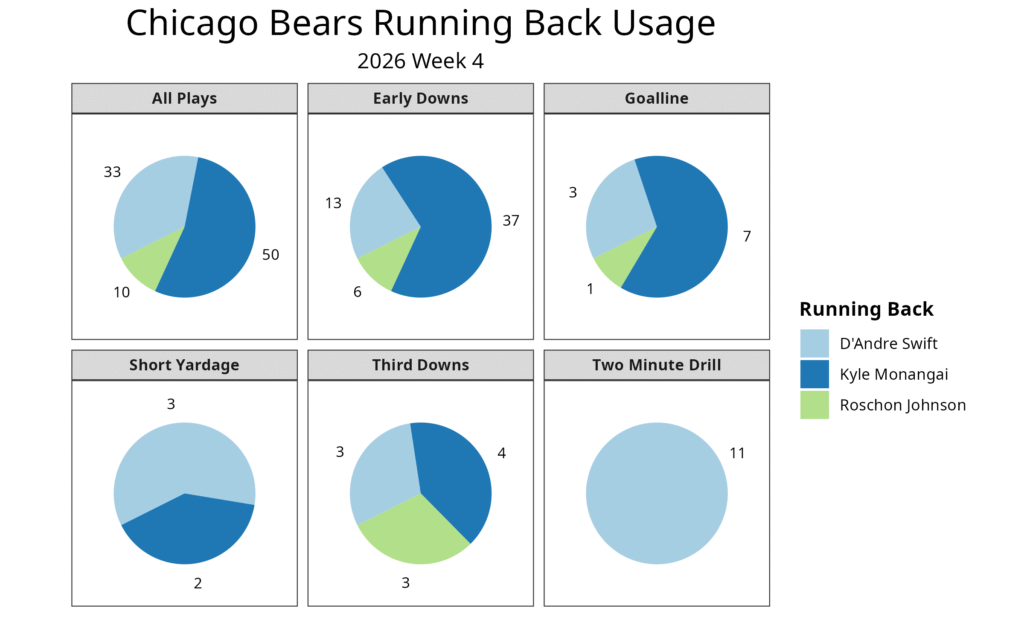
Chicago has started this season with a similar two-man rotation as last season, with Swift playing 64.7% of snaps and Kyle Monangai 35.7%, and Swift handling the majority of snaps in all situations. Over the first six drives of this game, the rates were slightly closer together, at 61.1% to 38.9%. That was largely because Chicago ran 54 plays over those six drives, which is more than usual, which naturally lends itself to more rotation.
The Bears' sixth drive was the first one in the third quarter, and Swift lost a fumble. That quickly led the Jets to score a field goal, making it a one-score game. Chicago had three more drives over the rest of the game, which lasted a ridiculous 39 plays. During that time, Monangai played 29 snaps to 10 by Roschon Johnson. Monangai ran 18 times during the stretch, compared to four runs by Johnson. If the Bears continued their usual rotation over those drives, Swift would have likely seen at least 10 more carries.
Swift has only fumbled three times in a season at most, but this was his second one of the 2026 campaign. As long as Swift doesn’t fumble again anytime soon, I wouldn’t expect the running back rotation to change. However, it might only take another Swift fumble for Monangai to become the lead back in Chicago, and the weekly must-start option.
Miscellaneous Notes
- Bears quarterback Caleb Williams missed his second game with a hamstring injury. Last week, Case Keenum started in his place after Tyson Bagent missed most of practice leading up to the game with a concussion. This week, Bagent was the starter.
- Chicago running back D'Andre Swift didn't practice on Thursday with a knee injury, but he was able to practice in full on Friday and wasn’t given a game status.
- Luther Burden III’s snap rate fell to a season-low 55.9% this week, even though he played over half of the 12 personnel snaps for the first time since Week 1. The Bears ran more 13 personnel than usual, at 20 total plays, and 12 personnel for a season-high 43 plays. His route participation rate was nearly identical to his season average.
- Colston Loveland more consistently lined up in 11 personnel over Cole Kmet compared to the first three weeks, leading to Loveland playing 92.5% of snaps. This was the highest rate for a game in Loveland’s career, which is remarkable considering Chicago ran 93 offensive plays.
- New York wide receiver Adonai Mitchell missed his second straight game with a finger injury, while tight end Mason Taylor sat out his second consecutive game with a thumb injury.
- The Jets activated wide receiver Sterling Shepard from the practice squad for this game on Saturday. Similar to last week, he was the third wide receiver, with Isaiah Williams as the second receiver. Shepard rotated out of 11 personnel less frequently than last week, leaving Malik McClain with reduced playing time.
- New York running back and returner Kene Nwangwu returned after missing three straight games with a back injury.
- The Jets signed Jason Sanders to the active roster and released Blake Grupe after having Sanders as a practice squad call-up each of the last three weeks.
Jacksonville Jaguars @ Cincinnati Bengals
Monitor Ja’Marr Chase and Tee Higgins’ health: Chase left the game with a concussion in the second quarter, while Higgins exited in the fourth quarter due to a leg injury.
The Bengals started this game down two of their top four wide receivers. They have used Andrei Iosivas as their third wide receiver over the last three seasons, but he landed on injured reserve over a week ago, allowing fourth-round rookie Colbie Young a chance to step up. He lasted one snap in his new role before suffering a knee injury, which led Young to sit out this week as well.
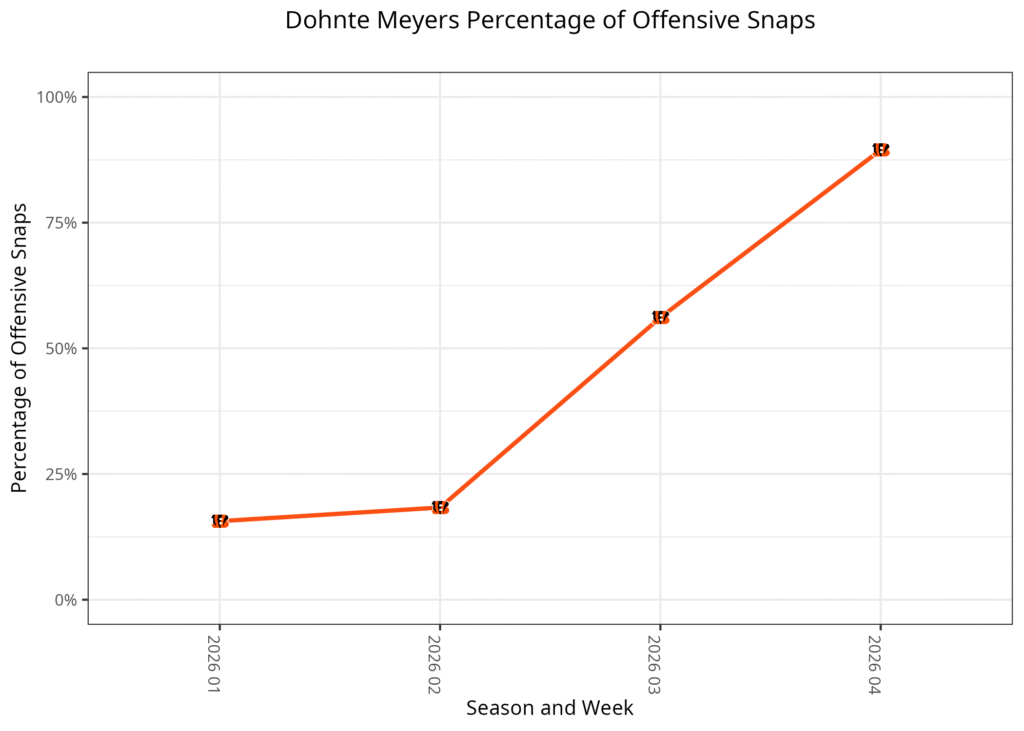
This left former Canadian Football League player Dohnte Meyers to step up in the third receiver role. This past week, the Bengals released Ke’Shawn Williams despite being down a receiver. As a result, they signed Mitch Tinsley off the Houston Texans‘ practice squad. Tinsley was the Bengals' fourth wide receiver last season.
The Bengals followed their expected wide receiver rotation in the first quarter, with Chase and Higgins taking 10 snaps of a possible 11, Meyers playing six Tinsley seeing two. Once Chase left the game, Meyers was consistently on the field, playing 35 of a possible 37 snaps over the first three quarters without Higgins, while Tinsley was the third receiver in 11 personnel.
Higgins suffered his leg injury with five minutes left in the game. He tried to return for two plays, but ultimately missed the final 11 plays of the contest. This meant Meyers was the top receiver, and Tinsley was the second option.
Meyers is the clear waiver-wire target. He caught seven passes for 82 yards in this game. Even if only Chase or Higgins misses next week, Meyers should have a full time role in the Bengals' offense, in a great matchup against the Miami Dolphins defense.
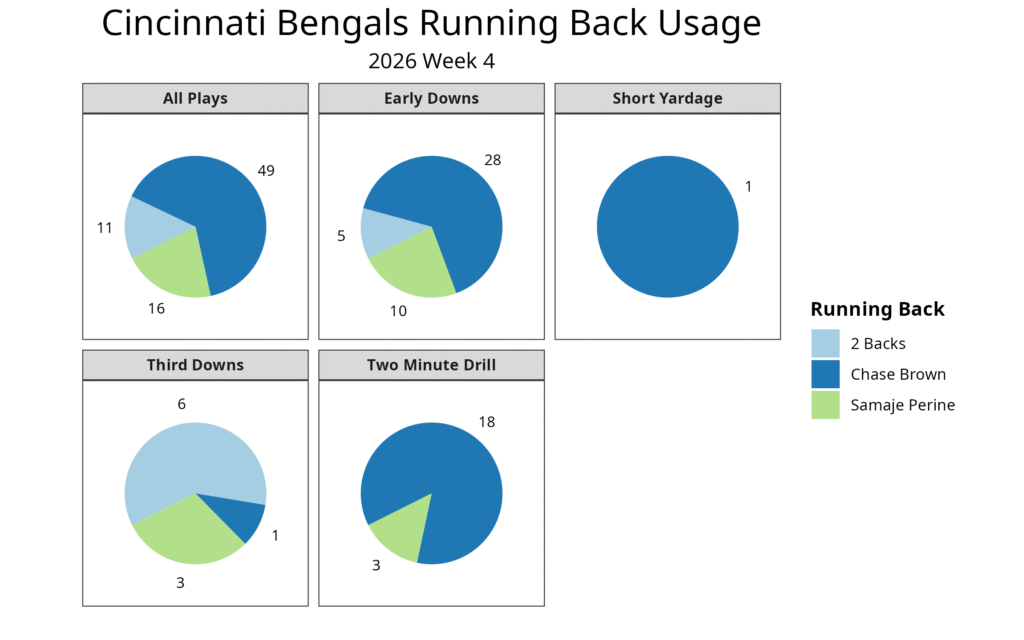
Chase Brown sets career highs in receptions: Brown caught 11 passes for 71 yards.
Brown is rarely mentioned in these recap articles because his situation in Cincinnati has been exceptionally stable. He played between 70-72% of snaps over the first three weeks, including most of the early-down snaps, roughly one-third of the third-down snaps and dominating snaps in two-minute drills, short-yardage situations and goal-line snaps. Samaje Perine has been the backup, taking all other snaps, while Tahj Brooks has three offensive snaps on the season. The situation was similar last season when both players were healthy.
This week, Brown was used more on third downs than usual, playing seven of a possible 10 snaps. This didn’t hurt his playing time in other situations, so he was on the field for a season-high 78.9% of snaps. Brown was completely ineffective as a runner, as Jacksonville has one of the highest-graded PFF run defenses of any team. However, his fantasy value was still fine thanks to his receiving production.
The reason Brown played more on third downs is the injuries at wide receiver. This led to more plays with both Brown and Perine on the field, with Brown often lining up in the slot in these situations. If the Bengals are down multiple wide receivers next week, we could see that trend continue, but we shouldn’t expect this to be a long-term change for Brown.
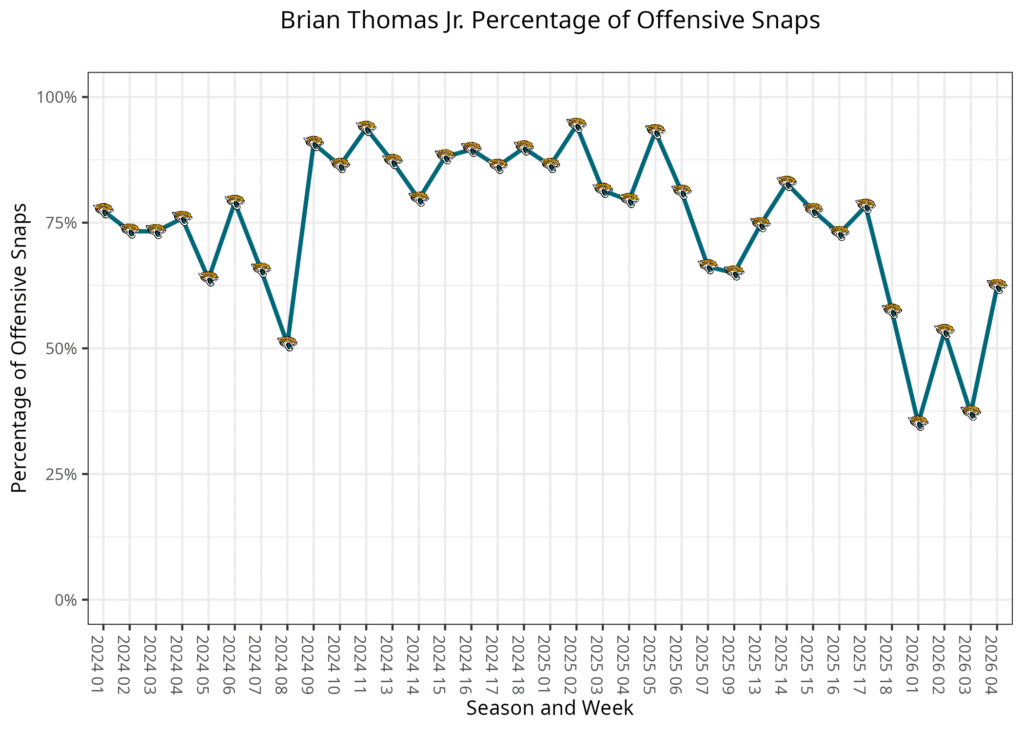
Brian Thomas Jr. reaches a season high in snap rate: Thomas played 62.3% of offensive snaps after seeing 37.1% last week.
Parker Washington and Jakobi Meyers have established themselves as the top two wide receivers on the Jaguars' depth chart, playing in both 11 and 12 personnel. Thomas has typically joined them in 11 personnel, but Josh Cameron has also become more involved. Cameron has been the Jaguars' primary wide receiver in 13 personnel, and he’s cut into Thomas’ time in 11 personnel.
One reason Thomas’ snaps were up this week is that the Jaguars ran a higher percentage of plays out of 11 personnel compared to the previous three weeks. This meant a lot less 12 personnel. Naturally, with Thomas playing much more in 11 personnel, this would help his snap rate. His clip of playing in 11 personnel compared to Cameron didn’t change.
However, Thomas also played four of 10 snaps in 12 personnel. This was not only his highest rate of 12 personnel snaps, but also his largest total despite the Jaguars running more than twice as many 12 personnel snaps in each of the first three games. Cameron didn’t play at all in 12 personnel this week. Thomas replaced Washington for three plays and Meyers for three plays.
We should expect the Jaguars to shift back to more 12 personnel usage going forward depending on the opponent, so Thomas’ snap rate will dip back down. However, we might not see it go as low as it did in Week 3 if Thomas continues to mix in to 12 personnel.
Miscellaneous Notes
- Jaguars running back LeQuint Allen Jr. (hip), wide receiver Jakobi Meyers (thumb) and tight end Nate Boerkircher (illness) were limited in practice at times this week, but all three played in this game.
- Jaguars running back Bhayshul Tuten left briefly late in the third quarter, but was able to return and play 15 more snaps over the rest of the game. Despite leaving briefly, he played a season-high 59% of the Jaguars' offensive snaps.
- Jaguars tight end Brenton Strange also received a slight boost in snaps, playing a season-high 86.9% of snaps. Similar to Thomas and Tuten, this was likely related to the Jaguars' increased usage of 11 personnel. Strange had his best game of the season with seven receptions for 95 yards, but most tight ends have big games against the Bengals' defense.
- Jacksonville wide receiver CJ Williams didn't dress (coach's decision), his third straight absence.
- The Bengals signed tight end Tanner Hudson off their own practice squad on Tuesday. Typically, either he or rookie Jack Endries would be active as the Bengals' fourth tight end. In this game, Cincinnati had both active, giving them five options at the position. Hudson played significantly in 12 personnel, ahead of Drew Sample. This was likely related to the Bengals' injuries at wide receiver.
Dallas Cowboys @ Houston Texans
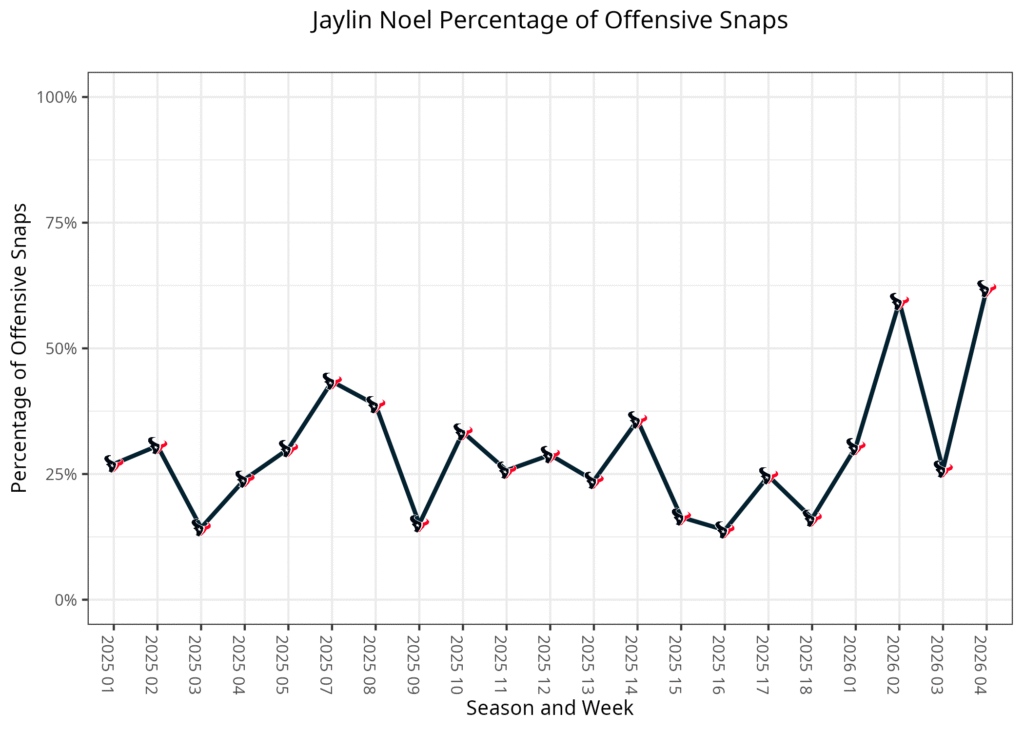
Texans may have found their top three receivers: Houston rotated its wide receivers less frequently this week than the first three despite having Nico Collins back.
Collins is clearly the Texans' top receiver when healthy. He was back in the lineup after missing back-to-back games with a hamstring injury. He was limited in practice on Wednesday and Thursday but practiced in full on Friday, suggesting he would play without limitations.
In his absence, Houston used a four-receiver rotation with Xavier Hutchinson, Kayshon Boutte, Jared Wayne and Jaylin Noel. All four played between 40-65% of snaps over the first three weeks. Wayne has been the closest thing to an X receiver without Collins, while Noel has mostly played in 11 personnel in the slot.
Collins was back this week, and while he was rotated out a little more frequently than usual, he led the Texans' wide receivers. Wayne mostly served as Collins' backup and was the clear fifth wide receiver on the depth chart in this game. The surprising factor was Hutchinson moving from the top wide receiver in snaps over the first three weeks to the fourth receiver. Boutte and Noel played twice as many snaps as Hutchinson.
Noel played 86.5% of snaps in 11 personnel after averaging 59.3% of snaps over the first three weeks. This was the most faith the Texans have put in Noel in a game in his career. Boutte’s snap rate decreased a little bit, but not nearly as much as it could have given how much the Texans have used Hutchinson over the last two seasons.
This means the Texans have a clear top three wide receivers for the first time in a while in Collins, Boutte and Noel. Noel caught three passes for 85 yards. In most leagues, I would still leave both of the latter players on the waiver wire because this was a one-game sample, but it’s possible either one could emerge as a fantasy option this season.
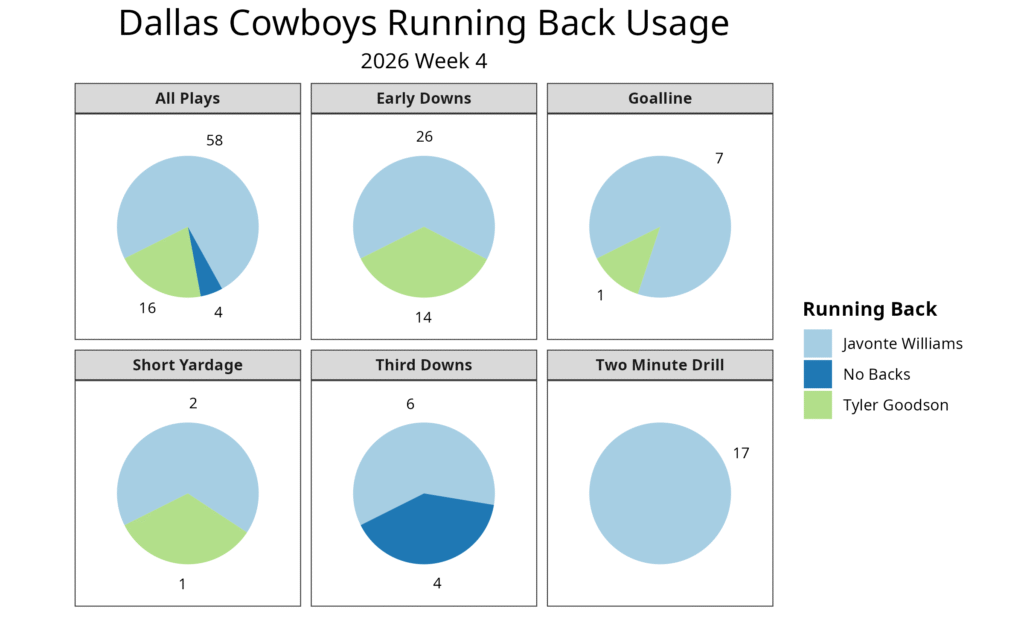
Subtle shift in the Cowboys' running back usage: Javonte Williams played a season-low 65% of snaps in early-down situations.
Williams’ playing time on early downs stayed remarkably consistent over the first three weeks, playing between 73-77% of snaps. Part of this has been instability on the depth chart behind Williams. Dallas has gone from Jaydon Blue to Malik Davis to Emari Demercado to Tyler Goodson as its primary backup running back. Demercado has spent the last two weeks as inactive, leaving Goodson as the main backup.
This week, Williams played 26-of-40 snaps in normal early-down sitautions compared to 14 by Goodson. Part of that was because Williams played a ridiculous 17-of-17 snaps in two-minute situations this week, but Goodson still logged five more total snaps this week than last.
This had absolutely no impact on Williams’ fantasy value this week, as he scored three touchdowns. However, Goodson has averaged more yards per carry, has a better avoided tackle rate, superior first-down rate and a higher clip of converting runs for five or more yards, as well as 10-plus yards. It’s unlikely Goodson becomes the Cowboys' main running back anytime soon, but it is possible Goodson starts chipping away at Williams’ touch totals.
Miscellaneous Notes
- CeeDee Lamb played a season-high 85.9% of offensive snaps this week. He and George Pickens have been rotated out a little more this season than last, with Ryan Flournoy mixing in at times in 12 personnel.
- The Texans made a subtle change to their running back rotation. In the first three games, David Montgomery would play on the first two drives, and then Houston would start a rotation by series, with Woody Marks coming in for the third possession. This week, Montgomery received the first drive, but the rotation started after that point, with Marks taking the second.
- The Texans placed running back British Brooks on injured reserve on Friday. While he can play halfback or fullback, he has appeared only on special teams over the first three weeks. Houston brought back Dare Ogunbowale, who had played for the team from 2022-2025, to be its third running back and special teams player.
- Houston made a change for the fourth tight end spot, making second-round rookie Marlin Klein a healthy inactive, while Brevin Jordan was active for the first time since 2024 Week 2.
Arizona Cardinals @ New York Giants
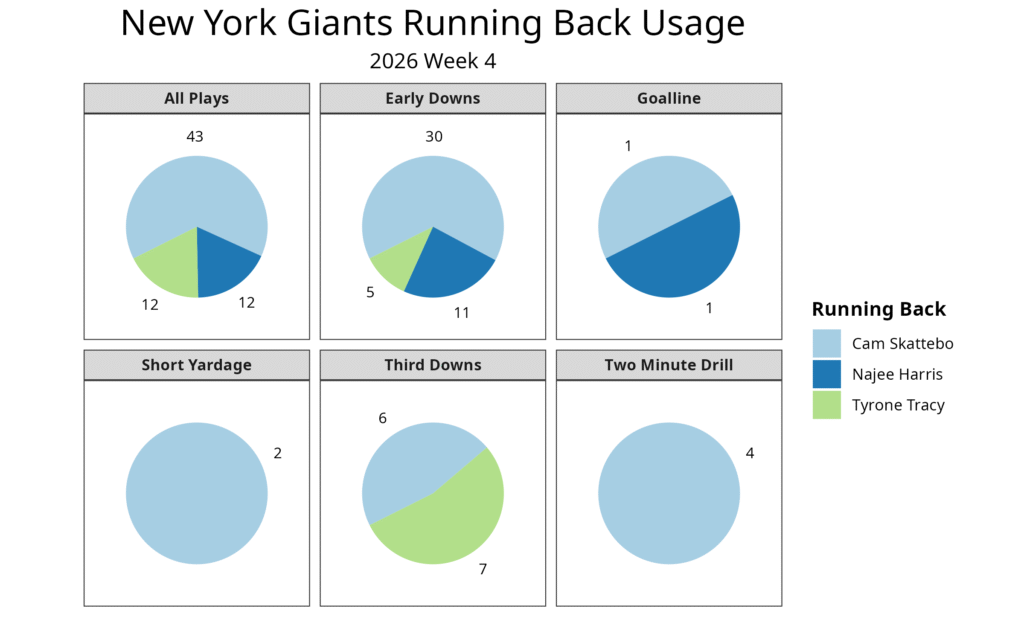
The Giants continue to tweak their running back rotation: Tyrone Tracy Jr. played a season-high 12 offensive snaps as the Giants' third-down back.
New York started the season with a typical two-man running back rotation, with Cam Skattebo playing more on early downs and Devin Singletary more in passing situations. That changed in Week 3, when Singletary was made a healthy inactive. Najee Harris became the primary backup on early downs, while Skattebo took on passing down duties.
This week, Skattebo’s playing time on third downs dipped back down, with Tracy taking the majority of those snaps. Harris and Tracy both mixed in on early downs, leading Skattebo to play a season-low 65.2% of snaps on early downs.
While Skattebo remains the clear lead back for the Giants, it’s worth noting Harris and Tracy are both averaging more yards per carry than Skattebo this season. It’s possible Harris and Tracy continue to cut into Skattebo’s playing time this season if they keep outperforming him in the run game.
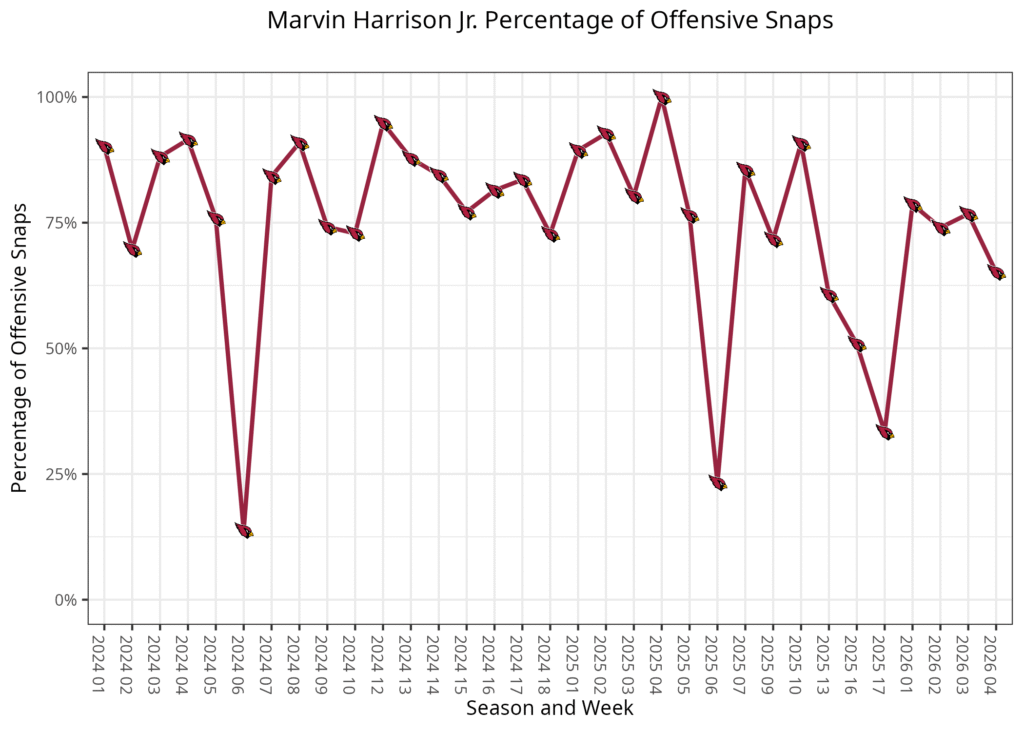
Marvin Harrison Jr. sees a season low in snap rate: While the Cardinals' wide receiver scored his first touchdown of the season, he wasn’t on the field as much as usual.
The Cardinals spent the first three weeks with Michael Wilson as the primary wide receiver in 13 personnel, Harrison joining Wilson in 12 personnel and Kendrick Bourne accompanying the two in 11 personnel.
Arizona followed a similar rotation this week, but the team played out of 13 personnel for a season-high 24 plays and never ran a snap out of 12 personnel. Harrison played all 42 snaps out of 11 personnel but only one of the 24 snaps out of 13 personnel. This led to a season-low 65.2% snap rate after playing at least 74% of snaps in each of the first three games. This had a subtle effect on his route participation rate, as he ran a route on 82.1% of the Cardinals' passing plays after averaging 85.4% over the first three weeks.
Head coach Mike LaFleur was the Rams' offensive coordinator last season when the Rams shifted more heavily toward 13 personnel. It’s possible Arizona continues to lean into that personnel grouping this year, as this was the Cardinals' second straight game using it on over 20% of snaps.
Miscellaneous Notes
- Tyler Allgeier out-snapped Jermeiyah Love, but only because the Cardinals ran 16 plays during two-minute drills, and Allgeier handled all 16 of those snaps. Love was the clear leader in normal early-down situations.
- As usual, rookie quarterback Carson Beck and wide receiver Reggie Virgil were healthy inactives for the Cardinals.
- Arizona third-string tight end Hunter Long suffered a knee injury early in the fourth quarter and didn’t return.
- The Giants traded for J.J. McCarthy this week. Jake Haener was released, signed to the practice squad and activated from the practice squad, giving New York three quarterbacks for this game.
- The Giants waived wide receiver Odell Beckham Jr. on Tuesday. They signed Braxton Berrios, who had been a practice squad call-up each of the first three weeks, to take Beckham’s place. The Giants also signed wide receiver Charlie Jones off their own practice squad on Tuesday to be their fifth wide receiver.
Los Angeles Rams @ Philadelphia Eagles
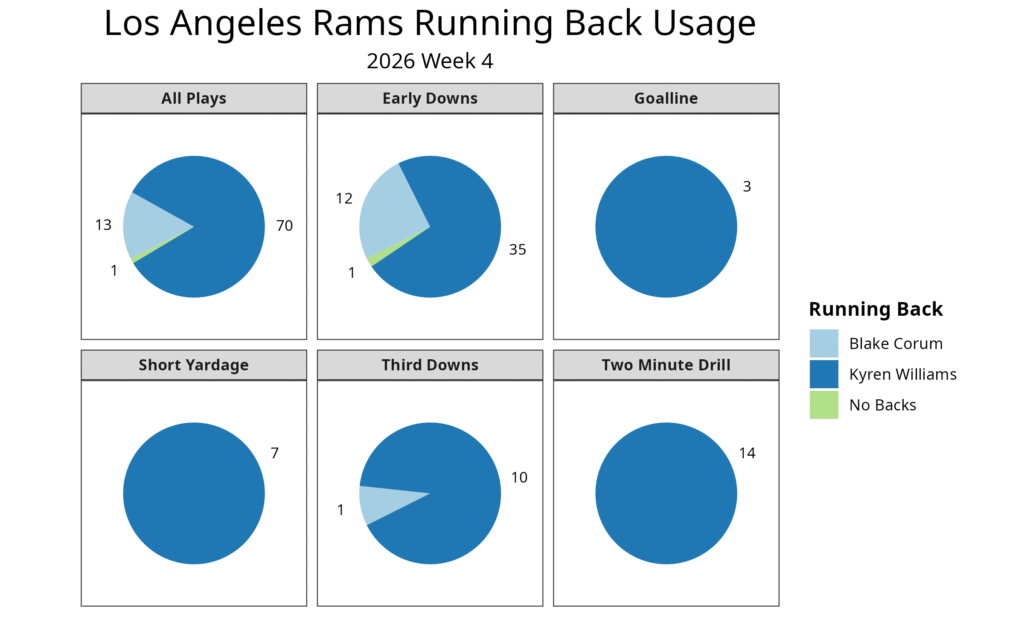
Kyren Williams plays 83.3% of the Rams' offensive snaps: The Rams may be moving away from their two-man rotation.
Williams started 2025 as the Rams' lead running back, but as the season progressed, they became a backfield with a two-man rotation. Williams played well throughout last year, but Blake Corum was also playing exceptionally well, leading to the rotation.
The Rams continued to use both running backs over the first two weeks, with Williams playing 59.3% of snaps to 34.1% by Corum. The two split carries with 23 by Williams and 22 by Corum; Corum gained more yards, but Williams tallied more yards after contact. Last week, Williams was more effective than Corum. While the Rams mostly kept with a rotation by drive, Williams was quick to substitute in for Corum on Courm’s drives.
This week was similar, with Williams taking the first drive and Corum playing seven snaps on the second, with Williams rotating in. Corum took two snaps on the fourth series to one by Williams. At the start of the fifth possession, the Rams were down by 10 points and spent the rest of the game trying to catch up to the Eagles. This left Williams playing 56 snaps over the final 61 compared to four by Corum.
While playing time over the last two weeks has been somewhat related to the game script, Williams has also played much better than Corum in these two games. Williams is averaging 4.1 yards after contact per carry to 1.7 by Corum. Williams has a solid 32.3% first-down rate, while Corum doesn’t even have a first-down.
If the Rams can become the dominant team everyone thought they would be at the start of the season, then there should be more than enough carries for both backs. Until then, we could see Williams continue to dominate playing time.
Los Angeles is forced to abandon 13 personnel: The Rams were without two of their top four tight ends.
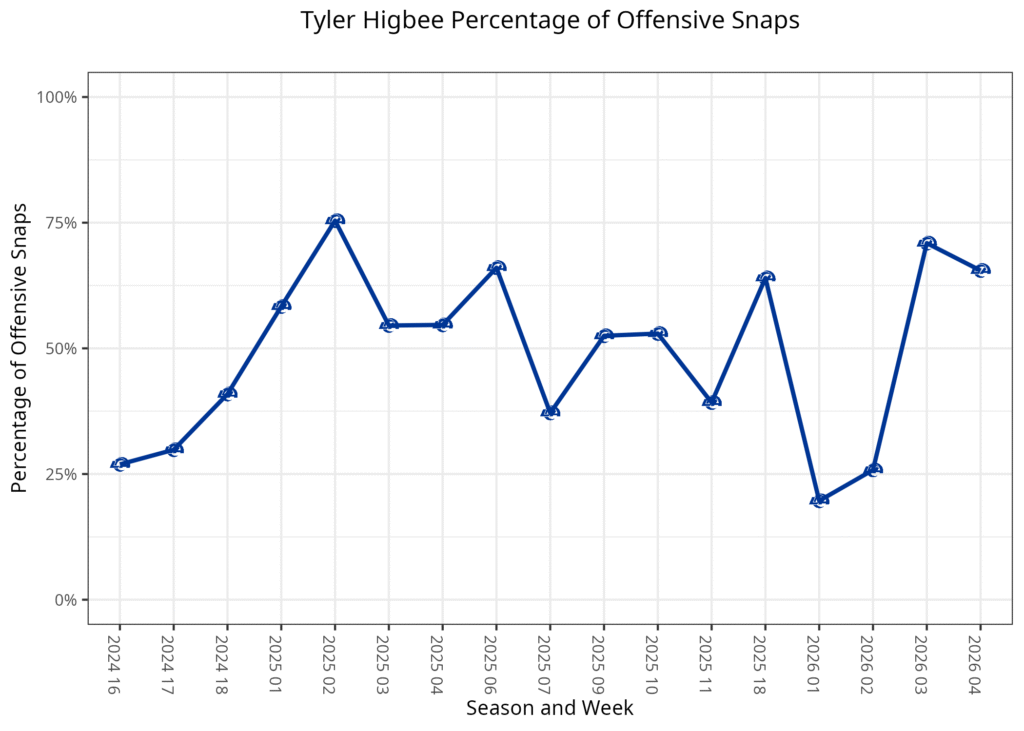
The Rams placed tight end Terrance Ferguson on injured reserve on Saturday. The second-year tight end had a breakout Week 2, catching six passes for 54 yards and a touchdown, but had an early exit in Week 3 with an ankle injury. He had been playing primarily in 11 personnel on third downs and two-tight end sets, but also at times in 11 personnel on early downs. Colby Parkinson took the other 11 personnel snaps, joining him in 12 personnel, while Davis Allen accompanied them in 13 personnel. Parkinson was questionable for this game with knee and shoulder injuries. Tyler Higbee didn't see as much playing time during the first two weeks but was the primary replacement for Higbee and Parkinson last week. Parkinson was also inactive for this game due to knee and shoulder injuries.
Higbee and Allen shared the field for 10 snaps in 12 personnel. The two split snaps on early downs, while Higbee dominated the third-down snaps. Los Angeles had second-round rookie Max Klare as its third tight end, but the Rams only trusted Klare for one snap in 13 personnel, showing the team isn’t ready to trust the newcomer yet.
Higbee caught five passes for 67 yards. Higbee should be able to maintain fantasy value even when Parkinson is back, as Higbee largely replaced Ferguson, while Allen generally replaced Parkinson. When Parkinson is back, Higbee’s workload should be fairly similar to this game.
Puka Nacua returns for Los Angeles: Nacua was not on a snap count in this game.
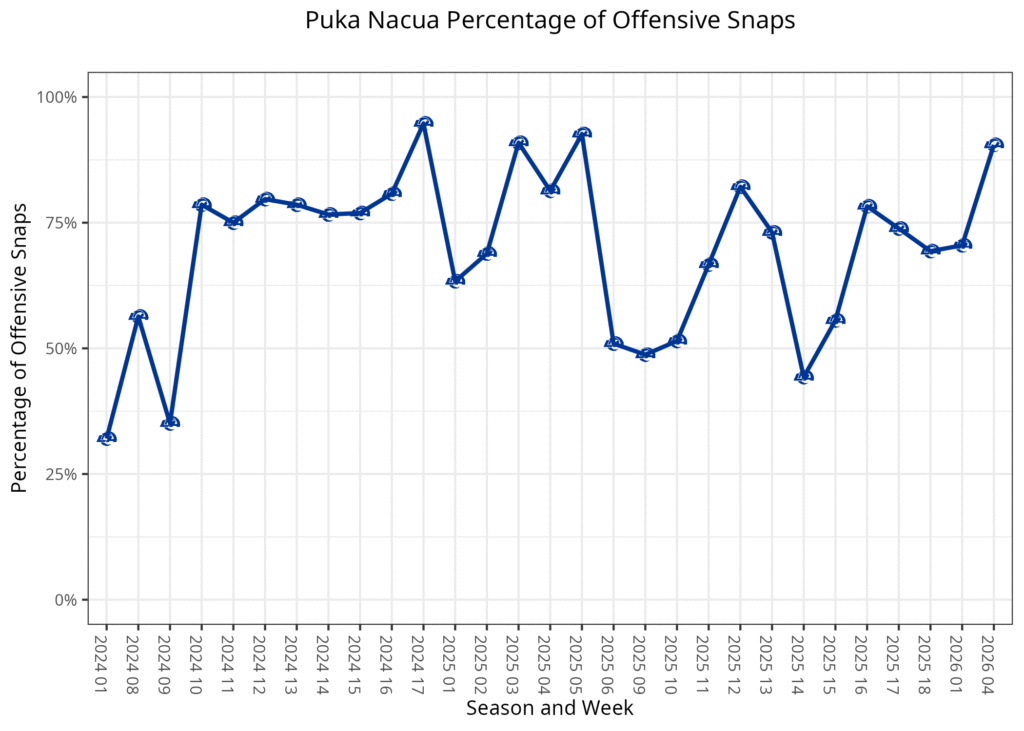
Nacua had missed the last two contests with a hip injury. In Week 1, Nacua only played 70.5% of snaps and 54.1% for Davante Adams. The Rams used a lot of 13 personnel, leaving only one of the two wide receivers on the field. This week, with the injuries at tight end, the Rams abandoned 13 personnel. This left both wide receivers seeing snap rates similar to most starting receivers.
It was also notable in this game that Jordan Whittington was back to being the third wide receiver for Los Angeles. He played 41% of snaps in Week 1, but he missed Week 2 due to injury and was eased back into action last week. This week, he was clearly ahead of everyone else on the depth chart.
Nacua can safely stay in fantasy starting lineups, and as long as the Rams are hurting at tight end, Adams is also relatively safe to start.
Monitor Saquon Barkley’s health: Barkley left the game with a hamstring injury early in the first quarter and didn’t return.
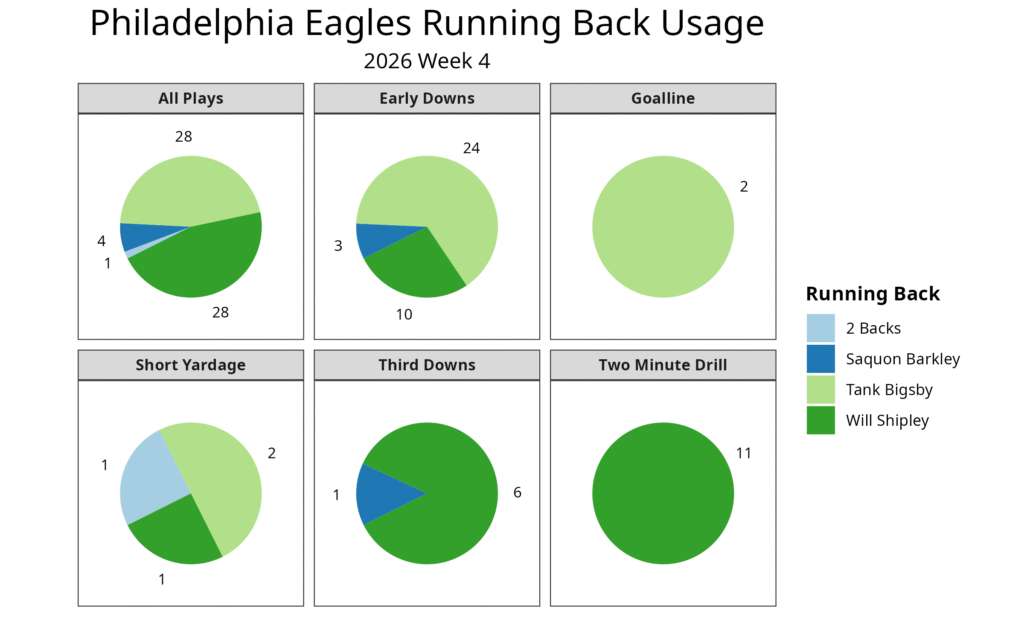
Barkley’s had two healthy games where he’s played over 70% of offensive snaps, and two where he’s exited in the first quarter and hasn’t returned. This week, he managed four offensive snaps before departing.
Similar to Week 2, Tank Bigsby became the early-down back and Will Shipley the passing down back in Barkley’s absence. The difference this week is Bigsby also suffered a right leg injury. He left at 3:59 in the fourth quarter and didn’t return. The Eagles only ran six plays after that point, and they were all clear passing situations where Shipley would have likely been on the field regardless of Bigsby’s health.
If Barkley misses time and Bigsby is fine, then Bigsby is the player to pick up off the waiver wire. If both Barkley and Bigsby are out, then Shipley would likely be the player to add, but that is no guarantee. Dameon Pierce and Jaydon Blue are the Eagles' practice squad halfbacks, and both fit more of an early-down role than a late-down one. If Barkley and Bigsby are both down next week, we could see the Eagles elevate both players, and we might not know who will lead the team in carries until their game starts.
The Eagles play the Jacksonville Jaguars next week, so it won’t be the best matchup for whoever is running for Philadelphia.
The Eagles adjust without DeVonta Smith: Philadelphia’s star receiver may miss multiple weeks with a hamstring injury.
Smith played 93.4% of snaps over the first three weeks, ranking third-best among wide receivers. Dontayvion Wicks has been the primary X receiver with Darius Cooper mixing in at times, while first-round rookie Makai Lemon has been the slot receiver in 11 personnel.
Smith was inactive this week with a hamstring injury. Hollywood Brown has been Smith’s primary backup in 11 personnel this season, but Brown was also out this week with an ankle injury. This left the possibility open for Cooper or Lemon to see more playing time, or Philadelphia could have kept those two in their usual spots and moved Britain Covey or Elijah Moore up the depth chart.
The Eagles just turned to Cooper to be their Z receiver, with Wicks and Lemon playing the same roles as usual. Moore was the fourth-string wide receiver for this game. Cooper ended up leading the team in receiving yards at 33, and he scored two touchdowns.
This makes Cooper a waiver-wire target in deep leagues, but it’s worth noting he only has 1.31 yards per route run on the season compared to 1.79 by Wicks. Cooper’s numbers look impressive largely because of his touchdown totals. Once Smith is healthy again, it’s unlikely Cooper will be anything more than a rotational option.
It’s also worth noting this wasn’t a great sign for Lemon’s fantasy value that he didn’t take the 12 personnel snaps. While it might not make sense to drop Lemon at this point given that he is a talented first-round pick in the first month of his career, this isn’t a good sign for Lemon having fantasy value anytime soon.
Miscellaneous Notes
- Philadelphia quarterback Tanner McKee was active this week, giving Philadelphia three passers. Andy Dalton notably threw an interception in his limited time on Monday Night Football, which may have contributed to the move. However, the Eagles also ruled out six players due to injury, had Lane Johnson as a surprise inactive for personal reasons and had a fourth-string quarterback as an eighth inactive. Even if nothing notable happened on Monday Night Football, McKee may have been active for this game.
- Eagles tight end Dallas Goedert missed his second straight game with a knee injury. Zach Ertz and Josiah Deguara were both practice squad call-ups for Week 4. Ertz played a lower snap rate this week compared to Week 3, with Johnny Mundt staying as the lead tight end in all situations. Mundt was held without a target, making this a situation to avoid.
- Eagles running back Will Shipley didn't practice on Wednesday and was limited in practice on Thursday, upgraded to full on Friday with a foot injury and wasn't given a game status.
- Los Angeles released backup wide receiver and returner Xavier Smith on Friday. The Rams signed Alex Bachman off their practice squad on Saturday to take his place.
- Los Angeles wide receiver Tutu Atwell returned after a healthy scratch last week. The Rams went with four active receivers last week, and this week, they had six.
- The Rams signed running back Dean Connors off their own practice squad on Wednesday. He is their third running back with Ronnie Rivers on injured reserve.
- As usual, rookie quarterback Ty Simpson and wide receiver CJ Daniels were healthy inactives.
Green Bay Packers @ Tampa Bay Buccaneers
Monitor the health of Chris Brooks: The Packers' receiving back left with a leg injury in the first quarter.
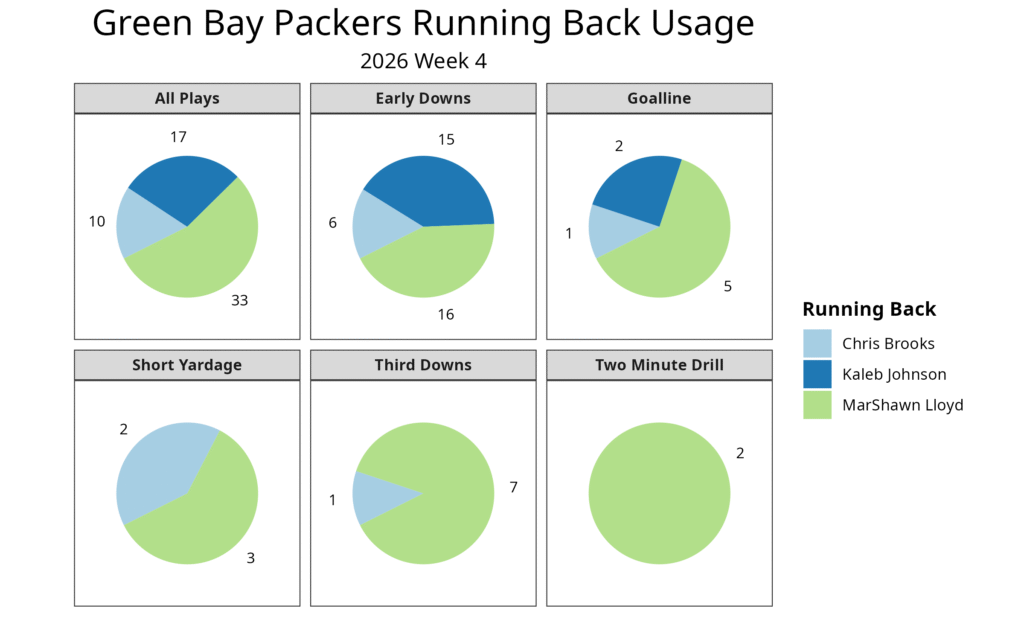
Green Bay has spent the first three weeks with a three-man rotation at running back, with Brooks leading the pack. Brooks, MarShawn Lloyd and Kaleb Johnson have all played significantly on early downs, but Brooks has played roughly 80% of snaps on third downs and two-minute drill situations, giving him the lead in snaps.
Green Bay started this game with a two-man mix, with Brooks playing nine snaps in the first quarter to seven by Lloyd. There was talk of Green Bay consolidating its rotation to see if one player could gain some momentum, which left Johnson without a first-quarter snap. Brooks left the game, and while he tried returning for one snap, he ultimately didn’t play for most of the afternoon. This left Lloyd as the Packers' receiving back. Johnson became more involved at this point and received twice as many carries as Lloyd over the final three quarters.
Johnson was able to get something going in the run game, largely thanks to a single 31-yard carry. Lloyd averaged 1.9 yards per carry. On the season, Johnson has been the more effective runner. He’s gained at least 10 yards on 15% of his runs compared to 3.3% by Lloyd. If Brooks misses time, it wouldn’t be surprising if Johnson becomes the main back, with Lloyd taking the passing-down opportunities.
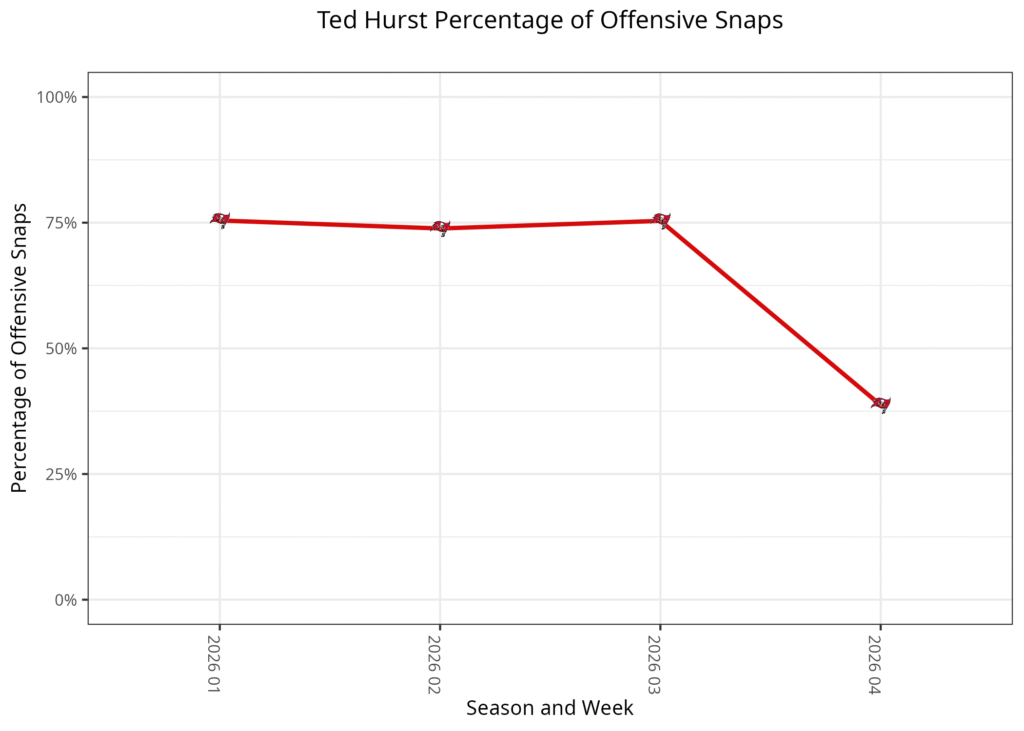
Tampa Bay makes a change at wide receiver: Tez Johnson appears to have surpassed Ted Hurst III on the depth chart.
Tampa Bay has spent the start of the season with Hurst as its X receiver, Emeka Egbuka at Z and Chris Godwin Jr. in the slot with Johnson as the top backup. Egbuka had played 81.7% of snaps, Godwin 77.5%, Hurst 74.9% and Johnson 25.1%. There was a heavy rotation in 12 personnel, but Hurst led the team in 13 and 12 personnel snaps. Egbuka and Godwin both played at least 97% of 11 personnel snaps, with Hurst playing 77.8%.
This week, Tampa Bay used 11 personnel for 56 of its 62 snaps. Egbuka and Godwin continued to dominate their 11 personnel usage, but this week, Johnson played 35 snaps to 21 by Hurst. The increase in 11 personnel usage left Egbuka and Godwin with an elevated snap rate than usual. While Johnson didn’t necessarily play X last season, he has played more X receiver this season and often was the X when he was on the field this game.
While Hurst was hyped up much more than most third-round receivers throughout the offseason, he appears further away from a breakout now than he’s been at any other point since being drafted.
Miscellaneous Notes
- The Packers placed wide receiver Jayden Reed on injured reserve on Wednesday and announced his season would be over. Reed missed last week and nearly all of Week 2, with Skyy Moore as the primary replacement for Reed in the slot.
- The Packers are the latest team to embrace 13 personnel. They used it for 17 plays this week after implementing it 19 times over the first three weeks. This left Christian Watson playing a season-low 68.3% of snaps.
- Baker Mayfield was inactive with a right thumb injury, and he’s expected to miss at least the next two games. Undrafted rookie Jalon Daniels made his first NFL start. This was the earliest an undrafted rookie quarterback started in a season in over 20 years. Easton Stick was activated off the practice squad to be Daniels’ backup.
- The Buccaneers had their first true goal-line snap of the season, and Sean Tucker took that rep, scoring a touchdown.
- The Buccaneers placed wide receiver Jalen McMillan on injured reserve on Wednesday. McMillan missed Week 1, played seven snaps in Week 2 and only managed two snaps last week before suffering his PCL injury. He is expected to miss six-to-eight weeks.
- Buccaneers tight end Ko Kieft didn't practice all week with an elbow injury and was inactive. He has only played three offensive snaps this season, all in 13 personnel.
- Tampa Bay running back Bucky Irving (glute) and wide receiver Chris Godwin Jr. (ankle) appeared on the injury report this week and missed some time early in practice, but both were fine by Friday and weren’t given game-day statuses.
Miami Dolphins @ Minnesota Vikings
The Dolphins adjust without De’Von Achane: Miami will be without the centerpiece of its offense for the rest of the season.
Achane played 80.7% of the Dolphins’ offensive snaps over the first two weeks, the second-highest rate among running backs. He tore his ACL last week, ending his season.
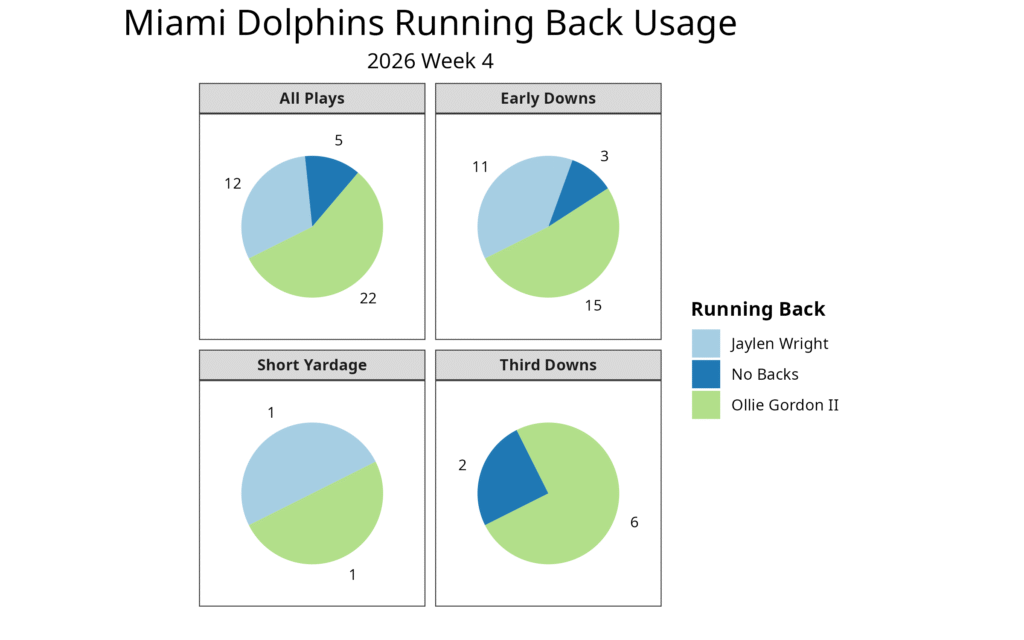
Usually, there is a clear next man up when a starting running back suffers a season-ending injury, but that wasn’t the case in Miami. Ollie Gordon II and Jaylen Wright have both served as the primary backup at different points over the past two seasons. Gordon held the role early last season while Wright dealt with stinger and foot injuries, but Wright gradually moved ahead of him as the season progressed. Gordon appeared to be the backup in Week 1 this year before Wright moved to the top of the depth chart. Wright then missed last week due to injury, leaving the hierarchy unclear entering this game.
Wright started for Miami, but the two rotated heavily over the first five drives. Wright played 10 snaps compared with Gordon’s eight and received more carries, but he was ineffective with his opportunities.
That changed quickly in the second half. Gordon started after halftime, gained 5 yards on his first carry and broke a 53-yard run on his next. From there, Gordon dominated the playing time, logging 14 second-half snaps compared with just two for Wright.
Given how much more effective Gordon was in this game and how decisively the second-half workload shifted in his favor, it’s reasonable to expect him to enter next week as Miami’s lead back.
The Vikings adjust without Justin Jefferson: Minnesota stuck with its Week 3 plan for replacing Jefferson for a second straight week.
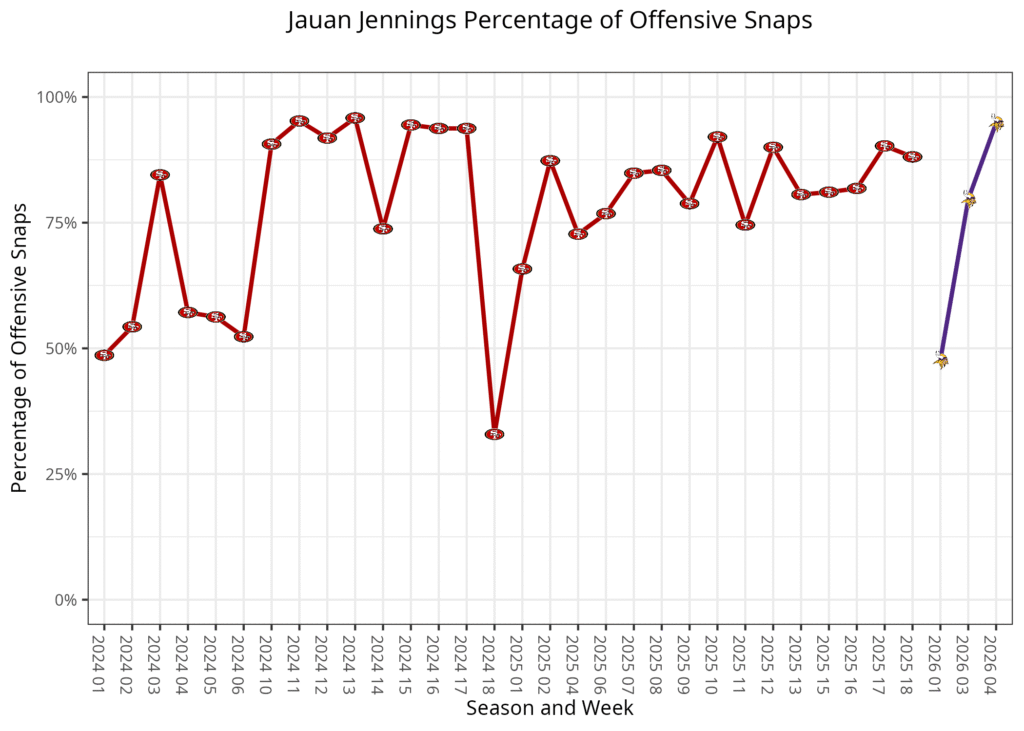
Jefferson suffered an ankle injury last week and was inactive this week. He played only seven offensive snaps before leaving last week’s game, giving us a good look at Minnesota’s preferred receiver rotation without him. Jordan Addison and Jauan Jennings served as the primary receivers in 12 personnel, with Tai Felton joining them in 11 personnel.
Minnesota followed the same plan this week. Addison and Jennings played 75 and 74 snaps, respectively, while Felton played 88.5% of the snaps in 11 personnel.
Unfortunately, the heavy playing time didn’t translate into significant target volume. All three receivers posted relatively low target rates, with much of the passing game flowing through T.J. Hockenson and Aaron Jones Sr.
Despite the high snap rates, it will be difficult to trust any of Minnesota’s wide receivers in fantasy lineups if Jefferson misses another game.
T.J. Hockenson shines without Josh Oliver: Hockenson led the Vikings’ receivers with 13 receptions for 119 yards.
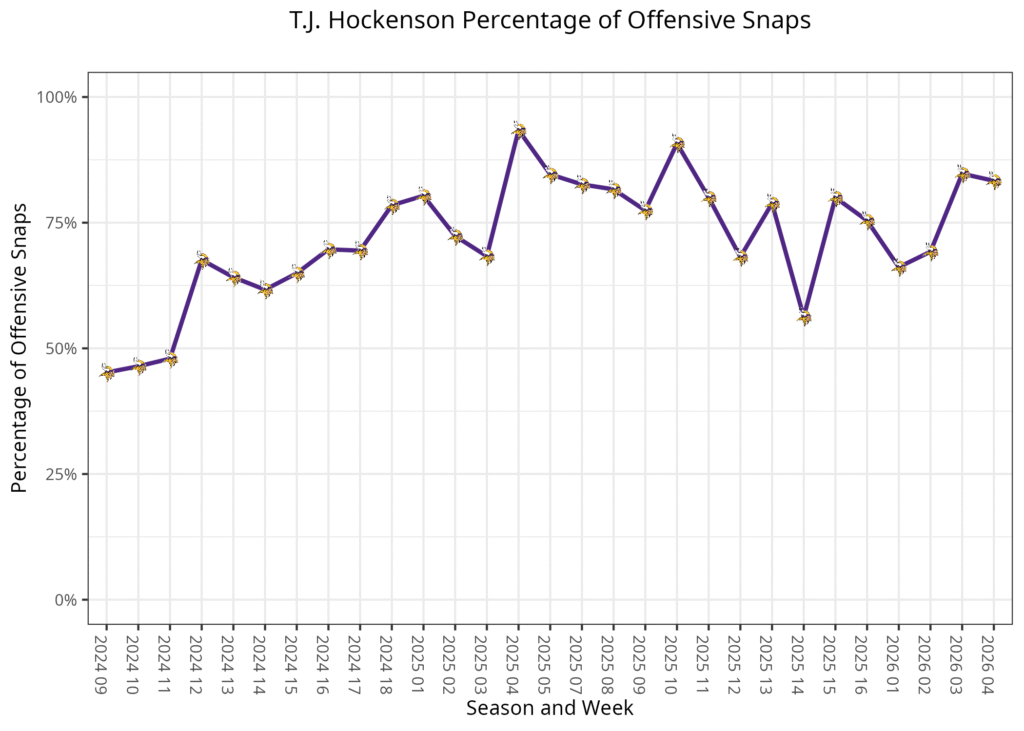
Hockenson played only 67.5% of Minnesota’s offensive snaps over the first two weeks, with much of his playing time coming on third downs and during two-minute drills. Oliver played 62.4% of the snaps, handling many of the early-down snaps in 21 personnel in addition to playing in 12 personnel.
Oliver tore his biceps last week and was placed on injured reserve Tuesday, leaving 2025 sixth-round pick Gavin Bartholomew as the next man up. Bartholomew didn’t play as a rookie last season and was limited to special teams over the first two weeks before logging four offensive snaps last week. Minnesota surprisingly didn’t add another tight end to the 53-man roster or elevate one from the practice squad, leaving the Vikings as the only team in the league with just two tight ends on their roster.
Oliver’s absence led to a significant increase in Hockenson’s playing time. He played 88.1% of the snaps in single-tight end sets on early downs after playing just 32.1% in those situations over the first two weeks. His route participation rate also jumped to 79.1%.
Some of Hockenson’s production can be attributed to Justin Jefferson being sidelined, with Hockenson absorbing much of that target volume. Still, his increased playing time should give him better fantasy value over the next few weeks. His route participation should remain high even after Jefferson returns, and he has clearly developed some chemistry with Kyler Murray.
Hockenson should be one of the top waiver-wire targets this week outside of players stepping into larger roles because of new injuries.
Miscellaneous Notes
- Miami elected to sign Carlos Washington Jr. off its practice squad to serve as the third running back rather than 2025 fourth-round pick Jarquez Hunter. If either Gordon or Wright struggles or suffers an injury, Washington could get an opportunity.
- Dolphins third-round rookie wide receiver Caleb Douglas missed his second straight game with an ankle injury. As was the case last week, Chris Bell and Kevin Coleman Jr. saw increased playing time in his absence.
- The Dolphins rotated their tight ends more this week than they did last week. Greg Dulcich played only 51.3% of the offensive snaps with a 50% route participation rate. Rookie Will Kacmarek played more overall, logging 61.5% of the offensive snaps, although his route participation rate was slightly lower at 45%. Dulcich remains the better fantasy option for now, but it wouldn’t be surprising to see Kacmarek receive more opportunities as the season progresses.
- Dolphins tight end Justin Joly was a healthy inactive after playing in the team’s previous game.
- The Vikings signed quarterback Max Brosmer off their practice squad Tuesday.
- Aaron Jones Sr. didn’t dominate the offensive snaps to the same extent as he had over the previous two weeks, playing 73.1% of the snaps. Dmond Claiborne served as the primary backup on early downs, while DeeJay Dallas took over as the third-down back.
- Minnesota signed former Saints running backs Devin Neal and Audric Estime to the practice squad Wednesday.
Kansas City Chiefs @ Las Vegas Raiders
Monitor Jalen Nailor’s health: Nailor suffered a concussion and didn’t return.
Las Vegas spent the first three weeks of the season with Nailor as their X receiver, Tre Tucker as their Z, and Jack Bech playing in the slot in 11 personnel. Las Vegas uses so much 12 personnel that Bech only played 46.6% of the Raiders' offensive snaps the first two weeks. He suffered a forearm injury last week, leading him to land on injured reserve on Tuesday. During the second half of last week’s game, rather than moving to the next man up at wide receiver, Las Vegas simply used 12 personnel even more frequently than they already were using it.
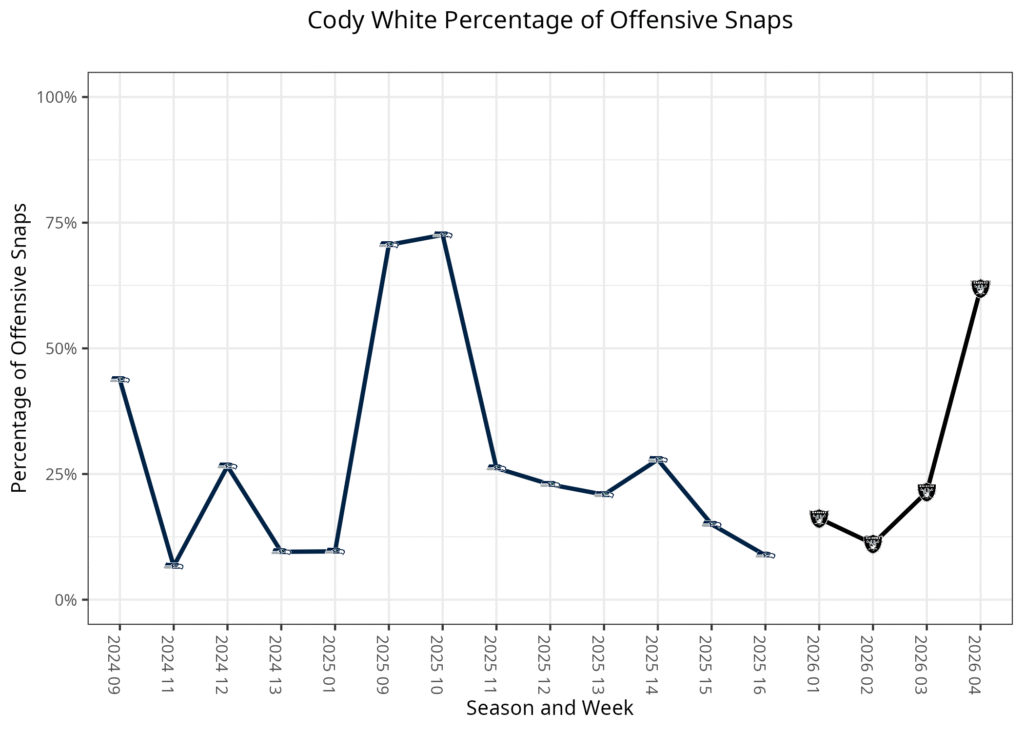
The Raiders only ran 11 personnel for six snaps in this game, compared to 11 snaps out of 13 personnel. 12 personnel was their base offense throughout the game. Cody White was the closest thing to a slot receiver for Las Vegas, as he was the only one to play all six snaps out 11 personnel, and he had the highest rate of slot snaps.
The Raiders were rotating their outside receivers more in the first half than usual, with Nailor only playing in 19 of 31 snaps, and Tucker playing in 21 of 31. Both White and Dareke Young were mixing in at times, and the high rate of 13 personnel was also a factor.
Nailor didn’t play in the second half, with White taking over as the X receiver in the second half. He played in 46 of a possible 53 snaps, playing ahead of Tucker, who played in 35 of 53. White has made a name for himself catching touchdowns, but he was also fine in this game with two receptions for 36 yards. He has 1.31 yards per route run on the season, ahead of 0.71 by Nailor. If Nailor misses time, that could be an opportunity for White to become a starting wide receiver for Las Vegas for the rest of the season.
Monitor the health of the Chiefs wide receivers: Neither Rashee Rice nor Tyquan Thornton was able to finish the game for Kansas City.
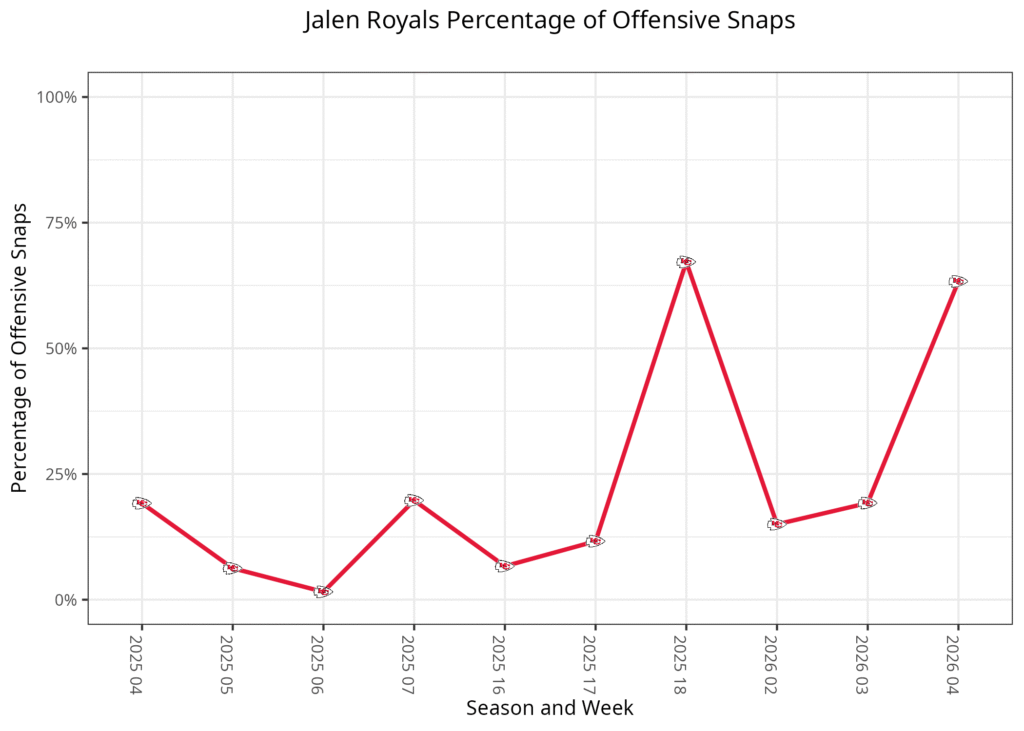
The Chiefs haven’t rotated their wide receivers nearly as much this season as they have in recent years. Over the first three weeks, Rice, Xavier Worthy and Thornton each played at least 96% of the snaps in 11 personnel. Worthy and Rice also played more than 85% of the snaps in 12 personnel, with Thornton serving as the top backup. Like most teams, Kansas City has mixed in some single-wide-receiver sets, which is the main reason Rice and Worthy haven’t played more than 90% of the offensive snaps this season.
Rice played only a few snaps before suffering a hamstring injury that sidelined him for the rest of the game. Jalen Royals took over Rice’s role, playing 16 of 18 snaps in 11 personnel. In 12 personnel, Thornton and Royals split the snaps opposite Worthy. While Royals saw more playing time, Worthy moved into the slot more often, playing 40% of his snaps there after lining up in the slot on 29.1% of his snaps over the first three weeks.
Thornton was having the best game of his career, catching five passes for 111 yards and two touchdowns, before suffering a gruesome ankle injury late in the fourth quarter that required him to be carted off. Kansas City didn’t run another snap out of 11 personnel after the injury, but Cyrus Allen likely would have been the next man up.
If both Rice and Thornton miss time, it’s unclear how Kansas City will structure its receiving corps. Thornton has an 18.1-yard average depth of target this season, so someone will need to replace his downfield role. Worthy has five deep targets of his own, but the Chiefs may prefer to keep him in Rice’s role. Allen was viewed as a natural replacement for Rice, although his lone target this season came 19 yards downfield.
Whoever inherits Rice’s role will likely have the best chance of providing fantasy value. Rice’s injury appeared to boost Worthy’s outlook by giving him more opportunities in the slot, but Thornton’s injury complicates matters. If Worthy is asked to run more deep routes to replace Thornton, it could actually hurt his fantasy outlook.
It’s also worth noting that JuJu Smith-Schuster, who has played Rice’s role in Kansas City before, is currently a free agent. Justin Watson, who played for the Chiefs from 2022 through 2024 and filled the high-average-depth-of-target role, is also available.
Kansas City will likely add a wide receiver, and who the Chiefs bring in could significantly influence which of their current receivers are worth targeting in fantasy.
Miscellaneous Notes
- The Chiefs are getting healthier on offense. Patrick Mahomes (knee) and Rashee Rice (knee) were full participants in practice all week. Kansas City hasn’t needed to make any changes to its offensive personnel, with quarterback Garrett Nussmeier and tight end Jared Wiley remaining healthy inactives, as they have been all season.
- Kenneth Walker’s 75% snap rate was identical to his season average, but both his route participation rate and targets per route were noticeably lower in this game. It didn’t hurt his fantasy production, as he finished with 177 rushing yards and two touchdowns, but a sustained decline in route participation could slightly lower his ceiling going forward.
- Travis Kelce played only four of seven snaps in 11 personnel on third downs, resulting in a 57.1% snap rate in those situations. It’s a small sample, and one additional snap would have made the number much less noteworthy, but it’s still something worth monitoring. His targets per route have declined over the past two weeks compared with the first two, although his overall route participation rate increased this week.
- Ashton Jeanty briefly left the game late in the third quarter but returned on the following drive. His snap rate was slightly lower than usual, but that was partially a product of the Raiders running more plays. Jeanty actually logged more total snaps than his season average. Las Vegas also gave Dylan Laube more work on third downs than it had over the first three weeks, but that shouldn’t have a significant impact on Jeanty’s fantasy value.
- The Raiders waived wide receiver Justin Shorter and signed Cody White to take his place Tuesday. White had been elevated from the practice squad over the first few weeks of the season.
- Raiders tight end Brock Bowers was limited in Friday’s practice with a knee injury. He had also been listed as questionable earlier in the day because of an illness, but it was clear he was going to play.
Los Angeles Chargers @ Seattle Seahawks
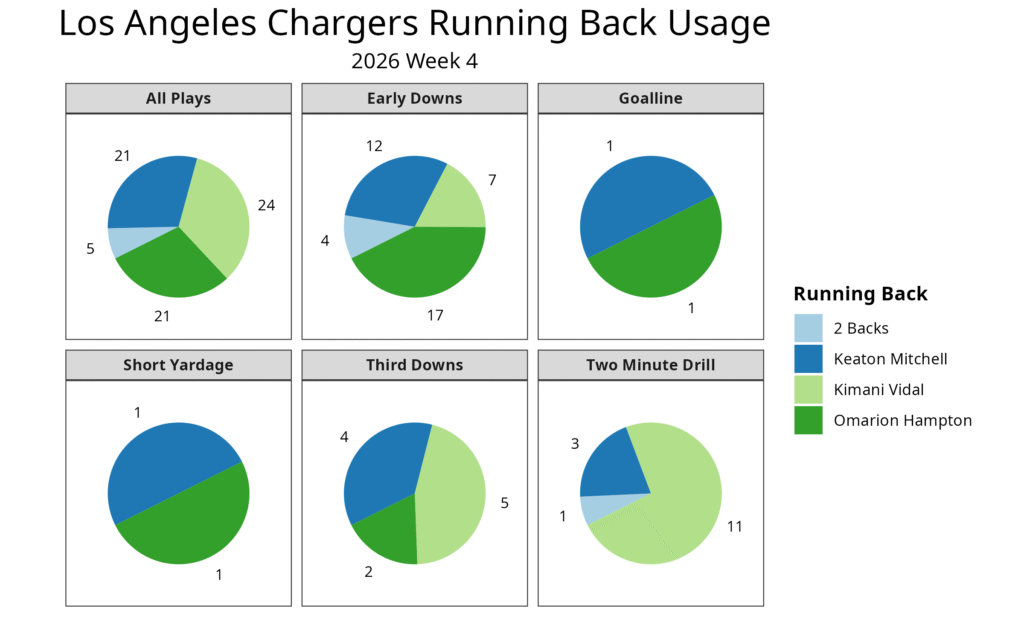
The Chargers embrace a three-man rotation: Keaton Mitchell led the Chargers’ backfield in snaps, playing one more than both Omarion Hampton and Kimani Vidal.
The Chargers started the season with Hampton as their lead back and Mitchell as the primary backup and passing-down option. Kimani Vidal has gradually taken over the majority of the passing-down work while also mixing in on early downs. As Mitchell has lost snaps in obvious passing situations, he has gained work on early downs at Hampton’s expense.
Hampton led the team in rushing yards this week, but Mitchell led the backfield in carries while also catching five passes for 24 yards. It has been a nightmare start for Hampton’s fantasy managers, particularly with most running backs drafted around him performing well. A three-man rotation was always one of the biggest concerns with Hampton, and not only has that concern materialized, but the Chargers also haven’t played as well as expected.
Mitchell should be one of the top running back targets on the waiver wire after recording 15 touches despite all three Chargers running backs being healthy. Hampton, meanwhile, is no longer a must-start fantasy option. If the Chargers start winning more games, Hampton could become easier to trust, but a difficult upcoming schedule means there could be plenty more games like this one.
Monitor Ladd McConkey’s health: McConkey’s foot injury limited him to 24 snaps in this game.
McConkey played a limited role over the first two weeks of the season because of a rib injury before finally returning to his normal workload in Week 3, when he played 88.4% of the offensive snaps. He appeared on the injury report this week with a foot injury, practicing in a limited capacity Wednesday, missing Thursday’s practice and returning on a limited basis Friday. He was listed as questionable but ultimately played.
McConkey’s role looked normal over the first eight drives, as he played 24 of 28 snaps. Tre Harris notably played a little more than Quentin Johnston during that stretch, while Marquez Valdes-Scantling occasionally rotated in for Johnston in 11 personnel. It’s unclear whether McConkey suffered a new injury or aggravated the foot injury he entered the game with, but he was unable to finish.
After McConkey left, Valdes-Scantling consistently joined Harris and Johnston in 11 personnel, with Valdes-Scantling and Harris splitting the slot snaps. Harris and Johnston were the more consistent options in two-receiver sets. In the past, Derius Davis would have been more likely to take on the additional work in 11 personnel, but Valdes-Scantling filled that role in this game.
If McConkey’s injury is serious, Harris would be the Chargers receiver to target on the waiver wire. He led the team with three receptions for 60 yards in this game. Even if McConkey is healthy, Harris has a chance to overtake Johnston as the team’s second receiving option.
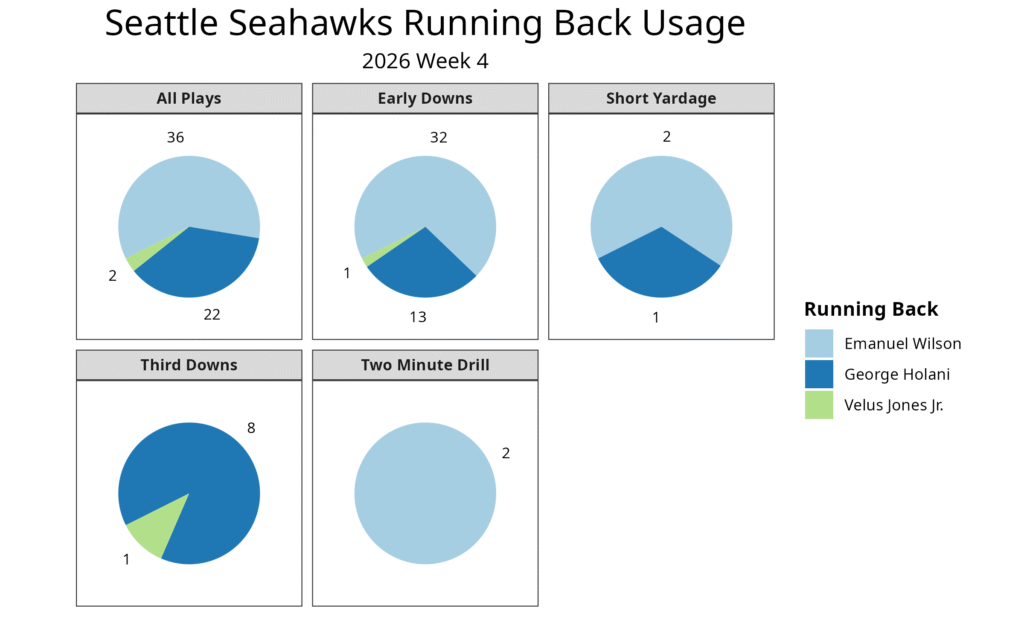
Emanuel Wilson leads the Seahawks backfield for now: Wilson carried the ball 21 times for 81 yards and a touchdown while adding one reception, but his role may be temporary.
The Seahawks started the season with rookie Jadarian Price as their early-down back and George Holani as their receiving back. Wilson began the year primarily as a short-yardage option, but a chest injury to Price in Week 2 led to more of a three-man rotation over the past two weeks. Price aggravated the injury and was placed on injured reserve Saturday, with Velus Jones Jr. signed off the practice squad to take his place. Holani also hasn’t been 100%, as he was limited in practice all week with a rib injury.
As expected, Wilson took over as the early-down back, with Holani serving as his backup and handling the receiving work. Wilson took full advantage of the opportunity and finished as one of the better fantasy running backs of the week.
Wilson should have significant fantasy value in the short term, but his hold on the role isn’t secure. Zach Charbonnet returned to practice on a limited basis last week. While Charbonnet would primarily be expected to take over Holani’s role on third downs and in two-minute situations, there is a chance he could also become the early-down back, at least until Price returns.
There have also been reports that Joe Mixon will work out for Seattle. If Mixon signs and can return to anything close to his previous form, he would likely take a significant portion of Wilson’s workload.
Miscellaneous Notes
- Los Angeles quarterback Justin Herbert appeared to be dealing with knee and chest injuries at times in the fourth quarter, but he remained in the game.
- Chargers rookie wide receiver Brenen Thompson missed his second straight game with a quadriceps injury.
- Chargers tight end Charlie Kolar missed his second straight game with a forearm injury. He took a positive step Friday, practicing on a limited basis. The Chargers elevated tight end Patrick Herbert from the practice squad Saturday to give Los Angeles three tight ends for the game.
- The Chargers’ tight end rotation was identical to last week, with Oronde Gadsden playing primarily in passing situations, Hayden Rucci playing primarily in running situations and the two sharing the field in 12 personnel.
- While Jaxon Smith-Njigba has consistently played in 12 personnel, the Seahawks have gone back and forth between Rashid Shaheed and Cooper Kupp as the other primary receiver in those sets. This week, Shaheed saw more snaps.
- Tory Horton caught a touchdown for Seattle this week, but he played only 10 offensive snaps, fewer than he logged in either of the previous two games.
Denver Broncos @ San Francisco 49ers
The 49ers adjust to their current wide receiver room: Every wide receiver who was expected to make the roster in July is either on injured reserve or was questionable for this game.
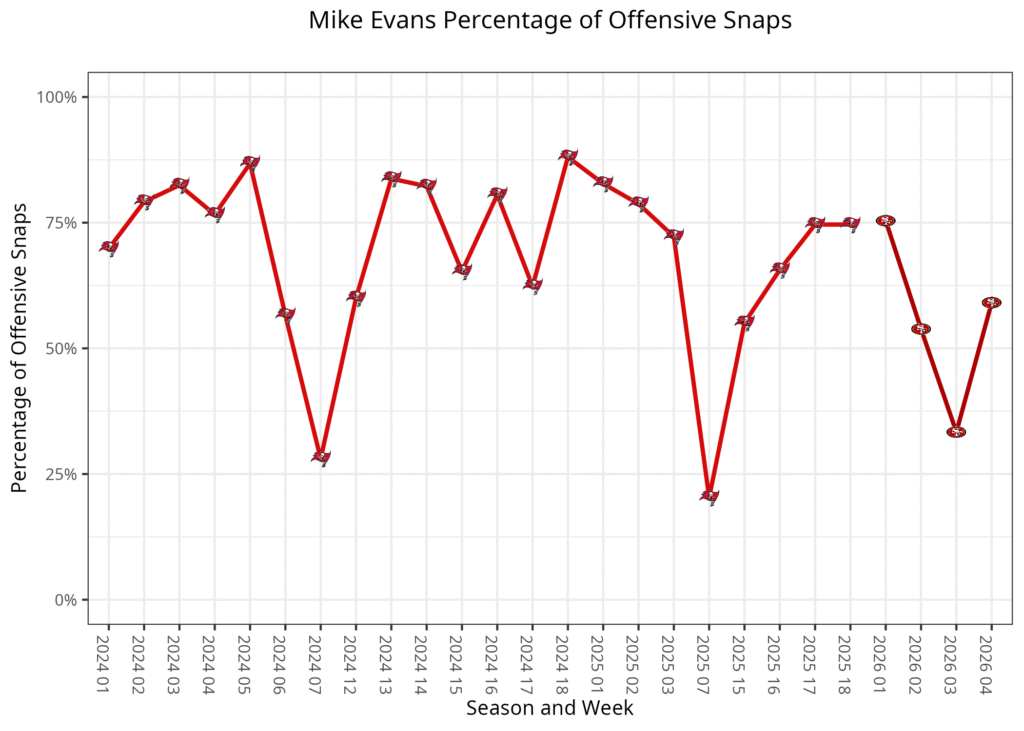
Similar to last season, the 49ers’ wide receiver room has been constantly changing because of injuries. Ricky Pearsall, De’Zhaun Stribling, Demarcus Robinson and Christian Kirk are all on injured reserve. Mike Evans is their top receiver, but he missed practice Wednesday and Thursday with a rib injury before returning on a limited basis Friday. He was listed as questionable but ultimately active.
Deebo Samuel Sr. has been their healthiest wide receiver this season, while Jacob Cowing and Jordan Watkins have been forced to move up the depth chart.
KhaDarel Hodge was another receiver who recently moved up the depth chart, but he also suffered an injury and was subsequently released. San Francisco signed Brandin Cooks off its practice squad to replace Hodge. The 49ers also added Malik Turner to the practice squad Tuesday and elevated him for this game. Turner spent 2022, 2024 and 2025 on San Francisco’s practice squad, appearing in six games without recording a catch. His last NFL reception came in 2021.
Evans played only 59.1% of the offensive snaps but posted a 73.5% route participation rate and was targeted on 32% of his routes. Watkins served as the backup X receiver and played the majority of the snaps in single-wide-receiver sets. Cowing was the third receiver in three-receiver sets, playing 100% of those snaps. Cooks was eased into action, while Turner didn’t play on offense.
None of the receivers outside of Evans and Samuel are likely to have fantasy value unless one of the two misses time. Even if Evans does miss a game, however, Cooks could overtake Watkins as the backup X receiver sooner rather than later.
Monitor Pat Bryant’s health: Bryant suffered a leg injury late in the third quarter and was carted to the locker room.
Bryant has been Denver’s third wide receiver this season, but his role hasn’t been significantly different from those of Courtland Sutton and Jaylen Waddle. All three have played at least 86% of the snaps in 11 personnel. The Broncos have rotated their receivers more heavily in 12 personnel, with Sutton and Waddle playing slightly more than Bryant. Bryant hasn’t played in single-wide-receiver sets, with Troy Franklin handling most of those snaps.
That rotation remained intact in the first half, with Sutton playing 26 snaps, Waddle 24 and Bryant 22. After Bryant’s injury, Franklin took over as Denver’s third wide receiver. The Broncos were playing from behind, so 13 of their final 15 plays came out of 11 personnel. Franklin played both snaps in 12 personnel, lining up opposite Sutton on one and Marvin Mims Jr. on the other.
If Bryant misses time, Franklin should see a significant increase in playing time, but he probably won’t command targets at the same rate as Bryant. Instead, Bryant’s absence could lead to more targets for Sutton and Waddle, slightly improving the fantasy outlook for both.
Miscellaneous Notes
- San Francisco running back Jordan James was a healthy inactive after suiting up last week. That left the 49ers with only two active halfbacks, although Kyle Juszczyk and Deebo Samuel could both fill in during an emergency.
- Juszczyk suffered a leg injury in the fourth quarter and was unable to return. Third-string tight end Brayen Willis saw increased playing time after the injury, including seven snaps in the backfield. If Juszczyk misses time, Willis could continue to fill that role.
- Tight end George Kittle’s playing time has increased each week. He played 90.9% of the offensive snaps after playing 85.2% last week.
- Broncos lead running back J.K. Dobbins had a notably lower snap rate this week, but that was entirely due to game situations. Denver ran 24 plays on third downs and in two-minute drills compared with just seven last week, and Dobbins hasn’t played a single snap in either situation this season.
- Denver wide receiver Marvin Mims Jr. returned after missing the previous two games with a foot injury.
- The Broncos waived wide receiver Lil'Jordan Humphrey on Friday before re-signing him to the practice squad Saturday.
- The Broncos signed fullback Adam Prentice off their practice squad Saturday.
Detroit Lions @ Carolina Panthers
Panthers adjust down two receivers: Jalen Coker and Xavier Legette were unavailable for this game, helping Tetairoa McMillan produce a career-best game.
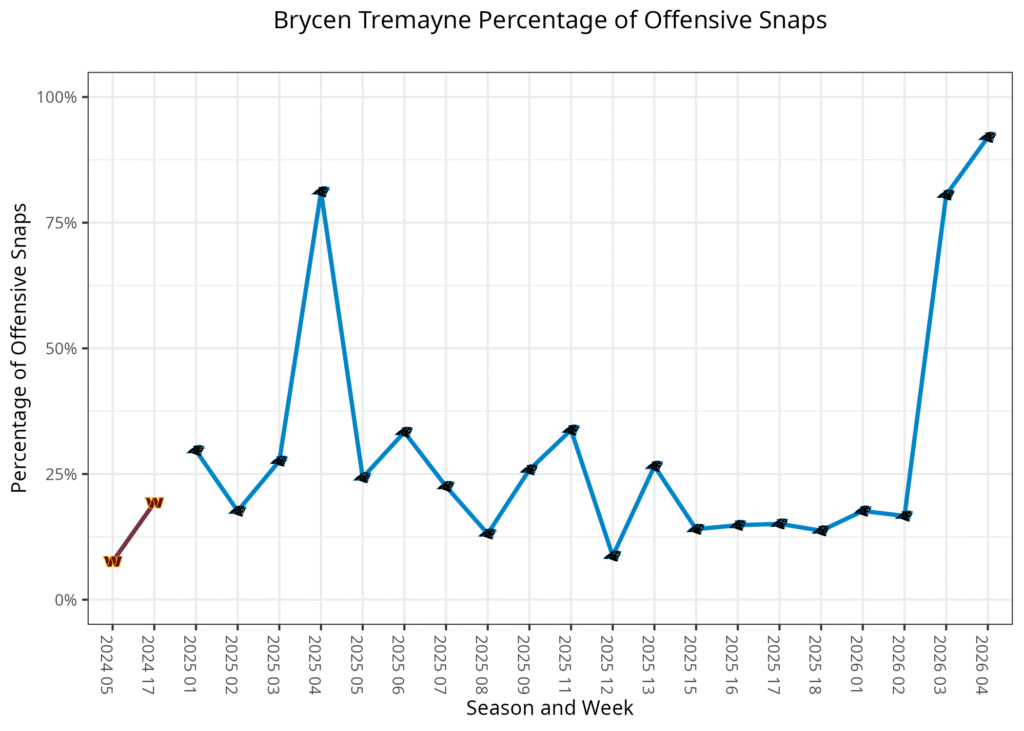
Carolina started the season with McMillan and Coker as its top two receivers, with Legette joining them in 11 personnel. Legette missed last week with a knee injury, leading Brycen Tremayne to take over as the third receiver. The Panthers placed Legette on injured reserve Saturday. David Moore was elevated from the practice squad last week to serve as the fifth receiver and has since been signed to the 53-man roster.
Coker suffered a quadriceps injury last week, leading him to be inactive this week. That pushed Tremayne to second on the depth chart, John Metchie III to third and Moore to fourth, while Ja’seem Reed was elevated from the practice squad to serve as the fifth receiver.
The Panthers followed a similar pattern in this game, with Tremayne playing in 11 and 12 personnel, as well as on many of the snaps in 13 personnel. Metchie typically joined McMillan and Tremayne in 11 personnel, with Reed occasionally mixing in.
Carolina centered its passing game around McMillan. While McMillan’s rate of snaps from the slot was similar to his other games this season, he was targeted on nearly half of his routes from the slot. Nearly half of his receiving yards and both of his receiving touchdowns came when he lined up there. He had only one reception from the slot over the first three weeks.
It will be worth monitoring whether the Panthers increase McMillan’s slot usage after his success there in this game, even though that is where Coker often lines up.
Sam LaPorta plays a decreased role: Detroit rotated its star tight end out more frequently this week than it did over the first three weeks.
LaPorta is typically an every-down tight end when healthy. He played only 80.5% of the offensive snaps in Week 1, in part because he missed time during training camp due to injury. His snap rate increased to 95.4% over Weeks 2 and 3, when he played 93% of the early-down snaps in 11 personnel, 91.7% of the third-down snaps and 100% of the snaps in two- and three-tight end sets.
This week, LaPorta continued to dominate the snaps on third downs and in two-tight end sets, but he rotated out more frequently on early downs in 11 personnel. Brock Wright has been the Lions’ blocking tight end, and he was the primary beneficiary of LaPorta’s reduced playing time. While many of those additional snaps came on running plays, LaPorta still finished with a season-low route participation rate.
The reduced role ultimately didn’t hurt LaPorta’s fantasy production because Detroit spent most of the game passing, leading to four Lions players finishing with at least 70 receiving yards. However, if the Lions’ defense improves and Detroit doesn’t need to pass as frequently in future games, the reduced route participation could hurt LaPorta’s fantasy value.
LaPorta is a reasonable sell-high option after this game.
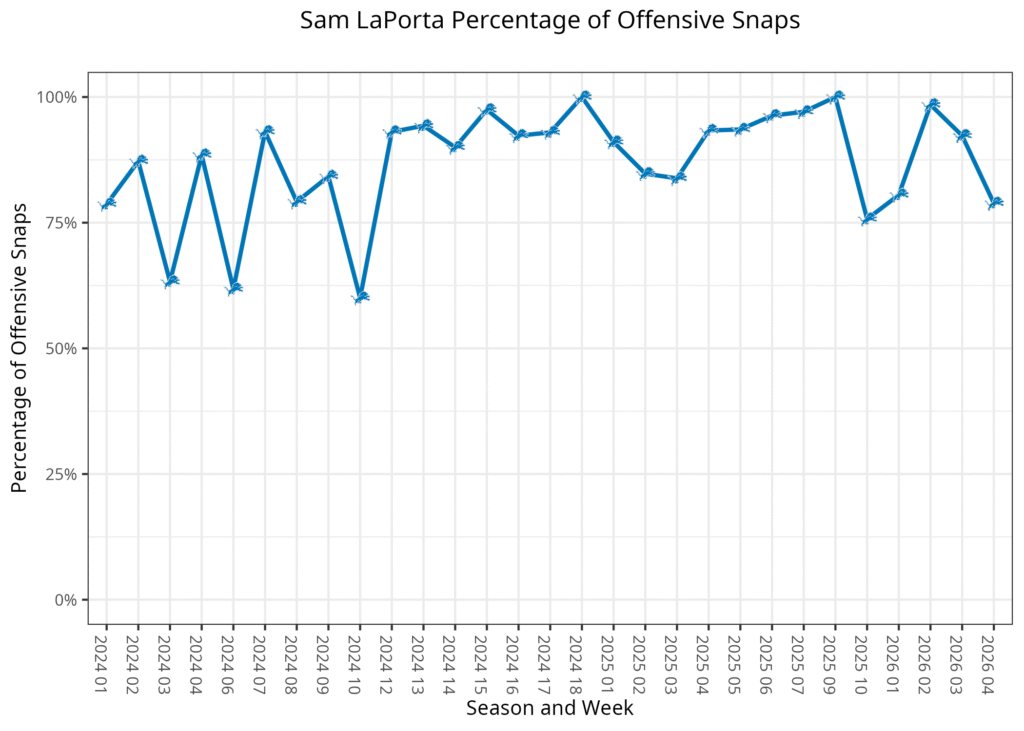
Miscellaneous Notes
- The Panthers’ running back rotation this week was identical to last week, with Chuba Hubbard receiving the vast majority of the work and AJ Dillon taking over when Hubbard needed a break.
- The Panthers signed running back Anthony Tyus III off their practice squad Wednesday. He served as their third running back but didn’t have a role on offense.
- Darren Waller’s role in the Panthers’ offense changed slightly from the previous two weeks. He played more frequently in 11 personnel, handling the majority of the early-down snaps in that personnel grouping for the first time this season. However, he played slightly less frequently in 12 personnel, and the Panthers used more 12 personnel while protecting a lead. We could see a notable increase in Waller’s playing time in games where Carolina is playing from behind.
- Detroit tight end Tyler Conklin was a healthy inactive for the second straight game.
Table Notes
• Snaps include plays called back due to penalties, such as offensive holding or defensive pass interference. The other three stats exclude these plays.
• Targets may differ from official NFL sources. The most likely discrepancy will be from a clear thrown-away pass where the NFL may credit the nearest receiver, but this data will not.
• Carries are only on designed plays. Quarterback scrambles won’t count toward the total number of carries in the game.

 © 2026 PFF - all rights reserved.