- A clear running back rotation for the Pittsburgh Steelers: Pittsburgh used a two-man rotation at running back, but it was with Jaylen Warren and Kenneth Gainwell — not Kaleb Johnson.
- Chris Olave played in the slot: Olave was consistently playing in the slot in three-receiver sets with the Saints' top receivers, suggesting he will play more in that spot this season.
- Subscribe to PFF+: It’s quick and easy. You’ll unlock industry-leading rankings, unlimited Fantasy Mock Draft Simulator use, PFF's Live Draft Assistant and our weekly Start/Sit Optimizer. It’s time to win.
Estimated Reading Time: 16 minutes

Editor's note: Enjoy this PFF+ article and explore others free until Aug. 29.
Nathan Jahnke’s fantasy football recap focuses on player usage and stats, breaking down all the vital information you need to achieve fantasy success in 2025. Here, we touch on only players who are relevant in fantasy football leagues.
These are my 10 biggest reactions to the games from the preseason Week 3 slate. To get a more in-depth breakdown, check out my full recap.
The Steelers used a surprising running back rotation
Jaylen Warren started the game, while Kenneth Gainwell played on third downs.
Most fantasy managers assumed that third-round rookie Kaleb Johnson would be the Steelers’ early-down back this season while Warren played on passing downs. The first two weeks of the preseason showed that Gainwell is clearly in their plans. He was the starter in the two preseason games, whereas Warren was among the veterans who had the day off.
The Steelers have featured a pretty clear rotation in recent seasons. Najee Harris played on early downs and Warren played on third downs, serving as Harris’ backup on early downs. In this game, Warren played in Harris’ role and Gainwell played in Warren’s role. Gainwell was a third-down back at times with the Philadelphia Eagles. Johnson took over on the third drive while other players who started the game were still playing.
This is good news for Warren's and Gainwell's fantasy stocks — and bad news for Johnson. A combination of eight wide receivers and four tight ends either were resting starters or played on the first two drives. Johnson is the Steelers' only skill player who is expected to make the roster but didn’t play until the third drive. While Johnson could end up playing 50% of the team's offensive snaps at some point, it seems like we are at least a few weeks away. Previously, the general thinking was that Warren wouldn't play more than 60% of the snaps, giving Johnson a safe 40% rate. Now, he would need to beat out Warren for any early-down snaps. Anyone drafting Johnson should not expect him to be in their fantasy starting lineup this month.
On the flip side, Warren seems in store for double-digit carries early in the season, as well as a decent amount of work in the passing game. Gainwell is typically going undrafted in fantasy leagues. His upside isn’t all that high, but he could be a borderline fantasy starter in this role in larger leagues.
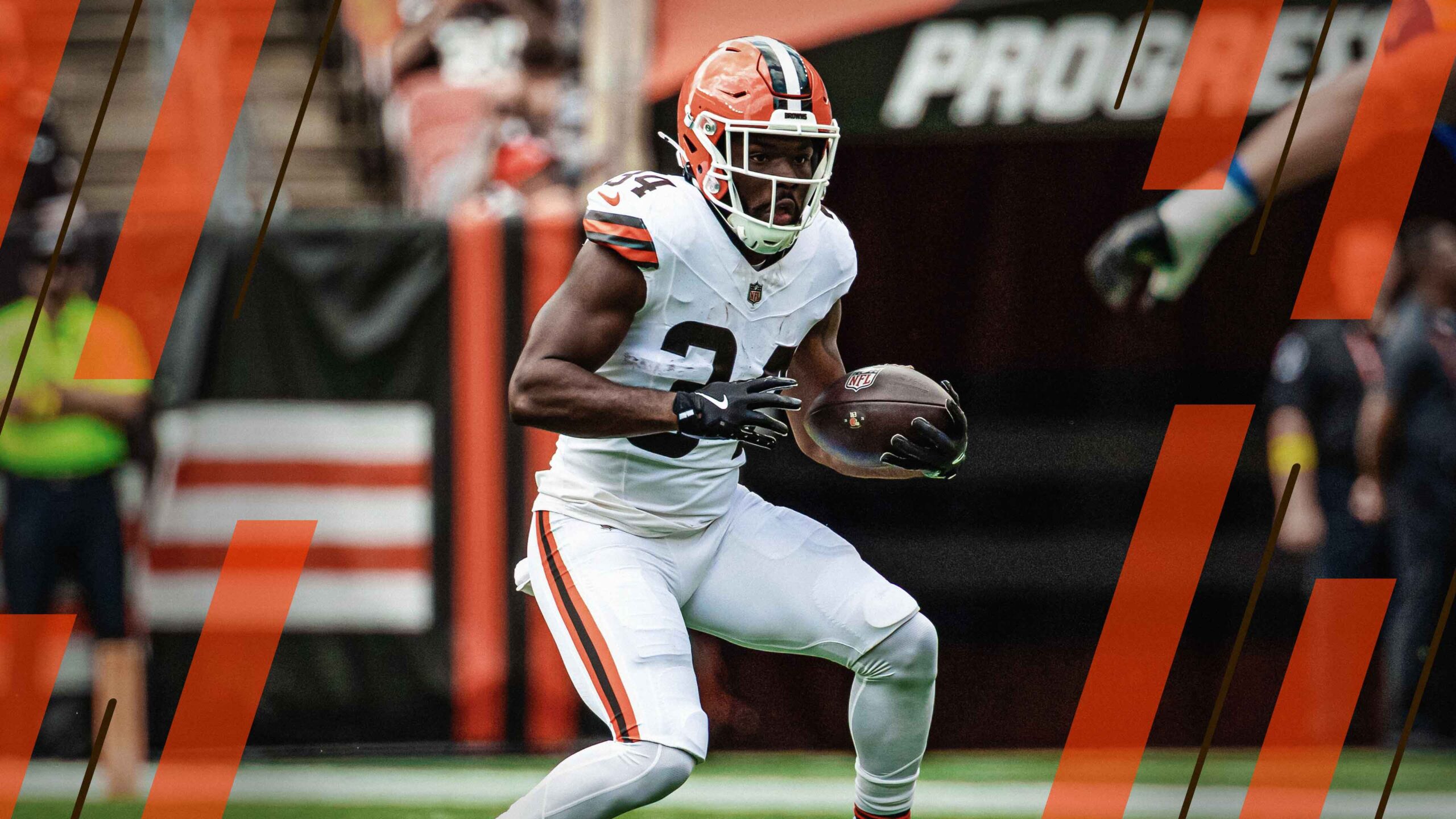
A first look at the Browns’ running back rotation
Jerome Ford made his preseason debut but didn’t start for Cleveland.
Quinshon Judkins is expected to be the team's lead running back at some point, but he has yet to sign his rookie contract or practice with the team. While Judkins is not facing criminal charges, the NFL could still discipline him. His contract is unlikely to be agreed upon until that is resolved. That leaves fourth-round rookie Dylan Sampson and Ford as the top two running backs on the depth chart.
Sampson got the start. He and Ford rotated every few plays, with each taking five snaps on the first two drives. Both received a third-and-long snap, suggesting there is no current clear third-down back or early-down back. Ford caught a pass to begin the third drive, with Pierre Strong Jr. taking over after that point. Both Sampson and Ford were done on offense by then.
It will be difficult for either one of these running backs to be in fantasy starting lineups with this 50-50 split, given the offense and offensive line. However, since they were used interchangeably, it’s possible that one player will start outplaying the other and gain more playing time. Given that the Browns have seen a lot of Ford in recent years, it’s more likely that Sampson, a rookie, takes time away from Ford than the other way around.
Brashard Smith moved up the Chiefs' depth chart
Smith received two targets with the Chiefs on their first drive.
The rookie didn’t appear to be a major part of the Chiefs’ plans through the first two preseason games. He played in the third quarter as the team’s fifth running back in the opener, and he didn’t see the field until the second quarter in the second game, still working as the fifth back on the depth chart.
In this game, Isiah Pacheco started as usual on a longer opening drive. Smith played two second-down snaps and was targeted deep on both, recording a 13.0-yard average depth of target. He dropped the first pass but hauled in the second. Kareem Hunt, returning from a two-week absence due to a quad contusion, also played a snap later in the drive.
Hunt played every snap on the second drive, reinforcing his place as the No. 2 back despite Smith’s earlier involvement. The Chiefs returned to Pacheco on the third drive, continuing the alternating pattern they used last season. Smith took the fourth drive with the backups, indicating he may now be third on the depth chart, leapfrogging Carson Steele and Elijah Mitchell. That shift makes Mitchell a long shot to make the 53-man roster.
Kansas City has traditionally deployed a designated third-down back but didn't use one this preseason. That role likely won’t be clarified until the regular season begins.
Jacory Croskey-Merritt rested for the Commanders
Washington rested more than one-third of its roster, including the en vogue seventh-round rookie.
The Commanders traded former starting running back Brian Robinson Jr. to the San Francisco 49ers, opening the door for a new lead running back to take the reins on early downs. While it’s possible Austin Ekeler will take some of those snaps, he is also the Commanders’ early-down back and a kick returner. At his age, it makes sense for the team to limit his snaps and give the early downs to another player.
Throughout the preseason, those two players were Croskey-Merritt and Chris Rodriguez Jr., while Jeremy McNichols was the primary backup receiving back. In the first preseason game, Croskey-Merritt played in the first half and Rodriguez started to mix in during the second quarter. In the second game, Rodriguez received the start, with a more frequent rotation by drive.
The fact that Croskey-Merritt was among the key players who didn’t play in this game, while Rodriguez played, suggests the rookie is at the top of the early-down depth chart.
Croskey-Merritt’s upside is limited since he’s in an offense that has a third-down back, a backup running back on early downs and a quarterback who is capable of running the ball. Typically, a player in that role doesn’t have a lot of fantasy upside, but the fact that he plays in a high-potential offense gives him potential RB2 value. His consensus ADP is currently RB48, making him a big value, but we also expect his ADP to continue to rise by multiple rounds between now and the start of the season.
Chris Olave took on the slot role
The Saints played all three of their top wide receivers for the first time this preseason.
Brandin Cooks played in the Saints' first preseason game, while Chris Olave and Rashid Shaheed suited up for the second. Across both outings, there was no clear answer as to who would handle slot duties. Cedrick Wilson Jr. served as the primary slot receiver in each game, suggesting Cooks may be viewed more as a depth piece than the team’s No. 3 option.
In this game, the Saints used Olave, Shaheed and Cooks exclusively over the first four drives. The trio shared the field for 11 snaps in 11 personnel. In 12 personnel, Shaheed played all five snaps, Olave played four and Cooks logged just one. Notably, Olave lined up in the slot on all 11 snaps from 11 personnel. That’s a shift from his typical usage — he’s played just 33% of his career snaps in the slot, including only 21% last season and 20% last week. Until now, it appeared he’d remain primarily an outside receiver.
This development could have a significant impact on Olave’s fantasy value. Over the past three seasons, he has averaged 2.23 yards per route run from the slot, compared to 2.16 out wide. New head coach Kellen Moore has a history of slot-heavy production — his primary slot receivers have averaged between 15.3 and 21.5 PPR points per game over the past three seasons. In contrast, most of his outside receivers in three-wide sets have lacked fantasy viability, with A.J. Brown last season being the major exception.
While the Saints' quarterback situation and Olave’s concussion history remain red flags, he has a chance to finish as a top-20 fantasy wide receiver in this role if he can stay healthy. The only potential problem is that the Saints traded a fourth-round pick for Devaughn Vele earlier in the week, and he primarily played in the slot for Denver. If he can surpass Cooks on the depth chart, Vele may become the Saints' top slot receiver, pushing Olave back out wide.
Luther Burden III played one snap with the starters
Burden remains a clear fourth option on the Bears‘ depth chart.
The rookie was projected to be one of Chicago’s top three receivers, but summer injuries delayed his training camp progress. That opened the door for free agent Olamide Zaccheaus, who has taken over as the third wideout in 11 personnel. In the first half, D.J. Moore and Rome Odunze played every snap and Zaccheaus joined them in three-receiver sets. Zaccheaus aligned in the slot on half of those plays, with Moore and Odunze rotating into the slot on the rest. Moore also lined up in the slot on five plays from 12 personnel.
Burden played just one first-half snap, replacing Moore late in the second quarter. He’s rotated between the slot and out wide throughout the preseason, but with the Bears’ wideouts frequently shifting formations, Burden would need to leapfrog a teammate on the depth chart — something that doesn’t appear imminent.
Burden saw extended action in the third quarter, which is telling. Since the NFL moved to a three-game preseason, only four rookie wide receivers drafted in the first three rounds have logged 15 or more second-half snaps in a preseason game: Tutu Atwell, Danny Gray, Amari Rodgers and Jermaine Burton. They combined for just nine receptions as rookies. While Burden projects for a more productive season, he’s not someone fantasy managers should rely on early in the year.

The Broncos‘ receiving room without Devaughn Vele
The Broncos traded Vele to the Saints earlier in the week, freeing up more room for their other wide receivers.
Through two preseason games, the team's wide receiver roles appeared fairly defined: Courtland Sutton held down the starting X role, Pat Bryant backed him up, Marvin Mims Jr. started at Z and Troy Franklin and Devaughn Vele were competing in the slot. Trent Sherfield Sr. was the next man up across multiple spots.
Vele's recent trade most directly benefits Mims. He played both inside and outside last season, with stronger production — measured in yards per route run — coming from the slot. His main issue was playing time; he didn’t top a 50% snap share in any regular-season game outside of the playoffs. This preseason, he’s clearly elevated — Mims was a locked-in starter in the opener and played every snap with the starters in this game, signaling a shift to full-time usage. With Vele out of the picture, Mims and Franklin may now share slot responsibilities. Mims remains one of the top wide receiver sleepers.
The move also helps Franklin. Rather than splitting slot reps, he played the majority of three-wide sets, increasing his path to snaps and targets. He may still fall short of weekly fantasy relevance, but the role gives him a real shot to carve out more volume.
Conversely, the trade had minimal impact on Bryant. Despite being the primary backup to Sutton at X, he didn’t play a single snap with the starters. Instead, Sherfield handled five snaps in 11 personnel. While the Broncos have shown flexibility at Z and slot under Sean Payton, Sutton has held a firm grip on the X role, which limits Bryant’s path to playing time unless he shows more versatility or Sutton misses time.
The Raiders continued their tight end rotation
Brock Bowers drew the start for the Raiders, but Michael Mayer led the tight end group in offensive snaps.
Earlier this week, I detailed why Bowers fell in my rankings based on everything that’s happened this offseason, along with his preseason usage. This game was more of the same. Bowers rotated in and out with Michael Mayer, typically playing a snap before Mayer took two or three, then reentering. The Raiders stuck with 11 personnel while the starters were on the field — an approach that’s unlikely to carry over into the regular season. The team also didn’t face a third-and-long situation with the starters, a scenario where Bowers is expected to see more consistent usage.
Over the past three weeks with Geno Smith under center in 11 personnel, Michael Mayer has logged 14 snaps to Brock Bowers' eight. They’ve split first-down usage evenly, with five snaps each. On second downs, Mayer played seven snaps, while Bowers saw none. On third downs, Bowers played four snaps, compared to two for Mayer.
During the regular season, both tight ends are expected to see more playing time, especially with increased usage of 12 personnel. The team should also face more third-down situations, and Bowers figures to be heavily involved in two-minute drills and come-back scenarios. Still, this usage trend suggests Mayer will continue to take snaps from Bowers in neutral 11-personnel sets, potentially limiting Bowers' route volume and making it harder for him to match his 2024 target total.
Evan Engram played less than half of the Broncos' snaps
This game gave the clearest look at why Engram will be inconsistent for fantasy managers this season.
The Broncos have used both Engram and Adam Trautman together for all three games. Throughout the preseason, they’ve entered and exited the game on the same drives, sharing the field in two-tight end sets, with a general tendency for Trautman to play more on early downs and Engram to play more on passing downs.
This game provided a better look at how the tight ends might rotate, as the Broncos had a blocker. Both fullback Michael Burton and tight end/fullback Nate Adkins missed the entire preseason due to injury. However, the Broncos signed fullback Adam Prentice, with whom Payton had experience in New Orleans, this past week. Denver used 21 personnel only twice with the starters, but Trautman (unsurprisingly) took both of those snaps.
Trautman and Engram split 11-personnel snaps, with nine each. Engram ran a route for seven of nine plays, while Trautman ran a route for only four of nine. Engram ran a route on eight of 15 pass plays. We can expect him to run a route on closer to 60%-65% of routes once the regular season hits.
While Engram has been part of the Broncos' plans in the passing game, that will likely make his fantasy value inconsistent. He should have several weeks as a top-10 fantasy tight end, but there will also be weeks where his fantasy production is minimal.
Colston Loveland and Cole Kmet continued to rotate
Cole Kmet operated as the Bears' primary tight end on the first two drives, while Colston Loveland saw increased usage over the next two.
Last week, Kmet and Loveland rotated almost interchangeably. They shared five snaps in 12 personnel, and each played three snaps in 11 personnel on early downs. Kmet had a slight edge on third downs, playing two snaps to Loveland’s one.
This week, Kmet started and played nine of the first 10 snaps across the opening two drives. Loveland joined for two snaps in 12 personnel and took just one snap in place of Kmet. A false start on the game’s second play may have contributed to Loveland’s limited early usage. He bounced back on the following two drives, logging 17 of 18 snaps, while Kmet played eight. Loveland finished the half with more snaps and routes, though that edge was largely a product of longer possessions, including a two-minute drill.
At this point, Kmet and Loveland appear locked into a true 50-50 split, with both likely to surpass a 50% snap share due to the team’s frequent use of 12 personnel. Their interchangeable usage is notable — Loveland has already earned the staff’s trust in all situations, which gives him a path to increased playing time. That sets them apart from most tight end tandems, where one typically leans more as a receiver and the other as a blocker, limiting the receiving threat’s snaps on early downs.

 © 2026 PFF - all rights reserved.