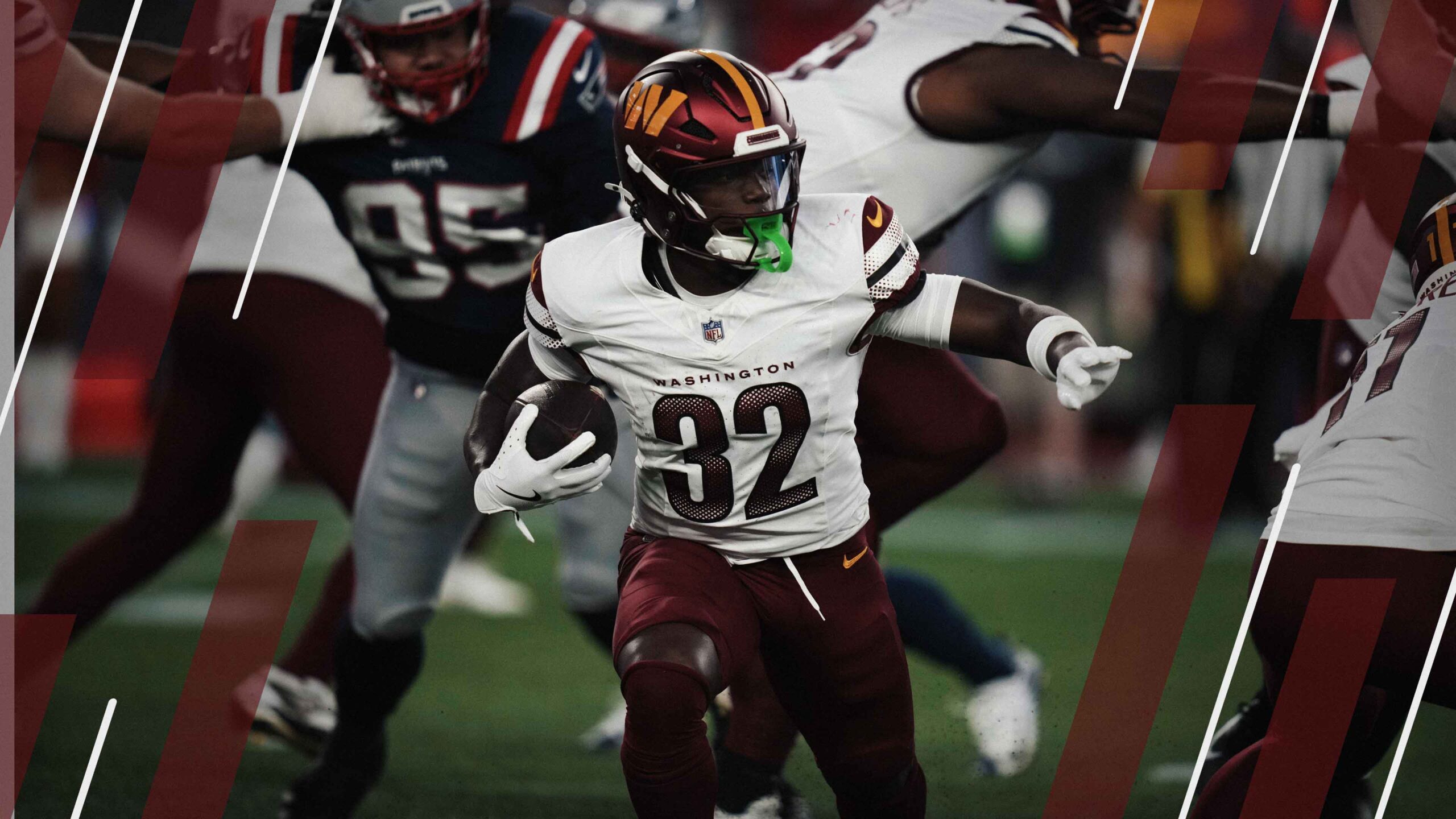
- Shrine Bowl and combine success: Jacory Croskey-Merritt showcased his potential with an impressive Shrine Bowl performance and strong combine results.
- Commanders' backfield shakeup: Croskey-Merritt's rapid ascent on the Washington Commanders‘ depth chart suggests a significant role in 2025.
- Data, tools and expert insights: Use code earlybird to save $20 on your PFF+ annual subscription.
Estimated Reading Time: 5 minutes

PFF’s Fantasy Football Player Profile series delivers the most in-depth fantasy football analysis available for the 2025 season.
Using PFF’s exclusive data, we evaluate player performance, competition for touches and how teammates and coaching staffs will impact each player's fantasy football outlook.
Last updated: 8:15 p.m. Sunday, August 17
Player performance
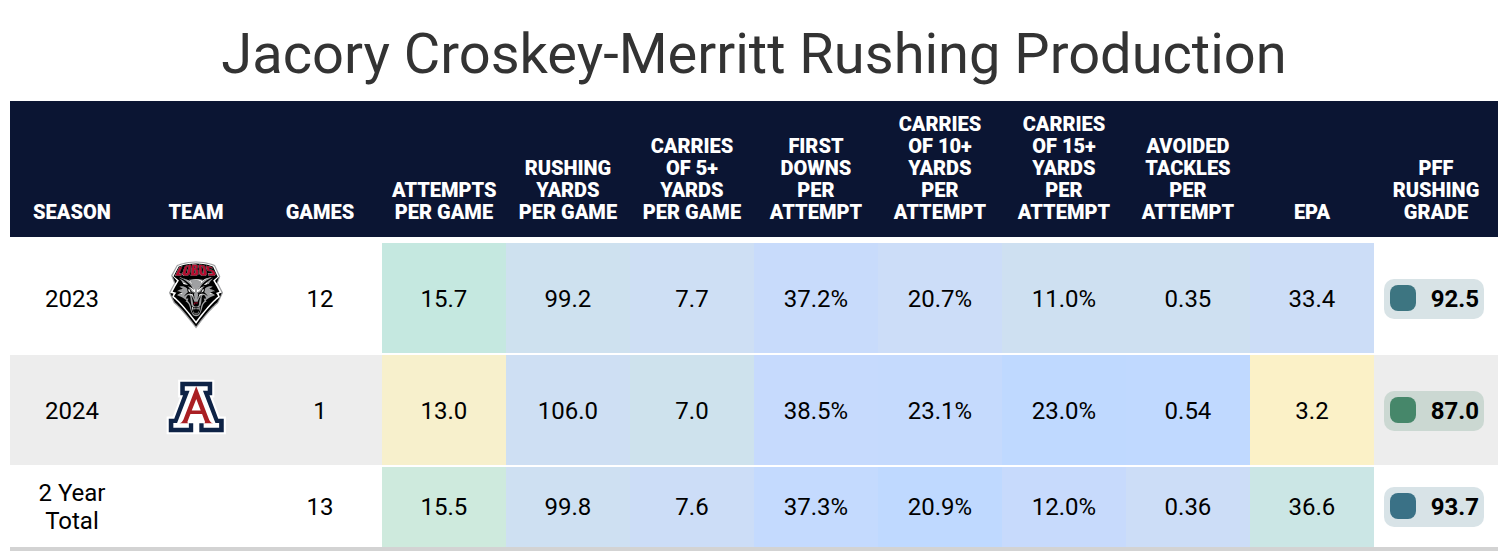
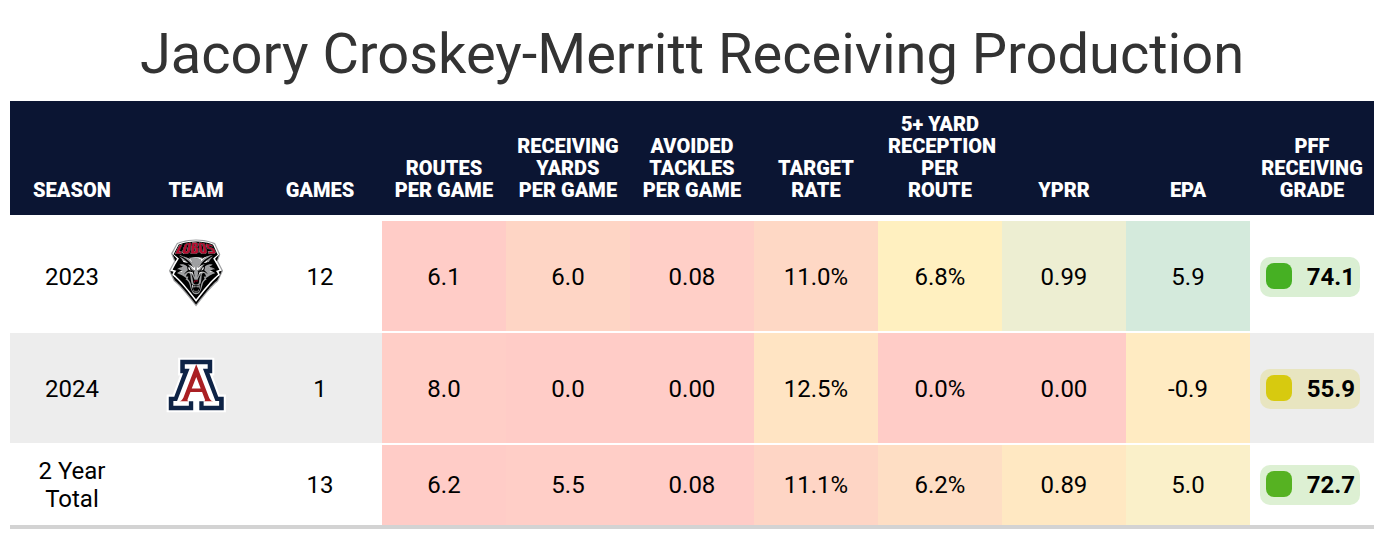
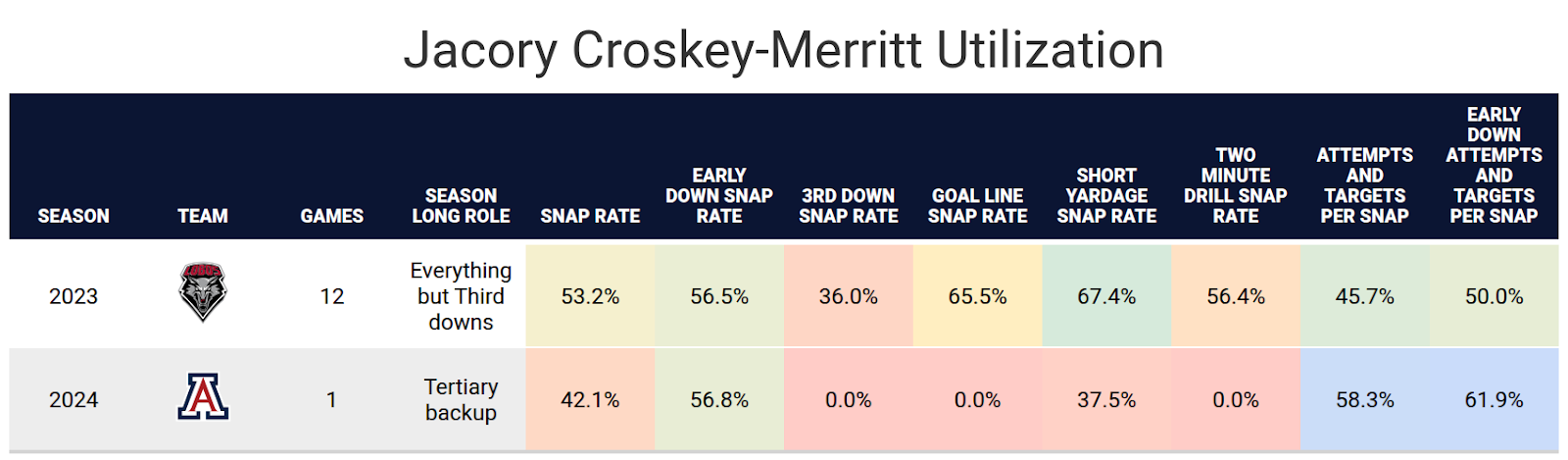
Jacory Croskey-Merritt spent 2019-2022 as a running back for Alabama State, playing a significant role in 2021 and 2022 with a steadily improving grade each season. He transferred to New Mexico in 2023 and significantly improved in both the running game and passing game, averaging a first down and breaking long runs at a ridiculously high rate, albeit against a lower level of competition than most running backs from the 2025 draft class. He was primarily used as a runner with New Mexico and was very rarely used as a receiver. When he was, he earned a decent grade.
He transferred to Arizona in 2024 and played one game, but an eligibility issue arose, which made him no longer eligible. He looked great on a relatively small sample, albeit against his former team, New Mexico. He played in the Shrine Bowl, gaining 97 yards on 11 carries and two touchdowns.
Croskey-Merritt impressed at the combine, finishing in the 80th percentile or better in the 40-yard dash, 10-yard split, vertical jump and broad jump. While his combine results were great, his PFF tracking data suggests a below-average speed compared to other running backs at the top of the draft class. However, he was faster than Cam Skattebo, Jordan James and Tahj Brooks.
Projected role
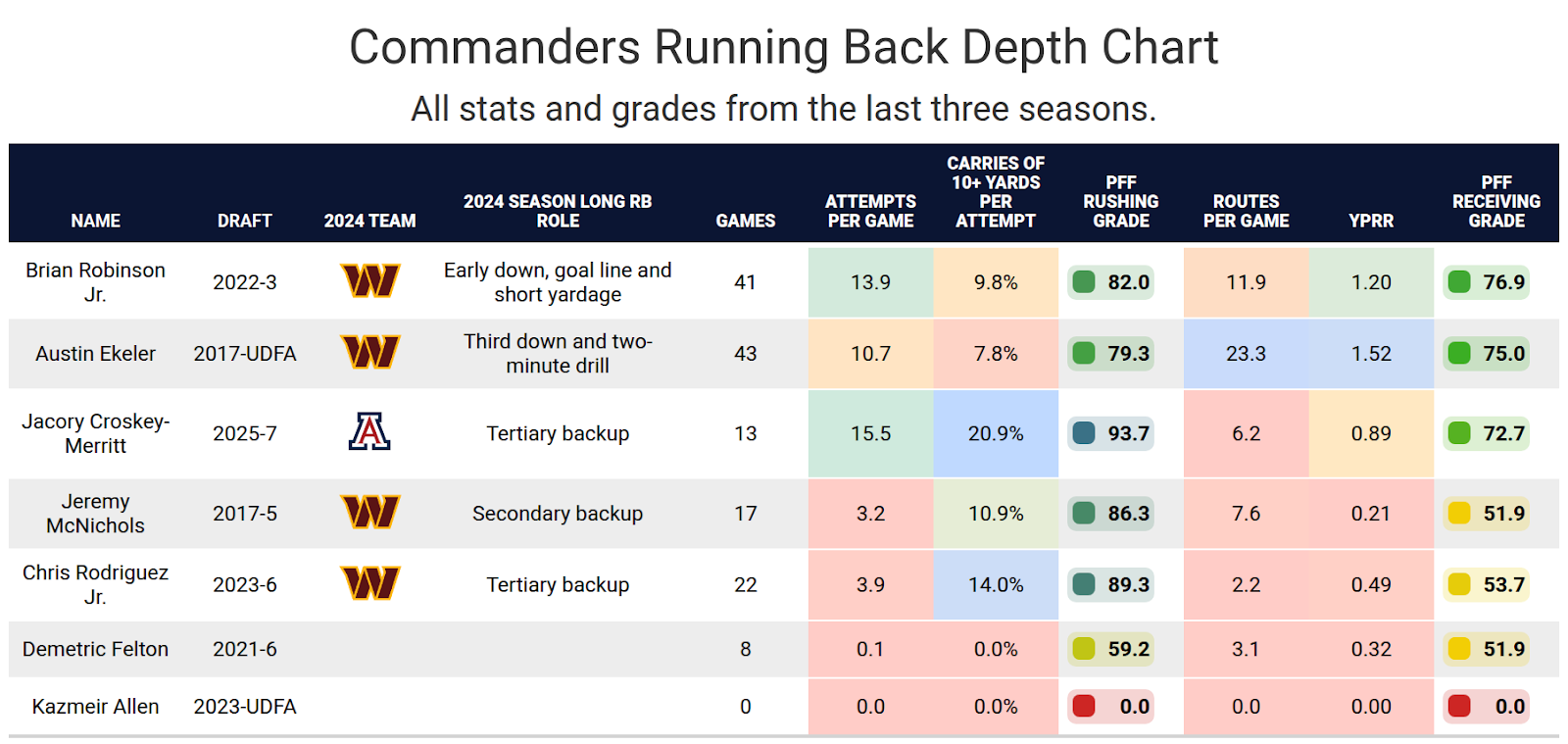
Croskey-Merritt was selected by the Washington Commanders, who had a crowded backfield last season with Brian Robinson Jr., Austin Ekeler, Jeremy McNichols and Chris Rodriguez Jr. The Commanders have used one clear early-down back and one clear receiving back in their games. Robinson has been the primary early-down back, and Ekeler has been the primary receiving back. This initially made it seem like Croskey-Merritt’s path to playing time would be very difficult.
However, he was already playing ahead of both McNichols and Rodriguez in the Commanders’ first preseason game. Robinson and Ekeler had the game off, but Croskey-Merritt served as the primary early-down back while McNichols was the receiving back. Rodriguez didn’t play until much later in the game, suggesting he was a clear fifth on the depth chart.
This made it seem like Croskey-Merritt would be the clear handcuff if Robinson were to get injured. Robinson has missed time every season, so it seemed likely that Croskey-Merritt would be the primary rusher for Washington at some point this season. However, Jordan Schultz of Fox Sports has reported that the Commanders have been shopping Robinson.
This suggests Washington is comfortable with Croskey-Merritt being their primary early-down running back. Even if Robinson isn’t traded, they will want their best runner on the field, and it seems like they believe that is Croskey-Merritt.
Impact of teammates
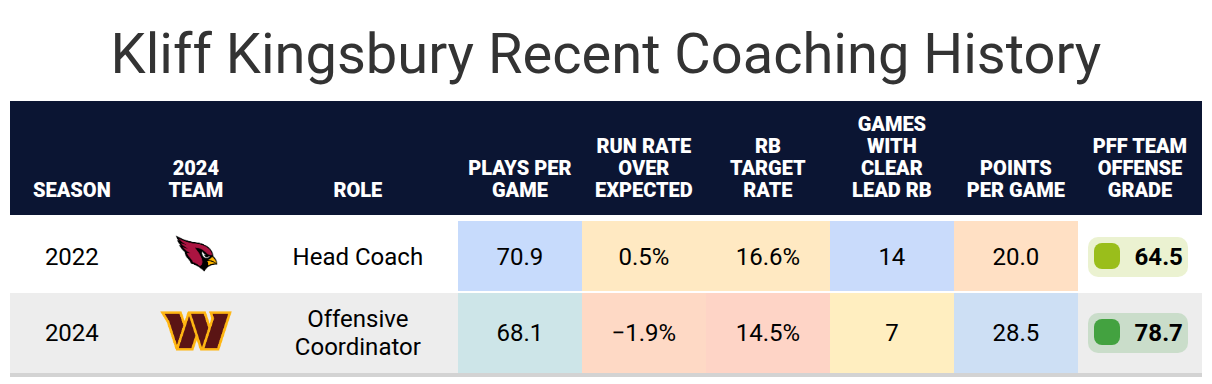
Croskey-Merritt will play in Kliff Kingsbury’s offense, where his running backs have often been fantasy starters when healthy. He’s had an every-down back at times but has also had an early-down back with a passing-down back. Given that Croskey-Merritt wasn’t used on third downs in their first preseason game and wasn’t even used very often at New Mexico, it seems very likely his role will only be as an early-down back. Kinsbury’s offenses have been balanced, producing a low rate of throwing to running backs. Deebo Samuel‘s presence at wide receiver will likely keep the target rate to running backs low.
Jayden Daniels is a quarterback who can run, which could also potentially limit the running backs. The Commanders didn’t necessarily use him on the one-yard line like other running quarterbacks, but that could change with Croskey-Merritt. Brian Robinson was noticeably bigger than Daniels, but Croskey-Merritt is slightly smaller.
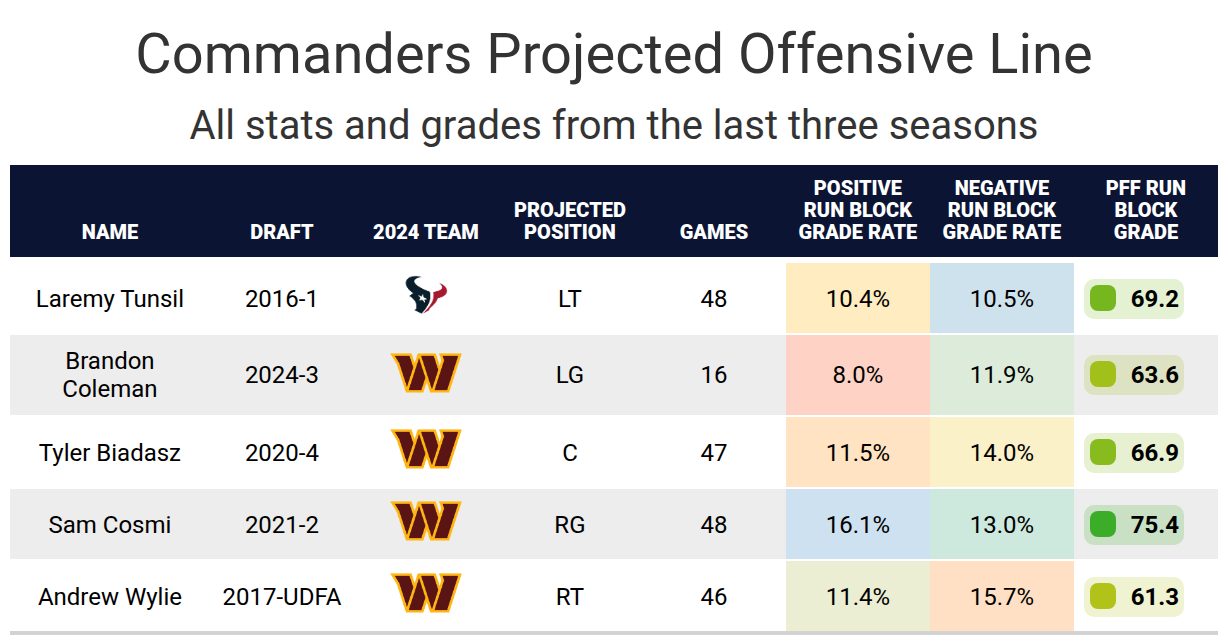
The Commanders made changes to the offensive line in 2024, which didn’t work out as well as expected. The three interior linemen all graded worse than at earlier points in their careers, despite being at an age where they should be around their prime. Brandon Coleman played fine for a third-round tackle for a rookie. The Commanders replaced their weakest link on the line with Laremy Tunsil, who is known for being an excellent pass protector, but he’s also been an adequate run blocker. The line should be improved over what it was last season, but the question is by how much.
Bottom line
Croskey-Merritt is about to fly up draft boards faster than most sites have their ADPs updated. This will especially be true if the Commanders find a trade partner for Robinson. He is worthy of being one of the top 32 running backs drafted, but you ideally won’t have to draft him that high.
Footnotes
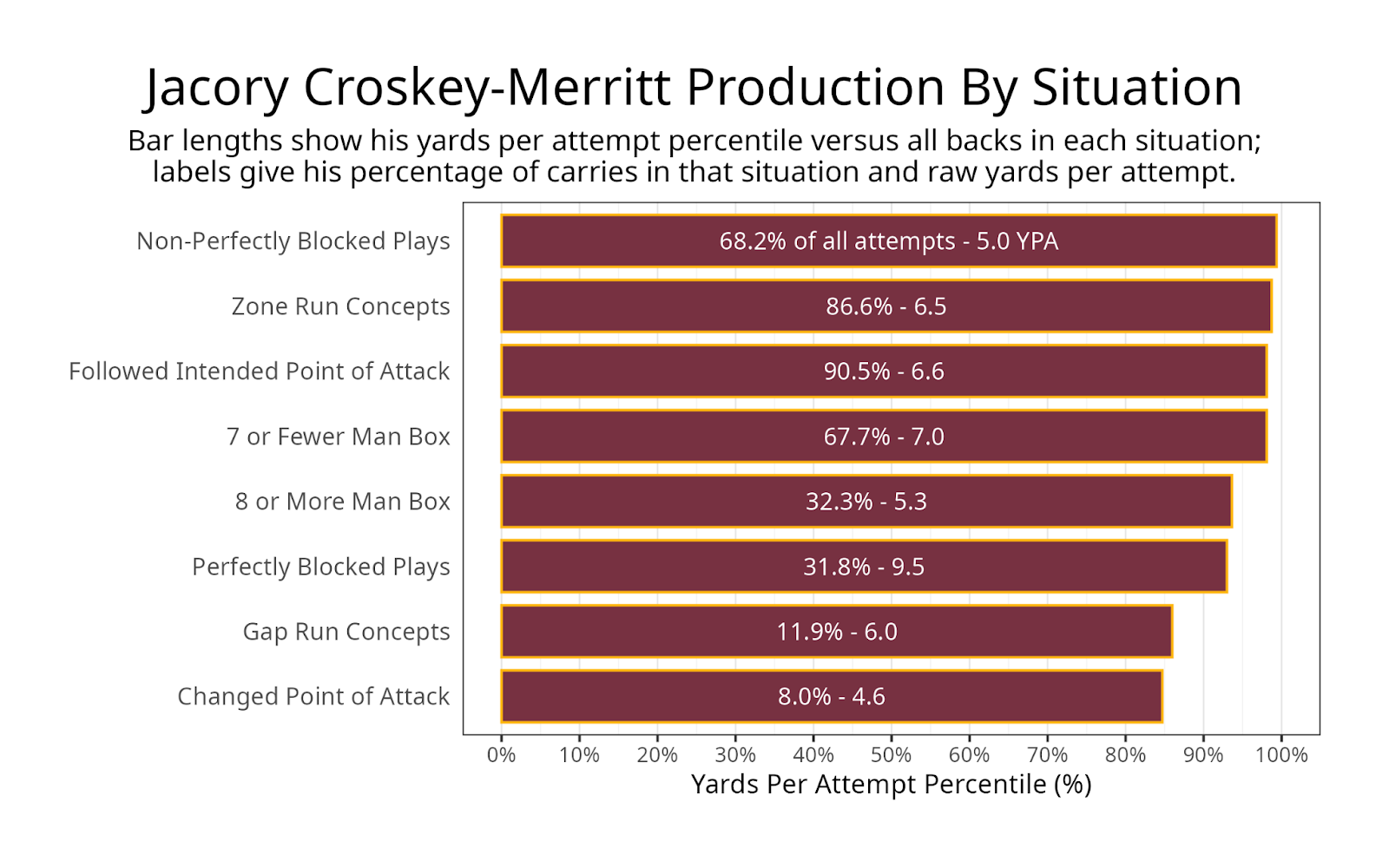
- Statistics in tables and charts were chosen based on their ability to predict future fantasy performance on a per-game or per-opportunity basis or to describe the player relative to others at the same position.
- “Opportunities” are defined as passing dropbacks, rushing attempts and routes run as a receiver.
- Numbers are provided either by season or based on the past three years. For rookies, only college statistics are included. For non-rookies, only NFL statistics are considered, regardless of whether they played in college within the previous three years.
- As college competition is easier than NFL competition, most rookies are likely to see a decline from their historical numbers.
- Only FBS data is considered for college players and comparisons.
- Kneel-downs are removed from rushing data to provide cleaner quarterback rushing rate statistics.
- The table colors in this article range from blue (indicating good/high) to red (indicating bad/low).
- All percentiles and color codings compare the given player to others with a high sample of opportunities. Generally, the cutoff is one-third of the possible opportunities in the sample. If a player does not meet the threshold, they are still included in the comparison, though their results may appear better or worse than expected due to the smaller, less predictive sample size.
- Information on utilization classifications and their importance can be found here for running backs, wide receivers and tight ends.

 © 2026 PFF - all rights reserved.