- The Seattle Seahawks will look far different on offense: The team has a new offensive coordinator, a new quarterback and three new wide receivers to join Jaxon Smith-Njigba at the top of the depth chart. The changes might not be good news for Smith-Njigba’s fantasy production.
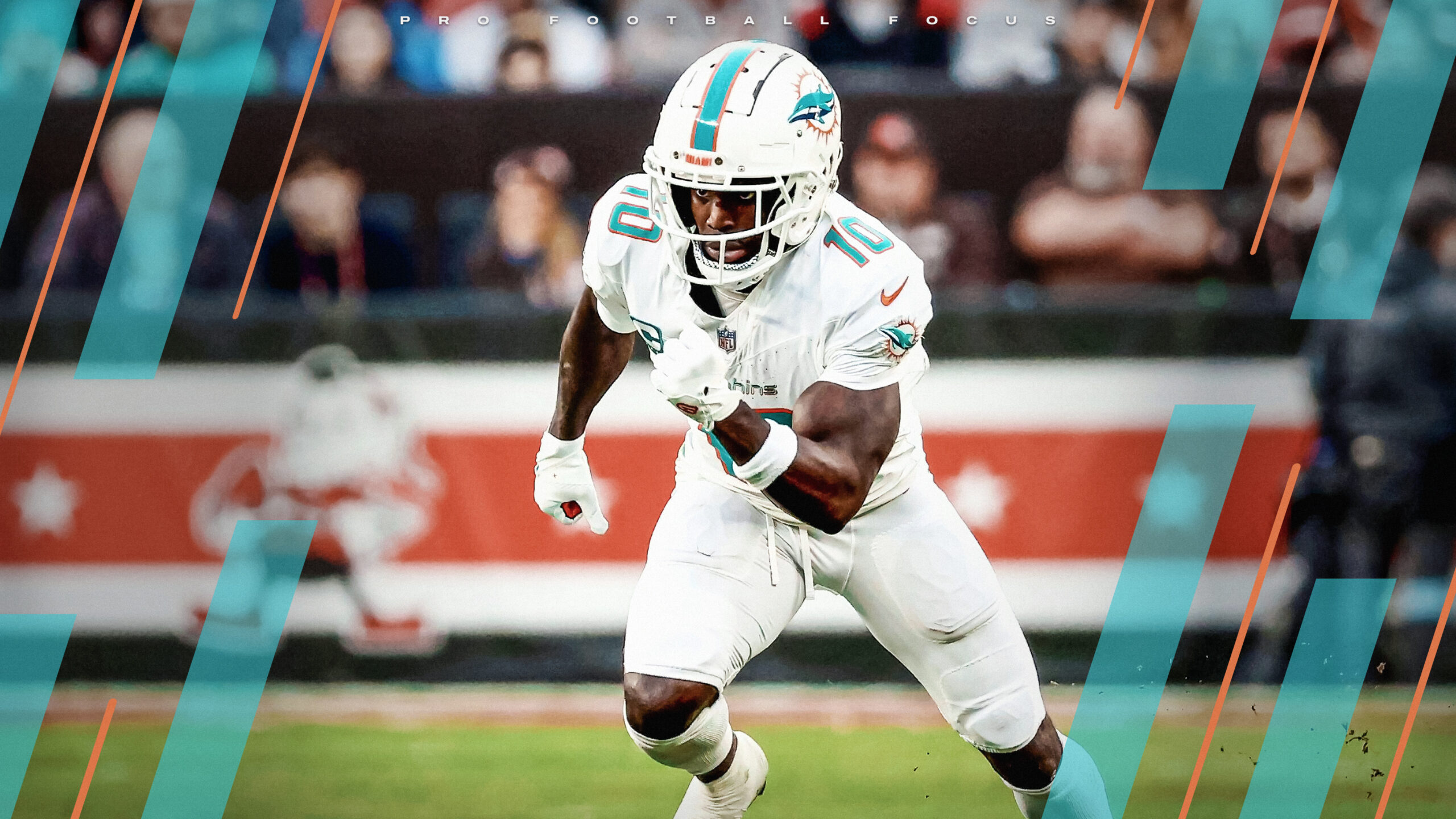
- A big step back in 2024: Tyreek Hill played every game, and his routes per game increased from the previous two, but his yards and fantasy points per game were nearly cut in half.
- Win with PFF+: From draft day to championship week, PFF+ is the ultimate Fantasy sidekick. Get the Fantasy Mock Draft Simulator, Live Draft Assistant, Fantasy Draft Kit, weekly waiver suggestions, Start/Sit Optimizer and more.
Estimated reading time: 20 minutes

In an ideal world, every player will put up the same stats as their best season, if not better, in 2025. Unfortunately, there are several reasons why a player might not reach those same heights. Specifically for wide receivers, this could include changes at quarterback, changes in competition, or simply the player playing another year past their prime. The wide receivers in this article are being drafted like they will put up similar numbers to recent years, but there is a reason to expect a decline in fantasy production.
The average draft position listed is from a consensus between ESPN, Sleeper and Yahoo! for where the player is picked on average in a 12-team, redraft league.
Last updated: Thursday, August 28
Ladd McConkey, Los Angeles Chargers (ADP: 2.12)
The Chargers drafted McConkey at the start of the second round of the 2024 NFL Draft. He immediately had a role as the team's slot receiver while playing on the outside for a decent number of snaps. He started slightly slower than other rookies, with 26-67 yards over his first six games. He caught six passes for 111 yards and two touchdowns against the New Orleans Saints and had another two relatively quiet games, but over the rest of the season, he was a must-start player.
McConkey scored at least 14.5 PPR points in each of his final seven regular-season games. From Week 11 until the end of the season, he averaged 18.7 PPR points per game, the 11th-best figure for a wide receiver during that time. He saved his best for last, with a nine-catch, 197-yard and one-touchdown performance in a playoff loss to the Houston Texans. If including that effort, he averaged 20.7 PPR points per game over his last eight contests.
Most receivers who primarily play in the slot tend to be strong against zone defense and not as great against man. His 2.98 yards per route run against man defenses ranked second among the 57 receivers with at least 115 routes against man. That includes the third-highest receptions per route rate (21.1%) and the most avoided tackles per route against man (0.65).
The main reason for his recent declining ADP is the Keenan Allen signing. A secondary reason could be that he has missed some practice time due to injury, but he has recently returned to practice. McConkey’s lack of competition for targets was one of the reasons for optimism for McConkey, despite an average routes per game rate. The Chargers had Quentin Johnston and subbed out Joshua Palmer for second-round rookie Tre Harris as his primary competition, which would be no problem for his target rate. Allen has four years of experience as Justin Herbert’s top target. While McConkey will continue being the team’s top target, this has led to a decrease in his projected targets.
Allen also has experience out of the slot, which is where McConkey primarily plays. Both Allen and McConkey are fully capable of playing on the outside, but there is at least a slight chance that there will be some plays where McConkey is off the field while Allen is in the slot. It’s also worth noting Kyren Williams and Chase Brown‘s ADPs are in the same ballpark as McConkey's. Williams had a new contract extension, and the hype around Brown has been high since the release of Zack Moss. That could also contribute to McConkey’s fall.
McConkey will continue to play under offensive coordinator Greg Roman and catch passes from Justin Herbert. Having Herbert as a quarterback is great because he’s one of the few top passers in the league. McConkey will remain the team's clear top target, despite the changes that were made to the wide receiver room.
There has been a concern all offseason due to Roman’s past as an offensive coordinator and the other changes that were made on offense. During his four-year stretch as the San Francisco 49ers‘ offensive coordinator, two years in the same position with the Buffalo Bills and four years with the Baltimore Ravens, Roman ranked in the bottom two in targets to wide receivers and the top two in run rate. The Chargers recorded only the 10th-highest run rate and the 15th-highest rate of throwing to wide receivers in 2024.
That will likely change this season. The team added Omarion Hampton and Najee Harris at running back, Tyler Conklin at tight end and Mekhi Becton at guard. First and foremost, that allows them to run the ball more frequently. Part of the reason they passed so much relative to Roman’s past teams is Herbert, but it was also due to having two running backs whom they moved on from this offseason, and no team prioritized picking them up, even on league-minimum contracts.
Now the Chargers have two running backs they prioritized and a right guard who ranked in the top 10 at the position in PFF run-blocking grade last season. That will result in a decrease in routes per game by McConkey this year.
Conklin is a more experienced receiving tight end than the others on the Chargers' roster, while Hampton should be a better receiving back than those whom Los Angeles featured last season. This could also lead to a slightly lower target rate for the wide receivers in general.
McConkey proved he could be a top-five fantasy wide receiver at the end of last season. The road to get there could be a little more difficult in 2025, as the Chargers added several players who could lighten McConkey's load. A top-15 finish is much more likely than a top-five finish.
Jaxon Smith-Njigba, Seattle Seahawks (ADP: 3.09)
The Seahawks made Smith-Njigba the 20th overall pick in the 2023 NFL Draft, joining entrenched starters D.K. Metcalf and Tyler Lockett as the third wide receiver in three-receiver sets. He averaged 64% of Seattle's offensive snaps during his rookie season, ranging from 44% to 82%. Naturally, he played more in losses, where he was typically in the 67%-75% range. In wins, he was typically in the 52%-66% range. Smith-Njigba caught a pass in every game but never gained more than 63 yards in an outing.
Smith-Njigba’s role changed in his second season, as he played more often in two-receiver sets. He averaged 86% of Seattle's offensive snaps in 2024, including playing at least 94% of the snaps in four of the last five games. He showed his potential in Week 2 with 12 receptions for 117 yards against the New England Patriots. His stat lines during the rest of September and October were reminiscent of his rookie season.
He then posted the best game of his career against the Los Angeles Rams, with seven receptions for 180 yards and two touchdowns. This time, he built on that momentum with six consecutive games of notching at least 70 receiving yards. From Weeks 9-16, he averaged 21.8 PPR points per game, which ranked second among wide receivers. He disappeared in the last two games of the season during two victories, catching a combined seven passes for 41 yards.
Seattle completely changed its wide receiver room, moving on from long-term starters D.K. Metcalf and Tyler Lockett this offseason. In their place, Seattle added veterans Cooper Kupp and Marquez Valdes-Scantling and fifth-round pick Tory Horton. Kupp is Smith-Njigba’s primary competition for targets. He was a great receiver earlier in his career, but his PFF receiving grade has dropped to 71.1 and 72.3 over the past two seasons, respectively. Talent-wise, Smith-Njigba should be the clear top option in the Seahawks' offense.
His fit with Kupp is interesting because both Smith-Njigba and Kupp have primarily been slot receivers in the NFL.
New Seahawks offensive coordinator Klint Kubiak has bounced around with four teams in the past four seasons, but there have been a few trends, including using three-receiver sets at a low rate. The New Orleans Saints were an extreme example last season after injuries to Chris Olave and Rashid Shaheed, and the San Francisco 49ers have generally been extreme throughout Kyle Shanahan’s time with the team. However, the trend has still been true in Kubiak's other landing spots.
This means Smith-Njigba and Kupp will play out wide more than usual. If Seattle uses three-wide receiver sets only 50% of the time and the two split the slot snaps evenly, both could line up in the slot for roughly 25% of their snaps. Smith-Njigba has a better yards per route run lined up out wide compared to the slot, so that might not be a terrible move for his fantasy value.
Kubiak’s offenses haven’t had a clear slot receiver in the past, with a lot of players typically sharing the role. Jerry Jeudy was the only wide receiver to surpass 500 yards out of the slot (519) in a Kubiak offense over the past four seasons, while Smith-Njigba racked up 993 of his yards from the slot last season. Either Kubiak’s offense will need to adapt to Smith-Njigba, or Smith-Njigba will need to adapt to the offense.
One concern is that Kubiak’s offenses have relied a lot on the run game, and that will likely be the case for the Seahawks. Kubiak may want the best run-blocking wide receivers on the field for some early-down plays. Smith-Njigba is the smallest of the Seahawks' top wide receivers, and his 42.2 PFF run-blocking grade is the 11th lowest among 80 wide receivers with at least 1,000 snaps in the past two seasons. Kupp ranks 12th at 60.3, while Valdes-Scantling places 33rd at 54.6. Rookie Tory Horton is also noted to be a willing blocker. Smith-Njigba might be back to primarily playing in three-wide receiver sets in this offense in 2025.
Kubiak’s offenses have also featured low target rates to wide receivers. Seattle has a strong running back room and just invested a second-round pick in tight end Elijah Arroyo. The team's offenses in recent years have been run-heavy, but the wide receivers were always the focal point of the passing game. The wide receivers who have produced in Kubiak’s offenses have generally had an average depth of target over 12 yards — notably higher than Smith-Njigba's and Kupp's figures last season. One exception was Adam Thielen, who was WR28 in 2021. The other was Deebo Samuel, who was WR15 in 2023 (but WR34 when ignoring his rushing production).
Smith-Njigba showed promise with Seattle last season, but volume is king in fantasy football. His production is built on volume, and it’s fair to question how much volume he will see in 2025. Past Klint Kubiak wide receivers haven’t produced the same way Smith-Njigba did last season.
Tyreek Hill, Miami Dolphins (ADP: 3.06)
Tyreek Hill is a future Hall of Fame receiver who made an All-Decade team, five first-team All-Pros and has a Super Bowl under his belt. His best season was 2023, when he earned 1,799 yards and 13 touchdowns. He finished second in fantasy points per game and was an early first-round pick in redraft leagues in 2024. While Hill played every game, he wasn’t nearly as effective.
His routes per game were up over last season, but his target rate was down 13%, leading to fewer yards per route run and EPA. Part of this could have been injury-related. He showed up on the injury report with a foot injury in late October before spending November, December and early January dealing with a wrist injury. Reports after the season said he dealt with the wrist injury since training camp, and he had multiple surgeries this offseason to help it.
However, he also dealt with hip, foot, hand, ankle and wrist injuries in 2023. He was great in Week 1 with seven receptions for 130 yards and a touchdown. Then Tua Tagovailoa suffered an injury in Week 2, so Hill only had one game when both he and his quarterback were fully healthy. It would be understandable that he was getting less separation if he was dealing with a leg injury all season, but it was a wrist injury causing him problems, which shouldn’t impact his separation much.
Hill’s entire game is built on speed, and at 31 years old, it would be understandable if he just doesn’t have the same speed as earlier in his career, which would impact his game. There is also a chance that injuries caused most of Hill’s problems last season, and he can rebound. Despite the down season, he still ranks first among wide receivers in targets per route (0.293), yards per route (2.88) and PPR points per route (0.593) over the last three seasons.
Hill’s usage has been consistent throughout his time in Miami, a Z receiver who can play significant snaps from the slot. Hill’s deep target rate notably declined last season, while his contested target rate increased, further hinting that something other than his wrist was a problem last season.
Hill’s primary competition for targets remains nearly identical to last season, led by wide receiver Jaylen Waddle and running back De’Von Achane. The Dolphins traded away Jonnu Smith and traded for Darren Waller. Smith and Achane provided more competition for targets compared to other recent seasons, contributing to Hill’s decreased targets. Waller will likely have fewer targets than Smith, but Waller is still more competition for targets at tight end than Hill was used to in 2022 and 2023.
Hill, at his best, is an elite option in fantasy football, but we didn’t see Hill at his best last season. It’s possible that a wrist injury and injuries to Tua Tagovailoa derailed his season and are a thing of the past. However, a lower separation rate, lower deep target rate and higher contested target rate suggest the 31-year-old receiver isn't the same player he once was. He is more likely to disappoint fantasy managers than not, but the chance of getting a top-two fantasy wide receiver in Round 4 or later will be too good for some fantasy managers to pass up.
D.K. Metcalf, Pittsburgh Steelers (ADP: 4.10)
D.K. Metcalf was a second-round pick by the Seattle Seahawks in 2019, and he became an instant starter for Seattle. The Seahawks' offenses typically highlight the 5-foot-10 wide receivers who can also play in the slot, including Golden Tate, Doug Baldwin and Tyler Lockett. The Seahawks' X receivers went from USC‘s Mike Williams to Sidney Rice to Jermaine Kearse before going to Metcalf, but none of those receivers exceeded 800 receiving yards in a season with Seattle.
Metcalf’s statistics peaked in 2020, when he caught 83 passes for 1,303 yards and 10 touchdowns. He finished with the seventh-most fantasy points that season. Metcalf’s receiving grade has ranged from 75.0 to 82.7 after his rookie season. His receiving yards per game dropped in 2021 and hovered around 57-70 yards per game through the following four seasons.
In 2024, Metcalf was off to a great start, accumulating three consecutive 100-yard games in September. He was 11th in fantasy points over the first seven weeks while averaging 15.1 PPR points per game. It was set up to be his best season since 2020. However, he pulled his MCL, which cost him two games, but he also didn’t look the same after that point. He was held to 70 receiving yards or less over the rest of the season.
Metcalf is the prototypical X receiver. He’s 6-foot-4 and 235 pounds, can handle press coverage better than most receivers and plays better against man defense and when he’s lined up out wide. He was traded to the Pittsburgh Steelers this offseason and signed a four-year, $132 million contract extension with $80 million guaranteed. Head coach Mike Tomlin has had 1,000-yard seasons by Antonio Brown, JuJu Smith-Schuster, Mike Wallace, Santonio Holmes, Hines Ward, Diontae Johnson and George Pickens. The only one taller than 6-foot-1 was Pickens, the player Metcalf is replacing.
The bad news for Metcalf is he’s joining Arthur Smith’s offense, which has been the most run-heavy in the league. He doesn’t use many three-wide receiver sets, which won’t be an issue for Metcalf, but his offenses also don’t target wide receivers as often as most teams. A.J. Brown averaged 71 receiving yards per game under Smith with the Tennessee Titans then jumped to 86 per game with the Philadelphia Eagles. Drake London also improved after Smith’s departure, going from 53 to 75 yards per game.
The Steelers signed Aaron Rodgers to be their quarterback. Rodgers has never had a wide receiver with the same combination of size, speed and athleticism. Rodgers is on the downside of his career, totaling three consecutive seasons below an 80.0 passing grade. Metcalf was uniquely suited to play with Geno Smith, who was the sixth-most accurate quarterback last season on passes 15 yards in the air or more, while Rodgers was merely average. Rodgers is used to a lot of play-action and motion, which has not been Smith’s offense. Rodgers has a low rate of first-read targets, which also isn’t great for Metcalf. The pairing is an awkward fit, but on the bright side, the addition of Rodgers might make the Steelers more pass-heavy than in recent seasons.
D.K. Metcalf is a talented receiver whose fantasy value will likely take a step back in the Pittsburgh Steelers‘ offense. Ideally, the signing of Aaron Rodgers makes the team more balanced, and Rodgers force-feeds Metcalf, but there is a chance the fit will be awkward.
Jayden Reed, Green Bay Packers (ADP: 10.04)
Jayden Reed was a second-round pick by the Green Bay Packers during the 2023 NFL Draft. In the Packers' first preseason game, Reed was the third wide receiver in three-receiver sets, and his role hasn’t changed in the last two seasons. Reed started slowly, finishing only one week as a top-40 fantasy wide receiver in the first five games. After the Packers' Week 6 bye week, Reed finished as a top-36 fantasy wide receiver in 10 of his last 12 games. He shined at the end of that season, finishing with eight receptions and one rushing touchdown in Week 14, six catches for 52 yards and a touchdown in Week 15, six receptions for 89 yards and two touchdowns in Week 17 and four receptions for 112 yards in Week 18. He averaged 20.0 PPR points per game over those last five weeks.
Part of his success was due to the injuries to other Packers players. Packers wide receivers Romeo Doubs, Christian Watson and Dontayvion Wicks, in addition to tight end Luke Musgrave and running backs Aaron Jones and A.J. Dillon, all missed various lengths of time during the five-game stretch, allowing Reed to touch the ball more often. The Packers were generally healthier in 2024, as new starting running back Josh Jacobs and tight end Tucker Kraft started all 17 games each. Wicks didn’t miss a game, while Watson and Doubs only missed a few games each.
Reed was an excellent fantasy option early in the season when the Packers needed him. In Green Bay’s first three losses, he caught four passes for 138 yards and a touchdown, seven receptions for 139 yards and a touchdown and five receptions for 113 yards. However, in the Packers' victories, they could focus on the run game and didn’t need Reed as much. He averaged 2.9 receptions for 33.3 yards in all other games last season. Reed averaged 14.8 PPR points per game over the first half of the season, 19th-best among wide receivers, and 8.0 over the second half, 64th-best among wide receivers.
Reed’s role in the Packers' offense has been a big detriment to his fantasy value. He’s played 87.3% of Green Bay's offensive snaps when the Packers have three or more receivers on the field and 4.6% of the snaps when the Packers have two or fewer wide receivers on the field. The Packers only use three or more receiver sets on two-thirds of their plays, so there is one-third of the plays where Reed is very likely off the field.
Typically, players in this role can only be fantasy-relevant if they have a very high target rate, which Reed doesn’t, or a team stays in 11 personnel the vast majority of plays, which the Packers don’t. The only reason Reed is considered for fantasy is his high deep target rate mixed with his success on those targets.
If anything, Reed could play fewer snaps this season. Christian Watson is expected to miss most, if not all, of the season. Doubs and Wicks return on the outside. Green Bay added Matthew Golden in the first round and Savion Williams in the third round of the NFL draft. Doubs, Wicks, Golden and Williams are all relatively inexperienced in the slot, but all have a higher yards per route run in the slot compared to out wide.
Reed has been a rare deep threat from the slot, but Christian Watson has also been a deep threat for Green Bay. Reed averaged 57 yards per game when Watson’s been inactive, and 47 yards per game when Watson has been active. However, Golden will take Watson’s place as the outside deep threat for Green Bay, likely cutting into Reed’s deep targets.
The additions at wide receiver make it unlikely Reed will start playing in two-receiver sets. Offensive coordinator Adam Stenavich mentioned that Williams, in particular, can play all over the field and potentially receive handoffs like Reed. He mentioned Reed needs to stay fresh, which, if anything, means less playing time.
Reed is also dealing with a fractured foot. He has recently returned to practice but plans on playing through the injury.
Reed’s fantasy value declined last season with fewer routes per game, largely from the Packers being healthier and the team playing better. After the Packers drafted two new wide receivers, it’s unlikely we'll see Reed have more consistent fantasy value this year. Ideally, Reed is drafted as a top backup who can be started when the Packers are underdogs or playing in a close game.

 © 2026 PFF - all rights reserved.