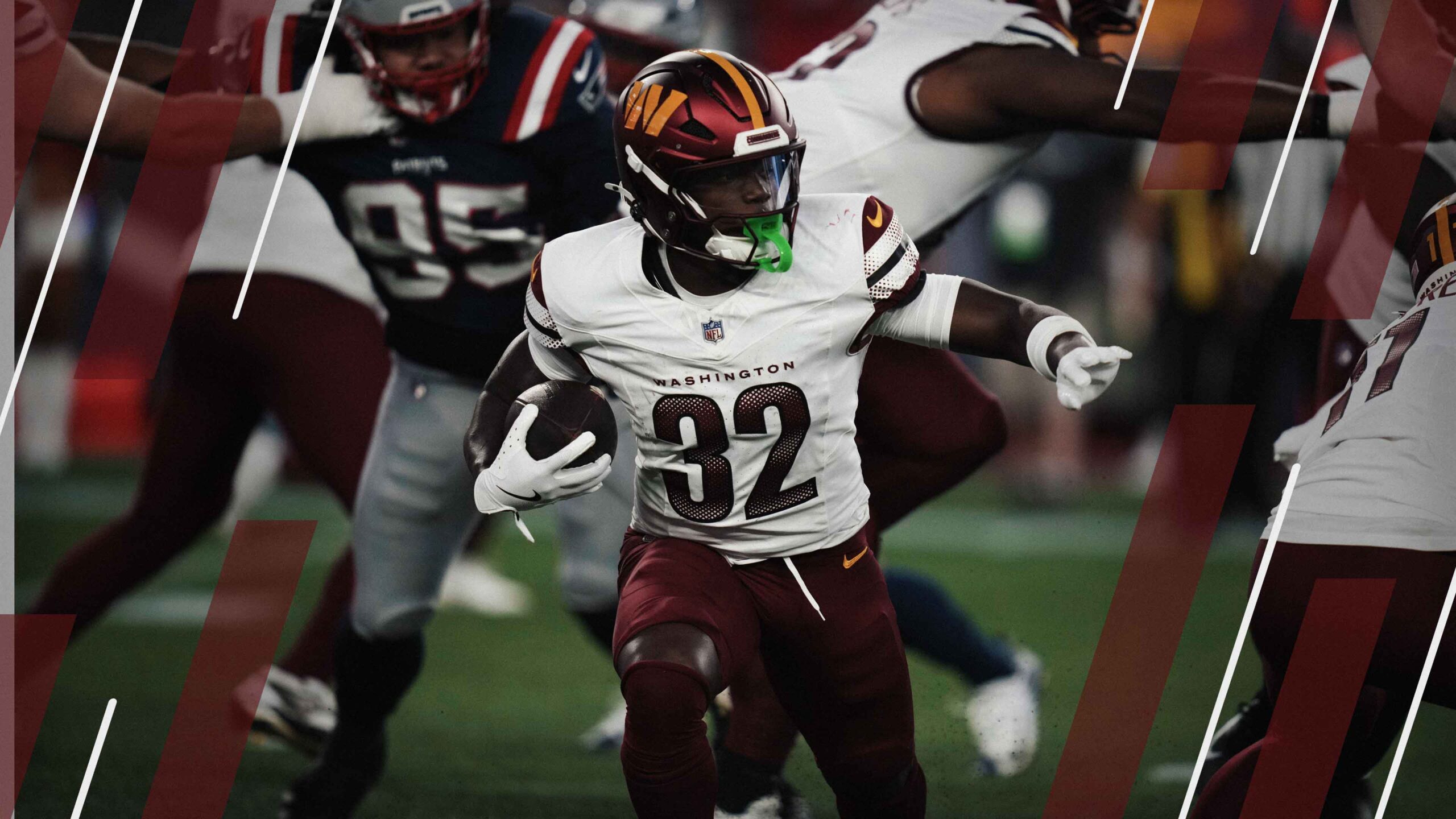
- Shrine Bowl and combine success: Jacory Croskey-Merritt showcased his potential with an impressive Shrine Bowl performance and strong combine results.
- Tank Bigsby flashed potential in relief of Travis Etienne Jr.: Bigsby delivered multiple 100-yard, two-touchdown performances while filling in for the injured starter.
- Subscribe to PFF+: Get access to player grades, PFF Premium Stats, fantasy football rankings, all of the PFF fantasy draft research tools and more!
Estimated reading time: 16 minutes

Regardless of whether a team goes zero-running back, hero running back or robust running back, it makes sense to target at least one late-round running back who has a chance to become their team's starter. Generally, the top players who are projected to be at the top of their team’s depth chart are gone in the first 10 rounds, but there are plenty of running backs with high upside available later in drafts. Players like J.K. Dobbins last season and De’Von Achane and Raheem Mostert the year before were steals in this range.
We're identifying five running backs who are being drafted from the 11th to 14th rounds and could end up becoming weekly must-start options.
The average draft position listed is from a consensus between ESPN, Sleeper and Yahoo! for where the player is picked on average in a 12-team, redraft league.
Last updated: Friday, August 29
Jacory Croskey-Merritt, Washington Commanders (ADP: 14.07)
Jacory Croskey-Merritt spent 2019-2022 as a running back for Alabama State, playing a significant role in 2021 and 2022 with a steadily improving grade each season. He transferred to New Mexico in 2023 and significantly improved in both the running game and passing game, averaging a first down and breaking long runs at a ridiculously high rate, albeit against a lower level of competition than most running backs from the 2025 draft class. He was primarily used as a runner with New Mexico and was very rarely used as a receiver. When he was, he earned a decent grade.
He transferred to Arizona in 2024 and played one game, but an eligibility issue arose, which made him no longer eligible. He looked great on a relatively small sample, albeit against his former team, New Mexico. He played in the Shrine Bowl, gaining 97 yards on 11 carries and two touchdowns.
Croskey-Merritt impressed at the combine, finishing in the 80th percentile or better in the 40-yard dash, 10-yard split, vertical jump and broad jump. While his combine results were great, his PFF tracking data suggests a below-average speed compared to other running backs at the top of the draft class. However, he was faster than Cam Skattebo, Jordan James and Tahj Brooks.
Croskey-Merritt was selected by the Washington Commanders, who had a crowded backfield last season with Brian Robinson Jr., Austin Ekeler, Jeremy McNichols and Chris Rodriguez Jr. The Commanders have used one clear early-down back and one clear receiving back in their games. Robinson has been the primary early-down back, and Ekeler has been the primary receiving back. This initially made it seem like Croskey-Merritt’s path to playing time would be very difficult.
However, he was already playing ahead of both McNichols and Rodriguez in the Commanders’ first preseason game. Robinson and Ekeler had the game off, but Croskey-Merritt served as the primary early-down back while McNichols was the receiving back. Rodriguez didn’t play until much later in the game, suggesting he was a clear fifth on the depth chart.
This made it seem like Croskey-Merritt would be the clear handcuff if Robinson were to get injured. The second game wasn’t as promising because Rodriguez started over Croskey-Merritt but then Robinson was traded. Croskey-Merritt was among the key players to sit out in their final preseason game, while Rodriguez played in the game. This suggested that Croskey-Merritt was back ahead of Rodriguez and the top running back on the depth chart for early downs.
Croskey-Merritt will play in Kliff Kingsbury’s offense, where his running backs have often been fantasy starters when healthy. He’s had an every-down back at times but has also had an early-down back with a passing-down back. Given that Croskey-Merritt wasn’t used on third downs in their first preseason game and wasn’t even used very often at New Mexico, it seems very likely his role will only be as an early-down back. Kinsbury’s offenses have been balanced, producing a low rate of throwing to running backs. Deebo Samuel‘s presence at wide receiver will likely keep the target rate to running backs low.
Jayden Daniels is a quarterback who can run, which could also potentially limit the running backs. The Commanders didn’t necessarily use him on the one-yard line like other running quarterbacks, but that could change with Croskey-Merritt. Brian Robinson was noticeably bigger than Daniels, but Croskey-Merritt is slightly smaller.
The Commanders made changes to the offensive line in 2024, which didn’t work out as well as expected. The three interior linemen all graded worse than at earlier points in their careers, despite being at an age where they should be around their prime. Brandon Coleman played fine for a third-round tackle for a rookie. The Commanders replaced their weakest link on the line with Laremy Tunsil, who is known for being an excellent pass protector, but he’s also been an adequate run blocker. The line should be improved over what it was last season, but the question is by how much.
Croskey-Merritt is about to fly up draft boards faster than most sites have updated their ADPs. His consensus ADP has improved by five rounds over the last week. He should be one of the top 32 running backs drafted, but you, ideally, won’t have to draft him that high.
Tank Bigsby, Jacksonville Jaguars (ADP: 12.05)
Tank Bigsby was a third-round pick in the 2023 draft by the Jacksonville Jaguars and entered the league with significant preseason hype as a potential sleeper. He scored a touchdown on seven carries in Week 1 but also made a critical mistake, picking up what he thought was an incomplete pass — actually a live ball — which led to a turnover. He also had a pass go through his hands and into a defender’s arms for an interception. Bigsby didn’t touch the ball in Week 2, and in Week 3, another drop nearly resulted in an interception.
From Weeks 3 to 10, he logged two to three carries per game for minimal yardage, lost a fumble in Week 8 and tipped another pass into a near-interception in Week 10 — his final target of the year. He ended the season with just one reception and three drops on four targets. After a 2.3 yards per carry average on nine attempts in Week 11, Bigsby saw minimal playing time until the final two weeks, where he logged 13 carries.
His 2024 season began on a better note, with 12 carries for 73 yards in Week 1. However, he didn’t play on offense in Week 2 and barely saw the field in Week 3. He bounced back in Week 4 with seven carries for 90 yards and played at least 20% of offensive snaps the rest of the season. From Weeks 4 to 8, with Travis Etienne Jr. limited or sidelined, Bigsby ranked as the RB20.
He returned to a reduced role and missed a game in November but saw an uptick again in December as Etienne’s effectiveness waned, logging double-digit carries in each of the final five games and ranking as the RB28 in that stretch. Bigsby showed strong efficiency, averaging 3.74 yards after contact per attempt (third among RBs) and 0.28 avoided tackles per attempt (fifth), but ball security and receiving remained issues — he fumbled four times and dropped two passes, catching just seven balls all season (0.4 per game).
Bigsby demonstrated in 2024 that he can be a borderline fantasy starter when given a significant role. He finished as a top-24 fantasy running back in half of the games where he played at least 50% of offensive snaps and was heavily involved in short-yardage and goal-line situations.
Looking ahead, Bigsby will continue to compete for snaps, not only with Travis Etienne Jr. but also with rookie Bhayshul Tuten. Tuten is a smaller, speedier back with solid receiving skills and strong rushing grades in college. The size difference between Bigsby and Tuten may actually work in Bigsby’s favor, as it could allow the two to complement each other more naturally than Etienne and Tuten would. Bigsby remains the biggest back on the roster, which could help him retain a role in goal-line packages.
Still, while the contrasting skill sets are encouraging for Bigsby’s role stability, Tuten’s presence alone makes it harder for Bigsby to carve out the kind of consistent fantasy value he had during parts of last season.
The Jacksonville Jaguars’ new head coach, Liam Coen, brings optimism after overseeing a productive Tampa Bay offense in 2024. If Tank Bigsby can secure a goal-line role, he could benefit from more scoring opportunities. However, Coen’s past running backs — like Bucky Irving and Cam Akers — have generally been smaller and more dynamic, a profile that fits rookie Bhayshul Tuten more than Bigsby. The only recent exception, Rachaad White, succeeded primarily as a receiving back, an area where Bigsby has struggled.
Tank Bigsby has a chance to lead the Jacksonville Jaguars in carries, but it will be difficult to trust him in fantasy unless he’s consistently reaching double-digit carries and starts catching at least one pass per game.
Braelon Allen, New York Jets (ADP: 15.07)
Allen joined the Jets as a fourth-round pick in the 2024 NFL Draft. He took over for New York's primary backup to Breece Hall in 2023, Dalvin Cook, whom the Jets didn’t end up re-signing. Hall was dealing with a quadriceps injury early in the 2024 campaign, allowing Allen to log seven carries for 33 yards and a touchdown in Week 2 and 11 carries for 55 yards in Week 3.
His playing time fluctuated throughout the year, between two to seven carries in most weeks. Allen started in Week 14 when Hall was out due to a knee injury. He played 54.4% of New York's offensive snaps in that game, while his high in other weeks was 36.5%. He ran 11 times for 43 yards and caught four passes for 38 yards, while fifth-round rookie Isaiah Davis was also given an opportunity to shine.
Allen averaged a low 3.6 yards per carry, but he graded well thanks to his excellent play in short-yardage situations. He ran the ball 16 times when the Jets needed 2 yards or less for a first down, and he converted 14 of them. He averaged 3.3 yards per carry on those runs, while the league average was 3.2. His 90.0 PFF rushing grade on such plays was the best among running backs.
The Jets didn’t make any changes to their backfield for 2025, as Hall and Davis were Allen's primary sources of competition. The team did add quarterback Justin Fields, who will be running the ball a lot more than Aaron Rodgers. This could also include short-yardage situations. The Jets voted to keep the tush push, so there is a chance Fields, in particular, could take those 1-yard carries, even though Allen was very successful on them.
Allen is one of the biggest running backs in the league, measuring 6-foot-1 and 235 pounds. Most running backs of that size aren't used significantly in passing situations. Derrick Henry, Najee Harris, Gus Edwards, D’Onta Foreman and James Conner have rarely been used in passing situations. Henry and Conner have been able to turn into consistent fantasy starters despite this, but Allen would need to at least double his rushing attempts per game to reach their level.
The Jets will feature a new coaching staff in 2025, headlined by head coach Aaron Glenn and offensive coordinator Tanner Engstrand, both of whom were hired from the Detroit Lions. In recent years, the Lions have used either Jamaal Williams or David Montgomery on early downs, and D’Andre Swift or Jahmyr Gibbs on passing downs. Allen could be well-suited for that early-down role, as he's bigger than Williams and Montgomery. The two were used to convert first downs, wear down defenses and, most importantly, score touchdowns.
The running back in this role has finished in the top 20 in fantasy points per game each of the past three seasons. A few things need to go right for Allen to reach that top-20 range. Engstrand needs to use the same running back rotation, and Fields can’t be used as the runner in short-yardage situations. The first preseason game was a step in the right direction. While Hall got the start, Allen and Hall rotated in and out throughout the first drive and Davis played on third downs.
The Jets also need their offensive line to play close to the Lions' level. Detroit has ranked among the top 10 in PFF run-blocking grade each of the past three seasons, while the Jets placed 12th last season. The Jets moved on from veteran tackles Tyron Smith and Morgan Moses and replaced them with two first-round picks in Olu Fashanu and Armand Membou. The entire line has a very high positively graded play rate, which is generally good for breaking long runs. The unit has mixed results when it comes to negatively blocked runs.
However, Allen stood out in how well he played on non-perfectly blocked runs, averaging 3.4 yards per carry. Montgomery also logged 3.4 yards per carry on non-perfectly blocked runs, but he was better on the positively blocked runs. If Allen can avoid more tackles once the line gives him those clean blocks, it could make a big difference to his fantasy production.
The goal is for Allen to be the next David Montgomery. The coaching staff needs to use him in that role, the offense needs to play well enough for Allen to score enough points, and Justin Fields can’t be used on the tush push. While that is a lot, there is similarly a lot for any other late-round running back, and this one doesn’t require an injury to a starter.
Nick Chubb, Houston Texans (ADP: 13.01)
Nick Chubb spent the first seven years of his career as the Cleveland Browns‘ lead running back. His 93.9 rushing grade over those seasons was third-best among all running backs, just behind Derrick Henry and Josh Jacobs. His 3.9 rushing yards after contact per attempt are the most among running backs with at least 250 carries.
Chubb was eased into playing time as a rookie with Carlos Hyde as the starter to begin the season, but he earned the starting job by mid-year. From 2019 to 2022, Chubb finished as a top-12 fantasy running back in PPR each season while making the Pro Bowl despite splitting the backfield with Kareem Hunt for three of those seasons. Chubb constantly performed better in standard leagues due to a lack of receiving production, finishing in the top eight each season. However, he failed to finish in the top four in either format in any season, largely due to the split backfield.
Chubb suffered a torn ACL, MCL and meniscus in Week 2 of the 2023 season. He didn’t return until Week 7 of the 2024 season, but even then, he wasn’t nearly as explosive or effective as a runner. After five games, the Browns eased up on his workload. He averaged less than 3.0 yards per carry over his first six games but improved in his last two, finishing with 4.4 and 4.6 yards per carry. A foot injury ended his season three weeks early.
Generally, it takes running backs at least a season to get back to the player they once were, although sometimes players never return. Chubb’s injury was worse than most knee injuries by running backs, so it’s fair to question if he ever returns to the same player. Chubb has said that the injury is all behind him and that he’s feeling as good as he has in a long time.
Chubb has typically been used frequently on early downs and on the goal line but less frequently on third down and the two-minute drill. Chubb was a free agent this offseason, and the Browns opted to draft two new running backs rather than re-sign Chubb. After the draft, he found his new home with the Houston Texans.
His primary competition will be Joe Mixon, who, for several seasons, played for Chubb twice a season with the Cincinnati Bengals. The two have played near-identical roles in their careers as early-down backs. Mixon has the second-most career rushing attempts by a running back currently on a roster at 1,816, while Chubb is ninth at 1,340. Understandably, the Texans might want to cut back on Mixon’s playing time.
Chubb played significant snaps with the starters throughout training camp as Mixon dealt with a foot injury. Mixon will miss the first four weeks of the season on the PUP list, and the Texans are unsure if Mixon will play at all in 2025. If Chubb plays well enough, or if Mixon simply doesn’t return to play, there is at least a chance that Chubb can keep the starting job for the whole season.
The Texans brought in a new offensive coordinator in Nick Caley. This will be Caley’s first time leading an NFL offense, so the offense will be less predictable than most. The offenses Caley was a part of in Los Angeles had one clear early-down back. However, early in Caley’s career, he had experience with the New England Patriots and three-man backfields. This means there is at least a chance we could see somewhere close to a 50-50 split with Mixon and Chubb, while Marks plays on third downs, which would be a nightmare for fantasy purposes. His offenses have been slightly run-heavy and average-to-good. This is largely in line with the Texans of last season.
Nick Chubb has gone from a must-start fantasy starter to a handcuff. His chances of playing significant snaps are higher than the typical handcuff, given his odds of playing very well in contrast to where Joe Mixon is in his career. However, his ceiling is also lower than other handcuffs due to his lack of receiving production and the Texans‘ struggling offensive line.
Jaydon Blue, Dallas Cowboys (ADP: 13.07)
Jaydon Blue spent his three seasons at Texas as a backup running back. In 2022, he was behind Bijan Robinson, Roschon Johnson, Keilan Robinson and Jonathon Brooks, who all made their way to the NFL. He reached starter status to begin the 2024 season, but in Week 7, he ran 11 times for 34 yards while Quintrevion Wisner ran 13 times for 114 yards, leading to Wisner taking over for the rest of the season. Blue continued to play significant snaps despite being the backup.
Where he stood out in 2024 was as a receiver. He ran 15 routes per game, but was targeted on over one-fourth of his routes, which is exceptionally high for a college running back. Understandably, all of his cumulative and rate stats were similarly high. His receiving grade wasn’t very high, primarily due to five dropped passes and a fumble. He was a clear top receiving back from the draft class when eliminating all negatively graded plays by receivers.
Blue is an undersized running back at 5-foot-9 and 196 pounds, but a fast one. His 4.38-second 40-yard dash time is among the best from a running back, and his PFF tracking data backs that up.
Blue lands with the Dallas Cowboys with a completely new backfield for 2025. They moved on from Rico Dowdle, Ezekiel Elliott and Dalvin Cook, but added veterans Javonte Williams and Miles Sanders in addition to drafting Blue and Mafah.
This should be a wide-open competition. Williams has the most recent experience as a runner. He received double-digit carries in six games in the first nine weeks, but then his role was toned down. Sanders has graded better as a runner, but that was largely from his 2022 season with the Philadelphia Eagles. During his two seasons with the Carolina Panthers, he averaged 3.5 yards per carry. Phil Mafah had both more experience and graded better as a runner among the two college players, but Blue was drafted earlier. Any one of these four players could lead the team in rushing, and it shouldn’t be a surprise.
On passing downs, the competition is likely between Williams and Blue, considering Sanders and Mafah’s grades on passing downs and low yards per route run.
The Cowboys have invested heavily in their offensive line after Tyron Smith‘s departure last offseason and Zack Martin‘s retirement this offseason. Veterans Tyler Smith and Terence Steele have become players to build around. Tyler Guyton and Cooper Beebe had mixed results as rookies, while Tyler Booker was the third first-round pick in four years. The line was ultimately below average last season, but it has sky-high potential if the younger players can live up to the draft capital invested in them.
Blue is a relatively inexperienced running back entering a wide-open competition for the Cowboys‘ backfield. Blue may be a full-time starter at some point this season, but it’s also possible he ends up fourth on the depth chart. At this point, all of the Dallas running backs are nothing more than late-round dart throws.

 © 2026 PFF - all rights reserved.