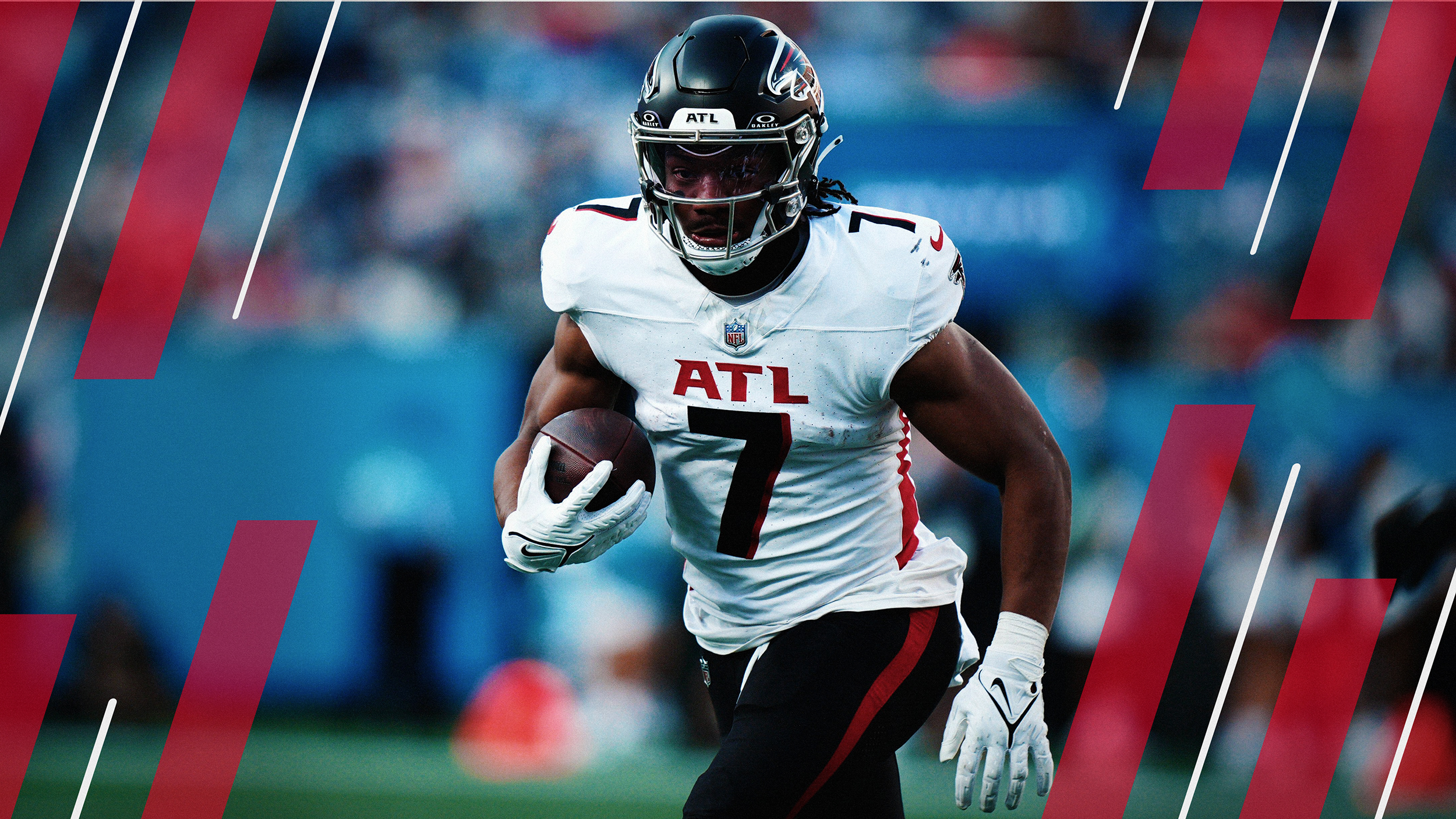
- Bijan Robinson takes the top spot: The Atlanta Falcons running back carries the best mix of risk and reward heading into next season.
- Chaos outside of the top 20: Over one-third of the NFL teams will be using a two or three-man rotation, will have some competition for playing time or have a lead running back who ended last season on injured reserve, leaving several options outside of the top 20 who could see dramatic changes in ranking over the rest of the offseason.
- 2026 NFL Draft season is here: Try the best-in-class PFF Mock Draft Simulator and learn about 2026's top prospects while trading and drafting for your favorite NFL team.
With the bulk of free agency now complete, the running back market saw significant movement.
Kenneth Walker, Travis Etienne Jr., David Montgomery, Rico Dowdle, Rachaad White, Tyler Allgeier and Emanuel Wilson all changed teams and are currently penciled in as Week 1 starters with their new clubs.
Several backup running backs also found new homes, affecting both their value and the value of the starters on their new teams. The draft will continue to reshape the landscape, as players like Jeremiyah Love and Jadarian Price could further drive down veteran value depending on where they land.
Below are the top 100 running backs in a redraft format based on the current landscape, broken into tiers. These rankings are for PPR leagues.
Last updated: April 1, 2026
1. Bijan Robinson, Atlanta Falcons
Robinson ranks ahead of Gibbs due to his potential for further improvement in 2026. The Falcons fielded a top-10 unit in PFF run-blocking grade last season despite missing right tackle Kaleb McGary for much of the year. McGary ranked among the top 10 right tackles in PFF run-blocking grade in 2022, 2023 and 2024, and he returns alongside the rest of Atlanta’s projected starting offensive line, which is under contract for 2026. With improved continuity up front, Robinson should be in a better position to generate explosive runs.
Atlanta also reshaped its backfield this offseason. Tyler Allgeier departed in free agency for a larger role with the Arizona Cardinals, while Brian Robinson Jr. was brought in as his replacement. Like Allgeier, Robinson is a bigger back who could siphon some goal-line work from Bijan Robinson. However, Allgeier graded higher than Robinson, making this transition more likely a lateral move — if not a slight positive — for Bijan Robinson’s overall outlook.
The Falcons also made a coaching change, hiring Kevin Stefanski as head coach. Stefanski has often deployed a two-back rotation, though that usage was influenced in part by Nick Chubb’s limited receiving role in Cleveland. In 2019, as Minnesota’s offensive coordinator, Stefanski featured Dalvin Cook heavily, with Cook playing over 70% of the team’s offensive snaps when healthy and finishing as the RB2 in PPR points per game. Stefanski has also shown a willingness to lean on one back when warranted, as Kareem Hunt logged games above an 85% snap share when Chubb was unavailable. His history of prioritizing the running back position should work in Robinson’s favor.
While the gap between Robinson and Gibbs remains razor-thin, Robinson gets the edge due to his stronger PFF grades over the past three seasons.
2. Jahmyr Gibbs, Detroit Lions
Gibbs ranks a close second for the top overall spot. He has finished inside the top five in each of the past two seasons, benefits from a top-12 offensive line in PFF run-blocking grade and returns to a unit that remains fully intact for next season. However, there is less room for improvement than with Robinson.
There is still reason for optimism. The Lions moved on from David Montgomery, whose presence had previously limited Gibbs’ fantasy ceiling. While that impact was less pronounced in 2025, Gibbs could still see an increase in rushing touchdowns with Montgomery no longer in the picture. Detroit added Isiah Pacheco in free agency as a backup, but he is unlikely to significantly impact Gibbs’ overall volume.
One minor concern is the number of established pass-catching options in the offense. Amon-Ra St. Brown, Jameson Williams, Sam LaPorta and Isaac TeSlaa all remain under contract, creating more competition for touches compared to Robinson, whose primary competition is Drake London, with Kyle Pitts set to hit free agency.
The Lions will also have a new offensive play-caller, hiring former Cardinals offensive coordinator Drew Petzing. Arizona often deployed a two-back committee under Petzing, but he has also shown a willingness to lean on a lead back, as James Conner recorded multiple games with a snap share above 75%. As a result, a major shift in Gibbs’ usage is not expected.
3. Christian McCaffrey, San Francisco 49ers
McCaffrey led all running backs in fantasy points this season, marking the fifth time he has finished among the top two at the position. He did so in a unique way, ranking 10th among running backs in rushing fantasy production while delivering receiving production that would rank among the top 10 wide receivers.
Despite ranking second in rushing attempts, McCaffrey averaged just 3.9 yards per carry and was less effective at generating explosive runs. NGS tracking data also indicates his top-end speed over the past two seasons has declined compared to earlier in his career. While a rebound in rushing efficiency is possible, there is also a scenario in which San Francisco begins to shift more carries to other backs.
His receiving production was also influenced by a depleted 49ers pass-catching group. San Francisco expected to feature Brandon Aiyuk, Jauan Jennings, Ricky Pearsall and George Kittle, but injuries disrupted that plan throughout the season. Aiyuk did not play. Pearsall missed six games and struggled upon return. Kittle missed five games and was limited early in his return, and Jennings also missed time.
The 49ers addressed that issue by adding veteran wide receivers Mike Evans and Christian Kirk, who, along with Pearsall, should form a much stronger receiving corps. That improvement could lead to a reduction in McCaffrey’s target volume.
All three of the top running backs rely on elite offensive line play, particularly from standout individuals — right guard Chris Lindstrom in Atlanta, right tackle Penei Sewell in Detroit and left tackle Trent Williams in San Francisco. Williams will be 38 next season, making him the most likely of the group to decline or miss time.
While McCaffrey still carries overall RB1 upside if everything breaks right, there are more indicators pointing toward potential regression based on how his production was generated and the early signs of decline in his profile.
4. De’Von Achane, Miami Dolphins
Achane has ranked among the top six running backs in fantasy points per game in each of the past three seasons. He also led all running backs in PFF rushing grade (91.0) this season, but his situation has not been as favorable as that of the top three backs.
The Falcons, Lions and 49ers have all ranked among the top 12 in PFF run-blocking grade in each of the past four seasons, while the Dolphins have finished in the bottom five in each of the past two. Miami has also ranked in the bottom 12 in scoring in both seasons, making it more difficult for Achane to match the touchdown production of his peers.
The Dolphins moved on from Tua Tagovailoa, Tyreek Hill and Jaylen Waddle this offseason. While that could negatively impact Achane’s touchdown opportunities, it should also make him one of the primary focal points of the offense. His combination of volume and efficiency should allow him to remain a top-five fantasy running back moving forward.
5. James Cook III, Buffalo Bills
Cook finished 11th among running backs in fantasy points per game in 2024, driven in large part by 16 rushing touchdowns. That level of scoring led to expectations of regression, which pushed his draft cost down. However, several factors from this past season suggest he can remain a high-level producer in 2026.
His workload saw a significant increase, with carries per game rising from 12.9 to 19.1. That jump was driven partly by a more run-heavy approach from Buffalo and a reduced role for Ray Davis. Cook also maintained strong efficiency, averaging 5.3 yards per carry, slightly above his 5.1 career mark. Importantly, that increase in rushing volume did not come at the expense of his receiving usage, which remained consistent with the previous season.
Buffalo’s offensive line also took a step forward, ranking sixth in PFF run-blocking grade. Right tackle Spencer Brown led the unit with the best season of his career, and the rest of the line provided steady play. While Cook’s PFF rushing grade dipped slightly, the improved blocking contributed to an overall increase in rushing efficiency.
The Bills’ offseason changes should have minimal impact on Cook’s outlook. The running back depth chart remains unchanged. Although the team lost starting guard David Edwards, his expected replacement, Alec Anderson, has graded well as a run blocker in limited action. Buffalo also added wide receiver DJ Moore, who should help the offense overall without necessarily shifting it toward a more pass-heavy approach.
Cook is well-positioned to deliver similar fantasy value in 2026.
6. Josh Jacobs, Green Bay Packers
The rest of the top 10 consists of running backs we can be relatively confident will remain top-15 options by August. Nearly half the league is set to have new offensive play-callers, and roughly a quarter of teams have starting running backs entering unrestricted free agency. While some backs will land in ideal situations and push into the top 10 — bumping others down — it’s unlikely this group falls far in the rankings.
Eight running backs finished among the top 12 in fantasy points per game in both 2024 and 2025. Four have already been discussed, with Jacobs standing out as the best option among the remaining group.
Jacobs ranks third among running backs in PFF offensive grade (92.6) over the past two seasons, helping separate him from his peers. He also benefits from playing in an above-average offense led by a young quarterback in a stable situation. The Packers allowed Emanuel Wilson to depart in free agency, leaving Chris Brooks and MarShawn Lloyd as the primary backups. However, the team could still add another running back, which may impact Jacobs’ workload.
The biggest concern for Jacobs is durability. He missed time at the end of the 2023 season and played through injury during the second half of 2025. If he stays healthy, he should remain a top-10 fantasy running back.
7. Jonathan Taylor, Indianapolis Colts
Taylor is a higher-risk, higher-reward option than Jacobs. For most of the 2025 season, he provided more rewards than risks. He was the only running back with double-digit +1 graded runs in addition to five or more runs with +1.5 or better grades. Almost all of that occurred in the first 12 weeks of the season, where he averaged 25.7 PPR points per game. He only had one run of +1 or better over the final third of the season, as he averaged 13.3 PPR points per game during that stretch. Taylor’s 71.4 PFF grade over the last two seasons is the lowest of the running backs listed so far.
Outside of Taylor’s inconsistency, there is concern about who will be his backup this season. Indianapolis added D.J. Giddens in the fifth round of the draft and Khalil Herbert in free agency to be Taylor’s backup last season, but neither ended up working out, so Indianapolis instead added veteran Ameer Abdullah to be the backup. Taylor played 84.2% of the Colts' offensive snaps, leading all running backs. The Colts are likely to bring in a back who can take at least some of the playing time away from Taylor. That didn’t happen in free agency, but could during the draft.
Taylor also has injury concerns. While he played every game last season, he missed at least three games in each of the three previous seasons. There is some uncertainty surrounding the quarterback situation, as Daniel Jones is recovering from injury. On the bright side, Taylor will keep his head coach and offensive coordinator.
Taylor will likely move up the rankings if Jones' health appears to be fine and the Colts‘ backup situation remains uninspiring.
8. Kenneth Walker, Kansas City Chiefs
Walker has been one of the NFL’s most efficient running backs on a per-play basis over the past three seasons. He is tied for first among running backs in PFF rushing grade (93.7) over that span, matching De’Von Achane, while his PFF receiving grade (77.3) ranks 11th among running backs with at least 1,000 snaps. Overall, he ranks second in PFF overall grade (93.2), trailing only Derrick Henry.
Despite that efficiency, it has not fully translated to fantasy success, particularly this past season. Walker split backfield work with Zach Charbonnet, who ranks 12th among running backs in PFF overall grade over the same three-year span. Charbonnet handled a significant share of goal-line work, limiting Walker’s touchdown production, while Seattle’s offense reduced running back involvement in the passing game, cutting into both players’ reception totals.
Walker now joins the Chiefs, who moved on from Isiah Pacheco and are unlikely to bring back Kareem Hunt. Kansas City added third-down specialist Emari Demercado, who joins Brashard Smith in the backfield rotation.
The Chiefs were the second-most pass-heavy team in the NFL last season, throwing on roughly two-thirds of their offensive plays, and they have maintained that approach in five of the past six seasons. They have also consistently leaned toward the pass in goal-line situations.
Walker should be a fantasy starter at a minimum. He has been effective as a receiver in a limited sample, and Kansas City historically targets running backs at a higher rate than most teams. While Demercado’s presence may limit Walker’s third-down usage, Walker has experience in two-minute situations, which could help elevate his role.
If his usage expands in the passing game or if Andy Reid leans more on the run than in previous seasons, Walker has the upside to finish as a top-five fantasy running back.
9. Ashton Jeanty, Las Vegas Raiders
Jeanty was selected sixth overall in the 2025 NFL Draft, a draft slot that typically supports immediate top-10 fantasy production. However, several factors outside of his control limited his rookie output.
The Raiders scored just 241 offensive points last season, the fewest in the NFL, and ranked third-lowest in PFF run-blocking grade (53.0). As a result, Jeanty averaged just 0.6 yards before contact per attempt, the second-lowest mark among running backs with at least 100 carries.
Despite those conditions, Jeanty forced 61 missed tackles on the ground, which ranked fifth among running backs. He also ranked fourth among running backs in PFF rushing grade (92.3) on carries with positive yards before contact, highlighting his ability to capitalize when given space and suggesting significant upside in an improved environment.
Las Vegas will have a new head coach next season, and all indications point to the team selecting quarterback Fernando Mendoza with the first overall pick. The Raiders also entered the offseason with the third-most cap space and invested in the offensive line by adding center Tyler Linderbaum, which should help improve Jeanty’s efficiency.
The primary remaining concern is the backfield behind him. Las Vegas has yet to add a clear backup, making it likely the team addresses the position in the draft. Several available prospects profile as bigger backs who could take goal-line opportunities from Jeanty. If the Raiders avoid a significant investment at the position, Jeanty could climb even higher in the rankings.
10. Chase Brown, Cincinnati Bengals
Brown ranked 10th among running backs in fantasy points per game in 2024 and seventh in 2025, and there is little reason to expect a significant change in 2026.
He benefits from playing in a high-scoring offense where defenses are primarily focused on the passing attack led by Joe Burrow, Ja’Marr Chase and Tee Higgins. Brown ranked seventh among running backs in carries against light boxes while seeing far fewer opportunities against stacked fronts, making his job easier on the ground.
He is also heavily involved in the passing game. Brown ranks third among running backs in first-read targets over the past two seasons and second in checkdown targets. When Burrow extends plays, Brown is also among the most frequently targeted options, tied with Samaje Perine.
The Bengals made no significant changes to their backfield in free agency, retaining Perine, Tahj Brooks, Gary Brightwell and Kendall Milton. The most notable offensive change was the departure of rotational tight end Noah Fant, though Erick All Jr. is expected to return from injury after previously filling that role.
The primary concern is whether Cincinnati adds competition in the draft. Because Brown’s production is closely tied to his situation, he may be more vulnerable than others on this list to being overtaken by a rookie addition.

 © 2026 PFF - all rights reserved.