
- Nico Collins is among the league’s top wide receivers: Collins has posted a 93.2 receiving grade over the last two seasons combined, which ranks first among all wide receivers.
- Drake London had a breakout 2024 season: A new coaching staff and quarterback led London to go from a borderline fantasy starter to a must-start and potential top-10 option.
- Subscribe to PFF+: It’s quick and easy. You’ll unlock industry-leading rankings, unlimited Fantasy Mock Draft Simulator use, PFF's Live Draft Assistant and our weekly Start/Sit Optimizer. It’s time to win.
Estimated Reading Time: 15 minutes

Editor's note: Enjoy this PFF+ article and explore others free until Aug. 29.
Identifying underappreciated players is one of the best edges in the fantasy football landscape. Thus, we are going to do our best to identify a few wide receivers today to give managers an advantage before they begin their drafts.
The average draft position listed is from a consensus between ESPN, Sleeper and Yahoo! for where the player is picked on average in a 12-team, redraft league.
Last updated: Monday, Aug. 25
Nico Collins, Houston Texans (ADP: 2.01)
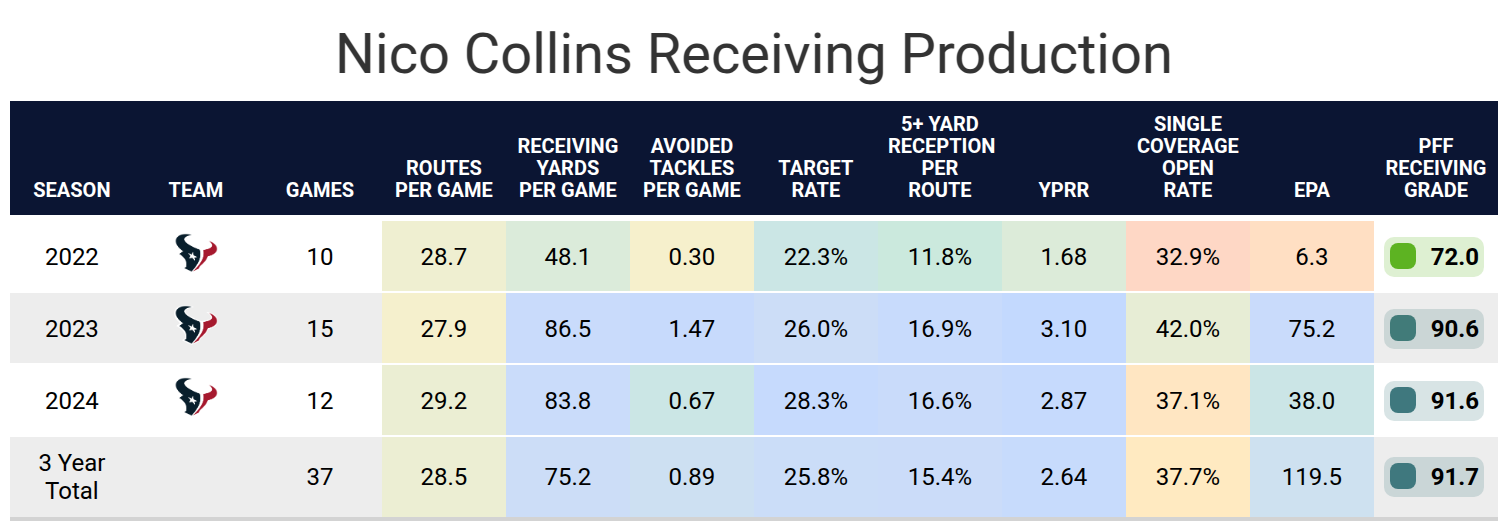
Collins was a Texans third-round pick in 2021 and immediately started playing a minimum of 55% of the Texans' offensive snaps. In 2022, he was in a rotation with Brandin Cooks, Chris Moore and Phillip Dorsett. In 2023, Houston moved on from all three other receivers and added C.J. Stroud at quarterback. This was enough for Collins to completely break out.
His target rate only increased slightly, but his catch rate increased from 57.8% to 73.4%, thanks to higher-quality passes. His average depth of target decreased slightly, but he became much more elusive, leading to an elite avoided tackle rate. This led to more yards after the catch, ultimately leading to more yards per reception. In 2024, Collins didn’t make quite as many big plays but was more consistently receiving positive grades when targeted, and he was targeted even more often.
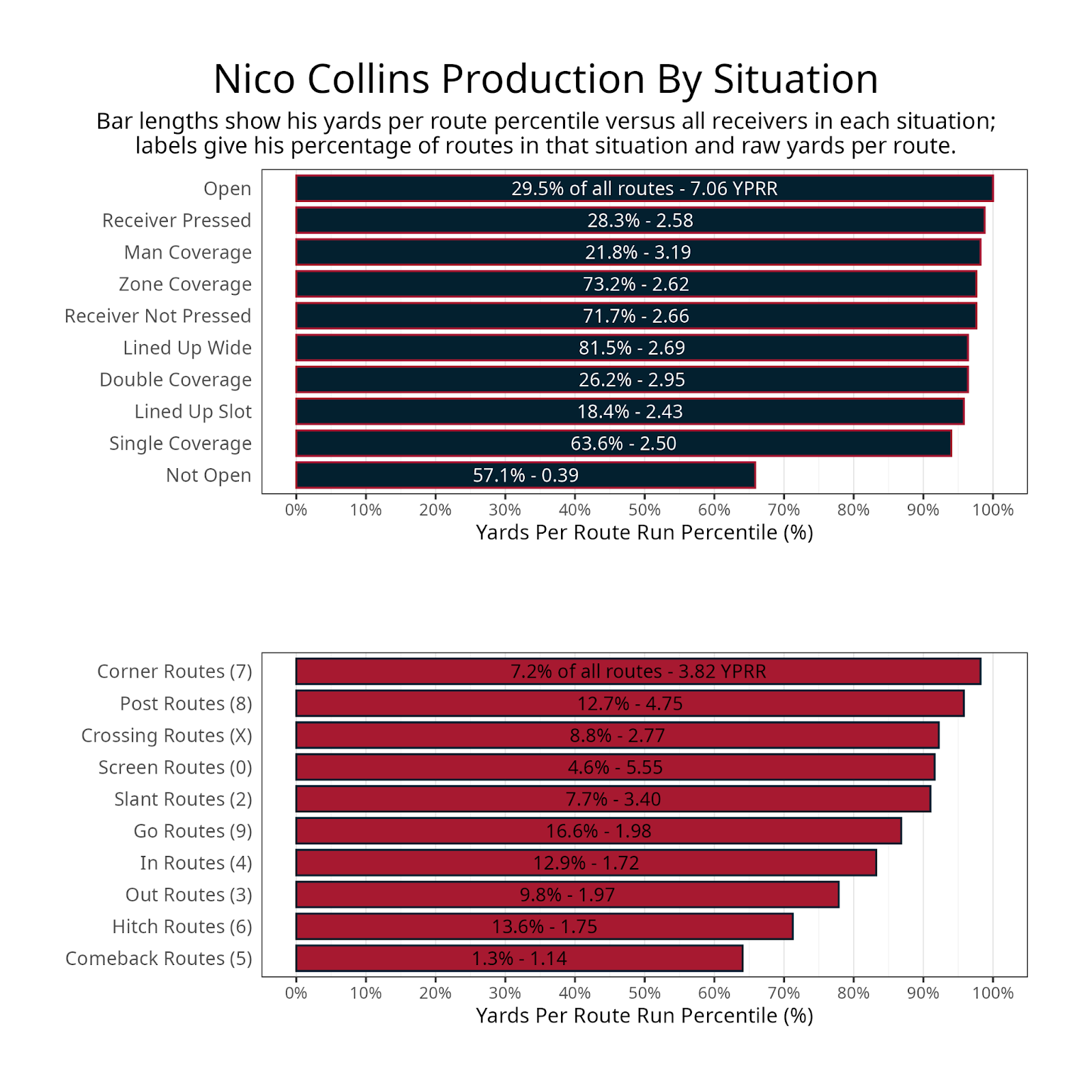
Collins has 0.612 fantasy points per route run in PPR leagues, which is the best for wide receivers over the past two seasons. This includes the most yards per route run at 3.0 and the second-most touchdowns per route at 0.02. When he can get open, there has been no receiver better in recent seasons. However, he’s not able to get open as often as other receivers, and he’s not as successful as plenty of other receivers when he’s not open.
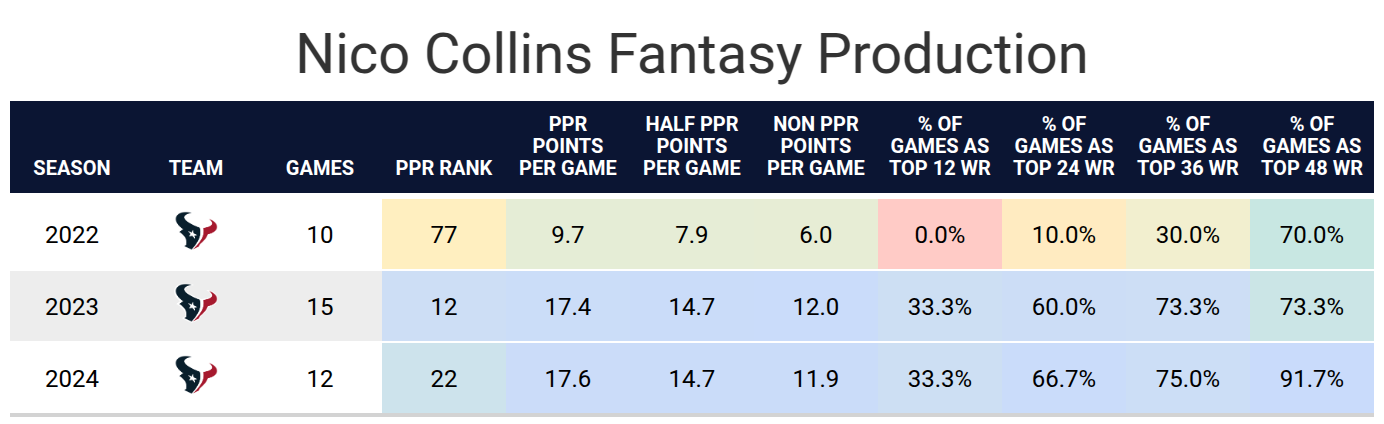
The main problem is that Collins runs fewer routes than other receivers, so he’s only finished seventh and eighth in fantasy points per game over the last two seasons. Collins has also missed at least two games in every season and averaged over four games per season. This has led him to finish even lower in total fantasy points each season.
However, it’s worth noting that Collins' per-game numbers from 2024 are deceiving because of games where his time was limited. He played nine snaps in Week 5 prior to injury, 30 snaps in Week 11 while returning from injury and 11 snaps in Week 18 with a playoff spot clinched. He was often playing over 80% of the snaps for the rest of the season. He averaged 18.9 fantasy points per game, removing those three games, which would have ranked third last year. He also averaged 19.1 points per game in the NFL playoffs.
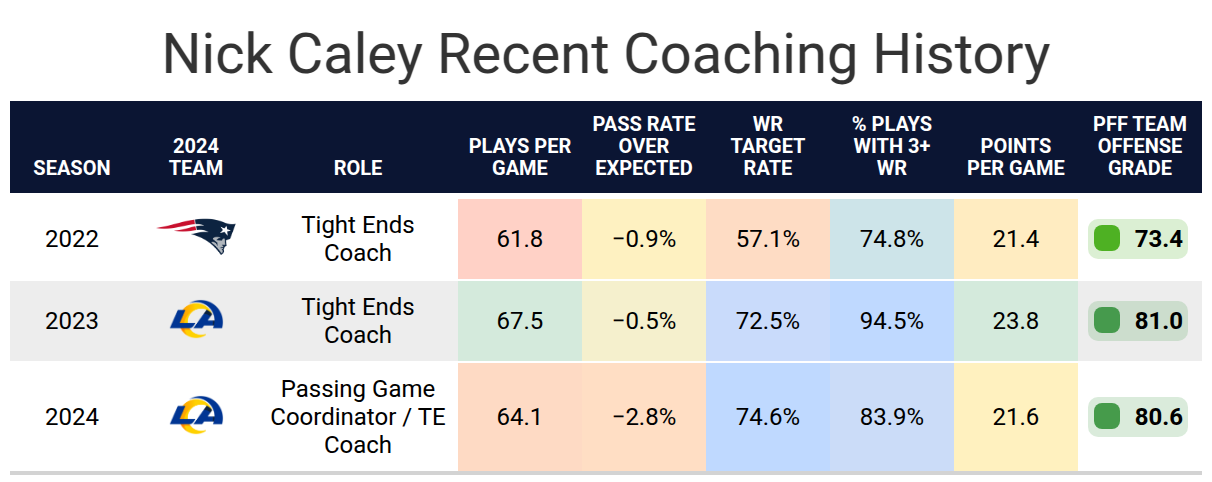
The Texans swapped out offensive coordinators, bringing in Nick Caley, but Ben McDaniels remained the wide receiver coach and passing game coordinator, a job he’s held since 2022. Caley has never been the lead offensive coach for a team, so we haven’t seen exactly what his vision looks like, but his past teams have relied heavily on three-receiver sets.
The big question is how much playing time Collins will get in Caley’s offense. It’s possible his limited playing time in the past was a coach's decision by previous coaches, but it’s also possible that the Texans know something about Collins, particularly with his injury history, and know they need to limit Collins’ snaps. Caley has been around wide receivers playing at least 85% of offensive snaps regularly before, so a notable increase in snaps for Collins is at least possible.
Collins is a very talented wide receiver with a history of top-10 success. There is reason to believe he can improve with more playing time or an improvement from C.J. Stroud. The main concern is his injury history, where he’s missed time each season.
Drake London, Atlanta Falcons (ADP: 2.08)
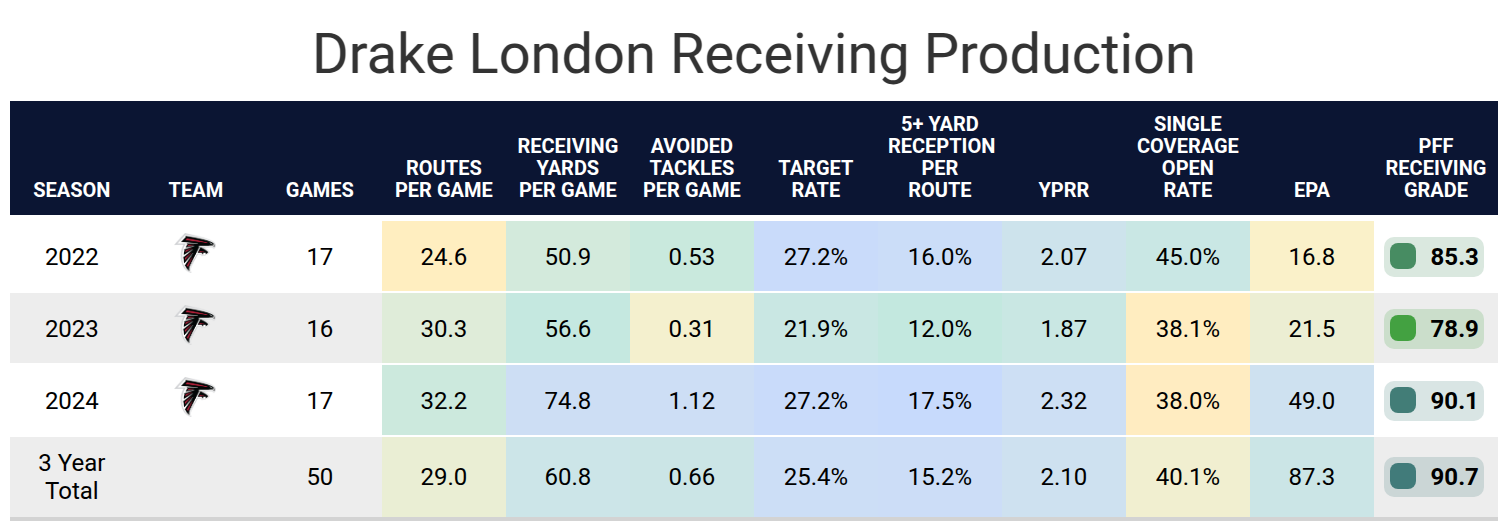
London was the eighth pick in the 2022 NFL Draft and instantly became the Atlanta Falcons‘ top wide receiver. In his first year, he played only 78% of offensive snaps. The Falcons were a run-first offense under Arthur Smith, which led to a low routes per game rate. While he had six games of at least five catches and 120 yards as a rookie, he also had two games with more than 40 offensive snaps and one reception for single-digit yards.
London's snap rate increased slightly in his second season, and the team was a little more pass-heavy. Unfortunately, that coincided with a notable drop in his target rate. His best games were even better than the previous season, including a 172-yard performance and a 125-yard performance, but he was also held under 50 receiving yards for half of his games and scored only two touchdowns. Despite being the top Falcons wide receiver, London was outside the top 40 at the position in fantasy points per game in both years.
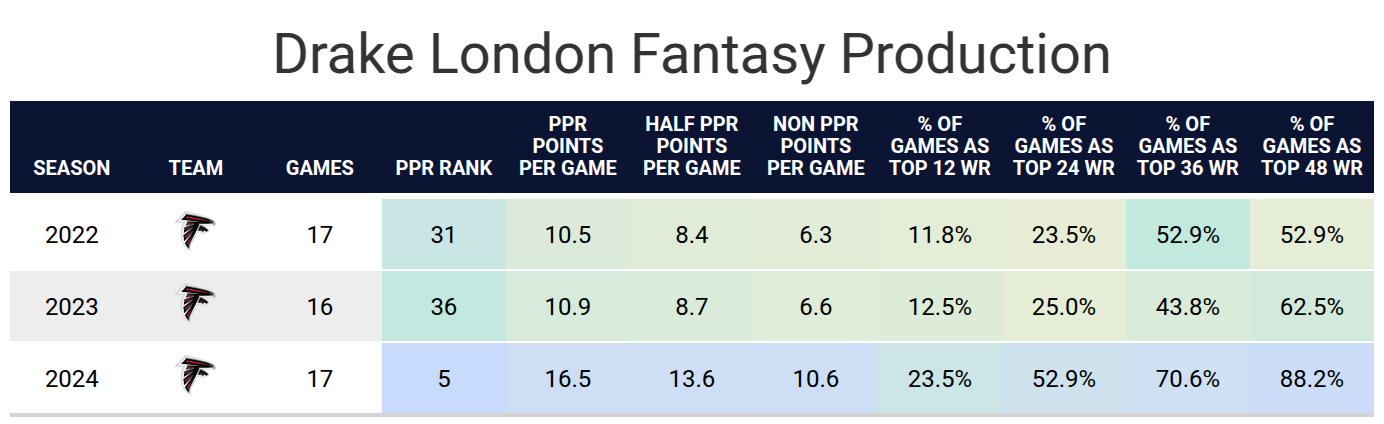
The Falcons remained a run-first offense in 2024, but London’s snap rate increased to 90%, leading to another increase in routes per game. Atlanta returned to giving him an elite target rate, as his 27.2% clip ranked fourth among wide receivers last year. His quarterback play also improved, allowing him to finish 14th in fantasy points per game and fifth in total fantasy points among wide receivers.
One of the many reasons for London’s improved statistics in 2024 was playing more out of the slot. His slot rate increased from 18.6% in 2023 to 39.6% in 2024. Typically, slot receivers are smaller, quick wide receivers, whereas London is 6-foot-4 and 219 pounds and on the slower side for wide receivers. His 11.0-yard average depth of target was the second highest among receivers with at least 50 targets in the slot. He was targeted on a league-leading one-third of his routes, resulting in a league-leading 2.57 yards per route run out of the slot.
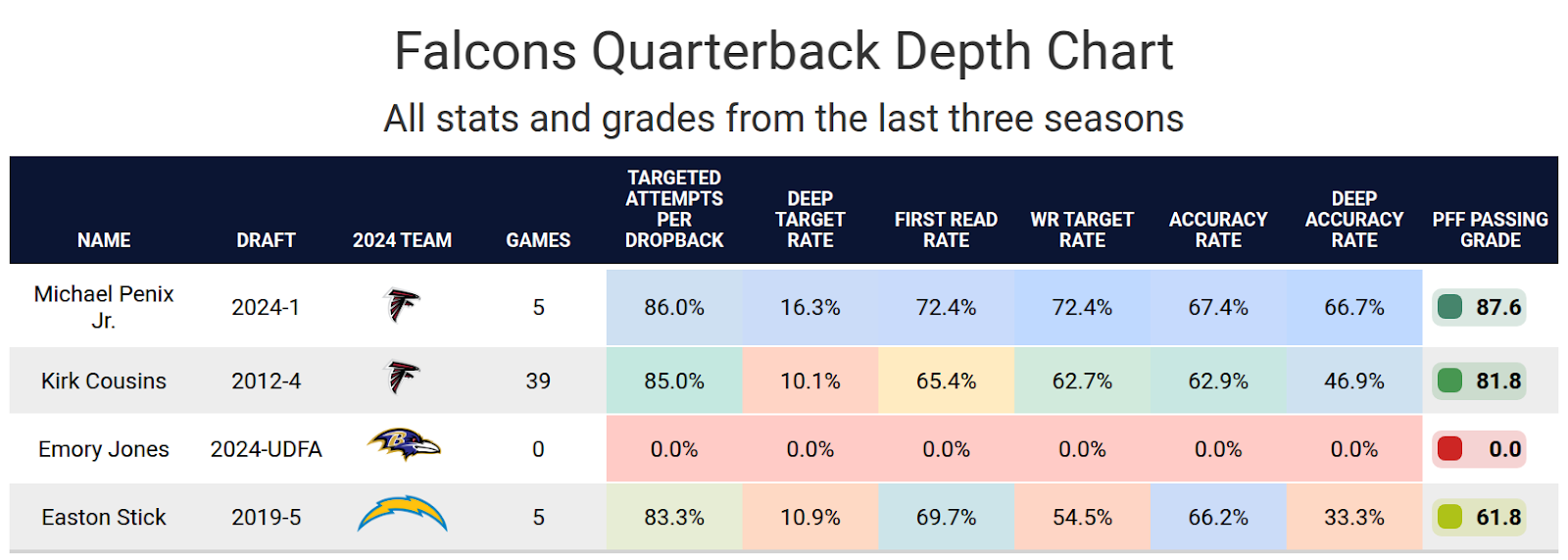
Quarterback play was a big reason for London’s struggles in his first two seasons. The Falcons had the second-lowest team PFF passing grade over the two seasons. While Kirk Cousins didn’t fully live up to expectations, Atlanta's 78.3 PFF passing grade last season ranked 10th among teams. Cousins played well enough to remain a starter for most teams, but Atlanta had first-round rookie Michael Penix Jr. waiting in the wings, and he played very well on a small sample last season.
London shone even brighter in the last three weeks of the season when Penix was the starter. He was thrown to on 37% of his routes, including at least 34% in all three games. That led to 3.52 yards per route run. London averaged 15.1 fantasy points per game with Cousins as the starter and 23.1 fantasy points per game with Penix. That is roughly the difference between WR20 and WR2. We should never expect a target rate to consistently exceed 30%, so some regression is on the table. Regardless, London's initial play with Penix is a promising sign for an even better season.
London improved significantly in 2024, thanks to increased playing time, more opportunities out of the slot and improved quarterback play. We should expect more of the same in 2025, with the most significant variable being Michael Penix Jr.‘s ceiling in his first season as a starter.
Travis Hunter, Jacksonville Jaguars (ADP: 6.11)
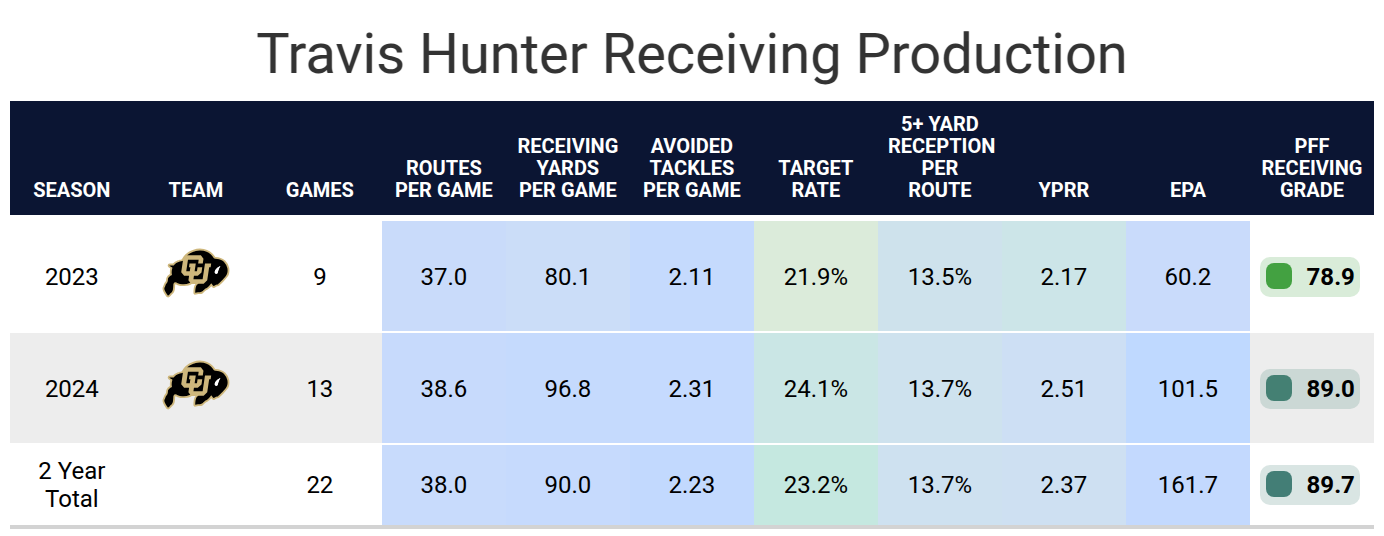
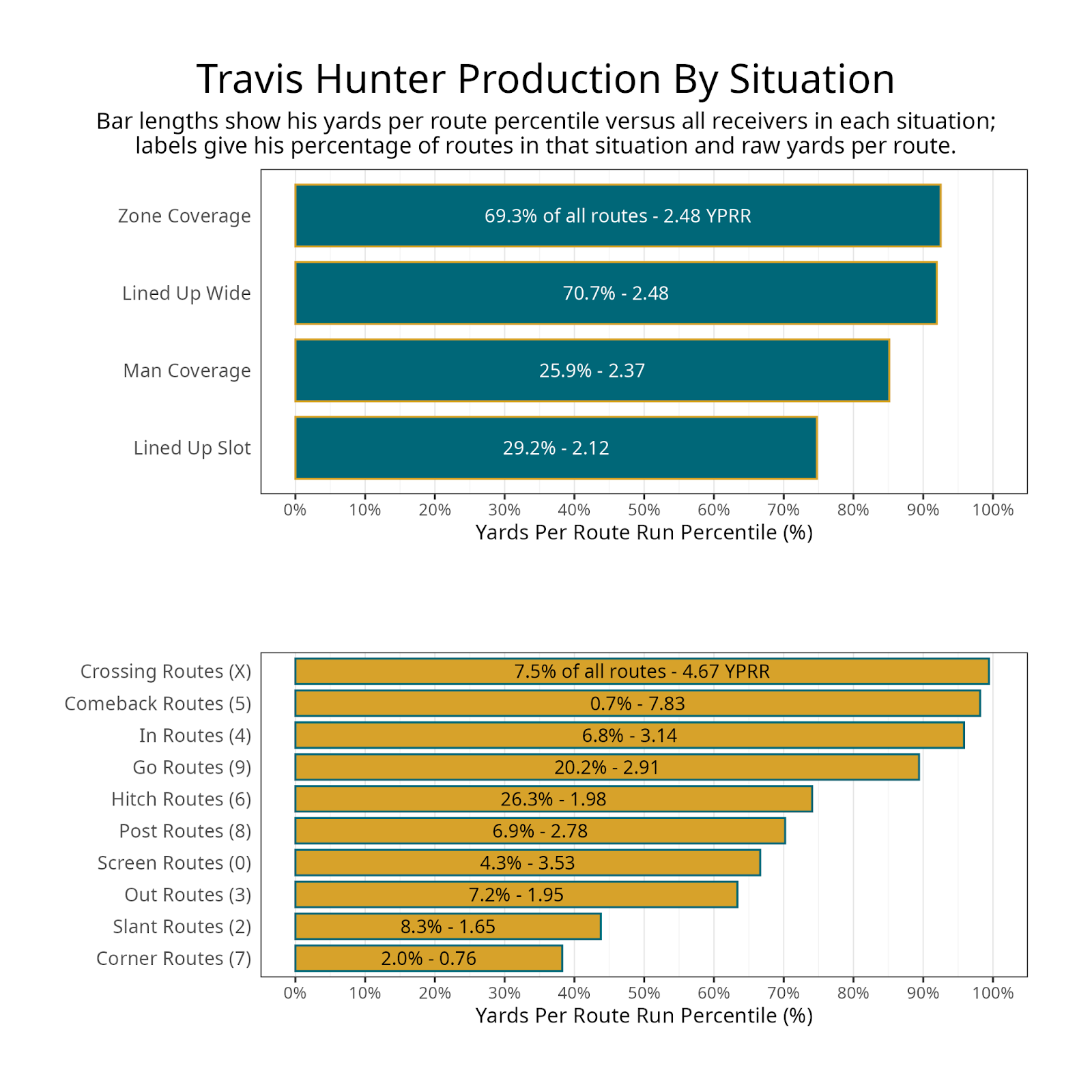
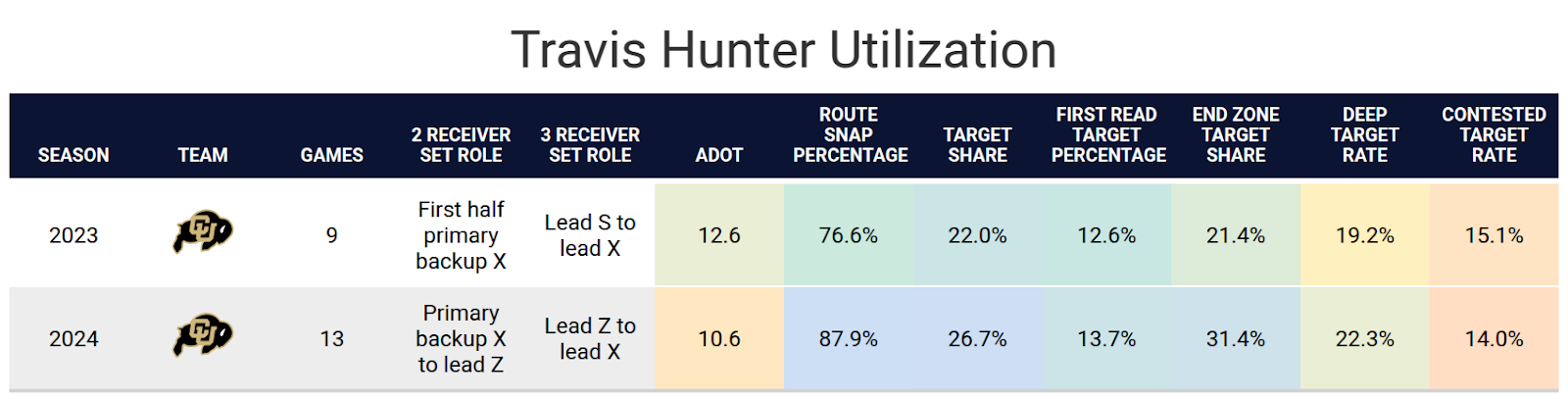
Hunter spent the past two seasons as a full-time wide receiver and cornerback for Colorado. His efficiency at wide receiver was strong but not elite, and he produced on a surprisingly high sample size, given his additional playing time on defense. His numbers improved across the board from 2023 to 2024. His production by situation was strong, too, but it’s worth noting that many of his routes were gos or hitches.
His 89.7 PFF receiving grade over the past two seasons is directly in the middle of the other receivers who were drafted in the first or early second round. He racked up the most touchdowns and the fewest dropped passes of the five, and his separation rate against single coverage is the best among the group.
While Hunter wasn’t as accomplished as a receiver as others in the class, many consider him the best receiving option. PFF's Draft Guide notes, “As a receiver, he doesn’t have as much polish in releases, route nuance and beating press. However, all that can be improved and explained by not devoting all his time to one position.” If Hunter becomes a full-time receiver, he will be the top wide receiver in dynasty drafts based on his talent.
Hunter joins the Jaguars, who have Brian Thomas Jr. and minimal other competition for targets. The first preseason game gave us a great look at how the Jaguars plan on using Hunter.
He started the game for Jacksonville and played in 11 of 12 snaps with the starters. The one play he missed was a two-wide receiver set with Thomas and Dyami Brown on the field. If this ends up being how he’s used in the regular season on offense, he can be a consistent fantasy starter. Several borderline fantasy starters only played in three-receiver sets last season, including Jayden Reed, Josh Downs, Khalil Shakir and Adam Thielen. The differences are that Hunter is more talented and the Jaguars should stay in 11 personnel for most of the game. Head coach Liam Coen’s Tampa Bay Buccaneers ranked eighth in 11 personnel usage last season at 71.9%, despite multiple wide receiver injuries. His 2022 Los Angeles Rams led the league at 90.9%. On the first drive, the Jaguars used it 91.8%.
Coen also commented that they have focused on 11 personnel, and that he’s learning 12 personnel, so he could also start playing snaps in 12 personnel in the upcoming weeks.
One surprising part of his usage is that Hunter lined up in the slot on five of his 11 snaps, tying Thomas at five of 12 snaps. Thomas was expected to be the primary slot receiver after leading the league in yards per route run out of the slot. Hunter played significantly out of the slot in 2023, but in 2024, he only lined up in the slot 36 times compared to 736 snaps outside. This is significant because Coen’s top wide receivers, from a fantasy perspective, have primarily played out of the slot. This includes Chris Godwin averaging 19.7 PPR points per game last season, which ranked second-most in the league, and Cooper Kupp leading the league in 2022 at 22.4. This is enough reason to raise expectations for Hunter this season while somewhat dampening expectations for Thomas.
Hunter didn’t play the first drive on defense, but he played left cornerback on the Jaguars’ second and third drives, playing all eight snaps on those drives. Tyson Campbell was one of multiple Jaguars defenders who only played the first drive. Jarrian Jones started the game at left cornerback and switched to right cornerback when Hunter entered. Jourdan Lewis, who joined the Jaguars from the Dallas Cowboys, played as their slot cornerback, even though Jones held that position last season. If Hunter plays on defense in the regular season, it would likely be at Jones' expense. This wouldn’t necessarily need to be in any particular personnel groupings.
The sky is the limit for Hunter, a truly unique athlete. That uniqueness makes it difficult to project how much he can help a fantasy manager at the wide receiver position. As the offseason has progressed, the risks around Hunter have decreased, but his ADP hasn’t increased at a commensurate rate.
Jameson Williams, Detroit Lions (ADP: 6.04)
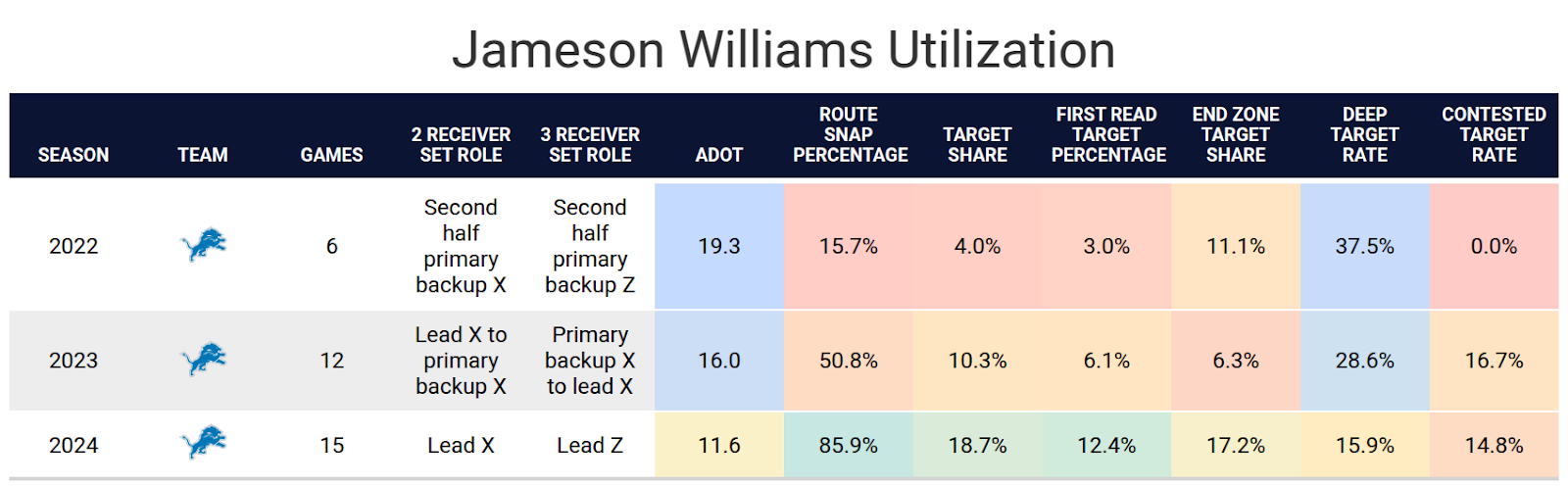
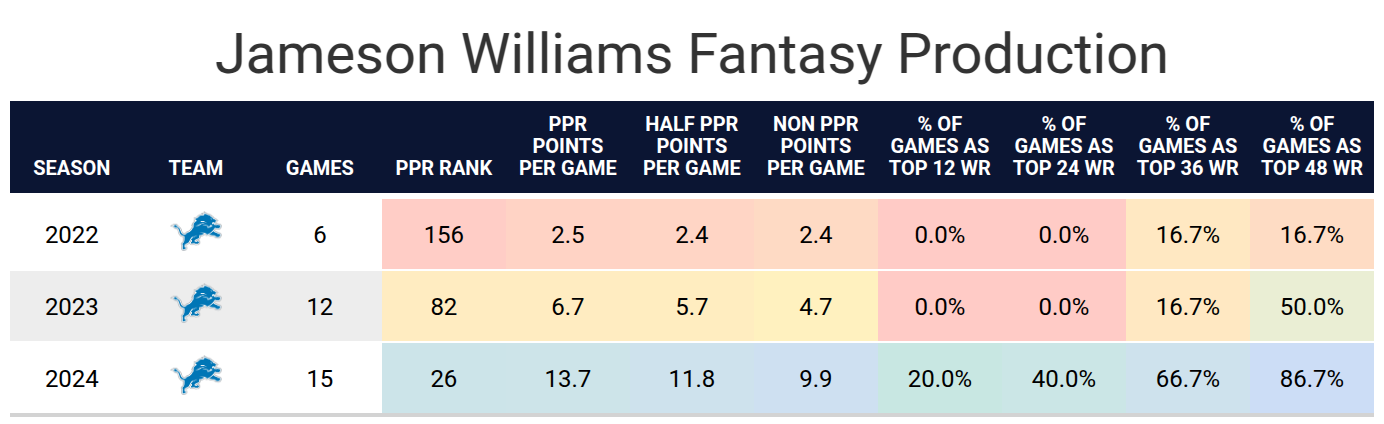
The Detroit Lions made Jameson Williams the 12th overall pick of the 2022 NFL Draft, despite his ACL tear just months before the draft. He returned for the last six games of his rookie season, playing at most 18 snaps in a contest. He touched the ball only twice, but both went for 40 or more yards.
Williams missed the first four games of the 2023 season due to the NFL’s gambling policy, and he was then eased into action, playing less than 50% of snaps over his first four games back. After the Lions' Week 9 bye, Williams played between 50%-70% of snaps over the rest of the season. His impact was minimal, with three total touchdowns, no games over 70 receiving yards and no games over five receptions.
He started Week 1 of 2024, and it was the best game of his career to that point. He played 85.2% of offensive snaps and caught five passes for 121 yards and a touchdown. He played 79.3% of snaps over the season, excluding the two games for which he was suspended due to the league’s PED policy. Williams gained at least 75 receiving yards in more than half of his games and averaged a touchdown every other game. There were two games early in the season where he was held to single-digit yards, but after his suspension, his floor was eight PPR points. From Weeks 10-18, Williams averaged 15.3 PPR points per game, which ranked 22nd among wide receivers.


With Ben Johnson off to helm the Chicago Bears, John Morton now leads the Lions‘ offense. Morton has been part of several offenses with different wide receiver rotations at each stop. His run-to-pass ratios have also changed, so it’s hard to tell how much his offense could help or hurt Williams. In his one season as an offensive coordinator with the New York Jets in 2017, he had a clear top two receivers in Chosen Anderson and Jermaine Kearse. While Williams is an undersized receiver, his PFF run-blocking grade last season was among the highest for wide receivers under 200 pounds, and higher than that of Amon-Ra St. Brown. He shouldn’t lose any playing time in the base offense despite his size.
Morton and new wide receivers coach Scottie Montgomery have given a lot of praise to Williams early in the offseason for his preparation, and they are expecting a breakout year. While early offseason praise doesn’t always lead to results during the season, it is certainly better than not receiving plaudits at all. While there is plenty of competition for touches in Detroit, there is at least a chance Williams can move up the priority list while others slip down. The Lions have the talent to have another great season on offense, and in that case, there should be at least two to three wide receivers who excel.
Jameson Williams became more than a deep threat in 2024, which allowed him to be a top-30 wide receiver, despite playing for a Detroit Lions team with several fantasy assets at the top 10 of their position. With a new offensive coordinator, Williams could get a larger part of the Lions' pie this season, at the expense of one or more players, due to his unique talents and playmaking ability.
Emeka Egbuka, Tampa Bay Buccaneers (ADP: 9.08)
Egbuka spent the past three seasons as the second option in Ohio State’s passing game, first behind Marvin Harrison Jr. and then behind Jeremiah Smith. The Buckeyes were often ahead in games, allowing them to run the ball with future NFL running backs. That hurt Egbuka's cumulative statistics, but his per-route numbers are very strong relative to other wide receivers. His target rates remained extremely high for a No. 2 receiver.
Egbuka checks many boxes, including high separation scores and catch rates. While his speed isn’t elite, it’s what you would expect from a mid-to-late first-round pick of his size. On the downside, the PFF Draft Guide notes his “route breaks could be sharper” and “his breaks aren’t as sharp or twitchy as some.”
In general, you hope to see college players improve each season, but that wasn’t the case for Egbuka. He played so well in his second year that there wasn’t as much room to put up bigger numbers. He also never exceeded an 85.0 PFF receiving grade in a season — a mark that most potential first-round wide receivers reach.

The big concern around Egbuka when he was drafted was his path to playing time. The Buccaneers' wide receiver room was among the best units in the league last season, headlined by Mike Evans, Chris Godwin and Jalen McMillan. However, Godwin is expected to miss playing time in September, while McMillan is expected to sit out for half the season with a neck injury.
Egbuka will likely take McMillan’s spot as the Z receiver for the first half of the campaign, even though most of his experience is from the slot. He was primarily playing Evans’ X receiver spot during the preseason. That experience at every position should help him maintain significant playing time, even when the other wide receivers are healthy.
Egbuka’s ADP has been on the rise, and will continue to do so as the start of the season nears. However, most ADPs can be slow to adjust to where players should actually be picked once news happens, particularly when it’s not a star player. Egbuka should be drafted closer to the sixth round, so even if his ADP creeps up to the seventh or eighth rounds, he will still be a value.


Egbuka is a very talented rookie, but he was consistently the second wide receiver in Ohio State’s offense. With the Buccaneers, he will likely continue to be a second option to Mike Evans, but he has a chance to be the offense's top wide receiver by the end of the season.

 © 2026 PFF - all rights reserved.