
- Bucky Irving exceeded all expectations: Irving went from a fourth-round pick and a backup to one of the best running backs in the league.
- Chase Brown was a league-winner: Brown wasn’t drafted to be a fantasy starter, but scored the third-most fantasy points per game over an eight-game stretch at the end of the season.
- Win with PFF+: From draft day to championship week, PFF+ is the ultimate Fantasy sidekick. Get the Fantasy Mock Draft Simulator, Live Draft Assistant, Fantasy Draft Kit, weekly waiver suggestions, Start/Sit Optimizer and more.
Estimated reading time: 17 minutes

Identifying underappreciated players is one of the best edges in the fantasy football landscape. Thus, we are going to do our best to identify a few running backs to give managers an advantage before they begin their drafts.
The average draft position listed is from a consensus between ESPN, Sleeper and Yahoo! for where the player is picked on average in a 12-team, redraft league.
Last updated: Wednesday, August 27
Bucky Irving, Tampa Bay Buccaneers (ADP: 2.11)
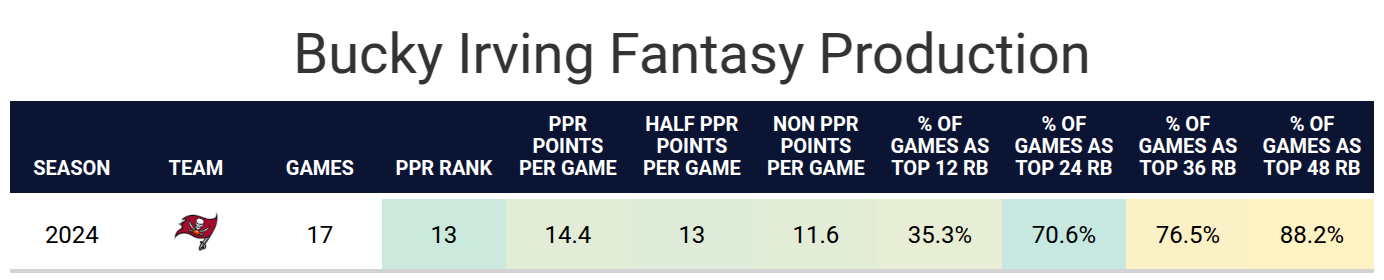
Irving was a Buccaneers fourth-round pick and won the backup job behind Rachaad White before Week 1 in 2024. By Week 10, he was an essential part of the Buccaneers' offense, running at least 12 times each game, outside of one where he suffered an injury. Over the last five games, including the playoffs, he ran at least 15 times and caught at least two passes each week. In Week 18 and the wild-card round of the playoffs, the Buccaneers gave him a significant increase in snaps, 72% and 69%, respectively.
Irving averaged 0.29 avoided tackles per attempt and 0.096 avoided tackles per route run, which were both the best among running backs last season. He also led the league in yards after contact per attempt (4.03) and the percentage of his carries that gained at least 30 yards (3.4%). He was incredible when the situations were less than ideal but struggled on zone runs.
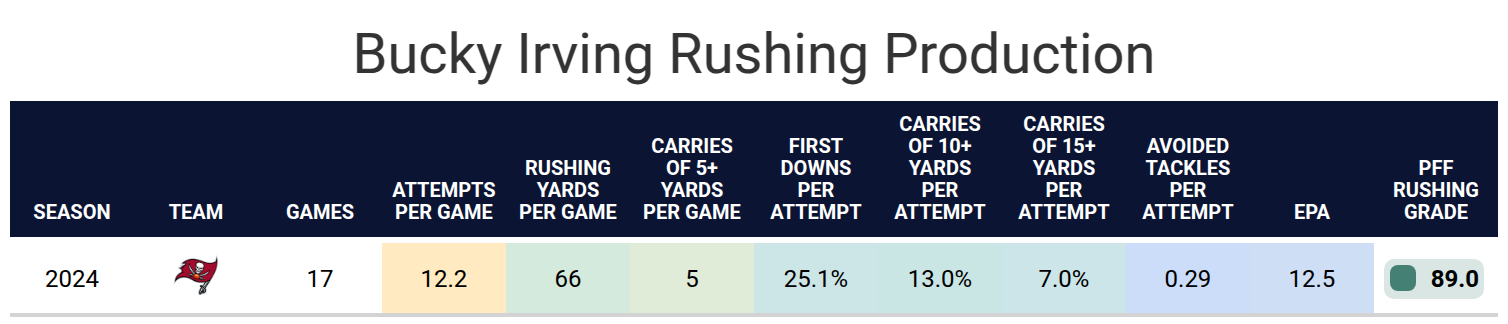
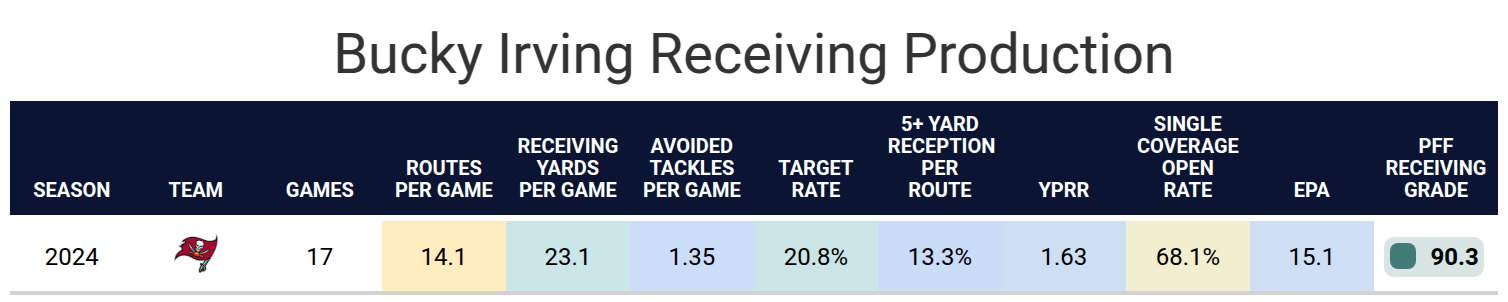
Irving is expected to be the starter after taking a much larger role in the offense in the last two games of the season. His snap rate in those games was better than usual for players like Derrick Henry, Josh Jacobs, Joe Mixon, De’Von Achane and James Cook.
The Buccaneers retained Rachaad White and Sean Tucker to be the backup and third-string running backs, respectively. In those last two games, Irving played nearly every snap on early downs, at the goal line and in short-yardage situations, while White played almost all of the third-down and two-minute drill snaps.
The Buccaneers retained their starting five offensive linemen from last season, all of whom played at least 950 offensive snaps, including the playoffs. At left tackle, Tristan Wirfs had one of the best pass-blocking seasons by a left tackle in recent memory but also endured his worst season as a run blocker. The rest of the young veterans on the line played notably better in 2024 than in previous seasons.
Irving was the fourth-highest-graded running back last season, and by the end of the year, he started playing a snap count more akin to one of the top running backs in the league. A new offensive coordinator could return to more of a committee, but he could also make Irving even more of a focal point of the offense.
Chase Brown, Cincinnati Bengals (ADP: 3.01)
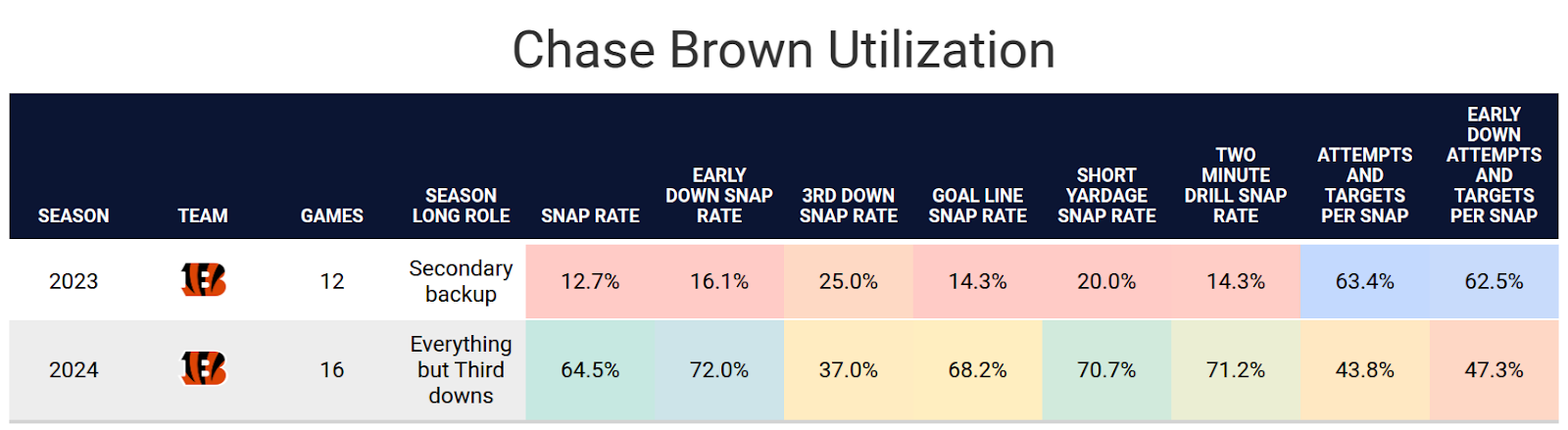
Brown was a Bengals fifth-round pick in 2023, when Joe Mixon was the starter. Brown was a non-factor over the first 12 weeks of his rookie season, finishing with two carries and three receptions on eight snaps. In Week 13, Brown started cutting into Mixon’s playing time. He played 11-18 snaps over the final six weeks of the season and averaged seven carries per game for 29 yards and 2.2 receptions for 29.8 yards.
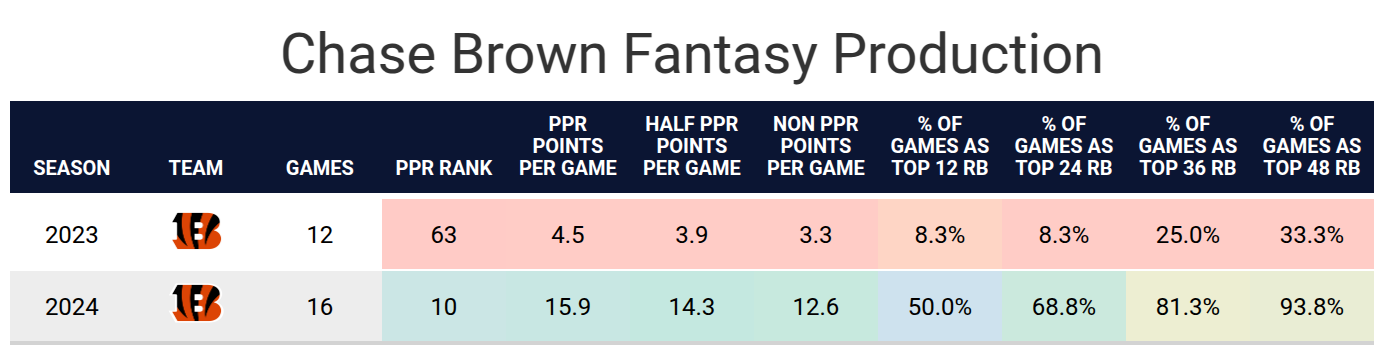
The Bengals elected to move on from Mixon and added free agent Zack Moss, who started to begin the season but by Week 4, Brown was receiving double-digit carries each week. In Week 8, Moss suffered a season-ending injury. Brown took the lead in Week 8, and from Weeks 9 to 17, he played at least 80% of Cincinnati's offensive snaps every week. He averaged 20.6 fantasy points per game during that stretch, third-most among running backs.
Brown earned a 73.8 rushing grade, which was tied for Mixon’s lowest rushing grade with the Bengals, outside of his 2020 season, when he only played six games. However, Brown’s fantasy production was better during that eight-game stretch because the Bengals scored 24-41 points each week, leading to a lot of offensive plays and touchdowns. Brown was also involved as a receiver despite not playing often on third downs. His numbers were remarkably similar to Mixon’s last season.
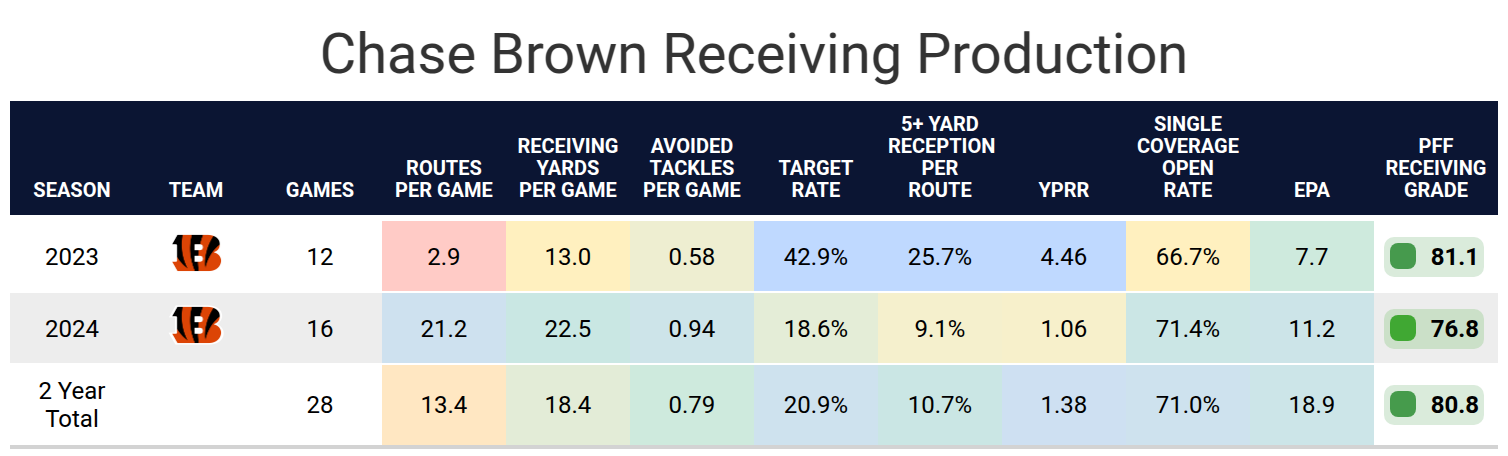
Once Brown became the starter and Moss was out, he was playing every situation outside of third downs. Instead of having a third-down back, Cincinnati simply used three wide receivers and two tight ends, or four wide receivers and one tight on on third downs, and one of those tight ends, Drew Sample, helped with blocking.
The backfield situation became notably more complicated this season. Samaje Perine returned to the team after playing for Cincinnati in 2020-2022. He was both a third-down back and a two-minute drill back for Cincinnati. In 2022, he played 58 two-minute drill snaps to Joe Mixon‘s 32, so we could see his two-minute drill snaps get cut in half. Luckily, the Bengals have never been a team to throw to running backs during two-minute drills that often, and Brown only caught four of his passes last season during two-minute drills.
The Bengals tend to have one clear running back for early downs. Since 2017, the Bengals have had one running back with 170 or more carries in first or second down, outside of two-minute drills. The most a backup has had is 83 runs. The exception was 2020, when Mixon was the clear leader before injury. This means Brown should still be the clear lead early back.
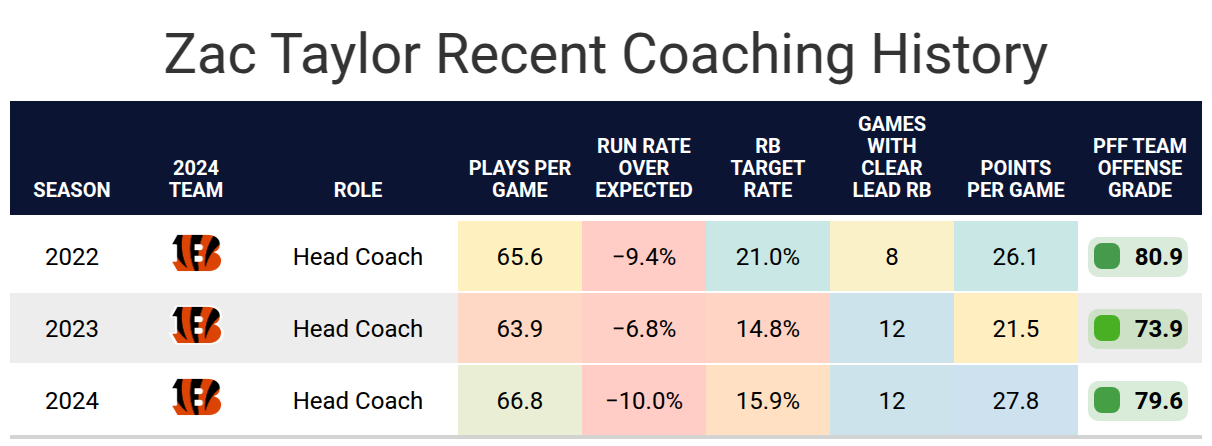
Brown will continue having Zac Taylor as his head coach. The Bengals running back has constantly had fantasy value in his offenses, even if they haven’t graded well, because he’s constantly had a lead runner. The offense scores a lot of points, which allows the running backs to score a lot of touchdowns. There are fewer carries to go around because of how much they pass the ball, so this is not an offense that can have two fantasy-relevant running backs at the same time, but as long as Brown is the guy, he should keep having value. While the Bengals are passing so much, defenses aren’t as focused on the run, which has also been an asset to the Bengals' running backs.
Brown was the third-best fantasy running back over an eight-game stretch last season, but the Bengals offense is bound to have a little regression. The real problem will be increased competition for touches. As long as Brown is starting, he should be a safe start in fantasy, but there is no guarantee he remains the starter all season, even if he stays healthy.
Jaylen Warren, Pittsburgh Steelers (ADP: 8.04)
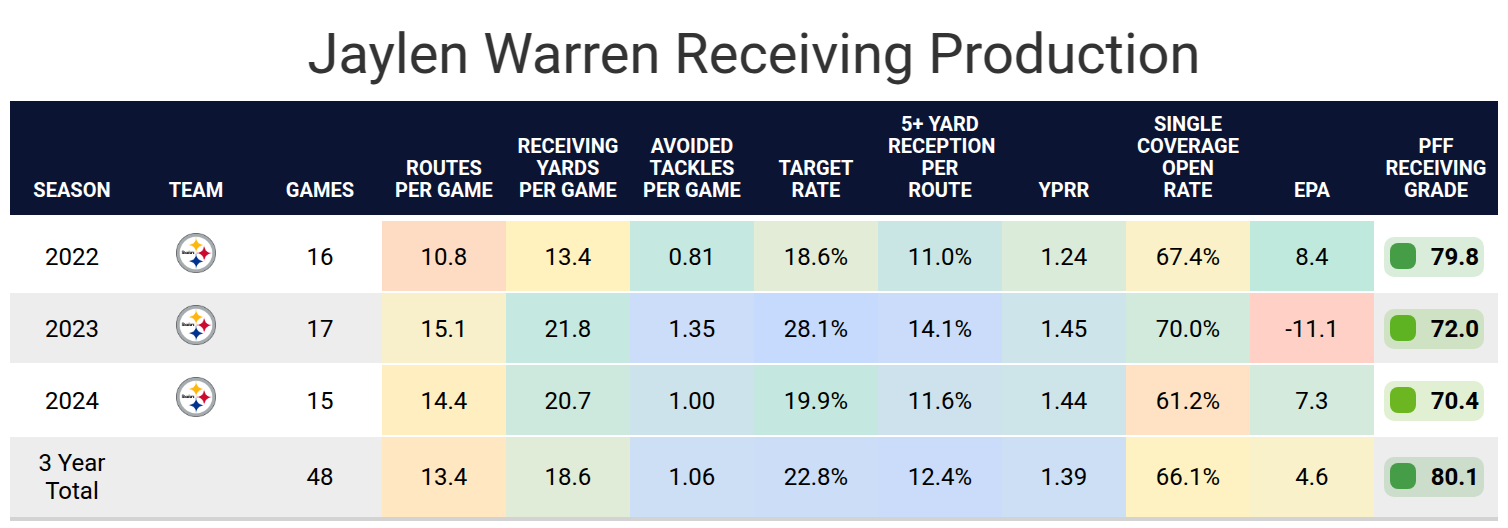
Warren was an undrafted rookie in 2022 who immediately found a role in the Pittsburgh Steelers‘ offense as the No. 2 running back and third-down back. He played 23 snaps in his first game and averaged over 30% of Pittsburgh's offensive snaps throughout the rest of the season. He slowly but surely earned more touches, finishing two games with double-digit carries over the last four weeks.
In 2023, Warren entered a near 50-50 split with Najee Harris, but Warren’s playing time increased in every situation. Naturally, Warren tended to play more when the Steelers were losing and less when they were winning. He averaged 5.3 yards per carry thanks to a very high rate of making breakaway runs. He was much more involved in the run game. He finished 22nd in fantasy points for a running back, but his situation and playing time made it difficult to ever start him unless it was a flex spot or a league where fantasy managers start three running backs.
Warren started the 2024 season with a hamstring injury in the preseason and a knee injury in Week 3. He was back playing in Week 6, but it wasn’t until Week 8 that his quality of play started to return to normal. He was RB25 from Week 10 until the end of the season. Once Week 14 hit, Warren started to consistently play at least 50% of Pittsburgh's offensive snaps.
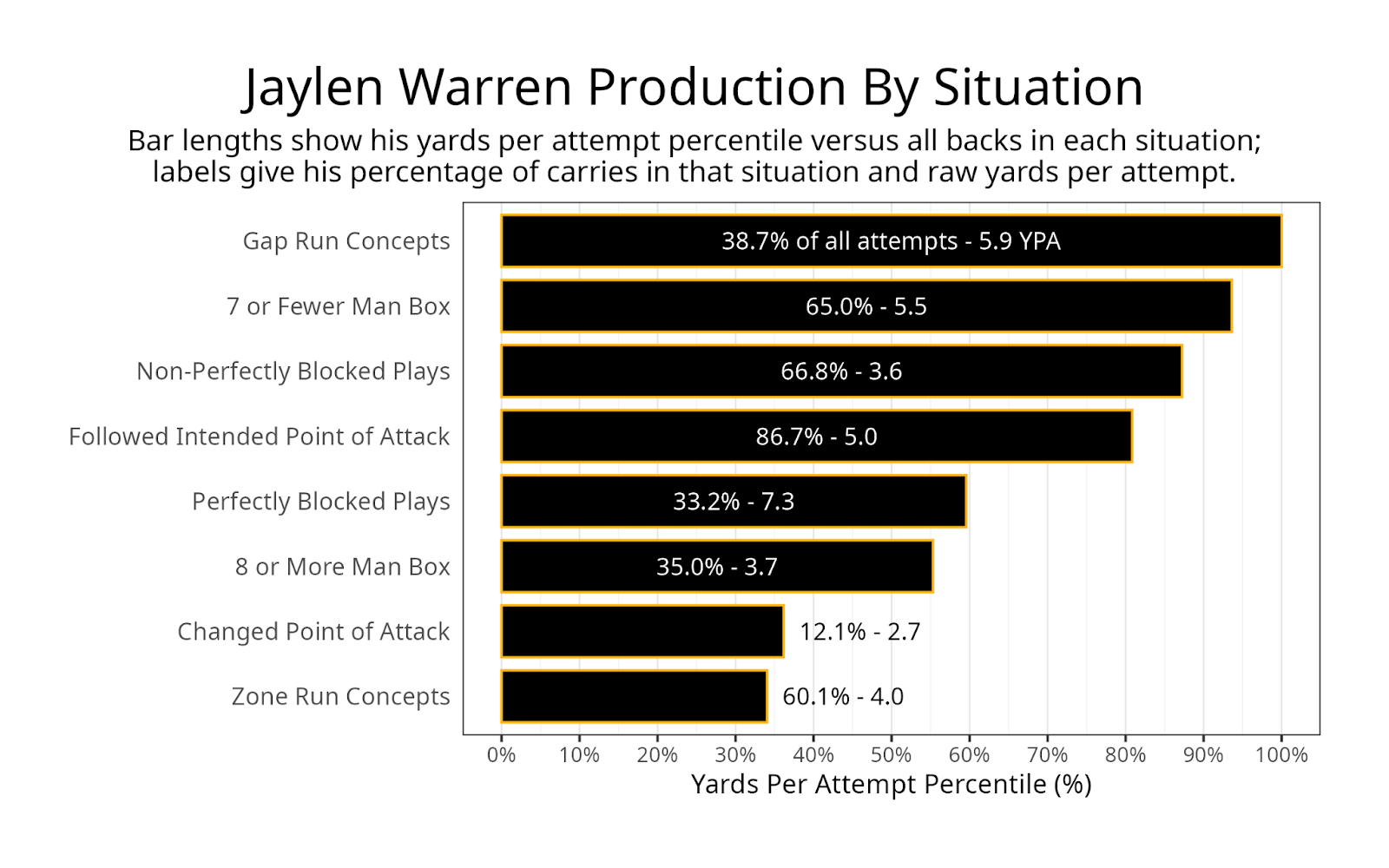
Warren spent the first three years of his career competing for offensive snaps with Najee Harris, whom the Steelers opted not to re-sign. The Steelers drafted Kaleb Johnson in the third round of the draft, and he will be Warren’s primary competition. The Steelers also added Kenneth Gainwell, as well as multiple former Indianapolis Colts, but most of those players will likely only see playing time if someone gets injured.
Johnson is unlikely to take Warren’s snaps on third downs. Considering how much the Steelers moved toward Warren in the two-minute drill, his snap count in those situations is also likely safe. While Johnson is a bigger back than Warren, the gap between them isn’t large, so there is a chance Warren will see more goal-line opportunities.
Warren's value compared to Johnson will largely depend on how quickly Johnson can develop. We can expect both players to play at least 30% of the early-down snaps and carries, but there will be a big difference between Warren playing 70% of the early-down snaps and 30%.
Throughout the preseason, it was clear Warren was at the top of the depth chart, as he sat out the first two preseason games, with Gainwell playing ahead of Johnson. In the third preseason game, Warren started and basically played in Harris’ old role while Gainwell played on third down. Johnson didn’t play until the other two running backs were done. While it’s unclear if this will be the exact rotation in the regular season, it does suggest Warren will have a significant role on early downs.
Warren will have Arthur Smith as his head coach for a second straight season. This is a big benefit for Warren because Smith’s offenses have always been more run-heavy than most. In the last two seasons, he’s had no problem throwing to running backs. When Smith was asked if the split between Johnson and Warren would be similar, Smith said it wouldn’t, suggesting Warren would play more on early downs than he did last season. He also talked about the need to run over 500 times, a mark only six teams hit last season, including the Steelers. The Steelers signed Aaron Rodgers at quarterback, which could lead the team to be less run-heavy. However, Rodgers has a high rate of throwing to running backs both with the New York Jets and Green Bay Packers, so this should help ensure Warren sees plenty of targets.
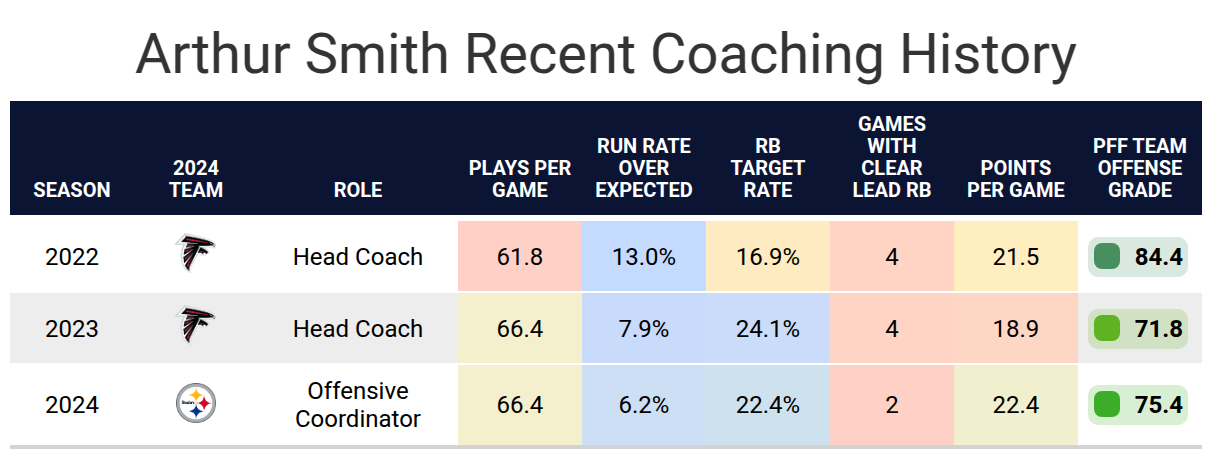
Warren has been a borderline fantasy starter when healthy the last two seasons, and that should continue this year. His upside is higher this time around because there’s a chance Warren stays ahead of Kaleb Johnson in both the run and pass games. However, there is also the risk that Johnson plays better than Harris, in which case Warren could lose playing time.
Jacory Croskey-Merritt, Washington Commanders (ADP: 14.07)
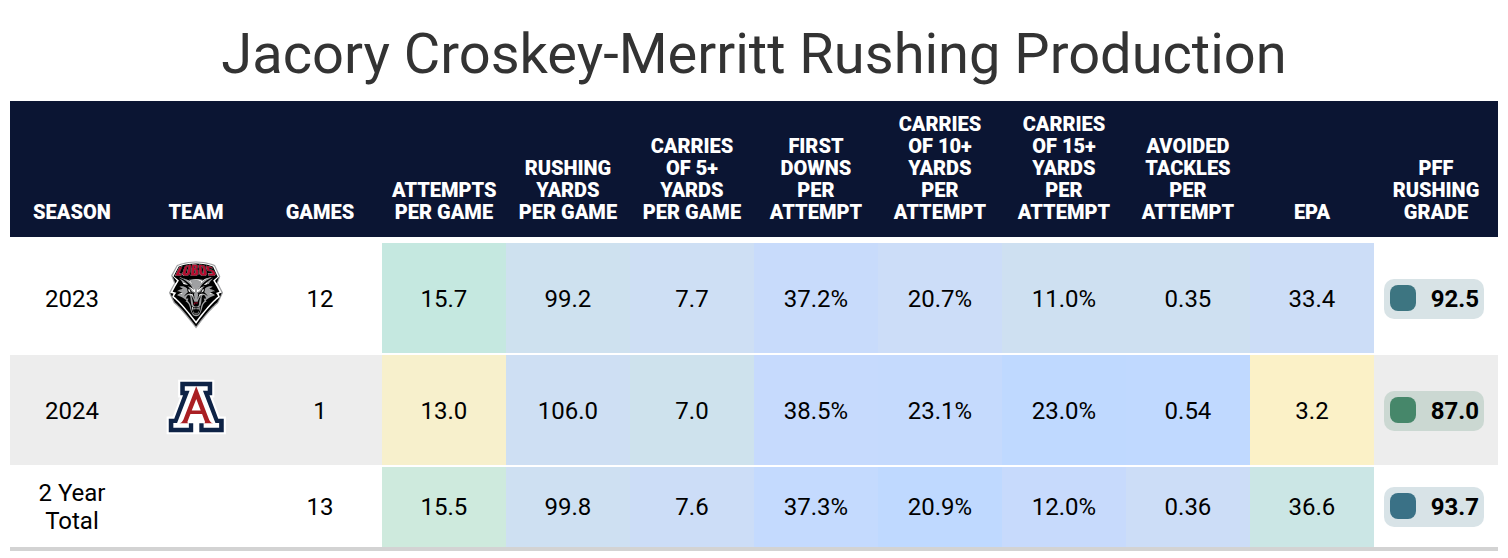
Jacory Croskey-Merritt spent 2019-2022 as a running back for Alabama State, playing a significant role in 2021 and 2022 with a steadily improving grade each season. He transferred to New Mexico in 2023 and significantly improved in both the running game and passing game, averaging a first down and breaking long runs at a ridiculously high rate, albeit against a lower level of competition than most running backs from the 2025 draft class. He was primarily used as a runner with New Mexico and was very rarely used as a receiver. When he was, he earned a decent grade.
He transferred to Arizona in 2024 and played one game, but an eligibility issue arose, which made him no longer eligible. He looked great on a relatively small sample, albeit against his former team, New Mexico. He played in the Shrine Bowl, gaining 97 yards on 11 carries and two touchdowns.
Croskey-Merritt impressed at the combine, finishing in the 80th percentile or better in the 40-yard dash, 10-yard split, vertical jump and broad jump. While his combine results were great, his PFF tracking data suggests a below-average speed compared to other running backs at the top of the draft class. However, he was faster than Cam Skattebo, Jordan James and Tahj Brooks.
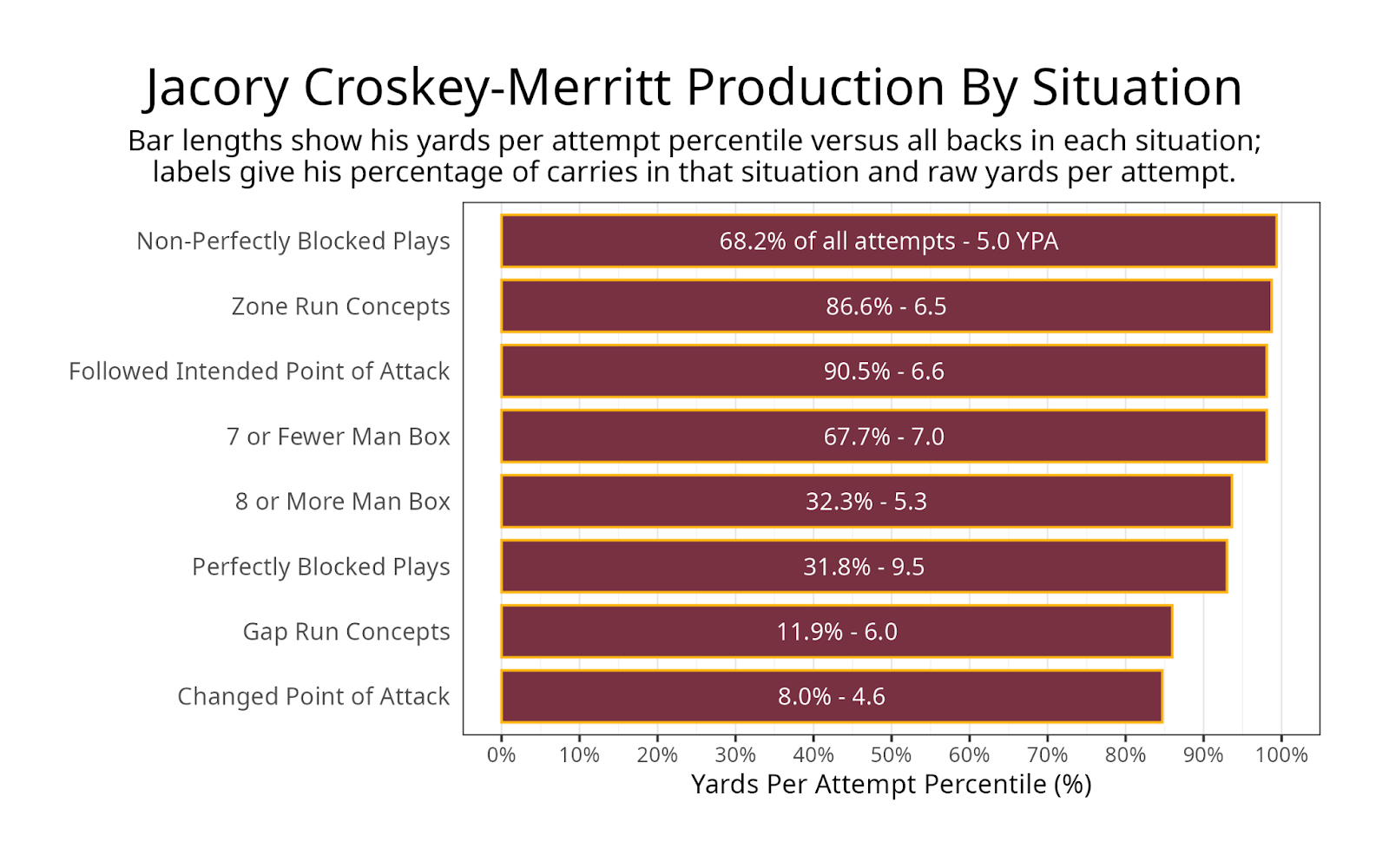
Croskey-Merritt was selected by the Washington Commanders, who had a crowded backfield last season with Brian Robinson Jr., Austin Ekeler, Jeremy McNichols and Chris Rodriguez Jr. The Commanders have used one clear early-down back and one clear receiving back in their games. Robinson has been the primary early-down back, and Ekeler has been the primary receiving back. This initially made it seem like Croskey-Merritt’s path to playing time would be very difficult.
However, he was already playing ahead of both McNichols and Rodriguez in the Commanders’ first preseason game. Robinson and Ekeler had the game off, but Croskey-Merritt served as the primary early-down back while McNichols was the receiving back. Rodriguez didn’t play until much later in the game, suggesting he was a clear fifth on the depth chart.
This made it seem like Croskey-Merritt would be the clear handcuff if Robinson were to get injured. The second game wasn’t as promising because Rodriguez started over Croskey-Merritt but then Robinson was traded. Croskey-Merritt was among the key players to sit out in their final preseason game, while Rodriguez played in the game. This suggested that Croskey-Merritt was back ahead of Rodriguez and the top running back on the depth chart for early downs.
Croskey-Merritt will play in Kliff Kingsbury’s offense, where his running backs have often been fantasy starters when healthy. He’s had an every-down back at times but has also had an early-down back with a passing-down back. Given that Croskey-Merritt wasn’t used on third downs in their first preseason game and wasn’t even used very often at New Mexico, it seems very likely his role will only be as an early-down back. Kinsbury’s offenses have been balanced, producing a low rate of throwing to running backs. Deebo Samuel‘s presence at wide receiver will likely keep the target rate to running backs low.
Jayden Daniels is a quarterback who can run, which could also potentially limit the running backs. The Commanders didn’t necessarily use him on the one-yard line like other running quarterbacks, but that could change with Croskey-Merritt. Brian Robinson was noticeably bigger than Daniels, but Croskey-Merritt is slightly smaller.
The Commanders made changes to the offensive line in 2024, which didn’t work out as well as expected. The three interior linemen all graded worse than at earlier points in their careers, despite being at an age where they should be around their prime. Brandon Coleman played fine for a third-round tackle for a rookie. The Commanders replaced their weakest link on the line with Laremy Tunsil, who is known for being an excellent pass protector, but he’s also been an adequate run blocker. The line should be improved over what it was last season, but the question is by how much.
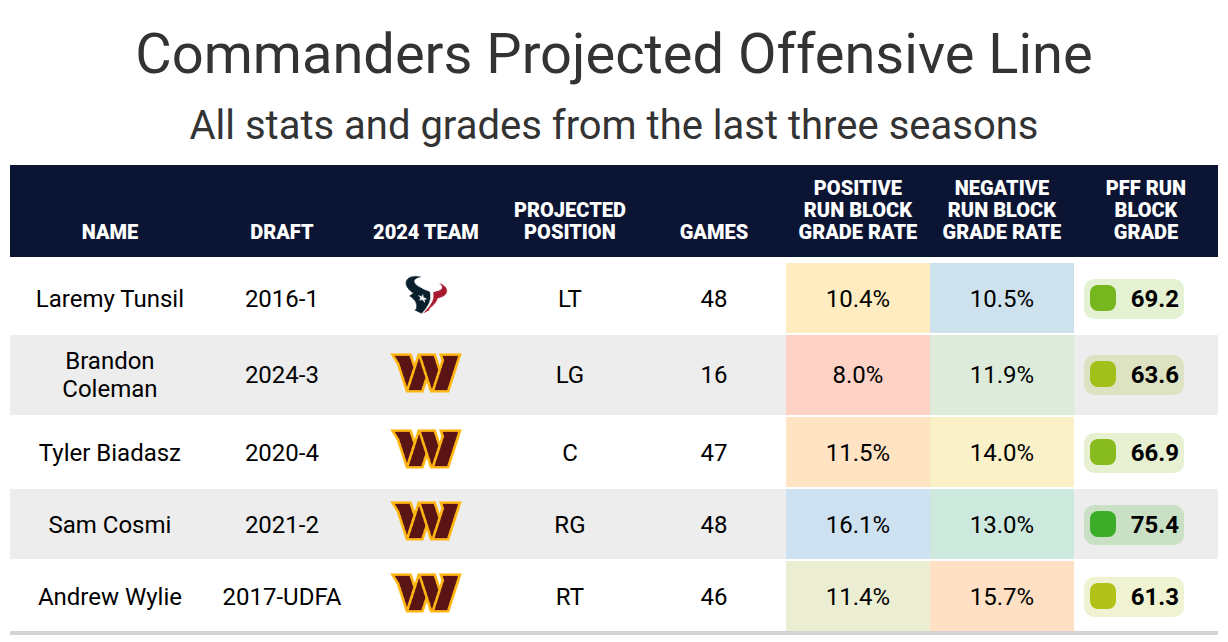
Croskey-Merritt is about to fly up draft boards faster than most sites have their ADPs updated. He is worthy of being one of the top 32 running backs drafted, but you, ideally, won’t have to draft him that high.
Zach Charbonnet, Seattle Seahawks (ADP: 11.07)
Zach Charbonnet was the 52nd overall pick of the 2023 NFL Draft, which was awkward for fantasy football purposes because Kenneth Walker III was the 41st overall pick of the 2022 draft by the Seattle Seahawks. Charbonnet started his career playing between 23-27% of Seattle's offensive snaps over the first five weeks, touching the ball a few times per week. From Weeks 8 to 10, Charbonnet started playing much more in passing situations as Walker was playing but not practicing due to calf and chest injuries. Not long after, an oblique injury kept Walker out for two weeks.
Charbonnet became a feature back for those two weeks. Unfortunately, he averaged 3.4 and 3.2 yards per carry in those games, respectively, and averaged 13.4 PPR points in his two starts. Walker returned for the final five games of the season, where playing time was a near-even split, but Walker was dominating carries while Charbonnet averaged 19 rushing yards per game.
Walker was healthy for the first week of 2024, in which Charbonnet was back down to a 34% snap rate. Walker missed six games over the course of the season, giving Charbonnet more opportunities as a starter. However, when Walker was available, Charbonnet was playing fewer snaps on average compared to the previous season. He wasn’t fantasy viable when Walker was healthy, but he averaged 19.2 PPR points over his six starts during the season. His fantasy points per start ranked fourth-best among running backs last season.
Part of his fantasy success last season came from high touchdown totals. He averaged a rushing touchdown per start, the best for all running backs, and his 0.059 rushing touchdowns per attempt over the entire season was fourth-most among running backs.
Walker has generally graded better as both a runner and a receiver over the last two seasons. Charbonnet has been more consistent at converting first downs, but Walker has broken more big plays when given the opportunity. Charbonnet has been notably better on gap runs than zone, finishing with 5.1 yards per attempt on gap plays compared to 3.5 on zone. The reverse is true for Walker, who averages 4.4 yards per attempt in his career on zone runs compared to 4.0 on gap runs.
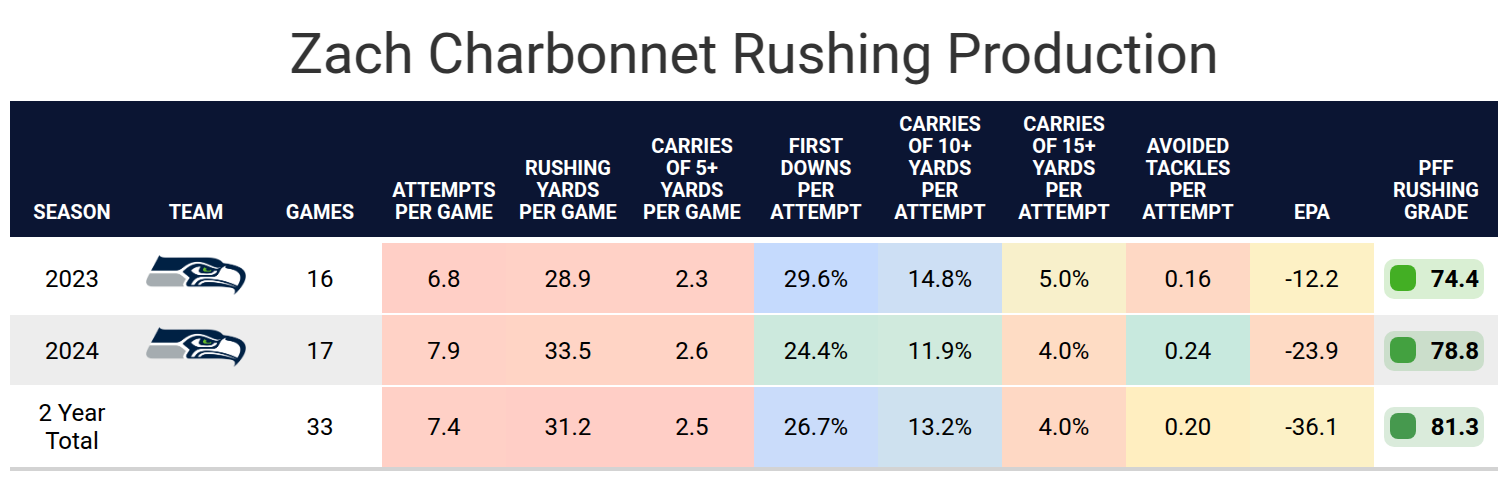
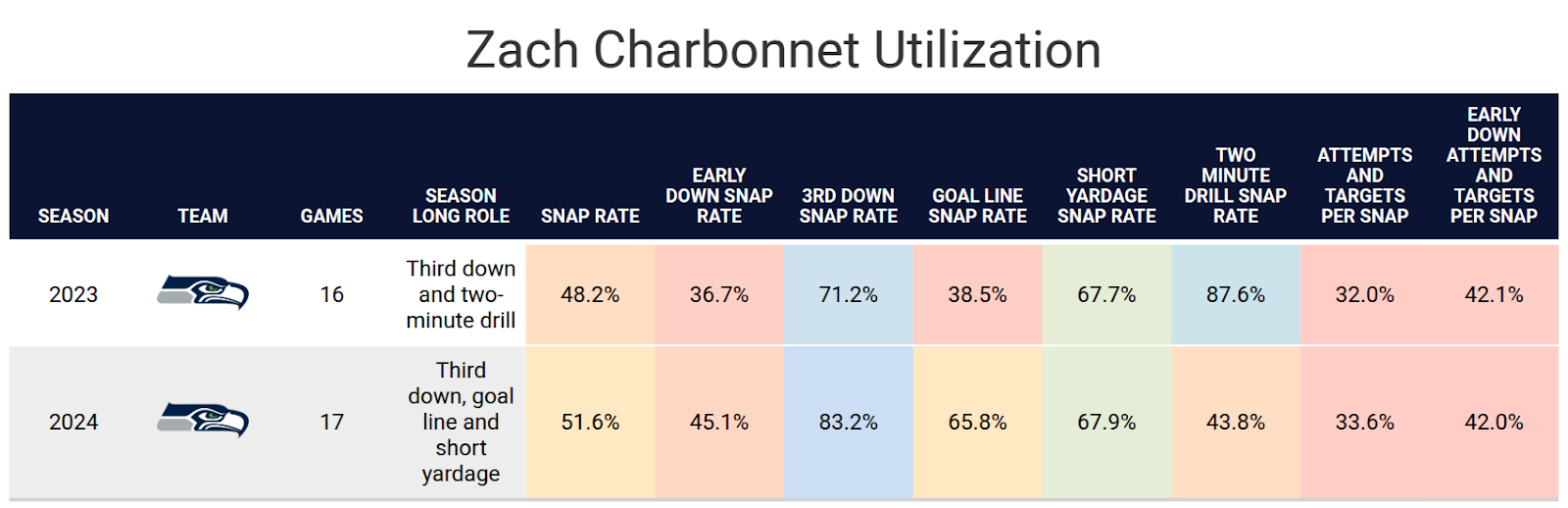
Charbonnet has had the unique combination of being the third-down back who also plays a lot in short-yardage and goal-line situations. That helps explain his high first-down conversion rates and high touchdown totals. Charbonnet is a tad taller and bigger than Walker, but not significantly.
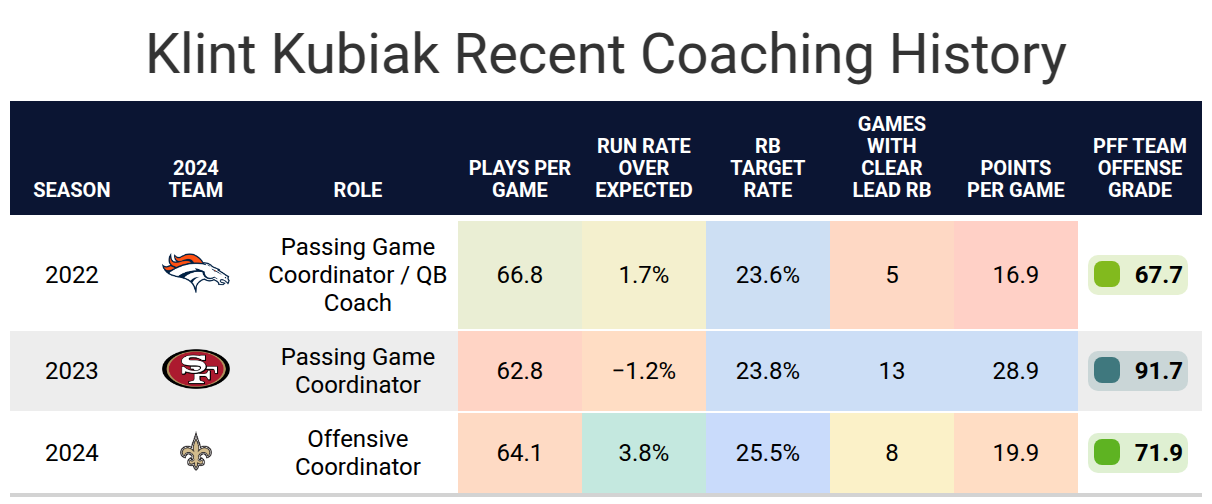
Klint Kubiak is the Seahawks' new offensive coordinator. He has worked as an offensive or passing game coordinator on five different teams in the last five seasons. In three of the last four stops, including his last two as an offensive coordinator, his team has had a top-12 fantasy running back. This includes Alvin Kamara, who was fifth in fantasy points per game last season, and Christian McCaffrey, who was first in 2023. His offenses have consistently featured the running back in the passing game.
While Walker seemed like a better fit for Kubiak’s offense, signs are pointing toward Charbonnet earning a larger role than last season. Walker has missed most of training camp due to injury, which has been a common occurrence in Walker’s career. This has given Charbonnet the first-team reps with the offense, and he’s been able to impress the new coaching staff. Kubiak has praised Charbonnet’s intelligence and said “longevity or just availability” is second-most important for elite running backs, which Charbonnet’s had this offseason, while Walker hasn’t over the last month.
This makes it at least possible that Charbonnet will have fantasy value even if there isn’t a new Walker injury. If he becomes the starter, he has top-15 potential, given Seattle’s desire to run the ball and Charbonnet’s talent.
Charbonnet might not be anything more than a handcuff this season, but he’s one of the most talented handcuffs on a team that wants to center their offense around the running back, behind a running back who has dealt with multiple injuries throughout his career. This makes him arguably the top pure handcuff option in the NFL this season.

 © 2026 PFF - all rights reserved.