- Saquon Barkley broke long touchdown runs at a historic rate: By any definition of a “long” touchdown run, Barkley was the NFL's best last season. He posted one of the best rates, if not the best, in NFL history. That will likely regress this year.
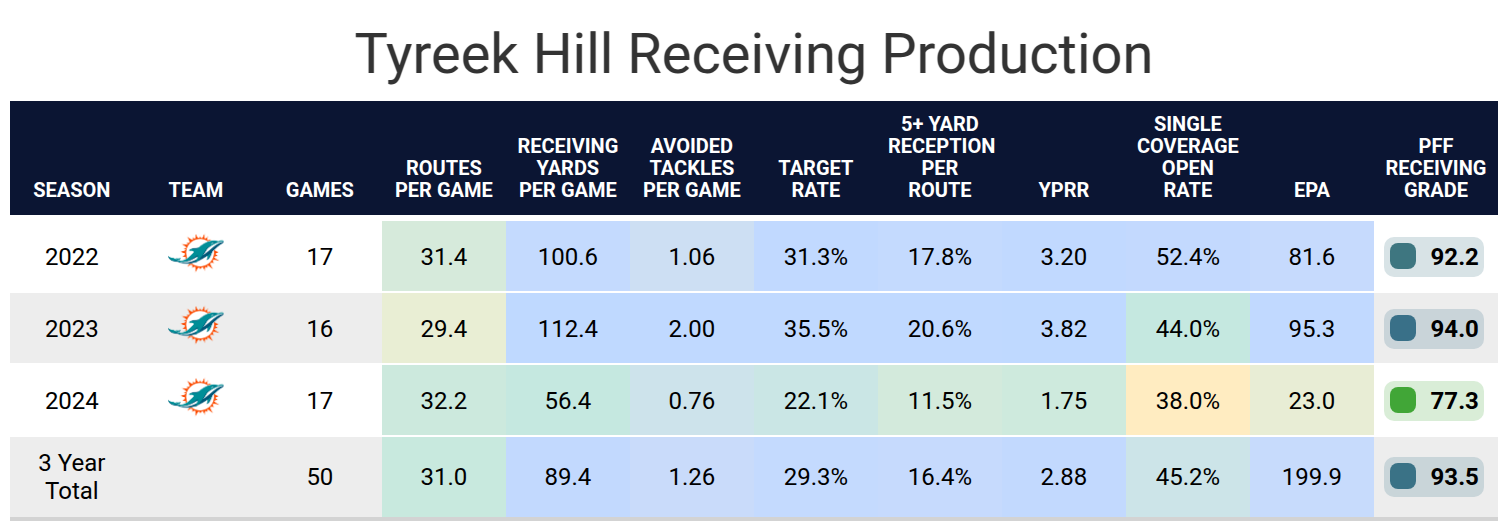
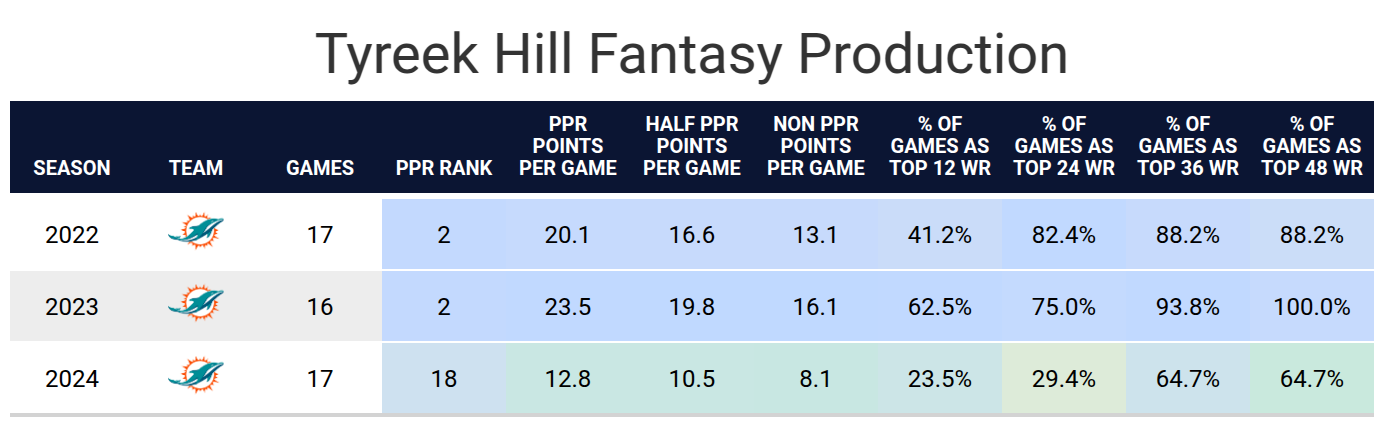
- A big step back in 2024: Tyreek Hill played every game last season, but while his routes per game increased from the previous two seasons, his yards and fantasy points per game figures were nearly cut in half.
- Subscribe to PFF+: It’s quick and easy. You’ll unlock industry-leading rankings, unlimited Fantasy Mock Draft Simulator use, PFF's Live Draft Assistant and our weekly Start/Sit Optimizer. It’s time to win.
Estimated Reading Time: 15 minutes

Editor's note: Enjoy this PFF+ article and explore others free until Aug. 29.
In an ideal world, every NFL skill player will match their best season or outperform it in 2025. Unfortunately, we know that won't happen, making fantasy football projections a tough job.
It often stems from regression. The root could be age, injury concerns or some combination of the three. However, once a player becomes a household name, their average draft position doesn’t fall as far as it should, making them a player to avoid. The ADP listed is from a consensus between ESPN, Sleeper and Yahoo! for where the player is picked on average in a 12-team, redraft league.
Last updated: Monday, Aug. 25
RB Saquon Barkley, Philadelphia Eagles (ADP: 1.03)
Barkley landed with the Philadelphia Eagles in free agency in 2024, putting him in a situation with a far better offensive line but also a quarterback, Jalen Hurts, who handles one-yard goal-line carries. There also wasn’t as much potential for receiving production for Barkley last season.
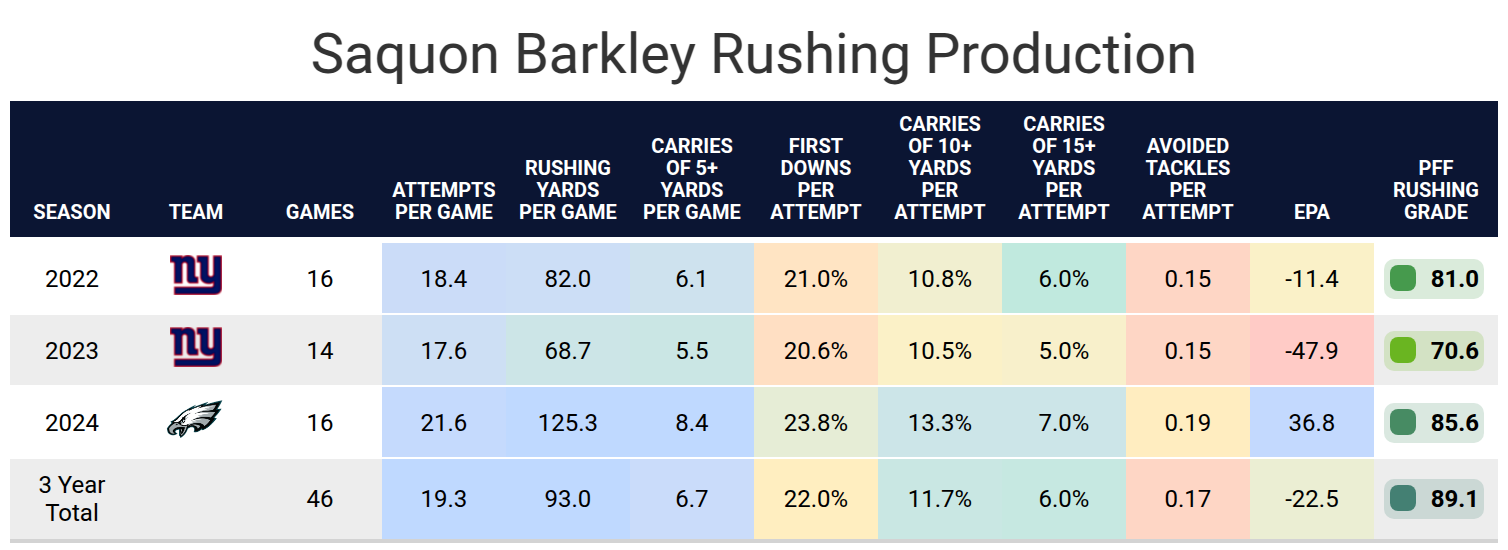
That all ended up being true. The Eagles earned the fourth-highest team PFF rushing grade. When they were on the one-yard line, Hurts turned 15 carries into 11 touchdowns, whereas Barkley had three carries for no scores. He ran fewer routes and posted a much lower target rate. He was among the league leaders in carries per game, and volume is king in fantasy football, but his per-play metrics suggest a good, but not great, running back.
This should have all added up to a low RB1 performance, but Barkley converted 60-plus-yard runs into touchdowns at the best rate in NFL history. He did so a record seven times, including the playoffs.
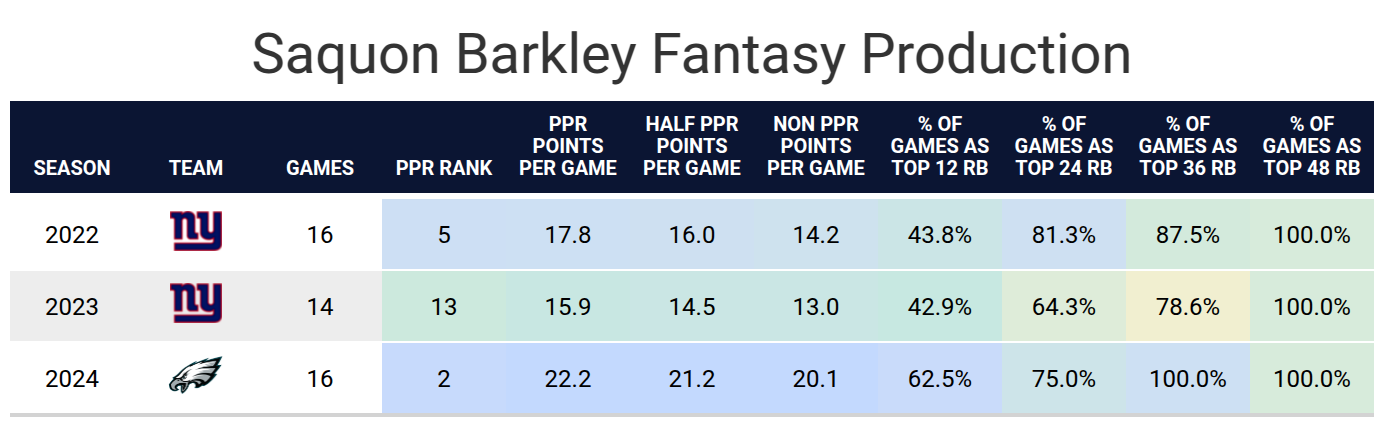
Barkley similarly led the league in touchdowns of 15 or more yards in the regular season (eight). If you removed all of the 15-plus-yard touchdown runs from all running backs, he would have finished seventh in fantasy points per game instead of first. Long touchdowns aren’t consistent from one year to the next, and those 60-plus-yard scores, in particular, should regress substantially. He is still in a position to break more long runs than any other running back, but it’s implausible he can continue at the same rate.
Barkley’s primary competition for touches, from a fantasy perspective, is Hurts. When the Eagles needed one yard for a first down or score in 2024, they ran 43 times with their quarterbacks and 21 times with their running backs. This is almost entirely due to the tush push's success. And with the tush push still legal for 2025, Barkley’s long-run touchdown total should regress without any increase in his short-run touchdown total.
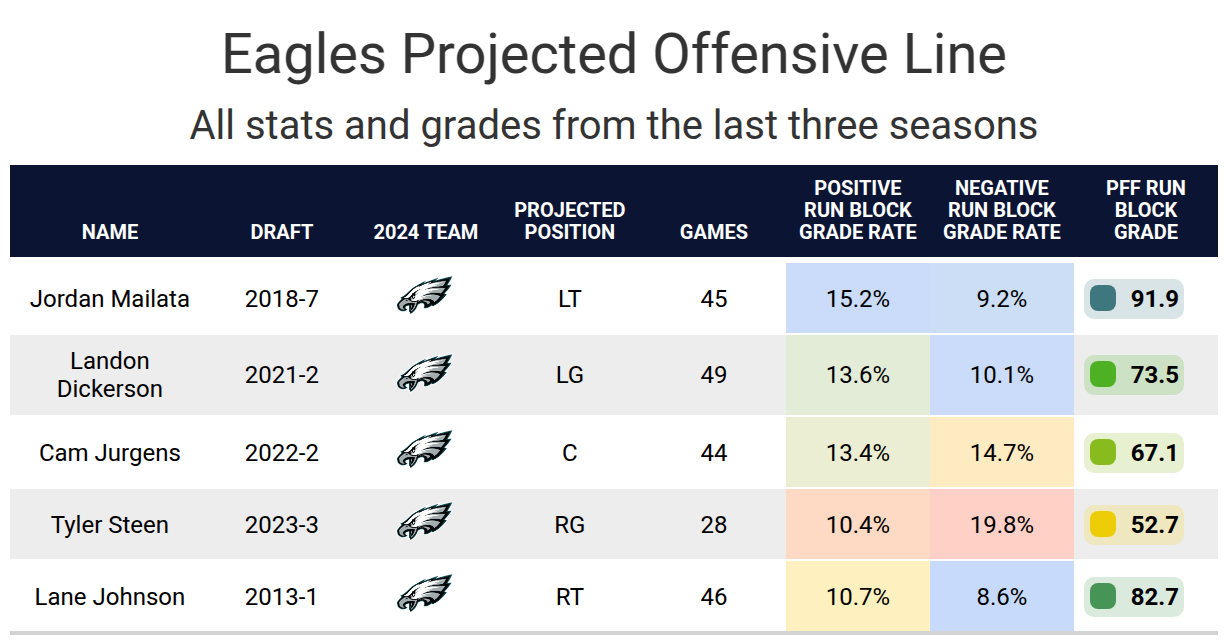
A large part of Barkley’s success has been Philadelphia's offensive line, which ranked fourth in PFF run-blocking grade last season. Left tackle Jordan Mailata enjoyed one of the best run-blocking seasons in PFF’s history last year, and Lane Johnson has played for more than a decade and just posted his highest PFF overall grade at 34 years old. Left guard Landon Dickerson made substantial progress in his fourth season. While Cam Jurgens wasn’t Jason Kelce, he still graded fine in run blocking in his first season at center.
The big question is at right guard, where Mekhi Becton left in free agency. Tyler Steen is the favorite to take over at the position, but there should be competition from Kenyon Green or Matt Pryor. Whoever wins the right guard job probably won’t play as well as Becton, and there could be some regression from the tackles, but this should remain among the best lines in the league.
Barkley is a talented running back who dominated fantasy leagues last season with an unsustainably high rate of long touchdown runs. He will continue to be a great back who sees elite volume, which alone makes him a top-10 running back, but it will be hard for him to remain elite due to likely touchdown regression.
WR Tyreek Hill, Miami Dolphins (ADP: 3.06)
Hill is a future Hall-of-Fame receiver who made an All-Decade team and five first-team All-Pro teams and with a Super Bowl ring. In 2023, his best season, he racked up 1,799 yards and 13 touchdowns. He finished second in fantasy points per game and was an early first-round pick in redraft leagues in 2024. However, he wasn’t nearly as effective.
His routes per game figure was up in 2023, but his target rate was down 13 percentage points, leading to fewer yards per route run and EPA. Part of this could have been injury-related. He showed up on the injury report with a foot injury in late October before dealing with a wrist injury in November, December and early January. Reports after the season indicated the wrist injury had lingered since training camp, and he had multiple surgeries this offseason.
Hill also dealt with hip, foot, hand, ankle and wrist injuries in 2023. He was great in Week 1 with seven receptions for 130 yards and a touchdown. Then, Tua Tagovailoa suffered an injury in Week 2, so Hill had only one game when both he and his starting quarterback were fully healthy. It would be understandable that he was getting less separation if he was dealing with a leg injury all season, but it was a wrist injury causing him problems, which shouldn’t impact his separation much.
Hill’s entire game is built on speed, and at 31 years old, it would be understandable if he just doesn’t have the same quickness as earlier in his career. Perhaps injuries caused most of Hill’s problems last season, and he can rebound. Despite the down season, he still ranks first among wide receivers in targets per route (0.293), yards per route (2.88) and PPR points per route (0.593) over the past three seasons.
Hill’s usage has been consistent throughout his time in Miami, a Z receiver who can play significant snaps from the slot. His deep target rate notably declined and his contested target rate increased last season, further hinting that something other than his wrist was a problem.
Hill’s primary competition for targets remains nearly identical to 2024, led by wide receiver Jaylen Waddle and running back De’Von Achane. The Dolphins traded away Jonnu Smith and added Darren Waller. Smith and Achane provided more competition for targets compared to other recent seasons, contributing to Hill’s decreased targets. Waller will likely see fewer targets than Smith, but Waller is still more competition for targets at tight end than Hill was used to in 2022 and 2023.
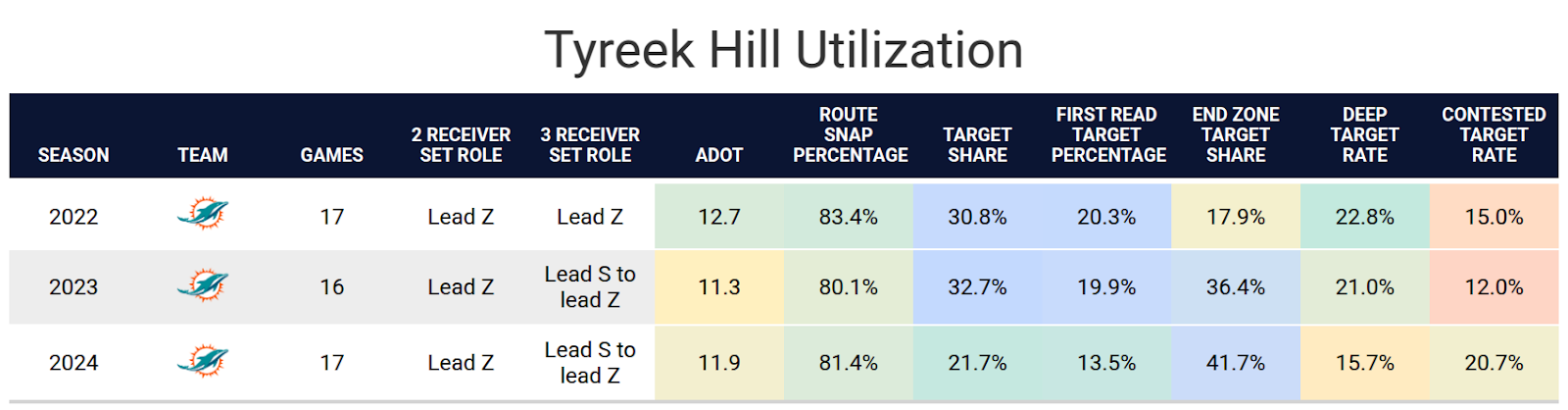
Hill, at his best, is an elite option in fantasy football, but we didn’t see him at his best last season. It’s possible that a wrist injury and injuries to Tua Tagovailoa derailed his season and are a thing of the past. However, a lower separation rate, a lower deep target rate and a higher contested target rate suggest the 31-year-old receiver isn't the same player he once was.
He is more likely to disappoint fantasy managers than not, but the chance of getting a top-two fantasy wide receiver in Round 4 or later will be too good for some fantasy managers to pass up.
RB Breece Hall, New York Jets (ADP: 4.08)
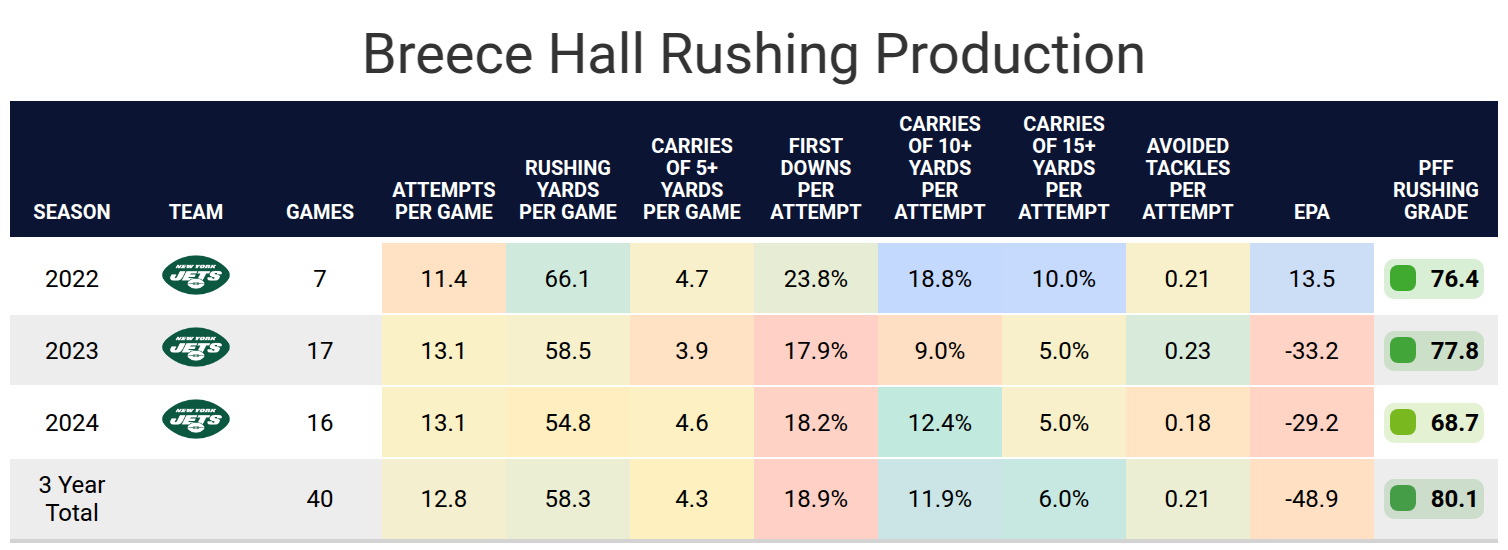
Hall was expected to take a step forward in 2024, another year removed from his 2022 injury, but it was largely much of the same. He ran the ball the same amount per game for the same number of total touchdowns. With Aaron Rodgers at quarterback, Hall was less involved in the passing game than in previous seasons. He also fumbled six times total after doing so three times over the previous two seasons combined.
While Hall has displayed up-and-down play, at times, his career 3.4 yards after contact per attempt average is the best among running backs over the past three seasons. He has one of the more extreme splits in how well he plays on perfectly blocked runs compared to not, going from 8.6 yards per attempt to 3.0. The problem is that he has seen fewer perfectly blocked runs than most backs. He also has an extreme split, playing better on gap runs than zone, but he has run more on zone plays.
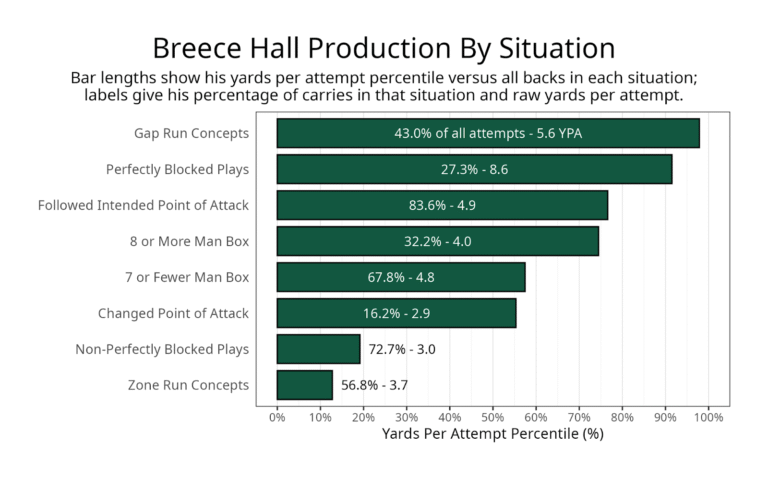
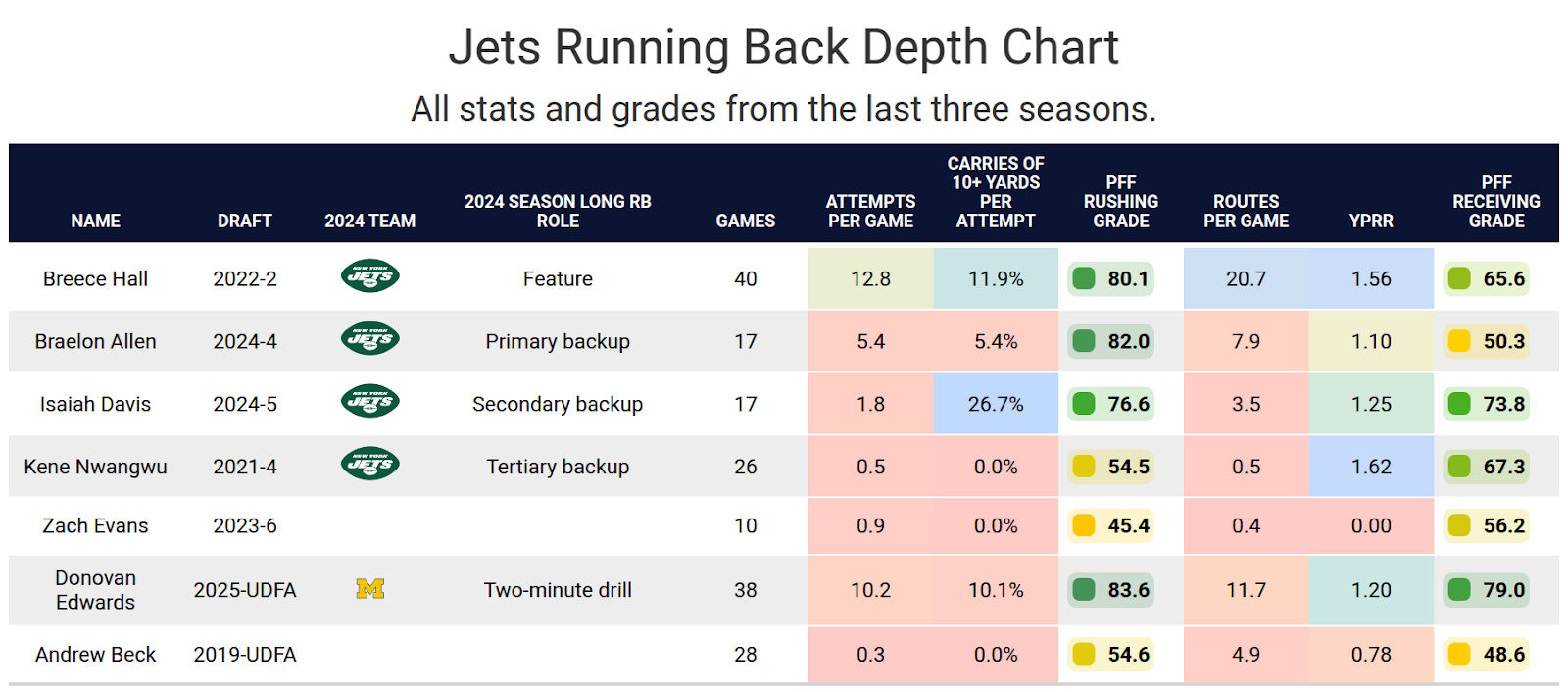
For most of last season, Hall played around 75% of New York's offensive snaps. He played notably more than last season, but rookies Braelon Allen and Isaiah Davis received significant attention after strong performances. Hall was the lowest-graded running back of the three.
The Jets' new coaching staff has been adamant this offseason that they plan on using all three running backs. That played out in the preseason. In the first game, Hall logged five of 10 snaps with the starters, with Allen playing two and Davis three. In the second game with Davis out, he played 11 of 18 snaps with the starters. This suggests a substantial drop in playing time. He also didn’t play on third downs in either game, with Davis taking third-down snaps in the first game and Allen taking them in the second.
If this split in playing time stands, it will lead to a substantial decrease in volume for Hall. Because Allen seems to be taking short-yardage snaps and Davis passing-down snaps, Hall will simply be an early-down back. Allen and Davis are also capable of playing on early downs. If one of the two starts playing better in normal early-down situations, then Hall could get phased out of the offense even further.
New Jets head coach Aaron Glenn brought former Detroit Lions passing game coordinator Tanner Engstrand with him to New York. It’s his first year leading an offense, so we don't know how much he will deviate from Ben Johnson’s play calling. It is very easy to picture Allen taking the David Montgomery role in this offense while Hall takes the Jahmyr Gibbs role. The Jets will need to have a good offense for Hall to have any chance of matching Gibbs' value.
New York deployed zone runs at the eighth-highest rate in the NFL last season, while the Lions ranked sixth. Hall plays better in gap schemes than zone, which could help explain why the Jets could be open to trading him. Most of the potential teams that need a running back are also expected to use a high zone run rate, but the Washington Commanders are the notable exception. Both Allen and Davis played better on zone runs last season.
A big difference in this offense compared to the Lions' is that New York has Justin Fields at quarterback. He runs much more than Jared Goff and will also take more sacks. Generally, rushing quarterbacks tend to hurt the value of receiving running backs because they will scramble rather than check down, at times. This means Hall’s receiving production is unlikely to bounce back with Fields, regardless of his playing time.
Hall’s past rushing and receiving production make him a potential top-five fantasy running back. Still, it’s very difficult to predict exactly what his role will be in the Jets' new offense, and there is a possibility that he will primarily be a receiving back while the other two younger players take a lot of the carries.
That all puts Hall outside of the top 10 running backs by ADP and makes him one of the biggest high-risk, high-reward options among the running backs from pick Nos. 11-20 by ADP.
TE Travis Kelce, Kansas City Chiefs (ADP: 5.11)
Kelce is arguably the best receiving tight end in NFL history. He barely played in his rookie season, but he finished eighth in fantasy points per game in his second campaign. From 2016 to 2022, he was consistently gaining at least 1,000 receiving yards and making the Associated Press’ All-Pro team. He finished first or second in PPR points per game in every season during that seven-year period.
His first signs of decline were in 2021, when his PFF receiving grade was the third lowest of his career. He had consistently played at least 85% of his team's offensive snaps each year, but his playing time dipped below 80% in his last five regular-season games. His playing time declined again in 2022, falling under 80% on average through the season.
His fantasy value jumped up thanks to a historic season in the red zone. He was thrown at 18 times when the Chiefs were within single-digit yards of scoring, which was the most for a tight end in a season in PFF’s history. He caught 13 passes, while no one else had more than nine, leading to eight of his 12 touchdowns that season. In each of the past two seasons, Kelce has seen eight targets in the same situation, and many have come outside of the end zone.
In 2023, Kelce's yards per game, yards per route run, target rate and PFF receiving grade all declined; yet, he still tied for first in fantasy points per game. In 2024, all of those numbers outside of his target rate declined again. This time, he dropped to seventh in fantasy points per game. His biggest problems were after the catch. He averaged 15.7 avoided tackles per game from 2014 to 2023, finishing with 17 in 2023, which dropped to four in 2024. He averaged at least seven yards after the catch per catch early in his career and 5.0 to 6.2 in the middle-to-late parts of his career, but that fell to 3.5 last season.
However, he played 84.4% of Kansas City's offensive snaps, the most for him in a season since 2020.
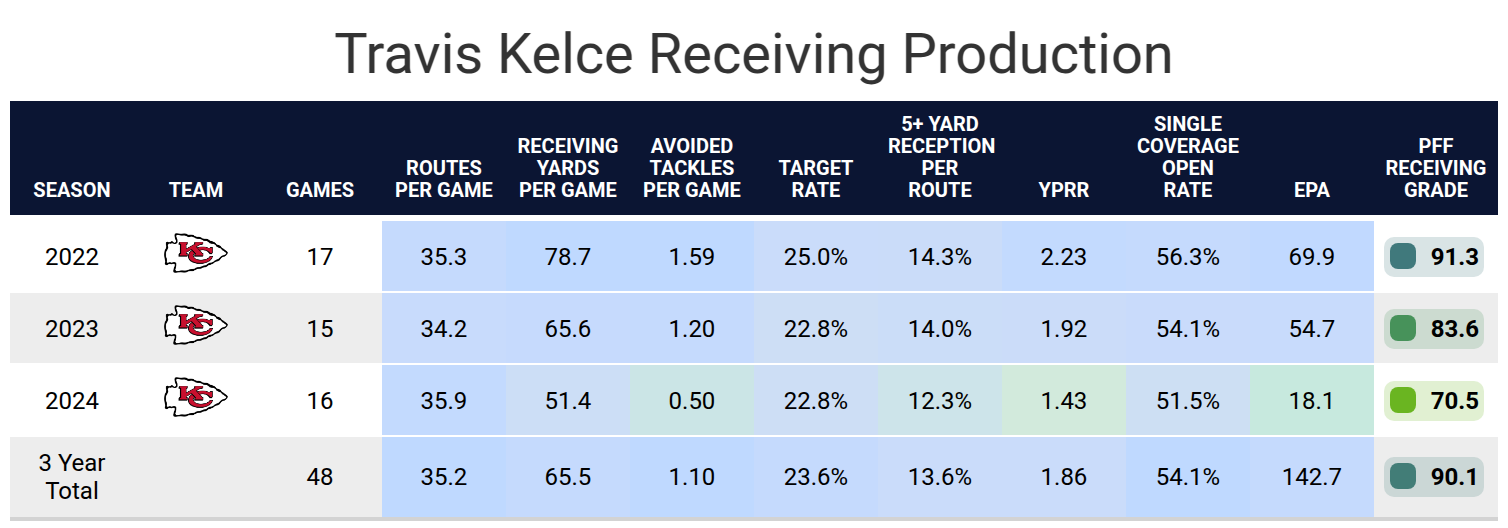
The Chiefs have invested in tight ends recently. Noah Gray played significant snaps last season, but that was more due to injuries at wide receiver rather than anything to do with Kelce. Once the team traded for DeAndre Hopkins and Hollywood Brown returned from injury, Gray’s role in the offense diminished.
The bigger concern for Kelce is the Chiefs' wide receiver room. Rashee Rice was the focal point of the offense over the first three weeks last season before he suffered a season-ending injury early in Week 4. Kelce was held to eight receptions for 69 yards over the first three weeks of last season, and those were three of his worst seven games of the regular season. Xavier Worthy started to step up late in 2024, especially in the Chiefs' last two playoff games, when Kelce notched a combined six receptions for 58 yards. Brown will be the third wide receiver, and he should be healthier this season than last, allowing him to be more involved.
The Chiefs' offense hasn’t been as good over the past two seasons, partly because Kelce isn’t playing as well, but there is a chance the team can bounce back with a better wide receiver room. Kelce saw only one end-zone target last season when the Chiefs were within 10 yards of scoring. If they have more drives near the end zone and more receiving options that defenses have to worry about, Kelce may not be the focus of defenses, leading to more targets and more touchdowns.
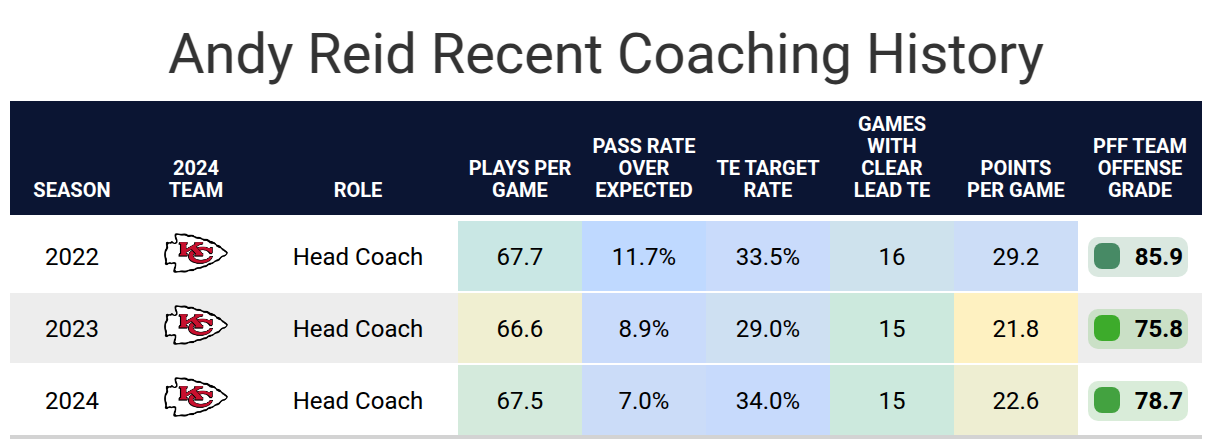
Kelce’s quality of play has declined each of the past two seasons, and he will be 36 years old by the end of the 2025 campaign. His target share could decline, but he might also score more touchdowns this season to remain a fantasy starter.
QB Dak Prescott, Dallas Cowboys (ADP: 9.09)
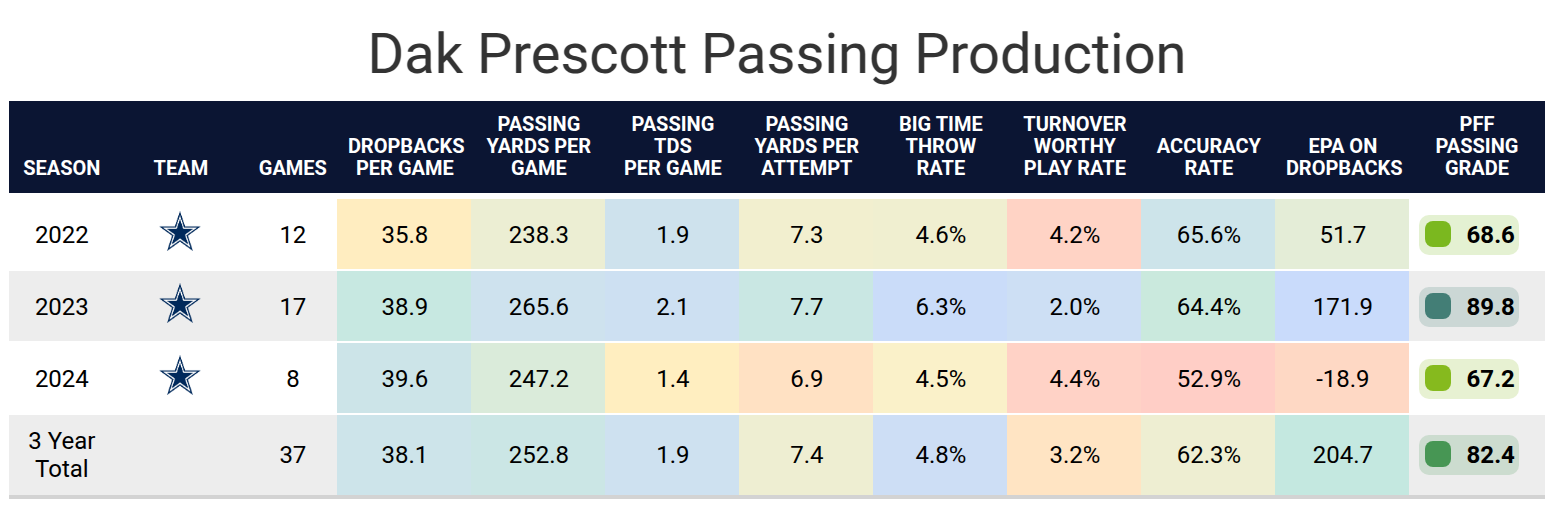
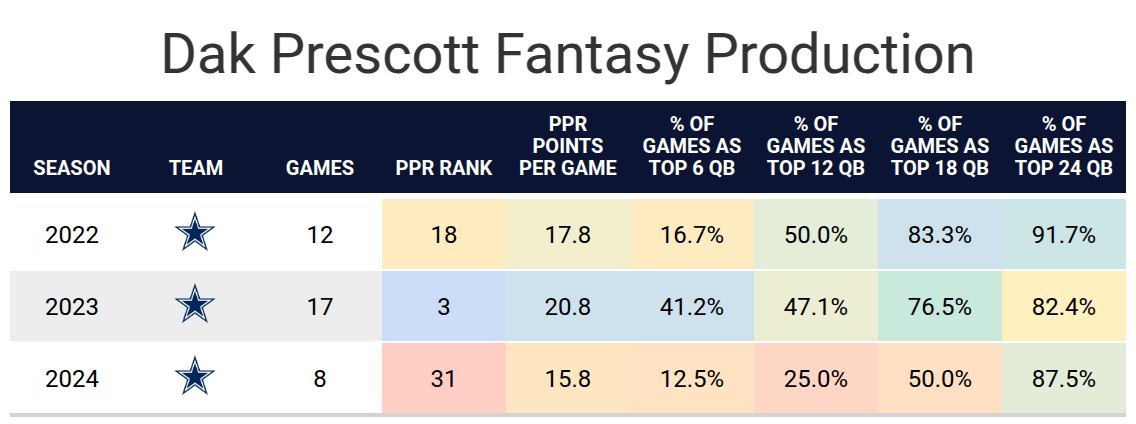
In 2021, Prescott dealt with a calf injury that caused him to miss a game, but he still managed 20.7 fantasy points per game. In 2022, a thumb injury on his throwing hand led to missed games and dwindling fantasy production. His 17.8 points per game that season ranked second lowest in his career, as did his 68.6 PFF passing grade. In 2023, Prescott didn’t miss a game and was never on the injury report. His fantasy points per game rebounded to 20.8, fifth best among quarterbacks. His PFF passing grade was a career high, too.
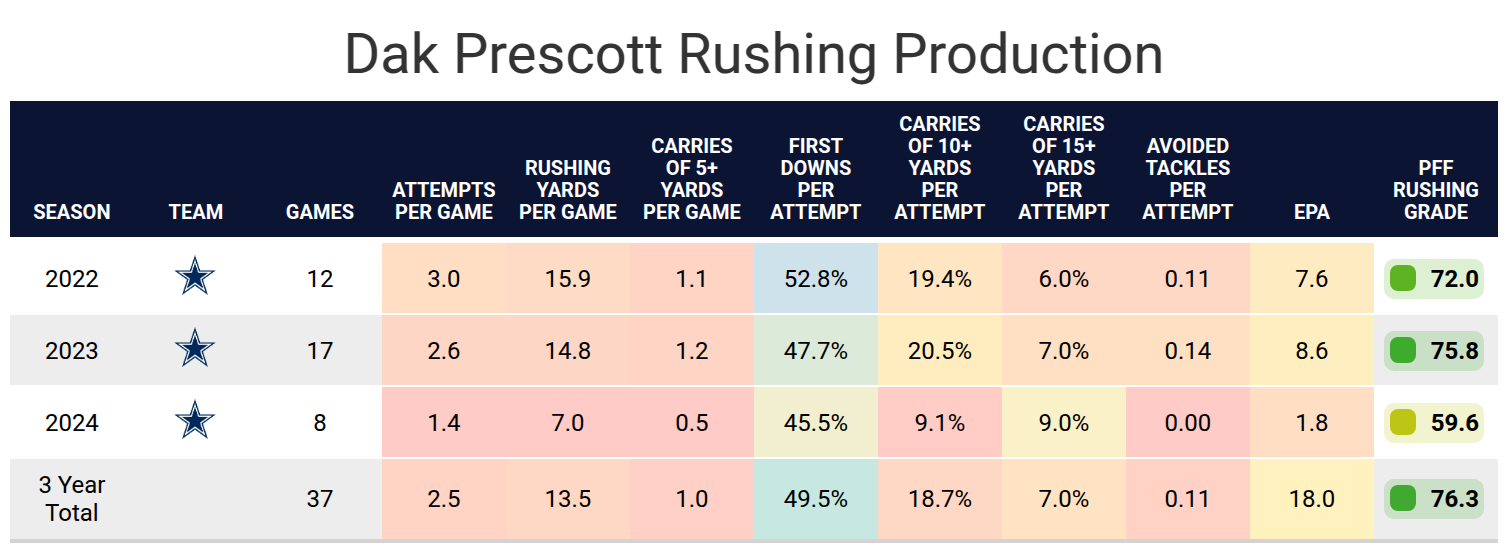
Prescott suffered a season-ending hamstring injury after eight games of the 2024 season. However, before that point, he wasn’t playing nearly as well. His 15.8 points per game and 67.2 PFF passing grade were both career lows. His accuracy plummeted, leading to an increase in turnover-worthy plays. While his dropbacks per game rose, both his yards and touchdowns per game declined. His rushing production further dropped, as well.
Despite the relatively poor play in 2024, Prescott has averaged two big-time throws per game over the past two seasons — the second-best mark among quarterbacks.
Prescott has generally benefited from a favorable schedule in recent seasons. Fifteen of his 37 games have been against teams in the top eight in allowing fantasy points per game to quarterbacks that season. He has averaged 21.4 fantasy points per game against those opponents. In his 22 games against the rest of the league, he has averaged 15.1 points per game.
The Cowboys' 2025 schedule appears to be much more difficult this season. They face a top-10 defense in preventing fantasy points to quarterbacks in nine of their 17 games, and there are only two games against opponents in the top 10 at allowing fantasy points to quarterbacks. While many defenses are likely to change in quality from 2024 to 2025, facing the NFC North and AFC West for eight non-conference games will be a significant challenge.
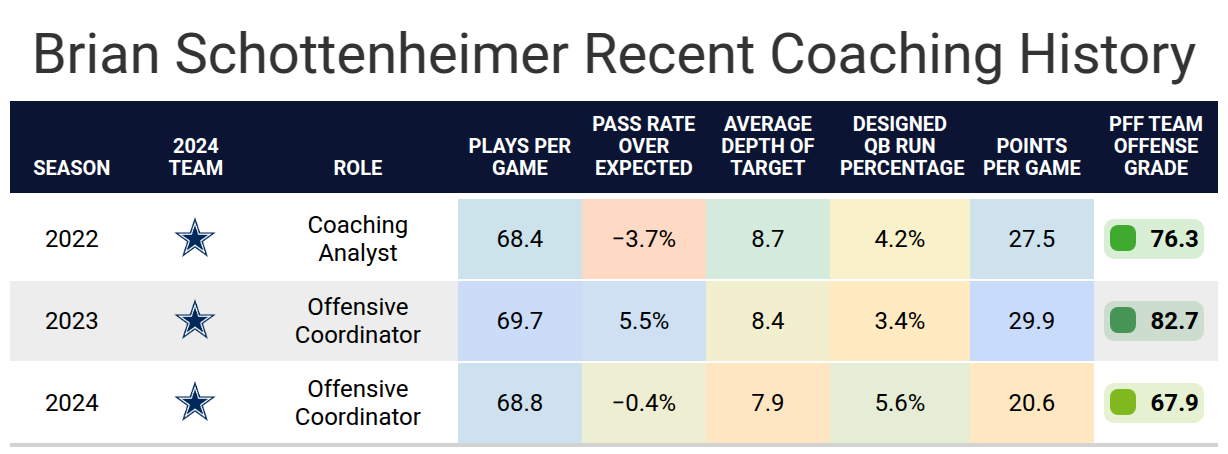
The Cowboys moved on from Mike McCarthy and elevated Brian Schottenheimer from offensive coordinator to head coach. Schottenheimer’s offenses have always ranked better in rushing yards than passing yards, outside of two seasons where the offense was nearly even.
Prescott has seen his scramble rate, designed run rate and average depth of target decrease in recent seasons, and it wouldn’t be surprising if those trends continue. His season-ending hamstring injury last year makes it unlikely that any of his run-game numbers will increase.
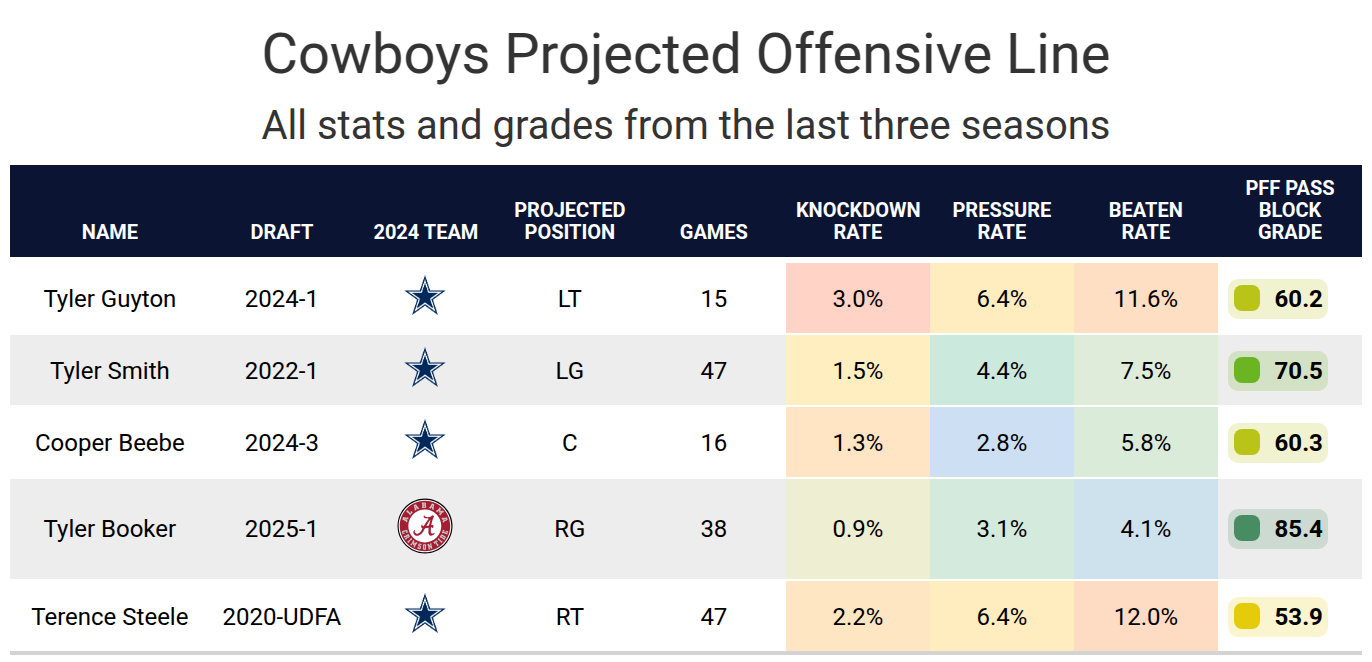
Dallas’ offensive line has generally declined in recent years, which has likely played a part in Prescott’s worse play. In 2021, the Cowboys had the third-highest-graded run-blocking line. They were average in 2022 and 2023, and fell to 23rd in 2024. The Cowboys drafted Tyler Booker in the first round to replace retired Zack Martin. Otherwise, the line remains the same as last year. Ideally, the unit will improve due to following the Cowboys' significant investments over the past few seasons. However, it’s more realistic that it returns to an average performance level.
While Prescott has the upside of a top-five fantasy quarterback when everything is going right, a lot is working against him, including a recent injury history, poor play last season while healthy, a young offensive line and a much more daunting schedule than recent years.
Prescott remains a potential fantasy starter in superflex leagues, but in single-quarterback leagues, several young, high-upside options make more sense as a backup option.


 © 2026 PFF - all rights reserved.