- The Carolina Panthers dominate the Atlanta Falcons: Tight end Darren Waller scored two touchdowns, while Tetairoa McMillan reached over 100 yards for the second time in his career.
- TreVeyon Henderson steals the show for the New England Patriots: After missing Week 1, Rhamondre Stevenson fumbled, leading Henderson to be the top back in New England, which included a touchdown run.
- Introducing the NEW PFF Pro subscription: PFF Pro includes everything in PFF+, plus an upgraded Premium Stats Pro experience, higher base access to Guru AI, revamped player and team pages, enhanced data and visualizations, an improved interface and programmatic data access for modeling. Click here to subscribe.

PFF's fantasy football recap focuses on player usage and stats, breaking down all the vital information you need to achieve fantasy success in 2026.
For fantasy players looking for additional data and tools, PFF+ provides access to fantasy and betting resources, the Mock Draft Simulator and more for $9.99 per month or $99.99 per year. Those who want to dive even deeper can sign up for PFF Pro, which comes with an upgraded Premium Stats Pro experience, revamped player and team pages, enhanced data and visualizations and programmatic data access for modeling.
Pittsburgh Steelers @ New England Patriots
Monitor Rico Dowdle’s health: Dowdle suffered a toe injury in the second quarter and was ruled out in the fourth quarter.
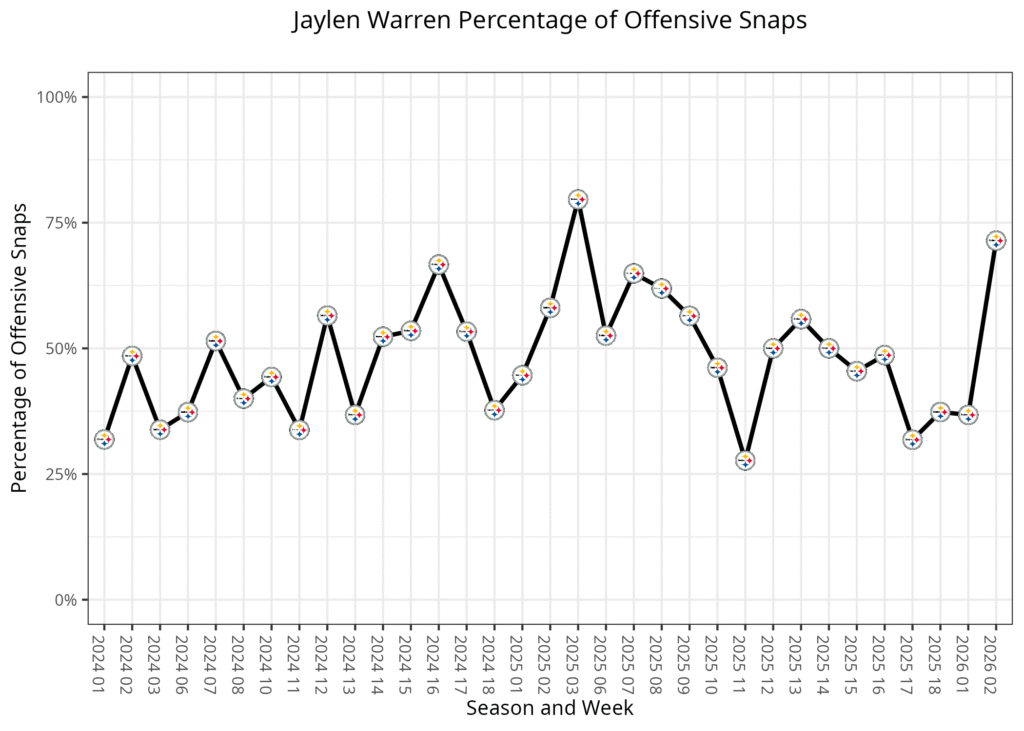
The Steelers used a two-man running back rotation last week: Jaylen Warren got the start, but Dowdle played more snaps, in part because the drives Dowdle was on the field for lasted longer. This week, Dowdle got the start. He played the first drive, Warren the second and they both played on the following two possessions. Dowdle left at that point but returned to start the second half. He played six snaps on the first drive of the half, but only two more plays over the rest of the game.
Travis Homer played two snaps in the first half when Dowdle first left the game, but otherwise, it was all Warren whenever Dowdle was out. On one hand, Dowdle appears to be ahead of Warren on the depth chart after beginning both halves. If the injury isn’t serious, then Dowdle could be a buy-low candidate.
On the other hand, this could be an opportunity for Warren to earn more playing time and maximize his fantasy value. Warren is in his fifth NFL season, and he’s never played a game where his primary competition for targets missed a contest. Najee Harris didn’t miss a game in his three years overlapping with Warren, and Kenny Gainwell played in every matchup this season. His 50 offensive snaps in this game were a career high. While there is a strong chance Pittsburgh rotates in one of the backups a little bit more than Homer was worked in for this game, Warren would be a must-start player next week against the Cincinnati Bengals if Dowdle misses that game.
The Steelers adjust without Michael Pittman Jr.: The former Indianapolis Colts receiver was inactive due to a foot injury.
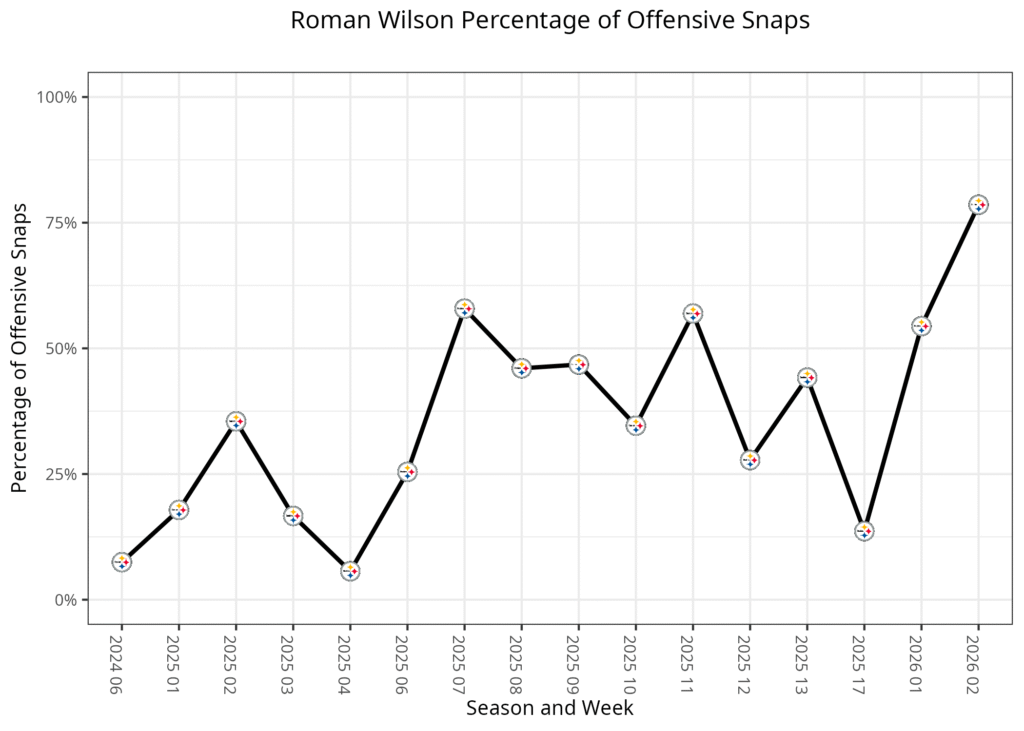
The Steelers' wide receiver rotation was straightforward last week. DK Metcalf played in one-, two- and three-wide receiver sets; Pittman played in two- and three-receiver sets, while Roman Wilson played in the slot in three-receiver sets. Rookie Germie Bernard only played three snaps in place of Wilson in his debut. Pittman showed up on the injury report with a foot injury and was ultimately inactive.
For the most part, the Steelers' wide receivers moved up a spot in the depth chart. Wilson consistently played in two-receiver sets, while Bernard was consistently on the field in 11 personnel. The only difference this week is Ben Skowronek substituted in more frequently, particularly for Wilson in 11 personnel. The Steelers ran so much 11 personnel that the plays Wilson missed balanced out with the snaps Bernard missed in two-receiver sets, leading the two to finish with the same snap totals.
Bernard led the team in receiving yards at 35 on four receptions, while Wilson paced Pittsburgh in receptions at five for 28 yards. It wouldn’t be surprising if we see Bernard mix in a little more frequently going forward, regardless of Pittman’s health.
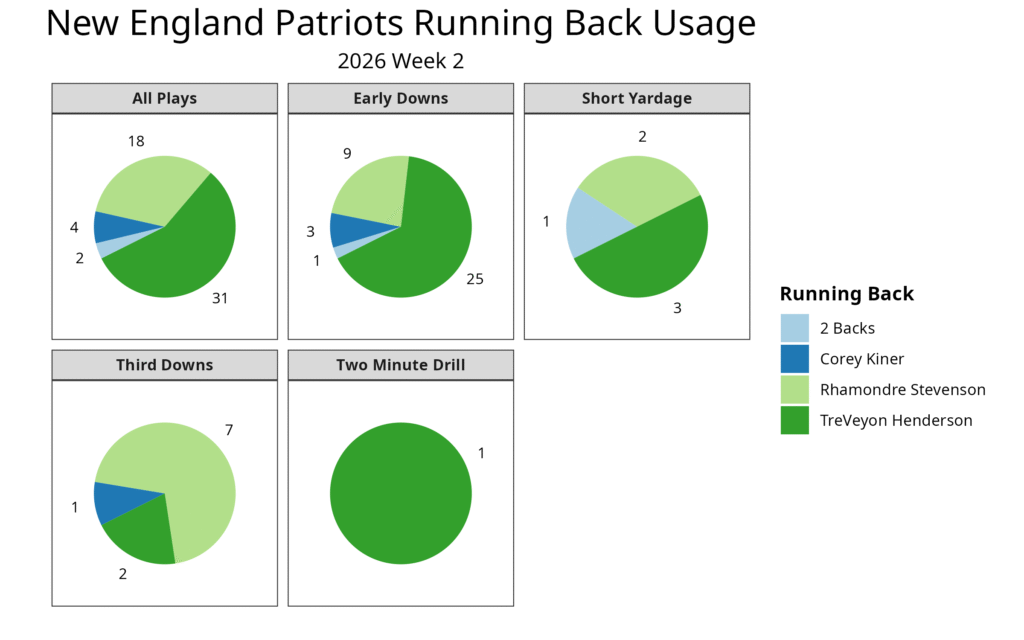
TreVeyon Henderson shines in his return: Henderson led the Patriots in rushing production with 16 carries for 76 yards and a touchdown.
Henderson missed Week 1 with an ankle injury, but was a full participant in practice all week and was ready to play in this game. In his absence, Rhamondre Stevenson played 84.5% of snaps last week, including 100% on third downs, in the two-minute drill, in short yardage and at the goal line. Corey Kiner was the primary backup, and Lan Larison was a practice squad call-up. This week, Larison remained on the practice squad.
Stevenson took all four snaps on the first drive, but ended up losing a fumble on a reception. This led Henderson to play 21 of 25 snaps over the next five drives while Stevenson played six. The split was a little more balanced in the following four series, with Henderson taking 12 snaps to nine by Stevenson. On the final drive, Kiner played four snaps to one by Stevenson.
The fumble likely impacted both backs' playing time; if the plan was to have Henderson as the lead back, he likely would have played on the first drive. However, it’s also possible that Henderson played well enough to take a lead going forward. Stevenson remained the primary third-down back throughout the game, so the only thing we can be decently confident in heading into next week is that Stevenson will likely remain the third-down option. Barring strong comments from the coaching staff one way or another, starting either back next week will be a bit of a gamble.
New England adjusts without A.J. Brown: The Patriots' new star wide receiver is on injured reserve, leaving the Patriots without a clear top wide receiver.
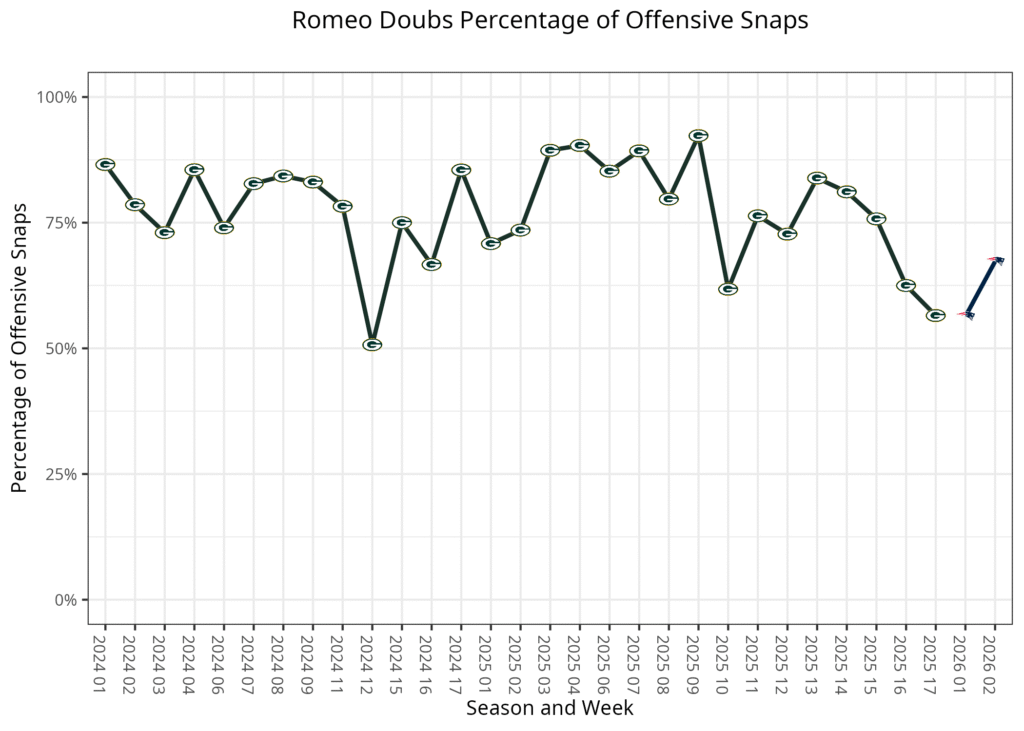
Brown made his debut with the Patriots as their lead receiver. Mack Hollins played much more than expected. Romeo Doubs and DeMario Douglas generally joined Brown in 11 personnel. Brown suffered a high ankle sprain, which landed him on injured reserve. He is expected to miss four to six weeks. Once he left the game last week, Hollins started playing more in 11 personnel, while Doubs saw more snaps in 12 personnel. Efton Chism III was a healthy inactive last week, but was active this week with Brown out.
Unsurprisingly, Hollins, Doubs and Douglas were the primary trio of wide receivers in 11 personnel, with Douglas taking 100% of snaps and Kyle Williams taking a few snaps from the outside receivers. In 12 and 21 personnel, it was primarily Hollins and Doubs, although Douglas and Williams both mixed in. Chism was the Patriots' primary wide receiver out of 22 personnel.
Doubs was the clear leader in receiving production with three receptions for 96 yards. While most of that was from a 63-yard catch, it’s fair to expect him to be New England’s lead wide receiver over the next few weeks. However, rotating out at times in 11, 12 and 21 personnel, as well as not playing at all in 22 personnel, left Doubs playing less than his typical game with the Green Bay Packers.
Miscellaneous Notes
- The Steelers activated running back Travis Homer from the practice squad for this game on Saturday, giving them four active halfbacks.
- Patriots backup tight end Eli Raridon left with a thigh injury. This led Cameron Latu to take over as the second tight end for the rest of the game. Once Raridon departed, Henry played 100% of snaps in single-tight end sets after rotating with Raridon at times last week and at the start of this game.
Carolina Panthers @ Atlanta Falcons
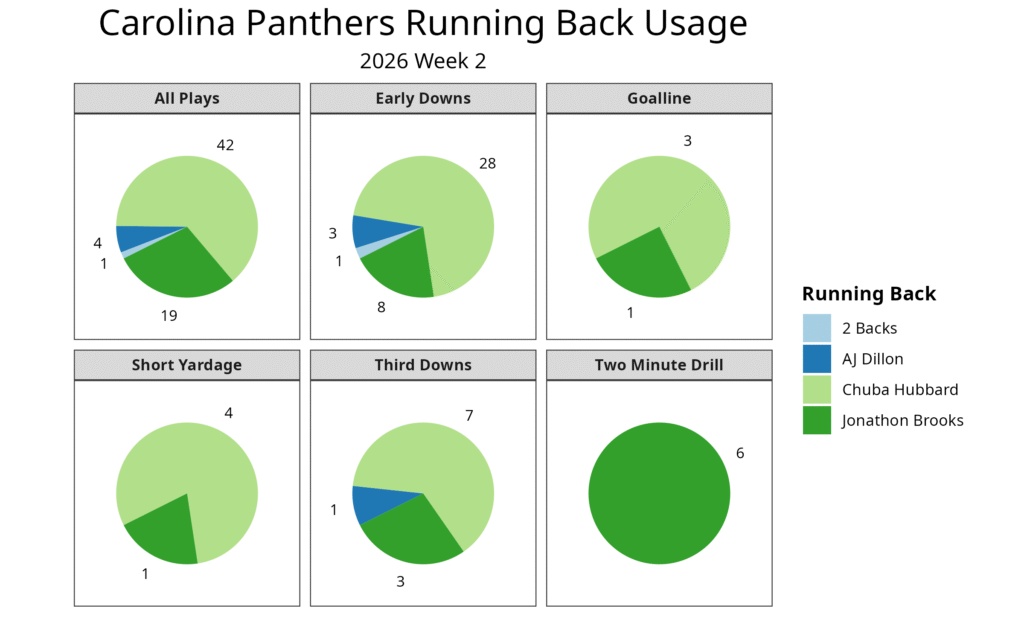
Monitor Jonathon Brooks’ health: The Panthers' backup running back left the game with a groin injury and didn’t return.
In Week 1, Chuba Hubbard played 70.6% of the Panthers' offensive snaps, including at least 60% in every major situation. His snap rate was at 78.7% if you exclude garbage time.
This week, there was more rotation before Brooks’ injury. Most notable was Brooks taking the two -minute drill after Hubbard dominated that situation last week. Brooks also played a higher percentage of third-down snaps. This led Brooks to play 30.3% of snaps, which was up over 10% compared to last week. Excluding the fourth quarter, the split was 65%-35% in favor of Hubbard.
Brooks only played one snap in the fourth quarter, with Hubbard taking the other seven early in the half. The Panthers again closed the game with a few snaps by AJ Dillon.
Hubbard is a must-start option at the moment, and that will be especially true if Brooks ends up missing any time with the groin injury. However, if Brooks is fine, the running back rotation will be worth watching, as it already changed from the first week to the second.
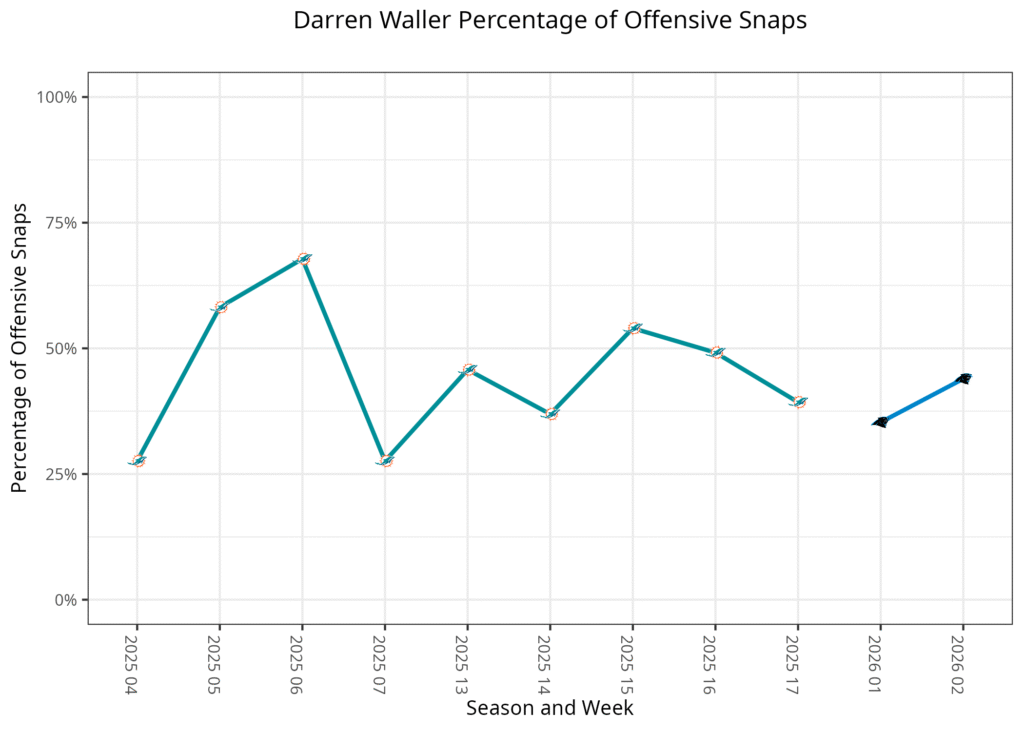
Darren Waller sees an uptick in snaps: The Panthers tight end scored two touchdowns and was on the field more often than last week.
Carolina added Waller late in the offseason to replace Ja’Tavion Sanders as its receiving tight end. Last week, he played 35.3% of snaps. That included the majority of 11 personnel snaps on third downs, but only 19% of early-down snaps and 35% of 12 personnel snaps.
This week, his snap rate was on the rise. He didn’t play as much in 12 personnel, but Carolina went from three plays in 13 personnel to 11. Waller was on the field for 10 of those, so he ultimately appeared on more multi-tight end sets. His snap rate on third downs was similar to last week, but he played a third of 11 personnel snaps on early downs, which was also an increase. He ran a route on 56.4% of the Panthers' pass plays, compared to 39.5% last week.
We generally expect Waller to play more when Carolina is playing from behind than the team has a lead, so the increase in snaps was a promising sign for him. He will likely need either a higher target rate or a higher snap clip to trust putting him in fantasy starting lineups, but he’s become an intriguing waiver wire target in case his role continues to expand.
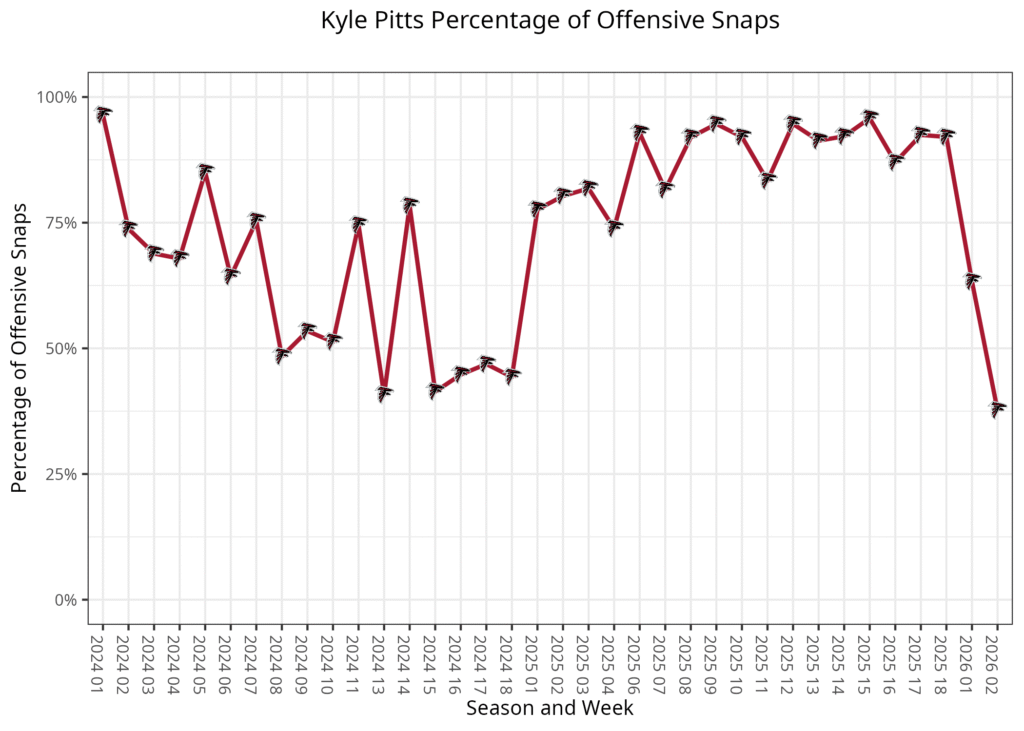
Kyle Pitts Sr. remains in a rotation: Charlie Woerner received more offensive snaps than Pitts, reminiscent of 2024.
Pitts had a breakout 2025 season, in part because his playing time was much higher in 2025 than in other recent years. However, there started to be some concern in the preseason when Austin Hooper started taking some snaps from Pitts in 12 personnel. That worry continued during the first week of the regular season, as Pitts played only 12 of 22 snaps in 12 personnel, losing snaps to both Hooper and Nick Muse. He played 20 of 32 snaps in 11 personnel, which also wasn’t ideal.
In this game, Pitts played a slightly higher rate in 12 personnel, taking six of nine snaps while the starters were still playing. However, in 11 personnel, his snaps fell to 11 of 23. While there was a general tendency of Pitts to be on the field for passing plays out of 11 personnel, and Woerner for run plays, Pitts was still restricted to 16 of 21 passing plays.
The Falcons put in backups, so Pitts didn’t close out the game. Pitts was held to one reception for 15 yards. While it’s likely Pitts’ fantasy value will improve once the Falcons have a different quarterback, it’s unlikely his fantasy ceiling will reach the same heights as last season due to the rotation at tight end.
Miscellaneous Notes
- The Panthers waived wide receiver Jimmy Horn Jr. on Tuesday after muffing a punt in Week 1. John Metchie III was a healthy scratch last week, but was active this week to replace Horn as a backup wide receiver and returner.
- Jalen Coker was limited in practice on Wednesday and Thursday with an ankle injury, but was ready to play in this game.
- While Tetaiora McMillan isn’t playing as much in the slot as he was in the preseason, he lined up slightly more at Z receiver this week than what we’ve seen in the past.
- Backup tight end Ja’Tavion Sanders was a healthy inactive for a second straight week.
- Atlanta took out its starters on offense for the final 13 plays, which included quarterback Cooper Rush, running back Bijan Robinson, wide receiver Drake London and tight ends Kyle Pitts Sr. and Charlie Woerner.
- While Jahan Dotson is the second wide receiver on the Falcons' depth chart, he only played in 24 of 40 snaps in the starters. He lost some snaps to Chris Blair in 11 personnel, and he doesn’t play in 13 personnel.
- The Falcons started Cooper Rush for a second straight week while Tua Tagovailoa (oblique) and Michael Penix Jr. (knee) remained out. There is optimism that at least one of the latter two, if not both, will be ready to play for their Week 3 game on Thursday Night Football.
- Atlanta lost Tyler Goodson from the practice squad, so it added Khalil Herbert to the practice squad on Wednesday. Atlanta has only had two active running backs each of the last two weeks.
- Tight end Nick Muse was a practice squad call-up last week to give Atlanta four tight ends. Muse was signed to the roster on Wednesday, and again gave the Falcons four tight ends.
New Orleans Saints @ Baltimore Ravens
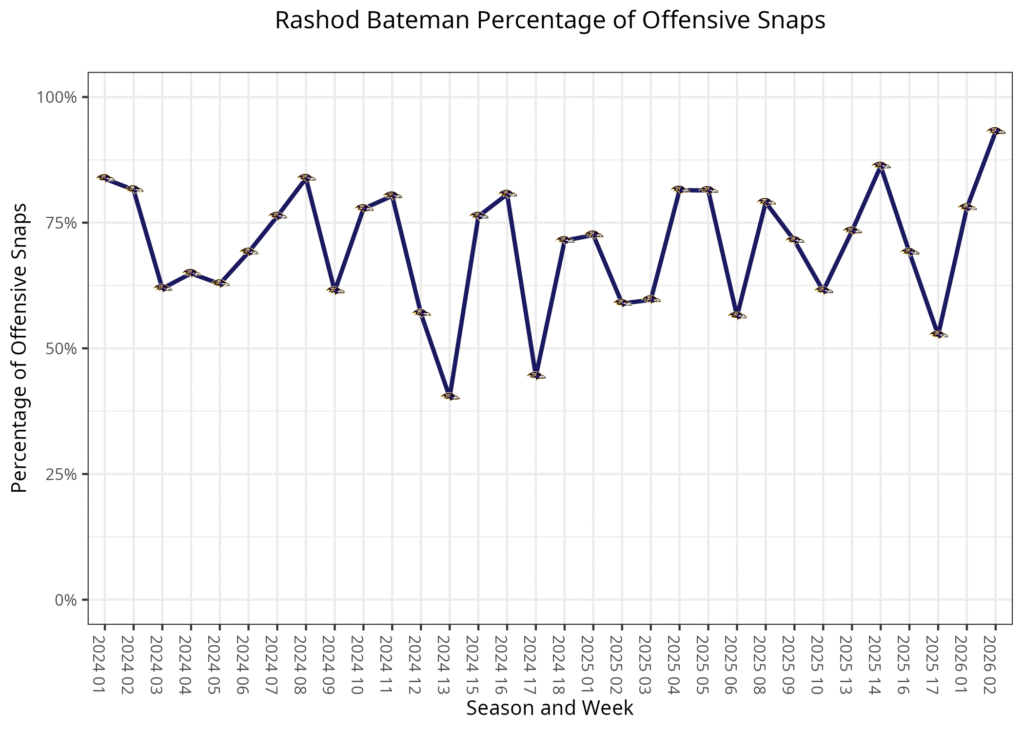
Ravens adjust without two top receivers: Rashod Bateman was the only Ravens wide receiver to start last week who was still healthy this week.
The Ravens began last week with Zay Flowers, Bateman and Ja’Kobi Lane as their primary wide receivers. Flowers left the game with a hamstring injury, and while he practiced on a limited basis Friday, he was ultimately inactive. Lane was placed on injured reserve on Wednesday with a fractured wrist.
In Week 1, Chris Moore was the primary backup on the outside and LaJohntay Wester was the top backup in the slot. Devontez Walker missed last week with a groin injury, but he was a full participant in practice this week and ready to step up. Fourth-round rookie Elijah Sarratt has been buried on the Ravens' depth chart and was a healthy inactive last week, but was active this week.
Bateman and Moore were the primary wide receivers for Baltimore, with Wester playing in the slot in 11 personnel. Walker rotated with Moore throughout the game in 11 and 12 personnel. It’s possible Walker would play more if he was closer to 100%, but it’s also plausible Moore is ahead of Walker on the depth chart at this point. While Sarratt was active, he didn’t play a single snap on offense. While it is common enough for a wide receiver to start low on the depth chart and slowly but surely work his way up, there has been no sign that Sarratt is higher than seventh on the depth chart when everyone is healthy.
Bateman was the clear waiver wire target at wide receiver later in the week once it was clear Flowers wasn’t playing, and he rewarded anyone who trusted him. He caught seven passes for 88 yards and a touchdown. It will be difficult to trust Bateman again once Flowers is back, but he is worth holding onto until it’s clear Flowers is ready to play again.
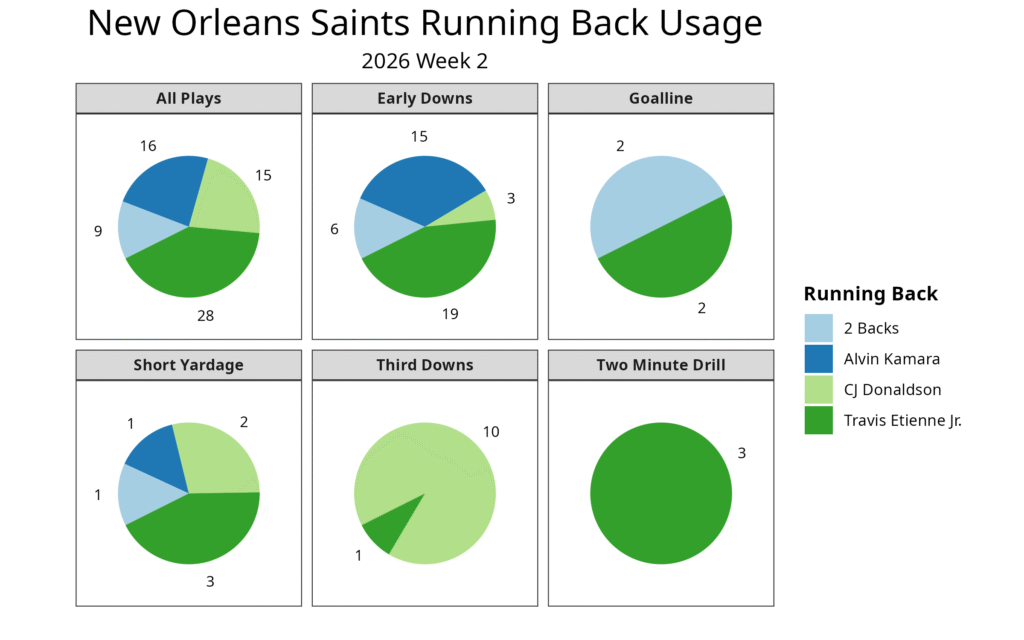
Alvin Kamara leads the Saints in touches: While Travis Etienne Jr. led the team in playing time, it was Kamara who had the most touches.
Kamara was inactive last week with a knee injury. This left Etienne as the early-down running back, Kendre Miller as his backup and CJ Donaldson as the third-down pick. Etienne’s usage in Week 1 was among the most surprising for running backs given the injuries to Kamara, as well as Devin Neal, Audric Estime and Ty Chandler, who were all on injured reserve. This week, Kamara was active for the first time with Etienne. Despite Kamara’s return, the Saints decided to sign Donaldson to the 53-man roster rather than making him a practice squad call-up like last week. This left Miller as a healthy inactive.
While most people expected Etienne would play on early downs and Kamara on third downs, Donaldson remained the third-down back. This left Etienne and Kamara splitting snaps on early downs. Etienne had the clear lead in snaps because he played eight snaps in goal-line and short-yardage situations, while Kamara didn’t see any.
For whatever reason, Kamara was either the ball carrier or received a target on 75% of his snaps, which is unsustainable. Kamara should be a sell-high candidate, as the Saints seem to like Donaldson on third downs, so Kamara is simply a rotational, early-down player. Even if Etienne suffers an injury, given the rotation the first two weeks, we would likely see Kamara mix in with Miller on early downs rather than carry a massive workload.
Etienne probably shouldn’t be in fantasy starting lineups in the short term. Once bye weeks hit, there might not be enough better options than Etienne, but it’s unlikely he will be ranked among the top 24 running backs in the short term given his role.
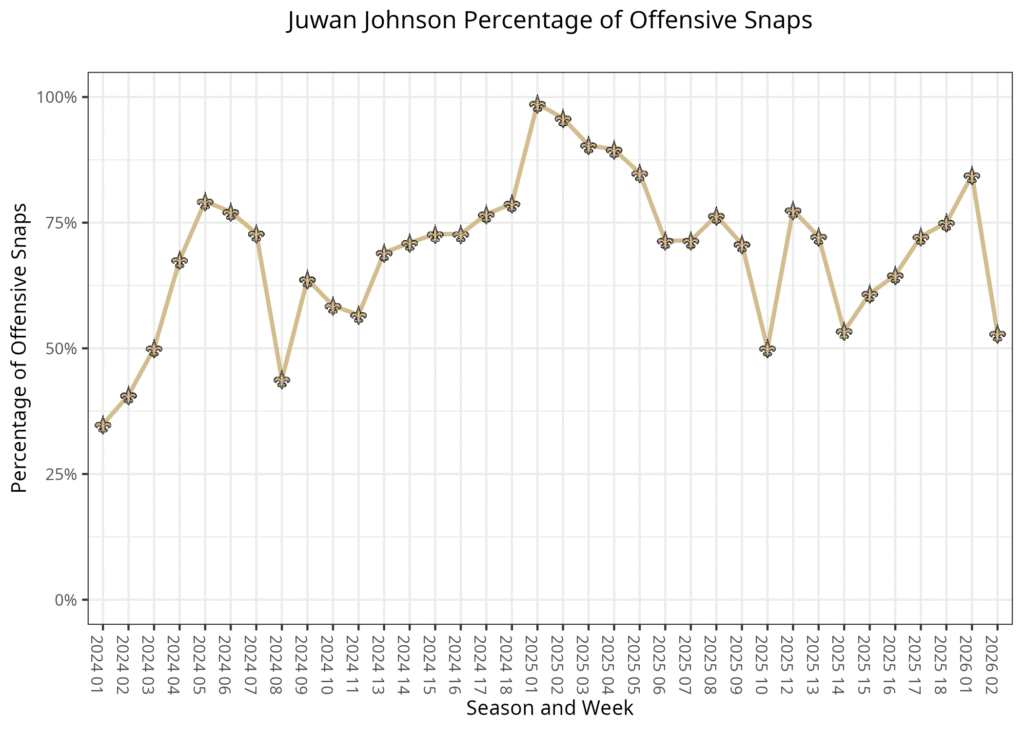
The Saints turn to a tight end rotation: Juwan Johnson played much less this week compared to last.
Johnson has slowly but surely turned into a full-time tight end after playing in a rotational role to start his career. His playing time peaked in early 2025 when Foster Moreau and Taysom Hill were both out with injury. The Saints moved on from their backup tight ends in the offseason and instead added free agent Noah Fant and rookie Oscar Delp.
Delp missed last week with a hamstring injury. Johnson played 80.4% of 11 personnel snaps on early downs, 93.8% of 11 personnel snaps on third downs, 82.6% of two-tight end sets and 100% of three-tight end sets. Fant was the only other tight end to play in 11 personnel, while it was Treyton Welch taking five of 23 snaps in 12 personnel.
Delp was active this week after practicing in full on Friday. While Johnson was still the clear tight end in 11 personnel on early downs, New Orleans rotated much more on early downs. Fant played 19 of 42 plays, Johnson 17 and Delp six. The Saints also rotated Johnson out more often in 12 personnel, only giving him five of 12 snaps. Fant played 11, Welch five and Delp three.
This left Johnson running a route on only 59% of the Saints' passing plays. Johnson had a 79% rate last week and averaged 74% last season. It’s worth noting, from Weeks 14-16 last season, his rate was 62.7%, also suggesting New Orleans didn’t want Johnson on the field as much this season as he was at his peak last season. Johnson caught four passes for 66 yards, which could give him some trade value. He is a clear sell-high candidate before Delp starts to become more involved and before Jordyn Tyson comes back.
Miscellaneous Notes
- Saints wide receiver Chris Olave was limited in practice on Thursday and Friday with a hamstring injury and was questionable, but was active.
- The Saints activated wide receiver Kevin Austin Jr. from the practice squad for this game on Saturday. He was their fifth option on the depth chart.
- Ravens rookie tight end Josh Cuevas remains fourth on the depth chart, but he rotated in at times in 12 personnel unlike last week.
Minnesota Vikings @ Chicago Bears
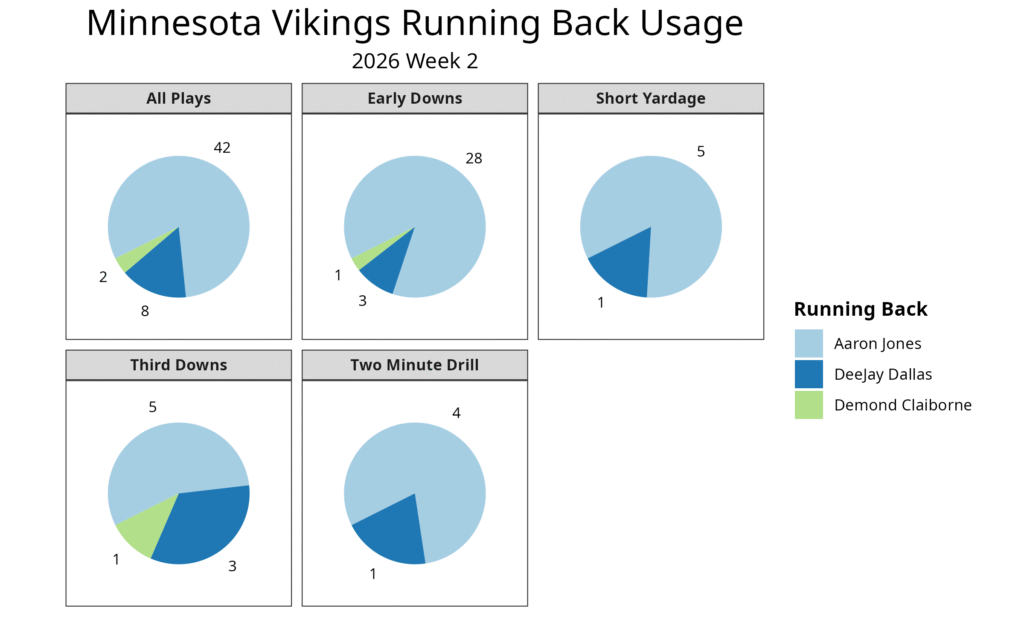
Aaron Jones Sr. dominates snaps without Jordan Mason: Jones played 80.8% of the Vikings' snaps, giving him one of the highest snap rates among running backs.
The Vikings' backfield was close to a 50-50 split last week after Jones was the clear leader last season. Mason played 56.1% of early-down snaps, while Jones saw 56.3% of third-down snaps. However, Mason landed on injured reserve on Wednesday with a thumb fracture. In Week 1, Minnesota opted to make DeeJay Dallas a practice squad call-up, and the third back over rookie Demond Claiborne, who was a healthy inactive. Dallas was signed to the 53-man roster on Wednesday, but Claiborne was active for the first time.
Jones played 31 of a possible 38 snaps over the first three quarters. Dallas was the primary backup with five snaps, while Claiborne played two. Jones left the game briefly in the fourth quarter with a knee injury, but he was able to walk off. Dallas briefly replaced him, but Jones still played 11 of 14 snaps in the fourth quarter.
The veteran’s playing time is enough to make him a must-start for these next few weeks until Mason is back.
Myles Price plays in place of Jauan Jennings: The Vikings' return man saw his first significant playing time on offense of his career.
Minnesota added Jennings late in the offseason as the replacement for Jalen Nailor. Jennings played 100% of snaps in 11 personnel, but barely played in the other personnel groupings, leading him to play just under 50% of offensive snaps. Jennings was inactive this week due to a personal family matter. This moved Tai Felton and Price up the depth chart, while Dillon Bell was a practice squad call-up.
While Felton had played with the starters at times in the preseason, it was Price who played 100% of snaps in 11 personnel for this game. This suggests that Felton is Jefferson’s backup, while Price is the backup for Jennings. Price had only played 20 offensive snaps in his career before this game. He was unfortunately held without a reception, so his first career NFL catch will need to wait.
While this doesn’t mean anything for the short term in fantasy, this is good to know in case we see a more serious injury to a Vikings wide receiver at some point this season.
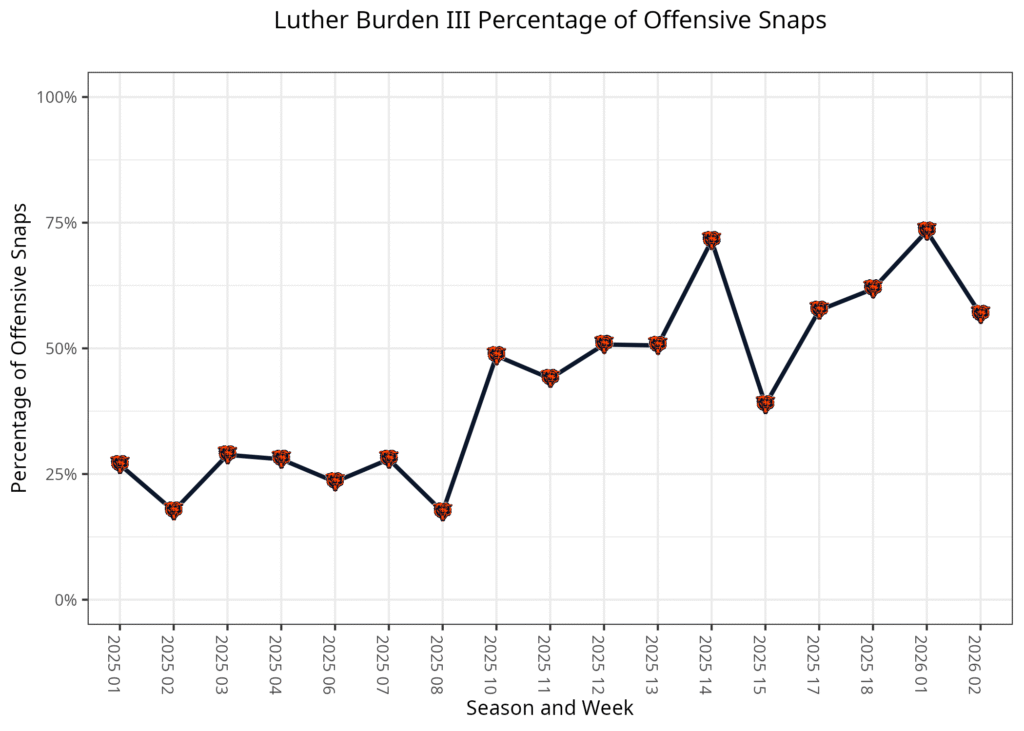
Luther Burden III’s concerning snap rate: Burden played a lower snap rate in this game than he was playing at the end of last season.
Chicago moved on from DJ Moore and Olamide Zaccheaus in the offseason, which moved Burden up to second on the depth chart at worst. He led Bears wide receivers in snap rate last week at 73.3%. He played 95% of the 11 personnel snaps and 65.2% in 12 personnel. The 12 personnel snap rate wasn’t ideal, but it was still better than last season. However, it was Kalif Raymond who stole the show in terms of his receiving production.
This week, Burden played 100% of snaps in 11 personnel. However, Rome Odunze was questionable last week and was healthier this week. This led Odunze’s snap rate in 12 personnel to jump up to 93.1%. This left Raymond and Burden splitting snaps in 12 personnel, with Raymond playing slightly more. The Bears also ran 17 plays out of 13 personnel. We have seen 13 personnel usage skyrocket across the league, which is making it harder to find consistent fantasy wide receivers. Burden only played one of those 17 snaps, and that is having an impact on his fantasy value.
Despite the decrease in playing time, Burden still ran a route on 71.4% of pass plays. He was targeted on 23.3% of routes, which is great, but a number of his targets weren’t catchable, yielding three receptions for 32 yards.
Burden has been a disappointment from a fantasy perspective relative to the hype around him. It’s fair to question if he’s a must-start player if the matchup isn’t right, especially if Caleb Williams misses time.
Miscellaneous Notes
- Minnesota quarterback Kyler Murray suffered a concussion last week, leading Carson Wentz to start this week.
- The Vikings added running back Jerome Ford to the practice squad on Wednesday. While he remained on the practice squad this week, there is a chance he will factor into the running back rotation in future weeks.
- T.J. Hockenson only played one-third of the snaps out of single-tight end sets on early downs, similar to last week. That’s partially because the Vikings are using a lot of 21 personnel so far this season.
- Bears running backs D’Andre Swift (ankle, knee) and Kyle Monangai (hamstring) were limited in practice on Wednesday and Thursday, practiced in full on Friday and weren’t given a game status. The backfield was more in Swift’s favor than usual this week because the Bears happened to have more third downs and two-minute snaps than usual.
- Caleb Williams suffered a hamstring injury on a non-contact play late in this game. That will be an injury worth monitoring, as it impacts the value of all Bears receivers.
- Chicago backup quarterback Tyson Bagent returned this week after missing last week with a back injury. Case Keenum was the emergency third-string quarterback for this game.
- Colston Loveland’s lack of receiving production isn’t from a lack of playing time. He’s played at least 86% of snaps each of the last three regular-season games after never hitting that mark before Week 18 last season. However, it’s worth noting he stayed in to pass block six times in this game, which is more than any other game in his career.
Cincinnati Bengals @ Houston Texans
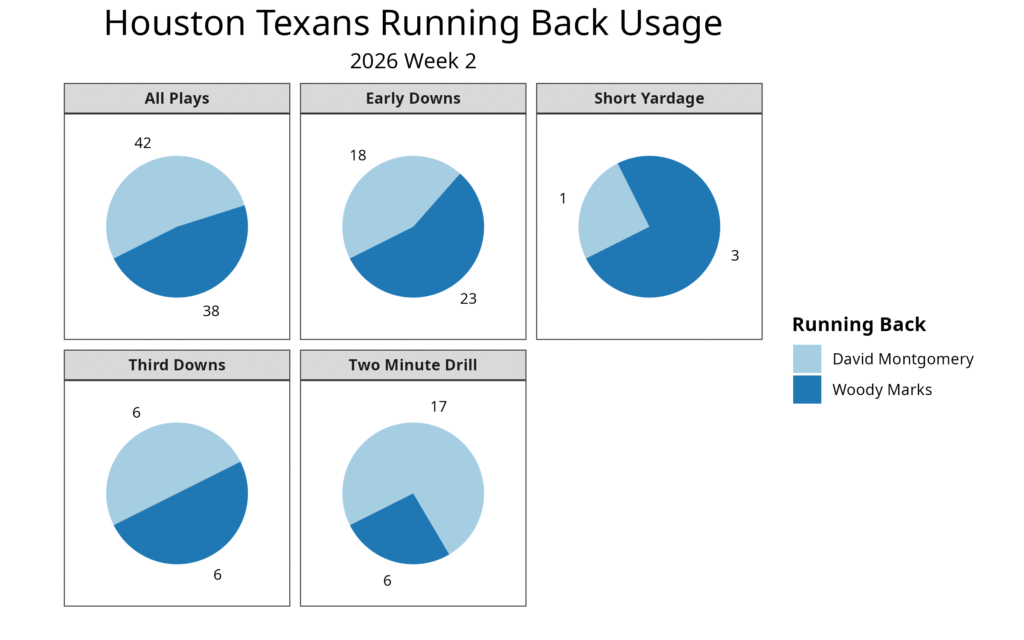
Houston’s straightforward backfield: The Texans have rotated by drive each of the last two games, with only a few minor exceptions.
The Texans traded for David Montgomery to pair him with Woody Marks. In Week 1, Montgomery played 13 of 15 snaps over the first two drives. There were a few longer possessions where both running backs took the field, but otherwise, it was a clear rotation.
This week, the rotation was nearly the same. Montgomery again handled the first two drives. Montgomery happened to have the last series of the first half and took the first possession of the second half. There was never a point where either running back took a snap on the other back’s drive.
This generally gives Montgomery more fantasy value, as the Texans have him lead at the start of the game, and they want him beginning the second half. At this point, both running backs should be considered buy-low candidates. Houston started the season facing Josh Allen and Joe Burrow, and it couldn’t stick with the run like as it would prefer to. In future games, we should expect a lot more runs by both players.
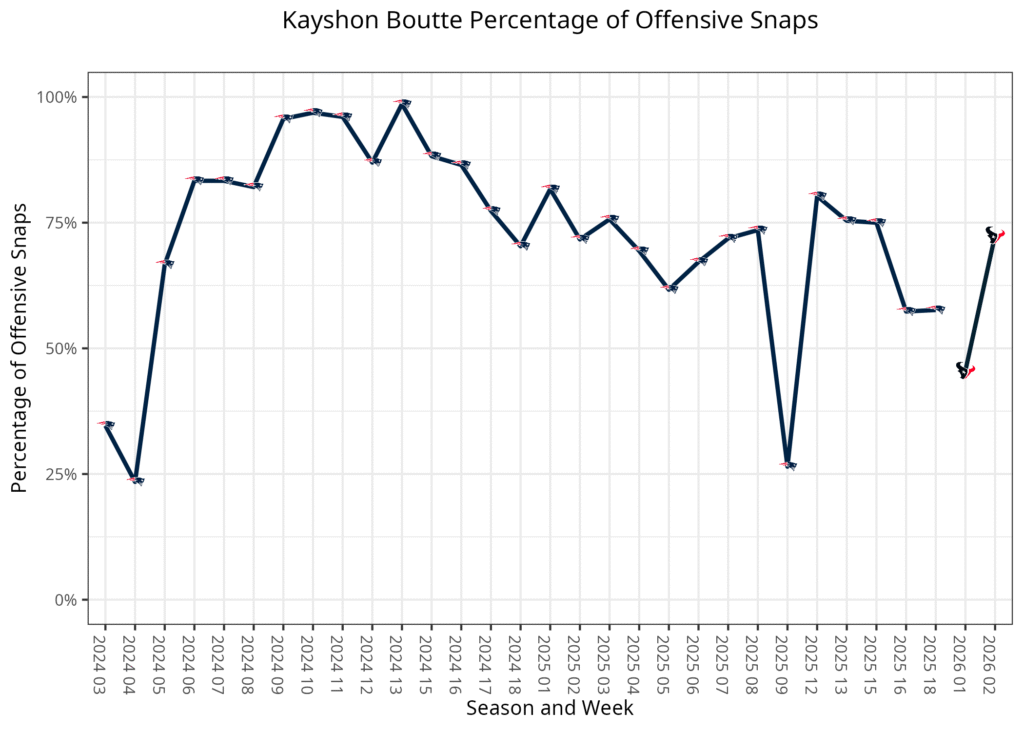
Texans adjust without Nico Collins: Houston’s top wide receiver was out with a hamstring injury, leading Houston to adjust its wide receiver rotation.
In Week 1, Nico Collins and Xavier Hutchinson were the two primary wide receivers. Kayshon Boutte played over 70% of 11 personnel snaps. Jaylin Noel also rotated in 11 personnel, while Jared Wayne was the primary backup in 12 personnel and played over half of the snaps in 13 personnel. Collins suffered a hamstring injury, leading him to be inactive this week. Sixth-round rookie Lewis Bond was a practice squad call-up to give Houston five wide receivers.
Houston largely consolidated to a four-man rotation, which has been rare for the last few seasons. Hutchinson, Boutte and Noel were the primary wide receivers out of 11 personnel, but Wayne rotated in significantly. Typically, Noel was in the slot, but Hutchinson also played greatly out of the slot, particularly when Noel wasn’t on the field. The only other consistent role was Wayne as an X receiver when he was on the field. The Texans rarely used any other personnel grouping in this game, as they were playing from behind.
While Houston’s wide receivers all received a boost in playing time, it was Dalton Schultz who stole the show as a receiver, catching 12 passes for 140 yards. He is a clear sell-high at this point. Schultz faced the best matchup for tight ends from last season in a game where the top wide receiver on the depth chart was hurt and C.J. Stroud threw the ball 55 times.
The Texans started the season with two of the other top teams in the AFC, but their schedule will get easier, where they will run the ball more often and use more 12 and 13 personnel. Schultz has only played 14.3% of snaps out of 12 personnel this season after occupying 90% of those snaps last season. The loss of 12 personnel snaps didn’t hurt Schultz this game because Houston barely played it, but that will change with different game scripts.
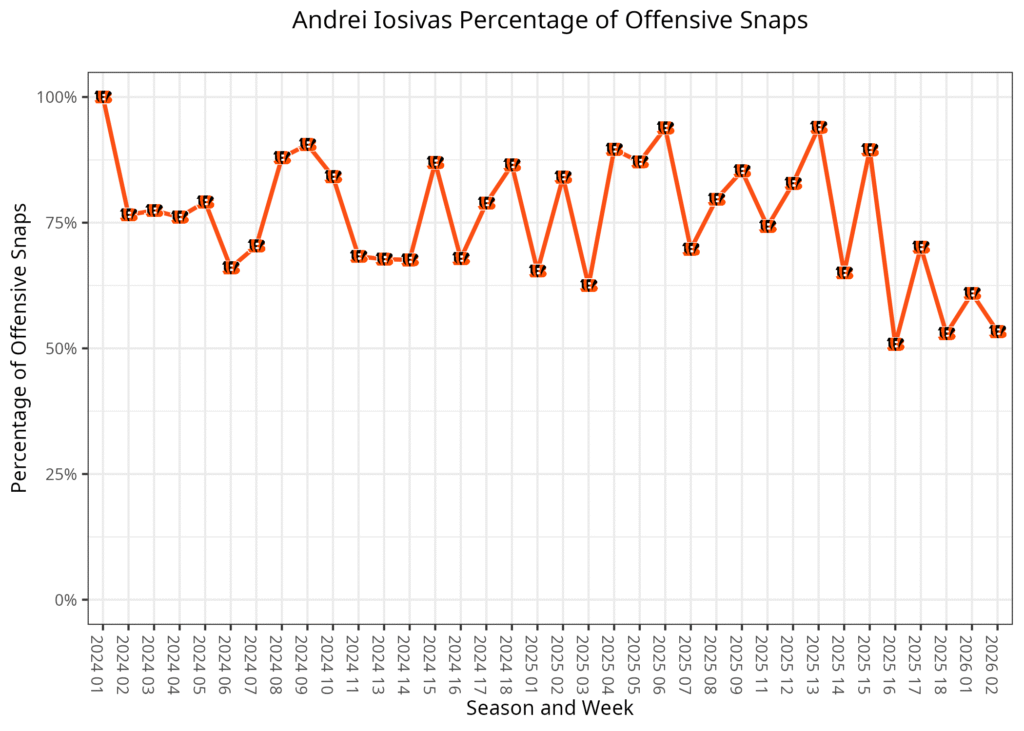
Andrei Iosivas’ role could be slipping: Iosivas only played 77.8% of snaps in 11 personnel, his lowest rate since 2024.
Bengals wide receivers haven’t been worth talking about in this article for years as long as everyone has been healthy. Ja’Marr Chase and Tee Higgins are every-down, must-start wide receivers, while Iosivas has joined them in 11 personnel. Iosivas played at least 88% of 11 personnel snaps in each game last season, as well as Week 1 this year.
This season, Iosivas has more competition. The Bengals spent a fourth-round pick on Colbie Young, while former Canadian Football Player Dohnte Meyers turned heads during training camp. Young and Meyers didn’t see a notable increase in snaps this week, but their snaps were more often in place of Iosivas this week compared to last week.
While a 10% change in snaps in a specific personnel grouping isn’t usually worth talking about, it is worth noting when Iosivas has so consistently hit 88% or better. It’s unlikely the third wide receiver for Cincinnati is worth starting, but if there is an injury to Chase or Higgins at some point this season, it’s possible it will be Young or Meyers worth picking up rather than Iosivas.
Miscellaneous Notes
- Bengals' quarterback Joe Burrow was limited in practice on Wednesday and Thursday, upgraded to full on Friday with a back injury and was questionable but was active. Cincinnati activated Josh Johnson off the practice squad on Saturday, and he was the emergency third quarterback for this game.
- Sixth wide receiver Ke’Shawn Williams was a healthy inactive for a second-straight week.
- Tight end Mike Gesicki had a huge first week of the season, but was held without a catch this week. His playing time was identical to last week at 21 total snaps, and his route participation rate was actually higher this week, but his target per route dropped from 41.2% to 0.0%.
- Seventh-round rookie tight end Jack Endries made his season debut. Last week, Cincinnati activated Tanner Hudson off the practice squad last week, but didn’t this week.
- Texans backup tight end Brevin Jordan was a healthy inactive for a second straight week.
Green Bay Packers @ New York Jets
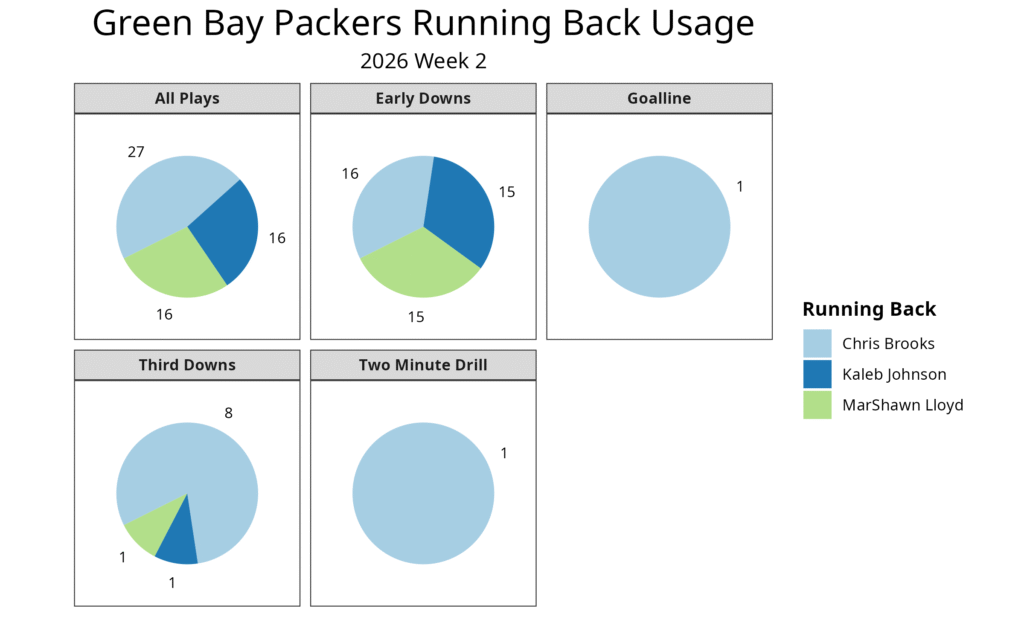
Packers turn to an ugly three-man running back rotation: Kaleb Johnson joined the running back rotation after not playing last week.
With Josh Jacobs on the Commissioner's Exempt List, Green Bay used a classic two-man rotation last week. Lloyd was the early-down back, and Brooks was the passing-down back.
This week, Brooks remained the clear passing-down back. On early downs, the Packers deployed a three-man mix, with all three backs playing nearly one-third of snaps. Johnson led the team in carries as well as yards per carry.
Part of this was game script-related. Over three quarters, Lloyd had 14 snaps, Johnson had 13 and Brooks had nine. The Packers were playing from behind, so Brooks played 18 snaps in the fourth quarter and overtime compared to three by Johnson and two by Lloyd, with only one snap by Lloyd after a lost fumble early in the fourth quarter.
Johnson is a clear waiver wire target. It would be difficult to trust anyone in this backfield for next week, but Johnson is trending up and could become Green Bay’s lead back sooner rather than later.
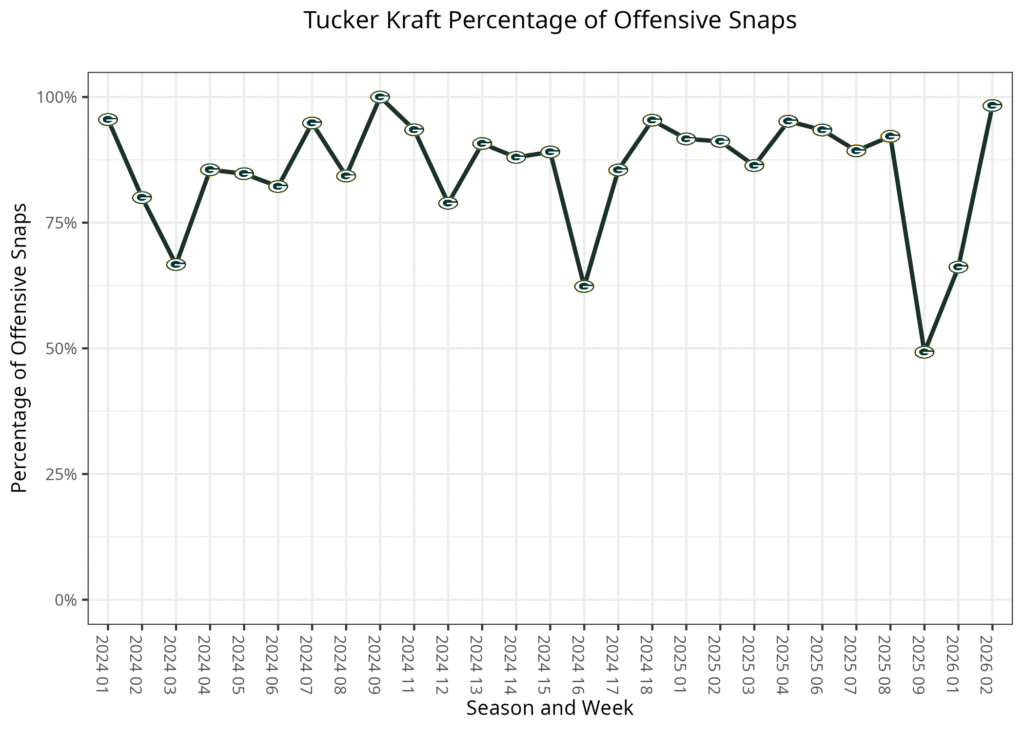
Monitor Jayden Reed’s health: Reed suffered a neck injury early in the first quarter, left the field on a stretcher and was quickly ruled out.
The Packers consolidated their five-man wide receiver rotation from last season to three this season, losing Romeo Doubs in free agency and trading Dontayvion Wicks. This meant more playing time for the Packers' remaining wide receivers, as Christian Watson and Matthew Golden both played at least 84% of snaps in 11 and 12 personnel. Reed saw over 90% of 11 personnel snaps and received more snaps in other formation groups than in past seasons.
Green Bay had Savion Williams, Bo Melton and Skyy Moore as the top backups in the preseason. Melton was a practice squad call-up last week but was signed back to the team on Monday. Williams is on injured reserve with a high ankle sprain, leading to rookie J. Michael Sturdivant making the roster. He was a healthy inactive last week but was active this week.
Reed only played two offensive snaps before his game-ending injury. While Melton is considered higher on the depth chart, Moore has been the backup slot receiver, so it was Moore who took over for the rest of this game. Moore was rotated out of 11 personnel more frequently than Reed usually gets rotated out, with both Melton and Sturdivant seeing time. Melton suffered a stinger late in the third quarter and didn’t return to the game.
Golden played some in the slot last season when Reed was injured. If Reed misses time, it’s possible we see more Golden in the slot, but only if Melton is healthy. The more likely solution is that the Packers could also use more 12 personnel going forward if Reed misses time.
This means there is unlikely to be a waiver wire target if Reed is out, but it would likely consolidate targets even further between Watson, Golden and tight end Tucker Kraft.
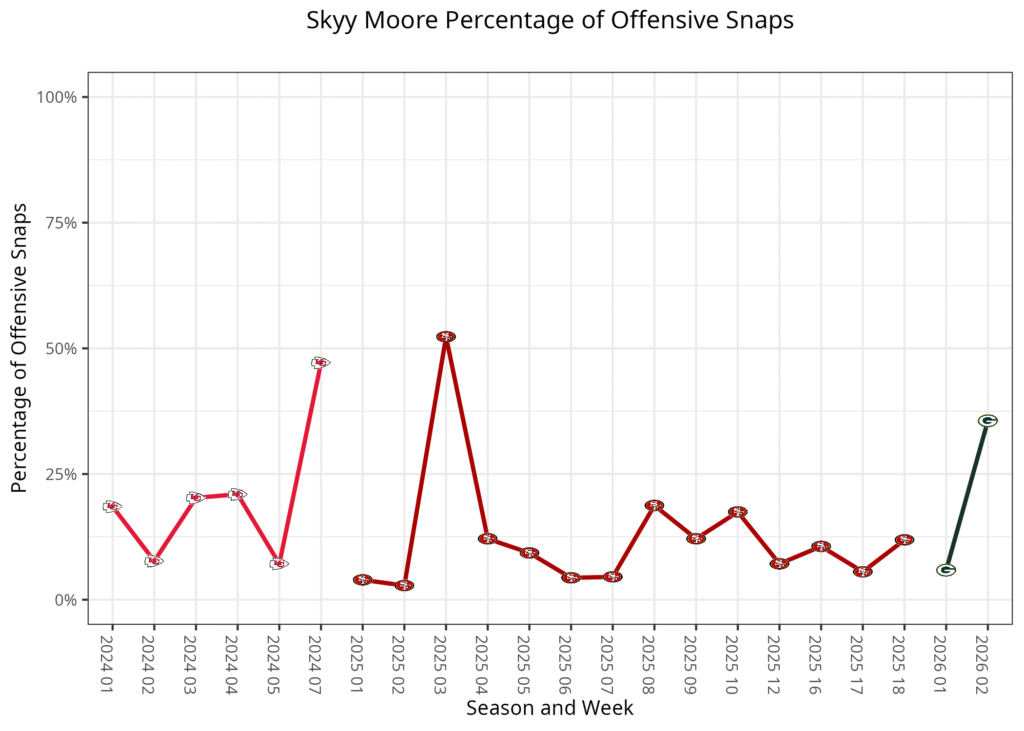
Tucker Kraft is no longer on a snap count: Kraft played 98.3% of snaps after seeing 66.2% last season.
Kraft missed the second half of last season with a torn ACL. He started training camp on the PUP list, and there was talk of him being on a snap count for the first half of the season. That was true in Week 1, as he only played 57% of 11 personnel snaps on early downs, 45% on third downs and 71% in two-tight end sets. The Packers valued his blocking, and he only ran a route on 47.8% of the Packers' pass plays.
This week, he was back to almost never leaving the field. He took one play off on 11 personnel on an early down, and that was his only play off the field. His route participation rate was 93.8%, but his target rate dropped to 10%.
At this point, it’s much more likely that his targets per route increase than his routes decrease, making Kraft a clear buy low after catching only two passes for 15 yards this week. If Reed’s injury is serious, that could increase his value even more.
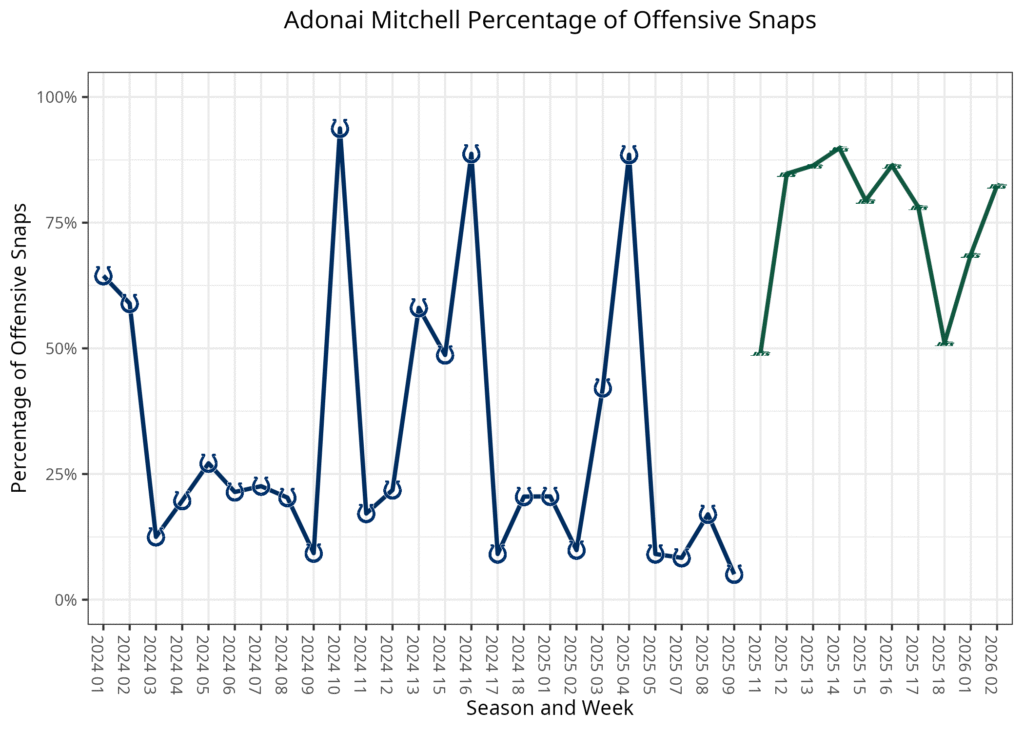
Jets' straightforward wide receiver rotation: Isaiah Williams basically became a starter with Omar Cooper Jr. on injured reserve.
Cooper began his NFL career last week as New York’s slot receiver in 11 personnel, with Garrett Wilson and Adonai Mitchell on the outside. Cooper left the game early with an ankle injury and was placed on injured reserve Saturday. Cooper had competed with Williams for the slot job, and Williams took over last week. The Jets have also been without their top backup on the outside, Tim Patrick, who is on injured reserve. This left Arian Smith as the top backup option. New York didn’t make any practice squad call-ups, so it only had four active wide receivers for this game.
Smith ended up playing only one snap in 11 personnel; otherwise, it was all Wilson, Mitchell and Williams. It was typically Wilson and Mitchell in 12 personnel, while Williams was the primary receiver in 13 personnel. All three receivers caught at least five passes this week. Given the lack of backup wide receivers that are healthy, Mitchell remains a clear waiver wire target. Over two weeks, he has an 80% route participation rate and 23.3% target rate. If he keeps that up throughout the season, he will be a consistent flex option.
Miscellaneous Notes
- The Jets have continued to use only two running backs, with Braelon Allen as the backup and third-down back, while Isaiah Davis has yet to take an offensive snap this season.
- Jets fourth-string running back and returner Kene Nwangwu was inactive with a back injury for a second straight week.
- New York added Sterling Shepard and Tyler Johnson to the practice squad last week. It wouldn’t be surprising if one of the two were part of the Jets' wide receiver rotation next week.
- Mason Taylor and Kenyon Sadiq both played notably less this week, because the Jets used much less 12 and 13 personnel. Neither of these tight ends can be trusted for fantasy purposes as long as they are rotating with each other, and Jeremy Ruckert and Jelani Woods are also heavily involved.
- For the second straight week, New York activated Jason Sanders off the practice squad to be its kicker while making Blake Grupe a healthy inactive.
Cleveland Browns @ Tampa Bay Buccaneers
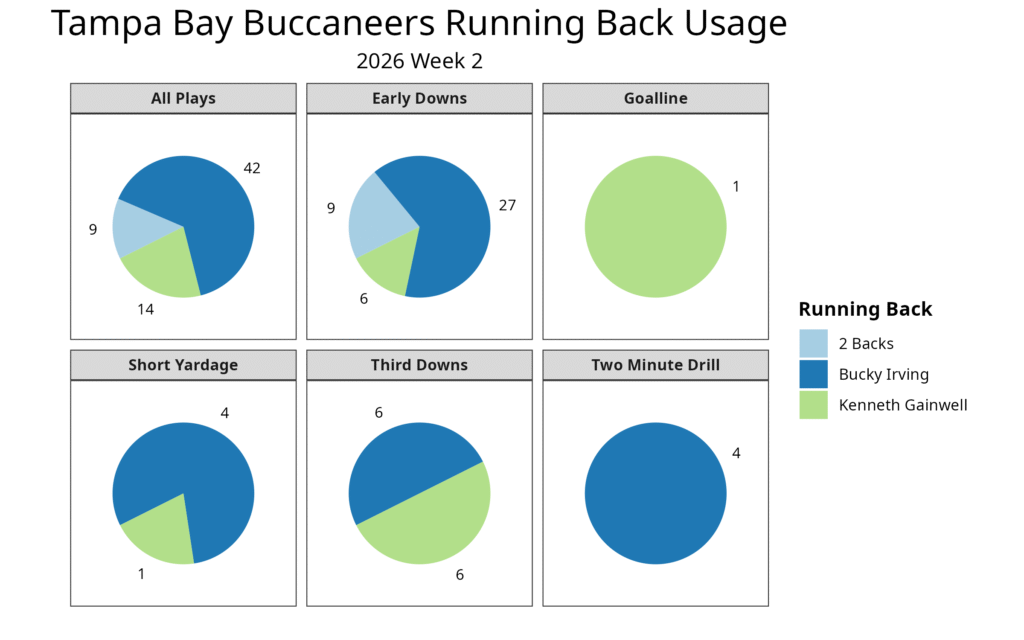
Bucky Irving takes a commanding lead of the Buccaneers' backfield: Irving ran the ball 17 times compared to two carries by Kenny Gainwell.
Last week, Irving had a slight lead in the two-man rotation with Gainwell. Irving played 60.5% of early-down snaps to 48.8% by Gainwell. Irving also had a lead on third downs at six snaps to two, and the two split short-yardage situations.
This week, Irving’s lead on early downs jumped to 72.9% to 42.4%, as there was also an increase in snaps with both running backs on the field. Irving also held an advantage on late downs, the two-minute drill and short-yardage plays. It is worth noting that while Gainwell played the one goal-line snap, it was a first-and-5, and Gainwell had been in on the previous play to get Tampa Bay to that situation. This wasn’t a case of the team reaching the goal line with Irving and the Buccaneers substituting him out.
Irving has become a must-start player with how well he’s played to start the season. In leagues with lighter benches, Gainwell can be dropped, although in leagues where most handcuffs are taken, Gainwell should remain on rosters.
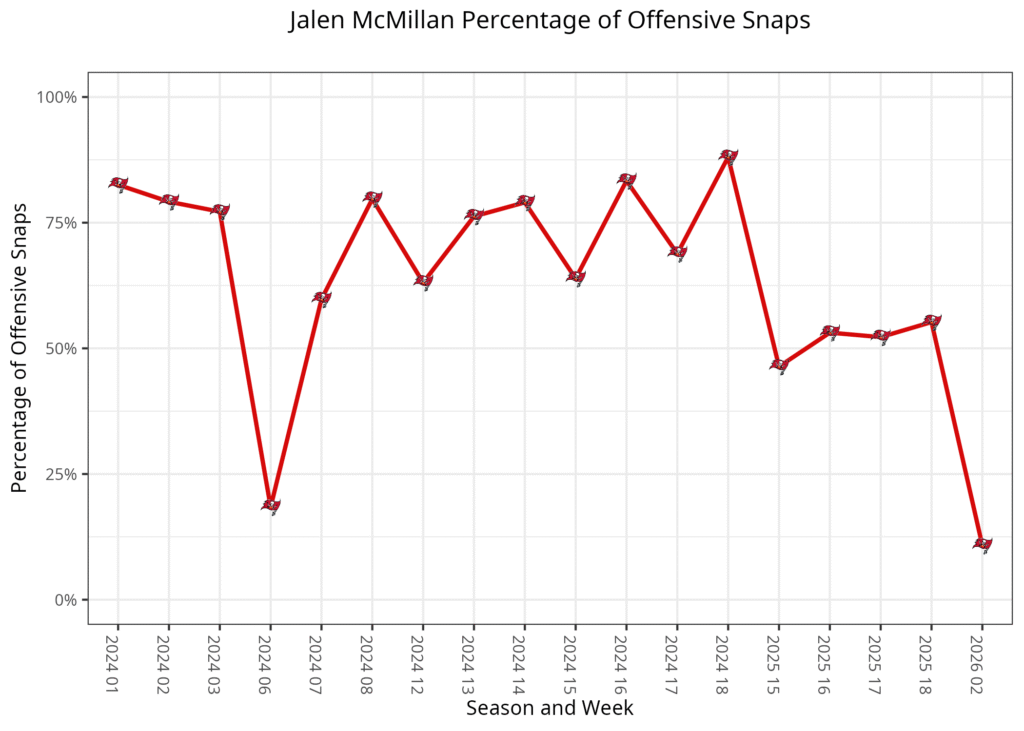
Jalen McMillan’s quiet return: McMillan was clearly limited in his first game back due to injury.
The Buccaneers had a crowded wide receiver room at the end of last season, with Mike Evans, Chris Godwin, Emeka Egbuka, McMillan and Tez Johnson. Tampa Bay lost Evans in free agency but drafted Ted Hurst III. McMillan missed Week 1 with a knee injury. Johnson was the odd man out of the rotation in 11 personnel, leaving Hurst at X, Egbuka at Z and Godwin in the slot. Each played at least 80% of 11 personnel snaps and 50% of 12 personnel snaps. McMillan fully participated in practice all week and was active, although reports said his role would be limited.
The Buccaneers didn’t change their plan in 11 personnel, although Johnson rotated in a little more often for Hurst in 11 personnel. In 12 personnel, Hurst and McMillan became the primary receivers, Egbuka only played in two of nine snaps in 12 personnel and Godwin didn’t see any. Luckily, Tampa Bay is not one of the teams jumping on the 13 personnel bandwagon, so even losing snaps in 12 personnel didn’t do much to Egbuka or Godwin’s playing time. However, if the Buccaneers start winning more games and they stick with Hurst and McMillan as the primary 12 personnel receivers, that could begin to hurt the top two players' time.
If McMillan doesn’t see a notable increase in snaps in 11 personnel in the near future, it’s unlikely he will be worth rostering this season, even if there is an injury.
Cleveland adjusts without Dylan Sampson: The Browns' receiving back was placed on injured reserve with a knee injury on Tuesday.
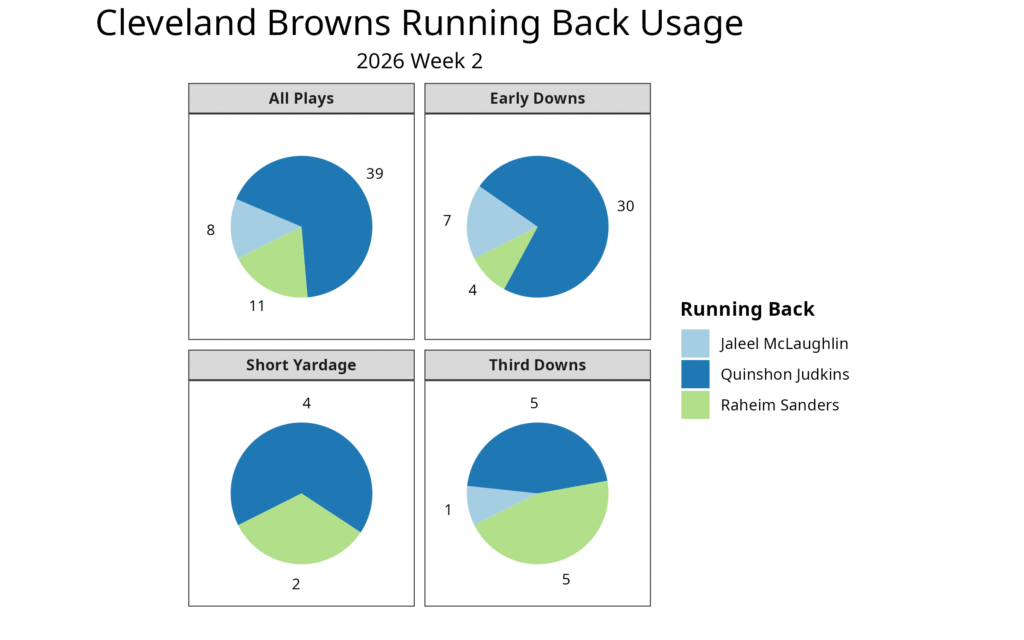
Cleveland had a three-man rotation last season, with Quinshon Judkins as the early-down back, Jerome Ford as the third-down back and Sampson as the backup in all situations. The Browns didn’t re-sign Ford, which was good news for the two younger backs. Sampson suffered an injury on special teams before playing a snap on offense last week, giving Cleveland a two-man rotation between Judkins and Raheim Sanders. Sanders played in clear passing situations, while Judkins appeared everywhere else.
With Sampson on injured reserve, Jaleel McLaughlin was signed to the active roster to take his place, while Eric Gray was added to the practice squad. Judkins' snap rate slightly increased this week. He played slightly less in normal early-down situations but played more often on third downs.
While Judkins dominated running back touches, Cleveland’s run game has remained completely ineffective. Judkins ran 12 times for 21 yards. The good news is that Judkins was targeted more often when he was on the field in passing situations. He caught five passes for 27 yards, tying his career high for receptions.
Judkins' playing time suggests he should be a must-start running back, but his quality of play in the Browns' offense has prevented him from reaching that potential. If he starts to catch more passes, Judkins is more likely to become a running back worth starting in most leagues.
Miscellaneous Notes
- The Browns continued the same wide receiver rotation as last week, with Denzel Boston as the primary receiver in 11, 12 and 13 personnel. KC Concepcion Jr. and Jerry Jeudy both played the clear majority of 11 personnel snaps while splitting snaps in 12 personnel. Boston remains the wide receiver to consider out of Cleveland given the clear gap in route participation rates between Boston and the other two.
- There were several reports the Browns would reconsider their starting quarterback this week if things weren’t going well. Given that the Browns won and Deshaun Watson’s box score stats, it wouldn’t be surprising if Watson is the starting quarterback for Cleveland at least one more week.
- Buccaneers third running back Sean Tucker was inactive last week due to a hamstring injury, but was a full time participant in practice all week and was back in the lineup for this game.
Philadelphia Eagles @ Tennessee Titans
Monitor Saquon Barkley’s health: Barkley missed significant playing time in this game due to a stinger.
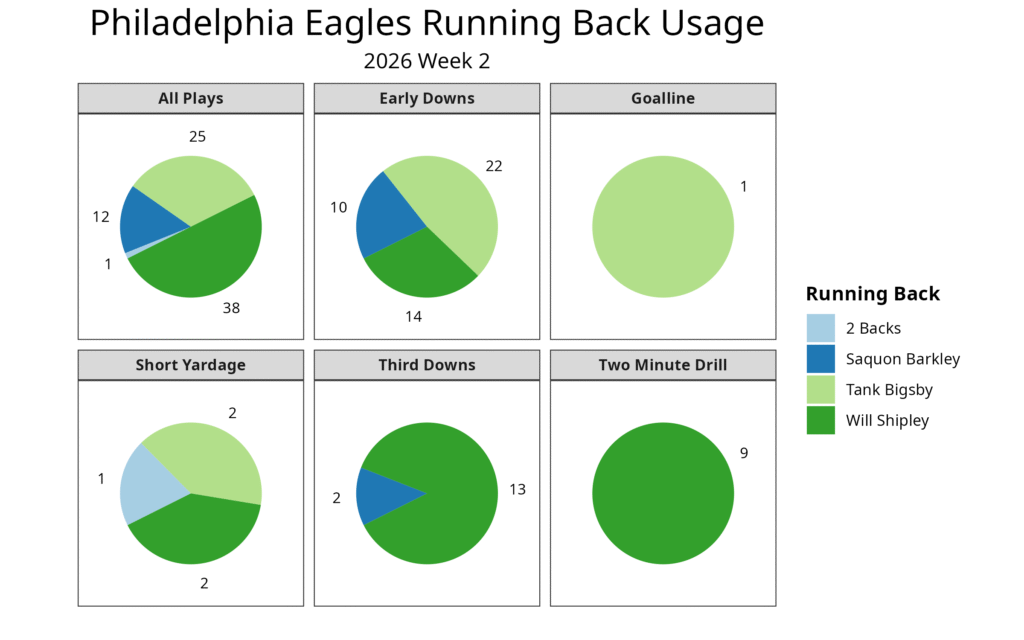
Barkley has been the clear lead back for Philadelphia when healthy, and he’s only not played in Week 18 the last two seasons. Barkley left for the locker room after one play in this game, leading Tank Bigsby and Will Shipley to take over for the rest of the first half. Shipley took 23 snaps in the first half to 19 by Bigsby. Barkley returned for the start of the third quarter, playing 10 of 14 snaps, with Shipley taking the other four. However, Barkley only played one of 20 snaps in the fourth quarter, with Shipley handling 12 and Bigsby seven.
Bigsby was the leader in the box score, carrying 13 times for 33 yards and a touchdown while catching two passes. Shipley ran seven times and caught two passes. Bigsby generally played more on early downs, while Shipley suited up in clear passing situations, and the Eagles had more of those than usual in this game.
If Barkley misses time, Bigsby is the clear waiver wire target despite the playing time difference in this game. Shipley would also be worth targeting in deeper leagues, but Bigsby is the clear favorite to lead the backfield in fantasy production if Barkley’s injury is serious.
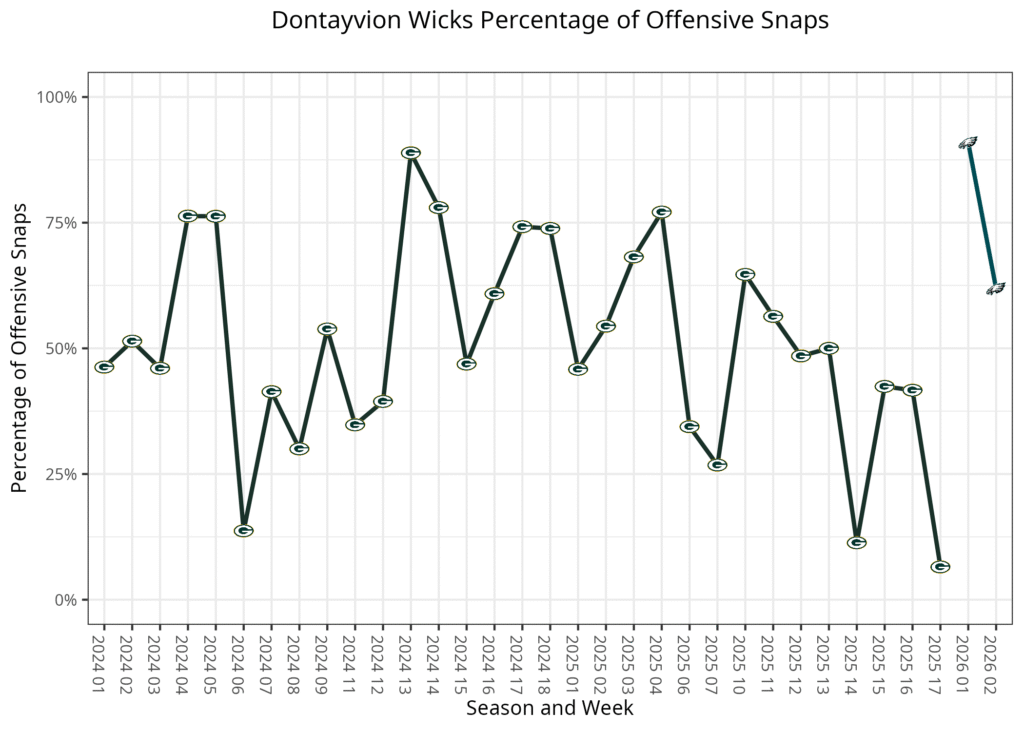
Dontayvion Wicks‘ starting job could be slipping: Darius Cooper rotated in more often as the game progressed, and he scored the game-winning touchdown.
The Eagles traded for Wicks to be their new X receiver after trading away A.J. Brown. He played 50 of a possible 55 snaps in Week 1, where he was rotated out for five plays for Cooper.
This week, Wicks only played 73.9% of snaps in the first quarter, so he was already getting rotated out more than last week. That rate fell to 68.4% in the second quarter, 50% in the third quarter and 50% in the fourth quarter. Cooper played 100% of snaps when Wicks wasn’t on the field. Wicks had a strong game in the box score with five receptions for 74 yards. While the Eagles ran 76 plays, likely contributing to Philadelphia rotating more often, the fact that the team alternated so much in the first quarter before we knew it would run so many plays suggests this could be a permanent change.
Wicks should be viewed as a sell-high candidate in deeper leagues, as it’s unlikely the Eagles will rotate Cooper in less after making the play of the game despite Wicks also performing well.
Monitor Dallas Goedert’s health: Goedert suffered a knee injury in the first half and didn’t return.
Goedert has been the clear lead tight end for Philadelphia, and that included Week 1, where he played in 52 of 55 snaps. Johnny Mundt was his backup and joined him in 12 personnel, while E.J. Jenkins accompanied for a snap out of 13 personnel. Both Grant Calcaterra and Eli Stowers are currently on injured reserve.
The Eagles started the game rotating tight ends a little more frequently, with Goedert playing 19 of the first 25 snaps, Mundt taking a few snaps from Goedert out of 11 personnel and Jenkins handling some snaps out of 12 personnel. After the injury, Mundt was the Eagles' primary tight end, playing 30 of 42 snaps in 11 personnel while the two shared the field for seven plays out of 12 personnel.
If Goedert misses time, Mundt would be the tight end to pick up in the short term. Calcaterra was often the receiving tight end when Goedert was sidelined in recent years, so there is a chance Calcaterra would take over once he’s healthy. There have also been rumors of Zach Ertz signing with Philadelphia given the injuries the Eagles already have at the position. Ertz played for Philadelphia from 2013-2021 and was most recently a member of the Washington Commanders, but didn’t sign with a team this off-season while recovering from a torn ACL. Ertz could be worth picking up if we find out Goedert will miss significant time.
Ignore the Titans running back snap count: Tyjae Spears missed significant time in the third quarter due to injury, but was able to close out the game.
The Titans have spent the last few seasons with Tony Pollard as their early-down back and Spears as their passing-down back when both were healthy. Those roles became a little less well-defined in Week 1.
Pollard played 11 snaps in the first half to 10 by Spears out of a possible 20 plays. There was a slight tendency for Pollard to play on early downs and Spears in passing situations. Spears only played two snaps in the third quarter due to injury.
It was noteworthy that rookie Nicholas Singleton started a rotation with Pollard. In past years, Pollard would have dominated snaps with Spears out. It was also notable because Singleton was a healthy inactive last week, with Julius Chestnut as the third running back. Chestnut was also active this week, but Singleton played ahead of him.
The Titans went back to a two-man rotation in the fourth quarter, with Pollard playing 11 snaps to seven by Spears. Despite Pollard having more touches, Spears ended up gaining more yards with both a 27-yard carry and a 27-yard catch. Given the big plays by Spears, it’s possible the Titans' backfield will be even closer to 50-50 going forward.
Miscellaneous Notes
- Titans fifth-round rookie running back Nicholas Singleton was a healthy inactive last week but was active this week as a fourth running back. Instead, Tennessee kept only three tight ends, with Kylen Granson as a healthy inactive.
- Philadelphia made Andy Dalton its backup quarterback over Tanner McKee and Cole Payton for a second straight week.
- Eagles backup wide receiver Elijah Moore was inactive for a second straight week. He was on the injury report with a neck injury, but was a full participant all week. Green Bay signed Britain Covey off its own practice squad, and he was the Eagles’ sixth wide receiver this week.
Jacksonville Jaguars @ Denver Broncos
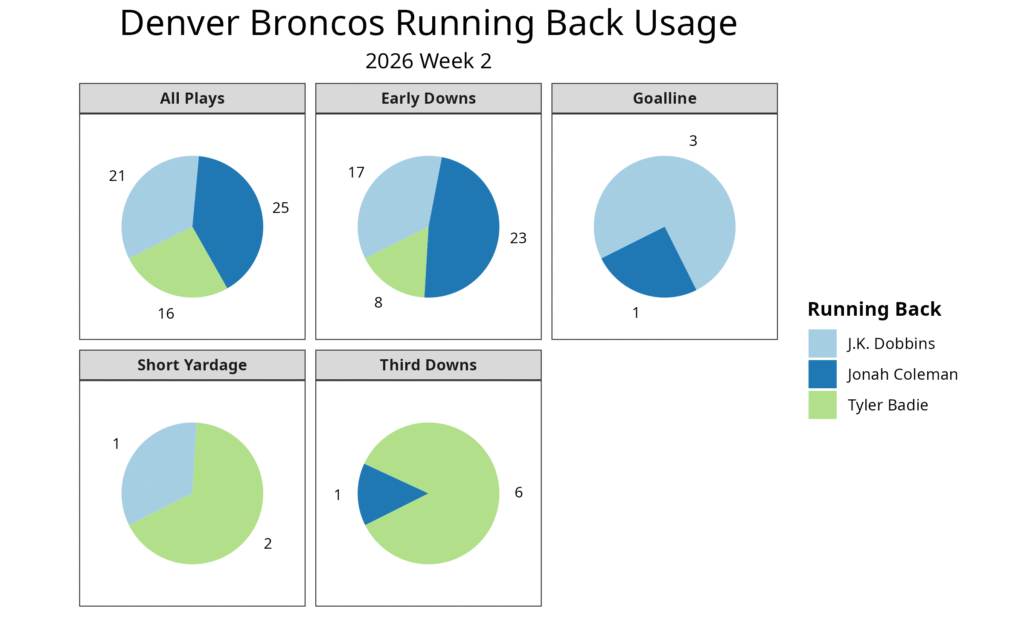
Monitor J.K. Dobbins’ health: Dobbins suffered a hamstring injury at the end of the third quarter, causing him to miss the fourth quarter.
The Broncos used a three-man rotation last season, with Dobbins as the lead back, RJ Harvey as the backup and Tyler Badie as the third-down back. Last week, Denver shifted to a unique two-man rotation. Dobbins played 71% of the early-down snaps, while Harvey played more than 87% of the snaps on third downs and during two-minute drills, as well as 100% of the short-yardage and goal-line snaps. Rookie running back Jonah Coleman was active ahead of Badie but played only three snaps in his debut.
Harvey was dealing with a hamstring injury entering this game. He was questionable and ultimately inactive, so Badie was activated.
The first three quarters resembled the Broncos’ rotation from early last season, but with Coleman taking Harvey’s place. Badie played on third downs and a few snaps late in the second quarter, while Coleman served as Dobbins’ backup on early downs. After Dobbins’ injury, Coleman became the clear early-down back, with Badie playing on third downs and a few second-and-long plays.
While Coleman was drafted in several leagues because of his upside, he remains available in 78% of ESPN leagues. He is among the top waiver-wire targets given the injuries to the other two running backs. Coleman’s box-score production was better than Dobbins’ in this game, particularly as a receiver. Even if some of the other running backs are healthy, we should start seeing Coleman mix in more frequently.
Bhayshul Tuten takes a stronger hold of the Jaguars’ backfield: Tuten led the team in both carries and yards per carry.
Last week, Tuten played just under 50% of offensive snaps, while Chris Rodriguez Jr. played 40.4%. Ameer Abdullah also mixed in, while LeQuint Allen Jr. wasn’t 100%.
This week, Allen rotated in more frequently, most notably taking most of the snaps in two-minute-drill situations. Tuten saw his playing time decline in those clear passing situations, but his snap rate in normal early-down situations jumped to 67.6%, which is the most important situation for running backs by far. Tuten ran 13 times for 65 yards and a touchdown against a strong run defense, while Rodriguez had six carries for 13 yards. Tuten also played on half of the goal-line snaps after there was some thought that Rodriguez could take a clear majority of those snaps this season.
Tuten can more safely be inserted into fantasy starting lineups going forward, but the backfield remains somewhat unsettled. It wouldn’t be surprising if Allen takes a higher percentage of the third-down snaps once he’s healthier. It also wouldn’t be surprising if the early-down split becomes more balanced when the Jaguars are playing with a lead.
Miscellaneous Notes
- Wide receiver Marvin Mims Jr. was inactive with a foot injury. He played only nine offensive snaps last week. The Broncos rotated their backup wide receivers more frequently last season, but in Week 1, they primarily relied on Courtland Sutton, Jaylen Waddle and Pat Bryant. Lil’Jordan Humphrey was released shortly before last week’s game but was re-signed Tuesday and was active for this game.
- Waddle rotated out a little more frequently this week than last, although he understandably could have needed a few additional breaks after catching eight passes for 138 yards.
- Evan Engram’s route participation rate dropped from 60.6% last week to 40% this week.
- The Broncos activated fullback Adam Prentice from the practice squad for the second straight week.
- Several Jaguars played this week despite being limited in practice all week, including running back LeQuint Allen Jr. (hip) and wide receivers Brian Thomas Jr. (shoulder) and Jakobi Meyers (thumb).
- The Jaguars’ wide receiver rotation was much more straightforward this week than last, with Parker Washington and Meyers playing in 11 and 12 personnel and Thomas joining them in 11 personnel. Travis Hunter rotated in a little more often, playing seven snaps, while rookie Josh Cameron played fewer snaps.
- Brenton Strange similarly rotated out less often this week than last, likely because of the game script.
- Jacksonville activated Nick Mullens from the practice squad to serve as the backup quarterback while Quinn Ewers was inactive for the second straight week.
- The Jaguars made rookie wide receiver CJ Williams a healthy inactive, leaving them with only five wide receivers after carrying six last week.
- Jaguars rookie tight end Tanner Koziol was a healthy inactive for the second straight week.
Las Vegas Raiders @ Los Angeles Chargers
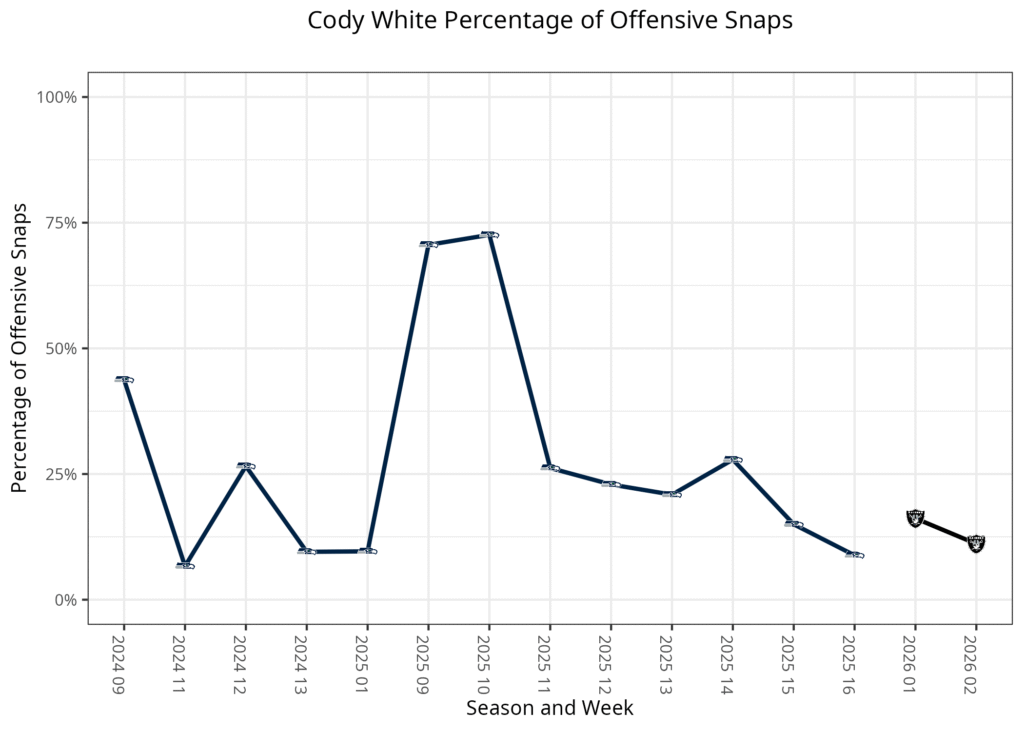
Cody White scores twice playing a small role: While White found the end zone twice, his playing time didn’t suggest he is in line for a starting role.
The Raiders’ top wide receivers have been clear for most of the offseason, with newcomer Jalen Nailor as the X receiver, Tre Tucker returning at Z and Jack Bech moving to the slot in 11 personnel. That remained the case in this game, with all three receivers playing at least 80% of the snaps in 11 personnel and Tucker and Nailor both playing at least 66% of the snaps in 12 personnel.
Las Vegas had several long drives in this game, starting with a 16-play drive, followed by eight-play and seven-play drives. Later, the Raiders had a 12-play drive. When drives reach that length, teams are more likely to rotate in their backup wide receivers, particularly when there are multiple long drives in a row. White had only two targets, but both went for touchdowns. White may start playing more at Nailor’s expense after this performance, but it didn’t appear that getting White more involved was part of the plan this week.
It is worth noting that the Raiders ran 24 plays in single-receiver sets, all with fullback Connor Heyward on the field. None of the Raiders’ wide receivers have played more than 65% of the snaps this season. There has been a league-wide trend toward more multi-tight-end sets, making it harder to trust wide receivers on teams embracing that trend without a clear lead option. While Tucker had a huge game this week with five receptions for 119 yards and a touchdown, his snap rate will make him difficult to trust on a weekly basis.
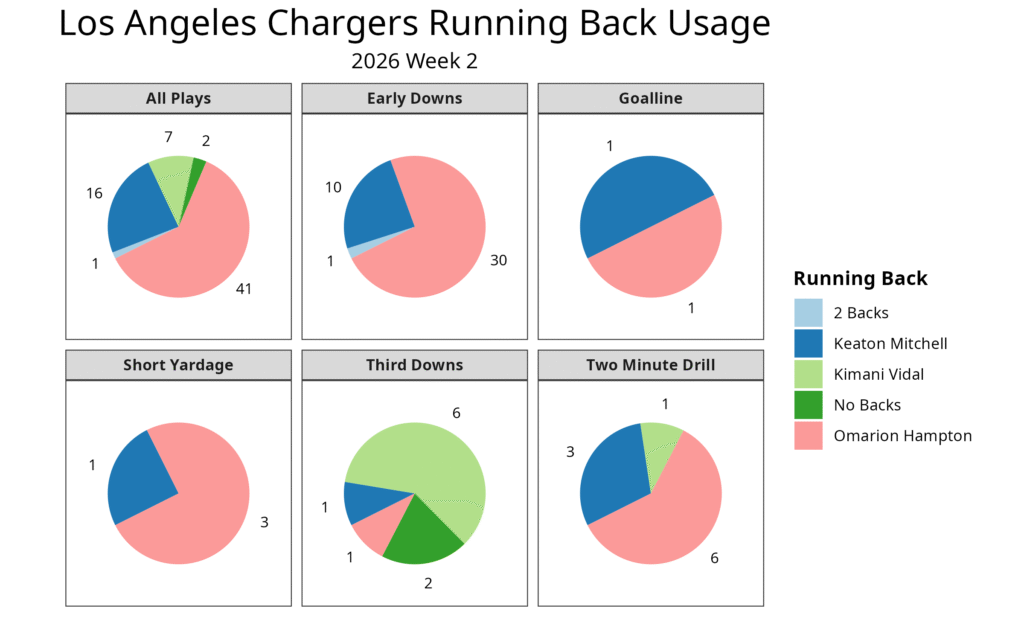
Chargers move more toward a three-man rotation: Kimani Vidal played more frequently on third downs compared with a week ago.
Los Angeles mostly used a two-man rotation last week, with Omarion Hampton playing roughly two snaps for every one by Keaton Mitchell. Mitchell and Hampton handled all of the third-down snaps, while Vidal played only a few snaps during a two-minute drill and at the goal line. It was a relatively traditional two-man backfield, with Hampton serving as the clear early-down back. Hampton played 74.3% of the early-down snaps compared with 20% for Mitchell, while Mitchell served as the receiving back.
This week, Vidal played six of 10 snaps on third downs after not playing a snap in that situation last week. Mitchell’s early-down snap rate also increased to 26.8%. Despite the three-man rotation, Hampton dominated the touches with 23 carries and two receptions. Mitchell had six touches for 39 yards, showing the explosiveness he displayed with the Baltimore Ravens.
The Chargers’ running backs dominated the touches despite the game script. If the offense starts playing better and Los Angeles begins winning games, that could benefit all three running backs. However, the Chargers have a very difficult schedule, so that might not happen anytime soon.
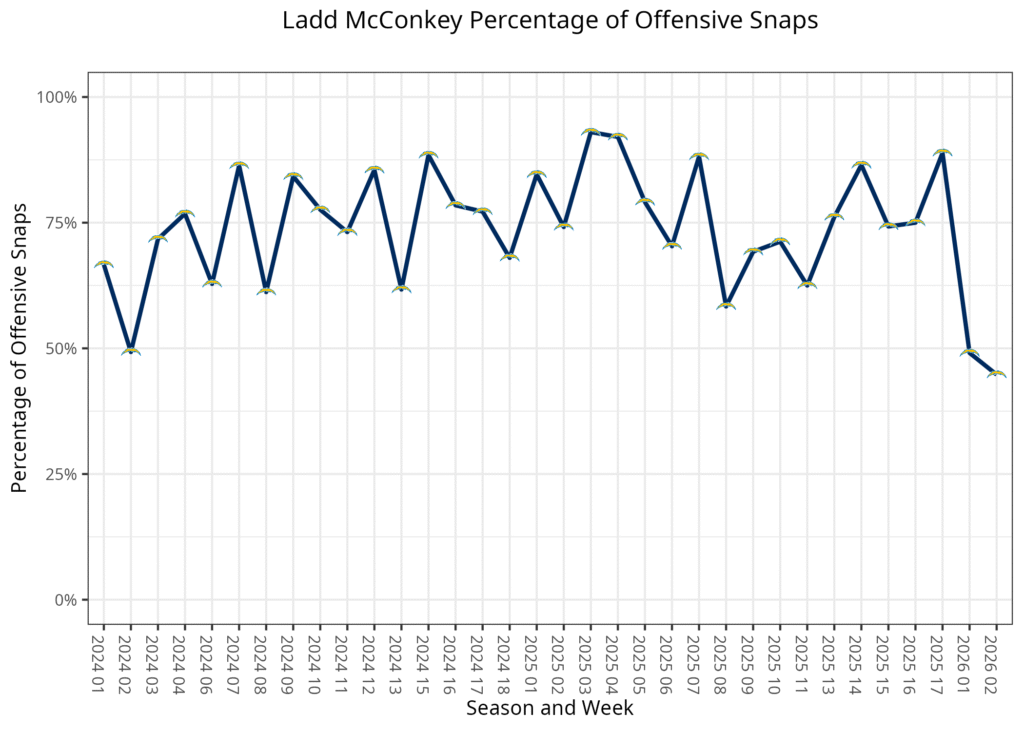
Ladd McConkey plays on a snap count: McConkey didn’t practice Wednesday or Thursday but was limited Friday with a rib injury.
The Chargers had a clear wide receiver rotation last season, which has largely carried over into this year. McConkey has played Z receiver in 12 personnel and in the slot in 11 personnel, while Quentin Johnston has been the X receiver. Last season, Keenan Allen played Z receiver in 11 personnel, while Tre’ Harris has filled that role this year.
With McConkey injured, Harris took over as the primary Z receiver in 12 personnel, leading him to play 82.1% of the offensive snaps. Derius Davis, who has been the Chargers’ backup slot receiver, also took some of McConkey’s snaps in 11 personnel. McConkey caught three passes, tied for the most on the team, for 35 yards.
It will be worth monitoring how much McConkey practices this week and whether he receives a game-day injury designation before starting him in fantasy leagues next week.
Monitor David Njoku’s health: Njoku was carted off the field with a knee injury at the start of the second quarter.
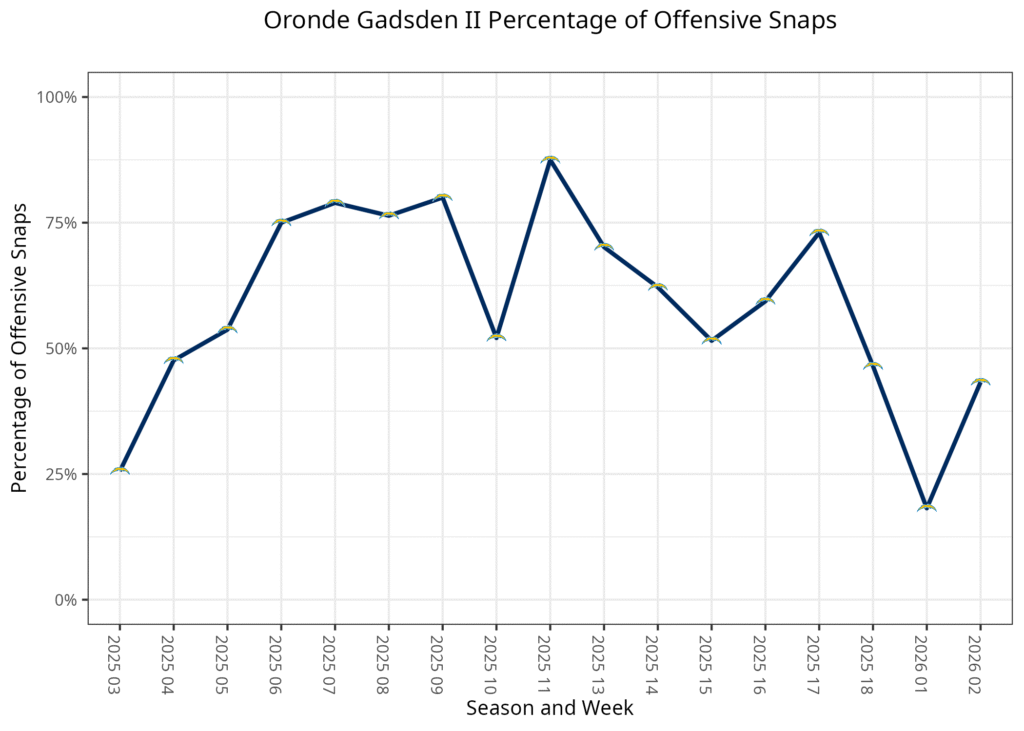
Los Angeles used a three-man rotation at tight end last week, with Charlie Kolar serving as the primary tight end on early downs and Njoku playing on third downs. The two shared the field for most snaps in 12 personnel. Oronde Gadsden played only 10 snaps last week as the third option in all situations.
The Chargers began changing their strategy this week, with Gadsden replacing Kolar as the primary tight end in 12 personnel. After Njoku’s injury, Gadsden received a significant increase in playing time. While Kolar remained the primary tight end in 21 personnel, Gadsden played 15 of 26 snaps in 11 personnel over the final three quarters.
If Njoku’s injury is serious, we can expect Gadsden to be the primary receiving tight end for Los Angeles. His usage would be somewhat dependent on game script, but given how Los Angeles has played so far this season and the Chargers’ upcoming schedule, Gadsden could be a significant factor if Njoku misses time.
Miscellaneous Notes
- Raiders top tight end Brock Bowers missed his second straight game with a knee injury. There is optimism that he will be ready to return next week. Chris Myarick was elevated from the practice squad to serve as Las Vegas’ third tight end in this game.
- Las Vegas running back Ashton Jeanty briefly left the game in the fourth quarter with an ankle injury but was able to return before the end of the game. There was some concern that Jeanty could lose goal-line snaps to Mike Washington Jr., but Jeanty played all four snaps in goal-line situations in this game.
- Cody White was elevated from the practice squad for this game, giving Las Vegas six active wide receivers.
- The Chargers placed backup wide receiver KeAndre Lambert-Smith on injured reserve with a hamstring injury. Gary Jennings was signed to the active roster to take his place, while Marquez Valdes-Scantling was added to the practice squad.
Seattle Seahawks @ Arizona Cardinals
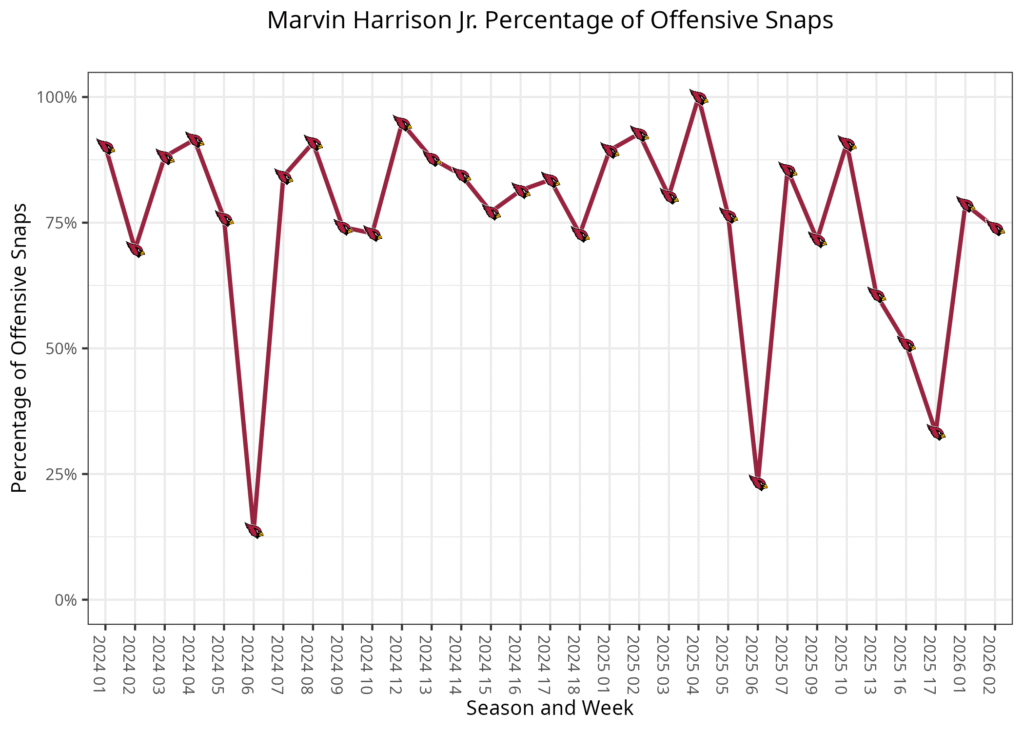
Marvin Harrison Jr. sees a decrease in snaps: The Cardinals’ X receiver has seen a decrease in playing time after a disappointing start to the season.
Arizona’s wide receiver rotation last week was simple, with Harrison, Michael Wilson and Kendrick Bourne all playing at least 46 of 50 snaps in 11 personnel. Wilson and Harrison split snaps out of single wide receiver sets. Wilson and Harrison both played five of eight snaps out of two receiver sets, but their three missed snaps each were all kneel-downs, which weren’t a big deal.
This week, the 11 personnel usage was the same, with all three seeing at least 29 of the 30 snaps. The first difference was in single-receiver sets, where Wilson took seven of eight snaps after last week’s split. In two-receiver sets, Harrison only played in seven of 10 snaps, excluding kneel-downs. Harrison often played 100% of 12 personnel snaps last season, and only fell to 70% or fewer when he was injured. Simi Fehoko was the receiver taking snaps from Harrison in 12 personnel.
Most of the plays he missed this week were run plays, so his target rate was a much bigger problem than his snap rate, but the fact that his snaps subtly decreased could be something worth monitoring going forward.
Monitor Jadarian Price’s health: Price left early in the fourth quarter with a chest injury and didn’t return.
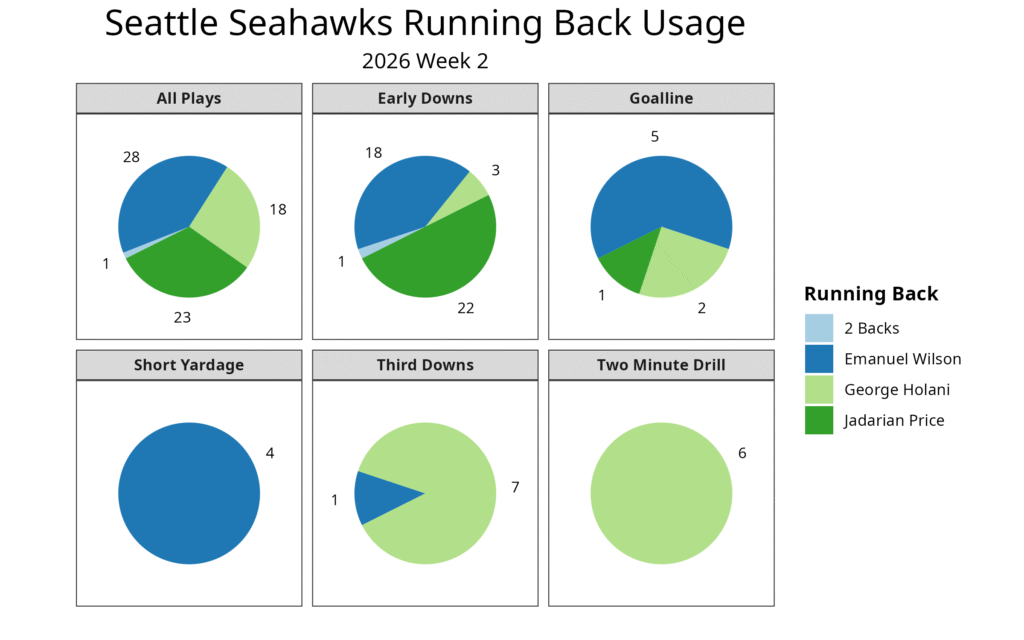
Seattle had a straightforward running back rotation last week, with Price as the primary back on early downs, George Holani as the primary backup and Emanuel Wilson playing in some short-yardage situations. The rotation shifted this week, with Wilson taking over for Holani as the primary backup on early downs, while Holani remained the third-down and two-minute-drill back.
Over the first three quarters, Price’s early-down snap rate was nearly identical to last week. He was solid as a runner, with 13 carries for 52 yards. Price played only one snap in the fourth quarter before Wilson completely took over the early-down role. Wilson was also the primary short-yardage and goal-line back throughout the game and finished with more yards per carry than Price. None of the running backs were major factors in the passing game.
Wilson is the waiver-wire target for Seattle if Price’s injury is serious. This also isn’t great news for Price because he had an opportunity to show he deserved more playing time but wasn’t able to take advantage of it. Even if he misses only a game or two, Zach Charbonnet could be returning around the same time. Price’s usage and production in this game could be close to his fantasy ceiling.
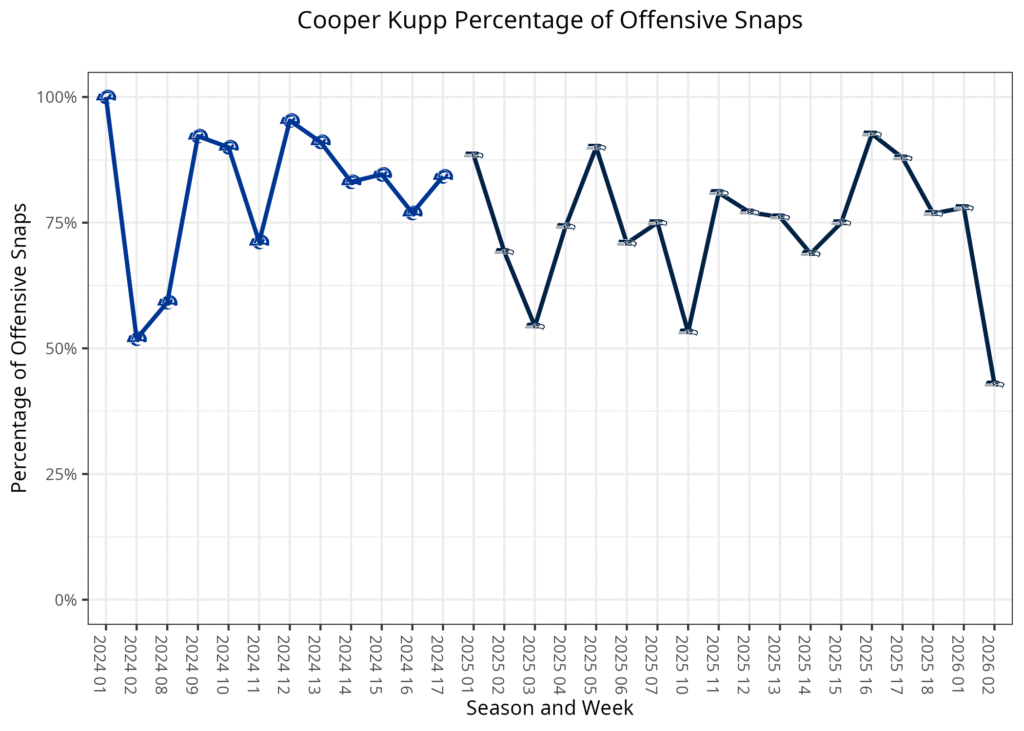
Cooper Kupp plays a decreased role in the Seahawks’ offense: Seattle had better wide receiver depth in this game than at any other point since Kupp joined the team.
At the start of last season, Seattle had Jaxon Smith-Njigba and Kupp as the starters, with Tory Horton joining them in 11 personnel. Horton suffered a season-ending injury in the middle of the year, leading Seattle to trade for Rashid Shaheed. All four wide receivers made the team this year, but Horton wasn’t ready to play in Week 1 because of a hamstring injury. He was a full participant in practice all week and was active for this game. The Seahawks made Montorie Foster Jr. inactive, leaving them with only four active wide receivers.
Smith-Njigba, Shaheed and Kupp remained the primary wide receivers in 11 personnel, although Horton took three snaps from Kupp. The bigger change came in 12 personnel, where Shaheed played more than Kupp, 21 snaps to 16. Kupp played 76.4% of the snaps in 12 personnel last season, and that rate fell to 64% last week. It dropped further to 44.4% in this game, with Horton also factoring into the rotation.
Another reason for Kupp’s dramatic decrease in playing time was that the Seahawks ran 15 plays from single-receiver sets, and Kupp didn’t play on any of them.
It was already difficult for any Seattle wide receiver outside of Smith-Njigba to be fantasy-relevant. Horton’s return and Shaheed’s increased usage make it even more difficult to trust Kupp in fantasy lineups.
Miscellaneous Notes
- Quarterback Sam Darnold suffered a glute injury early last week, leading him to be inactive this week. There is optimism that he will be ready to play next week. Drew Lock started for Seattle.
- Seahawks tight end Nick Kallerup was active this week, giving Seattle four active tight ends after having only three last week. Kallerup finished with more snaps than Eric Saubert and Elijah Arroyo, partially because of garbage time. However, the fact that his playing time was close to theirs before garbage time was a surprise.
- The Cardinals made rookie quarterback Carson Beck and rookie wide receiver Reggie Virgil healthy inactives for the second straight week.
- Arizona’s running back rotation didn’t change from last week to this week, with Jeremiyah Love playing a slight majority of the early-down snaps. Tyler Allgeier wasn’t far behind on early downs and also played in passing situations, leading him to play more snaps overall.
Washington Commanders @ Dallas Cowboys
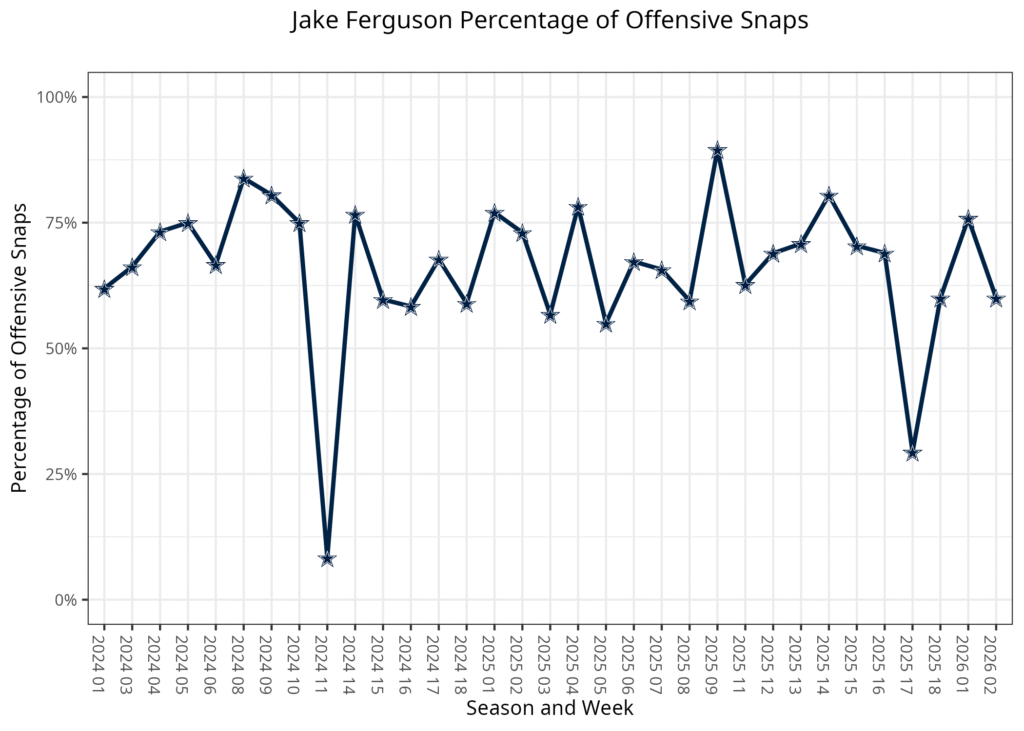
Jake Ferguson scores twice in a decreased role: Ferguson’s playing time resembled stretches earlier in his career when he wasn’t 100% healthy.
Ferguson has been the clear lead tight end for Dallas when healthy. His advanced metrics haven’t been great in recent seasons as he has dealt with several injuries, but he caught 82 passes and scored eight touchdowns last season. There have been more concerns this year with the emergence of Ryan Flournoy as the team’s third receiver, which could move Ferguson down to fourth in the target pecking order.
The biggest change this week came in 12 personnel, where Ferguson played only four of 11 snaps, with Brevyn Spann-Ford and Luke Schoonmaker serving as the two primary tight ends in that personnel grouping. Ferguson was similarly limited in 12 personnel at times last season, but his snap rate rarely fell below 40%. He also played only 53.1% of the snaps in single-tight-end sets on early downs, compared with 68% last season and 62.9% last week.
This left Ferguson running a route on only 63.9% of the Cowboys’ passing plays, a lower rate than Flournoy, George Pickens and CeeDee Lamb. If the Cowboys continue scoring 35-plus points every week, the reduced playing time might not matter. Typically, though, that route participation rate is a little lower than what you would like to see from a fantasy starting tight end.
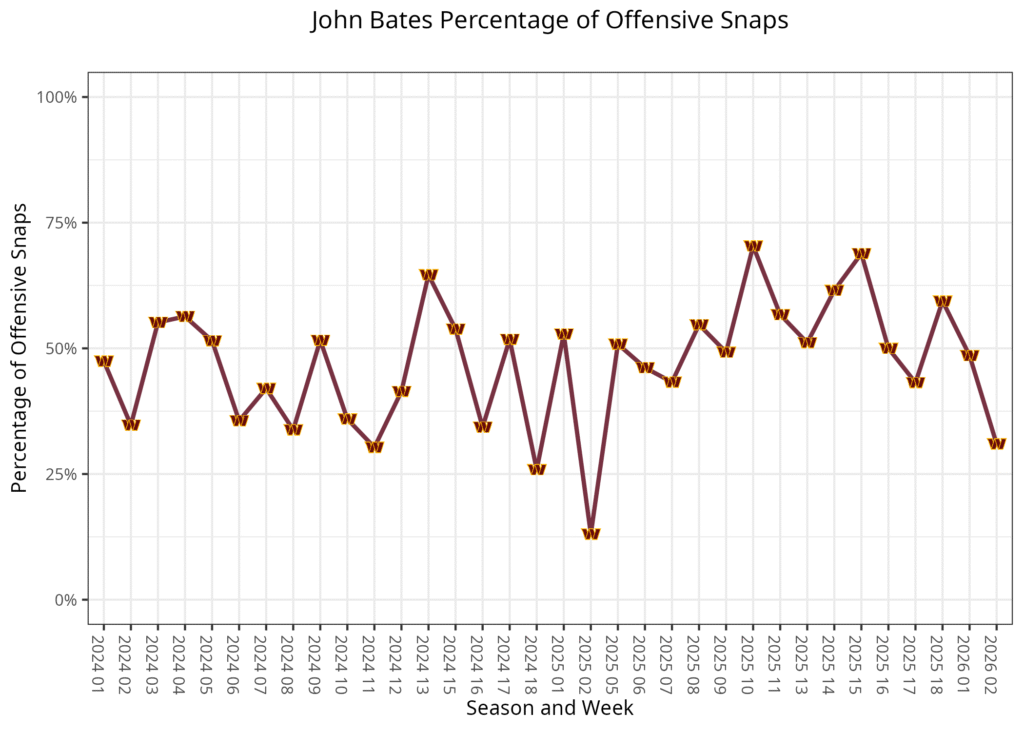
Commanders adjust their tight end rotation without Chig Okonkwo: Washington used an ugly three-man rotation that is best avoided if Okonkwo’s injury lingers.
The Commanders replaced Zach Ertz with Okonkwo this season. Okonkwo was among the league leaders among tight ends in route participation rate last week before suffering a hamstring injury. This left Washington with John Bates and Ben Sinnott, similar to the situation in the second half of last season after Ertz’s injury. Last week and during that stretch last season, Bates was the primary tight end on early downs, while Sinnott was the primary option on third downs. Washington also had Colson Yankoff available as its third tight end.
In this game, Sinnott replaced Bates as the primary tight end on early downs. Yankoff took over as the primary tight end on third downs, while Sinnott and Bates played together in 12 personnel. This left Yankoff and Sinnott with route participation rates around 40%, while Bates was below 10%. Yankoff and Sinnott each caught one pass.
If Okonkwo continues to miss time, it’s best to avoid Washington’s tight ends in fantasy leagues. Of the three, Yankoff appears to have the best chance of providing fantasy value because of his role on third downs.
Miscellaneous Notes
- The Cowboys released Israel Abanikanda on Tuesday and replaced him with Tyler Goodson, who was signed from the Atlanta Falcons practice squad. Abanikanda was signed to the Cowboys’ practice squad Thursday. Dallas made Goodson inactive, leaving the team with two halfbacks and fullback Hunter Luepke.
- Dallas made undrafted rookie wide receiver Camden Brown a healthy inactive for the second straight week, giving Dallas five active wide receivers.
- Commanders quarterback Jayden Daniels suffered what is believed to be a dislocated left elbow. He dealt with the same injury last season, which caused him to miss time.
- The Commanders made wide receiver Luke McCaffrey a healthy inactive for the second straight week. Treylon Burks, who was a healthy inactive last week, was active this week.
- Washington rotated its wide receivers more frequently than last week, likely because the Commanders ran so many offensive plays. McLaurin remained the clear leader in route participation rate.
Miami Dolphins @ San Francisco 49ers
Monitor Caleb Douglas’ health: Douglas left the game in the fourth quarter with an ankle injury and was spotted in a walking boot after the game.
Miami’s wide receiver rotation was largely similar to last week, with Douglas and Malik Washington serving as the top two receivers and Kevin Coleman Jr. and Chris Bell both seeing significant playing time in 11 personnel. This week, Coleman and Bell also rotated in a little more frequently in 12 personnel. Washington briefly left the game with an injury but was able to return, which may have contributed to the backups playing more.
Douglas’ injury came late in the fourth quarter, and Miami shifted to its backups shortly afterward. On all eight plays when Douglas wasn’t on the field, Bell was, as both have primarily played X receiver. If Douglas misses time, we should expect Bell to benefit the most.
Many believe Bell can be the best wide receiver on the team, and this would give him a chance to prove it. That makes Bell a waiver-wire option. Even if you wouldn’t trust him in your starting lineup for Week 3, he is worth picking up to see if he can earn a larger role in the offense.
Monitor the health of the 49ers’ wide receivers: Neither Mike Evans nor Demarcus Robinson was able to finish the game.
While the 49ers won in Week 1, they lost second-round rookie De’Zhaun Stribling. He underwent ankle surgery and is expected to miss 10 weeks. That left Evans, Robinson and Deebo Samuel Sr. as the top three wide receivers on the depth chart. Each played at least 85% of the snaps in 11 personnel last week, while they rotated in 12 and 21 personnel. Jacob Cowing was the top remaining backup with five snaps, while KhaDarel Hodge played one. With Stribling on injured reserve, Hodge was signed to the 53-man roster after being elevated from the practice squad last week.
The 49ers used an interesting rotation in the first quarter. Samuel and Robinson were often on the field in 11 personnel, while Evans, Hodge and Cowing rotated through the third spot. Evans was consistently on the field in 21 personnel, with Samuel and Robinson rotating through the other wide receiver spot. Robinson left the game in the second quarter with what appeared to be a high-ankle sprain, which could cost him significant time. Cowing played 21 of a possible 28 snaps without Robinson on the field, while Hodge played 16 of 28.
Evans left the game at the end of the third quarter with a hip injury. It’s less clear how serious that injury is, but the 49ers were leading 35-6, so there was little reason to risk bringing him back. Samuel played only five snaps in the fourth quarter before the 49ers turned to their backups, with Cowing and Hodge playing 15 and 14 of a possible 16 snaps, respectively.
As more 49ers players suffer injuries, it becomes safer to trust the remaining healthy players for San Francisco.
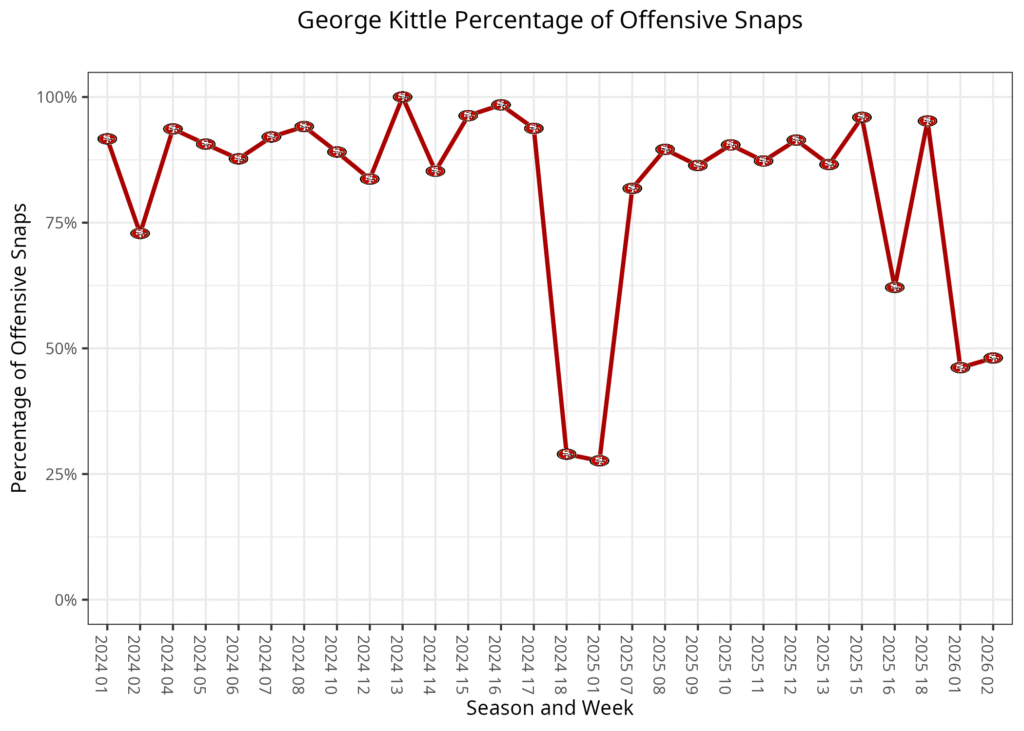
49ers adjust George Kittle’s usage: Kittle was used more frequently in passing situations and less frequently on running plays compared with last week.
Kittle tore his Achilles in the playoffs last season, leading many to believe he wouldn’t be ready for the start of this season. While Kittle still isn’t 100%, he has been playing a part-time role for San Francisco. Last week, he played just under half of the offensive snaps. He played only 27% of the snaps in single-tight-end sets on early downs but played two-thirds of the third-down snaps and 73.7% of the snaps in 12 personnel.
This week, his playing time in single-tight-end sets on early downs nearly doubled. His third-down snap rate increased from four-fifths to five-sixths, but his playing time in 12 personnel plummeted. As a result, his overall snap rate increased by only a few percentage points. More importantly for fantasy purposes, his route participation rate jumped from 47.2% to 60%. His target rate remained high, and more of his targets were catchable this week, leading to four receptions for 80 yards and a touchdown.
While Kittle still isn’t close to his normal snap rate, his increased usage in passing situations makes it a little safer to put him in fantasy starting lineups following his big game this week.
Miscellaneous Notes
- Similar to last week, quarterback Brady Cook, wide receiver Jalen Tolbert and tight end Justin Joly were among the Dolphins’ healthy inactives.
- Ollie Gordon II played ahead of Jaylen Wright in all situations for the Dolphins’ backup running back role. During the preseason, it appeared Wright was ahead of Gordon, while the two played four snaps each last week.
- Dolphins fifth-string wide receiver Ryan Miller led the team in receiving yards thanks to a 77-yard touchdown catch in garbage time. Miller played only five of 56 snaps before garbage time.
- 49ers backup running back Kaelon Black was limited in practice Thursday and Friday with a groin injury and was listed as questionable, but he was active. Similar to last week, Black handled a high percentage of the team’s carries and was a more effective runner than Christian McCaffrey.
- Fullback Kyle Juszczyk (finger) and tight end George Kittle (Achilles) were limited in practice early in the week, but both were active.
- The 49ers placed backup tight end Jake Tonges on injured reserve Wednesday, likely ending his season. The 49ers signed Brayden Willis from the practice squad Tuesday to serve as their new third tight end.
Indianapolis Colts @ Kansas City Chiefs
Monitor Alec Pierce’s health: Pierce suffered a heel injury and didn’t return.
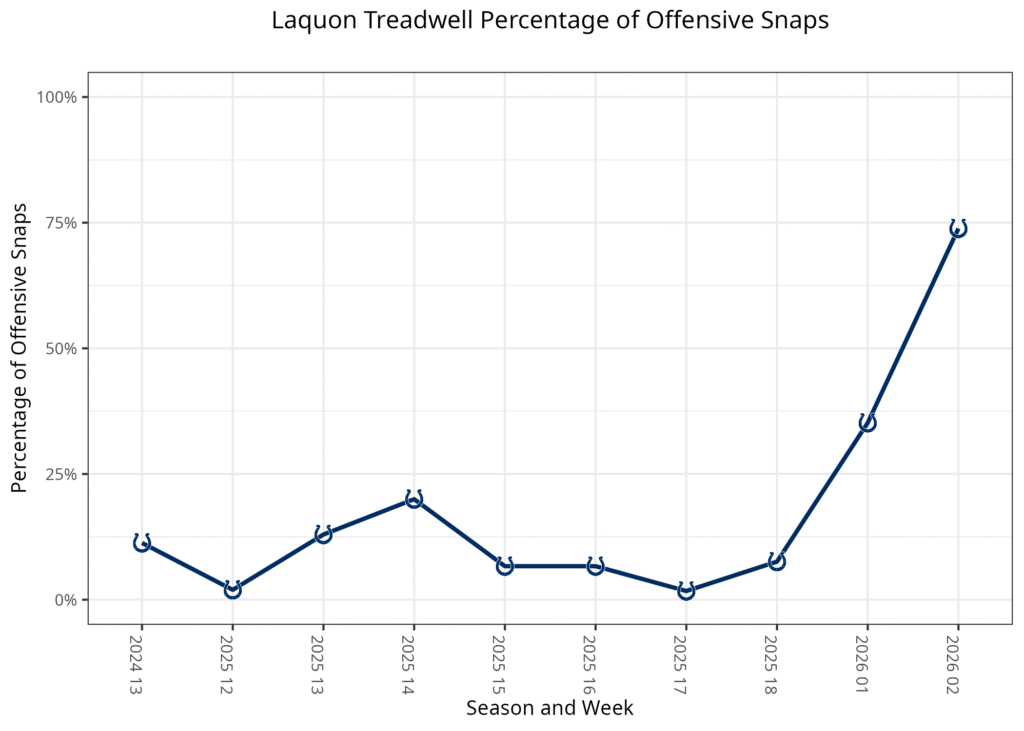
Pierce underwent ankle surgery in March, causing him to begin training camp on the PUP list. He returned for Week 1 but played only 59.3% of the offensive snaps, with Laquon Treadwell serving as his direct backup at X. Josh Downs played Z in two-receiver sets and moved to the slot in 11 personnel, while Keenan Allen played Z in 11 personnel.
Pierce’s playing time was increasing this week, as he was on the field for 17 of the Colts’ first 18 plays. However, he suffered a heel injury and was carted off the field. Treadwell took over as Indianapolis’ X receiver for the rest of the game, while the Colts kept Downs and Allen in their usual roles.
If Pierce misses time, Treadwell will likely take over as the Colts’ starting X receiver. However, he probably isn’t worth adding off the waiver wire because Indianapolis could instead increase Allen’s playing time in 12 personnel.
Rashee Rice’s changed role: Rice’s role has been notably different in 2026 compared to previous seasons.
Rice has been among fantasy’s top wide receivers when available over the past three seasons. His average depth of target was 5.2 yards in 2023, 5.2 in 2024 and 4.9 in 2025. He paired those low-depth targets with exceptionally high target rates, leading to significant fantasy success, particularly in PPR leagues. Much of that production came from the slot, where he averaged 2.5 yards per route run in each of the past three seasons. His slot target rate was 33.3% in 2024 and 35.3% in 2025. While Rice also earned targets at a high rate when lined up out wide, he averaged only 1.48 yards per route run from that alignment last season.
This year, Rice has spent less time in the slot, with Xavier Worthy taking a higher percentage of the slot snaps. Rice’s average depth of target remained low last week but increased to 8.0 yards in this game. The bigger concern is that Kansas City has been spreading the ball around more. Worthy has earned targets at a higher rate than Rice, while Tyquan Thornton has been used more as a deep threat. Thornton’s role helped him finish with more receiving yards than Rice in this game despite his lower target rate. Kenneth Walker has also been a factor, receiving some of the shorter passes that previously might have gone to Rice.
Rice finished with four receptions for 83 yards, including a 31-yard reception on the final play of regulation when Indianapolis’ priority was simply preventing a touchdown. Given the changes to his role and target competition, Rice is no longer the automatic must-start option he was in recent seasons. Depending on the matchup and a fantasy roster’s other options, it is reasonable to consider benching him. His final stat line also looks better than his usage would suggest, making this a reasonable time for fantasy managers to explore his trade value.
Miscellaneous Notes
- Colts backup wide receiver Ashton Dulin was inactive with an ankle injury. He had a chance to start in Week 1, but the team signed Keenan Allen, and Alec Pierce was healthy enough to play. Laquon Treadwell has also passed Dulin on the depth chart as the backup X receiver. Dulin primarily played in 13 personnel last week.
- DJ Giddens was a healthy inactive for the second straight week, leaving Seth McGowan as the only backup to Jonathan Taylor.
- Mo Alie-Cox is typically the clear-cut TE2 for Indianapolis behind Tyler Warren. Alie-Cox was the primary backup in 11 personnel, while he and Drew Ogletree split time in 12 personnel.
- Kenneth Walker played an even higher percentage of the Chiefs’ offensive snaps this week than last week, but his touches were more spread out throughout the game.
- Kansas City continued its general wide receiver rotation from last week, with Rashee Rice and Xavier Worthy playing in 11 and 12 personnel and Tyquan Thornton joining them in 11 personnel.
Table Notes
- Snaps include plays called back due to penalties, such as offensive holding or defensive pass interference. The other three stats have these plays removed.
- Targets may differ from official NFL sources. The most likely discrepancy would be from a clear thrown-away pass, where the NFL may give the target to the nearest receiver, while this data will not.
- Carries are only on designed plays. Quarterback scrambles won’t count for the total number of carries in the game.

 © 2026 PFF - all rights reserved.