
- Bucky Irving exceeded all expectations: Irving went from a fourth-round pick and a backup to one of the best running backs in the league.
- Kenneth Walker III has been a top-12 fantasy running back when healthy: Walker has consistently started seasons well from a fantasy perspective before injuries have kicked in.
- Subscribe to PFF+: It’s quick and easy. You’ll unlock industry-leading rankings, unlimited Fantasy Mock Draft Simulator use, PFF's Live Draft Assistant and our weekly Start/Sit Optimizer. It’s time to win.
Estimated Reading Time: 10 minutes

Five running backs have a clear path to being the top overall running back in 2025. Saquon Barkley, Jahmyr Gibbs and Bijan Robinson were all relatively close in fantasy production last season, while Christian McCaffrey was the top fantasy running back in 2023. Ashton Jeanty joins the group as one of the top prospects at the position in the past decade.
This article is for the less-obvious players who have the talent and are in a good enough situation to become the new top overall running back if everything goes well. All three have new play-callers who could potentially use them more than their previous play-callers did. None are first-round picks, and all are a good value at their current ADP.
The average draft position listed is from a consensus between ESPN, Sleeper and Yahoo! for where the player is picked on average in a 12-team redraft league.
Last updated: Monday, Sept. 1
Bucky Irving, Tampa Bay Buccaneers (ADP: 2.11)
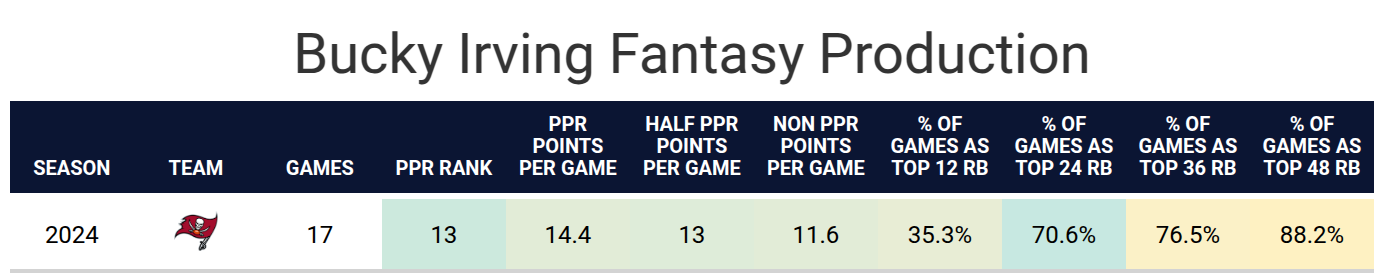
Irving was a fourth-round pick by the Buccaneers and won the backup job behind Rachaad White before Week 1 in 2024. By Week 10, he was an essential part of the Buccaneers' offense, running at least 12 times each game, outside of one where he suffered an injury. Over the last five games, including the playoffs, he ran at least 15 times and caught at least two passes each week. In Week 18 and the wild-card round of the playoffs, the Buccaneers gave him a significant increase in snaps, 72% and 69%, respectively.
Irving averaged 0.29 avoided tackles per attempt and 0.096 avoided tackles per route run, which were both the best among running backs last season. He also led the league in yards after contact per attempt (4.03) and the percentage of his carries that gained at least 30 yards (3.4%). He was incredible when the situations were less than ideal but struggled on zone runs.


The Buccaneers retained Rachaad White and Sean Tucker to be the backup and third-string running backs, respectively. In those last two games, Irving played nearly every snap on early downs, at the goal line and in short-yardage situations, while White played almost all of the third-down and two-minute drill snaps.
The Buccaneers retained their starting five offensive linemen from last season, all of whom played at least 950 offensive snaps, including the playoffs. At left tackle, Tristan Wirfs had one of the best pass-blocking seasons by a left tackle in recent memory but also endured his worst season as a run blocker. The rest of the young veterans on the line played notably better in 2024 than in previous seasons.
Irving was the fourth-highest-graded running back last season, and by the end of the year, he started playing a snap count more akin to one of the top running backs in the league. A new offensive coordinator could return to more of a committee, but he could also make Irving even more of a focal point of the offense.
Omarion Hampton, Los Angeles Chargers (ADP: 4.03)
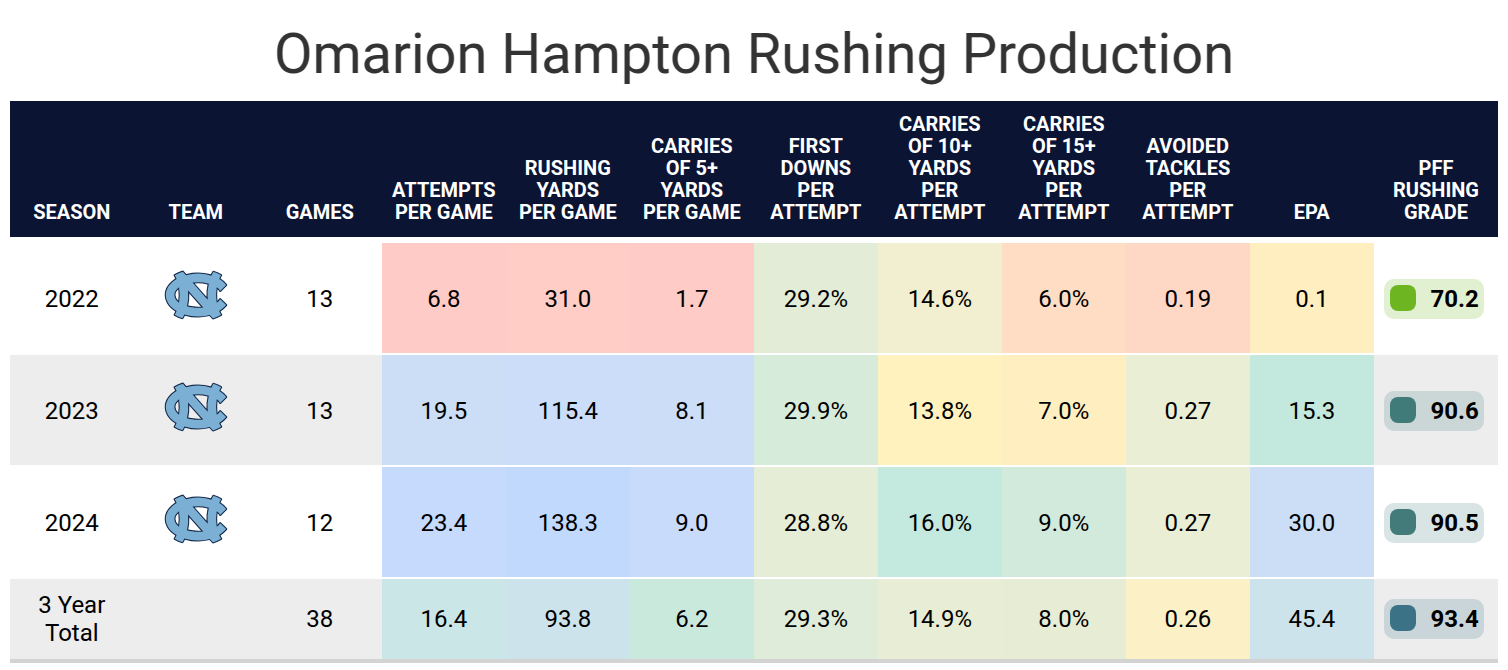
Hampton spent the 2022 season at North Carolina in a five-way committee at running back before taking over as an every-down back for the next two years. His volume improved each season. While there wasn’t significant growth in his rushing production between 2023 and 2024 — outside of a few longer runs that boosted his volume stats and EPA — he became more explosive as a receiver out of the backfield, even though his PFF receiving grade did not notably improve. Hampton ranks among the top 10 FBS running backs over the past eight seasons in average max speed, according to PFF's tracking data, with only Breece Hall and Keaton Mitchell clocking faster among current NFL backs.
As a runner, Hampton was elite in most situations. The one area where he was less consistent was on gap run concepts. He earned a 92.0 PFF rushing grade on zone runs compared to an 84.5 grade on gap runs. As noted in PFF’s draft guide, “Hampton can get impatient and get north before it is necessary,” which likely impacted his performance on man-blocking plays.
Hampton’s receiving metrics were generally strong over the past two seasons. He is more experienced as a receiver than most running backs who were projected to be selected on the first or second day of the draft. His combination of speed and tackle avoidance could make him an even better receiver in the NFL than he was in college.
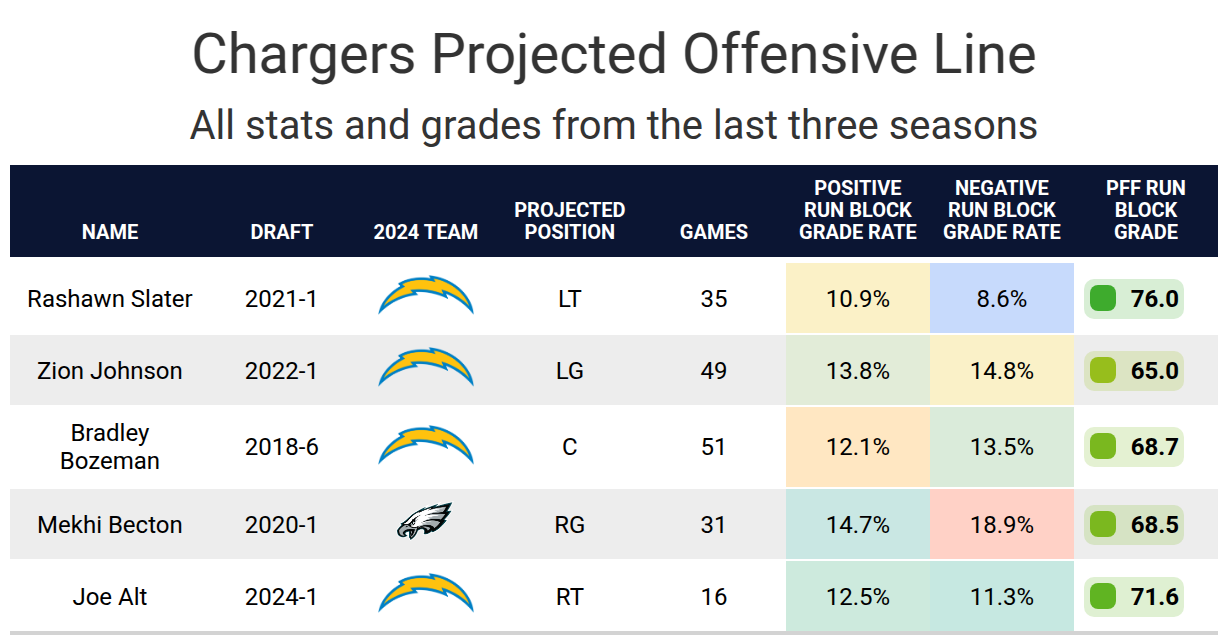
Hampton will be playing behind an offensive line that Los Angeles has heavily invested in through recent drafts. The team also added Mekhi Becton in free agency. While the unit does not feature any elite run blockers, it also lacks any clear liabilities. Both Rashawn Slater and Zion Johnson posted higher PFF run-blocking grades in 2022 than in 2023 or 2024. Although Slater is lost for the year to injury, Johnson will ideally return to his earlier form. Overall, the offensive line should not be viewed as a major asset or a significant concern.
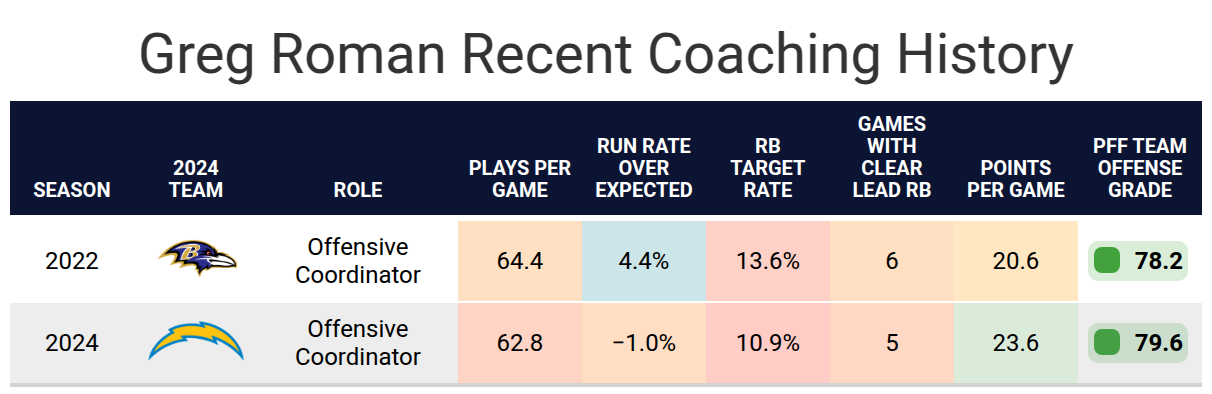
Hampton is paired with offensive coordinator Greg Roman, which presents a somewhat unusual fit. Roman has typically relied heavily on man-blocking schemes throughout his career, while Hampton has been more effective on zone runs. Najee Harris also performs better in zone schemes than on gap runs. Notably, the Chargers’ offensive line ranked 11th on zone runs last season, compared to 16th on gap runs. This suggests that there is a chance Roman and the Chargers will adjust their offensive philosophy to better suit their personnel.
Roman has generally led run-first offenses, with last season being an exception, likely driven by the quality of the running back room. After investing heavily in the position this offseason, the Chargers are expected to return to a more run-heavy approach.
The primary concern is Roman’s historical underemphasis on targeting running backs in the passing game. For example, Justice Hill averaged less than five receiving yards per game under Roman but posted 13 and 25 receiving yards per game in the two years following Roman’s departure. Regardless of the snap split between Harris and Hampton, expectations for Hampton’s target volume should be tempered.
Hampton should be viewed as one of the top rookie running backs from the past few seasons and as the lead back on a run-heavy team. The fact that Harris has missed nearly all of training camp should only help Hampton’s odds of a strong start to the season. The more the Chargers tailor their offense to fit Hampton’s strengths, the better his outlook will be.
Kenneth Walker III, Seattle Seahawks (ADP: 4.07)
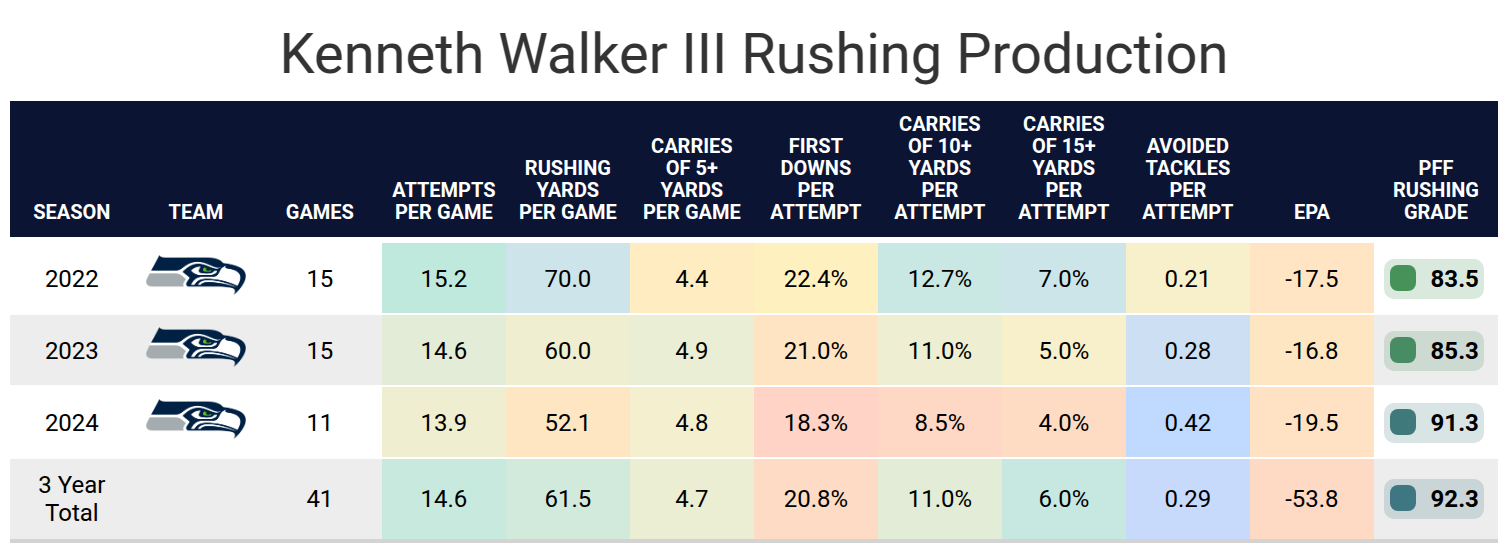
The Seahawks selected Walker 41st overall in the 2022 NFL Draft. After spending his first month as a backup, he took over as Seattle’s starter in Week 6 and has held the role ever since. Across his career, he’s delivered stretches of elite fantasy production but has also been hampered by injuries.
As a rookie, Walker averaged 19.7 PPR points per game across his first six career starts before an ankle sprain slowed him down. He missed one game and struggled in his return but still closed the year with three 100-yard performances. In 2023, Walker again started strong, averaging 17.4 points per game through six weeks, only to see his snaps and effectiveness decline due to injuries. He didn’t play 60% of Seattle’s offensive snaps again that season. The 2024 campaign followed a similar pattern: 22.3 points per game through five weeks, followed by missed time and diminished production as injuries piled up.
Walker’s inconsistency has been tied to his health and Seattle’s bottom-10 offensive line, but his flashes of dominance are undeniable. His 0.42 avoided tackles per attempt in 2024 was the highest mark in PFF’s 19-year database (minimum 50 carries). For context, the next-best mark by a player with at least 150 carries is 0.31, shared by Marshawn Lynch (2014) and Nick Chubb (2020). Over the past two seasons, Walker has also earned a play-level grade of +1 or better at the third-highest rate among all running backs, trailing only Jahmyr Gibbs and Derrick Henry.
In addition, Walker’s role in the passing game expanded in 2024, with increases in both routes run per game and targets per route run. His PFF receiving grade over the past two years ranks ninth among backs with at least 400 routes.
Klint Kubiak joins the Seahawks as their new offensive coordinator after spending five seasons in similar roles across five different teams. In three of his past four stops — including both of his previous stints as an offensive coordinator — his offenses produced a top-12 fantasy running back. That list includes Alvin Kamara (fifth in fantasy points per game last season) and Christian McCaffrey (first in 2023). A common thread in Kubiak’s schemes has been a heavy emphasis on the run game and running back involvement in the passing attack. His offenses have also ranked in the top seven in zone concept frequency at all four stops, suggesting Seattle will shift back to primarily zone runs in 2025 after leaning more on gap concepts last season. That shift could benefit Walker, who has historically been more effective on zone runs.
In his introductory press conference, Kubiak emphasized the importance of building the offense around the run game and specifically cited Walker as their best back, saying they’d “get him the ball any way we can.” Seattle also plans to convert two tight ends into fullbacks, further signaling a commitment to the ground game.
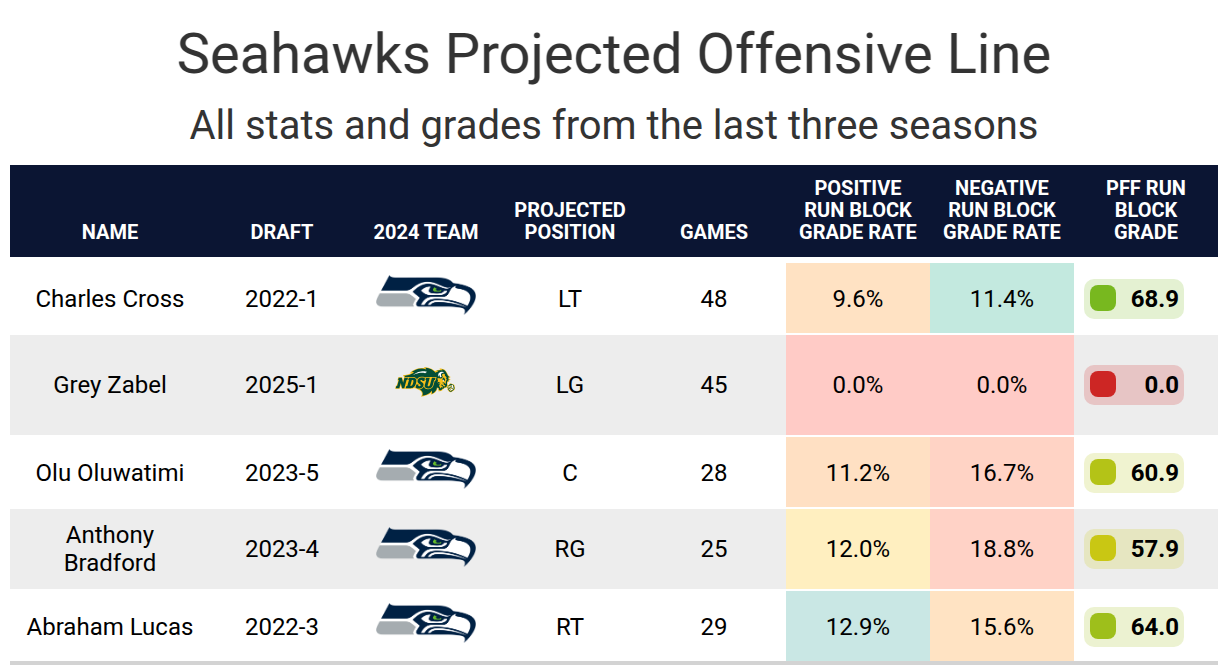
One consistent issue for Walker has been Seattle’s offensive line, which regressed from an average unit in his first two seasons to a bottom-10 group in 2024. However, there’s reason for optimism. Charles Cross took a major leap forward last year, earning a 77.9 PFF run-blocking grade and an 81.3 PFF pass-blocking grade, establishing himself as one of the league’s best young left tackles. The Seahawks also spent a first-round pick on guard Grey Zabel, who posted an 86.4 PFF run-blocking grade in his final season at North Dakota State and should provide an immediate upgrade.
The remaining three projected starters are recent mid-round picks. Injuries played a large role in last year’s struggles — Cross and Laken Tomlinson were the only linemen to log at least 11 starts. The starting five graded significantly better than their backups, so with improved health and natural development, this group has a chance to rebound to league-average or better in 2025.
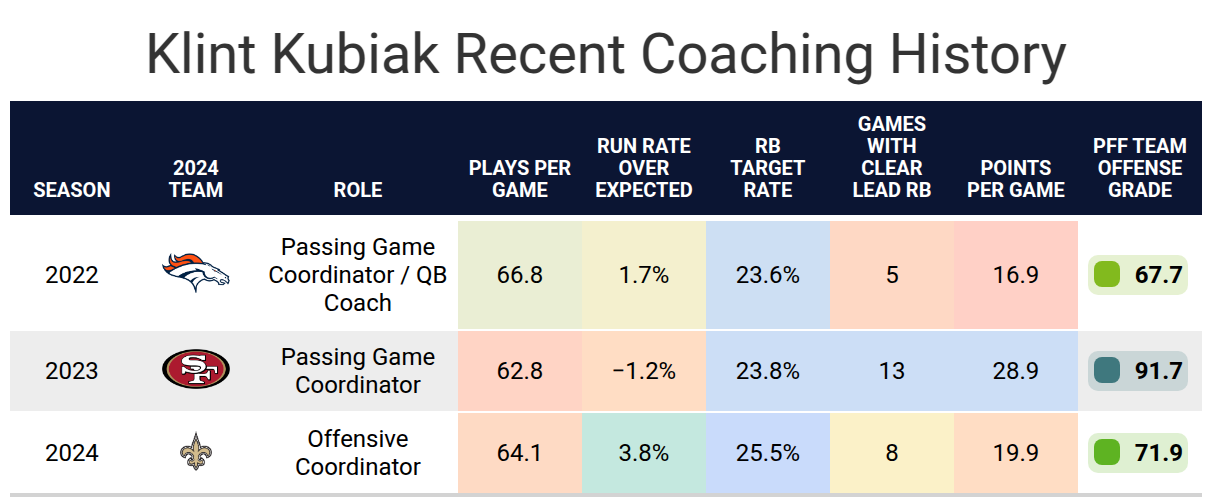
Walker finished 12th among running backs in fantasy points per game last season, showcasing the talent that makes him one of the league’s most explosive backs. With Klint Kubiak’s run-focused scheme and improved offensive line play, Walker has the upside to crack the top eight in 2025. However, durability concerns and Seattle’s still-unproven line remain potential hurdles that could limit his consistency over a full season.

 © 2026 PFF - all rights reserved.