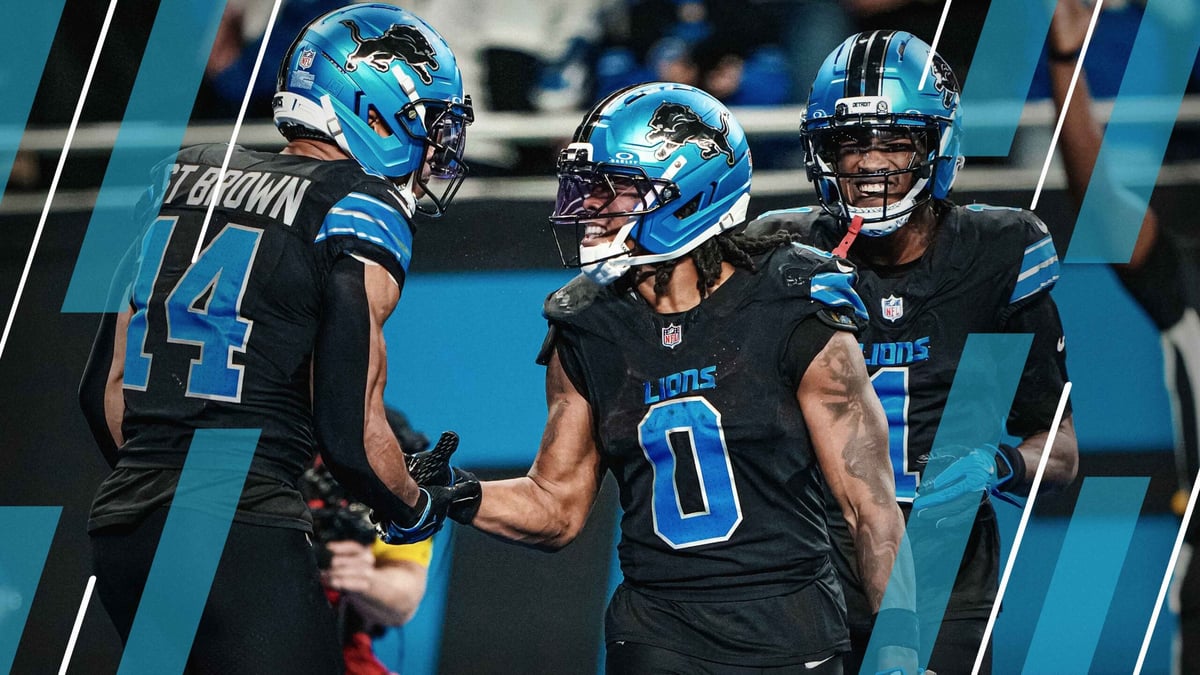
- Good luck guarding the Lions: Detroit boasts Amon-Ra St. Brown, Jameson Williams, Jahmyr Gibbs and Sam LaPorta.
- The Eagles come in the top 10: Even without A.J. Brown, Philadelphia has a high-upside and deep pass-catching room.
- Dallas ranks second: CeeDee Lamb and George Pickens give the Cowboys a high-end receiving duo, with Jake Ferguson providing another end-zone threat.

Every NFL passing offense has its own nuance. Some teams rely heavily on one elite wide receiver, while others share targets, including to tight ends or pass-catching running backs.
We’re ranking all 32 receiving corps entering the 2026 NFL season, evaluating the complete collection of pass-catchers each offense has at its disposal.
1. Detroit Lions
The only offense in the league to boast both a wide receiver and a running back with PFF receiving grades above 90.0 last season, this unit is rightfully awarded the top spot. Amon-Ra St. Brown is one of the most well-rounded receivers in football, while Jameson Williams brings both downfield and cross-field elements few players can match. Jahmyr Gibbs has a case for being the most dangerous receiving back in the league. Don’t forget about Sam LaPorta either, who has hauled in a staggering 72% of his career contested targets; nobody else near his level of contested volume comes close to this success rate. The Lions are also expecting big things from second-year player Isaac TeSlaa, who caught six touchdowns as a rookie and didn’t drop a pass, albeit in limited play time.
2. Dallas Cowboys
CeeDee Lamb is yet to rediscover his elite production from 2022 and 2023, but he’s still playing like a well-above-average starting receiver. George Pickens is fresh off a career year, and if the pair can click simultaneously in 2026, Dallas could propel to the top spot on this list. Jake Ferguson presents the team with an additional end-zone threat after collecting eight touchdowns last season. One of the only critiques of this unit is that no two pass-catchers have fumbled the ball more than Pickens or Ferguson over the last three seasons, with 16 collectively.
3. Cincinnati Bengals
The recent numbers may suggest there are better receiving duos, but Ja’Marr Chase and Tee Higgins still form a partnership worthy of Cincinnati’s inclusion among the league’s elite. Chase leads the NFL in both receiving yards and touchdowns since entering the NFL, while Higgins posted a career-high 114.7 passer rating when targeted last season. The lack of proven depth behind this pair is the obvious knock on this unit. Also, running back Chase Brown’s PFF receiving grades have worsened over each of his three NFL seasons.
4. Seattle Seahawks
Jaxon Smith-Njigba was the breakout star of last season, but his six lowest-graded games all came after Week 13. This unit loses Kenneth Walker’s average receiving presence, but returns veteran Cooper Kupp, Rashid Shaheed and tight end AJ Barner. Shaheed has long been regarded as a deep threat, but he has grown into a reliable target too. His 1.2% drop rate is the lowest of any player with at least 120 receptions since 2023.
5. Minnesota Vikings
Many fans still consider Justin Jefferson the best receiver in the sport, and he will be hungrier than ever to make right on a very uncharacteristic down year in which issues at quarterback largely contributed to his lack of success. Jordan Addison is still only 24 years old, but his play really fell off toward the latter stages of last year, with a 57.0 PFF receiving grade from Week 10 onward. The addition of Jauan Jennings helps Minnesota stay ranked inside the top 10. He brings a true possession receiver presence, making 18 contested grabs last year. However, no NFL team got less receiving production from its non-wide receivers last year (1,012 yards).
6. Los Angeles Rams
Puka Nacua has established himself as arguably the best receiver in football, and 33-year-old Davante Adams remains one of the most respected secondary options in the league. This receiving corps led the league by almost any metric last season, including PFF receiving grade. However, the unit’s success in areas like yards and touchdowns can be partially attributed to the outstanding supply it received from Matthew Stafford.
7. Atlanta Falcons
Drake London is one of the league’s few true alpha receivers capable of winning contested catches at a high rate. His 52 catches in traffic since 2023 are tied for the most in the league. Kyle Pitts finished last season with a 91.8 PFF receiving grade over his last six games, so it’s easy to convince yourself this is his year in fantasy football once again. Then there is Bijan Robinson, who is good at everything, and therefore unsurprisingly one of the league’s best receiving backs. His 858 yards after the catch was the most of any offensive weapon last season.
8. Philadelphia Eagles
PFF’s top-ranked receiving corps entering last season now loses A.J. Brown, with Makai Lemon, Hollywood Brown and Dontayvion Wicks brought in as replacements. Whether DeVonta Smith can establish himself as a true WR1 is the central question. Dallas Goedert returns as well. This group has plenty of mouths to feed and will look to be more dynamic in 2026 — its 4.3 yards after the catch per reception last season ranked second-worst in the league.
9. New England Patriots
The additions of A.J. Brown and Romeo Doubs give New England’s receiving corps a significant talent upgrade. TreVeyon Henderson also brings untapped potential as a receiving threat out of the backfield. Hunter Henry is also back following the most productive season of his 10-year career. This is a group with far more proven options than it had a season ago.
10. Jacksonville Jaguars
Jacksonville posted the highest drop rate in the NFL last season (9.6%), which should statistically regress toward the mean. Travis Hunter may not be a major factor in this receiving room, and that is fine given the other options. Brian Thomas Jr. needs to rediscover his 2024 form, while Parker Washington will hope his strong finish to last season carries into 2026. He was the second-highest-graded receiver in the league from December onward.
11. Green Bay Packers
This group was situationally strong last season with the NFL’s highest PFF receiving grade on third down. Its development may hinge on how Tucker Kraft looks coming back from a torn ACL. He was dominant early last year by averaging 10.8 yards after the catch, a full three yards more than the nearest eligible tight end. Christian Watson’s return from injury was seamless, as he recorded an 88.3 PFF receiving grade over the second half of last season. A step forward in production from Matthew Golden would help this room.
12. Denver Broncos
Courtland Sutton and newly acquired Jaylen Waddle bring complementary skill sets that give Denver’s passing game real versatility. The bigger question is whether Troy Franklin or Pat Bryant can emerge as a third option, or if the bulk of Bo Nix’s targets will stay concentrated on his top two receivers. Trust may be running thin elsewhere, as Broncos running backs and tight ends led the league with 22 total drops last season.
13. San Francisco 49ers
Ricky Pearsall’s season-ending injury is a significant blow, but this team doesn’t always need wide threats to find aerial success. San Francisco’s 90.1 PFF receiving grade from running backs and tight ends was by far the highest in the NFL last year. George Kittle remains one of the most complete tight ends in the league, and Christian McCaffrey was the only running back to record 1,000 receiving yards in 2025. The addition of veteran Mike Evans gives this offense a proven outside contributor to help offset the loss of Pearsall.
14. Chicago Bears
Tight end Colston Loveland impressed last season and is ready for an expanded role in Year 2. Luther Burden III’s outlook is also trending upward after a slow start to his rookie campaign. The pieces are here for this group to take a real step this season and display more reliability. Despite coming up in the clutch several times last year, Bears receivers dropped seven targets beyond 20 yards downfield last season, the most of any offense.
15. Arizona Cardinals
The Cardinals’ roster doesn’t do much right, but not many questions can be asked of their passing options. Trey McBride is statistically the best pass-catching tight end in football. Meanwhile, Michael Wilson caught six touchdowns in the last six games of last season, and rookie Jeremiyah Love will bring an additional receiving threat out of the backfield. This squad forced 94 missed tackles on receptions last year, 15 more than any other team. Uncertainty remains over Marvin Harrison Jr.’s long-term prospects.
16. Pittsburgh Steelers
Michael Pittman Jr. and DK Metcalf form a physically imposing combination, though it remains to be seen how well that fits a quarterback in Aaron Rodgers who is less inclined to push the ball vertically. Darnell Washington and Pat Freiermuth return at tight end, while Jaylen Warren delivered the best PFF receiving grade of his career last year (83.6). The Steelers led the NFL in average yards after the catch in 2025 (6.5).
17. Tampa Bay Buccaneers
Losing Mike Evans leaves a significant void, both on the field and in the locker room. Emeka Egbuka steps into a larger role after getting close to a 1,000-yard rookie season, although his 68.5 PFF receiving grade doesn’t even rank among the top 30 rookies of the last five seasons. It’s tough to envision a vintage season from an aging Chris Godwin coming off multiple injuries. Jalen McMillan and Tez Johnson round out a group still finding its identity.
18. Houston Texans
Nico Collins is a legitimate WR1 talent when on the field and healthy. Only Puka Nacua has averaged more yards per route run over the last three seasons. Sophomore receivers Jayden Higgins and Jaylin Noel are both capable of contributing more significant volume, which becomes especially important if Tank Dell is unable to make a full return from his career-threatening injury. This unit had the safest hands in the league last year with just a 3.6% drop rate, but that may have been helped by how shallow its receptions were: Houston was the only offense to amass 2,000 yards on throws within 10 yards of the line of scrimmage in 2025.
19. Los Angeles Chargers
Under Jim Harbaugh, this remains a team built around the run despite having a superb talent at quarterback. Additions like Charlie Kolar and David Njoku will primarily support the ground game, though tight end Oronde Gadsden II already posted 664 yards last season, opening the door for passing out of heavier personnel groupings. Ladd McConkey needs to clear up a lingering hamstring injury if he wants to rekindle the rookie form that saw him compile 1,300 yards two years ago.
20. Buffalo Bills
Despite acquiring DJ Moore, there is not much depth out wide beyond him. The rushing threat posed by James Cook and Josh Allen remains the beating heart of this offense. Josh Palmer and Khalil Shakir round out the receiver room, while a trio of tight ends in Dalton Kincaid, Dawson Knox and Jackson Hawes could lead to some triple tight end sets this season. Kincaid was particularly brilliant, leading all eligible tight ends with 2.7 yards per route run in 2025.
21. Indianapolis Colts
Alec Pierce was one of only two qualifying receivers to average more than 20 yards per reception last year, and now steps into a larger role following the Pittman trade. The big question is whether either he or Josh Downs has the talent ceiling to function as a true WR1, and until that is answered, this group carries lingering doubt. Tyler Warren will continue to dominate when collecting possession in shallow areas. His 487 yards after the catch ranked second among tight ends last year.
22. Carolina Panthers
Tetairoa McMillan has been a major success so far, and Jalen Coker finished last season on a 1,000-yard pace. Beyond those two, there is very little proven talent to speak of in this receiving room. Tight ends Ja’Tavion Sanders and Tommy Tremble have combined for four straight PFF receiving grades in the 50.0s over the last two seasons.
23. New York Giants
This is perhaps a little low for a side with Malik Nabers at its disposal. If he returns back to his best, this group could be propelled into the top half of the league. Darnell Mooney joins after a brutal 443-yard, six-drop season in Atlanta where he was the NFC South’s lowest-graded receiver. Meanwhile, Isaiah Likely adds a useful receiving option at tight end.
24. New York Jets
The Jets owned the lowest PFF receiving grade in the league last season (60.3) and were the only offense to register fewer than 50 explosive passing plays, but they’ve attempted to put things right this offseason. Garrett Wilson looks to assemble a full, healthy season after missing over half of last year’s action. Breece Hall remains one of the league’s more underrated receiving backs. Rookies Omar Cooper Jr. and Kenyon Sadiq add athletic upside to a, dare I say, promising group.
25. Washington Commanders
Luke McCaffrey, Jaylin Lane, Treylon Burks, Dyami Brown and Van Jefferson make for a fairly uninspiring group behind veteran Terry McLaurin, who leads the league in contested catches over the last five years. Third-round pick Antonio Williams could quickly work his way into starting reps if that room struggles to produce. Incoming running back Rachaad White was a proven passing game contributor in Tampa Bay, representing another option that can shoulder the load for Jacory Croskey-Merritt, who caught just nine passes in his rookie season.
26. Baltimore Ravens
This is not a great spot to be in for Baltimore after down years from Rashod Bateman and Mark Andrews, the latter of whom failed to surpass a 75.0 PFF receiving grade for the first time in his career. Zay Flowers remains the clear WR1, and Baltimore will be hopeful that third- and fourth-round picks Ja’Kobi Lane and Elijah Sarratt can provide a spark behind him.
27. New Orleans Saints
With first-round pick Jordyn Tyson expected to miss roughly two months with a hamstring injury, the Saints will once again be heavily reliant on Chris Olave, who has struggled to stay on the field himself. Alvin Kamara reworked his contract to remain in New Orleans, while the addition of Travis Etienne Jr. gives the Saints another option out of the backfield. Juwan Johnson is coming off a career year at tight end. No team produced more contested catches when its quarterback was under pressure last season than the Saints.
28. Kansas City Chiefs
The definition of insanity may be trotting out Xavier Worthy, Rashee Rice and Travis Kelce again in hopes that this group finally clicks the way it is supposed to on paper. The talent is evident, but the on-field results have not matched as of late. Only the Jets posted a lower PFF receiving grade over the second half of last season. One major upgrade comes from the backfield, where Isiah Pacheco’s league-worst 35.6 PFF receiving grade from last season has been swapped for Kenneth Walker’s much more respectable 71.4 receiving grade. Second-year pro Brashard Smith remains a major asset in the passing game here too.
29. Tennessee Titans
Calvin Ridley is the only returning starter in a group that caught the fewest touchdowns of any offense last year. Carnell Tate arrives with high expectations given his lofty draft selection, but the loss of Chig Okonkwo might be felt. Wan'Dale Robinson and Elic Ayomanor round out what is an underwhelming group of weapons. However, bonus points are in order for Tyjae Spears, who forced the most missed tackles on receptions of any running back last year.
30. Cleveland Browns
First-rounder KC Concepcion and second-rounder Denzel Boston should provide a boost here. Veteran Jerry Jeudy is still in the fold, although he tied for the most drops in football last year. Meanwhile, Harold Fannin Jr. looks poised for an even larger target share in his second season after forcing 22 missed tackles last year, second among tight ends behind Trey McBride. Running back Dylan Sampson is another source of optimism following an 80.6 PFF receiving grade in a rookie season which saw him finish third among running backs in yards per route run.
31. Las Vegas Raiders
Brock Bowers was the highest-graded pass-catcher in the red zone last season and is the clear centerpiece of this passing attack. Ashton Jeanty does not carry a reputation as a big receiving producer out of the backfield, and there is very little to speak of at wide receiver. Jalen Nailor, Tre Tucker, Jack Bech and Dont’e Thornton Jr. would struggle to see the field in a number of other offenses around the league.
32. Miami Dolphins
This may be one of the worst wide receiver corps in recent memory on paper, since Miami did not meaningfully address this severe need this offseason. The Dolphins were the only team in football without 500 passing yards against man coverage last year. Tutu Atwell, Jalen Tolbert and Malik Washington sit atop the depth chart. None of these players have ever registered a single-season PFF receiving grade above 75.0, nor have any of them achieved 700 yards in a season. There is a chance for someone to emerge from nowhere, but the outlook here is bleak.


 © 2026 PFF - all rights reserved.