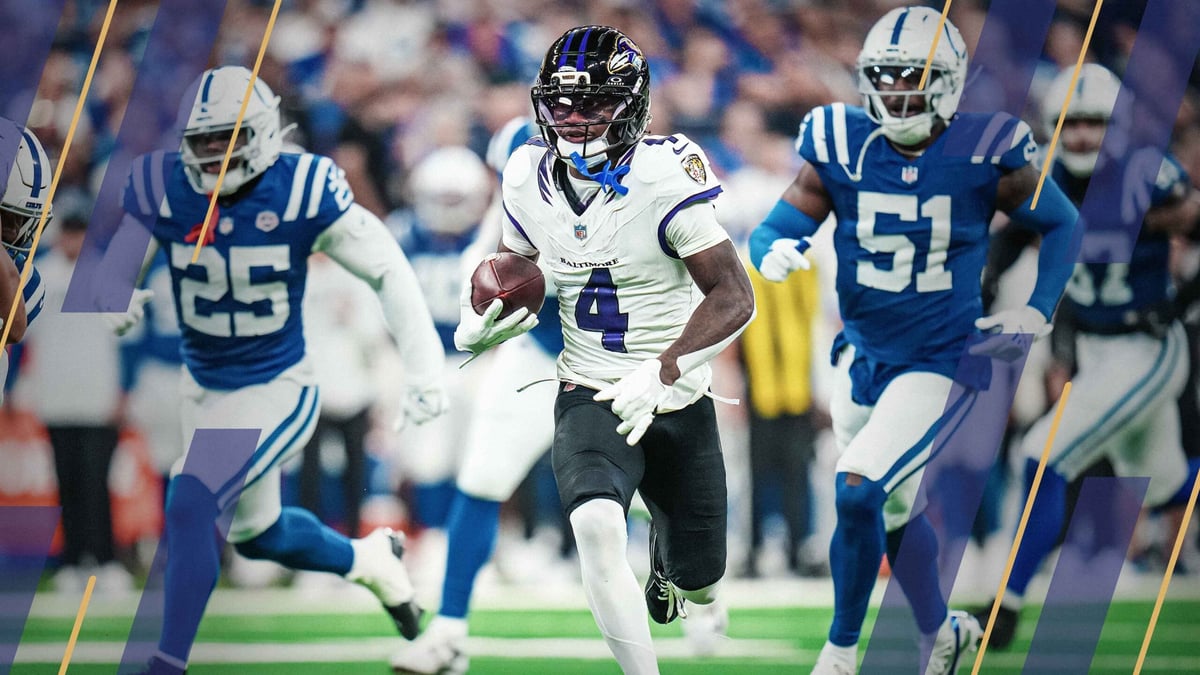
- Zay Flowers dominates before injury: Flowers caught five passes for 150 yards and a touchdown, but saw an early exit due to a hamstring injury.
- The Jacksonville Jaguars‘ passing game dominates: Trevor Lawrence only attempted 23 passes, but he averaged 10.7 yards per pass and threw for four touchdowns.
- Introducing the NEW PFF Pro subscription: PFF Pro includes everything in PFF+, plus an upgraded Premium Stats Pro experience, higher base access to Guru AI, revamped player and team pages, enhanced data and visualizations, an improved interface and programmatic data access for modeling. Click here to subscribe.

PFF's fantasy football recap focuses on player usage and stats, breaking down all the vital information you need to achieve fantasy success in 2026.
For fantasy players looking for additional data and tools, PFF+ provides access to fantasy and betting resources, the Mock Draft Simulator and more for $9.99 per month or $99.99 per year. Those who want to dive even deeper can sign up for PFF Pro, which comes with an upgraded Premium Stats Pro experience, revamped player and team pages, enhanced data and visualizations and programmatic data access for modeling.
Chicago Bears @ Carolina Panthers
Coming soon!
Tampa Bay Buccaneers @ Cincinnati Bengals
First look at the new Buccaneers‘ running back rotation: Bucky Irving remained the lead running back regardless of the situation despite changes over the offseason.
The Buccaneers made a significant change to their backfield this offseason, opting not to re-sign Rachaad White and instead paying Kenny Gainwell much more after his breakout season with the Pittsburgh Steelers. Coaches' comments throughout the offseason suggested Irving would remain the starter, but Gainwell would see significant playing time, particularly in passing situations.
Irving led the two-man rotation as expected, but the two were used interchangeably rather than having specific roles. There weren’t any clear patterns, like a rotation by drive. Typically, someone would take the first few plays of the drive, but if a possession extended past three plays, we typically saw both running backs at some point.
In general, Irving was the leader. This suggests that the backfield will be fluid, and if one running back starts greatly outperforming the other, it would be easy for the team to adjust the rotation. Until then, it will be hard to trust Gainwell in the smaller role.
Part of the narrative around Irving was his goal-line opportunities after Sean Tucker consistently played at the goal line last season. Tucker was inactive for this game with a hamstring injury. There were no goal-line snaps for Tampa Bay in this game, so it will be difficult to be too optimistic about Irving until we see more goal-line snaps by the team and with Tucker healthy.
Tampa Bay’s straightforward wide receiver rotation: The Buccaneers moved around their wide receivers relative to last season.
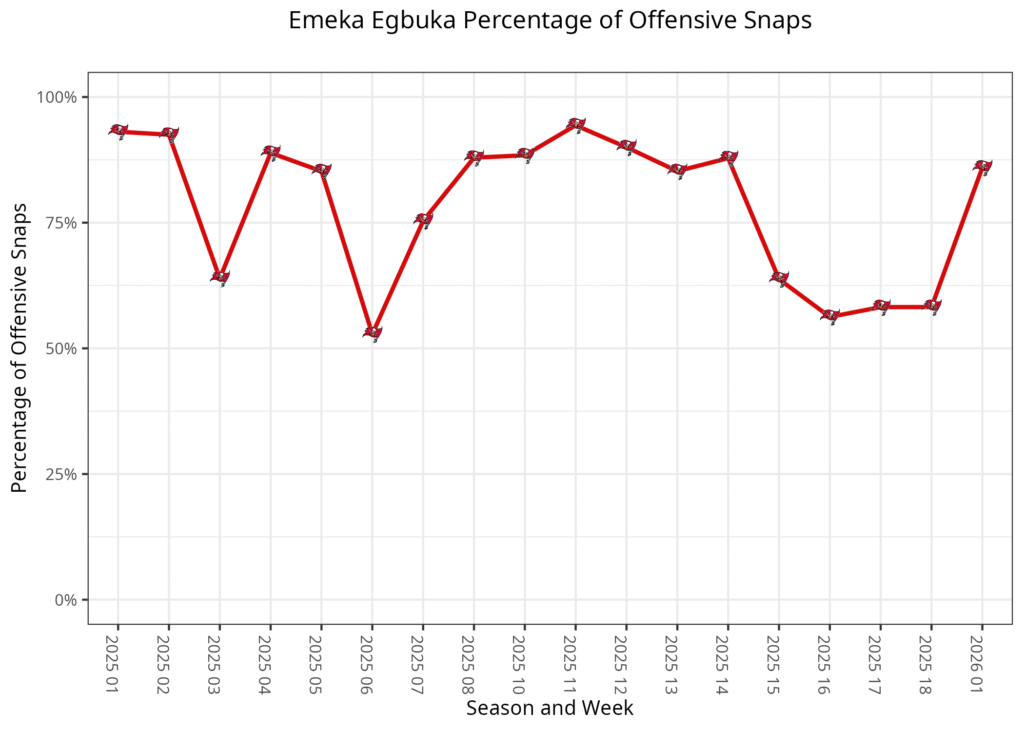
Injuries impacted Tampa Bay’s wide receiver room throughout last season, with Mike Evans, Chris Godwin, Emeka Egbuka, Tez Johnson, Jalen McMillan and Sterling Shepard all receiving significant playing time. Evans and Shepard are no longer with the team, but Tampa Bay added Ted Hurst III in the draft. McMillan was limited in practice with a knee injury. Egbuka was also dealing with a toe injury, but that didn’t impact his playing time in this game.
While Hurst was the rookie and Johnson wasn’t, Hurst was one of the top three receivers. As expected, Hurst was the X receiver in 11 personnel. Egbuka, who primarily played in the slot and X receiver last season, moved to Z receiver, while Godwin remained in the slot. The three of them played over 80% of snaps in 11 personnel. In 12 personnel, it was a four-man rotation, with all four playing between 4-to-6 snaps out of 10.
Egbuka led the team in receiving, with five receptions for 63 yards. It will be difficult to get too excited about the wide receivers until we know how McMillan impacts the wide receiver rotation, but for now, Egbuka is off to a fine start.
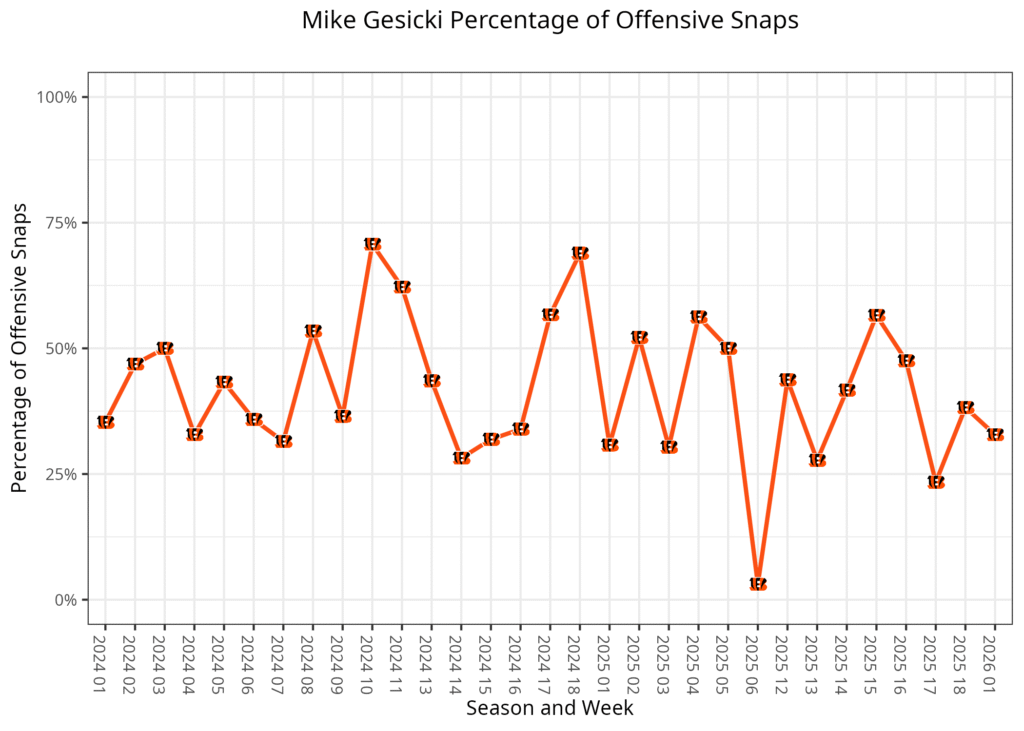
Mike Gesicki shines in Erick All Jr.’s return: While All is the tight end several were excited about heading into the season, Gesicki caught five passes for 78 yards and a touchdown.
The Bengals' biggest addition on offense this offseason was the return of All, who missed half of 2024 and all of 2025 with an ACL tear. While All is a talented tight end, his path to being fantasy-relevant has been blocked by his role in Cincinnati. Drew Sample receives significant playing time for his blocking, while Gesicki plays in the most obvious passing situations.
All was the main receiving tight end on early downs when he was healthy. Noah Fant took that role last season before leaving in free agency. Based on All’s one preseason game, we expected him to have that responsibility again. A tight end needs a receiving role on both early downs and the obvious passing situations to be fantasy-relevant.
The Bengals largely continued their typical rotation, where Sample was the primary tight end in 11 personnel on early downs. Sample also took several of the 11 personnel snaps on third downs for his blocking. Sample was consistently on the field in 12 personnel, while Gesicki and All split snaps in those situations.
If anything, Gesicki received less playing time than his usual game from last season, particularly in 11 personnel, but his target rate skyrocketed to 41.2% targets per route. Last season, his rate was 18%, with a few spike games in the 30s but under 20% in half of his games.
Gesicki will probably be a popular waiver target for those who just look at the box score, but his play is unsustainable in this role. It also means All won’t be fantasy-relevant anytime soon.
Miscellaneous Notes
- Cincinnati running back Chase Brown received very similar usage to last season, although he played 100% of the two-minute snaps. Brown only reached 100% of two-minute snaps once last season, and that was a game where Samaje Perine was inactive. This suggests a slight increase in playing time for Brown this season.
- The Bengals elevated Tanner Hudson off the practice squad for this game, while they made backup Jack Endries a healthy inactive.
- Cincinnati made Ke’Shawn Williams inactive, leaving the team with only five wide receivers. Former Canadian Football League player Dohnte Meyers and fourth-round rookie Colbie Young were the available backups. Meyers was typically a slot receiver while he was on the field, while Young was usually an outside receiver.
- The Buccaneers elevated running back Josh Williams from the practice squad for this game. He took the place of Sean Tucker, who was inactive with a hamstring injury.
- Cade Otton remains a favorite to lead all tight ends in offensive snaps, as in recent seasons. He played all but one snap, with Bauer Sharp taking one snap from him.
New Orleans Saints @ Detroit Lions
Coming soon!
Buffalo Bills @ Houston Texans
Coming soon!
Baltimore Ravens @ Indianapolis Colts
Monitor Zay Flowers‘ and Ja’Kobi Lane’s health: Flowers' hamstring was bothering him in the first half, while Lane was ruled out by the third quarter with a wrist injury.
Baltimore kept its top two wide receivers from last season in Flowers and Rashod Bateman. The team spent two mid-round picks on rookies, including Lane and Elijah Sarratt. They joined other recent picks Devontez Walker and LaJohntay Wester as the backups. Through the preseason, it became clear Lane was the third option.
The Ravens elevated wide receiver Chris Moore to the practice squad for this game. He was insurance for Walker, who was out with a groin injury. Sarratt was a healthy inactive. Based on Sarratt's preseason usage, he ranked below players like Moore on the depth chart, but Sarratt stayed on the roster because of the investment made in him.
The Ravens started the game with Flowers, Bateman and Lane in 11 personnel; Flowers and Bateman in 12 personnel; and a rotation between Bateman and Lane in 13 personnel. When Flowers left the game, Moore took over in 12 personnel, and Wester in 11. Once Lane exited, Moore also started playing in 11.
While Bateman was held without a catch, he is likely the best waiver target if some of these wide receivers miss time. He is the only one assured of a role, as it’s possible Sarratt or Walker would cut into the playing time of Moore or Wester.
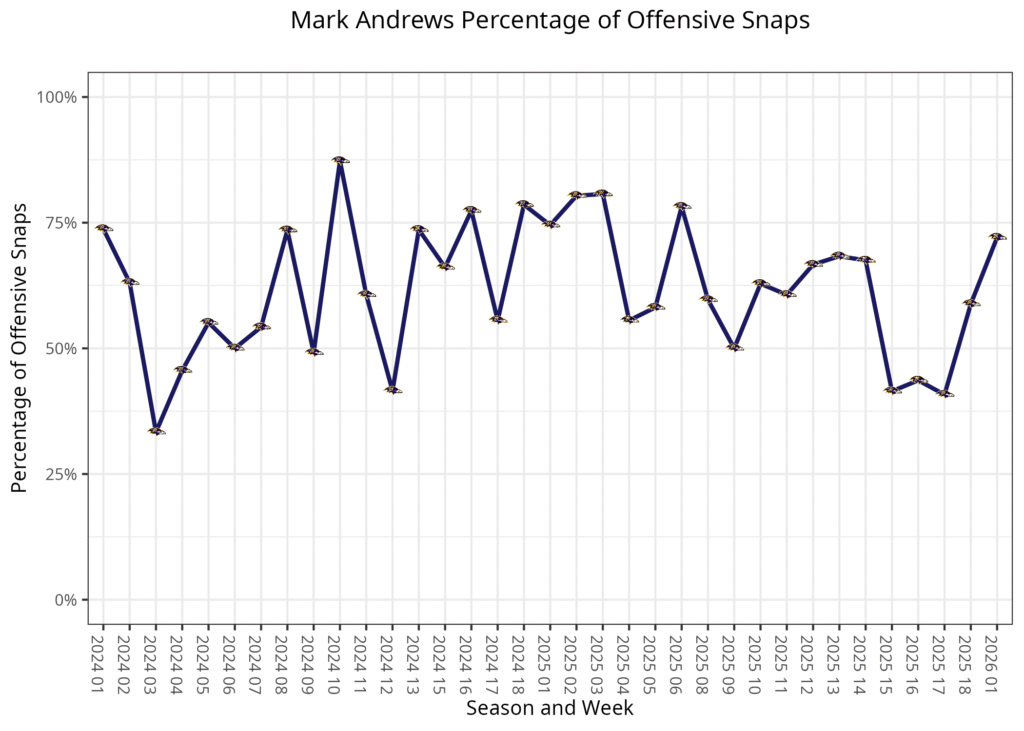
Mark Andrews takes a larger role: The Ravens lost two of their top three tight ends from last season, which is good news for Andrews’ fantasy value.
In 2021, Andrews was the top overall tight end in fantasy football, with 17.7 points per game. Andrews played 75.4% of offensive snaps that season. He was also top-five in 2022, but since then, his playing time has declined while competing for snaps with Isaiah Likely and Charlie Kolar. Andrews played 62.2% of snaps last season, but was often under 60% when everyone was healthy. Likely and Kolar left for large deals in free agency to be the top tight ends for their new team. They were replaced by run-blocking tight end Durham Smythe and rookies Matt Hibner and Josh Cuevas.
Andrews was used more consistently in single-tight-end sets. On early downs, he played two-thirds of them after seeing 52.7% last season. On third downs, he was at 100% compared to 64% last year. His two-tight-end sets stayed consistent at around 65%. Smythe played all of the 12 personnel snaps and was typically the person to replace him on early downs.
The Ravens also jumped on the 13 personnel bandwagon, using it 12 times after implementing it only 56 times last season. Andrews' total snap rate wasn’t as high as in some other games, but that was partially because the Ravens had a solid lead by halftime. In closer games, Andrews' snap rate will be even higher.
Most importantly, Andrews ran a route on 80% of the Ravens' pass plays, up from 63.5% from last season. His target rate was also elevated a little bit, leading to four receptions for 49 yards. This makes Andrews a potential fantasy starter over the rest of the season. Most of the Ravens' touchdowns were on the ground in this game, but Andrews typically catches a high rate of touchdowns. A high touchdown rate with an elevated floor than other seasons should make anyone who drafted Andrews happy.
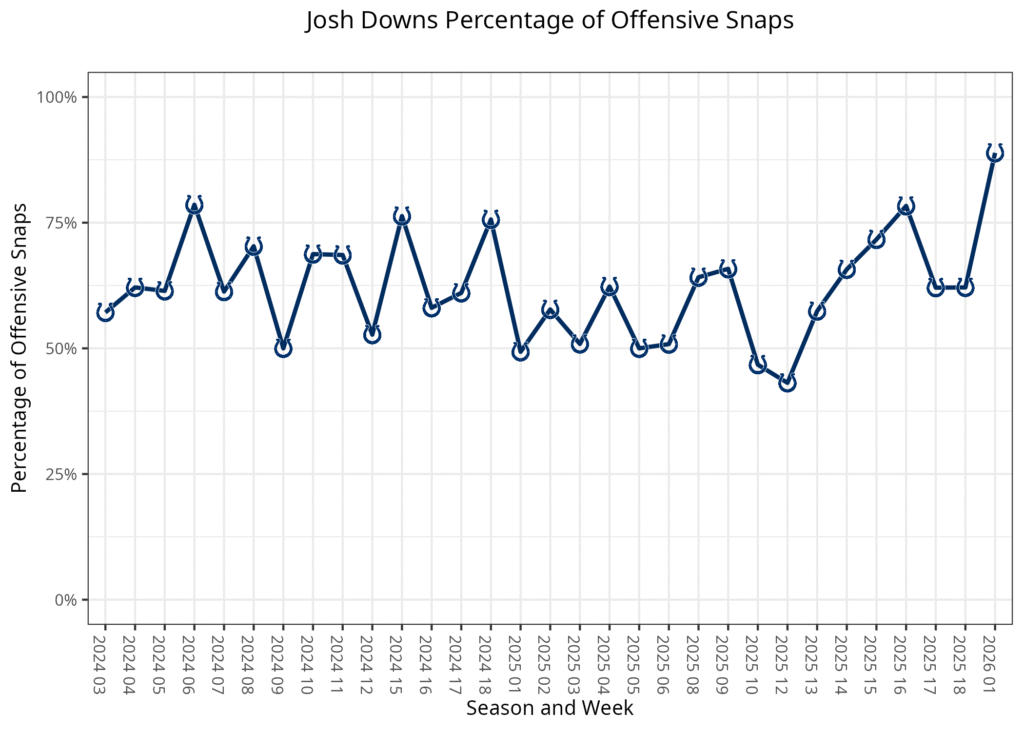
Josh Downs takes a full-time role: Downs played 10 of 11 snaps in 12 personnel after rarely playing in two-receiver sets in past seasons.
The talk of the offseason for the Indianapolis Colts was their wide receiver room. Michael Pittman Jr. was traded to the Indianapolis Colts. Alec Pierce signed a new long-term deal, but spent most of the offseason on the PUP list. He was still limited throughout this week with a heel injury, but wasn’t given an injury designation. Downs was expected to have a larger role with Pittman gone, but that came into question when the team added veteran Keenan Allen, who has a history with head coach Shane Steichen.
Pierce split snaps with Laquon Treadwell at X receiver. There were reports before the game that Pierce would be eased into action after missing so much time this summer. Despite this, Pierce led the team in receptions. Downs was the other player in 12 personnel. In 11 personnel, Downs moved to the slot while Allen played the Z receiver role, very similar to what Allen did with the Los Angeles Chargers last season.
Downs only caught two passes for 37 yards, while Allen caught six for 32. Downs should be considered a buy-low candidate. He had a low targets-per-route rate at 12.5%, but that should increase at least a little bit. The Colts will also run more than 54 plays in most games.
Miscellaneous Notes
- While the Ravens have a new coaching staff, their running back rotation was very similar to the last two seasons when Justice Hill was healthy. Henry took over two-thirds of the early-down snaps and took the goal-line snaps, while Hill played 100% of the obvious passing situations, including third downs and the two-minute drill.
- DJ Giddens was a healthy inactive for the Colts. This made Seth McGowan the primary backup. The rookie played six snaps in his debut, with four of them coming during two-minute drills.
- Tyler Warren played 92.6% of snaps after averaging 84% last season. While part of the reason for his high snap rate may have been the Colts only running 54 plays, this suggests a slight increase in snaps relative to last season.
Cleveland Browns @ Jacksonville Jaguars
Monitor Dylan Sampson’s health: The Browns' backup running back left in the first quarter and was ruled out early in the second.
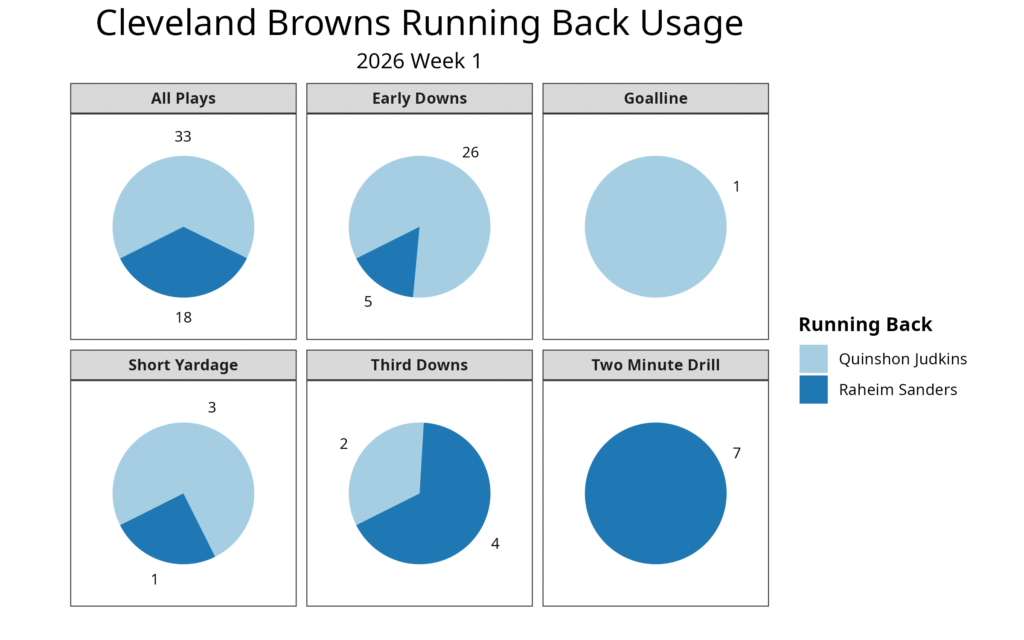
The Browns had a three-man running back rotation last season, with Quinshon Judkins as the early-down back, Jerome Ford as the third-down back and Sampson as the backup in all situations. Cleveland opted not to re-sign Ford and instead move Raheim Sanders up the depth chart. That presumably meant more opportunities for both Judkins and Sampson.
Sampson was one of the two primary returners and suffered the knee injury on special teams before having an opportunity to play on offense. This left Judkins and Sanders as the two running backs for the entire game.
Judkins played notably more on normal early downs compared to his baseline last season. He averaged 61.1% of early-down snaps last season, and that was up to 83.8% in this game. He rarely played on third downs or in the two-minute drill last season, and that remained true in this game, with Sanders taking those situations. In an ideal world, Judkins would be playing in two-minute drills
While it would have been nice to see Judkins playing more in passing situations, it was good to see his snaps increase relative to last season. However, the Browns offense will continue to hold him back. He received 14 touches, but the game script prevented them from sticking with Judkins as they did early in the game.
Cleveland leans on rookies at wide receiver: Boston and Concepcion finished first and second on the team in receiving yards, respectively.
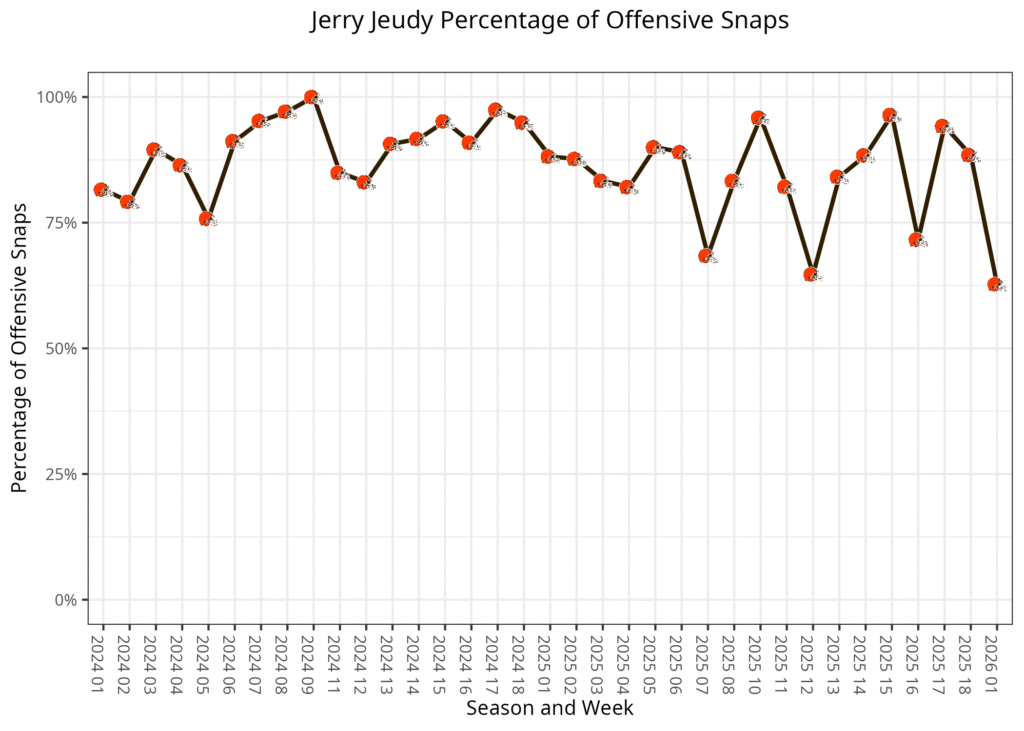
The Browns' wide receiver room was one of their bigger problems last season, leading the team to draft KC Concepcion Jr. and Denzel Boston in the first and second rounds. The preseason made it clear they were the starters along with Jerry Jeudy, while Isaiah Bond and Tylan Wallace were the top backups.
Boston played over 90% of snaps in both 11 and 12 personnel, making him the clear leader on the team in snaps. Concepcion played 80.6% of 11 personnel snaps, but just under 50% of 12 personnel, as he generally shared those reps with Jeudy. Jeudy played more than Concepcion in 12 personnel, but less in 11. Wallace was Jeudy’s backup in 11 personnel, while Bond was Concepcion’s backup.
This suggests Boston may be the better fantasy option of the two, as Boston was on the field for a lot more pass plays. His target rate was relatively low, but it wouldn’t be surprising if that increases. It also wouldn’t be shocking if Concepcion eventually overtakes Jeudy completely in 12 personnel, but the target rates are more likely to change in a short period of time. As for Jeudy, his snap rate has decreased too much for him to remain on fantasy rosters in most redraft leagues.
The Jaguars' new running back rotation: There was more bad news than good for Bhayshul Tuten.
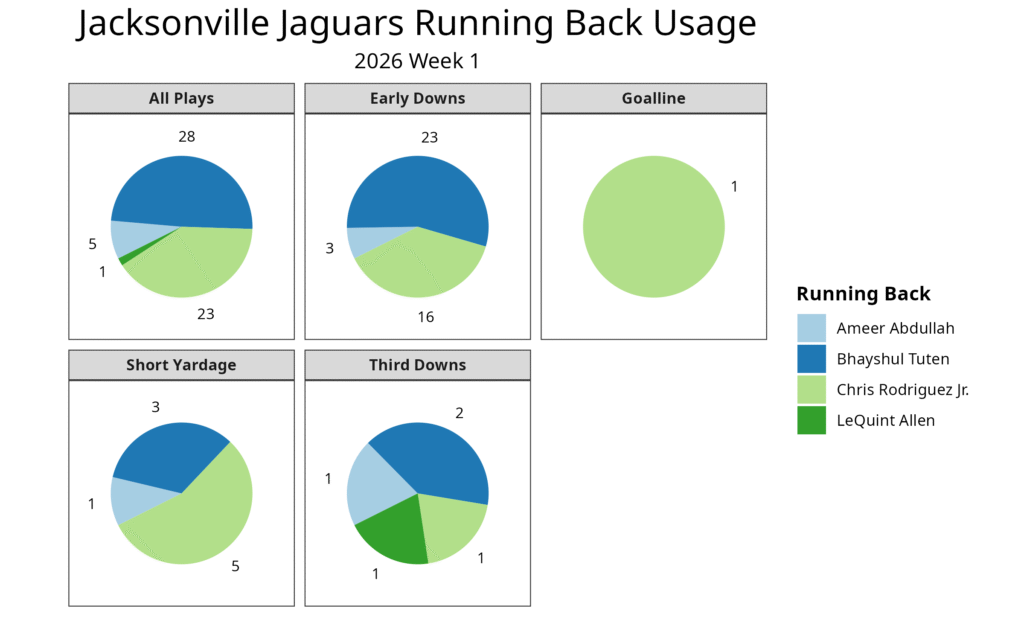
The Jaguars' backfield was among the most discussed in the offseason. Last season, Travis Etienne Jr. was the early down back, Tuten his backup and LeQuint Allen the third-down and two-minute-drill back. Jacksonville didn’t re-sign Etienne, but instead brought in Chris Rodriguez Jr. Neither Tuten nor Rodriguez has a lot of NFL experience, but both have high yards-after-contact-per-carry and first-down rates. Tuten was drafted well ahead of Rodriguez due to his receiving relative to Rodriguez’s, but it was unclear how snaps would be distributed, both on early downs and at the goal line.
The first piece of good news for Tuten is he played more third-down snaps than anyone else. This might stick, but it’s worth noting Allen didn’t practice on Wednesday and was limited on Thursday and Friday with a hip injury. He was listed as questionable. It was good to see that Ameer Abdullah didn’t take the third-down snaps. Tuten also led the team in rushing production at 15 carries for 66 yards, but it is worth noting four of those were in the fourth quarter with Nick Mullens at quarterback.
The bad news is that Chris Rodriguez took the only goal-line snap. He also received most of the short-yardage snaps and a very high percentage of the early-down snaps. The Jaguars also won’t be blowing out opponents this much every week, so Trevor Lawrence will be throwing more than 23 times in most games.
Tuten could be a sell-high candidate for anyone who just looked at this total rushing attempts and isn’t taking into account the context for how he got those carries.
The Jaguars' new-look wide receiver room: The Jaguars have a clear top three wide receivers to start the season.
Jacksonville began last year with Brian Thomas Jr., Dyami Brown and Travis Hunter as its top receivers. Parker Washington slowly but surely earned more playing time, and the team traded for Jakobi Meyers after Hunter suffered a season-ending injury. We knew heading into this season that Washington, Thomas and Meyers would be the top wide receivers, but it was unclear how snaps would shake out in 12 personnel and how much the backups would rotate in.
In 11 personnel, the top three receivers all played over 75% of snaps. In 12 personnel, Meyers played 72.7% to 54.5% by Washington. Thomas only played 9.1% in 12 personnel. The Jaguars ran 12 plays out of single-receiver sets, and also deployed seven snaps at the end of the game with only backups. Hunter only played four snaps, all out of 11 personnel.
This rotation left Meyers only running a route on 80% of pass plays, 72% for Washington and 56% for Thomas. This is all notably lower than the end of last season. This shouldn’t be too alarming for Meyers and Washington. The Jaguars had several long drives, including two 14-play series, so it’s understandable the wide receivers would rotate a lot in those situations. The Jaguars also used backups for 20% of their drives. Thomas also left briefly with an injury, which may have impacted his playing time as well. This will be a situation worth monitoring throughout the season.
Miscellaneous Notes
- Browns tight end Harold Fannin Jr. had a very similar role to the end of last season, playing all of the 12 personnel snaps, 90% of the third-down snaps and a clear majority of single-tight end sets on early downs.
- Jaguars tight end Brenton Strange’s snap rate decreased slightly after the addition of Nate Boerkircher, as he only played two-thirds of the snaps out of 12 personnel after playing 80.9% of those snaps last season. However, his route participation numbers were identical to last year.
- The Jaguars elevated quarterback Nick Mullens from the practice squad for this game on Saturday to be the backup quarterback, while Quinn Ewers was inactive despite not appearing on the injury report.
- Jacksonville wide receiver Jakobi Meyers was limited in practice all week with a thumb injury, but wasn’t given an injury designation.
- Jaguars fifth-round rookie tight end Tanner Koziol was a healthy inactive. He may not be active this season unless there is an injury.
Atlanta Falcons @ Pittsburgh Steelers
Coming soon!
New York Jets @ Tennessee Titans
Coming soon!
Arizona Cardinals @ Los Angeles Chargers
Coming soon!
Miami Dolphins @ Las Vegas Raiders
Coming soon!
Green Bay Packers @ Minnesota Vikings
Coming soon!
Washington Commanders @ Philadelphia Eagles
Coming soon!
Dallas Cowboys @ New York Giants
Coming soon!
Table Notes
- Snaps include plays called back due to penalties, including offensive holding or defensive pass interference. The other three stats exclude these plays.
- Targets may differ from official NFL sources. The most likely discrepancy will be from a clear thrown-away pass, where the NFL may assign the target to the nearest receiver while this data will not.
- Carries are only on designed plays. Quarterback scrambles won’t count for the total number of carries in the game.

 © 2026 PFF - all rights reserved.