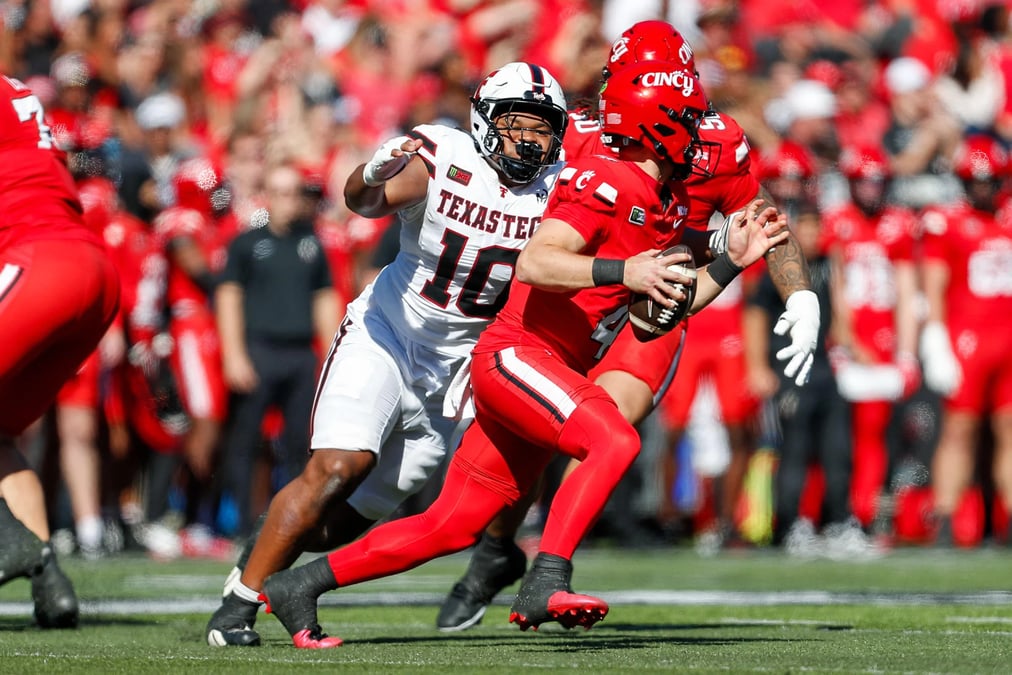
- Trey'Dez Green continues to rise: The LSU tight end caught seven passes for 72 yards and a touchdown against Tennessee, while his drop rate has improved from 12.5% last season to 2.4% this year.
- Darian Mensah's production has declined: The Miami quarterback has earned a 72.1 PFF passing grade over his past three games, down from 92.8 through the first nine weeks.
- A.J. Holmes Jr. strengthens his draft stock: The Texas Tech interior defender recorded two sacks against Baylor, extending his streak of games with at least one sack and four pressures to six.

Despite an unassuming slate of games on paper, Week 12 of the college football season delivered plenty of upsets. Five of the top 17 teams in the latest College Football Playoff rankings suffered defeats on Saturday, setting up an intriguing final weekend of the regular season.
For several of the top prospects in the 2027 NFL Draft, their College Football Playoff hopes came to an end. Most notable among them was Ohio State wide receiver Jeremiah Smith, the No. 1 overall prospect on PFF’s big board, who at least went down fighting with another performance featuring more than 150 receiving yards and multiple touchdown catches.
Smith’s draft stock simply cannot rise any higher at this point, and he remains the clear front-runner for the Heisman Trophy despite the Buckeyes’ shortcomings. Elsewhere, several prospects who will have the opportunity to showcase their talents in December did their draft stock a world of good this weekend.
Stock Up: TE Trey’Dez Green, LSU
While LSU came up short against Tennessee on Saturday, Green’s individual performance was particularly encouraging given how well the Volunteers have defended tight ends this season — allowing just two touchdowns to the position entering Saturday.
Green caught seven passes for 72 yards, including a 26-yard touchdown reception. The 6-foot-7 tight end has been a consistent presence whenever he’s been on the field — his lowest receiving yardage total of the season was a respectable 49 yards against Texas.
Few tight end prospects in recent draft classes have possessed Green’s physical upside. His sheer size and catch radius make him a difficult matchup for opposing defenses in the red zone, but his ability to contribute between the 20s against quality SEC defenses will be of greater interest to NFL evaluators.
Green is becoming a more reliable every-down presence. His mildly concerning 12.5% drop rate from a year ago is down to just 2.4% this season. His production against quality SEC defenses also carries a little more weight than that of other top tight end prospects, such as Virginia Tech’s Luke Reynolds and Texas Tech’s Terrance Carter Jr.
Even in what has been a disappointing year for the Tigers, Green has done plenty to convince NFL teams of his potential to become a focal point of a passing offense at the next level. He’s not quite viewed in the same tier as Kyle Pitts or Colston Loveland were as prospects, but he’s moving up the board.
Stock Down: QB Darian Mensah, Miami (FL)
Miami took care of business against Virginia Tech on Saturday, but it wasn’t an overly convincing outing from Mensah, who threw multiple interceptions in a game for the first time this season.
It’s crucial to note that neither of Mensah’s two interceptions against the Hokies was his fault. His intended receivers were to blame in both instances. The bigger issue was that Mensah averaged just 6.5 yards per attempt in the victory — his second-lowest mark of the season, ahead of only his outing in the loss to Notre Dame.
Mensah’s performance has taken a notable dip in the absence of superstar wide receiver Malachi Toney. His 72.1 PFF passing grade over his past three games pales in comparison to his 92.8 PFF passing grade through the first nine weeks of the season. The matchup with Virginia Tech should have presented an opportunity to rediscover his form.
This quiet stretch shouldn’t undo an entire season of high-quality quarterback play, but Mensah’s lack of high-end playmaking without one of the most dynamic weapons in college football at his disposal doesn’t send the best message to NFL teams near the top of the draft order that lack talent out wide.
As the quarterback of a legitimate championship contender, Mensah will have ample opportunity to rediscover his early-season form against some of the best opposition college football has to offer.
 PFF Premium Stats · 2026 seasonDarian Mensah
See Darian Mensah's full PFF grade profile
Stock Up: DI A.J. Holmes Jr., Texas Tech
We highlighted two interior defensive line prospects on show in this Texas rivalry game in last week’s draft preview, with A.J. Holmes Jr. and Baylor’s Traevon Mitchell both enjoying impressive seasons. It was Holmes who had the better of the two outings on Saturday.
Holmes registered two sacks against the Bears, continuing what has been an excellent run of form for the Texas Tech interior defender. It marked his sixth consecutive game with at least one sack and four pressures. He has climbed to No. 24 on PFF’s big board.
Interior defensive line prospects who can consistently collapse the pocket without being liabilities in the run game are always going to be coveted by NFL teams. Holmes has built a compelling body of work over the past two seasons. His production is becoming difficult to overlook in what is shaping up to be a strong class of interior defenders.
The Red Raiders’ success this season should afford Holmes a few more opportunities to distinguish himself from some of the other interior defenders in this class whose college careers are drawing to a close.
Stock Down: Edge Kenyatta Jackson Jr., Ohio State
Much of the blame for Ohio State’s slide to 7-4 will be attributed to the absence of quarterback Julian Sayin, and rightly so, but Matt Patricia’s defense certainly isn’t absolved of responsibility.
Several of the more experienced players on the Buckeyes’ defense have failed to elevate their play in Sayin’s absence. Ohio State is allowing opposing offenses to convert 42% of their third downs this season, ranking 109th in the FBS.
Jackson was largely anonymous once again against a Nebraska offense that churned out 178 rushing yards on Saturday. Ohio State’s entire defensive line failed to register a sack against the Cornhuskers. Jackson has now gone six consecutive games without earning a PFF pass-rushing grade above 60.0.
Jackson is in his fifth year at Ohio State, and there were indications early this season that he might have found another gear in his development as a pass-rusher. His recent performances have been much more reminiscent of what we saw from him over the previous few seasons. His 11.7% pressure rate this season is actually down from 15.3% a year ago.
There is certainly a place in the NFL for a player with Jackson’s physical profile and experience, but it is difficult to envision much room for further development in his game. For a player who has spent five years developing at one of the premier defensive line factories in college football, his lack of a truly dominant stretch of play is concerning.
Stock Up: WR Jordan Faison, Notre Dame
Faison produced one of the catches of the college football season on Saturday night against SMU, hauling in a 21-yard touchdown pass with one hand. The Notre Dame wideout finished the game with seven receptions for 109 yards.
Faison had done well to get open in the end zone, but an overthrow from quarterback CJ Carr meant he still had plenty of work to do. It was a wonderful exhibition of the catch radius Faison possesses despite being listed at just 5-foot-11 and 185 pounds.
In a draft class littered with big-bodied wideouts, Faison is emerging as one of the more appealing options among the smaller receivers. His refined route-running skills and ability to create after the catch help alleviate some of the reservations NFL teams might have about his size and the extent to which it could limit his utility at the next level.
This was only Faison’s second outing with more than 100 receiving yards this season, although he has now caught a touchdown pass in three consecutive games. His game isn’t entirely without flaws, though. A fumble early in the game while fighting for extra yards cost Notre Dame a possession, following a three-game stretch in which he recorded at least one drop in each contest.
Black Friday! Save 30% on a PFF+ Annual Subscription
Stock Down: WR Ryan Coleman-Williams, Alabama
Alabama rolled over Chattanooga in its annual late-season tuneup game ahead of the Iron Bowl. Coleman-Williams ran just 14 routes in the contest, managing two receptions for 12 yards. Eight Alabama players finished the game with more receiving yards than he did.
Saturday’s outing in isolation is the least of Coleman-Williams’ problems. The overarching concern is that he has now failed to reach 50 receiving yards in all but one game since Week 4. Part of the reason his draft stock has taken a hit is just how productive several of the other wideouts in this class have been.
We mentioned Faison’s impressive outing for Notre Dame, but Arizona State’s Reed Harris also had 172 receiving yards on Saturday, while Wake Forest’s Carlos Hernandez continued his excellent season with another 145 yards. Vanderbilt’s Junior Sherrill went for 149 yards and a touchdown.
Coleman-Williams is now down to WR12 on PFF’s big board, and the idea of him returning to Tuscaloosa for his senior season is becoming increasingly plausible. He is in an unusual position given that he could spend four full seasons developing in college and still enter the NFL at just 21 years of age.
Coleman-Williams has shown up in big spots for Alabama in the past, and there is no questioning the caliber of player he can be at his best. The Iron Bowl would be a particularly good occasion for him to remind NFL teams of that.
Stock Up: Edge Boubacar Traore, Notre Dame
Traore didn’t come away with a sack against SMU on Saturday night, but no other player on the field made his presence felt as frequently as the Notre Dame edge defender.
Lining up against right tackle PJ Williams, one of SMU’s few notable prospects in the 2027 NFL Draft class, Traore was flying around the field against both the run and the pass. He showed how effective he can be on stunts, and his motor as a pass-rusher never seemed to waver, even when the Fighting Irish were protecting a 20-point lead.
Traore put on a clinic in lateral agility and effort when defending the edge. SMU tried to attack the Notre Dame defense horizontally through a variety of concepts, and Traore repeatedly proved capable of sealing off the corner.
He snuffed out outside zone carries and option pitches and even blew up a tunnel screen to his side of the field. He finished with four tackles that resulted in either a loss or no gain. His ability to redirect and close down ball carriers is excellent for a player of his size.
Saturday’s outing was a great example of how disruptive an edge defender can be without bringing down the quarterback or even registering many pressures. Traore is steadily emerging as a candidate to be selected in the top half of the first round.
 NCAACollege Football Scores 2026: Week 12 Results
 NCAACollege Football Week 12: 20 Observations From PFF Data
 NCAACollege Football Team of the Week: Week 12
 Draft2027 NFL Draft Order: Updated First-Round Picks
 SALE!PFF Black Friday Sale: 30% Off PFF+
 NCAACollege Football Week 12 Grades: Top Players at Every Position
 NCAACollege Football Playoff Rankings Week 13
 NCAACollege Football Rankings Week 13: Top 25 | PF

 © 2026 PFF - all rights reserved.