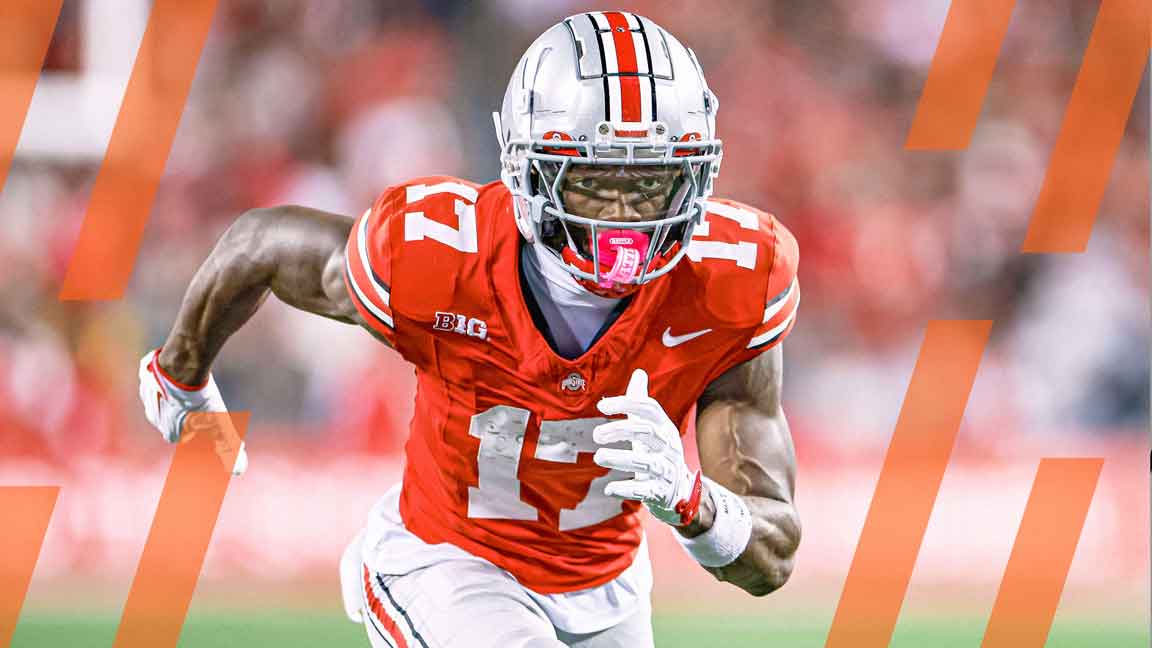
- Carnell Tate is the Tennessee Titans‘ top wide receiver: The last time Brian Daboll had a top-10 rookie wide receiver, that player ranked second among all wide receivers in target rate.
- Tyler Allgeier loses a starting job again: Allgeier spent one season as an NFL starter before first losing a starting job to Bijan Robinson, and then losing one to Jeremiyah Love.
- 2026 NFL Draft season is here: Try the best-in-class PFF Mock Draft Simulator and learn about 2026's top prospects while trading and drafting for your favorite NFL team.
The first day of the 2026 NFL Draft is in the books, and the fantasy football landscape is already shifting. Round 1 featured several key developments, from top rookies landing in strong situations to veterans facing new competition, that will impact draft boards this summer.
Here’s a breakdown of the biggest fantasy winners and losers after Day 1 of the 2026 NFL Draft.
Winner: WR Carnell Tate, Tennessee Titans
Tate was expected to be a top-10 pick, but it was a surprise that the Titans selected him in the top five. The best-case scenario is that he ends up like Ja’Marr Chase or Malik Nabers, both of whom were top-six options at their position in their rookie seasons. Jaylen Waddle, Garrett Wilson and Tetairoa McMillan were other recent top-10 wide receivers who immediately worked out to be fantasy starters.
Tate joins Tennessee, where he should be the Titans’ top outside receiver. Tennessee restructured Calvin Ridley, who will likely be the other outside option, while Wan’Dale Robinson was a notable free-agent addition to line up in the slot. In 2024, Robinson played alongside Malik Nabers as a rookie and ranked second in target rate (29.8%). There is a chance Tate could rank among the top 10 wide receivers in target share as a rookie.
Tate’s fantasy production in his rookie season will largely depend on how much better Cam Ward plays. The two will be tied together for the foreseeable future, but Ward’s 56.4 passing grade last season was the fifth-lowest among those with at least 150 dropbacks.
Winner: WR KC Concepcion, Cleveland Browns
Concepcion started his career as a slot receiver for NC State but was more well-rounded in his alignment at Texas A&M. According to our draft guide, he wins with quickness, allowing him to gain separation. He had a problem with drops throughout college, but that hasn’t been a predictive number heading into the NFL. His player comp was Luther Burden III — someone who can play multiple offensive positions.
He joins Cleveland, which had the biggest need among all teams for a wide receiver. Last season, 10 teams had a team PFF wide receiver receiving grade below 70.0. Seven teams have made one or more moves in free agency to improve their team, and two teams dealt with significant injuries at the position. The one wide receiver room that looks similar to last season is the Browns, and they had the lowest team PFF receiving grade of the group.
Jerry Jeudy, Cedric Tillman, Isaiah Bond, Malachi Corley, Gage Larvadain and Jamari Thrash were the six wide receivers for Cleveland last season, and they remain the top six on the depth chart at the moment. Corley was the only one with a PFF receiving grade above 60.0, at 65.1, but he only caught 11 passes for 789 yards. Jeudy was the only wide receiver with more than 25 receptions, and he caught 50 for 602 yards.
Concepcion has an opportunity to lead the Browns in targets as a rookie, giving Concepcion possibly higher upside in 2026 than some of the wide receivers drafted ahead of him, but less long-term upside, as the Browns will likely invest more at wide receiver in the coming seasons.
Winner: RB Jadarian Price, Seattle Seahawks
Price has emerged as the second-best running back of the class, despite being a backup last season. He has the least collegiate experience among the top-10 running backs of the class, but his 6.0 yards per carry were second-best among the top-20 running backs behind Love. He is tied for the most yards after contact per carry at 4.3.
Where he really stands out is his rate of making big plays. He has both the best rate of runs with a 1.5 grade or better, as well as the highest rate of runs with a 1.0 grade.
His inexperience is a red flag, particularly as a receiver. He has 15 receptions over the last three seasons. His 9% targets per route are by far the lowest among the 20 running backs. However, our draft guide notes his strength and willingness as a pass protector could still make him a three-down back.
Most big boards had Price as a second-round player, but he went higher than expected to the Seahawks. Seattle was the team most in need of a running back after losing Kenneth Walker III in free agency and Zach Charbonnet due to an ACL injury. Price has an opportunity to be an immediate starter for both the Seahawks and fantasy teams. There is a concern Price could get stuck in the Walker role once Charbonnet is healthy, but he might not be fully healthy at any point this season.
Winner: QB Ty Simpson, Los Angeles Rams
Simpson was a surprise pick for Los Angeles, as many expected him to be selected late in the first round or early in the second. He started only 15 games in college, beginning his short career strongly but struggling as the season progressed. Our draft breakdown of Simpson called him a solid starter, and that he ideally would have had another year to improve his decision-making and get a better feel in the pocket.
Luckily, Simpson will have another year, but will need to improve during practice rather than during games. Matthew Stafford was the NFL’s MVP last season and will be the Rams' starter for as long as he is healthy. This means Simpson will need to sit for at least one season. Stafford is 38 years old and may not be in Los Angeles much longer after 2026, especially if Simpson develops.
Luckily, whenever Simpson is the starter, he will be in an excellent situation. Sean McVay is arguably the best coach in the NFL, and the Rams had by far the highest offensive grade among teams last season at 92.0, even when excluding quarterbacks from every team. Simpson would be a borderline fantasy starter in single quarterback leagues once he’s in the starting lineup, and certainly a starter in superflex leagues.
Winner: RB Quinshon Judkins, Cleveland Browns
The first round was full of offensive tackles, all of whom graded well as pass blockers in college. Spencer Fano stands out among the group for his run blocking. He earned a 91.6 PFF run-blocking grade over the past two seasons, while all other first-round linemen graded below 80.0 in that metric. Fano was also the first offensive lineman selected, going ninth overall to the Cleveland Browns.
There were high expectations for Judkins in his rookie season, but he struggled behind the Browns’ offensive line. Judkins ranked last among running backs with at least 100 carries in yards before contact per attempt (0.4). Fano should help increase that figure moving forward.
Loser: RB Tyler Allgeier, Arizona Cardinals
Giants or Washington Commanders. Regardless of the destination, the other running backs on the roster were always likely to be among the biggest losers of Round 1. Love is expected to step in as an every-down back immediately, leaving others in backup roles at best.
In this case, it’s Tyler Allgeier. He went from fifth on the depth chart to a starter as a rookie, lost his job to Bijan Robinson, then landed on a team with a chance to start — only to lose that opportunity again. Arizona also retained James Conner and Trey Benson, although it remains possible one of those players is traded in the coming days.
Loser: WR Jordyn Tyson, New Orleans Saints
Tyson was the second wide receiver selected, and, in general, top-10 wide receivers have significant potential, even in their rookie season. Our draft guide gave Tyson excellent marks in every category outside of his blocking. The biggest concern was his various injuries, but recent reports suggested NFL teams weren’t as worried about them, and that showed in how early he was selected.
He joins the Saints, where he will be the second option across from Chris Olave. Tyson projects as an outside receiver, and that becomes more likely in New Orleans, where Olave plays well in the slot, and third receiver Devaughn Vele is primarily a slot receiver.
While Tyson is very talented and was highly sought after, this was not the best landing spot compared to other teams he could have joined. Most other teams that could have considered a first-round wide receiver had a better offense, had a better quarterback, had a high chance of adding a great quarterback in the 2027 draft, or had minimal competition for targets. Most teams were better than the Saints in two or three of these categories. In Kellen Moore‘s offenses, most wide receivers who find fantasy success are slot receivers. However, those situations could be temporary, and if Tyson plays well enough, he will overcome those challenges.
Loser: WR Omar Cooper Jr., New York Jets
Cooper is a well-balanced receiver with significant experience out of the slot, but should be able to play the Z receiver role for an NFL team. Cooper was the second receiver taken by the Jets on the first day of the draft after taking Kenyon Sadiq 14 picks earlier.
Cooper will likely help the Jets more than he helps fantasy managers, at least early in his rookie season. Both he and Garrett Wilson fill more of a Z/slot role, while Adonai Mitchell is a clear X receiver. New offensive coordinator Frank Reich is used to having a tall X receiver like D.J. Chark, Alec Pierce and Michael Pittman Jr.; however, T.Y. Hilton at 5’10” also filled that role at times in the Colts offense. This makes it questionable if Cooper will play in two-receiver sets. The Jets also appear to be a team that will use a lot of 12 personnel after drafting two tight ends early in the last two seasons.
However, Cooper was the 24th overall player on our big board, and fourth among wide receivers. There have been plenty of situations where a wide receiver appears slated for a lower-than-ideal snap rate, but ends up playing much more than expected. Cooper is still a better bet than any wide receiver selected later than him.
Loser: TE Mason Taylor, New York Jets
Taylor was a second-round pick last season and found some early success, including back-to-back 60-yard games. However, he and the rest of the Jets’ offense struggled over the second half of the season.
Taylor was the consensus TE26 before the draft, placing him on the borderline of being selected in redraft leagues, though he was more highly regarded in dynasty formats at just 21 years old. However, the Jets used a first-round pick on Kenyon Sadiq, a receiving tight end who projects to push Taylor into 12 personnel and other run-first sets. The best scenario for Taylor’s fantasy value is a potential trade.
Loser: WR Denzel Boston
Boston is the one player at a fantasy-relevant position with first-round potential who wasn’t selected. Ideally, he lands early in the second round with a team that has a significant need at wide receiver, but it’s unlikely he will remain a top-10 dynasty rookie pick in superflex leagues after entering the draft as the consensus No. 9 overall option.


 © 2026 PFF - all rights reserved.