
- RJ Harvey starts for the Denver Broncos: Harvey was the Broncos' early down back with the starters in their first preseason game, while J.K. Dobbins was the third-down back.
- Travis Hunter plays 100% of the 11 personnel snaps with the starters: The Jacksonville Jaguars wide receiver and cornerback played significantly with the offense during the first week of the preseason, including several snaps out of the slot.
- Data, tools and expert insights: Use code earlybird to save $20 on your PFF+ annual subscription.
Estimated reading time: 12 minutes

It’s exceptionally rare for a player to be a true “must-draft,” someone who makes sense for your roster no matter your draft strategy or team build. Last year, Rashee Rice fit that mold. Despite being drafted as late as Round 6 on some platforms, he emerged as the WR2 over the first three weeks before his injury.
While no player offers that kind of clear-cut value this early in the offseason, the three names below are ones I’m consistently drafting — even if it means reaching slightly ahead of ADP. They’re the kind of players I’m comfortable selecting regardless of how my roster is shaping up.
Average draft position (ADP) reflects a consensus of ESPN, Sleeper, and Yahoo! rankings for 12-team redraft leagues.
Last updated: Monday, August 18
RB R.J. Harvey, Denver Broncos (ADP: 6.07)
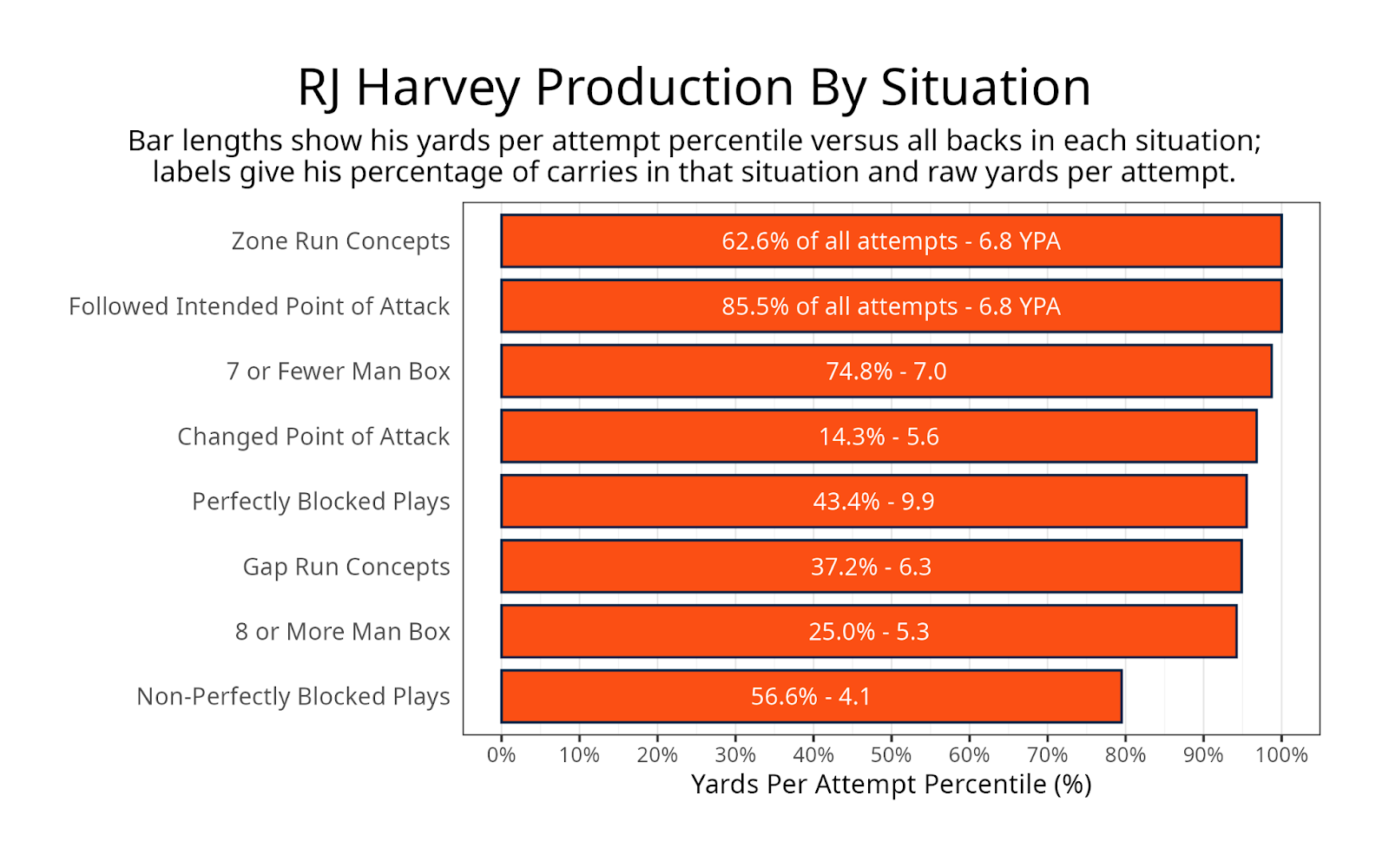
Harvey steadily climbed UCF’s depth chart, going from a non-factor in 2021 to an efficient backup in 2022 before excelling in a lead role across the 2023 and 2024 seasons. His breakout came despite UCF’s jump from the American Athletic Conference (AAC) to the Big 12, where he continued to shine. Harvey earned a 93.4 PFF rushing grade against Power Five opponents over the past three years — higher than Blake Corum, Quinshon Judkins and TreVeyon Henderson, and just behind Cameron Skattebo, Damien Martinez and Bucky Irving.
As a receiver, Harvey’s production was generally strong throughout his college career. His grade dipped slightly in 2024 due to a small sample (31 targets, 22 catches) that included one fumble and two drops, which skewed the numbers.
Our draft guide highlighted Harvey’s impressive elusiveness as a runner and receiver. Lead draft analyst Trevor Sikkema even named Harvey his favorite prospect in the class, praising his unique skill set and compact frame (5-foot-8, 205 pounds). Among recent NFL backs with similar builds, Devonta Freeman carved out the most success, while Darrell Henderson and Michael Carter have also flashed at times.
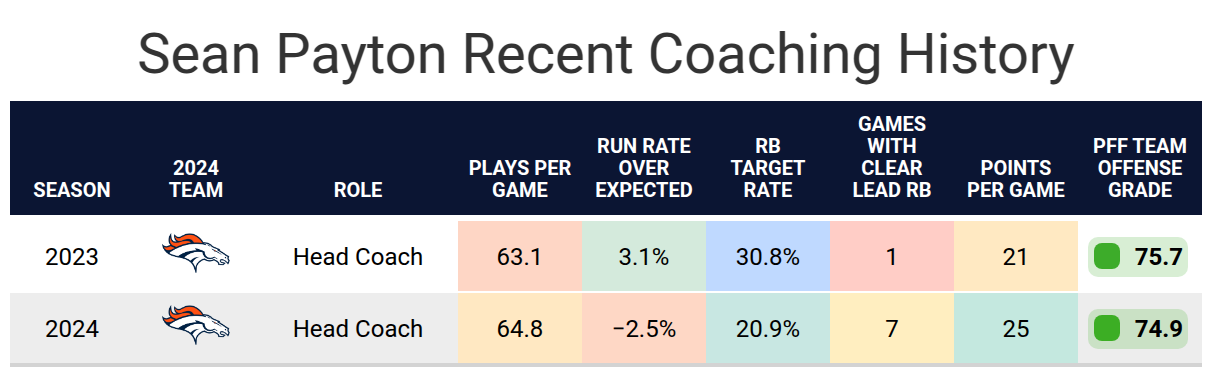
A big reason for optimism with Harvey is his fit in Sean Payton’s offense. Broncos running backs have combined for 214 receptions over the past two seasons — more than any other team in the NFL. Payton’s history with versatile backs in New Orleans is well-documented, where Reggie Bush, Darren Sproles, Pierre Thomas and Alvin Kamara all delivered fantasy relevance, even in split backfields. Kamara is a particularly relevant comparison. Drafted 67th overall (compared to Harvey at 60th), Kamara played just 44.9% of New Orleans’ offensive snaps as a rookie but still finished fourth in fantasy points per game, thanks to 120 carries and 81 receptions.
That said, the Broncos’ backfield has been highly volatile in recent seasons. Predicting which back would lead in carries from week to week was nearly impossible, and Payton’s public comments about player roles often didn’t align with usage. Even preseason rotations proved misleading when it came to final depth chart decisions. While the hope is that Harvey and J.K. Dobbins can stabilize the backfield, there’s no guarantee history won’t repeat itself.
While Payton’s preseason usage hasn’t always led to regular-season usage, Harvey played all but one snap with the starters on first and second downs in the first preseason game, while Dobbins was restricted to playing a third-down role. While we expect a little more rotation for the regular season, this points to Harvey leading the team in carries while catching a lot of passes.
Harvey was arguably the biggest winner among rookie running backs, landing in a situation where his skill set could translate to fantasy stardom. A top-10 finish is within reach if he secures the passing-down role and averages eight or more carries per game. Still, Denver’s backfield has been notoriously volatile in recent years, and there’s a chance that unpredictability continues even with Harvey in the mix.
WR Travis Hunter, Jacksonville Jaguars (ADP: 6.04)
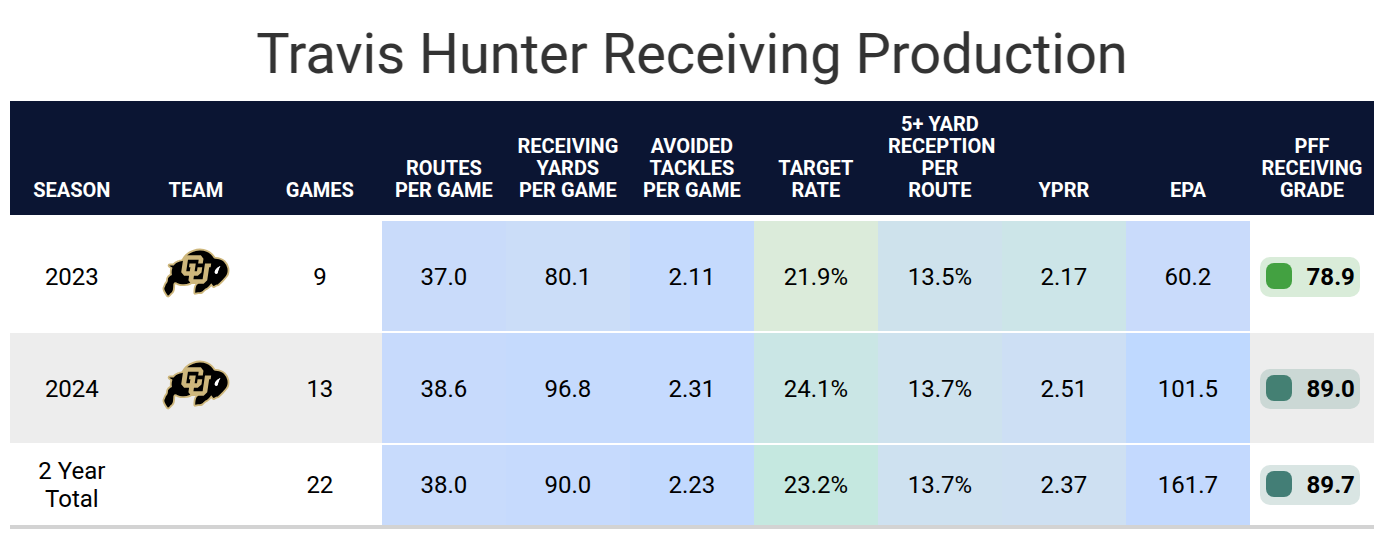
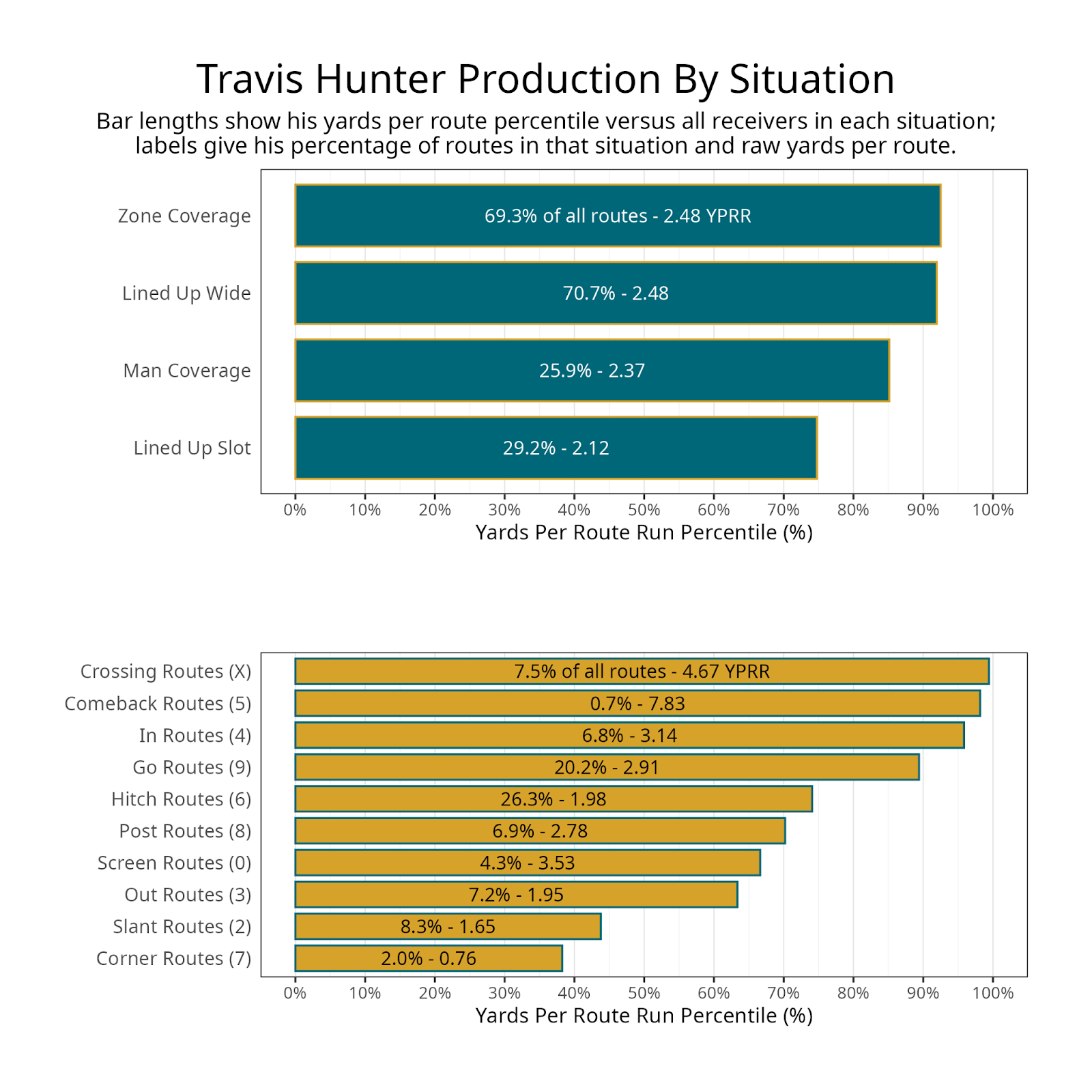
Hunter spent the past two seasons as a full-time wide receiver and cornerback for Colorado. His efficiency at wide receiver was strong but not elite, and he produced on a surprisingly high sample size, given his additional playing time on defense. His numbers improved across the board from 2023 to 2024. His production by situation was strong, too, but it’s worth noting that many of his routes were gos or hitches.
His 89.7 PFF receiving grade over the past two seasons is directly in the middle of the other receivers who were drafted in the first or early second round. He racked up the most touchdowns and the fewest dropped passes of the five, and his separation rate against single coverage is the best among the group.
While Hunter wasn’t as accomplished a receiver as others in the class, many consider him the best receiving option. PFF's draft guide notes, “As a receiver, he doesn’t have as much polish in releases, route nuance and beating press. However, all that can be improved and explained by not devoting all his time to one position.” If Hunter becomes a full-time receiver, he will be the top wide receiver in dynasty drafts based on his talent.
Hunter joins the Jaguars, who have Brian Thomas Jr. and minimal other competition for targets. The first preseason game gave us a great look at how the Jaguars plan on using Hunter.
He started the game for Jacksonville and played in 11 of 12 snaps with the starters. The one play he missed was a two-wide receiver set with Brian Thomas Jr. and Dyami Brown on the field. If this ends up being how he’s used in the regular season on offense, he can be a consistent fantasy starter. Several borderline fantasy starters only played in three-receiver sets last season, including Jayden Reed, Josh Downs, Khalil Shakir and Adam Thielen. The differences are that Hunter is more talented and the Jaguars should stay in 11 personnel for most of the game. Head coach Liam Coen’s Tampa Bay Buccaneers ranked eighth in 11 personnel usage last season at 71.9%, despite multiple wide receiver injuries. His 2022 Los Angeles Rams led the league at 90.9%. On the first drive, the Jaguars used it 91.8%.
Coen also commented that they have focused on 11 personnel, and that he’s learning 12 personnel, so he could also start playing snaps in 12 personnel in the upcoming weeks.
One surprising part of his usage is that Hunter lined up in the slot on five of his 11 snaps, tying Thomas at five of 12 snaps. Thomas was expected to be the primary slot receiver after leading the league in yards per route run out of the slot. Hunter played significantly out of the slot in 2023, but in 2024, he only lined up in the slot 36 times compared to 736 snaps outside. This is significant because Coen’s top wide receivers, from a fantasy perspective, have primarily played out of the slot. This includes Chris Godwin averaging 19.7 PPR points per game last season, which ranked second-most in the league, and Cooper Kupp leading the league in 2022 at 22.4. This is enough reason to raise expectations for Hunter this season while somewhat dampening expectations for Thomas.
Hunter didn’t play the first drive on defense, but he played left cornerback on the Jaguars’ second and third drives, playing all eight snaps on those drives. Tyson Campbell was one of multiple Jaguars defenders who only played the first drive. Jarrian Jones started the game at left cornerback and switched to right cornerback when Hunter entered. Jourdan Lewis, who joined the Jaguars from the Dallas Cowboys, played as their slot cornerback, even though Jones held that position last season. If Hunter plays on defense in the regular season, it would likely be at Jones' expense. This wouldn’t necessarily need to be in any particular personnel groupings.
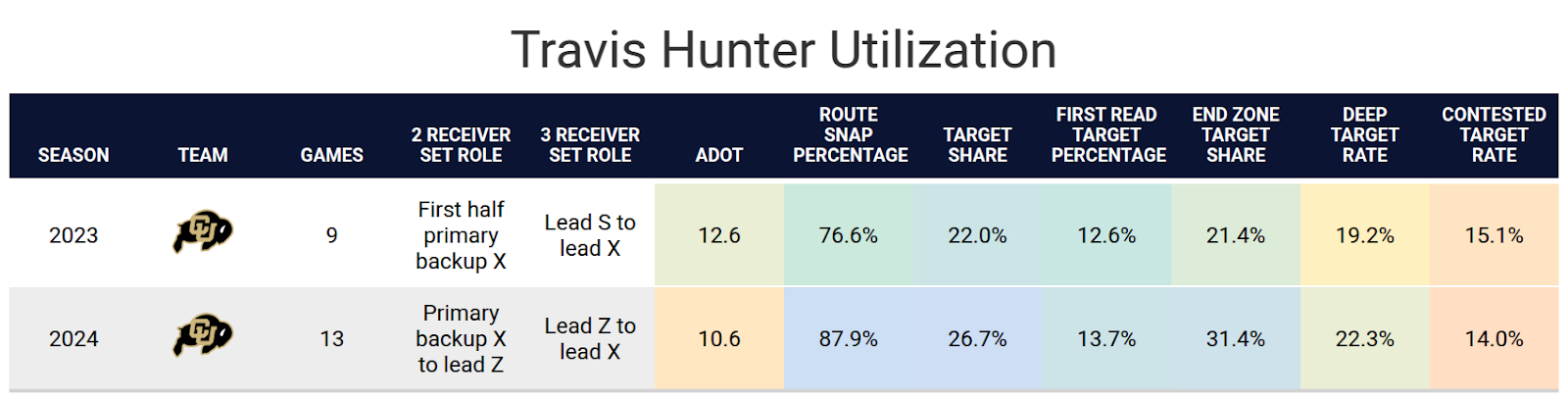
The sky is the limit for Hunter, a truly unique athlete. That uniqueness makes it difficult to project how much he can help a fantasy manager at the wide receiver position. As the offseason has progressed, the risks around Hunter have decreased, but his ADP hasn’t increased at a commensurate rate.
RB Jordan Mason, Minnesota Vikings (ADP: 10.05)
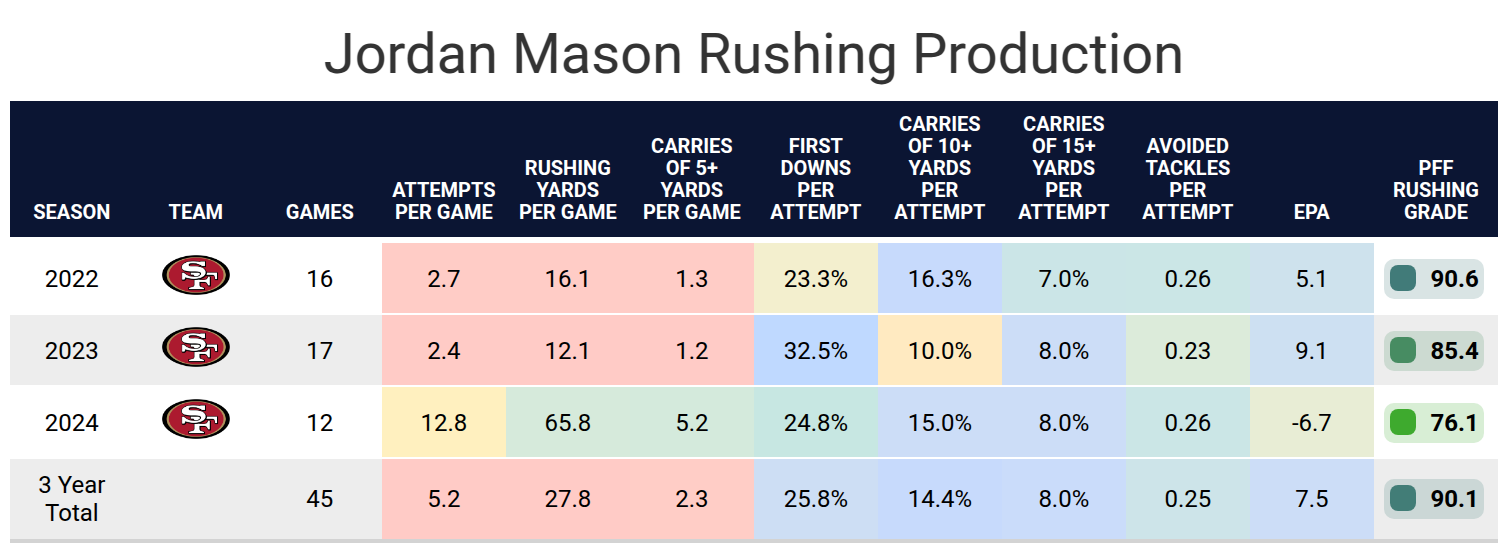
Mason entered the league as an undrafted rookie in 2022, signing with the San Francisco 49ers. Midway through his rookie season, the 49ers overhauled their backfield by trading for Christian McCaffrey and elevating Mason to the primary backup role. He made the most of his limited opportunities, earning a 90.6 PFF rushing grade and averaging 6.0 yards per carry.
In 2023, Mason slid to third on the depth chart with Elijah Mitchell’s return. However, when Mitchell missed time, Mason again stepped in as the primary backup and performed at a high level, much like he did in his rookie year. Heading into 2024, there was speculation that Mason could overtake Mitchell as McCaffrey’s primary backup, a scenario that played out after Mitchell suffered a season-ending injury. With McCaffrey nursing an Achilles sprain to start the year, Mason briefly opened the season as the 49ers' lead back.
He capitalized on the opportunity, ranking as a top-six fantasy running back through the first five weeks of the season. While Mason fumbled three times and saw some regression in efficiency with a larger workload, he remained explosive, breaking off long runs at an elite rate and rushing for at least 70 yards in six of his first seven games. He also averaged 4.1 or more yards per carry in each of those outings. As a receiver, Mason remained limited, catching just one or two passes per game.
Injuries derailed the second half of his season. He sustained a shoulder injury in Week 6 and aggravated it the following week. McCaffrey returned during that stretch, pushing Mason back into a reserve role. It's important to note that many of Mason’s per-game stats from 2024 include games where he was not the starter. When McCaffrey suffered a season-ending injury in Week 13, Mason stepped in with 13 carries for 78 yards, only to suffer a season-ending high-ankle sprain of his own shortly after.
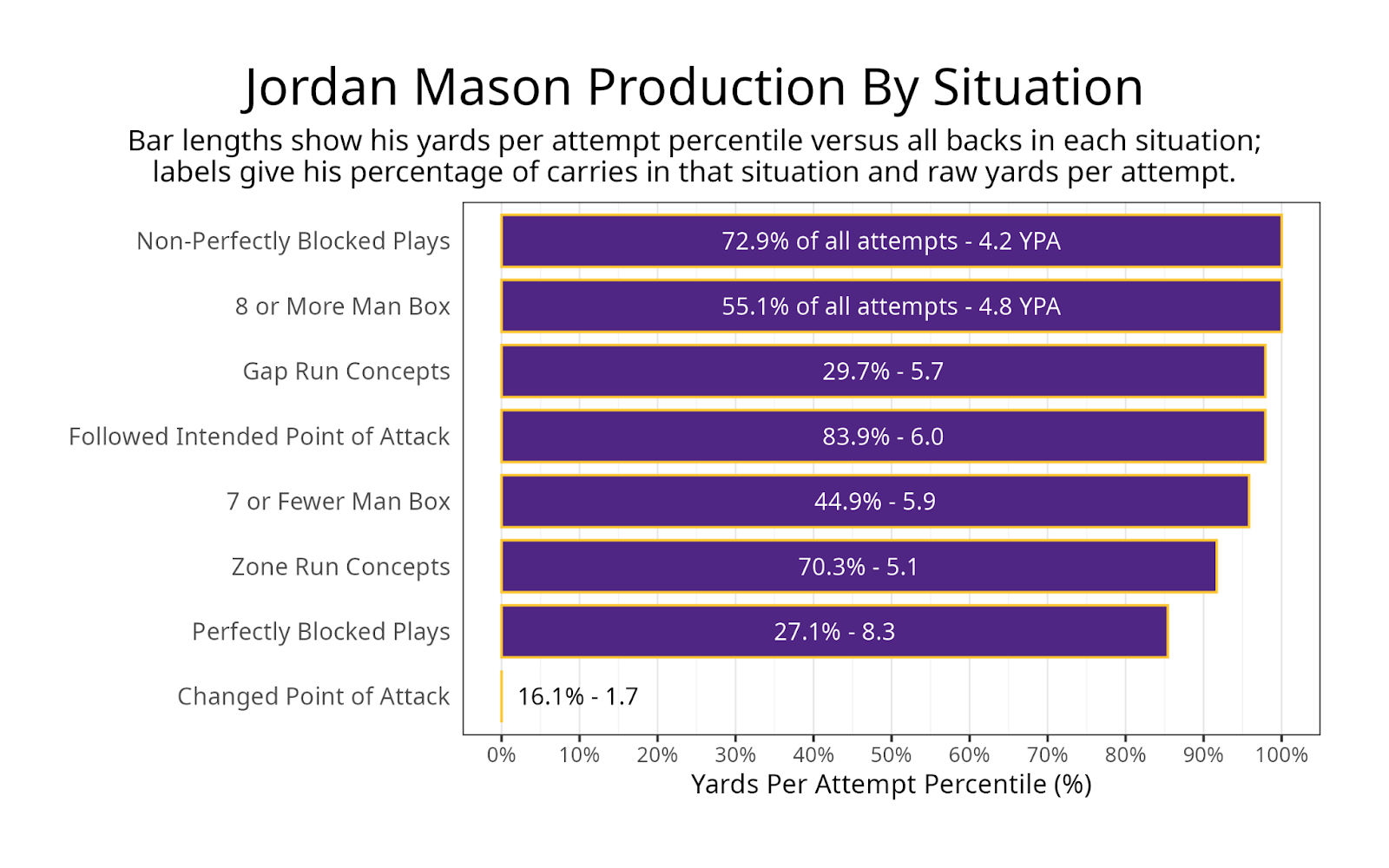
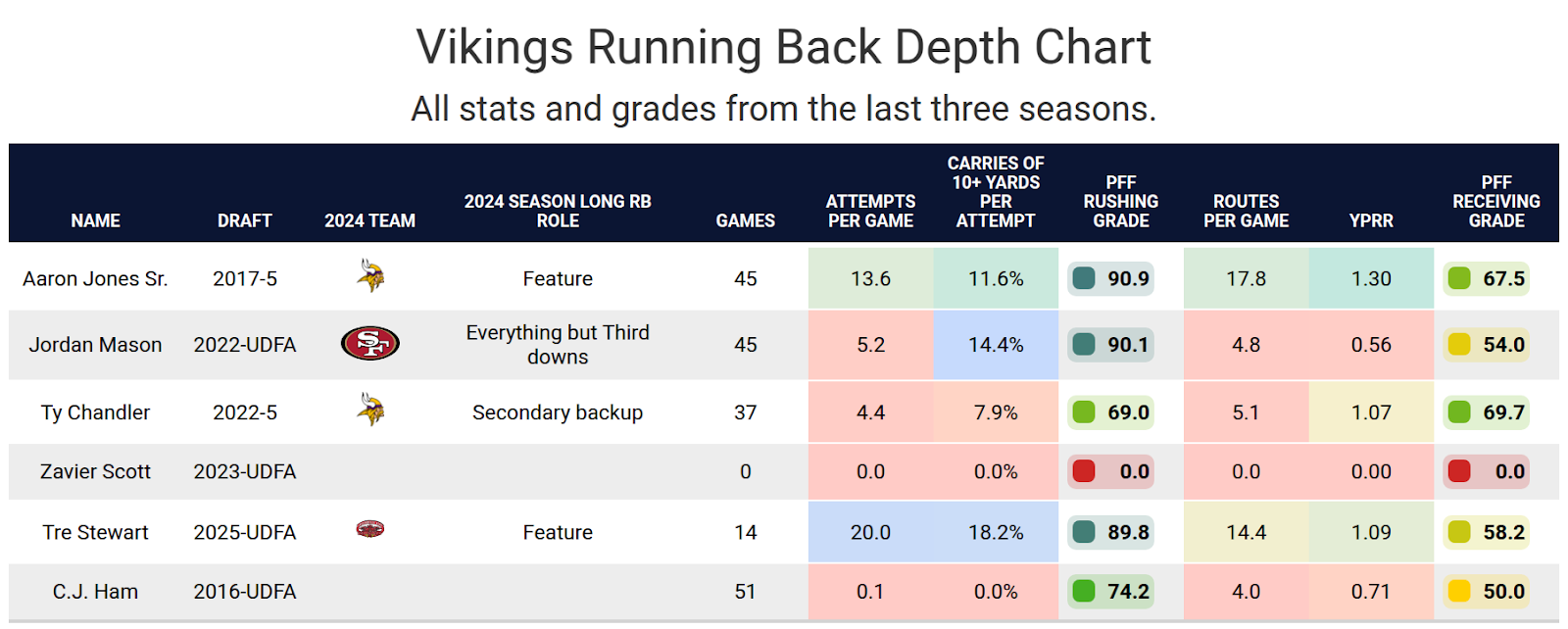
Mason was traded to the Minnesota Vikings this offseason, giving him a chance to escape McCaffrey’s shadow and potentially earn more playing time. Minnesota’s lead back last season was Aaron Jones Sr., a veteran who has spent most of his career in a two-back committee. Jones, now 30 years old, has dealt with a string of injuries in recent years — including hamstring, MCL, hip, rib, and quad issues — and may no longer be able to shoulder a full workload.
Mason has primarily operated as an early-down back in his NFL career, while Jones offers a more well-rounded skill set. Jones posted 408 receiving yards in 2024, his highest mark since 2019, and has consistently graded well as a runner. However, signs of decline have surfaced, as his rushing efficiency has slipped toward average in recent seasons. A likely backfield split would see Mason handling early-down work, with Jones playing a significant role in passing situations.
If Jones were to miss time, Mason could step into a featured role similar to his five-game stretch as the 49ers’ starter. Fullback C.J. Ham has taken on third-down pass protection duties in recent years and would likely continue to do so, limiting Mason’s role on passing downs. Ty Chandler would serve as the backup, but Mason would likely receive as much volume as the Vikings believe he can handle.
The Vikings had a relatively average offensive line in 2024, but the unit could take a notable step forward this season, depending on how quickly it develops chemistry. Star left tackle Christian Darrisaw, the team’s best run blocker, missed more than half of last season. Minnesota also addressed its interior issues by signing Will Fries and drafting Donovan Jackson in the first round. While it's difficult to predict how a rookie lineman will perform, Jackson is expected to be an upgrade at left guard.
That said, this could still represent a slight downgrade for Mason. During his time with the 49ers, he consistently ran behind a top-10 offensive line.
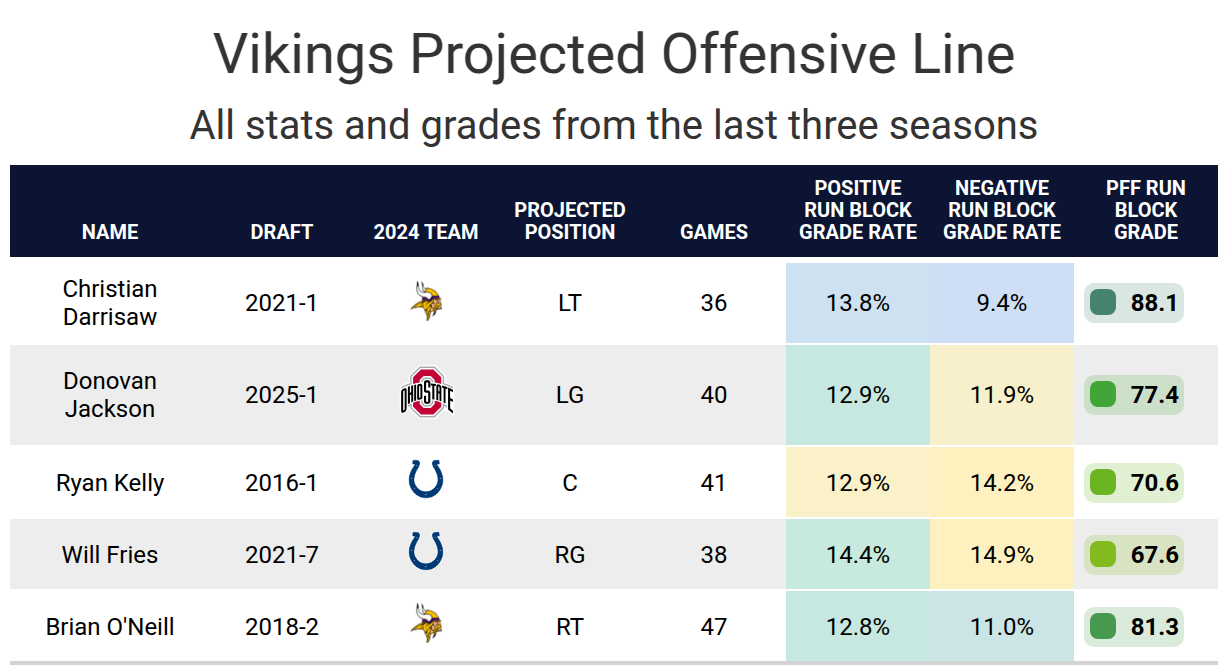
The snap distribution between Mason and Aaron Jones remains uncertain. Still, there’s a realistic path for Mason to emerge as the more valuable fantasy option, even if both stay healthy. If Jones continues to struggle with injuries, Mason is likely to step in as a reliable fantasy starter.

 © 2026 PFF - all rights reserved.