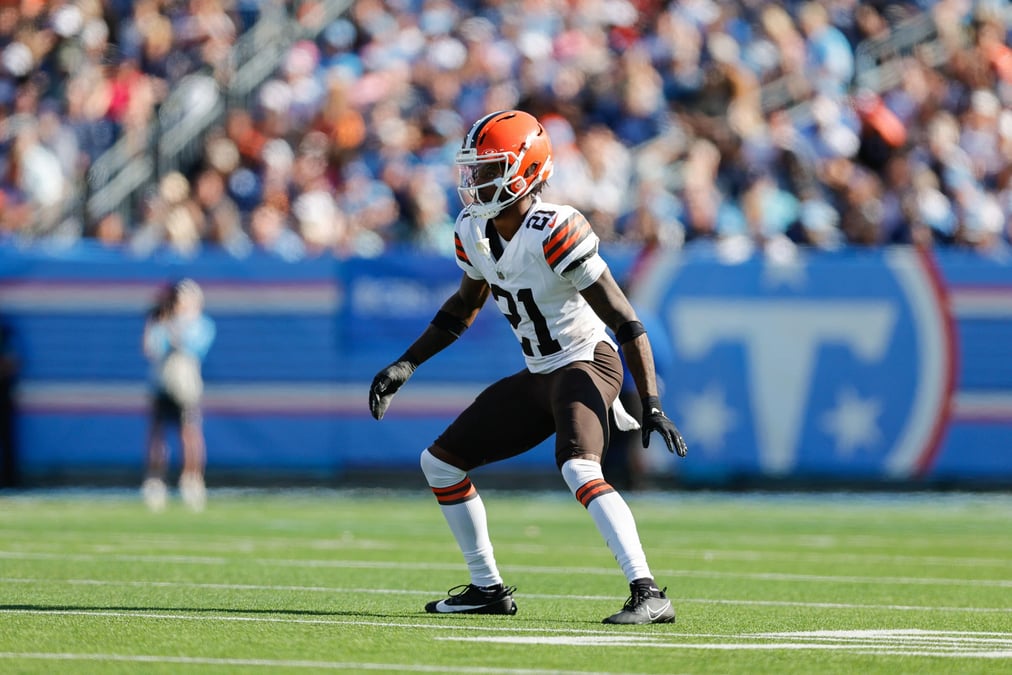
- Denzel Ward has dominated for the Browns: Ward leads the league in PFF coverage grade on an impressive Cleveland defense.
- The Ravens miss Lamar Jackson: Jackson's 91.3 overall PFF grade is the best for Baltimore, although he's played in only four full games.
- Rookies stepping up: Zakee Wheatley, Akheem Mesidor and Caleb Douglas have all turned heads by making paramount impacts through their first nine weeks as pros.

Nine weeks of the 2026 NFL season are complete, and a ton has already transpired. From multiple starting quarterbacks suffering season-ending injuries to hot teams cooling off to stars on the move, the league has packed a lot into just over two months of action.
While half a season isn’t a fully representative sample size, it serves as a strong time to take stock of player and team performance. In particular, it’s apropos to recognize the brightest stars around the sport for what they’ve done thus far.
Below is every NFL team’s highest-graded player in 2026, using 200 snaps as a minimum threshold.
Click here to jump to a team:
ARI | ATL | BAL | BUF | CAR | CHI | CIN | CLE | DAL | DEN | DET | GB | HOU | IND | JAX | KC | LV | LAC | LAR | MIA | MIN | NE | NO | NYG | NYJ | PHI | PIT | SF | SEA | TB | TEN | WAS
Arizona Cardinals: WR Michael Wilson (77.9)
Although Wilson suffered a season-ending neck injury in Week 9, he had continued to blossom in his first season as Arizona’s outright WR1. His 78.3 PFF receiving grade is a career high, slotting 17th among qualified wideouts. On top of that, Wilson dropped just two catchable targets. As the Cardinals sort out who will be under center in 2027, they can count on the 26-year-old Wilson.
Atlanta Falcons: G Chris Lindstrom (89.0)
Even as he approaches age 30, Lindstrom keeps on chugging along, playing like one of the sport’s premier linemen. His 0.31 Wins Above Replacement are the second-most among all guards, and Lindstrom’s 90.1 PFF run-blocking grade is second as well. This is becoming familiar territory for the four-time second-team All-Pro, who’s collected an 87.6-plus overall PFF grade in five straight years.
Baltimore Ravens: QB Lamar Jackson (91.3)
This is an unfortunate one for Baltimore, as Jackson has thrived when on the field — but that’s only happened in five total games. Across his effective four starts, Jackson has tossed six big-time throws compared to just three turnover-worthy plays, amassing an 80.9% adjusted completion percentage in the process. Further, his 90.9 PFF rushing grade is second among all passers. With Jackson now on injured reserve, the Ravens can only cross their fingers that the two-time MVP will return at some point in 2026.
Buffalo Bills: EDGE Greg Rousseau (88.1)
It may have been stunning to see anyone take Josh Allen’s mantle on this list, but that’s the kind of season Rousseau is currently assembling. He’s been borderline unstoppable as a pass-rusher, collecting 49 pressures on an 18.9% pass-rush win rate — both of which stand as top-five marks among all qualified defensive linemen. Rousseau has quietly played like an above-average edge defender in each of the previous four years, but he’s elevated himself to the point that he’s firmly in the Defensive Player of the Year race.
Carolina Panthers: S Zakee Wheatley (90.2)
The Panthers’ overhauled defense was a driving storyline entering 2026, but it’s the rookie Wheatley — not big-ticket additions — that’s made the biggest difference. The fifth-round Penn State product has played to an 85.4 PFF coverage grade, allowing only 63 yards over 190 coverage snaps while securing an interception and breaking up two other passes. Wheatley has also shined as a downhill player, missing only 9.7% of tackle attempts and adding an 82.8 PFF run-defense grade. All told, Wheatley is one of two qualified safeties with an 80.0-plus grade in both coverage and run defense, joining Evan Williams.
Chicago Bears: T Darnell Wright (85.9)
The Bears have numerous standouts on offense, but it’s tougher to find a better player than Wright. The 2025 second-team All-Pro has continued to dominate this season, producing an 87.0 PFF run-blocking grade and an 8.9% positively graded run-block rate — both of which are top-three marks among qualified tackles. In pass protection, Wright has also prevented damage to his quarterback by letting up just one sack and 12 pressures all year.
Cincinnati Bengals: QB Joe Burrow (93.7)
The Bengals possess four players with an 89.0-plus overall PFF grade through the early going, but Burrow has been particularly remarkable. The former first overall pick is the league’s highest-graded passer (92.5) by a sizable margin, placing fourth in big-time throw rate (5.8%) with the eighth-lowest turnover-worthy play rate (2.1%). Burrow’s all-around excellence, including his strong marks under pressure, make him arguably the league’s MVP favorite going into the second half of 2026 — after all, his 2.03 WAR leads the NFL.
Cleveland Browns: CB Denzel Ward (90.5)
Ward has rebounded from a more pedestrian 2025 season to play at a truly lockdown level this season. His 91.8 PFF coverage grade leads all defensive backs, letting up only 129 yards across 349 coverage snaps with an accompanying 42.5 passer rating against. The 29-year-old has given Cleveland no hesitation after the franchise rewarded its homegrown star with a two-year, $62.2 million extension this summer.
Start your free trial of PFF Pro today!
Dallas Cowboys: WR CeeDee Lamb (87.9)
Even on a vaunted Dallas offense, Lamb has separated himself. His 88.2 PFF receiving grade is the fifth-highest among qualified receivers, adding a gaudy 2.91 yards per route run. While Lamb struggled with drops in recent seasons, he’s been even more reliable this year with an above-average 2.8% drop rate. Further, Lamb’s 13 missed tackles forced already surpass his 2025 season total.
Denver Broncos: EDGE Nik Bonitto (88.1)
It felt as though Bonitto made strides in 2025, and he’s firmly entered the superstar realm in 2026. His 90.5 PFF pass-rush grade is the second-best among qualified edge defenders, and his 19.4% pass-rush win rate is fourth. The 27-year-old has been just as elite on true pass sets, placing third with a 26.6% pass-rush win rate.
Detroit Lions: T Penei Sewell (92.0)
After a slower start to his time at left tackle, Sewell has firmly settled in and returned to the mantle of highest-graded tackle in the NFL. His 93.2 PFF run-blocking grade leads all offensive linemen, while his 9.1% positively graded run-blocking mark is the best for anyone at his position. In pass protection, Sewell has let up just one pressure over his last four games. The three-time first-team All-Pro is on the cusp of joining Tristan Wirfs as the only players to ever be named to the team at both left and right tackle.
Green Bay Packers: S Evan Williams (91.1)
A 2024 standout as a fourth-round rookie, Williams has only continued refining his game in Green Bay. He’s played as the league’s most-valuable safety by PFF WAR, making splash plays in run defense, coverage and even as a pass-rusher. Williams’ 13 pressures are the second-most at the position, and his 5.4% missed tackle rate is the sixth-lowest among qualifiers. The 25-year-old has been a foundational piece of the Packers’ upstart defense, one which leads the NFL in PFF coverage grade.
Houston Texans: EDGE Will Anderson Jr. (90.5)
After a monster 2025 season, Anderson looks just as hungry to secure his first career Defensive Player of the Year plaudits. His 43 pressures are the fourth-most among edge defenders, and his 81.4 PFF pass-rush grade is sixth. Anderson has been just as disruptive against the run, leading his positional counterparts with a 90.3 PFF run-defense grade and an 11.3% stop rate.
Indianapolis Colts: G Quenton Nelson (85.7)
It’s perhaps fitting that the Colts’ highest-graded player through this point is no longer on the team. Before his move to Seattle, Nelson was excellent as usual in Indianapolis, powering the team’s run game with an 82.3 PFF run-blocking grade. In pass protection, Nelson also surrendered just six pressures and no sacks over 275 pass-blocking snaps. With the 30-year-old gone, Indianapolis hopes the draft capital it recouped can help accelerate its rebuild.
Jacksonville Jaguars: LB Ventrell Miller (92.6)
One of the overarching questions for the Jaguars going into the season was how they would replace Devin Lloyd, and Miller has responded in spades. He’s been fantastic in virtually every dimension — whether racking up four pass breakups, collecting eight pressures or making 15 stops against the run. All told, Miller is the NFL’s highest-graded defensive player to this point — not bad for a player acting as a first-time starter for a full season.
Kansas City Chiefs: RB Kenneth Walker III (91.7)
Walker’s arrival in Kansas City has indeed been a perfect marriage. His 91.7 overall PFF grade leads qualified running backs, averaging 3.74 yards after contact per attempt while forcing 51 missed tackles. The Super Bowl 60 MVP has remained an explosive play machine, churning out 24 runs of 10-plus yards — which ties for the second-most.
Las Vegas Raiders: TE Brock Bowers (90.4)
The arrival of Klint Kubiak in Las Vegas has, not coincidentally, coincided with Bowers’ best season yet. His 90.3 PFF receiving grade is the best among tight ends, averaging 2.57 yards per route run and dropping zero of his catchable targets. Bowers’ 40.6% wide alignment rate easily leads all tight ends, but it’s proving to be a savvy changeup to give him matchups he can seize.
Los Angeles Chargers: EDGE Akheem Mesidor (78.2)
There haven’t been many sources of positivity for the winless Chargers this season, but Mesidor’s play is a silver lining. The team’s first-round pick owns the second-highest grade among rookie edge defenders, amassing 17 pressures over 172 pass-rushing snaps. Likewise, Mesidor’s 7.8% run stop rate is the third-best among rookies at the position. The Miami (FL) product’s play should only incentivize team brass to trade either Khalil Mack or Tuli Tuipulotu before Tuesday’s deadline.
Los Angeles Rams: WR Puka Nacua (90.4)
The star-studded Rams field several players with an 85.0-plus overall PFF grade, but Nacua has been the best of them all. His 89.6 PFF receiving grade and 2.86 yards per route run are both sixth among qualified wideouts, and his 14 contested catches tie for the second-most. With Nacua likely headed to injured reserve due to several leg injuries endured in Week 9, his absence will be tough to replicate for a Los Angeles offense sitting 14th in passing EPA per play.
Miami Dolphins: WR Caleb Douglas (74.6)
Given the team’s depleted roster, it’s not surprising to see the Dolphins have the lowest-graded top player on this list. Nevertheless, that fact doesn’t detract from what Douglas has been able to achieve. The third-round pick has secured a 75.3 PFF receiving grade over five games, averaging 2.26 yards per route run while adding an encouraging 6.7 yards after the catch per reception. While Miami figures to boost its receiving corps this offseason, Douglas is proving to be a worthwhile player worth building around.
Minnesota Vikings: LB Blake Cashman (85.0)
Minnesota’s unbelievable defense has taken the league by storm, and Cashman is the centerpiece of it. Cashman ties for seventh in WAR among linebackers, particularly flashing as a blitzer in Brian Flores’s scheme — where his 83.0 PFF pass-rush grade is fifth. On top of that, the 30-year-old has flashed in coverage with four pass breakups, a 75.9 passer rating allowed and a 78.3 PFF coverage grade.
New England Patriots: WR Mack Hollins (80.4)
On a team with Drake Maye, Christian Gonzalez, A.J. Brown and many more, it’s Hollins who holds the best mark by overall PFF grade. Although he’s been limited to five games, Hollins has produced when on the field with a career-high 78.6 PFF receiving grade, 83.3% contested catch rate and lofty 15.1-yard average depth of target. Hollins’ best work has come as a blocker, where his 78.8 PFF run-blocking grade leads all receivers.
New Orleans Saints: WR Chris Olave (87.5)
Olave has been able to partake in all eight Saints games this season, and the results have been marvelous. He’s earned a career-high 87.8 PFF receiving grade with 2.35 yards per route run, each of which sits among the top-13 receivers. Olave has done damage whether inside or out, as reflected in his 86.6 slot receiving grade despite aligning there just 30.8% of the time.
New York Giants: Dl D.J. Reader (90.0)
New York’s defense is chock full of impressive youngsters, but Reader has taken the cake through nine games. His 90.0 overall PFF grade leads all qualified interior defenders this season despite signing for a relatively pedestrian contract in the offseason. Believe it or not, Reader is the only player at the position with an 80.0-plus PFF run-defense and pass-rush grade.

New York Jets: G Dylan Parham (83.7)
In his first season in New York, Parham has quickly coalesced along the team’s rising offensive line. The former Raider has appeared on only 306 snaps but has made them count, producing an 82.8 PFF run-blocking grade. Parham has been especially good in pass protection, giving up 12 pressures and zero sacks this year. If Parham maintains this kind of play, he may soon receive another contract from the franchise.
Philadelphia Eagles: WR DeVonta Smith (90.5)
Smith has flourished in his first season as the Eagles’ bonafide WR1, although he’s barely been on the field to display it. Seeing just 211 snaps, the former Heisman Trophy winner has accrued a 90.2 PFF receiving grade with 2.21 yards per route run, both of which would be career highs. Playing just once since Week 3 due to a hamstring issue, Smith has seen his team collapse during a stunningly poor and injury-marred season.
Pittsburgh Steelers: RB Jaylen Warren (87.3)
Multiple Steelers rank near the top of their positional groups, but the headliner of the year has been Warren. His 91.1 PFF rushing grade is the best for any back, leading the way with 4.14 yards after contact per attempt while adding 11 runs of 15 or more yards. On top of that, Warren has thrived in the passing game with 1.70 yards per route run and a staggering 14.2 yards after the catch per reception. The former undrafted free agent has finally been let loose in Mike McCarthy’s offense and has played like one of the game’s better all-around offensive players.
San Francisco 49ers: T Trent Williams (87.7)
It would be anyone’s guess who would make this list for the juggernaut 49ers, especially with the returns of Fred Warner and Nick Bosa, but Williams has been the best out west. His 87.7 overall PFF grade trails only Sewell at tackle, while his 87.6 PFF pass-blocking grade is also second — permitting just eight pressures all season. It should be noted that receiver Mike Evans (92.4) would have made this list, but he was only three snaps shy of qualifying.
Seattle Seahawks: WR Jaxon Smith-Njigba (92.8)
Last year’s Offensive Player of the Year has shown no signs of slowing down in 2026. The second-highest-graded player in football, Smith-Njigba is leading the pack in PFF receiving grade (92.9), yards per route run (3.49) and first downs gained (51). Impressively, Smith-Njigba is also in the top 11 in receiving grade against both man and zone. The Seahawks star is aiming to be the first player to take home such hardware in two straight seasons since Marshall Faulk in 2001.
Tampa Bay Buccaneers: CB Jacob Parrish (83.9)
Tampa Bay’s defense leads the NFL in EPA per play, and Parrish has been an instrumental part of that. In coverage, Parrish has played as well as any cornerback with an 83.1 PFF coverage grade, 18% forced incompletion rate and 71.2 passer rating when targeted. On top of that, the second-year corner has chipped in with a 77.5 PFF run-defense grade, while his 14 stops tie for fourth at the position. The 22-year-old has flourished as a full-time perimeter corner despite standing just 5-foot-10, making the case to be an All-Pro.
Tennessee Titans: RB Tony Pollard (85.6)
The Titans have hardly found any offensive rhythm, but Pollard has looked like his vintage self. His 86.5 PFF rushing grade is the fifth-highest among running backs, averaging 3.53 yards after contact per carry while fumbling just once. With the 29-year-old in the final year of his contract, Tennessee has a difficult junction to face about whether or not to keep him around beyond this season as it looks to provide more insulation for Cameron Ward.
Washington Commanders: S Jeremy Reaves (74.8)
Little has gone right for Washington in Dan Quinn’s third season at the helm, but Reaves has displayed promise in the secondary. His 74.2 PFF coverage grade is a top-10 mark among qualified safeties, ranking 10th with 28.0 snaps per reception and showcasing the ability to identify route patterns while making plays on the ball. Further, Reaves has been successful coming downhill with a 4.5% run stop rate and an 8.3% missed tackle mark.

 © 2026 PFF - all rights reserved.