
- Get PFF+ for 40% off: Use promo code BLACKFRIDAY to unlock the PFF Player Prop Tool, Premium Stats, fantasy dashboards, the PFF Mock Draft Simulator, industry-leading fantasy rankings and much more — everything you need to win your season.

Last year, I introduced a new framework for understanding wide receiver play, quarterback decision-making and offensive potential. This framework relies on an XGBOOST model and PFF’s impressive collection of route-level data. Using machine learning and this breadth of PFF data, we can create models with the goal of predicting where a target should go on a given play.
The resulting metrics, Share of Predicted Targets and Share of Predicted Air Yards, are both more stable than their “actual” counterparts.
Week 11 Recap
- Ja’Marr Chase: 10 targets – 25.64% target share
- Isaiah Williams: 4 targets – 15.38% target share
- Hunter Henry: 6 targets – 18.18% target share
- Jalen Coker: 4 targets – 9.09% target share
- Brock Bowers: 12 targets – 30.77% target share
Potential Breakouts: Week 12
These are players who were open far more often than they were targeted in Week 11. In general, players who show up on this list see an uptick in targets per route run and target share relative to both themselves and all players with similar target shares.
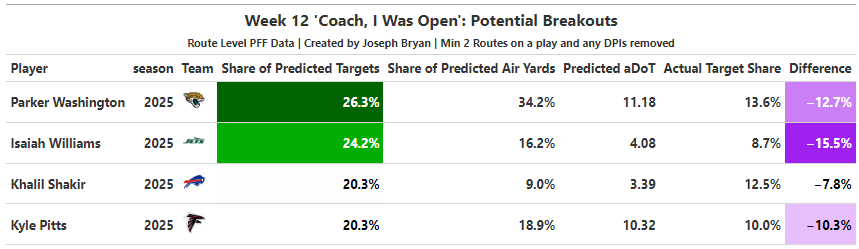
With Tyrod Taylor starting and a potentially improved New York Jets passing attack, Isaiah Williams is an interesting sleeper to target.
The last time Kirk Cousins started and Drake London was out, Kyle Pitts tallied his most receptions this season.
Quarterback EPA Capture Rate
Using route-level PFF data, we can dive into even more interesting holistic offensive metrics. Additionally, we can attempt to separate the impact of a quarterback from their scheme or routes on the field.
Every route has a predicted time to throw, predicted target probability and predicted number of air yards. We have discussed the creation of these models before and the spectacular PFF data used for training the models.
From this same data source, and using similar methods, we can create a predicted EPA value on any given route using information like a player’s play-level PFF grade, if they are categorized as open, if they are facing one-on-one coverage and many other features. We train our model using these features and attempt to predict EPA on a target.
On a play-by-play basis, the R-Squared for predicting the actual EPA result using our predicted EPA is 0.02. Any given play has incredibly high variance, and a low R-Squared is somewhat expected.
On a game-by-game basis for quarterbacks, the R-Squared using the sum of actual EPA and predicted EPA is much better at 0.293. On a season-by-season basis for quarterbacks, the R-Squared using the sums is 0.779.
These are all validated R-Squared numbers on data for which the model did not train. I want people to understand that this model is quite good, especially as we expand the timeframe of our observations.
Using this model, I want to gain a better understanding of how a quarterback facilitates their offensive system. The first step will be creating a proxy for the offensive system: potential EPA.
To attain a total potential EPA for quarterbacks, I look at each play, acquire the maximum predicted EPA and add that total across our timeframe. We then divide total potential EPA by pass attempts to arrive at potential EPA per attempt. In my view, this gives us a decent proxy of offensive scheme and receiver ability.
Just so that it's clear, we are looking at attempts, meaning the ball left the quarterback’s hand. This metric doesn't include sacks or rush attempts.
Here are the 2025 leaders in potential epa per attempt (min 100 qualified attempts):
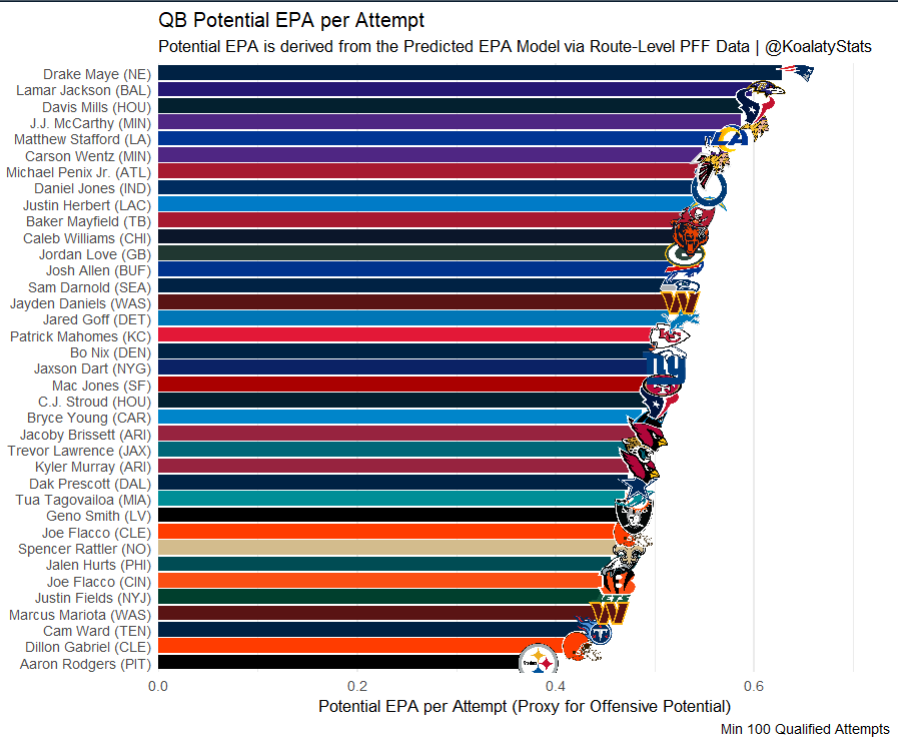
Offenses that I would generally consider limited show up toward the bottom, while offenses that feel exciting show up near the top. I would consider this a great first run for a newly created metric.
Drake Maye is operating at an MVP level in what might be the league’s highest-potential offense.
Per PFF Premium Stats, Aaron Rodgers has the fifth-quickest average time to throw and is generally very decisive. As we’ll see, even in a lower-potential offense, Rodgers is capturing a very high percentage of its EPA.
The Vikings with Justin Jefferson, Jordan Addison, T.J. Hockenson and Kevin O’Connell calling plays feel like a high-potential offense, and my metric would completely agree. Both J.J. McCarthy and Carson Wentz posted very high scores in this metric, showing that O’Connell did not really alter his passing attack given his quarterback situation.
Furthermore, if we divide our total actual EPA from the result of the play by the total potential EPA discussed earlier, we can see how well the quarterback is capturing the offense's potential. I call this the QB EPA Capture Rate.
It is important to note that QB EPA Capture Rate isn’t the perfect representation of skill, but it gives us some insight into how well a quarterback is facilitating an offense.
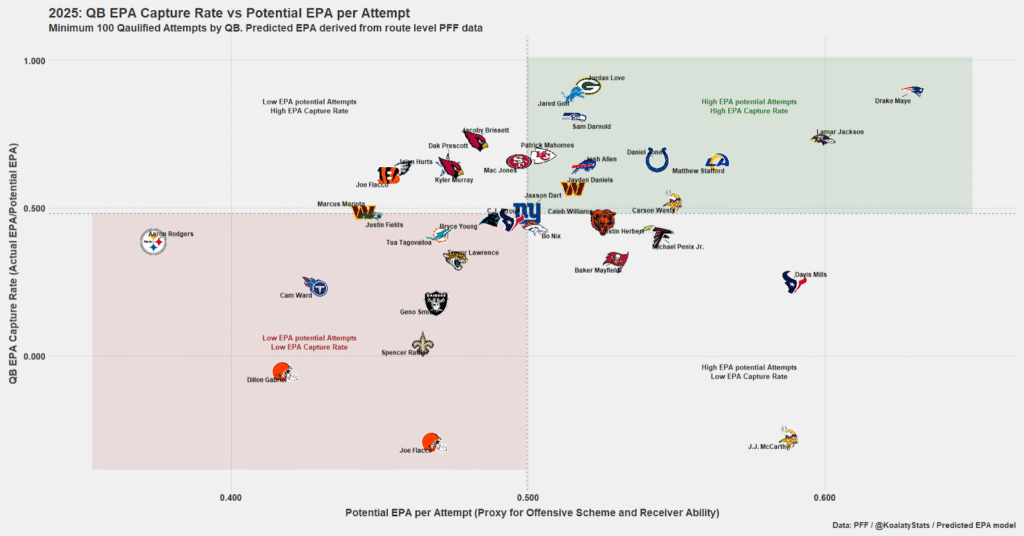
As we saw in the bar chart, J.J. McCarthy has a very high potential EPA per attempt, but one of the worst EPA Capture Rates in the league. This makes intuitive sense given his accuracy struggles and simply watching his pass attempts. This is an incredible offensive system, but it is currently being limited.
Joe Flacco’s movement from one of the worst EPA Capture Rates while in Cleveland to above average in Cincinnati is fascinating. It begs for further exploration into the metric and a receiver’s impact on the quarterback’s ability to capture EPA.
The top three QBs in capture rate are Jordan Love, Jared Goff and Drake Maye. They are facilitating their respective offenses better than anyone else while also having high-potential units.
“Coach I Was Open” Week 11 Review
This week, we will use the new predicted EPA model to look at one of the largest missed opportunities of the week.
The Vikings are losing by 4 points with 3:45 left in the second quarter. It is first-and-10, and the Vikings run hard play action with only three developing routes: Jordan Addison on a deep seam/go route, Justin Jefferson on a deep crossing route and C.J. Ham on a flat route.
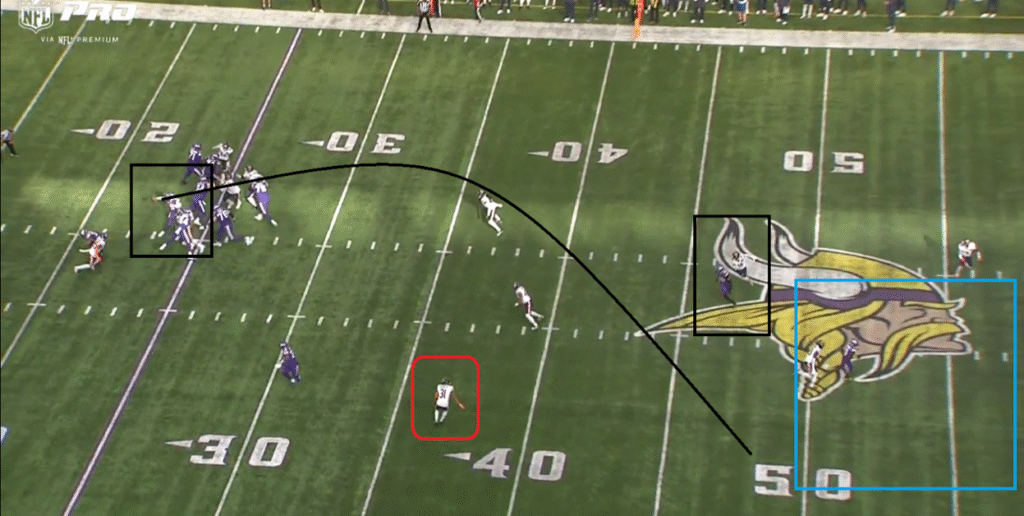
J.J. McCarthy targets Justin Jefferson, and to McCarthy’s credit, Jefferson had the highest target probability (28%). Safety Kevin Byard makes a great read on McCarthy and undercuts the pass to intercept it with a good return, resulting in a -5.5 EPA.
Jordan Addison is considered open on his deep seam/go route with a 19% probability of being targeted. His predicted EPA was a whopping 2.06, the second-highest for any route in Week 11. This would have taken a very accurate and very polished throw, something that McCarthy might not have in his arsenal yet — hindering this Vikings offense.

 © 2026 PFF - all rights reserved.