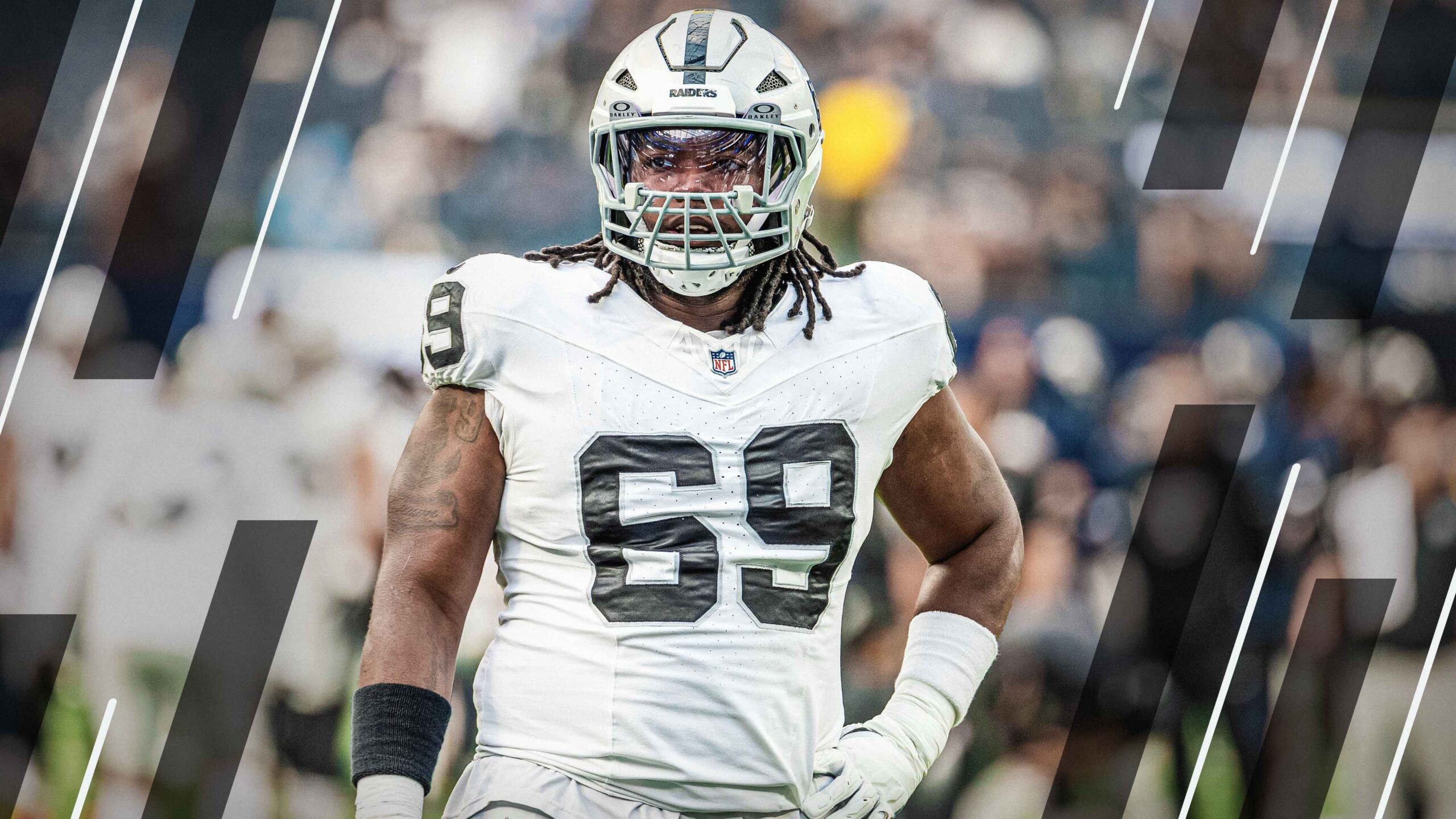
- The Raiders have more work to do: Even after a headline-grabbing draft, Las Vegas still desires more at receiver and interior defender.
- The Jaguars lack a tone-setting rusher: Jacksonville didn't select a running back, leaving a relatively unknown committee for Liam Coen.
- The Bills‘ linebacker room is still thin: Fourth-rounder Kaleb Elarms-Orr presents some upside, but Buffalo could use another presence over the middle of its defense.
One of the focuses of any NFL Draft is plugging roster gaps for not only the current season, but also campaigns down the line. Teams like the Browns, Cowboys and Dolphins did just that in both the first round and on all three days of the 2026 draft.
At the same time, certain franchises seemed to neglect positions that currently field few, if any, quality starters. Even after seven rounds of drafting, these eight units look lackluster as is.
Las Vegas Raiders interior defenders
The Raiders assembled a terrific draft class, finding what could be the face of the franchise in Fernando Mendoza while also upgrading their secondary and other slots. Yet, general manager John Spytek didn’t do much to fix his interior defensive line.
Despite holding 10 overall picks, Spytek didn’t add to his defensive tackle room until the seventh round with NC State product Brandon Cleveland. As such, the room currently projects to start Adam Butler and Jonah Laulu, who each finished below a 54.0 overall PFF grade in 2025.
While it’s tough to argue against picking the versatile Treydan Stukes, Las Vegas’ decision to bypass the likes of Christen Miller and Lee Hunter in the second round could be regretted if the team’s defensive line underperforms yet again.
Philadelphia Eagles safeties
The Eagles lived up to the billing of an offensive-oriented draft, landing Makai Lemon, Eli Stowers and Markel Bell with their initial three picks. However, Philadelphia still has a large hole at safety.
After losing Reed Blankenship in free agency and trading away Sydney Brown, Philadelphia had its depth at the position depleted this offseason — and that comes after the room sat last in overall PFF grade in 2025. Seventh-round choice Cole Wisniewski has upside after producing an 83.9 overall grade at Texas Tech last season, but expecting him to start off the bat seems ambitious.
What doesn’t help matters for Philadelphia is that free-agent provisions at safety are relatively thin. Either Howie Roseman is content to give Marcus Epps a shot, or he has a trade in the works.
Cincinnati Bengals linebackers
Even without a first-round pick, the Bengals didn’t let up on their defensive investments — selecting edge defender Cashius Howell and corner Tacario Davis with their initial two draft picks. But, Cincinnati’s linebacker unit still projects as one of if not the worst in football.
Last season, the Bengals’ linebacker corps played to the lowest overall PFF grade in the NFL, with both Demetrius Knight Jr. and Barrett Carter sitting under a 40.5 mark. Each player not only missed at least 14.8% of tackle attempts, but also allowed no lower than a 115.3 passer rating when targeted.
Perhaps Cincinnati’s front office didn’t want to spend another top-100 pick on a linebacker. But finding an late-round option over the middle instead of depth elsewhere would’ve been a more shrewd move based on the team’s construction as is.
Jacksonville Jaguars running backs
The Jaguars compiled an unconventional draft class, seemingly ignoring both consensus value as well as their overarching team needs. In particular, Jacksonville’s running back room is the unit that may have suffered the most by not drafting an impact player.
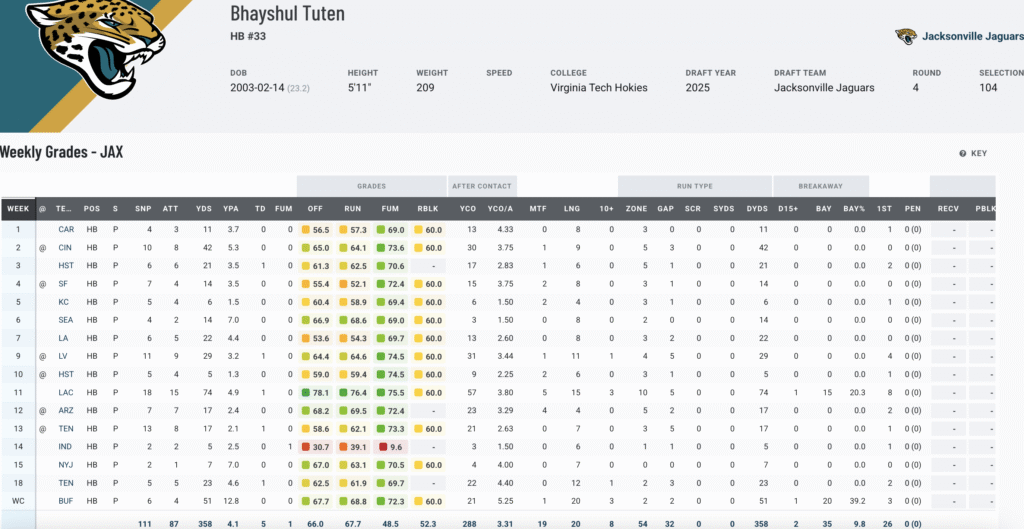
With Travis Etienne departing, the Jaguars are left with second-year rushers LeQuint Allen and Bhayshul Tuten, who respectively ranked 13th and 17th in PFF rushing grade among 20 qualified rookie running backs. While former Commander Chris Rodriguez Jr. does offer potential with a career average of 3.59 yards after contact per attempt, he’s never rounded into a consistently good starter.
As currently built, Liam Coen will rely on a true committee approach in 2026 with three unproven names. With several veterans still available, it wouldn’t be shocking to see the Jaguars pick up an impact player to raise the room’s floor.
New York Giants interior defenders
The Giants found a mix of blue-chip talent and team needs in John Harbaugh’s first draft, but New York still needs more up the middle of its defense.
After trading away Dexter Lawrence in a pre-draft blockbuster, New York waited until the sixth round to find an interior defender, when it picked Auburn’s Bobby Jamison-Travis. In addition to the Day 3 pick, New York primarily returns Roy Robertson-Harris and former third-rounder Darius Alexander, who each compiled a sub-52.0 overall PFF grade with no higher than a 7.1% pass-rush win rate.
It won’t be possible to replace Lawrence’s production in one fell swoop, but the Giants are still yearning for an upgrade along the interior. The team has been linked to veterans like D.J. Reader, and acquiring one of several names left would make sense.
Las Vegas Raiders receivers
It’s somewhat paradoxical that the Raiders made this list twice after generating a strong draft class. But, the team’s receiver room didn’t get the help that was expected and needed over draft weekend.
The Raiders didn’t zero in on a wideout until Day 3, when they grabbed Oregon’s Malik Benson (75.6 PFF receiving grade) in the sixth round. The late acquisition comes after Las Vegas signed Jalen Nailor to a three-year, $35 million deal in free agency, but he finished the 2025 season with just a 67.1 PFF receiving grade and 1.06 yards per route run. On top of that, returners Jack Bech, Tre Tucker and Dont’e Thornton Jr. sat below a 66.0 receiving grade for Las Vegas’ sputtering offense.
Las Vegas had multiple opportunities to find more talented weaponry for Mendoza, including reuniting him with his former college running mate Elijah Sarratt. Instead, new head coach Klint Kubiak currently must work with a patchwork receiving corps that lacks a well-defined top option.
Chicago Bears interior defenders
The Bears entered draft weekend fielding a defense that sought more consistent playmakers. Chicago landed that in first-round pick Dillon Thieneman, but didn’t obtain the help it commanded along its interior defensive line.
The Bears drafted Georgia Tech’s Jordan van den Berg in the sixth round, but that felt too late considering that Chicago’s defensive line sat 24th in overall PFF grade and 29th in PFF pass-rush grade last year. Although Gervon Dexter Sr. flashed with an 8.9% pass-rush win rate in 2025, he was poor against the run with a 42.8 PFF run-defense grade. Similarly, veteran Grady Jarrett struggled with a 56.9 overall mark in his first year in Chicago, and newcomer Neville Gallimore sat at a 56.6 in his lone campaign with the Colts.
Like the Raiders and Giants, the Bears still have the opportunity to sign a free-agent interior defender. If general manager Ryan Poles doesn’t do so, he’ll risk the position being a weak point again.
Buffalo Bills linebackers
The Bills entered the draft as one of the teams with the greatest need at linebacker. Even after April 25, that hasn’t changed much.
Buffalo did select TCU’s Kaleb Elarms-Orr in the fourth round, whose 89.1 PFF run-defense and 75.4 PFF coverage mark should help the unit. At the same time, projected starters Terrel Bernard and Dorian Williams generated below a 48.5 PFF coverage grade in 2025, and the team has minimal depth without Shaq Thompson and Matt Milano under contract.
Adding a new defensive play-caller in Jim Leonhard should provide some natural revisions, but the Bills may not be able to reliably count on their linebacker room as it’s presently shaped.


 © 2026 PFF - all rights reserved.