
- Get PFF+ for 40% off: Use promo code BLACKFRIDAY to unlock the PFF Player Prop Tool, Premium Stats, fantasy dashboards, the PFF Mock Draft Simulator, industry-leading fantasy rankings and much more — everything you need to win your season.

Fantasy and DFS enthusiasts, bettors and analysts often rely on a wide array of statistics and models to gain a competitive edge. These range from basic box score stats to advanced metrics available in PFF's Premium Stats 2.0 and models like Josh Hermsmeyer‘s Buy Low model and WOPR (Weighted Opportunity Rating).
There is always room for new insights and analyses to help bettors and fantasy managers refine their strategies. That’s why I developed a new metric that offers several advantages over WOPR. Click here for an in-depth explanation of the model, my process and its advantages.
Week 11 Recap
Tetairoa McMillan: WR2 – 33.0 PPR points (2 touchdowns)
Deebo Samuel: WR5 – 20.7 PPR points (1 touchdown)
Tre Tucker: WR17 – 14.7 PPR points (1 touchdown)
Justin Jefferson: WR25 – 11.1 PPR points
D.K. Metcalf: WR31 – 9.9 PPR points
Wan’Dale Robinson: WR43 – 7.6 PPR points
Darnell Mooney: WR49 – 6.4 PPR points
Jerry Jeudy: WR59 – 5.1 PPR points
Kyle Pitts: TE38 – 3.4 PPR points
As we discussed last week, Week 10 was the third-lowest overall scoring week for the wide receiver position when four or fewer teams were on bye in the last decade. Week 11 was the ninth-lowest. Some combination of offensive utilization and defensive suppression is causing wide receivers to underperform across the league.
This naturally means a larger list and output from a model with the goal of predicting positive regression. Even with the receiver position scoring far less than normal, we were able to identify two receivers that finished in the top five last week.
Potential Breakouts: Week 12
PWOPR is significantly more stable than FPpG and serves as a stronger indicator of future performance. To help identify potential breakout candidates, the residual is calculated by subtracting a player’s predicted FPpG from their actual FPpG. Players with a strong PWOPR and a residual of -3.0 or lower are included on this list. Players remain on the list until one of the following conditions is met:
- They fulfill their PWOPR potential with a big game
- Their PWOPR decreases to match their expected FPpG
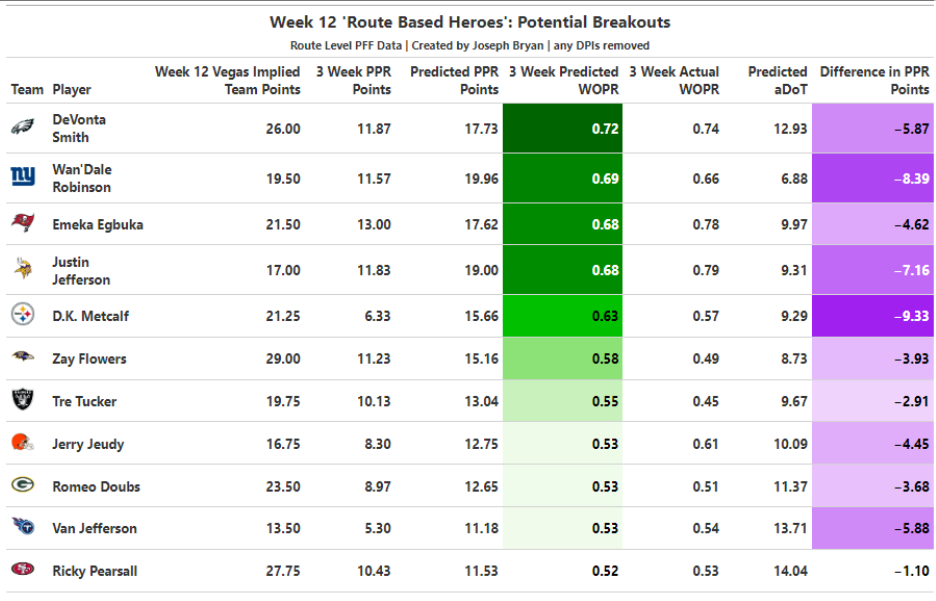
DeVonta Smith, Philadelphia Eagles vs. Dallas Cowboys
Dallas has allowed the highest rate of open targets to wide receivers this season at 61.4% (next-closest is Las Vegas at 57.0%). Over the past five weeks, the Cowboys still rank fifth in open target rate given up to the position. Per PFF Premium Stats, Dallas’ season-long team coverage grade ranks fourth-worst, while DeVonta Smith sits at WR18 in PFF receiving grade among players with at least 25 targets.
Over the last month, Dallas has shifted to a man-heavy approach with the sixth-highest man coverage rate. Smith's THREAT jumps from 20.6% against zone to 26.1% against man, setting up a clear ceiling spot. This is a strong bounce-back opportunity for Smith.
Wan'Dale Robinson, New York Giants vs. Detroit Lions
The Lions have played the highest rate of man coverage over the last month at 42.9%. Robinson leads the team with a 24.0% THREAT against man coverage, although his 63.4 PFF receiving grade in those looks is closer to league average.
Detroit has faced an average pass rate over the past month and the 12th-highest pass rate across the full season. With the Lions favored by 10.5 points and owning the sixth-best team PFF run-defense grade, game script and defensive strength both point toward elevated pass volume. Overall, this is a solid matchup for Robinson to earn targets.
Emeka Egbuka, Tampa Bay Buccaneers vs. Los Angeles Rams
The Rams permit the sixth-lowest rate of open targets to wide receivers but have faced the 10th-most total targets at the position. Over the past month, opponents have chosen to throw on Los Angeles, giving the Rams the seventh-highest percentage of pass plays faced. They also hold the highest team PFF coverage grade and the seventh-best team PFF pass-rush grade.
This is a difficult individual matchup, but the Rams' high-powered offense can force the Buccaneers into a pass-heavy script, which helps Egbuka's volume outlook even in a tough environment.
Justin Jefferson, Minnesota Vikings vs. Green Bay Packers
Green Bay has the 14th-lowest open target rate allowed to wide receivers and ranks sixth in yards per reception allowed. Over the past month, the Packers have encountered the ninth-highest run rate, as opponents likely try to avoid their pass-rush unit.
As discussed last week, J.J. McCarthy has struggled badly with accuracy, posting a 50.4% accurate throw rate — the worst mark this season for any quarterback with at least 100 dropbacks. Per PFF Premium Stats, the Packers own the fifth-best team PFF pass-rush grade and the second-best team PFF coverage grade. This is a stiff test for McCarthy and, by extension, for Justin Jefferson and the entire Vikings passing attack.
D.K. Metcalf, Pittsburgh Steelers vs. Chicago Bears
Chicago allows the ninth-highest percentage of open targets to wide receivers and the second-most yards per reception to the position. The Bears have the worst PFF team grade when defending wide receivers this season, making this one of the best on-paper matchups Metcalf has seen.
Andrew Shaver and Maurice Smith outline how Chicago has been consistently tested deep this season, and how either Mason Rudolph or Aaron Rodgers should be able to exploit this. Metcalf would be the perfect target in these situations.
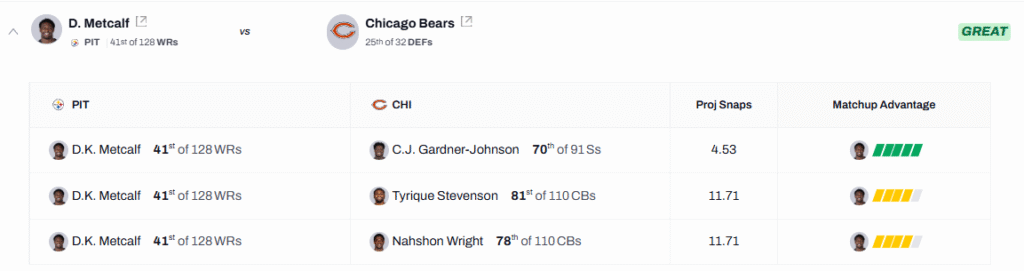
Per the PFF Matchups Tool, D.K. Metcalf is one of eight wide receivers in a great matchup against opposing cornerbacks this week.
Zay Flowers, Baltimore Ravens vs. New York Jets
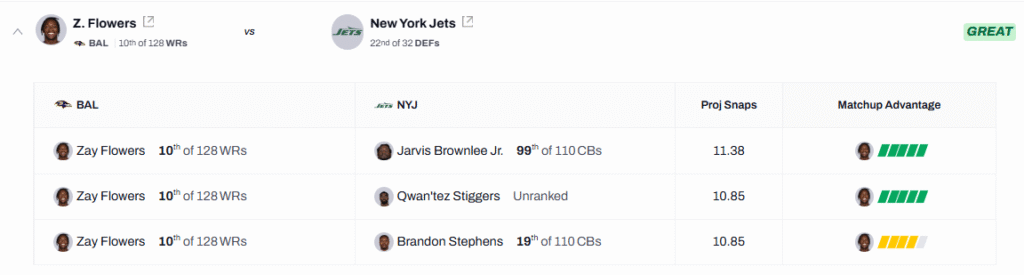
Per PFF Premium Stats, the New York Jets rank as the 10th-worst team in PFF coverage grade and the eighth-worst in PFF pass-rush grade. On paper, this gives Zay Flowers a favorable matchup against a defense that has not consistently disrupted opposing passing games.
However, Lamar Jackson has been banged up throughout the season and enters Week 12 dealing with three separate injuries. That context raises the risk of a run-heavy, low-volume passing script for Baltimore.
Flowers still projects well relative to his matchup, but overall passing volume may be capped. He’s another member of the eight “Great” matchup wide receivers this week.
Tre Tucker, Las Vegas Raiders vs. Cleveland Browns
Cleveland enters Week 12 with the seventh-best team PFF coverage grade and the top team PFF pass-rush grade, while also playing the second-highest rate of man coverage. Tre Tucker‘s usage profile does not benefit from that coverage tendency: His THREAT falls from 15.9% against zone to 13.1% against man.
When pressured, Geno Smith owns the fifth-lowest PFF passing grade this season, which compounds the matchup concerns. Between Cleveland's pass rush, man-heavy scheme and Tucker's usage splits, this does not profile as a strong spot for him.
Jerry Jeudy, Cleveland Browns vs. Las Vegas Raiders
On the other side, Jerry Jeudy draws an advantageous matchup against the Raiders. Las Vegas ranks second-worst in team PFF coverage grade and 11th-worst in team PFF pass-rush grade. The Raiders allow the second-highest rate of open targets to wide receivers and the fifth-highest expected points added per play on passes to the position.
Jeudy is positioned to capitalize on that combination of weak coverage and limited pressure, giving him a path to efficient volume in this game. His biggest hurdle will be the mostly unknown play of Shedeur Sanders in his first career start.
Romeo Doubs, Green Bay Packers vs. Minnesota Vikings
To my surprise, the Vikings rank third-worst in team PFF coverage grade and 10th-worst in team PFF pass-rush grade. They compensate for that talent gap with scheme, leading the NFL in blitz rate and quick pressure rate while placing second in unlocked pressure rate.
Against the blitz, Romeo Doubs has produced a 22.0% THREAT and a 69.5 PFF receiving grade, both solid marks. Jordan Love has been superb in those situations as well, posting an 87.7 PFF grade versus the blitz — the best in the NFL this season.
Given Minnesota's aggressive approach and the Packers' ability to punish the blitz, this is a strong matchup for the Green Bay offense — and for Doubs in particular.
Van Jefferson, Tennessee Titans vs. Seattle Seahawks
Seattle presents one of the toughest defensive matchups in the league, especially for a Titans offense that owns the second-worst overall PFF offensive grade. The Seahawks yield the third-lowest EPA per play to wide receivers and the third-lowest open target rate to the position, and they rank sixth in overall team PFF coverage grade.
The Seahawks generate the 11th-most quick pressures, while Cam Ward holds the second-worst PFF passing grade under pressure. That combination of coverage and pressure creates a very challenging environment for Tennessee's passing game. Van Jefferson and the Titans’ offense are facing an uphill battle here.
Ricky Pearsall, San Francisco 49ers vs. Carolina Panthers
Carolina holds the third-lowest quick-pressure rate this season and an average team PFF coverage grade, ranking 14th in that category. Opponents have chosen to attack through the air; over the past month, the Panthers have faced the eighth-highest pass rate.
Carolina also plays the second-highest rate of zone coverage, where Ricky Pearsall earns a strong 21.1% THREAT. With a team-leading 0.535 PWOPR and 35.9% share of predicted air yards, Pearsall is emerging as the 49ers‘ premier downfield option. This is a favorable matchup for him to continue ascending and potentially solidify himself as San Francisco's WR1.

 © 2026 PFF - all rights reserved.