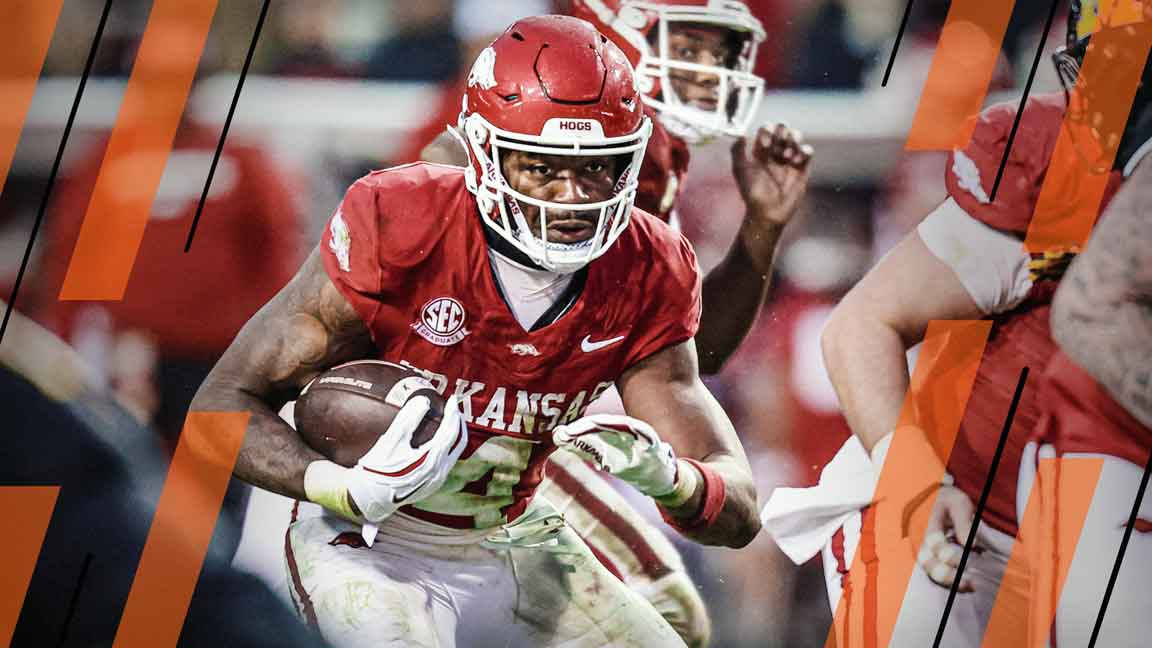
- The Las Vegas Raiders have a backup running back: Mike Washington Jr. landed with the Raiders, where he will likely be a handcuff, as well as a potential touchdown thief.
- Several veterans are safe: Several teams were expected to prioritize a running back, wide receiver or tight end in the early or mid parts of the draft, but didn’t, giving the current players on the depth chart a chance to improve.
- 2026 NFL Draft season is here: Try the best-in-class PFF Mock Draft Simulator and learn about 2026's top prospects while trading and drafting for your favorite NFL team.
The third day of the 2026 NFL Draft is in the books, and the fantasy football landscape is already shifting. Rounds 4 through 7 featured several key developments — from top rookies landing in strong situations to veterans facing new competition — that will impact draft boards this summer.
Here’s a breakdown of the biggest fantasy winners and losers after Day 3 of the 2026 NFL Draft.
Winner: RB Mike Washington Jr., Las Vegas Raiders
Washington’s statistics are in the middle of the pack for running backs in this class. His runs lasted for at least 10 yards on 18% of his carries in his final year, after jumping from one school to the next. However, he has the potential to be a great early down back.
He’s 6-foot-2 and 228 pounds, making him one of the biggest running backs in this draft class. The only running backs of that size or larger to see at least 1,000 snaps over the last eight seasons are Derrick Henry, Latavius Murray and Brian Robinson. Where Washington stands out is his speed relative to his height. He ran a 4.33-second 40-yard dash at the combine, and the tracking data backs up. He is the most athletic and best at accelerating in the draft class. Even without accounting for size, he is among the faster running backs of the draft class.
Washington lands with the Raiders, where he should have no problem earning the backup job behind Ashton Jeanty. Washington’s size could lead him to take goal-line touches from Jeanty, and at the very least, he will be the handcuff. There is a higher chance he has fantasy value over the two running backs drafted ahead of him.
Winner: Most Veteran Running Backs
The Arizona Cardinals, Tennessee Titans, New York Giants and Washington Commanders were all potential landing spots for Jeremiyah Love. The Cardinals landed him, while the Titans and Commanders didn’t add a running back until after pick 160, while the Giants didn’t address the position. This is good news for Tony Pollard, Cam Skattebo and Rachaad White, as they all project to lead their backfield in fantasy production.
Similarly, the Minnesota Vikings, Carolina Panthers and Jacksonville Jaguars all have backfield committees that could have been prioritized. The Vikings added Demond Claiborne at pick 198, which is no threat to Aaron Jones or Jordan Mason, while the other two didn’t add a running back.
Teams like the Indianapolis Colts, Dallas Cowboys and Cincinnati Bengals used late-round picks on running backs last season, but ended up not trusting them with much playing time. Those teams didn’t address the backup spot in free agency. The only one who drafted a running back was the Indianapolis Colts, adding Seth McGowan at pick 237. The lack of significant investment at running back will give D.J. Giddens, Jaydon Blue and Tahj Brooks a second chance.
There are still plenty of veteran running backs who are free agents who could shake up a backfield, but for now, there are several running backs who can move up the rankings because their roles are safer now than they were a few days ago.
Winner: WRs Tre Tucker, Jalen Nailor and Jack Bech, Las Vegas Raiders
There were several wide receivers taken over the first five rounds of the NFL draft, with most teams that had a large need at the position adding multiple rookies. Las Vegas was the one notable team that had a potential need at wide receiver, but didn’t significantly address the position. The Raiders drafted Malik Benson with the 195th overall pick, but he’s no threat to the top four players on the depth chart.
The Raiders had a great wide receiver duo at the start of the 2024 season in Davante Adams and Jakobi Meyers, but both were traded away. Tre Tucker, who started that 2024 season as the third wide receiver, served as the Raiders' top wide receiver at the end of last season.
Las Vegas spent two early picks on wide receivers last season in Jack Bech and Dont’e Thornton, but neither was able to maintain a starting job consistently. They were held to a combined 30 receptions.
The Raiders made one free agent addition in Jalen Nailor, who had been the Minnesota Vikings‘ third wide receiver. He is the highest graded wide receiver currently on the roster, but he’s never had a game of more than five receptions in his four NFL seasons.
There is still a chance the Raiders add a veteran or two to help bolster the wide receiver room, but for now, Nailor, Tucker and Bech all have a chance to become a favorite target for Fernando Mendoza.
Winner: TE Mark Andrews, Baltimore Ravens
The Ravens lost both Isaiah Likely and Charlie Kolar in free agency. Andrews averaged under 63% of offensive snaps each of the last two seasons because of Baltimore’s tight end rotation after playing over 80% of snaps during the peak of his career, when he was a top-tier fantasy tight end.
Baltimore added run-blocking tight end Durham Smythe in free agency, but had no other tight end on the roster heading into the draft. During the Ravens' pre-draft press conference, general manager Eric DeCosta suggested Baltimore would draft multiple tight ends.
Several tight ends were drafted earlier than expected, so Baltimore didn’t draft a tight end until the 133rd overall pick, with Matthew Hiber, who primarily played on special teams before transferring to SMU. He was 392nd overall on our big board. Baltimore then added Josh Cuevas at pick 173, who is more of a hybrid fullback. This makes it unlikely that any of the new tight ends will be a threat to Andrews’ playing time, and he should receive as much playing time as he can handle.
Loser: RB Ashton Jeanty, Las Vegas Raiders
As mentioned above, the Raiders have a new big backup in Mike Washington. Las Vegas has a new head coach in Klint Kubiak, who was just with the Las Vegas Raiders, where Zach Charbonnet (220 pounds) was consistently stealing goal-line touches from Kenneth Walker III (211).
Now, Kubiak has a back heavier than Charbonnet in Washington (223), and a back lighter than Walker in Jeanty (208). While Jeanty still has an opportunity to be among the league-leading backs in touches, a lack of goal-line touches will hurt his chances of finishing among the top-5 fantasy running backs.
Loser: RB J.K. Dobbins, Denver Broncos
Denver was the first team to select a running back in the fourth round, adding Washington’s Jonah Coleman.
Coleman stands out among running backs in this class for a variety of reasons. He is the third-highest graded runner of the top 20 running backs with a 95.1 PFF grade. His 4.3 yards after contact per carry are tied with Jeremiyah Love and Jadarian Price for the best in the class. Coleman’s is arguably more impressive, finishing with 1.3 yards before contact per carry, which were the lowest in the class. His 148 avoided tackles on carries are the most among running backs in the class. He has 249 pass-blocking snaps, which makes him the most experienced pass blocker of the top running backs of the class.
He is also a unique size for a running back, listed at 5-foot-9 and 220 pounds on Washington’s website, and weighed at 228 pounds at the combine. No current NFL running back weighs that much while being that short. Doug Martin is the best comparison to Coleman’s unique size, who has found success in the NFL in the last 20 years.
Denver utilized a three-person committee last season, with J.K. Dobbins as the bigger back, RJ Harvey as the change-of-pace back, and Tyler Badie as the third-down back. There are a few possibilities, including a four-person rotation, someone taking over third downs for Badie, or Denver choosing to go younger at running back and move on from Dobbins. Regardless, Denver could use Coleman at the goal line, hurting the value of both Dobbins and Harvey.

 © 2026 PFF - all rights reserved.