- The Seattle Seahawks have a two-man committee at running back: Zach Charbonnet and Kenneth Walker III split the backfield, making it harder to trust either running back in fantasy lineups until one player emerges.
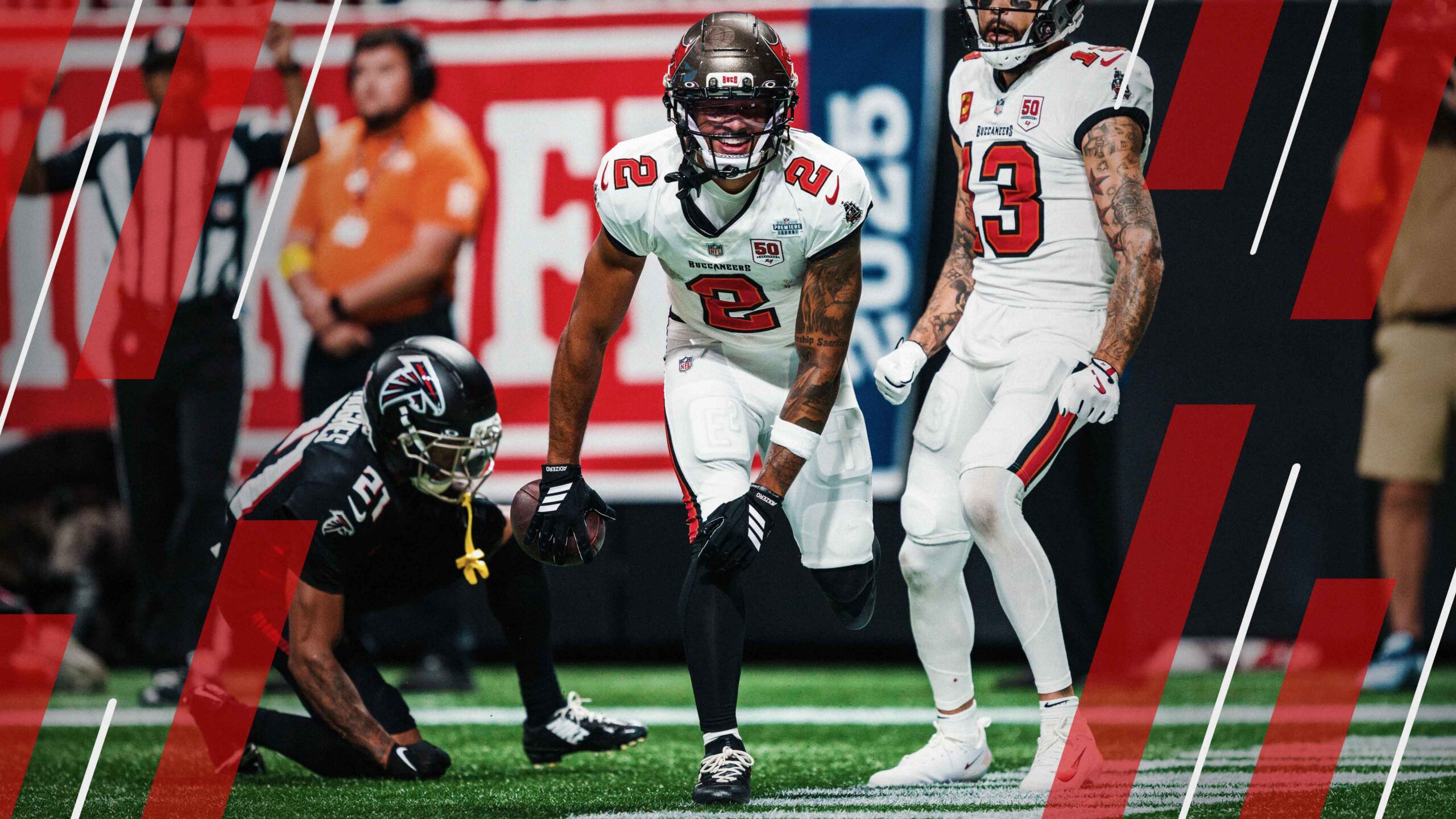
- Emeka Egbuka shines in his first game: The first-round rookie wide receiver already appears to be the top option in the Tampa Bay Buccaneers’ passing game.
- Unlock your edge with PFF+: Access Premium Stats, dominate fantasy with in-season tools and projections and make smarter bets with the new PFF Player Prop Tool.
Estimated Reading Time: 18 minutes

Welcome to PFF’s NFL Usage and Production Report—your one-stop for the fantasy football utilization you actually need. This hub pulls together snap counts, routes run, targets per route run (TPRR), carry share, red-zone usage, alignment, ADOT, time to throw, situational splits, fantasy points and so much more, so you can quickly spot role changes and act before your league does. Use it for waiver wire decisions, buy-low/sell-high trades, rest-of-season (ROS) rankings context, dynasty stashes, DFS builds, and prop research.
Below you’ll find the top 10 most crucial usage and production takeaways. If you want more details on these top 10 players, or any other quarterback, running back, wide receiver or tight end in the league, you can jump into the interactive tool right below. It’s the most comprehensive fantasy tool, providing information on how a player is utilized, their performance, and how the defense responds to them. You can view by player, team or position, sort any column, filter by week and snaps, and switch between totals and percentages to see the full picture on anything you’re looking for. You’ll also find all of the information found in the usual recap articles.
1. Zach Charbonnet cuts into Kenneth Walker III’s playing time
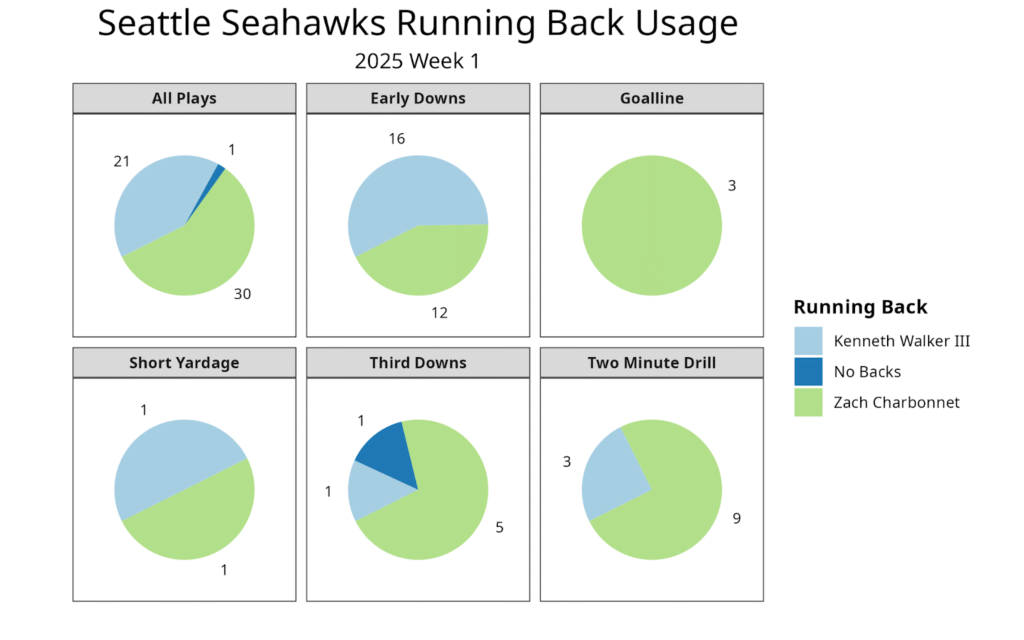
Charbonnet played more often in multiple situations compared to last season and led the team in carries, rushing yards and touchdowns.
The Seahawks' top two running backs from last season remain the same in Walker and Charbonnet. However, there has been reason to believe their rotation might be different from last season. The Seahawks have a new offensive coordinator, and Walker missed most of training camp due to injuries. Last season, Walker played at least 60% of Seattle's offensive snaps in all situations, except for third downs, where Charbonnet played over 80% of the snaps on the year.
The running back usage in this game was very different. Walker played 57% of the early-down snaps, which was a step down from last season. Charbonnet took the two-minute drill snaps back and also took the goal-line snaps. This led to a one-yard touchdown run. Charbonnet also averaged nearly twice as many rushing yards per carry as Walker. Charbonnet gained at least five yards on 50% of his carries, compared to a 20% rate by Walker.
There are reasonable arguments toward this backfield going in either running back's direction. Walker is coming back from injury and could both play better and more once he’s healthier. Charbonnet played better this week, which could earn him more playing time going forward. This will be a situation to watch. If one running back can take a firm hold of the backfield, they would have top-10 potential due to how much the Seahawks want to run the ball.
2. Travis Etienne Jr. shuts down all trade rumors
Etienne ran 16 times for 143 yards and caught three passes for 13 yards.
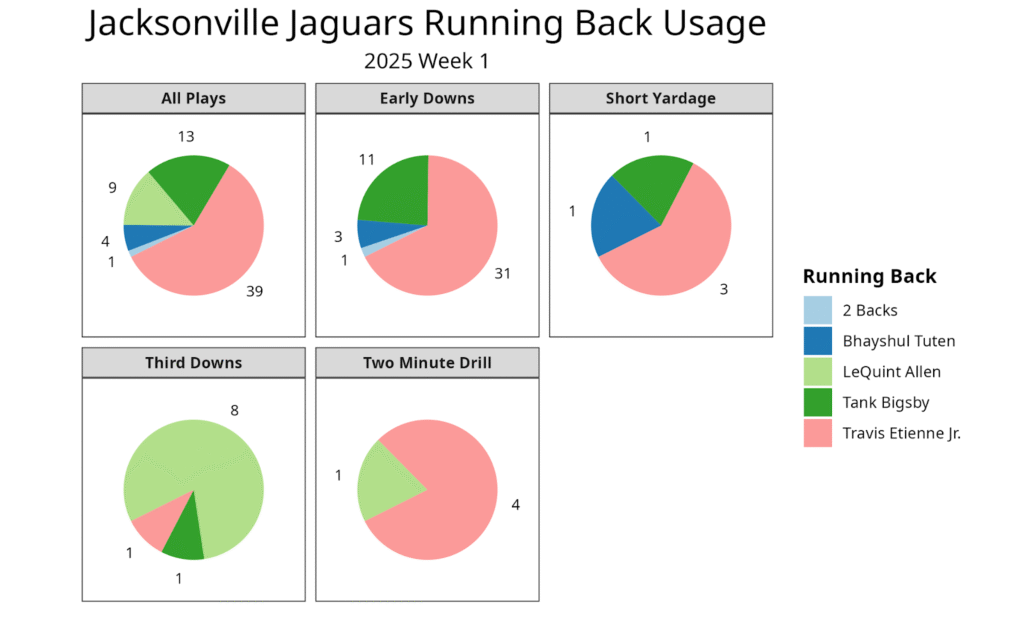
The Jaguars' backfield has been a constant source of conversation since Liam Coen became the head coach after the success he had with Bucky Irving with the Tampa Bay Buccaneers last year. Jacksonville retained Tank Bigsby and Travis Etienne Jr., who both started one preseason game, while adding rookie Bhayshul Tuten and LeQuint Allen Jr.
While it had seemed like Bigsby would be an early-down back while Etienne is a third-down back, it ended up being Etienne as the clear early-down back, playing 70% of the snaps in those situations. While Allen seemed to be fourth on the depth chart, he ended up winning the third-down role, playing 80% of the snaps in those situations. This left Bigsby and Tuten rarely seeing the field. Bigsby mixed in a little bit more late in the game, but that was likely to give Etinne a rest after gaining so many yards. While Etienne had the most yards per attempt and yards after contact per attempt on the team, he had the lowest rate of gaining first downs on his runs.
Etienne can return to being a fantasy starter if he continues playing in this role. Because this backfield seemed to be evolving throughout training camp and the preseason, it’s worth waiting to go all in on Etienne until we see this rotation continue for a few weeks. Allen should be left on the waiver wire, because third-down backs who aren’t the primary backup on early downs will rarely have fantasy value. I would wait at least a couple of weeks before releasing Bigsby or Tuten to see if this backfield evolves. In a month, if neither of them is playing much and Bigsby hasn’t been traded, then it would be worth cutting them. At this point, the best situation for everyone’s fantasy value here would be for Bigsby to get traded.
3. Breece Hall dominates despite rotating
Hall didn’t play as much as last season, but he ran 19 times for 107 yards and caught two passes for 38 yards.
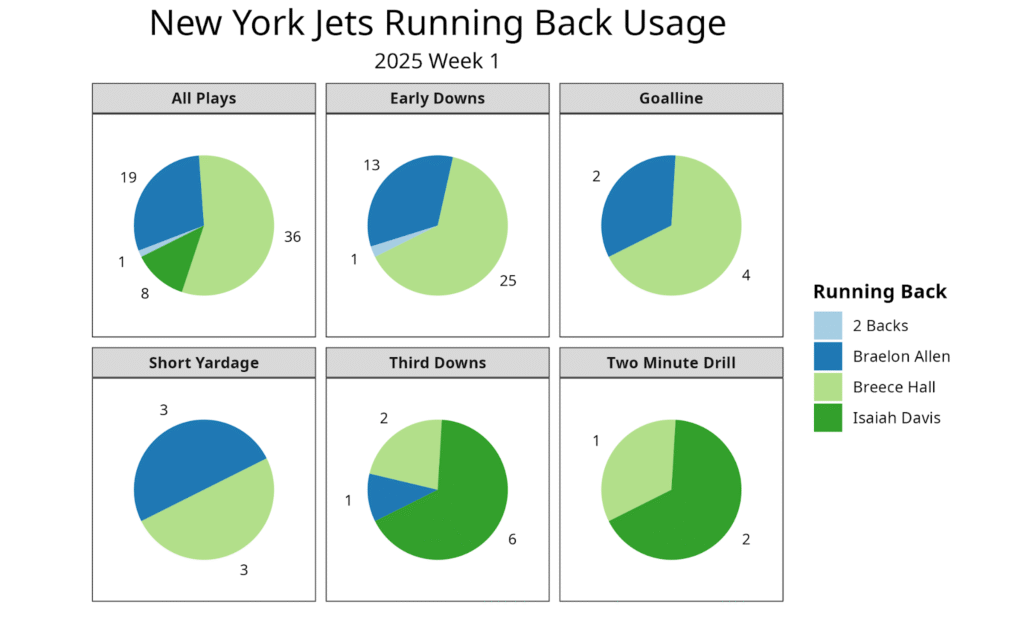
The Jets kept the same three players at the top of their depth chart from last season, including Hall, Braelon Allen and Isaiah Davis. Last season, Hall played 72% of New York's offensive snaps when healthy, while Allen played 27% and Davis played 10%. Hall played a clear majority of the early-down and passing-down snaps while playing roughly 55-60% of the short-yardage and goal-line snaps, and Allen taking a lot of that work.
The Jets' running back rotation was similar to their second preseason game. Hall led a two-man rotation with Allen on early downs, and Davis took the passing-down work. It was promising for Hall to see over half of the short-yardage and goal-line work combined, considering this is a situation where Allen typically excels. Hall had the second-best rate among all running backs this week in gaining 15 or more yards on his carries at a 15.8% rate. However, Allen ended up scoring a touchdown on an eight-yard run.
Hall can still be a fantasy starter playing 57.8% of New York's offensive snaps, but it will be much harder than in past years when he played a higher snap rate. If there is a game script where the Jets are falling behind, this could lead to a significant increase in Davis' snaps compared to this game, meaning much fewer snaps for Hall. He is someone I’d consider selling high for a running back with a more stable role.
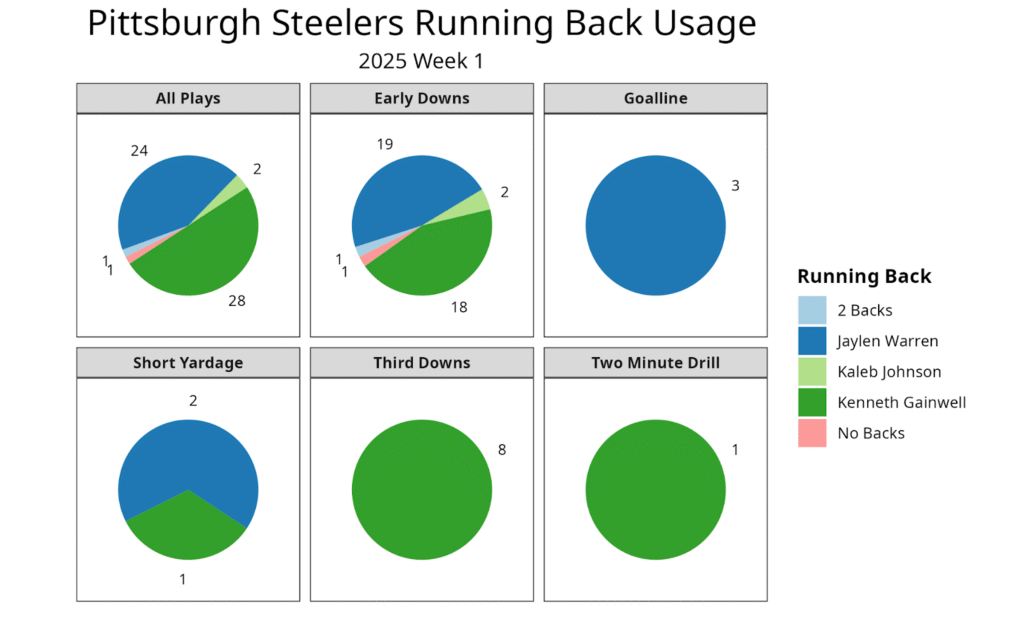
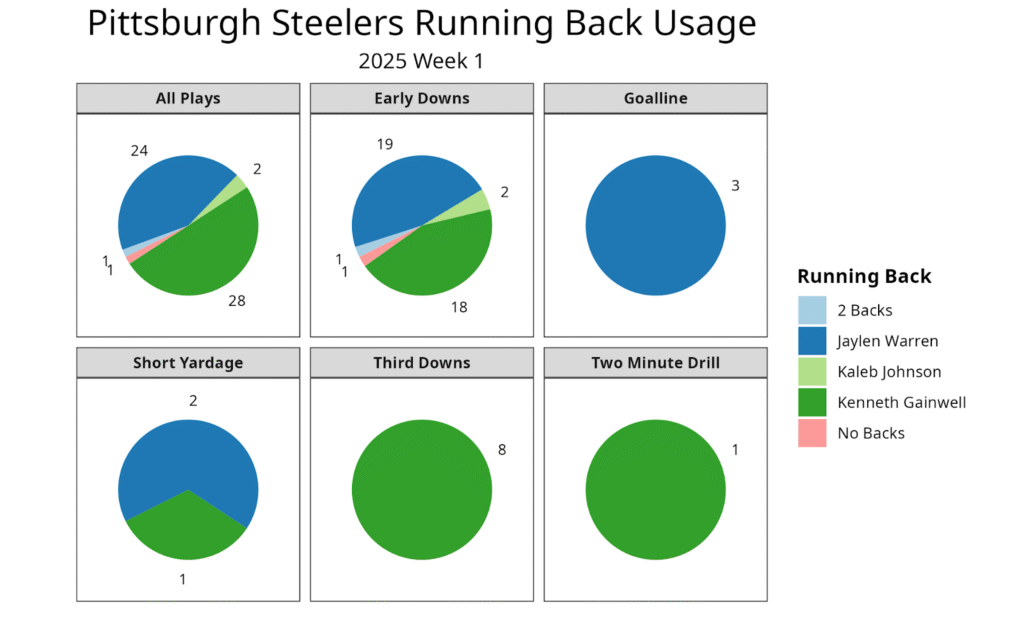
4. The Pittsburgh Steelers‘ surprising running back rotation
The preseason suggested Kenneth Gainwell would play significant snaps, but he surprisingly led the Steelers' running backs in offensive snaps.
The Steelers moved on from long-time starting running back Najee Harris this offseason, elevating Jaylen Warren to the starting lineup, while bringing in veteran Kenneth Gainwell and adding third-round rookie Kaleb Johnson. While most assumed that Johnson would be the early-down back while Warren was the receiving back, the preseason pointed toward Warren playing on early downs, while Gainwell plays on third downs, and Johnson was third on the depth chart.
Rather than a traditional two-man rotation with one player playing the clear majority of the early-down snaps and the other playing in passing situations, the backfield resembled Pittsburgh from last season. Warren took on the Harris role, and Gainwell took Warren’s role. Warren played a very slight majority of the early-down snaps, and he took all of the short-yardage and goal-line work.
Warren led the team in carries, which should continue going forward, and Warren scored the receiving touchdown, but Gainwell is a waiver-wire target. It’s at least possible that Gainwell earns a larger role going forward.
Johnson played two offensive snaps, both late into the third quarter. While you don’t want to give up on a rookie too early, it’s probably worth dropping him from most normal leagues or leagues with light benches. While he will probably see his role increase as the year progresses, that would simply lead to a three-man rotation. At best, it would be a two-man rotation, where Johnson is playing roughly half of the early-down snaps. This would be true even if one of the other two backs suffered an injury. There are plenty of other, better handcuff options worth rostering in case of an injury. In leagues with deeper benches, it’s fine to hold onto him just in case a best-case scenario happens.
5. Emeka Egbuka dominates in his first game: The Tampa Bay Buccaneers‘ first-round rookie caught four passes for 67 yards and two touchdowns in his first game.
The Buccaneers seemed set at wide receiver in March once the team re-signed Chris Godwin. Mike Evans has been their X receiver for over a decade, Godwin was back in the slot, and Jalen McMillan proved himself as the Z receiver by the end of last season. The team made a splash in the draft by adding Egbuka, who didn’t seem to have a clear path to a starting job. However, McMillan suffered a preseason neck injury that will cost him the first half of the season, while Godwin, who suffered a season-ending ankle injury in Week 7 last season, is expected to miss the first few weeks.
Evans and Egbuka were the top two receivers, as expected, while Shepard was typically the third wide receiver in three-receiver sets. The Falcons treated Evans and Egbuka as equals in terms of how much they double-covered the receivers, as well as how much help they gave their cornerbacks against each receiver. Instead of Tampa Bay having one consistent slot receiver, Egbuka and Shepard split the snaps from the slot. Even Evans had a 29.2% slot rate, which is something he surpassed only twice last season.
Egbuka is already someone who needs to be in fantasy starting lineups, at least until Godwin is back. Once Godwin is back, he will likely take Shepard’s snaps to start with. The situation will become more complicated once Godwin is closer to 100% and McMillan is back, but there is a chance Egbuka will prove they can’t take him off the field before that point.

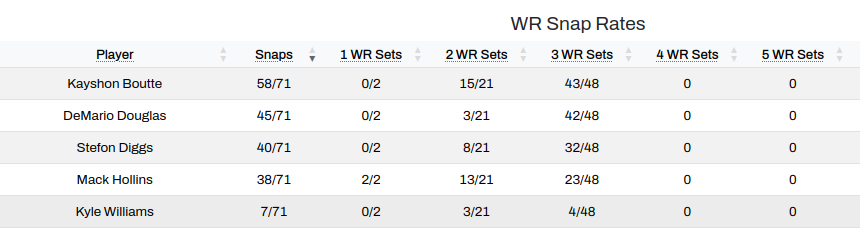
6. The New England Patriots utilized a clear wide receiver rotation
New England had four different receivers who all played significant snaps.
New England similarly made changes to their wide receiver room, retaining DeMario Douglas and Kayshon Boutte, adding free agents Stefon Diggs and Mack Hollins, drafting Kyle Williams in the third round and retaining undrafted rookie Efton Chism III, who was a healthy inactive in this game. It was clear during the preseason that Douglas would be the starting slot receiver. It was also clear there would be some kind of rotation on the outside, but it was unclear what that rotation would look like, particularly because Diggs didn’t play in the preseason.
Boutte, Diggs and Douglas were the primary receivers in three-receiver sets, while Boutte and Hollins were the primary receivers in two-receiver sets. This left Boutte as the Patriots' lead receiver, catching six passes for 103 yards. Boutte’s 2.64 yards per true route were the fourth-best among all wide receivers this week. This makes Boutte at least worth considering off the waiver wire, as any wide receiver with 100 yards after Week 1 is worth considering. It’s probably that Diggs will play more as he gets more comfortable with the team, but it’s also possible he remains in a rotation. It will be much harder to trust him in fantasy starting lineups if he’s not playing the majority of two-tight-end sets.
It’s also worth noting that Williams appears to be a distant fifth on the depth chart. While it’s possible he can surpass Hollins at some point, it seems unlikely that he will surpass Boutte or Diggs, which would be necessary for Williams to have any fantasy value this season.
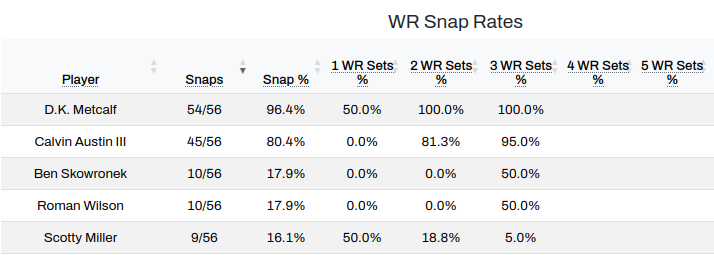
7. The Pittsburgh Steelers have a clear WR2, but not a WR3
Calvin Austin III caught four passes for 70 yards and a touchdown, making him Pittsburgh's second wide receiver option.
Pittsburgh swapped out X wide receivers this offseason, trading away George Pickens and trading for D.K. Metcalf. They also moved on from starter Van Jefferson, leaving the door open for one more spot with the starters. Based on the preseason, that competition was wide open. After cut-down day, that was only a battle between Roman Wilson, Scotty Miller and Ben Skowronek.
Austin was the presumed WR2, but he missed some time in the preseason due to injury. However, this game made it very clear that there is a gap between him and the other three receivers. Scotty Miller was both Metcalf and Austin' III's backup, while Skowronek and Wilson split time in 11 personnel. Typically, Skowronek was in the slot and Austin was out wide when Skowronek was on the field, while Wilson was out wide and Austin played in the slot when Wilson was on the field.
Austin is worth a waiver-wire add at this point. While Austin didn’t have as many receiving yards as Metcalf, he achieved his production despite cornerbacks getting help on Austin twice as often as Metcalf did. Aaron Rodgers has a long history with wide receivers who can play both out wide and in the slot, and Austin is the Steelers' only wide receiver who fits that description. If Rodgers keeps playing as well as he did in this game, then Austin could be a fantasy starter in the right matchups.
8. Monitor Brock Bowers’ health
Bowers suffered a knee injury early in the fourth quarter and didn’t return.
The Raiders retained their top two tight ends from last season in Brock Bowers and Michael Mayer. Over the last five weeks of last season, Bowers played 92% of Las Vegas' offensive snaps to Mayer's 73%. Bowers was playing 74% of the snaps out of 11 personnel on early downs compared to 83% on third downs, while the two were almost always on the field together in two-tight-end sets. The preseason suggested that Mayer could be cutting into Bowers’ snaps in 11 personnel, particularly on early downs.
Those playing time concerns played out over the first three quarters, where Bowers played in 32 of a possible 45 snaps. Bowers was pretty consistently on the field in two- and three-tight-end sets, but he only played 15 of 27 snaps in 11 personnel over the three quarters. He was consistently on the field on third downs and during the two-minute drill. The Raiders had eight third downs and seven snaps in two-minute drills.
On 14 snaps out of 11 personnel on early downs, outside of the two-minute drill, Bowers played three snaps, Mayer played seven, and Ian Thomas played four. Typically, teams will run more plays out of 11 personnel on early downs outside of the two-minute drill than third down or two-minute-drill plays combined. This means we should expect Bowers’ snap rate to be even lower than it was in the first three quarters of this game.
Bowers suffered a knee injury in the fourth quarter and didn’t return. It does not sound like it will be a long-term injury, but there is a chance it could impact him in the short term. Bowers caught five passes for 103 yards with multiple big plays against the Patriots defense. He gained 4.29 yards per true route, which was the second-best mark by a tight end this week, but that should regress in future weeks. He averaged 2.11 yards per true route last season, which was fifth-best for tight ends. He remains a must-start option despite the playing time, but there will be some games where his stat line won’t live up to his reputation because he’s running fewer routes.
9. Harold Fannin Jr. emerges as a tight end option
Fannin led the Cleveland Browns in targets, catching seven passes for 63 yards.
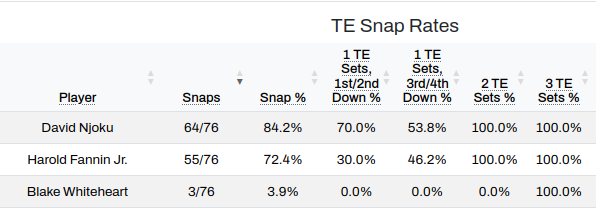
David Njoku has spent the last three years as a top-eight fantasy tight end on a per-game basis. While a big part of that is his talent, it’s also been a lack of competition for playing time or targets. He played at least 86% of Cleveland's offensive snaps in four of his last five games last season. That could be in danger this season, as Cleveland spent a fourth-round pick on Fannin.
Fannin played nearly as many snaps as Njoku in most situations. They shared the field for all two- and three-tight-end sets while splitting the third downs out of 11 personnel. The difference was 11 personnel on early downs, where Njoku played 70% of the snaps to Fannin's 30%.
It is rare for a team to use 12 personnel instead of 11 consistently. While this game wasn’t a significant drop in snaps for Njoku, there is a chance he will see a more notable drop if the Browns stop using as much 12 personnel. It also seems likely that Fannin will play more as the season progresses based on how well Fannin has played this season. Fannin was open on 57.1% of routes against single coverage, which was top-10 among tight ends. That was not only better than Njoku this week, but better than 70% of Njoku’s games last season. Njoku is in the last season of his contract, so it’s at least possible that the Browns trade Njoku. While I wouldn’t want to risk putting Fannin in my fantasy starting lineup yet, he is well worth a waiver-wire pickup to see how this situation plays out.
10. Monitor Evan Engram’s health
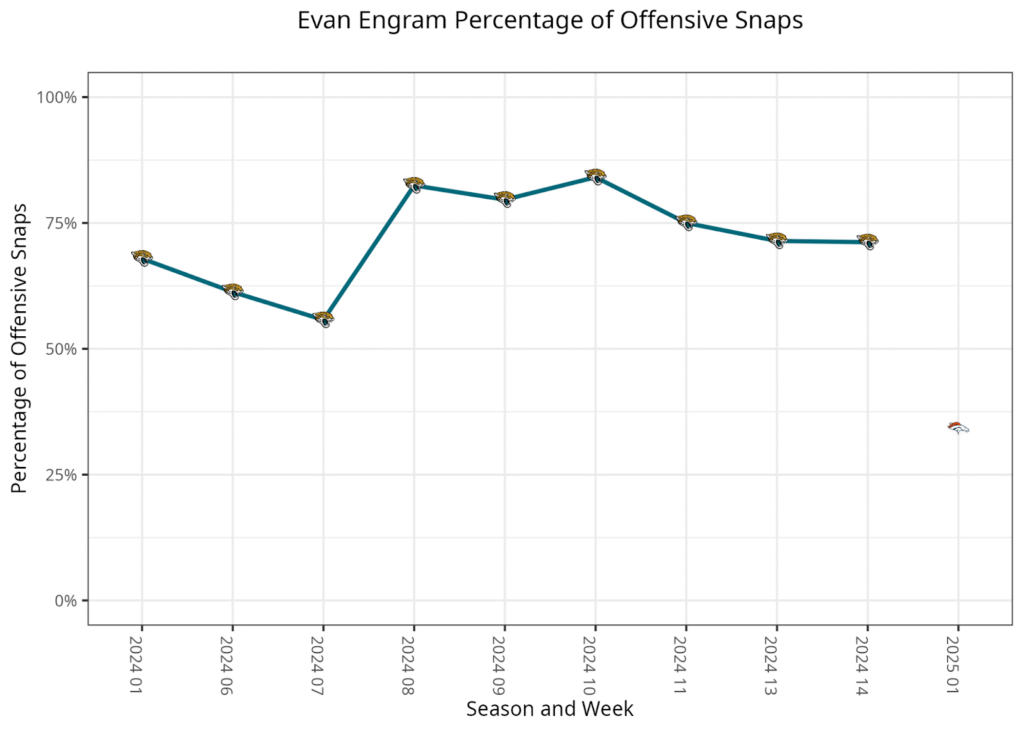
Engram suffered a calf injury. He tried to return for one play in the fourth quarter but decided against playing again after that play.
The Broncos' tight ends have not been on fantasy radars in any league size in the first two years of Sean Payton being the head coach. That changed this off-season, when the team added Engram from the Jacksonville Jaguars. Engram played 33 of 54 snaps in the preseason when both he and Adam Trautman were playing, while Trautman took 27 snaps, suggesting this would remain a heavy rotation.
The Broncos continued their rotation through the first three quarters of this game. Engram only played in 25 of a possible 57 snaps, running a route on 17 of 35 pass plays. It is near-impossible to have fantasy value at tight end running a route on less than 50% of the team's pass routes. He caught three passes for 21 yards.
Part of the problem is that Lucas Krull was also part of the rotation, which wasn’t the case in the preseason. Engram’s only snap in a two-tight-end set was out of 02 personnel. The Broncos used 12 personnel for 10 plays in the first three quarters, and Trautman and Krull were the two tight ends for all 10 of those plays.
While Engram was drafted to be a fantasy starting tight end, it’s not out of the question to drop him, particularly if he misses time due ot the calf injury.
Links to other resources
If you’re looking for a more specific resource to help you with your fantasy decisions, check out
- NFL Week 2 fantasy football waiver wire targets 2025
- NFL Week 1 Game Recap: Immediate fantasy football takeaways from Thursday's game
- NFL Week 1 Game Recap: Immediate fantasy football takeaways from Friday's game
- NFL Week 1 Game Recap: Immediate fantasy football takeaways from Sunday’s games

 © 2026 PFF - all rights reserved.