
- Unlock your edge with PFF+: Access Premium Stats, dominate fantasy with in-season tools and projections and make smarter bets with the new PFF Player Prop Tool. Get 25% off your PFF+ annual subscription with code PFFFANTASYPODCAST25.
Estimated Reading Time: 6 minutes

Fantasy and DFS enthusiasts, bettors and analysts often rely on a wide array of statistics and models to gain a competitive edge. These range from basic box score stats to advanced metrics available in PFF's Premium Stats 2.0 and models like Josh Hermsmeyer‘s Buy Low model and WOPR (Weighted Opportunity Rating).
There is always room for new insights and analyses to help bettors and fantasy managers refine their strategies. That’s why I developed a new metric that offers several advantages over WOPR. Click here for an in-depth explanation of the model, my process and its advantages.
Week 4 Recap
- Garrett Wilson: WR10 – 20.2 PPR points
- DeVonta Smith: WR66 – 4.9 PPR points. The Eagles had zero passing yards in the second half. DeVonta Smith was open plenty, as he appears in this week’s “Coach, I Was Open” article as well.
- Justin Jefferson: WR8 – 22.6 PPR points
- Chris Olave: WR31 – 11.0 PPR points
- A.J. Brown: WR85 – 2.7 PPR points. The Eagles had zero passing yards in the second half, and A.J. Brown received eight targets for the game. Only two of his targets were considered catchable.
- Drake London: WR5 – 25.0 PPR points
- Jalen Nailor: WR52 – Scored a TD and 2-point conversion. Jordan Addison’s return caused Nailor to fall to the WR3 on the depth chart.
- Darnell Mooney: Injured in the second quarter.
Potential Breakouts: Week 5
As a quick refresher on how regression-to-the-mean models work: A player’s fantasy points per game (FPpG) are projected based on their three-week PWOPR average (explained more here). For this week’s projections, only two weeks of 2025 data is available and is used accordingly.
PWOPR is significantly more stable than FPpG and serves as a stronger indicator of future performance. To help identify potential breakout candidates, the residual is calculated by subtracting a player’s predicted FPpG from their actual FPpG. Players with a strong PWOPR and a residual of -3.0 or lower are included on this list. Players remain on the list until one of the following conditions is met:
- They fulfill their PWOPR potential with a big game
- Their PWOPR decreases to match their expected FPpG
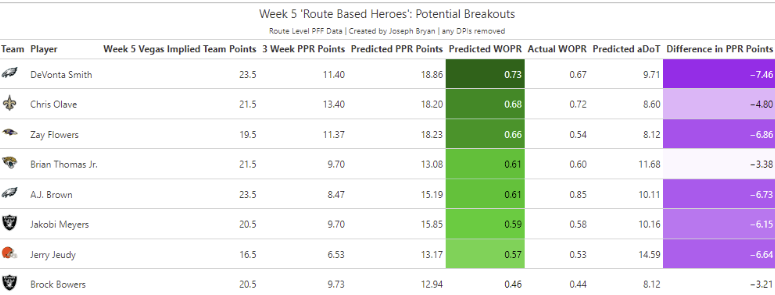
If the Eagles’ passing attack continues to struggle, A.J. Brown and DeVonta Smith are going to be weekly additions to this list. They are awesome at getting open and one of the best duos in the league. A.J. Brown has the fifth-best actual WOPR and the 12th-best PWOPR, while DeVonta Smith holds the 33rd-best actual WOPR and the second-best PWOPR.
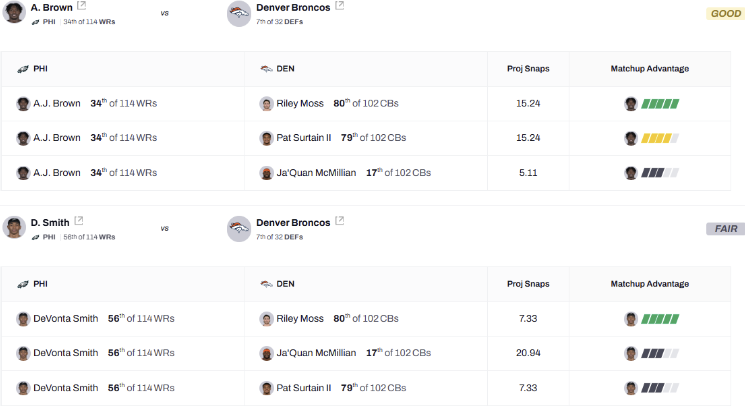
These are elite numbers for both receivers who face the Broncos in Week 5. Shockingly, the Broncos have the eighth worst team coverage unit by PFF grade, but they do boast the ninth-best team pass-rush grade. The Broncos play the fifth-highest rate of Cover 1, but still run various zone coverages around 57% of the time.
PFF’s Matchup Tool has this rated as a good matchup for A.J. Brown and a fair matchup for Smith. There is a good chance that Pat Surtain II will shadow A.J. Brown, which might allow Smith to have a big game.
Chris Olave owns the second-most targets in the NFL with 41, the 10th-highest WOPR and the seventh-best PWOPR. Those are all elite numbers, but the Saints have mostly struggled to score this year, even with a pretty aggressive passing offense. Spencer Rattler has attempted the fourth-most passes in the NFL and sports a 62.4 PFF passing grade.
The Saints play the man-coverage heavy Giants this week. The Giants are the only team so far this season to play more man coverage than zone coverage. Olave sees a two-point increase in THREAT when facing man coverage as opposed to zone coverage, as his THREAT increases from 26.6% to 28.6%.
The Giants field the 16th-ranked coverage unit and fifth-ranked pass rush unit by PFF grade. Rattler has only had 37 dropbacks versus man coverage this season and has earned a respectable 76.6 PFF grade (ninth in the NFL) in those situations.
Zay Flowers owns the 10th-best PWOPR in the NFL in what is normally one of the best offenses in the NFL. Assuming Lamar Jackson is out for Week 5, Cooper Rush is a serviceable backup, and the Texans’ defense is a bottom-10 coverage unit and ranked as the 14th-best run-defense unit. The Texans run a very high amount of zone coverage (82.0%), and Flowers sees a large decrease in THREAT when facing zone. This could be a tough matchup for Flowers to have a big game.
Brian Thomas Jr. might be the most exciting name to see on this list for fantasy fans. The second-year wideout is currently the WR44 in fantasy points per game but 11th in PWOPR. The entire point of this model framework is to identify players who have a good PWOPR — which is more stable than FPpG — and a low FPpG. FPpG typically will rebound to meet PWOPR’s expectation given a good enough offensive environment.
Thomas and the Jaguars have a very tough matchup this week against the Kansas City Chiefs. The Chiefs rank No. 1 as a coverage unit and have the fifth-best quick pressure rate in the NFL. The Chiefs mostly play zone coverage and are the best team in the NFL when they choose to play man coverage. These coverage matchups do not mean it’s impossible for Thomas to break out this week, but it does mean it will be a more difficult journey.
Jakobi Meyers and Brock Bowers face the Colts, who mostly run zone coverage and are one of the worst teams in the NFL when deploying man coverage. Indianapolis has been the eighth-worst team in PFF coverage grade when a tight end is being targeted, and slots as the eighth-worst team in yards per reception when tight ends are thrown to.
Meyers sees a .04 increase in his THREAT when playing zone coverage, which the Colts use around 71% of the time. Overall, Indy owns the 10th-worst team PFF coverage grade.
Lastly, the Colts’ offense has been spectacular this season. Per Timo Riske’s Week 5 review, they have the second-best offensive strength and best passing strength. They could easily push the Raiders into a pass-first gameplan.
Lastly, Jerry Jeudy, Dillon Gabriel and the Browns face the Vikings in London this week. Gabriel is a big unknown, but we do know that Brian Flores and the Vikings have a complex defense that can certainly rattle a rookie QB in his first game. The Vikings boast the fourth-best quick pressure rate and No. 1 pass blitz rate. This is an incredibly tough first start for Gabriel, and should be a big challenge for the Browns’ offense in general.
As always, not every player on this list will break out. But on average, players on this list score more fantasy points, score more touchdowns and earn more targets over the course of a season.

 © 2026 PFF - all rights reserved.