
- Jaylen Warren‘s ranking would skyrocket without touchdowns included: The Steelers star would move from RB13 to RB4 when negating scores.
- The cream still rises to the crop: Superstars like Jaxon Smith-Njigba and Jahmyr Gibbs would still boast tremendous outputs even if their touchdowns were removed.
- Inflation can be real: Players like Pat Freiermuth and Derrick Henry have benefited immensely from scoring.

Offer valid for new subscribers on annual plans only
Touchdowns can turn an ordinary fantasy afternoon into something worth screenshotting. They can also conceal how little a player has produced between trips to the end zone.
To examine that dependence, we removed six points for every rushing or receiving touchdown from each running back, wide receiver and tight end’s PPR total, then recalculated the positional rankings. Receptions and yardage, including those on scoring plays, remain. These are cumulative rankings rather than points-per-game comparisons.
The results reveal some substantial changes. They also show why dependence on touchdowns and undeserved production are different questions.
The elite keep their statuses
Jaxon Smith-Njigba has scored 10 receiving touchdowns, but confiscating those 60 points still leaves him with 202.6. He remains WR1, comfortably ahead of CeeDee Lamb’s adjusted 174.0.
Smith-Njigba’s 79 receptions and 1,207 receiving yards have created a substantial foundation beneath the scoring. A 93.9 PFF receiving grade and 3.81 yards per route run, both first among qualifying wide receivers, reinforce how well he has performed.
Jahmyr Gibbs passes the same inspection. Removing his 13 touchdowns reduces his total from 257.4 to 179.4, but he remains an RB1 and would be the RB6 overall.
Gibbs has combined 1,000 rushing yards with 41 catches for another 384 yards. His 85.6 PFF rushing grade and 90.5 PFF receiving grade reflect the different ways he has contributed. Taking away the touchdowns leaves plenty of production behind.
Jaylen Warren climbs into the top four
Warren makes one of the biggest moves, rising from RB13 to RB4. His three touchdowns account for only 18 of his 151.9 points, leaving an adjusted 133.9.
He has accumulated 1,039 scrimmage yards, including 320 receiving yards on 30 catches. His 90.5 PFF rushing grade leads qualifying running backs, supporting the quality of that production.
The comparison with D’Andre Swift is revealing. Swift has scored 157.8 points, just 5.9 more than Warren, despite adding seven additional touchdowns. Remove both players’ touchdown points, and Warren leads 133.9 to 97.8.
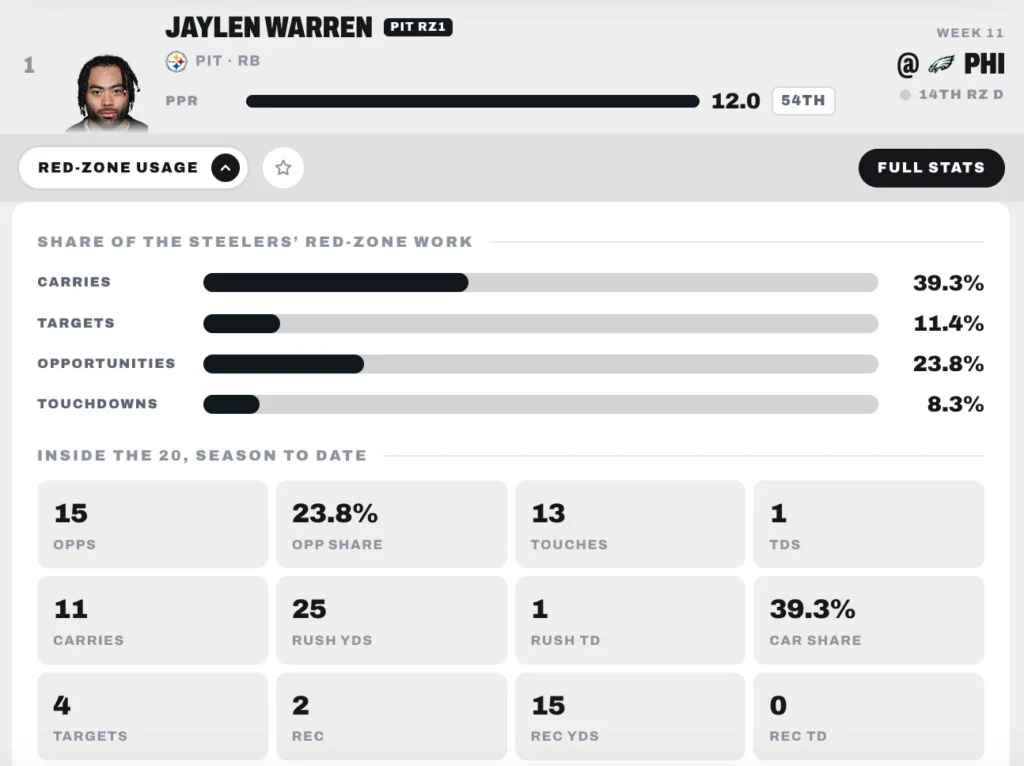
However, Warren has received only three carries inside the 5-yard line. His strong production away from the end zone supports his fantasy usefulness, while that limited goal-line involvement helps explain why the touchdowns have been scarce.
Derrick Henry and D’Andre Swift have paid for valuable real estate
Derrick Henry falls from RB11 to RB17 after losing the 66 points supplied by his 11 touchdowns. Those scores account for 40.9% of his 161.4-point total.
Meanwhile, Swift drops from RB12 to RB16, with touchdowns responsible for 38.0% of his production.
Both have built significant value around their work near the goal line. Henry has converted 19 carries inside the 5 into nine touchdowns, and Swift has posted exactly the same figures.
Those assignments deserve weight in any evaluation. Henry’s 162.7 expected fantasy points actually exceed his 161.4 scored, while Swift has produced 157.8 against 166.6 expected. Their scoring dependence has come with substantial opportunity.
For fantasy managers, the vulnerability emerges if those valuable carries become less frequent. The adjusted rankings show how much less production has come from the rest of their workloads.
Drake London’s receiving work deserves more credit
London rises from WR15 to WR10 when his lone touchdown is removed. His adjusted 130.5 points underline how much he has contributed through catches and yardage.
He has caught 50 passes for 801 yards, earning an 87.1 PFF receiving grade and averaging 2.71 yards per route run. Touchdowns have supplied just 4.4% of his 136.5 PPR points.
That makes him an interesting player to assess beyond his overall ranking. His receiving output has held value even without repeated scoring.
However, London has drawn only two end-zone targets. Any expectation of a touchdown surge should account for that usage. His existing yardage and receiving performance provide firmer reasons for confidence.
Start your free trial of PFF Pro today!
Tight end offers the sharpest warning
Pat Freiermuth’s six touchdowns, five receiving and one rushing, have helped him reach TE10 with 90.5 points. Negating those scores leaves 54.5 and drops him to TE23.
His 27 receptions for 270 yards have provided a relatively modest base, accompanied by a 65.2 PFF receiving grade and 1.09 yards per route run. Yet almost 40% of his fantasy production has arrived through touchdowns.
Trey McBride provides the opposite example. His five touchdowns disappear, but his adjusted 141.5 points still lead all tight ends. His 78 receptions alone have generated more points than Freiermuth’s entire adjusted total.
When evaluating second-half trades and lineup choices, look at both the production beneath the touchdowns and the opportunities supporting them. Warren’s receiving work and London’s yardage offer useful protection. Henry’s goal-line role has its own value. Freiermuth’s smaller receiving workload leaves considerably more riding on the next scoring opportunity.

 © 2026 PFF - all rights reserved.