- Get PFF+ for 30% off: Use promo code HOLIDAY30 to unlock the PFF Player Prop Tool, Premium Stats, fantasy dashboards, the PFF Mock Draft Simulator, industry-leading fantasy rankings and much more — everything you need to win your season.

Fantasy and DFS enthusiasts, bettors and analysts often rely on a wide array of statistics and models to gain a competitive edge. These range from basic box score stats to advanced metrics available in PFF's Premium Stats 2.0 and models like Josh Hermsmeyer‘s Buy Low Model and WOPR (Weighted Opportunity Rating).
There is always room for new insights and analyses to help bettors and fantasy managers refine their strategies. That’s why I developed a new metric that offers several advantages over WOPR. Click here for an in-depth explanation of the model, my process and its advantages.
Week 13 Recap
- Ja’Marr Chase: WR13 – 18.0 PPR Points
- Kyle Pitts: TE5 – 15.2 PPR Points
- Quentin Johnston: WR29 – 11.3 PPR Points
- Jordan Addison: WR39 – 8.6 PPR Points
- Emeka Egbuka: WR40 – 8.2 PPR Points
- D.K. Metcalf: WR53 – 6.2 PPR Points
- Jerry Jeudy: WR57 – 5.6 PPR Points
- Tre Tucker: WR61 – 5.0 PPR Points
- Van Jefferson: WR61 – 5.0 PPR Points
- Parker Washington: WR74 – 3.6 PPR Points
- Zay Flowers: WR77 – 2.6 PPR Points
- Justin Jefferson: WR79 – 2.9 PPR Points
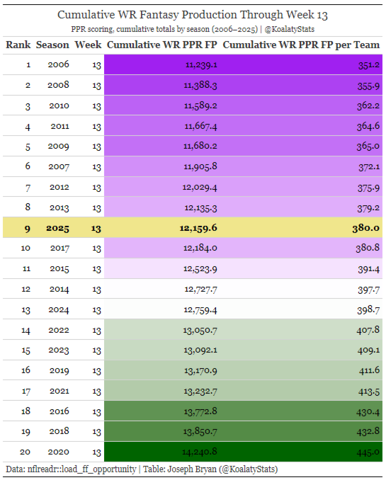
Since 2006, the 2025 season ranks ninth-lowest in cumulative wide receiver fantasy points through Week 13 and the worst since 2013. Defenses have reduced wide receiver efficiency, while offenses have shifted opportunity toward tight ends.
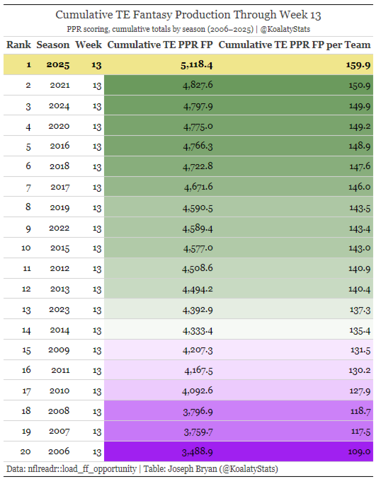
The transition to heavier personnel has also likely been a huge benefit toward the tight end position. This season’s cumulative tight end fantasy total is the highest since 2006.
Potential Breakouts: Week 14
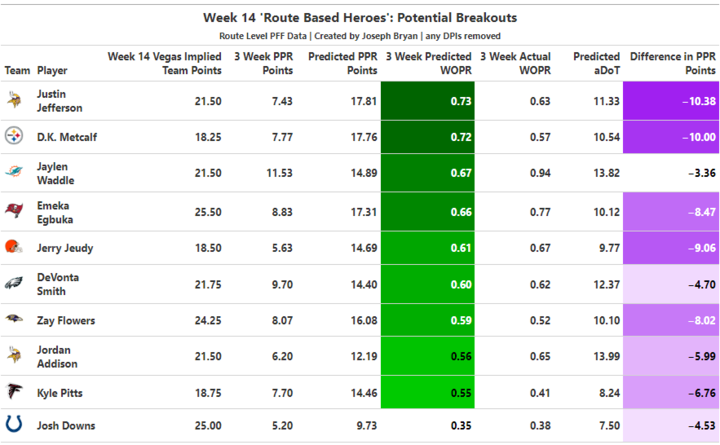
PWOPR is significantly more stable than FPpG and serves as a stronger indicator of future performance. To help identify potential breakout candidates, the residual is calculated by subtracting a player’s predicted FPpG from their actual FPpG. Players with a strong PWOPR and a residual of -3.0 or lower are included on this list. Players remain on the list until one of the following conditions is met:
- They fulfill their PWOPR potential with a big game
- Their PWOPR decreases to match their expected FPpG
WRs Justin Jefferson & Jordan Addison, Minnesota Vikings vs. Washington Commanders
Based on Justin Jefferson’s incredible PWOPR (seventh-best), and very solid actual WOPR, he should be scoring 17.81 PPR points per game. Jefferson currently holds the largest deficit between predicted PPR points and actual PPR points in the league.
This is an excellent matchup for the Vikings’ wide receiver group. Per PFF Premium Stats, the Commanders have the worst team PFF coverage grade and the 11th-worst team PFF pass-rush grade. Washington also allows the ninth-highest open-target rate to wide receivers.
Quarterback play has limited this Minnesota passing game. If there is a matchup that could spark optimism for improvement, this is it. The Commanders’ defense is favorable at every level, which should allow for more accurate throws and potential explosive plays for both Jefferson and Jordan Addison.
WR D.K. Metcalf, Pittsburgh Steelers vs. Baltimore Ravens
Metcalf has remained one of the league’s most efficient receivers by PWOPR (4th-best), but his fit within Pittsburgh’s offensive structure continues to cap his weekly ceiling. The Steelers operate out of heavy personnel at the second-highest rate, a look that usually benefits a true WR1. For context, Seattle uses those same groupings (seventh-highest rate) to create vertical opportunities, as the Seahawks posted the highest deep-attempt rate in the league from heavy sets.
Meanwhile, Pittsburgh sits near the bottom in deep-attempt rate from heavy (eighth-lowest), which removes many of the routes and concepts that Metcalf has historically converted into explosive plays. This coincides with Aaron Rodgers’ quick time to throw (sixth-fastest), and is a real problem for Metcalf’s production.
Baltimore provides a neutral to slightly favorable matchup for outside receivers, but Metcalf will continue to struggle if these underlying offensive trends continue.
WR Jaylen Waddle, Miami Dolphins vs. New York Jets
Since Tyreek Hill’s injury, Waddle has surged in PWOPR with a 0.602 mark (16th-best). The Week 14 matchup is favorable.
Per PFF Premium Stats, the Jets rank as the sixth-worst team PFF coverage unit and allow the 10th-most yards per reception to opposing wide receivers. Even after the Sauce Gardner trade, New York plays the third-highest man-coverage rate, a look where Waddle and Tua Tagovailoa have historically excelled.
This season, Waddle earns a 23.8% THREAT versus man with a 74.2 PFF grade. These metrics allow for a high-floor, high-ceiling situation for Waddle in Week 14.
WR Emeka Egbuka, Tampa Bay Buccaneers vs. New Orleans Saints
Over the past month, Egbuka ranks third among wide receivers in targets, yet sits 14th in receiving yards and 11th in receptions. The Saints are a favorable efficiency spot. New Orleans permits the sixth-highest open-target rate to wide receivers and has a bottom-five pass-rush unit.
On a broader note, Egbuka’s rookie season has yielded a 30th-percentile PFF grade and a 23rd-percentile grade against single coverage, but an 81st-percentile yards per route run mark. These point to a receiver who is being schemed open within the structure of the offense. Against a defense that concedes space to the wide receiver position and does not consistently pressure the quarterback, Tampa Bay’s system is well-positioned to convert Egbuka’s volume into production.

WR Jerry Jeudy, Cleveland Browns vs. Tennessee Titans
The Titans carry the eighth-lowest PFF coverage grade versus wide receivers and the ninth-lowest overall team coverage grade. Over the last month, Tennessee has faced the 12th-highest opponent pass rate and has yielded a league-average open-target rate to wide receivers. The market projects a very low total for this game at 33.5.
Per PFF Premium Stats, among wide receivers with at least 50 targets, Jeudy possesses the lowest PFF receiving grade this season. In a low-total environment with a defense that is slightly favorable toward wide receiver matchups — and a quarterback with the second-lowest projected passing yards in Week 14 — his range of outcomes skews modest.
WR DeVonta Smith, Philadelphia Eagles vs. Los Angeles Chargers
Smith ranks sixth in PWOPR for the season, but A.J. Brown has pulled ahead over the past month: Brown’s PWOPR is .640 over that span, compared to .600 for Smith. The box score has reflected that, with two games over 25 PPR points for Brown and none for Smith.
However, the Chargers’ defense better fits Smith’s profile as a receiver. Los Angeles plays the fourth-highest zone rate. Against zone, Smith leads the team in THREAT at 21.5% and owns a 78.6 PFF grade.
Over the last month, opponents have leaned into the run against the Chargers with the seventh-highest run rate faced. But if Philadelphia reaches even league-average passing volume, Smith should see a solid performance.
TE Kyle Pitts, Atlanta Falcons vs. Seattle Seahawks
After a top-five tight end finish in Week 13, Pitts returns with continued positive-regression signal. In Kirk Cousins‘ starts this season, Pitts has led the Falcons in targets in all three games.
However, the matchup in Week 14 is very difficult. Per Premium Stats, Seattle owns the fourth-best team PFF coverage grade and the 10th-best team PFF pass-rush grade.
The Seahawks generate the third-highest pressure rate, and in games with Cousins, Pitts leads the team in THREAT when the quarterback is pressured at 20.7%. Seattle has also allowed the third-most targets to tight ends while holding the position to an average open-target rate.
Overall, this is a good matchup for Pitts, but an awful situation for the Falcons’ offense as a whole.
WR Josh Downs, Indianapolis Colts vs. Jacksonville Jaguars
Jacksonville plays the 10th-highest zone coverage rate, both season-to-date and over the past month. Downs shows a clear split by coverage. Against man, he leads the team in THREAT at 30.9%, but against zone, he ranks third on the team in THREAT at 21.6%. The latter is solid, but not quite as impressive as his man coverage THREAT.
The Jaguars carry the sixth-best team PFF coverage grade and the 12th-best grade against wide receivers. It is a somewhat challenging individual matchup, but Downs’ usage remains sticky. Expect a stable target share with most of his work arriving on zone beaters and underneath leverage wins.

 © 2026 PFF - all rights reserved.