
- Unlock your edge with PFF+: Access Premium Stats, dominate fantasy with in-season tools and projections and make smarter bets with the new PFF Player Prop Tool. Get 25% off your PFF+ annual subscription with code PFFFANTASYPODCAST25.

Fantasy and DFS enthusiasts, bettors and analysts often rely on a wide array of statistics and models to gain a competitive edge. These range from basic box score statistics to advanced metrics available in PFF's Premium Stats 2.0, as well as models such as Josh Hermsmeyer‘s Buy Low model and WOPR (Weighted Opportunity Rating).
There is always room for new insights and analyses to help bettors and fantasy managers refine their strategies. That’s why I developed a new metric that offers several advantages over WOPR. Click here for an in-depth explanation of the model, my process and its advantages.
Week 9 Recap
- Brock Bowers: TE1 (Best PPR performance of any position all year), 43.3 PPR Points
- Jameson Williams: WR19, 16.6 PPR Points
- Romeo Doubs: WR20, 16.1 PPR Points
- Zay Flowers: WR31, 11.4 PPR Points
- Courtland Sutton: WR35, 10.0 PPR Points
- Tre Tucker: WR49, 6.8 PPR Points
- Jakobi Meyers: WR51, 6.3 PPR Points
- Keon Coleman: WR62, 3.7 PPR Points
- Rome Odunze: 0 PPR Points
Potential Breakouts: Week 10
PWOPR is significantly more stable than fantasy points per game (FPpG) and serves as a stronger indicator of future performance. To help identify potential breakout candidates, the residual is calculated by subtracting a player’s predicted FPpG from their actual FPpG.
Players with a strong projected weighted opportunity rating (PWOPR) and a residual of -3.0 or lower are included on this list. Players remain on the list until one of the following conditions is met:
- They fulfill their PWOPR potential with a big game
- Their PWOPR decreases to match their expected FPpG
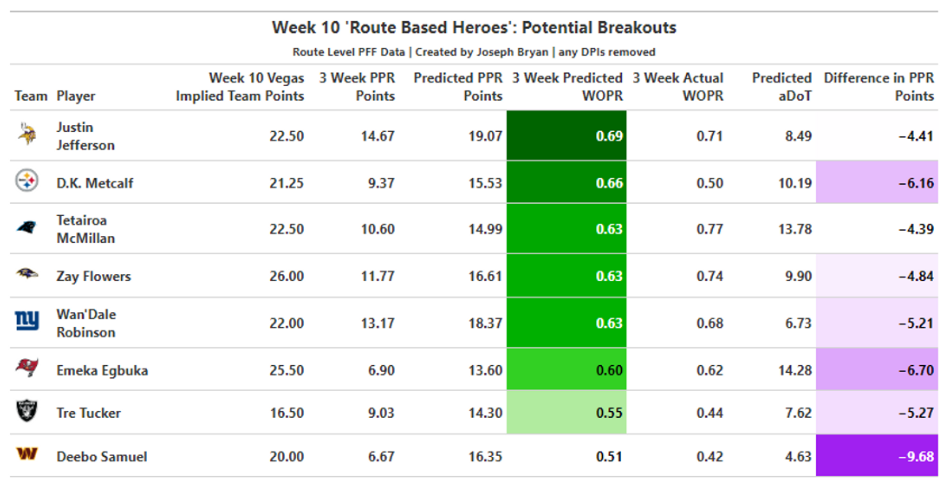
WR Justin Jefferson, Minnesota Vikings: vs. Baltimore Ravens
Over the past month, Baltimore has played man coverage at a top-five rate while allowing the 12th-most EPA per play and the eighth-highest success rate to opposing wide receivers. The Ravens limit yards after the catch (sixth-lowest yards allowed after the catch per reception) and keep throwing windows tight (11th-lowest open-target rate), but their coverage structure invites one-on-one opportunities.
Justin Jefferson leads Minnesota in target rate against man coverage at 24.5%, positioning him as the primary counter if Baltimore stays aggressive. His man-beating usage and the Ravens’ coverage tendencies create a clear path to double-digit targets and intermediate or vertical wins outside the numbers.
WR DK Metcalf, Pittsburgh Steelers: at Los Angeles Chargers
The Chargers allow the fourth-highest open-target rate to wide receivers yet rank bottom 10 in yards per reception allowed and third in team coverage grade when receivers are targeted. Los Angeles has been elite at speeding up the clock, ranking second in quick-pressure rate and second in average time to pressure despite a middling blitz rate.
The Chargers play zone coverage at the fourth-highest rate, and D.K. Metcalf has been far more effective in those situations, posting a 22.8% target rate against zone compared to 15.5% against man. This sets up as a strong breakout opportunity for Metcalf — assuming the Steelers can get the ball to him quickly.
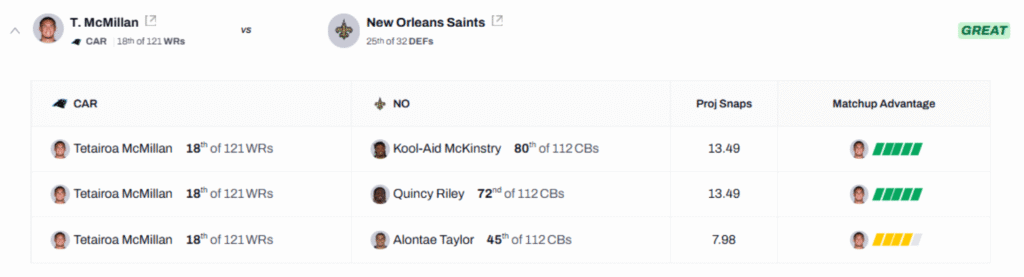
WR Tetairoa McMillan, Carolina Panthers: vs. New Orleans Saints
Since Week 5, the Saints have allowed the ninth-fewest EPA per play to wide receivers, but also the seventh-highest yards per reception and third-highest average depth of target. They’ve conceded the ninth-highest open-target rate, though teams haven’t challenged them often, as opponents have opted to run. The Saints have faced the lowest pass rate in the league at 52.3%.
The Panthers will likely continue leaning on the ground game, as they have all season, but PFF’s matchup tool highlights this as a strong spot for Tetairoa McMillan when Carolina does throw.
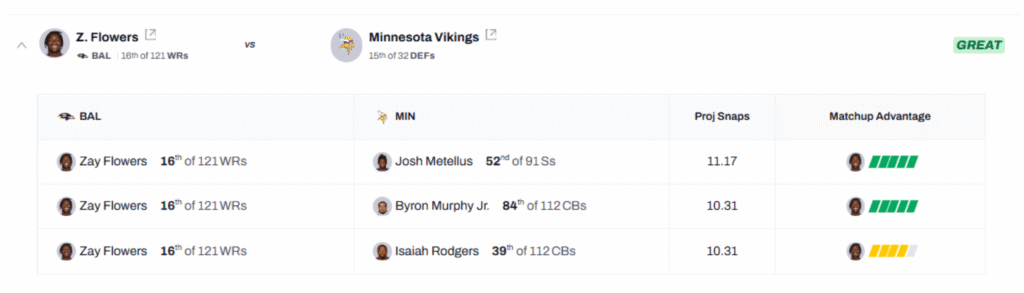
WR Zay Flowers, Baltimore Ravens: at Minnesota Vikings
Zay Flowers has become a weekly staple in this article, and for good reason. He’s been one of the league’s most dynamic receivers, earning a 79.9 PFF grade.
Minnesota leads the NFL in blitz rate and quick-pressure rate since Week 5, pairing that with the league’s highest two-high usage. Lamar Jackson has graded top three against the blitz in 2025 but ranks 26th versus two-high looks. Over the past month, the Vikings have posted the third-worst team coverage grade against wide receivers and have allowed the most EPA per play to the position.
Similar to the Saints, teams have leaned on the run against Minnesota, which ranks second in the lowest percentage of pass plays faced. This defense may make it difficult for Flowers to post a full breakout, but it still offers big-play potential. PFF’s matchup tool, which evaluates specific wide receiver–cornerback matchups, rates this as one of Flowers’ best opportunities of the season.
WR Wan’Dale Robinson, New York Giants: at Chicago Bears
Chicago has the second-worst team coverage grade against wide receivers over the past month, allowing the third-most EPA per play and second-most yards per reception to the position. The Bears have the league’s worst man-coverage grade yet still play it more often than expected, ranking inside the top 20 in usage.
According to PFF Key Insights, Robinson leads the NFL with 435 slot yards, while Chicago ranks 26th in slot yards allowed. The Bears also generate quick pressure at a bottom-five rate, setting up a strong spot for the Giants’ offense as a whole.
WR Emeka Egbuka, Tampa Bay Buccaneers: vs. New England Patriots
New England has shifted from heavy man coverage early in the season (eighth-highest rate through Week 4) to a more balanced approach. Since Week 5, the Patriots rank 15th in man-coverage rate. For the season, they rank 29th in deep completions allowed and 26th in receptions allowed.
This sets up as a favorable matchup for Tampa Bay’s passing game, which has leaned on both volume (Baker Mayfield ranks top-10 in attempts) and explosive plays (top-10 in completions of 20-plus yards). Egbuka has seen 21 targets over the past two weeks without much production, making this a strong rebound opportunity.
WR Deebo Samuel, Washington Commanders: vs. Detroit Lions
Detroit has been excellent in coverage, especially considering its injuries. Over the past month, the Lions have allowed the eighth-lowest open-target rate and fourth-lowest EPA per play to opposing wide receivers — all while playing the second-most man coverage. They rank top-10 in zone-coverage grade and top three in man-coverage grade.
The good news for Deebo Samuel is that he’s targeted at a strong 27.8% rate against man coverage and has earned a 71.9 PFF grade.

 © 2026 PFF - all rights reserved.