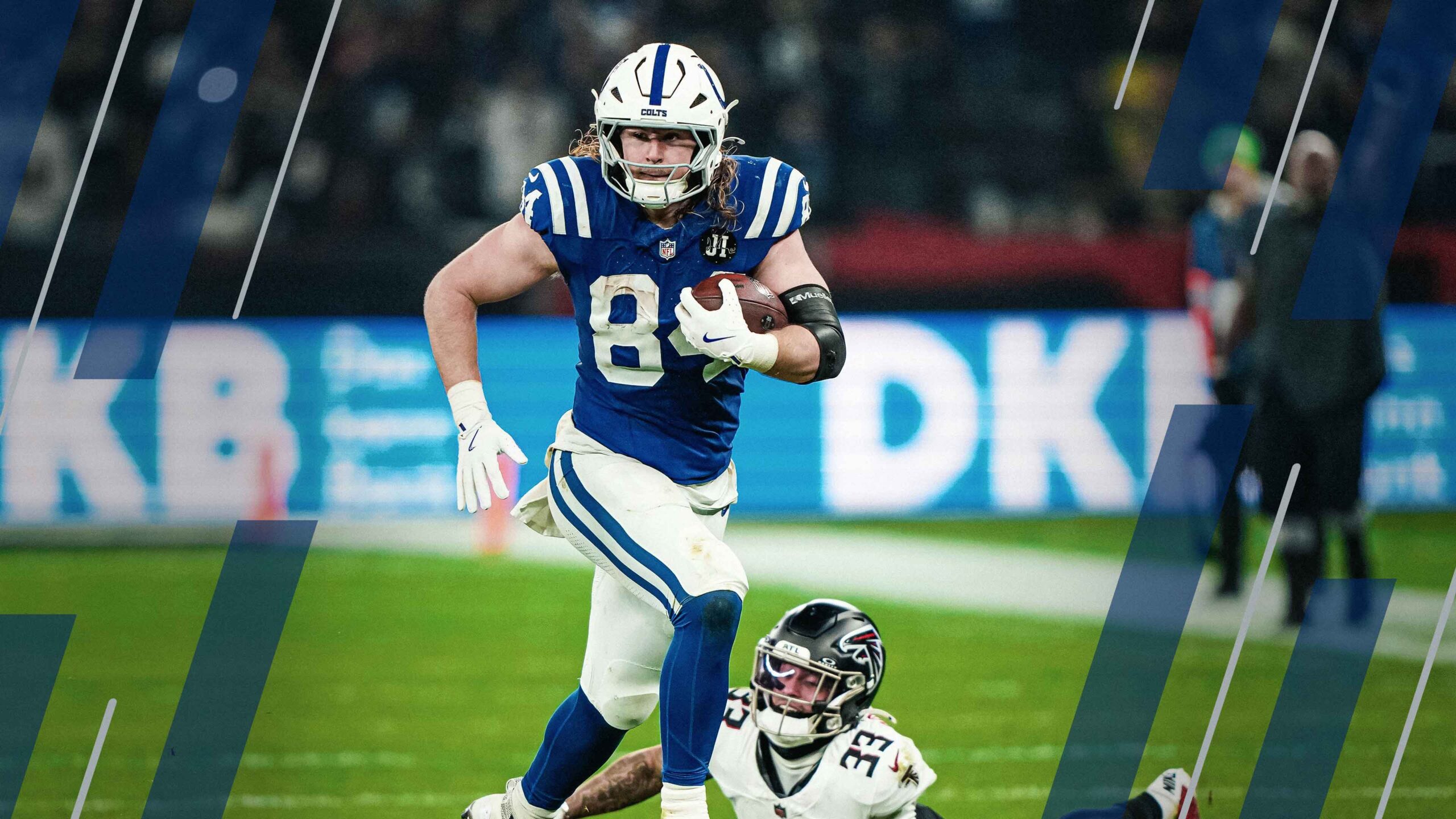
- Tight end is a volatile fantasy position: For every Oronde Gadsden II, there is a Ben Sinnott. For every Mark Andrews, there’s a Jace Sternberger. In dynasty rookie drafts, it's best to take multiple shots at the position.
- First-round tight ends tend to be inconsistent: T.J. Hockenson, Dalton Kincaid and Kyle Pitts are just a few recent first-rounders who have put together up-and-down seasons.
- Get PFF+ for 40% off: Use promo code BLACKFRIDAY to unlock the PFF Player Prop Tool, Premium Stats, fantasy dashboards, the PFF Mock Draft Simulator, industry-leading fantasy rankings and much more — everything you need to win your season.
Estimated Reading Time: 8 minutes

Tight ends in fantasy football are a bit misunderstood, a touch confounding, even. They aren't quite receivers, but they also can be as versatile as any running back. Some make a living from just being red-zone monsters. But the tight end can also be your ace in the pack if you nab a good one.
In the penultimate edition of this series (click for quarterbacks and running backs), we’re looking at first-round tight ends.
Since 2015, just 11 tight ends have been selected in the first round. In order of draft class, they are O.J. Howard, Evan Engram, David Njoku, Hayden Hurst, T.J. Hockenson, Noah Fant, Kyle Pitts, Dalton Kincaid, Brock Bowers, Colston Loveland and Tyler Warren.
Looking at the group, you can almost plot the arc of the NFL wanting a much more dynamic, pass-catching prototype of tight end. Before we do a deep dive, we should probably set some expectations and flag that the data will probably look odd. And to illustrate that, Hurst has 1,975 career receiving yards and 15 touchdowns since being drafted in 2018. Bowers is up to 1,577 yards and eight scores to date. It can be very reasonably argued that had he not missed time through injuries, he’d have already topped Hurst’s career total of receiving yards.
Buckle up, folks. This is going to be strange.
So, how did this cohort of first-round tight ends get on in their rookie seasons? Well, the group features more players with less than 400 yards than with 1,000 yards, so it’s a wide data set.
| Player | TE Finish | Catches | Yards | TDs |
| O.J. Howard | TE20 | 26 | 432 | 4 |
| Evan Engram | TE5 | 64 | 722 | 6 |
| David Njoku | TE24 | 32 | 386 | 4 |
| Hayden Hurst | TE55 | 13 | 163 | 1 |
| T.J. Hockenson | TE31 | 32 | 367 | 2 |
| Noah Fant | TE14 | 40 | 562 | 3 |
| Kyle Pitts | TE6 | 68 | 1,026 | 1 |
| Dalton Kincaid | TE11 | 73 | 673 | 2 |
| Brock Bowers | TE1 | 112 | 1,194 | 5 |
| Colston Loveland (to date) | TE25 | 24 | 329 | 2 |
| Tyler Warren (to date) | TE2 | 50 | 617 | 3 |
The average first-round tight end from this cohort logs 48 catches for 588 yards and three scores. In a standard-scoring PPR league, that adds up to 125.37 fantasy points, and in tight end premium leagues (an extra point per reception for the position), it equates to 173.92 fantasy points. In standard leagues, that would have landed as the TE16 in 2024. That means the average first-round tight end is a TE2 option, so they are riding the bench and are used in favorable matchups or when your starter is injured or on a bye week.
But the consensus is that the position is a difficult transition from college to the NFL — unless you're Bowers. So, let’s take their second-year numbers, when the players have had a chance to get their feet wet.
| Player | TE Finish | Catches | Yards | TDs |
| O.J. Howard | TE15 | 34 | 565 | 5 |
| Evan Engram | TE13 | 45 | 577 | 3 |
| David Njoku | TE9 | 56 | 639 | 4 |
| Hayden Hurst | TE34 | 30 | 349 | 2 |
| T.J. Hockenson | TE5 | 67 | 723 | 6 |
| Noah Fant | TE11 | 62 | 673 | 3 |
| Kyle Pitts | TE33 | 28 | 356 | 2 |
| Dalton Kincaid | TE29 | 44 | 448 | 2 |
| Brock Bowers (to date) | TE17 | 32 | 383 | 3 |
| Colston Loveland (17-game pace) | TE16 (17-game pace in 2024) | 46 | 620 | 3 |
| Tyler Warren (17-game pace) | TE5 (17-game pace in 2024) | 85 | 1,048 | 5 |
Not taking into account Loveland's and Warren’s 17-game paces, nor that of Bowers, first-round tight ends in their second seasons typically experience a drop-off in receiving production but have a very marginal increase in touchdowns (0.22 to be exact). However, much like the running back position, the swings from player to player can be hefty.
For example, Pitts’ numbers tumbled to 40 fewer catches and a staggering 670 fewer receiving yards, although he did double his touchdown total from one to two, so silver linings. It is worth mentioning that he played in seven fewer games as a sophomore. Meanwhile, Hockenson shot up the rankings by improving on his catches (35 more), yards (356 more) and touchdowns (four more).
Overall, the second season for first-round tight ends results in 44 catches for 523 yards and 3 touchdowns, which totals 116.59 total fantasy points (standard-scoring PPR leagues). That total would have finished as the TE21 in 2024 — basically nothing more than a streaming option. In fact, since 2015, that points total would have been enough to rank in the top 15 at the position just once (2019, TE14).
Such low totals beg the question: Should you be more interested in tight ends selected in the second round? Well, the hit rate is slightly better. Seventeen tight ends have been drafted in the second round since 2015: Maxx Williams, Hunter Henry, Gerald Everett, Adam Shaheen, Dallas Goedert, Irv Smith Jr., Cole Kmet, Pat Freiermuth, Trey McBride, Sam LaPorta, Michael Mayer, Luke Musgrave, Luke Schoonmaker, Brenton Strange, Ben Sinnott, Terrance Ferguson and Elijah Arroyo.
McBride and LaPorta are the obvious standouts. Although McBride posted meager totals during his rookie season — 29 catches for 265 yards and one touchdown — he has since exploded to become the focal point of the Arizona Cardinals‘ passing attack and one of the best players at his position.
LaPorta shook the fantasy world with an overall TE1 rookie season in which he logged 86 catches for 889 yards and 10 touchdowns. And while his season-and-a-half since that has not been as eye-popping, he’s still a must-start TE1 in all fantasy formats. He finished as the TE7 in 2024, and prior to landing on injured reserve this season, he was the TE8.
Outside of those two, Freiermuth and Goedert have both been tight ends whom fantasy managers can start with reasonable confidence each week, and Strange is carving out a nice role in the Jacksonville Jaguars‘ passing attack.
There isn't a plethora of marquee tight ends coming out of the second round, either. What about the third? No. We’re not even naming them all. Just know that across the past 11 drafts, Mark Andrews and Tucker Kraft are the only two with any real fantasy value. Alas, Brevin Jordan has not been the mismatch nightmare the Houston Texans or fantasy managers hoped he’d be.
While running back may be the most volatile position year to year, tight end is easily the hardest position to find a starter whom you can feel confident in week to week. A first-round tight end isn't guaranteed fantasy production. In fact, they’re more likely to promise fantasy disappointment. And the middle rounds can be just as disheartening.

If you’re looking for fantasy advice for the position, it’s probably to take swings in volume. In dynasty drafts, take a couple of chances in the middle and late rounds. For every Oronde Gadsden II, there is a Ben Sinnott. For every Mark Andrews, there’s a Jace Sternberger. If there is a truly special player at the position, consider shifting some assets to go up and get them. It might hurt in the short term, but you’ll rest a lot easier knowing you don’t have to worry about the position down the line.
When it comes to redraft formats, pick your tight end strategy early. If you don’t want the headache of finding one in the later rounds, then use a premium pick on one of Bowers, LaPorta, McBride or Kittle. But don’t go into the dead zone of the middle rounds where the likes of Henry, Goedert, Njoku and others live. Sure, they’ll give you week-winning performances, but they’re also just as likely to provide three catches for 25 yards and leave you frustrated. There is perhaps no bigger boom-or-bust position than tight end, so fantasy managers should plan accordingly.

 © 2026 PFF - all rights reserved.