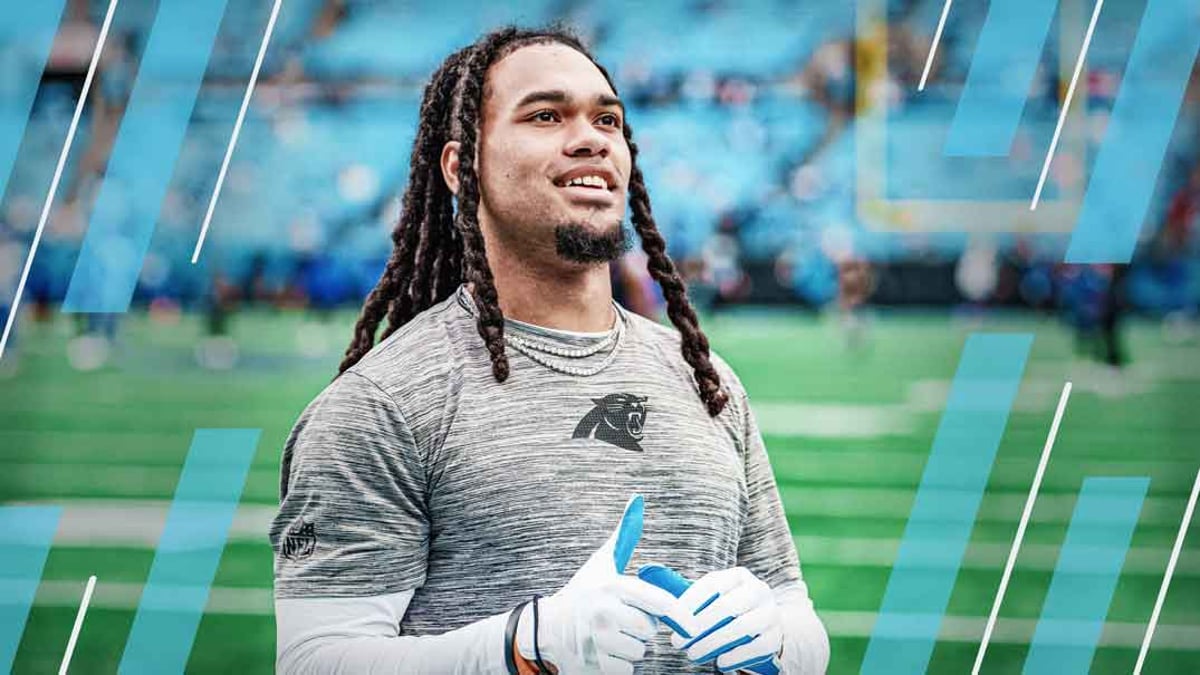
- Quinshon Judkins should benefit from a rebuilt offensive line: Judkins ran behind the worst run-blocking situation in two decades as a rookie, so with Cleveland overhauling the line and a larger workload ahead, he has the volume and setup for a top-20 season.
- A healthy Jonathon Brooks should lead the Carolina Panthers backfield: The former second-round pick is finally healthy, and if he proves he can stay on the field, he has a clear path to becoming Carolina's lead back.
- Save $10 on PFF+ this Labor Day: Get a PFF+ Annual subscription for just $89.99 and unlock PFF+ content and tools, Premium Stats, fantasy, NFL, college and betting tools, the Mock Draft Simulator, Guru AI football insights and more.

Several running backs have flashed breakout potential without quite putting everything together. That could change in 2026. These three backs have a clear path to career-best seasons and are being drafted late enough to offer significant upside at their current ADPs.
The average draft positions below are a consensus of ESPN, Sleeper and Yahoo drafts for 12-team redraft leagues.
Quinshon Judkins, Cleveland Browns (ADP: 5.03)
Judkins was Cleveland's lead back as a rookie but played just 50% of the offensive snaps in a three-man rotation. He led the team in carries, rushing 230 times for 827 yards and seven touchdowns.
His 3.6 yards per carry was heavily affected by poor offensive line play. Judkins averaged just 0.4 yards before contact per rushing attempt, the lowest mark among NFL running backs with at least 200 carries over the past 20 seasons. Teammate Dylan Sampson averaged 0.3 yards before contact per attempt, tied for the second-lowest figure among backs with at least 50 carries.
Cleveland completely overhauled its offensive line this offseason, drafting Spencer Fano at left tackle, trading for right tackle Tytus Howard and adding interior linemen Zion Johnson and Elgton Jenkins. The unit may still project below league average, but it should no longer rank among the NFL's worst.
The Browns also moved on from veteran running back Jerome Ford, the third member of last season's rotation. Their only additions at the position were undrafted rookies. Ford's departure should primarily benefit Sampson, though it could also create more receiving opportunities for Judkins.
Judkins’ rookie season ended early because of a dislocated ankle and fractured fibula, but he was healthy enough to return for Cleveland’s preseason opener. His usage was encouraging: Judkins played every first-team snap except on third-and-medium and third-and-long, giving him the kind of early-down, short-yardage and goal-line role that can support consistent fantasy production. The biggest remaining question is how the Browns will divide two-minute drill snaps between Judkins and Sampson.
If he returns to form, the better offensive line and expanded workload could position Judkins for a top-15 fantasy season. If the Browns offense and offensive line outperform expectations, Judkins has top-10 upside, though that is unlikely this year. As long as he stays healthy, he should see enough volume to be worth starting in fantasy lineups each week.
Jonathon Brooks, Carolina Panthers (ADP: 8.07)
Brooks was the top running back in the 2024 draft class. Our draft guide praised his vision, footwork, change of direction, contact balance, burst, receiving ability and tackle-breaking skills, with no clear weaknesses in his profile.
His lone negative was a torn ACL suffered in November of his final collegiate season, which ensured he would miss much of his rookie year. Even so, the Carolina Panthers made him the first running back selected in the 2024 NFL Draft. Brooks made his debut in Week 12, playing five snaps. He followed that with 15 snaps the next week, recording six carries and three receptions.
Brooks tore his right ACL again the following week. The Panthers shut him down not only for the rest of 2024 but also for all of 2025, giving him ample time to recover and ensuring he would be ready for 2026. Carolina allowed Rico Dowdle to leave in free agency and didn't make a significant investment at running back, suggesting the team is counting on Brooks.
Early in the offseason, the ideal scenario for Brooks was to be eased back into action before eventually challenging for the starting job around midseason. Chuba Hubbard’s injury could accelerate that timeline, as he is expected to miss the rest of training camp, giving Brooks an extended opportunity to work with the first-team offense. Hubbard may not be 100% even when he's back, giving Brooks a higher floor early in the season.
Brooks’ usage in the first two preseason games offered another encouraging sign. He handled all of the early-down work with the starters, suggesting he would be Carolina’s featured runner if Hubbard misses time. He also received some work on third downs and was taken out of each game when the rest of the starters left. Hubbard has returned to practice, so the backfield could settle into a two-man split, with Brooks handling more of the carries and Hubbard seeing more work on passing downs.
Brooks was an excellent value at his previous ADP, but even with his ADP improving after Hubbard’s injury, he remains a strong value. He should be selected over several running backs in known committees this season.
MarShawn Lloyd, Green Bay Packers (ADP: 12.04)
The 2024 season was supposed to be a changing of the guard at running back for Green Bay, moving on from Aaron Jones and A.J. Dillon and replacing them with free-agent addition Josh Jacobs and third-round pick Lloyd. Instead, Lloyd suffered a hamstring injury in the preseason that cost him Week 1 of his rookie year. He played in Week 2 but hurt his ankle, landing on injured reserve. He was activated in November, only to develop appendicitis that ended his season.
In 2025, another preseason hamstring injury kept Lloyd out all year. He tried to return but reinjured it and went back on injured reserve. Through two NFL seasons, he has played a small role in one regular-season game.
He nonetheless opens the year as Green Bay’s Week 1 starter after Josh Jacobs was placed on the Commissioner’s Exempt List. There is a wide range of possibilities here, including Jacobs returning in the next few weeks, not returning until the middle of the season or not playing at all this season. It’s highly likely the league knows more than the general public, and unless we learn more between now and Wednesday, we’ll need to draft Lloyd with caution.
His competition for carries consists of receiving back Chris Brooks and newly acquired Kaleb Johnson. The Packers are expected to be somewhat cautious with Lloyd given his durability record. However, if they believe he can handle a very large workload without additional injury risk, he will receive that workload. Brooks is more of a third-down back who also spent some time at fullback during OTAs. Johnson may need time to learn the offense before seeing significant playing time, and by then, the Packers should have a better idea of what they can expect from Lloyd.
The risk runs in two directions: Lloyd’s own health and the uncertainty over when or whether Jacobs returns. Lloyd has top-10 potential if he holds up and Jacobs stays away, though Jacobs could return sooner than expected or another injury could end Lloyd’s run.
Blake Corum, Los Angeles Rams (ADP: 9.06)
Corum was a third-round pick by the Rams in 2024. There was some thought he could take over as the lead back, and since Sean McVay tends to lean on one clear leader, that would have made Corum a steal at his rookie ADP. Instead, he remained a backup, topping 20% of the offensive snaps in only one game.
Los Angeles added Jarquez Hunter in the 2025 draft, which made it look like Corum could slide down the depth chart. Instead, he consistently played between 20% and 30% of the snaps over the first half of the season while running at a high level. That earned him more work in the second half, when he was regularly in the 30%-to-40% range, including a steady 37% in the playoffs.
Corum was among the league’s most effective runners last season. His 5.1 yards per carry ranked fifth among running backs with at least 125 carries, and his 30.3% first-down-or-touchdown rate ranked second. He earned a positive grade on 52.4% of his runs, which led all running backs.
The general expectation is that his snap rate holds near where it ended last season or climbs a bit. Kyren Williams wasn’t far behind in those rushing metrics but was far more involved as a receiver, catching 36 passes to Corum’s eight. Corum also dropped three passes.
The Rams are expected to be one of the league’s best teams after making significant improvements on defense, which should allow them to run even more than they did last season. That makes Los Angeles one of the more likely teams to support two fantasy-relevant running backs. But as long as Corum has next to no role in the passing game, his upside will be capped.
Jacory Croskey-Merritt, Washington Commanders (ADP: 10.07)
Croskey-Merritt was one of the biggest stories in fantasy football last August, going from a seventh-round rookie seemingly buried on the depth chart to a potential starter, ultimately helping push former starter Brian Robinson Jr. out of Washington. His role was limited early in the season, but an injury to Austin Ekeler created more opportunities. Croskey-Merritt broke out with 111 yards and two touchdowns on 14 carries in Week 5 and averaged 12.4 carries over his next five games. However, he managed only 3.0 yards per carry during that stretch and eventually lost the starting job.
Washington reshaped its backfield this offseason, moving on from Rodriguez and Ekeler while retaining Croskey-Merritt and Jeremy McNichols. The Commanders added Rachaad White and Kaytron Allen, but all three veterans in the backfield are more accomplished receivers than Croskey-Merritt, who caught only nine passes in 17 games. That makes a significant third-down role unlikely.
The rest of the offseason has largely worked in Croskey-Merritt’s favor. The buzz around Allen has cooled, while most of the positive discussion surrounding White has focused on his receiving ability. Croskey-Merritt sits atop the unofficial depth chart and rested with the starters in Washington’s first preseason game, providing further evidence that he enters the season as the team's primary early-down back.
The biggest potential development is his receiving work. Washington has emphasized getting Croskey-Merritt more involved as a receiver during training camp, and reports have been positive. He averaged only one reception every other game as a rookie and didn't catch a pass over his final six games. He doesn't need to become the primary third-down back to make a meaningful jump in receiving production, as plenty of running back targets come on first and second downs.
There is still risk. White could earn more than a passing-down role, while Allen could emerge as a short-yardage or goal-line option. Still, Croskey-Merritt has a much clearer path to carries than his 10th-round ADP suggests. If his receiving role expands at all, he has a realistic chance to go from a potential flex option to a weekly fantasy starter.

 © 2026 PFF - all rights reserved.