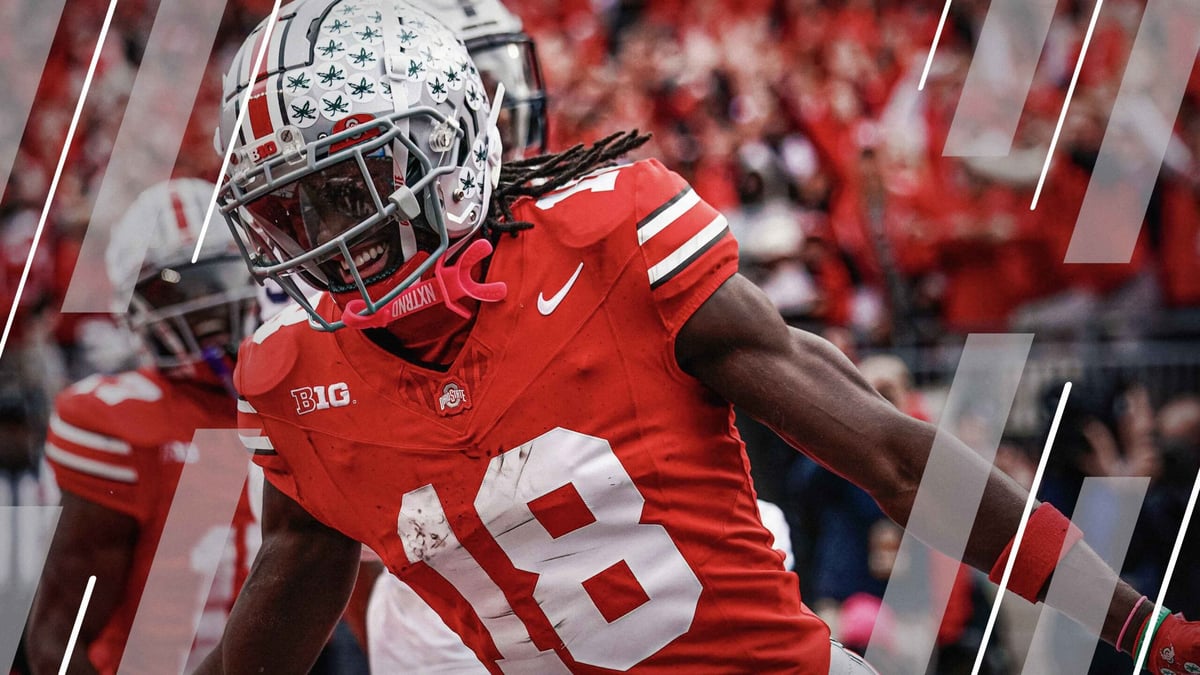
- Buckeyes dot the list: Ohio State‘s dominance is reflected by the feature of players like Marvin Harrison Jr., C.J. Stroud and Nick Bosa.
- Two Northwestern stars at tackle: Rashawn Slater and Peter Skoronski have turned their success in Evanston into fruitful NFL careers.
- Recent standouts align in the secondary: Caleb Downs, D'Angelo Ponds and Dillon Thieneman all earn spots thanks to their performance over the last two years.
Following on from our SEC All-Decade Team, we now turn our attention to the other dominant conference in college football over the past decade: the Big Ten.
While the SEC led the discussion when it came to Heisman seasons, the Big Ten enters 2026 on the back of three consecutive national championships, won by three different programs.
Recent additions, including Oregon and USC, have quickly established themselves among the conference’s top teams. But with only two seasons of Big Ten play under their belts, they are understandably underrepresented on this list.
Eleven different programs ultimately feature on our Big Ten All-Decade Team, with Ohio State obviously leading the way, starting at quarterback.
Quarterback
Unlike Joe Burrow’s obvious claims in the SEC, this selection wasn’t quite as straightforward. Fellow Ohio State alum Justin Fields has a legitimate argument here, and so too does the undefeated and unblemished Fernando Mendoza despite only playing one season in the conference.
Ultimately, Stroud’s mesmerizing 85-to-12 touchdown-to-interception ratio while at Ohio State seals the deal in his favor. He registered overall PFF grades of 92.3 and 89.7 in his two seasons at the helm.
Despite not finding any success in the shape of national championships at Ohio State, Stroud played his best football in the biggest moments, including a career-best 92.2 PFF grade against an other-worldly Georgia defense in his lone College Football Playoff appearance.
Running Back
Fear not if you were worried this team would comprise exclusively of Buckeyes and Wolverines: Jonathan Taylor is a no-brainer inclusion here. His 6,159 rushing yards at Wisconsin is quadruple-digits clear of all other modern Big Ten running backs.
Taylor’s 95.0 PFF rushing grade, 6.7 yards per carry and 220 missed tackles forced are all among the best marks in recent conference history. Fumbles were his only recurring issue (he had 16 at Wisconsin), but he made up for it by leading the conference in virtually every other production metric.
Wide Receiver
- Marvin Harrison Jr., Ohio State
- Tyler Johnson, Minnesota
- Jeremiah Smith, Ohio State
Jeremiah Smith has the rare honor of making it onto his conference’s all-decade list with another season still ahead of him. The top overall prospect on PFF’s 2027 NFL Draft Big Board has set such a historic pace through his first two college seasons that he has earned his way onto this list regardless of what the upcoming season brings.
Aside from Smith, you could’ve taken your pick among a half-dozen Ohio State receivers who have a real case for making this team. I lean toward Harrison Jr., who earned the highest PFF receiving grade among all of Ohio State’s pass-catching exports. His NFL career has gotten off to a very sluggish start, but Harrison’s dominance at the college level was undeniable — highlighted by 32 contested catches, 31 receiving touchdowns and just 10 drops.
Minnesota’s Tyler Johnson will be a surprise inclusion for many here. A former fifth-round pick from an average program, he doesn’t bring the same level of fame as names like Chris Olave, Garrett Wilson or Jaxon Smith-Njigba. However, Johnson out-produced all of those players thanks to four meaningful seasons at Minnesota. His 3,296 receiving yards are the most of any Big Ten receiver. So too is his 93.3 PFF receiving grade.
Tight End
The Big Ten is unquestionably the top conference for tight end talent. Colston Loveland, Mike Gesicki, Sam LaPorta, Noah Fant and T.J. Hockenson are just a few names to emerge at this position over the last decade. Tyler Warren’s 1,833 receiving yards and 25 total touchdowns trump them all.
Not only was Warren incredibly productive in a traditional receiving tight end role, but his work in the backfield, as a run-blocker and in pass protection were all key factors in why he was drafted 14th overall in 2025. Unlike some of our receiving options, Warren’s collegiate success has easily transferred over to the NFL, where he and our all-decade running back form the backbone of the Colts’ offense.
Offensive Tackles
Who would’ve guessed that the Wildcats would supply both bookend tackles for this roster? Skoronski and Slater combined for 5,000 snaps at Northwestern, delivering overall PFF grades of 90.6 and 87.1, respectively. Both played three full seasons of college football and never overlapped.
Skoronski’s dominance came as a bull-dozing run-blocker, meanwhile Slater refined his ability in pass protection — a trait that has translated well to the NFL. Slater allowed just five pressures in his final season, none resulting in sacks. He closed out his collegiate career with five straight pressure-free games.
Interior Offensive Linemen
The offensive guard position is not the most stellar group to choose from. Guards Jonah Jackson and Kendrick Green were both third-round draft picks. Green was an elite run-blocker in his final season at Illinois, albeit one shortened by the pandemic.
Linderbaum, meanwhile, is an absolute slam-dunk selection for our center spot. His 94.2 overall PFF grade over his three seasons at Iowa is the highest of any FBS center since PFF grading began. Over his final two years, Linderbaum’s lowest single-game grade was 68.5. It was the only time his performance dipped below 70.0, and over half of the contests from his final year earned a grade above 85.0.
Read more
Read moreSEC All-Decade Team: Alabama fill 10 spots, Joe Burrow headlines at QB
(opens in new tab)Interior Defensive Linemen
Ten of the 12 highest-graded Big Ten interior defensive linemen over the last decade have come from either Michigan or Ohio State. These two programs have set the standard in the trenches.
Maurice Hurst is the oldest inclusion on our list. He posted three consecutive elite season grades for the Wolverines, including an incredible 52-pressure, eight-sack year in 2017. Mason Graham never quite produced numbers like that as a pass-rusher. His talent was more apparent on rushing downs: Graham accumulated a defensive stop on 21% of interior carries.
Edge Defenders
You probably could’ve picked this pair before looking at a single number. For those of you looking to throw Aidan Hutchinson’s hat in the ring, it’s worth remembering his 14.1% pressure rate pales in comparison to Bosa’s 20.2%, and Young’s 19.0%.
Chase Young registered 34 total sacks with the Buckeyes, the most of any Big Ten defender over the last decade. Bosa’s decision to opt out of his final season hurts his case, but when on the field, nobody came close to his levels of production.
Linebackers
It’s perhaps surprising that it has taken this long for our first Penn State inclusion. Parsons has obviously gone onto bigger and more valuable things as a superstar pass-rusher in his NFL career, but he played and was evaluated as a linebacker at Penn State, where he thrived in space while showcasing excellent play recognition and gap discipline. Back then, Parsons’ 87.0 PFF pass-rushing grade was just seen as the icing on the cake.
T.J. Edwards has generated the highest overall PFF grade of any conference linebacker since 2016 at 93.2 overall. As the leader of the Badgers’ defense, his success was more coverage-oriented than Parsons’. Edwards came away with nine interceptions across his four collegiate seasons while surrendering just one touchdown in coverage. His passer rating when targeted never breached 80.0 in a single season.
Cornerbacks
- D’Angelo Ponds, Indiana
- Devon Witherspoon, Illinois
- Denzel Ward, Ohio State
Indiana deserved to have some feature on this list following two phenomenal seasons under Curt Cignetti, but this is by no means a handout. Ponds’ 92.0 overall PFF grade is the highest of any comeback to play over 1,200 snaps. He was targeted on just 14% of opponents’ dropbacks last season, and over half of those attempts fell incomplete.
Ponds’ success at the next level is yet to be determined. Devon Witherspoon and Denzel Ward, on the other hand, have both established themselves as premier cornerbacks in the pros. Witherspoon logged three solid if unspectacular seasons at Illinois before his breakout senior season in 2022. Quarterbacks compiled just a 17.2 passer rating when throwing the ball in his direction, and his 92.5 PFF coverage grade was only held back by committing six penalties.
Denzel Ward’s Ohio State career is perhaps best remembered for Gus Johnson’s legendary “Hurt my feelings” line on commentary when the cornerback delivered a huge hit stick against Maryland. Ward didn’t create many big plays as a Buckeye, snagging just two interceptions. However, his remarkable 34% completion percentage allowed is the lowest among all qualifying Big Ten cornerbacks over the last decade.
Safeties
- Caleb Downs, Ohio State
- Dillon Thieneman, Oregon/Purdue
The Big Ten’s two highest-graded safeties over the last decade both departed for the NFL this offseason. Downs is an obvious inclusion here. He would probably be the leading candidate for an FBS-wide all-decade team when you add his prolific freshman year at Alabama.
Similar to Denzel Ward, Downs did not always show up with highlight-reel plays, but he practically never put a foot wrong across over 1,500 snaps for the Buckeyes. Downs hasn’t been responsible for a passing touchdown since Week 6 of his freshman year in the SEC.
Thieneman is perhaps a surprise inclusion, but college football savants will know of his superb play over two years at Purdue before joining Oregon for his final season. Thieneman caught nine interceptions in his college career while committing only one coverage penalty. He posted almost 250 total tackles on 2,400 snaps while being whistled for just two total penalties.

 © 2026 PFF - all rights reserved.