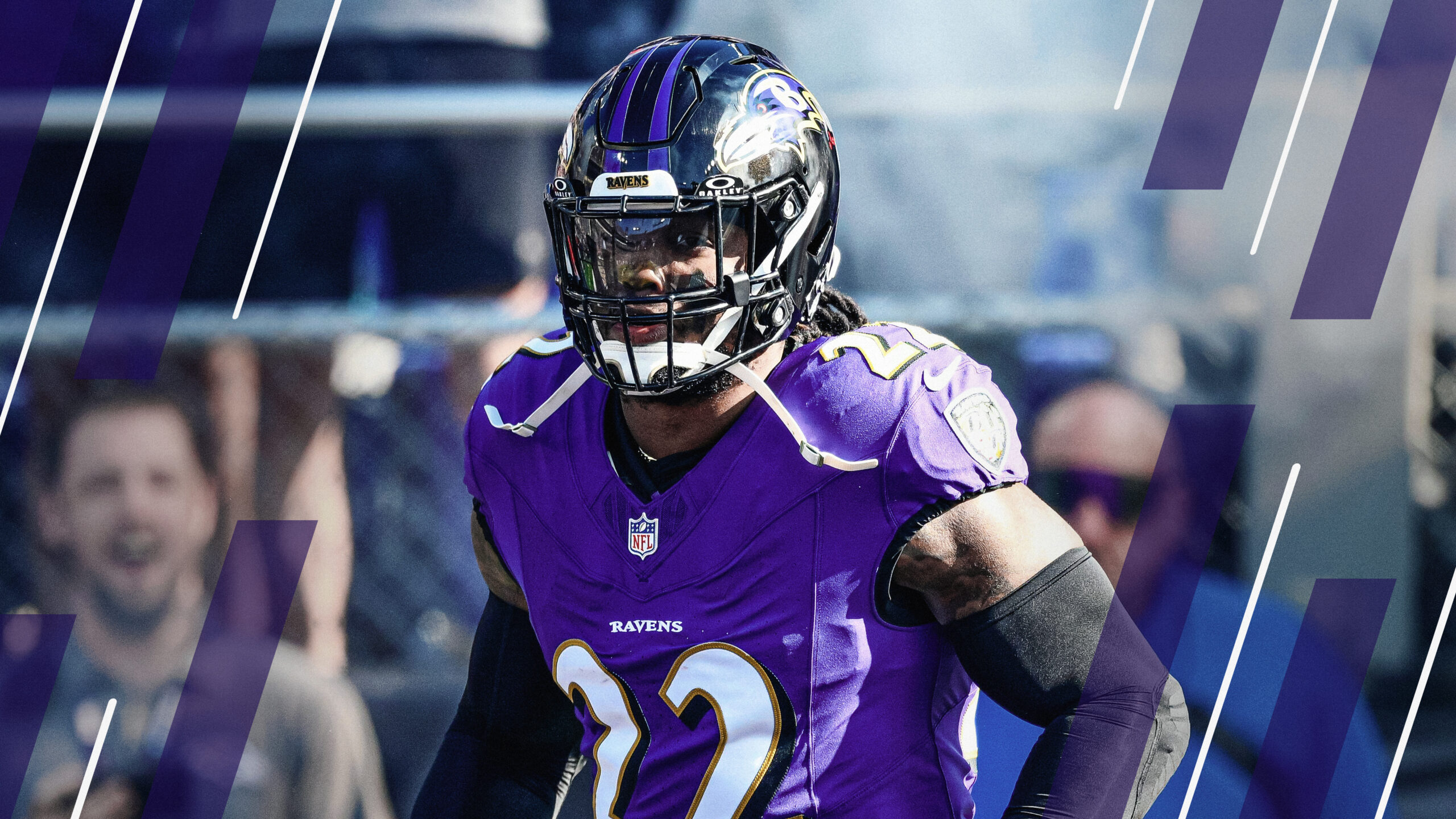
- RB Derrick Henry, Baltimore Ravens: Henry’s declining ability to force missed tackles makes him unlikely to repeat as an RB1 next year.
- RB Alvin Kamara, New Orleans Saints: Kamara began losing passing-down snaps in Week 7.
- 2026 NFL Draft season is here: Try the best-in-class PFF Mock Draft Simulator and learn about 2026's top prospects while trading and drafting for your favorite NFL team.
Estimated Reading Time: 5 minutes





Age and the ability to handle significant workloads play a significant role in NFL skill position productivity. Very few NFL running backs maintain usable fantasy football workloads after turning 30 years old. The article below details the usage and results for NFL running backs age 30 or older. Various timeframes are used below to accurately reflect touch volume, efficiency and fantasy football productivity.
A dozen NFL running backs, age 30 or older, totaled at least 10 offensive touches from Week 1 through conference championship weekend.
Among those 12 NFL running backs, nine started at least one game and operated as a meaningful rotational player when not operating as the team’s starter this season. Among those nine NFL running backs, two suffered season–ending injuries, limiting them to 40 or fewer offensive touches. Among the seven remaining NFL running backs, six totaled 100-plus offensive touches. Among those six NFL running backs, only Baltimore Ravens running back Derrick Henry finished as a Weeks 1-17, half-points-per-reception (half-PPR) RB2 or better, finishing as the overall RB7. His 80.4 PFF offense grade ranks first among the six qualifying NFL running backs.
Offensive data among six NFL running backs age 30 or older with at least 90 touches in Weeks 1-17.
| NFL RBs Age 30 Or Older | Offensive Touches | Age | PFF Offense Grade | Half-PPR Fantasy Finish | Rush Att. – Yds. – TD – FUML | Rec./Tgt. – Yds. – TD – FUML |
| Derrick Henry | 302 | 31 | 78.8 | RB7 | 287 – 1,469 – 16 – 3 | 15/19 – 150 – 0 – 0 |
| Kareem Hunt | 173 | 30 | 73.1 | RB30 | 158 – 597 – 8 – 1 | 15/21 – 122 – 1 – 0 |
| Alvin Kamara | 164 | 30 | 51.7 | RB46 | 131 – 471 – 1 – 1 | 33/39 – 186 – 0 – 1 |
| Aaron Jones | 160 | 31 | 65.0 | RB43 | 132 – 548 – 2 – 0 | 28/37 – 199 – 1 – 1 |
| Nick Chubb | 135 | 30 | 70.5 | RB49 | 122 – 506 – 3 – 0 | 13/18 – 67 – 0 – 0 |
| Samaje Perine | 90 | 30 | 64.5 | RB57 | 76 – 340 – 3 – 2 | 14/17 – 77 – 0 – 0 |
Kamara, Jones and Perine are accomplished pass-catching running backs. Despite their presence, zero running backs from the qualifying sample earned the requisite 45-plus targets to finish among the top 12 target-earning running backs in Weeks 1-17. Kamara’s 39 targets tie for 20th among NFL running backs during that span. Jones’ 37 targets tie for 24th. Hunt’s 21 targets rank just 48th.
The sample’s rushing data suggests it is far easier for aging running backs to maintain rotational rushing roles than it is for them to retain a fantasy-friendly in a pass-catching role. This correlates positively with the findings detailed previously: “Among all offensive environment metrics, snap count, touch count, touch share and efficiency metrics, overall offensive snap share, situational snap shares and rushing attempt share show the strongest correlation with PPR RB1 success… While three of four high-volume pass catchers… impressively maintain high-end per-route efficiency, high-end receiving efficiency is unnecessary for players with high-volume touch counts, particularly those with high-volume rushing roles.”
Hunt, Kamara and Jones’ rushing attempt sums rank in the Nos. 27-38 range, while Chubb’s 122 rushing attempts rank 43rd. It is fair to note that Kamara played through an ankle injury for multiple weeks and suffered a season-ending MCL sprain in Week 12, but he began ceding passing-down snaps to rookie running back Devin Neal in Week 7. Neal earned a 58.7 PFF offense grade this year.
Henry’s 287 rushing attempts rank fourth. Only he produced in an elite, reliable manner, but a simple point remains: rushing volume allows running backs to remain fantasy-relevant more so than per-play efficiency.
Henry will be 33 years old by the time his contract expires in 2027. He is the lone qualifying player to retain a featured offensive role all season, yet he forced the fewest missed tackles per rushing attempt (0.14) since his 2016 rookie season (0.14). His 3.6 yards after contact per rushing attempt rank sixth among his 10 NFL seasons, and his 79.4 PFF rushing grade ranks seventh. Among 32 NFL running backs with at least 165 rushing attempts in Weeks 1-NFL Conference Championship weekend, Henry’s three data points tie for 30th, rank third and 15th, respectively. The article linked above shows that an “average-to-above-average tackle-breaking skillset is necessary for RB1 productivity. PFF rushing grade unsurprisingly showed even stronger average-to-above-average skillset correlation, with 10 players ranking 16th or better; eight finished inside the top 12.”
Henry could return RB1 value again next year, though his waning ability to force missed tackles renders the outcome unlikely.
Among the remaining qualified NFL running backs, Hunt (0.17) and Kamara (0.15) produced the fourth-career-worst missed tackles forced per rushing attempt average. Jones (0.09) produced the worst, while Chubb (0.21) produced the third-worst. Perine, the lifelong pass-catching specialist, produced his third-best, 0.20, albeit while failing to impress.
NFL running backs over 30 years old likely require access to a triple-digit rushing workload to remain fantasy-relevant. When targeting aging running backs in 2026 drafts, betting on per-play efficiency is not advised.

 © 2026 PFF - all rights reserved.