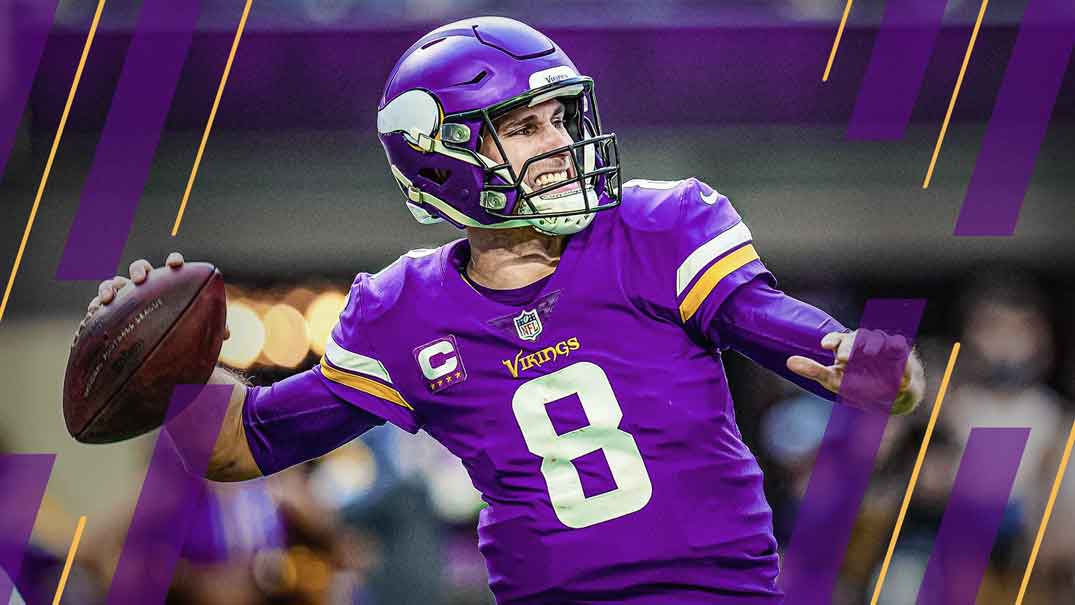
- Kirk Cousins outlasts legendary single-season peaks: While Brett Favre delivered the highest-graded individual quarterback season of the PFF era for Minnesota, Cousins secured the starting job on the strength of his consistent multi-year structural longevity.
- Bryant McKinnie narrowly edges Christian Darrisaw at left tackle: In one of the closest positional choices on the entire roster, McKinnie claimed the starting role over Darrisaw by fewer than a single point after injuries limited Darrisaw's recent playing volume.
- Harrison Smith stands as the lone modern defensive anchor: The exceptional safety group is headlined by potential future Hall of Famers Smith and Antoine Winfield, with Smith notably finishing as the only defensive player from the past two seasons to make the cuts.

As part of PFF's celebration of 20 years of NFL data, we're building an All-Star team for every franchise, highlighting the best players at each position from the PFF era. This installment turns to the Minnesota Vikings.
PFF's database dates back to the 2006 NFL season, providing a unique lens for evaluating and comparing players across eras. More details on the methodology used to construct these teams are available at the bottom of the page.
Offense
- QB: Kirk Cousins (2018-2023)
- HB: Adrian Peterson (2007-2016)
- WR: Justin Jefferson (2020-2025)
- WR: Stefon Diggs (2015-2019)
- Slot WR: Adam Thielen (2014-2022, 2025)
- TE: T.J. Hockenson (2022-2025)
- TE: Kyle Rudolph (2011-2020)
- LT: Bryant McKinnie (2006-2010)
- LG: Steve Hutchinson (2006-2011)
- C: John Sullivan (2009-2013)
- RG: Joe Berger (2011-2017)
- RT: Brian O’Neill (2018-2025)
The Vikings' offense combines two of the franchise's most successful eras from the past 20 seasons. The earlier group was built around a dominant rushing attack led by future Hall of Fame running back Adrian Peterson, Hall of Fame left guard Steve Hutchinson and a strong offensive line.
More recent Vikings offenses have centered on the passing game. Stefon Diggs emerged as the team's top wide receiver before Justin Jefferson took over that role. While Brett Favre delivered the best single season by a Vikings quarterback during the PFF era, Kirk Cousins‘ longevity ultimately won out. Cousins produced the second-, third-, fourth- and fifth-best seasons by a Minnesota quarterback over that span, earning him the starting spot on this roster.
One of the closest position battles on any team came at left tackle between Bryant McKinnie and Christian Darrisaw. Both played exactly five seasons with the Vikings during the PFF era, and fewer than one point separated them in this scoring system. Darrisaw reached a higher peak, but injuries caused him to miss too much time over the past two seasons, tipping the scales in McKinnie's favor.
Defense
- DI: Kevin Williams (2006-2013)
- DI: Linval Joseph (2014-2019)
- ED: Danielle Hunter (2015-2023)
- ED: Jared Allen (2008-2013)
- LB: Eric Kendricks (2015-2022)
- LB: E.J. Henderson (2006-2011)
- SLB: Anthony Barr (2014-2023)
- CB: Cedric Griffin (2006-2011)
- CB: Xavier Rhodes (2013-2019)
- Slot CB: Antoine Winfield (2006-2012)
- S: Harrison Smith (2012-2025)
- S: Anthony Harris (2015-2020)
The Vikings featured a strong blend of players from different eras on offense, and the same is true on defense. Early PFF-era standouts such as Jared Allen, Kevin Williams and E.J. Henderson are joined by Linval Joseph, Danielle Hunter, Anthony Barr and Eric Kendricks from later years. While Minnesota has fielded several quality front-seven defenders over the past two decades, these selections were relatively straightforward.
The secondary is the strength of this defense, led by Harrison Smith and Antoine Winfield. Both have built résumés worthy of Hall of Fame consideration. Minnesota has not enjoyed the same level of success at cornerback, however. Outside of Winfield, Xavier Rhodes and Everson Griffin earned spots largely because of their longevity, narrowly beating out players such as Captain Munnerlyn and Terence Newman.
Notably, Smith is the only Vikings defender from the past two seasons to make the roster, and no other recent defender came particularly close.

Methodology
Selections were based on normalized PFF grades adjusted by season. To balance peak performance and longevity, only a player's five best seasons with a franchise from 2006-25 were considered. Any season with an overall PFF grade below 60.0 was excluded, ensuring that strong years helped a player's case while weaker seasons were not held against him. Postseason play was included, though all seasons were capped at a 16-game equivalent to maintain consistency across eras. At each position, the player with the highest score under this methodology earned the spot.
Each team consists of 12 offensive and 12 defensive players. Because 11 personnel and nickel defense were the league's most common alignments over the past two decades, those personnel groupings served as the foundation for every roster. Teams received either a second tight end or a fullback, depending on whether they used more 12- or 21-personnel. Defensively, teams received either a third interior defender or a third linebacker depending on whether they primarily operated from a 3-4 or 4-3 front.
Players who logged significant snaps at multiple positions during their tenure with a franchise were eligible at either spot. In most cases, those players were assigned to the position where they provided the greatest value, though their versatility occasionally influenced the final roster construction.
Unlike some All-Pro teams that group offensive linemen by position type, these rosters were built according to where players actually lined up. If a team's two best tackles both played exclusively on the left side, only the top left tackle was selected. One of the three wide receivers and one of the five defensive backs was also required to have significant slot experience. In a 4-3 defense, one linebacker needed experience at the Sam linebacker position, while in a 3-4 defense, one defensive tackle needed experience at nose tackle.
When multiple players are listed at the same position, the first name represents the top selection. Players designated as slot wide receiver, slot cornerback, nose tackle or Sam linebacker were selected specifically for those roles rather than as the third-best player within their broader position group.

 © 2026 PFF - all rights reserved.