
- Green Bay Packers wide receivers find the end zone four times: Dontayvion Wicks had his best game of the season, while Christian Watson and Romeo Doubs also scored despite all three wide receivers showing up on the injury report.
- Amon-Ra St. Brown suffers an ankle injury: The Detroit Lions began the day without their top two tight ends and one of their top three wide receivers. The injury to St. Brown meant the entire offense had to rely on Jahmyr Gibbs and Jameson Williams.
- Get PFF+ for 40% off: Use promo code BLACKFRIDAY to unlock the PFF Player Prop Tool, Premium Stats, fantasy dashboards, the PFF Mock Draft Simulator, industry-leading fantasy rankings and much more — everything you need to win your season.

PFF's fantasy football recap focuses on player usage and stats, breaking down all the vital information you need to achieve fantasy success in 2025.
Green Bay Packers @ Detroit Lions
Monitor Amon-Ra St. Brown’s health: The Lions' top wide receiver suffered an ankle injury after just four plays and didn’t return to the game.
Detroit’s wide receiver rotation has been stable all season, with Amon-Ra St. Brown and Jameson Williams each playing more than 89% of offensive snaps prior to this week. Kalif Raymond has typically handled just over half of the snaps when healthy, with Issac TeSlaa logging a little more than a quarter of the reps in 11 personnel and seeing additional work whenever Raymond has been sidelined.
The Lions entered this game dealing with multiple injuries at the position. Raymond missed the entire week of practice with an ankle injury and was ruled out on Wednesday, while TeSlaa was limited with a hand issue but ultimately active. To help fill the gap, Detroit elevated Tom Kennedy from the practice squad. Kennedy has appeared in 24 games for the Lions since 2019 and has 14 career receptions.
St. Brown suffered his injury at the start of Detroit’s second drive. He was quickly ruled questionable and then ruled out after halftime. TeSlaa had already stepped into Raymond’s outside role in three-receiver sets and, after St. Brown exited, handled those snaps in two-receiver sets as well. Kennedy became the Lions’ slot receiver in 11 personnel, emerging as a frequent target for Jared Goff, while TeSlaa found the end zone.
If St. Brown’s injury proves serious, Raymond would be a strong waiver option once healthy. He played the second-most slot snaps for Detroit before this week and would likely take over St. Brown’s role in both two- and three-wide sets. When St. Brown last missed a game (Week 5 of the 2023 season), Raymond handled primary slot duties. However, if both St. Brown and Raymond are unavailable, Tom Kennedy would remain the slot option.

Detroit dug deep into their tight end depth chart: The Lions entered the game without their top two options at the position.
Sam LaPorta landed on injured reserve after Week 10 due to back surgery and is unlikely to return this season. His backup, Brock Wright, missed the week’s practices with a neck injury and did not play. Over the first nine weeks, LaPorta and Wright were on the field together for 185 of their 186 snaps in 12 personnel, and one of the two handled 272 of the 273 snaps in 11 personnel. Ross Dwelley had played just 39 snaps, with 37 coming in three-receiver sets.
Dwelley operated as the Lions’ top tight end in this game. Anthony Firkser was elevated from the practice squad and played in some passing situations, while undrafted rookie Zach Horton was also called up in a tight end–fullback hybrid role. Both Dwelley and Firkser recorded a reception. Without LaPorta — and then Wright — Detroit wasn’t willing to feature the position nearly as much in the passing game.
As long as LaPorta and St. Brown remain out, the Lions will funnel a larger share of touches to Jahmyr Gibbs and Jameson Williams.

Josh Jacobs returns for the Packers: Jacobs missed Week 12 due to a knee injury.
Jacobs opened the season playing at least 65% of the offensive snaps each week. A calf injury in October reduced his workload to the 53-59% range from Weeks 7-9. He briefly returned to his normal usage before missing most of Week 11 and all of Week 12 with the knee issue.
Emmanuel Wilson has been Green Bay’s primary backup since Week 3, playing ahead of Chris Brooks. Wilson recorded 28 carries and two receptions last week — far more than the Packers typically give a single back — largely because the team knew they wouldn’t need him as heavily in this matchup.
Jacobs' role this week resembled his usage from Weeks 7-9. He dominated the early-down rushing work but came off the field for several passing situations. Brooks handled third downs again, just as he did last week. Wilson may reclaim more of those snaps later in the season, but Brooks entered this game fresher and held the role.
Jacobs remains a fantasy starter going forward, with Wilson still profiling as the handcuff despite the Week 12 snap split. Ideally, Jacobs’ snap rate will tick back up next week now that he’s had extended time to recover.

Packers wide receivers shine despite injuries: The Packers’ top six wide receivers entered the week dealing with injuries, but that didn’t stop the group from finding the end zone four times.
Romeo Doubs (wrist) and Christian Watson (knee) have been the Packers’ top receivers in recent seasons and were the top two in playing time in this game. Both appeared on the injury report during the week but were able to practice in full.
Dontayvion Wicks (calf) opened the week limited in practice and continued operating as Green Bay’s slot receiver in three-receiver sets while mixing in at times in two-receiver groupings. Last season, he produced one breakout game with five catches for 78 yards and two touchdowns while staying under 50 yards in every other outing. This year followed a similar pattern — he had been held below 50 yards in every game before this week. He spent most of the fourth quarter at a 5-78-2 line until the game-clinching 16-yard reception.
Jayden Reed remained limited in practice all week with foot and shoulder injuries, and the Packers kept him on injured reserve for one more game. Matthew Golden missed his second straight contest with a wrist injury, while Savion Williams was ruled out Wednesday with a foot issue. Malik Heath and Bo Melton filled in as the fourth and fifth wide receivers.
Golden has already slipped to fourth on the depth chart and will likely fall to fifth once Reed returns. It will be difficult for him to reclaim meaningful playing time after Wicks’ performance, making Golden a drop in all redraft formats. Reed may also be eased back into action, especially given how well the wide receivers played in this game. He normally plays only in 11 personnel, but there’s a real chance he handles just a portion of those snaps during his first few weeks back.
For now, Watson is the only Green Bay wide receiver who can be trusted in fantasy, and even then only in the right matchup.

Josh Whyle takes the top tight end spot for Green Bay: Whyle was the Packers’ primary tight end in 11 personnel.
When Tucker Kraft suffered his season-ending injury, Luke Musgrave initially stepped into the starting role. John FitzPatrick worked as his backup, while Whyle began the season on the practice squad and joined the active roster after Kraft went down.
Musgrave played 76.5% of the snaps in Week 10 and opened Week 11 with a similar workload, but the Packers shifted toward FitzPatrick and Whyle as the game progressed. FitzPatrick led the three-man rotation last week, and Whyle’s role has climbed sharply each week. In this game, he played at least 50% of the snaps in every personnel grouping and situation. Musgrave’s overall snap rate stayed close because he continued to handle more of the 12-personnel run snaps.
Musgrave was the only Packers tight end with a reception — a 23-yard gain — but it wouldn’t be surprising if Whyle emerges as the primary receiving option over the rest of the season. The fantasy upside may still be limited, as Green Bay could lean more heavily on 10 personnel on third downs once the wide receiver room gets healthier.

Miscellaneous Notes
- The Packers signed wide receiver Will Sheppard from their own practice squad on Wednesday. He served as the team’s sixth wide receiver and wasn’t involved on offense.
- Green Bay waived kicker Lucas Havrisik on Wednesday, with Brandon McManus’ return.
- The Lions waived running back Craig Reynolds on Wednesday. Detroit had kept five running backs on its roster this season, but one had typically been injured most weeks. Reynolds will likely sign with the team’s practice squad.
- Backup running backs Sione Vaki (ankle and thumb) and Jacob Saylors (back and shoulder) were limited in practice all week, but both were active, contributing to Reynolds’ release.
Kansas City Chiefs @ Dallas Cowboys
Isiah Pacheco quietly returns: The Chiefs’ former lead running back had missed three straight games because of a knee injury.
Pacheco spent the first three weeks as Kansas City’s lead running back, playing more than two-thirds of the snaps on early downs and in two-minute situations, while Kareem Hunt handled third downs, short yardage and goal-line work. Pacheco held the edge in carries, yards, receptions and rushing efficiency, but Hunt produced more fantasy points thanks to his touchdown opportunities near the goal line.
In Pacheco’s three-game absence, Hunt dominated the workload, playing more than 70% of the snaps across all situations. Brashard Smith mixed in for 19% of the snaps, with Clyde Edwards-Helaire and Elijah Mitchell contributing occasionally.
Pacheco was a full participant in practice this week, but Hunt still drew the start.
Hunt again took most of the early-down snaps, with Pacheco rotating in for brief stretches. Hunt also remained the primary third-down option. As usual, a Chiefs running back essentially needed a touchdown to produce fantasy value given the offense’s pass-heavy approach and low running-back target volume. None of Kansas City’s backs scored in this game, leaving the group with minimal fantasy output.
This doesn’t guarantee Hunt will start next week. Pacheco started every game he played last season except his first game back from injury. At the same time, Hunt has graded better as a runner due to his ability to convert first downs, which could keep him in the lead role if Kansas City opts to ride the hot hand.
It’s generally a situation to avoid, but it’s worth noting the Chiefs face the Tennessee Titans in Week 16 — and if one running back emerges as the clear lead option by then, he could be a top-24 fantasy play that week.

Chiefs adjust without Noah Gray: Kansas City’s backup tight end was inactive after suffering a concussion in their last game.
Travis Kelce has played more than 80% of Kansas City’s offensive snaps this season outside of garbage time, while Noah Gray has logged 53.6%. Gray briefly appeared fantasy-relevant last year when injuries elevated his role and he scored four touchdowns, but his target rate this season has been far too low to keep him on fantasy radars.
Robert Tonyan has operated as the Chiefs’ third tight end, working primarily in three-tight-end sets. Jared Wiley had been a healthy inactive all season but was active for the first time this week. He immediately jumped Tonyan to become the primary No. 2 tight end in two-tight-end sets, while Tonyan handled the 11-personnel snaps when Kelce needed a breather. Kelce ended up playing an even higher percentage of single-tight-end snaps than usual.
With Wiley taking over the 12 and 13 personnel work, Kansas City responded by drastically reducing those groupings and leaning heavily on 11 personnel instead. Rashee Rice and Xavier Worthy both saw increased usage, while the rest of the wide receiver rotation remained similar to recent weeks.
The Chiefs have 10 days until their next game, so the expectation is that Gray will be ready to return. If he does, Kansas City’s tight end usage should return to its normal structure.

Malik Davis produced a career-high 47 rushing yards: Davis was the Cowboys' leading rusher for nearly half of the game.
Dallas opened the season with Javonte Williams as its lead back and Miles Sanders as the backup. Sanders played 22.2% of the snaps over the first four weeks before suffering a season-ending injury. The team then turned to fifth-round rookie Jaydon Blue for the next four weeks, but he played only 17.6% of the snaps and averaged 3.0 yards per carry on 22 attempts with a fumble.
That pushed Dallas to elevate Malik Davis from the practice squad. Davis appeared in 12 games for Dallas in 2022 but slipped down the depth chart, playing three games in 2023 and none in 2024 before this stretch. From Weeks 9–12, he played just 14.4% of the snaps. Naturally, Williams’ workload has grown steadily throughout the season.
The Chiefs were one of nine defenses allowing fewer than 100 rushing yards per game this year, so Williams’ limited success on the ground was no surprise. Davis didn’t get many opportunities, but he broke a 43-yard touchdown run in the second quarter, making him the more effective option for most of the second half. Williams found a bit more traction in the fourth quarter and eventually overtook Davis in rushing yards.
It wouldn’t be surprising if Davis earns a slightly larger role moving forward, both because Williams was one of just six running backs to play more than 80% of snaps from Weeks 9–12 and because of Davis’ explosive run in this game.

Miscellaneous Notes
- Dallas wide receivers George Pickens (knee and calf) and KaVontae Turpin (illness and shoulder) didn't practice on Monday, were limited on Tuesday, and practiced in full on Wednesday.
- Wide receiver Jalen Tolbert was active in each game from Weeks 1-11, while Jonathan Mingo was either on an injured list or inactive during that stretch. Last week, Dallas opted to make Mingo active instead of Tolbert. Mingo played three offensive snaps and didn’t see a target. This week, Dallas had Tolbert back as the fifth receiver, and Mingo was inactive.
- Kansas City wide receivers Rashee Rice (hamstring) and Xaviert Worthy (ankle) were limited in practice on Monday, but practiced in full on Tuesday and Wednesday.
Cincinnati Bengals @ Baltimore Ravens
Samaje Perine returns for the Bengals: Perine returned to the lineup after missing back-to-back games with an ankle injury.
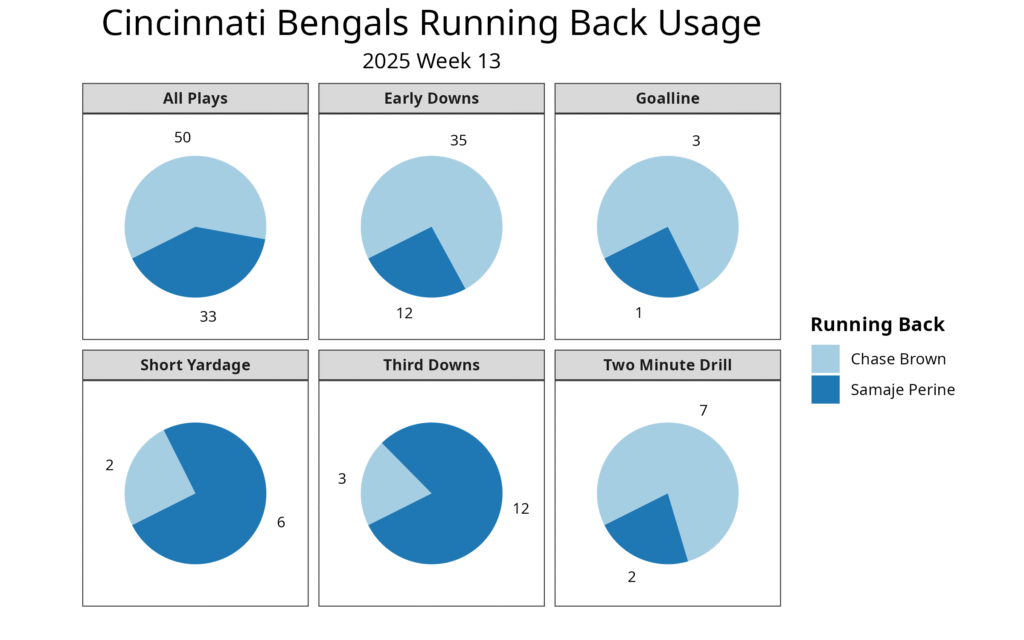
The Bengals’ running back rotation was straightforward early in the season, with Chase Brown handling early downs and Samaje Perine working as the third-down back. Perine performed well enough on the ground that his role began to grow in October — after staying under 30% of snaps in the first three weeks, he played at least 40% of the snaps in three of four games from Weeks 5-8.
With Perine out, Brown’s workload spiked to 89% of the snaps. Tahj Brooks operated as the primary backup during that stretch, but he was inactive this week with a concussion. Cincinnati got a boost with Perine practicing fully and returning to the lineup.
Perine mostly settled back into his usual role. He remained the clear third-down option and primary backup, and while his snap share wasn’t quite back to pre-injury levels, the Bengals used him more heavily as a runner, similar to right before the injury. Brown notably handled most of the two-minute drill work — a spot that typically belongs to Perine, though not always consistently.
Perine is a viable waiver option in deeper leagues, as he should maintain a path to close to double-digit touches. With Cincinnati holding the best running back schedule over the final four weeks of the fantasy season, Perine would become a fantasy starter if Brown were to miss time.
Bengals adapt at wide receiver: Ja’Marr Chase returned from his one-game suspension, though Tee Higgins was inactive due to a concussion.
The Bengals typically use Ja’Marr Chase and Tee Higgins on every down, with Andrei Iosivas joining them in three-wide receiver sets. All three were available for the first 11 weeks, with Chase playing 95.2% of snaps, Higgins 86.0% and Iosivas 79.2%.
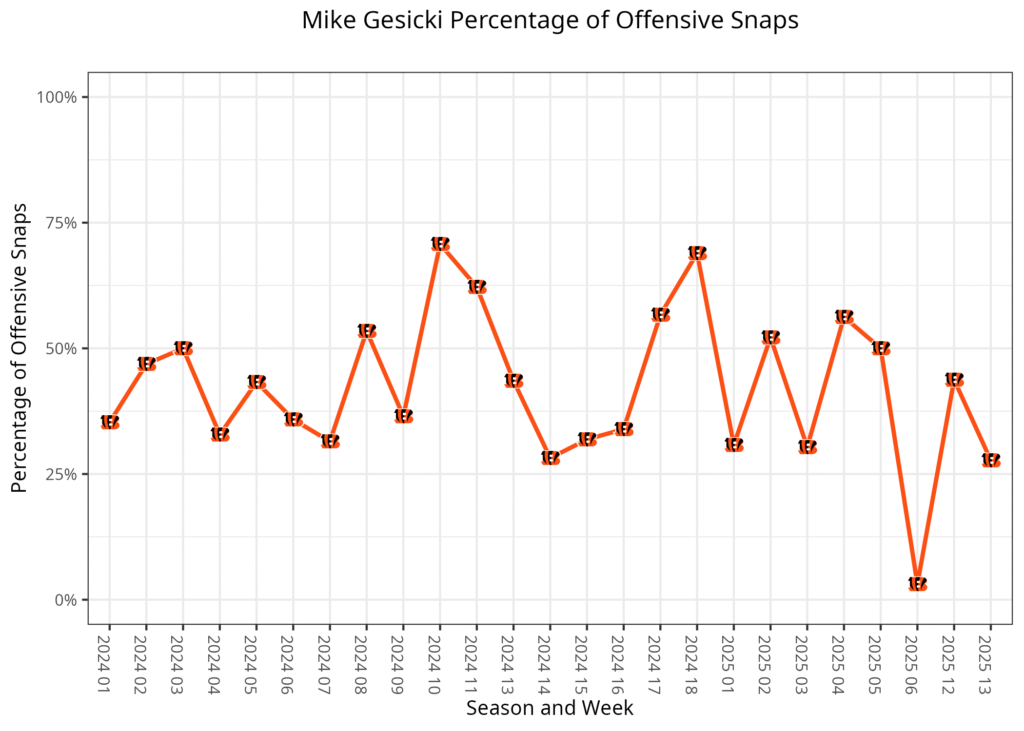
Last week, Cincinnati largely replaced Higgins with Mitch Tinsley. Tinsley had played just 14.3% of snaps over the first 11 weeks as the next man up whenever a wide receiver needed a breather. The Bengals also leaned heavily on 12 personnel, with Mike Gesicki returning and sharing the field with Tanner Hudson on several passing downs.
This week, the Bengals simply swapped out Higgins for Chase, with Tinsley continuing to handle the outside receiver role. Cincinnati moved away from the heavy 12-personnel usage and kept Tinsley on the field on passing downs. Their 12-personnel package remained part of the game plan as they built a lead, and it consistently included blocking tight end Drew Sample. As a result, Gesicki — who was a major contributor last season whenever Higgins was out — wasn’t a significant part of the offense.
Ideally, Higgins will return next week with the Bengals having 10 days before their next game. If that happens, Cincinnati should return to an even heavier dose of 11 personnel, making it increasingly difficult for any of their tight ends to carry fantasy relevance.
Justice Hill lands on injured reserve: Hill showed up on the Tuesday injury report with a neck injury. He missed this week and will miss at least the next three games.
Derrick Henry and Justice Hill have spent most of the season in a two-back committee, with Henry handling the majority of early-down and short-yardage work while Hill takes third downs and the two-minute drill. Over the first 10 weeks, Henry played 56.4% of the snaps compared to Hill’s 38.5%, with Keaton Mitchell gradually working his way into early-down usage.
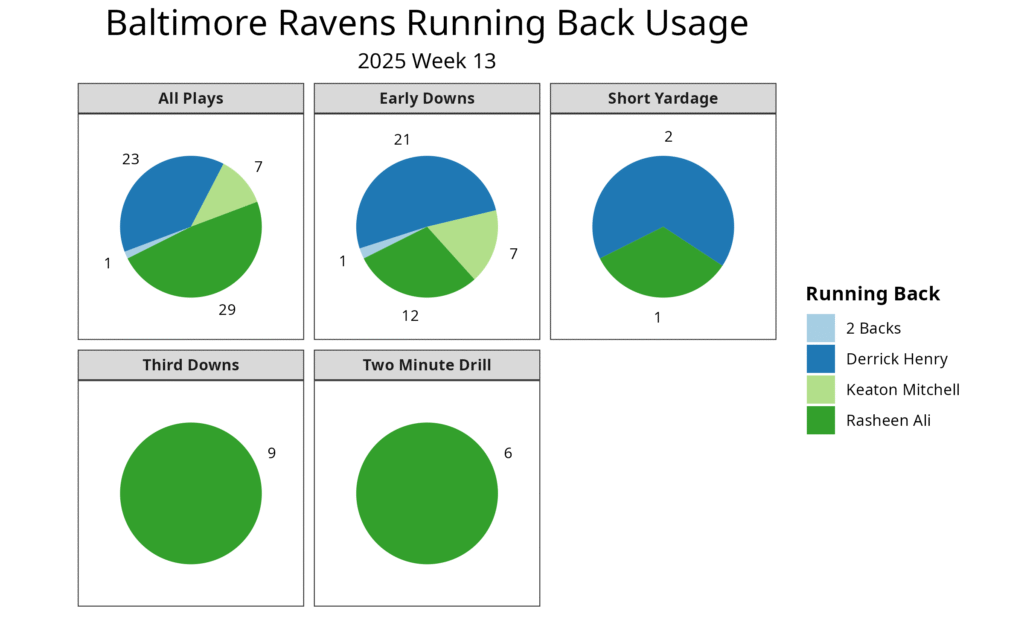
Hill missed Week 11 with a toe injury, which pushed Mitchell into the backup early-down role and put Rasheen Ali on third downs and in two-minute situations. Hill returned last week and Ali was inactive. This week, Ali and Mitchell split the backup work, due in part to Baltimore playing from behind, with Ali continuing to handle late-down snaps.
Although the game script wasn’t favorable, it’s notable that Henry’s playing time has been trending downward. He played 71.8% of early-down snaps over the first 10 weeks, dipping below 60% only once, but he has been at 60% or lower in each of the past three games. Most starters see more work when a backup is out; Henry has seen less.
Henry played just one of 15 fourth-quarter snaps. One of those plays was a two-minute drill, and two were third downs, but the game remained within one score throughout the quarter, so the score wasn’t the driver. On normal early-down snaps, Ali played six of 12, Mitchell played five and Henry played only one.
Henry salvaged his fantasy day with a 28-yard touchdown run and a 44-yard reception, but the usage trend is concerning for his fantasy value during the playoffs and for his outlook heading into 2026.
Miscellaneous Notes
- The Bengals activated quarterback Joe Burrow from injured reserve on Wednesday. His return meant Joe Flacco was the backup, Jake Browning was inactive, and Sean Clifford was released on Tuesday and signed to the practice squad on Wednesday.
- The Bengals elevated running back Gary Brightwell from the practice squad for this game on Thursday to be their third running back. He only played on special teams, including being the team’s primary kick returner.
- Cincinnati wide receiver Jermaine Burton was ruled out due to an ankle injury. He has been inactive all season, but with the Higgins injury, he could have been active this week if he were healthy.
- Baltimore quarterback Lamar Jackson didn't practice on Monday with a toe injury.
- Baltimore wide receiver Rashod Bateman was back in the lineup after missing back-to-back games with an ankle injury. He was back to his usual role as the second wide receiver, with DeAndre Hopkins moving back to the third receiver spot.
- Baltimore wide receiver Tylan Wallace was a healthy inactive for the first time this season. He started the season in a rotation with Hopkins for the third receiver spot, but eventually lost that job. Devontez Walker had been the inactive receiver when everyone was healthy earlier in the season, but he was active for this game.
Table notes
- Snaps include plays called back due to penalties, including offensive holding or defensive pass interference. The other three stats have these plays removed.
- Targets may differ from official NFL sources. The most likely discrepancy would be from a clear thrown-away pass, where the NFL may give the target to the nearest receiver, while this data will not.
- Carries are only on designed plays. Quarterback scrambles won’t count for the total number of carries in the game.

 © 2026 PFF - all rights reserved.