
- Fernando Mendoza is the clear top option in this year’s class: The reigning Heisman trophy winner leads an underwhelming class of quarterback prospects this year.
- Gauging the level of hope for the others in this class: Looking at the chances of fantasy success for Ty Simpson, Trinidad Chambliss, and more.
- Unlock your edge with PFF+: Access Premium Stats, dominate fantasy with in-season tools and projections and make smarter bets with the new PFF Player Prop Tool. Get 25% off your PFF+ annual subscription with code PFFFANTASYPODCAST25.
Estimated Reading Time: 12 minutes
NFL draft season is in full swing, which naturally comes with a plethora of ways to evaluate potential talent coming out of college. This article series is no different, as we’ll add a fantasy football spin to the evaluation process to identify which incoming prospects have a shot to become fantasy-relevant early on in their NFL careers.
So far, we’ve covered running backs, tight ends, and wide receivers via position-specific prospect models this season.
Next up is the quarterback position for fantasy football, where this year’s class leaves something to be desired, though we’ll still need to dive in and get a better feel for how they shake out. To help sort through this year’s options, this model will account for the data and metrics that correlate most closely with NFL success for college prospects and utilize the key factors for each player to devise a prospect score. Like with any position, there is not one metric that will tell us whether a college prospect will be good or not in the NFL, but the purpose of this model is to combine the metrics and factors that data has proven to be the most relevant while providing weight to those that are more important than others.
For the quarterback position, in no particular order, we’re looking at career passing grades, rushing production through various metrics, stable metrics such as scramble rate and sack rate, level of competition faced, and draft capital, among a few others.
Note: This is an updated version of the article coming out of the NFL Combine and headed into NFL draft month. This will be updated post-NFL draft once draft capital becomes official.
Keys
- The prospect pool for this model consists of 123 past quarterback prospects dating back to 2017.
- 11 quarterbacks drafted since 2017 have become a top-four finisher for their position at least once (8.9%).
- Of those 11 top-four finishers, nine (81.8%) finished as top-four finishers within their first three NFL seasons.
- Also, of those 11 top-four finishers, 10 of them (90.9%) have been repeat top-12 finishers.
- 18 quarterbacks drafted since 2017 have become a top-eight finisher for their position at least once (14.6%).
- 19 quarterbacks drafted since 2017 have become a top-12 finisher for their position at least once (15.4%).
- This is an important context when understanding hit rates, as many more prospects will not become fantasy-relevant than most, given such a large pool of players.
- However, using this model, the higher the prospect score, the better the success rate will be for each prospect, as highlighted below.
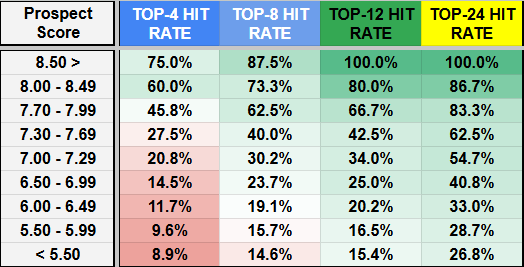
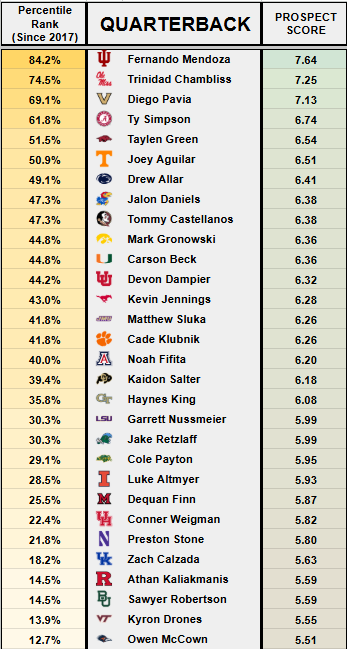
With all this in mind, it’s time to look at this year’s quarterback prospects in order of expected draft capital to identify our future fantasy football contributors. It should also be noted that these scores should not necessarily be used so much as your rankings, as they should be more of a guide toward the quality of the player. Draft capital and landing spot can and will play a big part in actual rankings, though these scores can help us determine which players to trust or not when it comes time to pull the trigger on these players in our rookie drafts.
Fernando Mendoza, Indiana
- Consensus draft capital: 1st overall
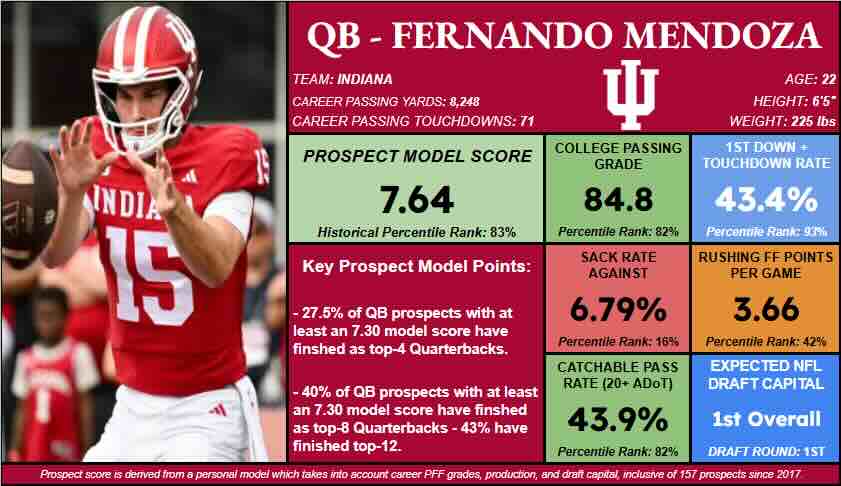
- Mendoza is the clear favorite to go first overall (to the Las Vegas Raiders), and while that alone will afford him a likely long NFL career, he doesn’t quite live up to the level of prospect as other highly-drafted quarterbacks.
- Even Cameron Ward, who also came in as a lower-end quarterback prospect last year, scored higher (7.79) than Mendoza, though that doesn’t mean he’ll have an impossible path to success at the next level.
- Mendoza still earned strong marks as a passer, including his overall passing grade and deep throw accuracy, which were both good enough to crack the top 80th percentile.
- Mendoza's main concerns for translating to fantasy success in the NFL come from below-average rushing upside – represented by his 56th percentile mark in scramble rate (6.8%) and 42nd percentile mark in rushing fantasy production (3.66 per game) – and a tendency for a high rate of sacks.
- Both are among the more stable tendencies to translate to the NFL, and more importantly for fantasy, which could still mean he is a successful NFL quarterback who doesn't have weekly fantasy upside.
- That being said, because of the gap in draft capital and the very likely immediate starting opportunity, he’ll be a potential second-round pick in rookie drafts, just not the 1.01 in superflex formats.
Ty Simpson, Alabama
- Consensus draft capital: 34th overall
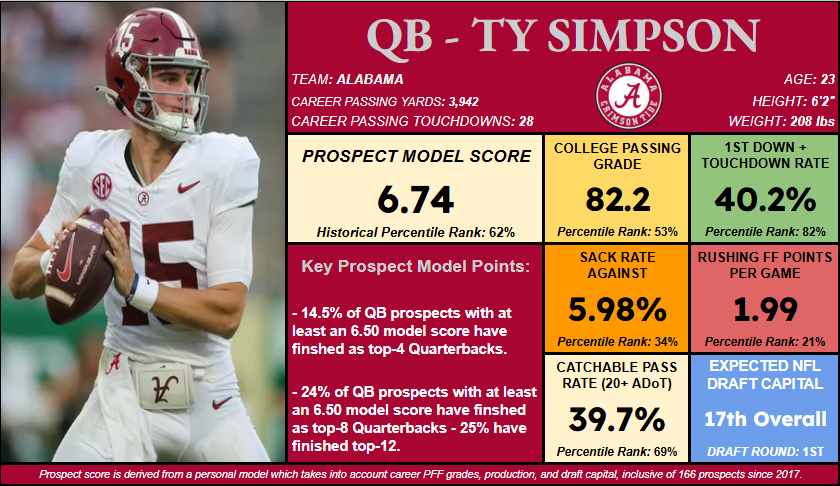
- Simpson’s draft stock has gone up and down over the past few months, including a potential mid-first-round expectation prior to the combine to now being mocked as an early second-round pick.
- It’s still possible that Simpson becomes a first-round pick and lands on a quarterback-needy team, but with a little over a month to go before the NFL draft, his second-round projection hurts his outlook just a little bit more.
- Simpson is just a one-year starter coming out of college, though he appeared in games throughout his four-year career at Alabama, which brings down a lot of his per-game stats, specifically highlighted in his rushing fantasy points per game in the graphic above.
- If we’re just using 2025 to evaluate Simpson, his numbers obviously improve. He still earned just 2.75 rushing fantasy points per game, a 32nd percentile mark since 2017.
- Simpson’s passing marks aren’t overly impressive either to create a ton of confidence that he’ll deliver at the next level, though it was promising to see him flourish with a career year in his first opportunity as a starter in 2025.
- Ideally, he’ll continue to develop if he’s given a starting opportunity in the NFL, and considering he was able to thrive in that role this past season, there is hope that maybe that can translate into fantasy success at some point as well.
- For now, the chances are low (see hit rates above) compared to players like Dwayne Haskins, Will Levis, and Kellen Mond – though there are two outliers (among 70 past prospects) like Brock Purdy and Jordan Love who have found fantasy success despite scoring below 7.00 in the model.
Garrett Nussmeier, LSU
- Consensus draft capital: 86th overall
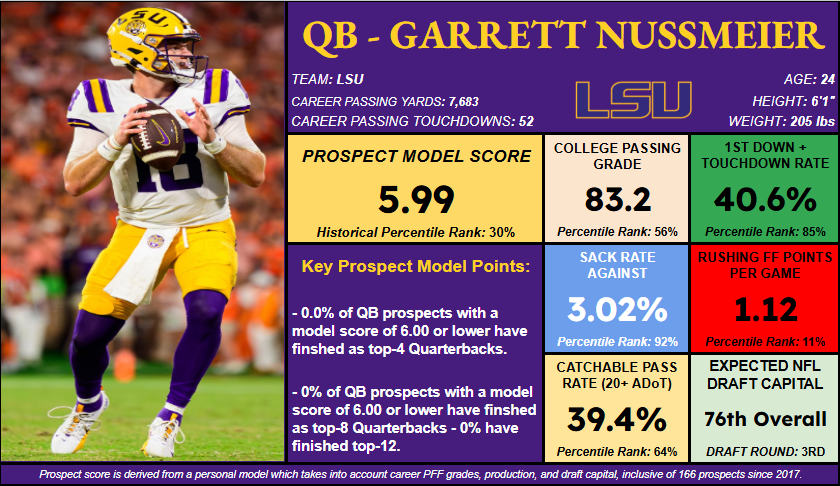
- Nussmeier is a two-year starter at LSU, though he missed some time this past season due to an injury and benching. He did play in the Senior Bowl and won MVP.
- Unfortunately, there are too many red flags in Nussmeier’s profile to let that accolade be our guiding light in viewing him as a potential fantasy asset.
- Nussmeier’s five-year career and less-than-stellar metrics pretty much across the board will lump him in with past Day 2 or later prospects like Davis Mills, C.J. Beathard, Kyle Lauletta and Jacob Eason, who all scored below 6.00 and were drafted no later than Round 4 in the NFL Draft.
- Sadly, none of the quarterbacks drafted since 2017 who scored below 6.50 in the prospect model have gone on to become top-12 fantasy finishers at their position in the NFL, only Gardner Minshew (QB21 in 2023 and 2019) came even remotely close.
- Nussmeier will purely be a deep superflex league option only, and one where we’ll likely hope for some spot starts if he fills in for an injured starter, as he projects to be an NFL backup at best.
Drew Allar, Penn State
- Consensus draft capital: 114th overall
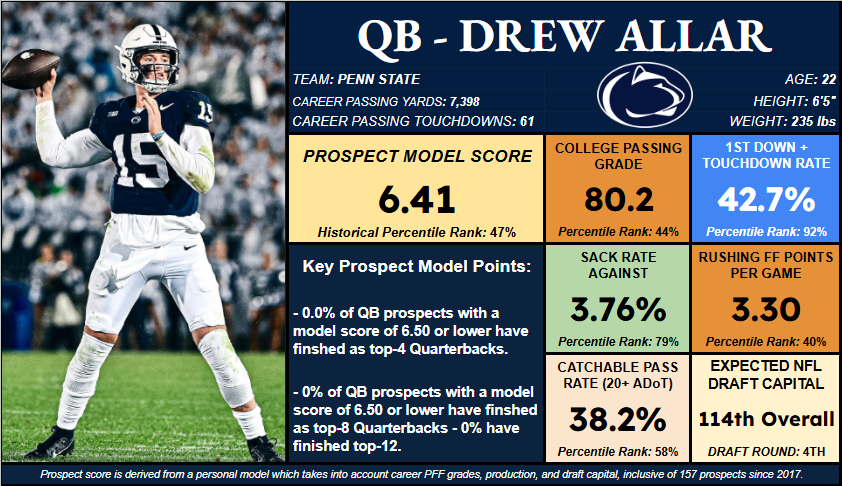
- Allar’s stock has recently improved to crack the top-five projected quarterbacks in this class after a season-ending ankle injury cut his 2025 short.
- Allar was able to participate at the NFL combine and will potentially throw at his pro day as well, continuing to help build on his draft stock heading into April.
- Allar has been a full-time starter at Penn State since 2023, though he has never really excelled in terms of PFF passing grade, resulting in just a 44th percentile mark in his career PFF passing grade.
- While he’s not particularly poor in any one key metric, he doesn’t really stand out either, which pushed his overall model score just below the dreaded 6.50 threshold where we haven’t seen a top-12 fantasy performer since 2017.
- This is a common concern with the majority of this class, as Nussmeier, Allar, and Carson Beck all fall into a similar bucket.
- Again, they may find success at the next level, but their odds of doing so are incredibly low, which should push them outside of a draftable range in typical one-QB rookie drafts.
Carson Beck, Miami (FL)
- Consensus draft capital: 119th overall
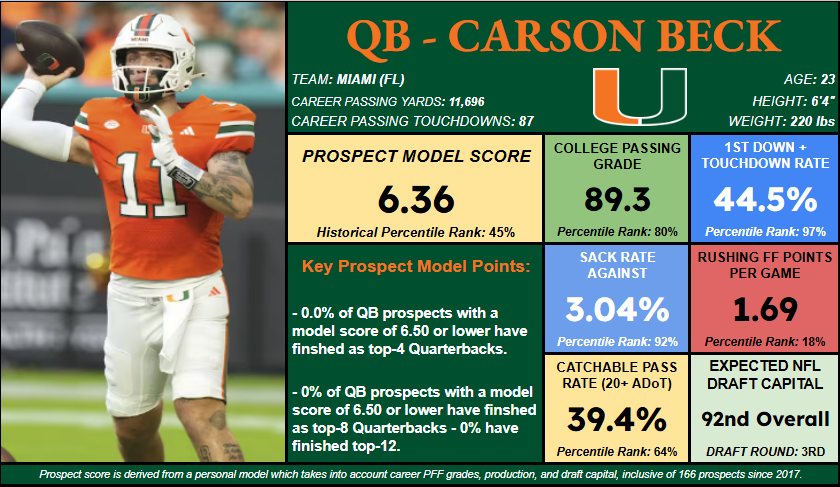
- Beck suffers from all the same concerning factors mentioned above with Nussmeier and Allar, though scores slightly better in the prospect model.
- However, that score isn’t enough to create any optimism that he’ll turn into a legitimate fantasy asset, as he also scores in a bucket of players (sub-6.50) that have never delivered a top-12 fantasy finish since 2017.
- Nothing is impossible, and Beck has three years of starting experience coming out of college, which will be valued by the NFL, though he also seemingly peaked in 2023 with his 90.8 passing grade, which has only decreased since then.
- Beck, much like most of this class, is looking at a potential backup role in the NFL, which isn’t interesting for fantasy purposes outside of the deepest leagues.


 © 2026 PFF - all rights reserved.