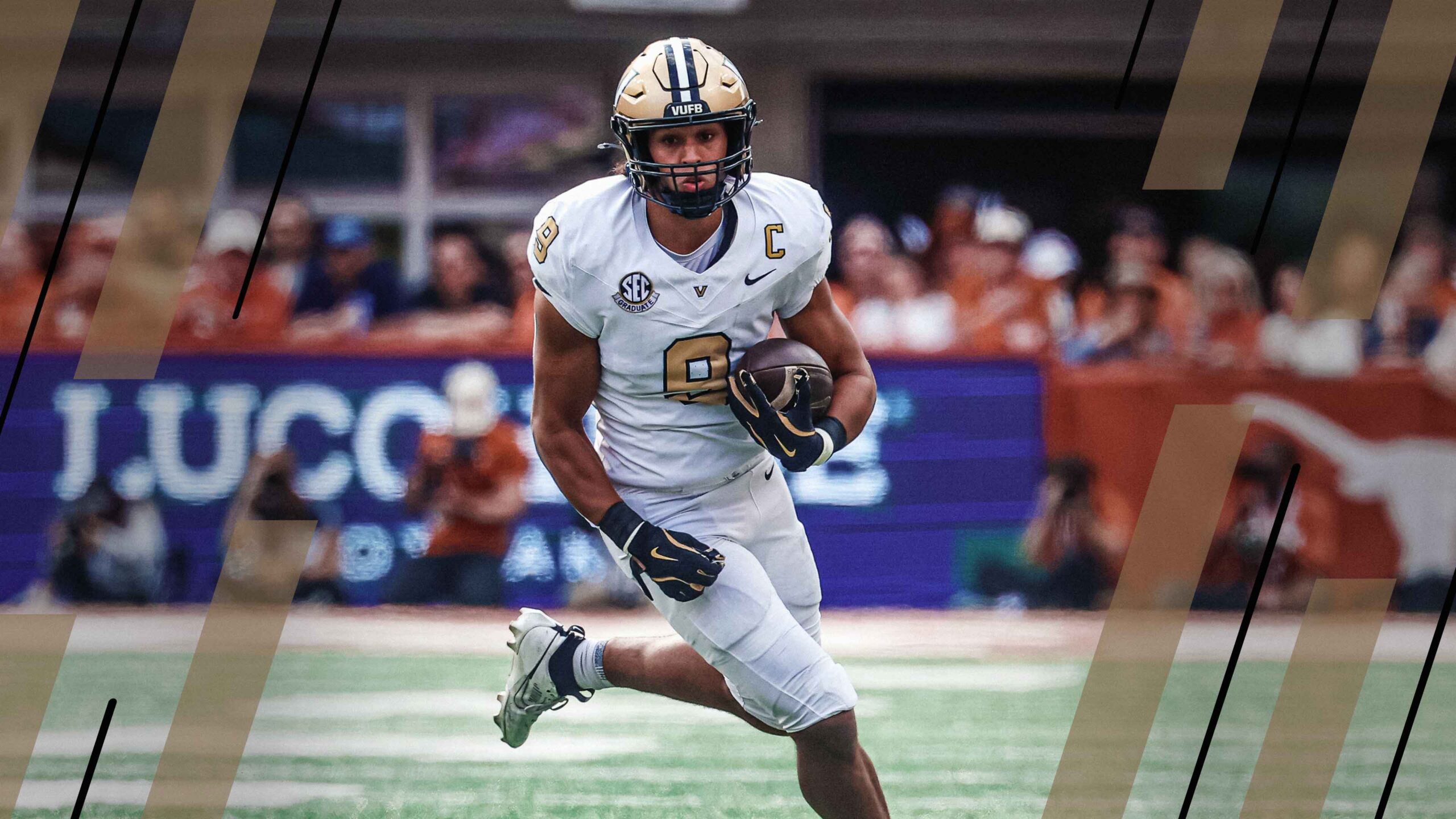
- Eli Stowers could end up being the fantasy gem to target this year: Currently mocked as the TE3 in this year’s class, Stowers boasts an impressive resume, which should help him translate smoothly into the NFL.
- Kenyon Sadiq appears to be the lone first-round tight end in 2026: Despite his high expected draft capital, Sadiq isn’t without some blemishes. He should still be a solid prospect.
- 2026 NFL Draft season is here: Try the best-in-class PFF Mock Draft Simulator and learn about 2026's top prospects while trading and drafting for your favorite NFL team. Get 25% off your PFF+ annual subscription with code PFFFANTASYPODCAST25.
Estimated Reading Time: 9 minutes
NFL draft season is in full swing. There are a plethora of ways to evaluate potential NFL talent, and this article series is one such method. We’ll add a fantasy football spin to the evaluation process to identify which incoming prospects have a shot to become fantasy-relevant early on in their NFL careers.
To help sort through this year’s options, the model will account for the data and metrics that correlate best to NFL success for college prospects and utilize the key factors for each player to devise a prospect score. As with any position, no one metric tells us whether a college prospect will excel in the NFL, but this model will encompass the most relevant factors.
For the tight end position, we’re looking at career PFF receiving grades, yards per route run, athleticism, level of competition faced and draft capital, among a few other numbers.
Note: This is an updated version of the article coming out of the NFL Combine and headed into NFL draft month. This will be updated post-NFL draft once draft capital becomes official.
Keys
- The prospect pool for this model consists of 131 past tight prospects, dating back to 2019.
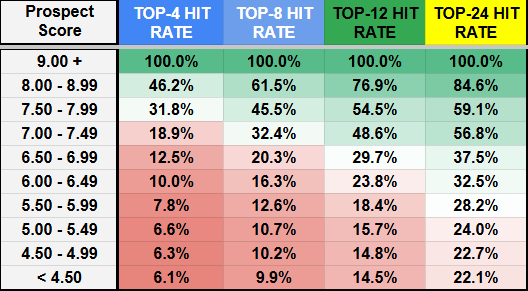
- Eight tight ends drafted since 2018 have become a top-four PPR finisher at least once (6.1%).
- Thirteen tight ends drafted since 2018 have become a top-eight PPR finisher at least once (9.9%).
- Eighteen tight ends drafted since 2018 have become a top-12 PPR finisher at least once (13.7%).
- All 18 of those top-12 finishers achieved the feat within their first three NFL seasons.
- Sixteen have played more than one season, with 12 (75%) of them becoming repeat top-12 finishers.
- Twenty-nine tight ends drafted since 2018 have become a top-24 PPR finisher at least once (22.1%).
- This is important context when understanding hit rates, as far more prospects will not become fantasy-relevant because of the large pool of players.
- The higher the prospect score in this model, the better the success rate will be for each prospect, as highlighted below.
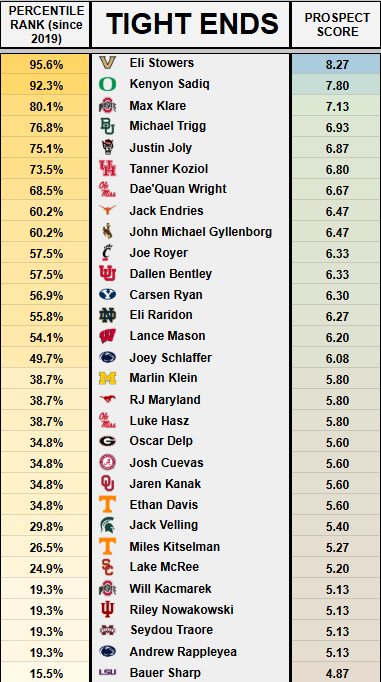
With all this in mind, it’s time to look at this year’s tight end prospects in order of expected draft capital to identify future fantasy football contributors. These scores should not necessarily be used as rankings; they are more of a guide to player quality. Draft capital and landing spot can and will play a big part in actual rankings, though these scores can help us determine which players to trust when it comes time to pull the trigger in our rookie drafts.
Kenyon Sadiq, Oregon
Consensus Draft Capital: 18th overall
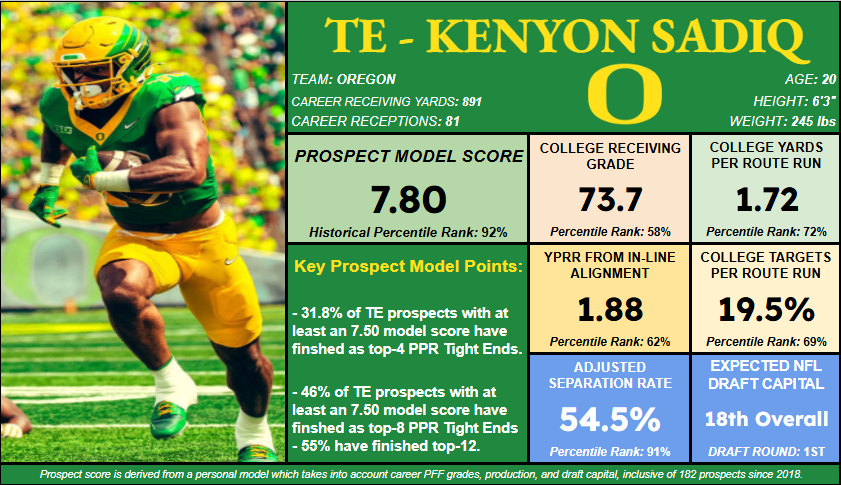
- Sadiq is the lone consensus first-round tight end in this year’s class. There is a wide gap in expected draft capital between him and the next-closest player.
- Still, the model took his data and spit out the second-best score among tight ends in this year’s class. He owns a strong 92nd-percentile score dating back to 2018.
- Coming off a strong combine, and weighing athletic testing – which has mattered for tight ends to have success at the next level – Sadiq improved his showing in this model, previously sitting at a 7.80 model score and now jumping up to above 8.00.
- Pushing Sadiq down the model is his receiving metrics, many of which don’t come close to some of the top tight ends of years past. Brock Bowers, Colston Loveland, Tyler Warren and Sam LaPorta all earned 90.0-plus PFF receiving grades coming out of college, and Sadiq ranks last, by far, among that group.
- In fact, Sadiq’s 73.7 career PFF receiving grade would be the lowest mark among first-round tight end prospects since Hayden Hurst in 2018 (68.3). That's also true for his 1.72 career yards per route run average.
- Sadiq joins past tight end prospects, drafted in the first two rounds, who scored below 8.50 in the prospect model and also owned a sub-75.0 career PFF receiving grade — the likes of Brenton Strange, Ben Sinnott, Luke Schoonmaker, Drew Sample, Elijah Arroyo, Terrance Ferguson, Luke Musgrave, Cole Kmet, Mason Taylor and Hayden Hurst – and Hurst is the lone tight end to have top-12 fantasy success so far.
- Again, there’s more confidence in Sadiq because of his expected draft capital, so he still has a good shot to succeed, but we’re fortunate to have had many elite rookie tight ends as of late, so expectations for Sadiq should be at least a little tempered in Year 1.
Eli Stowers, Vanderbilt
- Consensus draft capital: 50th overall
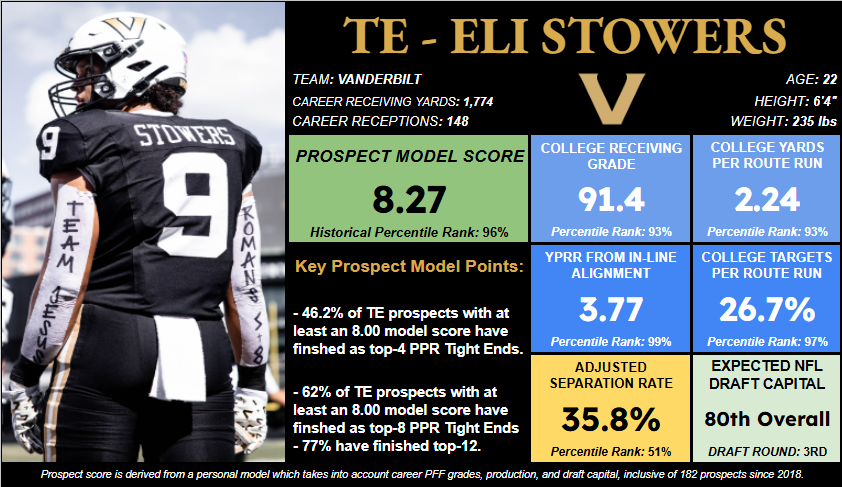
- Stowers leads the 2026 tight end class in model score, ranking in the 98th percentile among prospects since 2018. He is in a great spot to deliver at the next level.
- Stowers boasts all the high-end receiving metrics we wanted to see from the tight end prospects expected to go ahead of him in this draft, including a 91.4 PFF receiving grade and 2.24 yards per route run for his career.
- Stowers led all Power Four tight ends in receiving yards this season (769) and ranked second in yards per route run (2.55).
- Stowers also earned an elite 26.7% target rate for his career, ranking second to only Harold Fannin Jr. (29.0%) among prospects with at least 150 career targets since 2018.
- Fannin was previously the lowest-drafted tight end prospect to place in the 95th percentile in the model. Considering Fannin's immediate success in 2025, Stowers' draft capital shouldn’t scare fantasy managers away.
- For rookie drafters who need tight end help and aren’t willing to spend up to get Sadiq, Stowers makes sense as the primary target, potentially in the early-to-middle second round of rookie drafts — or higher in tight-end-premium leagues.
Max Klare, Ohio State
- Consensus draft capital: 75th overall
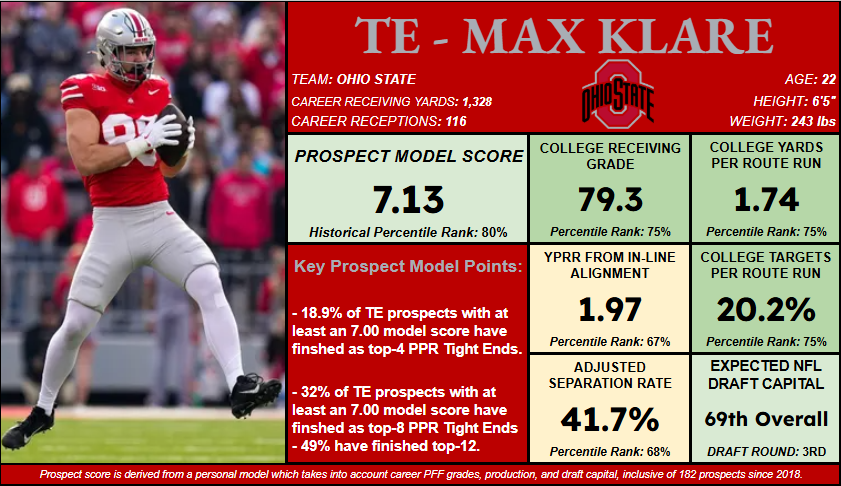
- Klare's career receiving metrics are slightly better than Kenyon Sadiq's; he comes in a fair bit lower in the model due to expected draft capital.
- Klare outperforms Sadiq across several metrics, but their expected draft capital sets them apart more than anything else at the moment.
- Where Klare differs from Sadiq is that he dealt with elite target competition in the form of Jeremiah Smith and Carnell Tate this season, which pushed him down to third, at best, in Ohio State's passing-game pecking order. Meanwhile, Sadiq led Oregon in targets.
- Klare’s receiving metrics also dropped off this season after he transferred from Purdue. His PFF receiving grade fell from 85.6 in 2024 to just 66.5 this past season.
- As a result, Klare’s current 7.13 model score isn’t ideal. Ninety-eight prospects have scored 7.20 or lower, and only three (Cole Kmet, Dawson Knox, andJake Ferguson) have delivered top-12 PPR finishes in their NFL careers so far.
- All things considered, Klare will likely be more of a taxi-squad stash in dynasty rookie drafts this year as a fringe second- or third-round pick at best.
Michael Trigg, Baylor
- Consensus draft capital: 96th overall
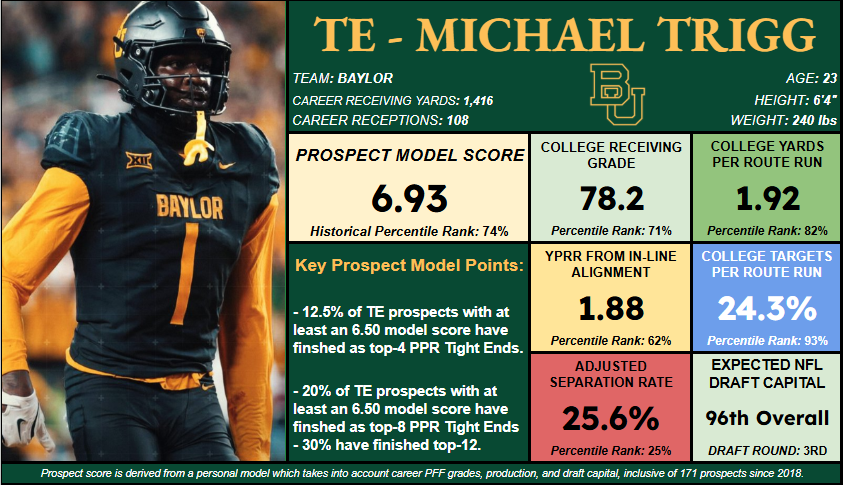
- Trigg is coming off a strong season, finishing second to only Stowers in receiving yards (694) among Power Four tight ends.
- It took Trigg five college seasons and three teams to finally have that breakout year, so he's in a somewhat concerning position. That's part of the reason his score comes in lower than the rest of the third-rounders.
- Trigg was targeted at a high rate during his college career, and he was relatively efficient on those opportunities, helping him land an 82nd-percentile mark in career yards per route run.
- That level of efficiency provides some hope for Trigg at the next level if he can land in a positive situation as a primary receiving option.
- That’s easier said than done for a third-round pick, though. Trigg has the size and experience to potentially earn a large enough role and deliver on some of his potential, but he’ll still likely be a later-round rookie draft pick.
Justin Joly, North Carolina State
- Consensus draft capital: 107th overall
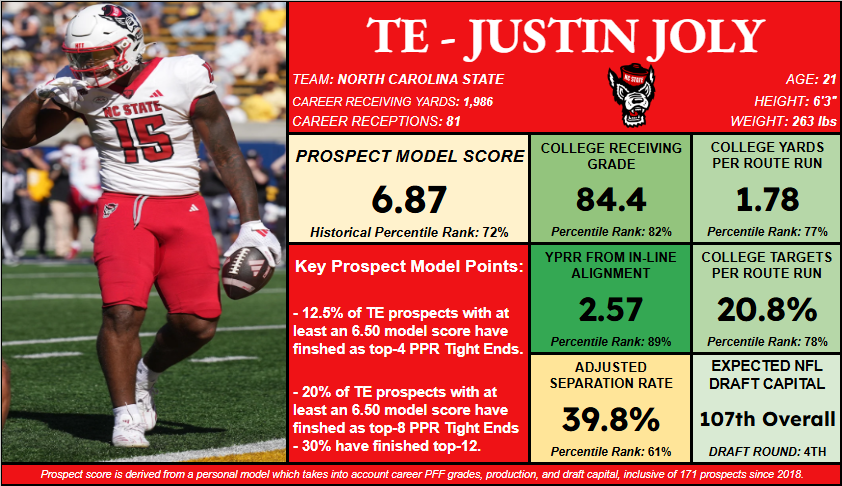
- Joly leads off the potential Day 3 tight ends in this class, though he does so without overly encouraging sleeper value based on his model score.
- Having split his college career between Connecticut and North Carolina State, Joly has gained solid starting experience and a substantial sample size to draw from, running over 1,100 routes.
- This past year was Joly's career-best season, and his 81.6 receiving grade – a top-15 mark in the FBS for his position.
- Joly had more productive seasons in his college career than 2025 in terms of raw numbers, though nothing spectacular, which keeps his overall model score in a less-than-ideal range.
- Most of these Day 3 prospects won’t be worth spending real rookie draft capital on this season, and Joly isn’t too different in that regard, as he’ll likely fit in as more of a deep-league taxi squad stash.
Jack Endries, Texas
- Consensus draft capital: 138th overall
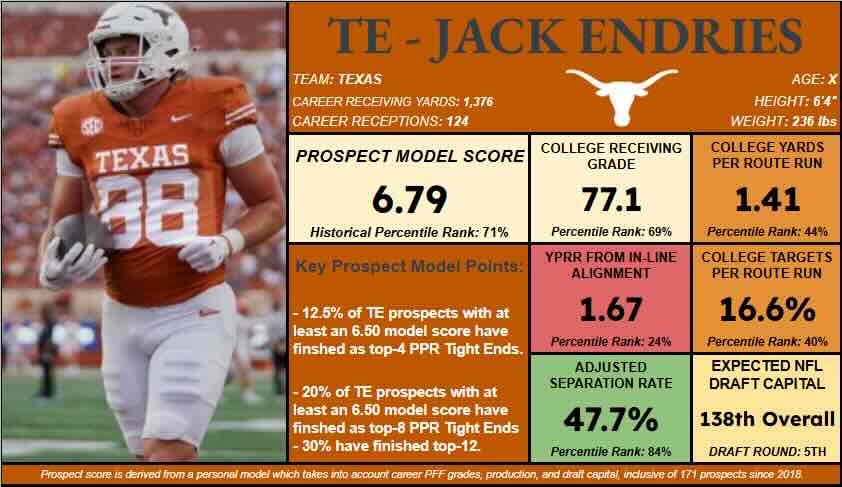
- Unfortunately, Endries doesn’t offer many intriguing metrics to excite prospective dynasty managers, coming in as the model's eighth-ranked 2026 tight end prospect.
- While there are typically some Day 3 players worth taking shots on in rookie drafts, Endries doesn’t necessarily stand out as one of them at this point.
- If Endries was as effective a receiver as he was in 2024 when he was with California, then it would have likely been a different story for him and his value.
- Unfortunately, Endries went from an 85.4 PFF receiving grade in 2024 to just a 65.1 mark this past year after transferring to Texas. His efficiency took a nosedive, with his yards per route run dropping from 2.13 to just 1.07 in 2025.
- It’s also worth noting that among 94 prospects to score below 7.00 in this model, only Jake Ferguson has finished among the top 12 PPR scorers at the position — a group that also includes 11 Day 2 prospects.
- Endries is unlikely to greatly increase his score from now until after he’s selected in the 2026 NFL Draft, so he’ll remain a deep-league dynasty rookie pick.






 © 2026 PFF - all rights reserved.