
- Jeremiyah Love leads the way by a mile: In a weaker running back class, Love stands out as the clear best option, though is also among the better options in recent years.
- Jonah Coleman has a shot to be a decent value in rookie drafts: Coleman boasts strong enough career college metrics to be worthy of a second-round NFL Draft pick, though is currently being mocked in the third round by consensus.
- Unlock your edge with PFF+: Access Premium Stats, dominate fantasy with in-season tools and projections and make smarter bets with the new PFF Player Prop Tool. Get 25% off your PFF+ annual subscription with code PFFFANTASYPODCAST25.
Estimated reading time: 21 minutes

NFL draft season is ramping up, which naturally comes with a plethora of ways to evaluate potential talent coming out of college that has the potential to translate to the next level. This article series is no different, as we’ll add a fantasy football spin to the evaluation process to identify which incoming prospects have a shot to become fantasy-relevant early on in their NFL careers.
Starting with the running back position for fantasy football, where volume is king and draft capital often reigns supreme when it comes to prospects – as is typically the case with every position. Through years of data collection and analysis to understand which metrics correlate best to NFL success for college prospects, this prospect model considers the key factors and metrics for each player to devise a prospect score. Like with any position, there is not one metric that will tell us whether a college prospect will be good or not in the NFL, but this model's purpose is to combine the metrics and factors that data has proven to be the most relevant while providing weight to those that are more important than others.
For the running back position, in no particular order, we’re looking at career rushing grades, career production, key elusive metrics, level of competition faced and draft capital, among several others.
Note: This is an updated version of the article coming out of the NFL combine and headed into NFL draft month. This will be updated post-NFL draft once draft capital becomes official.
Keys
- The prospect pool for this model now consists of 306 eligible past running back prospects dating back to 2017 – 52 from the 2026 class.
- Of the 254 past prospects, we’ve had 30 unique running backs since 2017 that have become a top-12 PPR finisher for their position at least once (11.8%).
- Of those 30 top-12 finishers, 27 (90%) finished as top-12 finishers within their first three NFL seasons.
- Also, of those 30 top-12 finishers, 19 of them (63%) have been repeat top-12 finishers.
- 58 running backs drafted since 2017 have become a top-24 PPR finisher for their position at least once (22.8%).
- 78 running backs drafted since 2017 have become a top-36 PPR finisher for their position at least once (30.7%).
- This is an important context when understanding hit rates, as many more prospects will not become fantasy-relevant than most, given such a large pool of players.
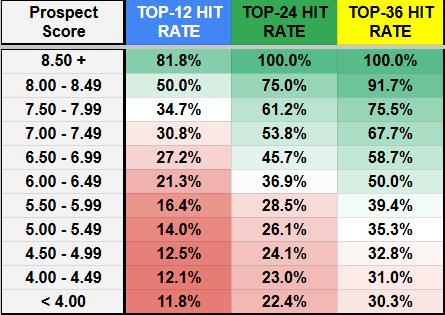
- However, using this model, the higher the prospect score, the better the success rate will be for each prospect, as highlighted below.
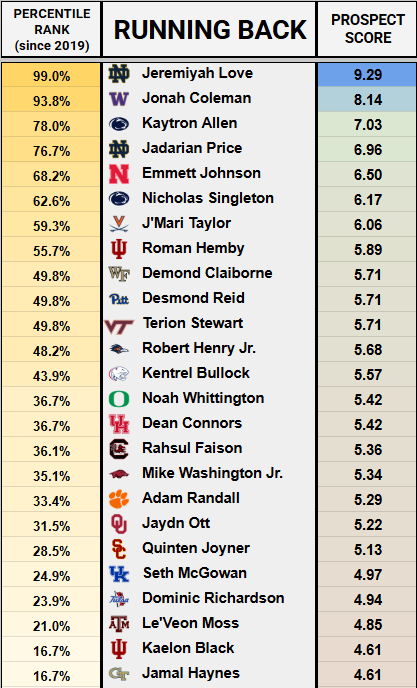
With all this in mind, it’s time to look at this year’s running back prospects in order of expected draft capital to identify our future fantasy football contributors. It should also be noted that these scores should not necessarily be used so much as your rankings, as they should be more of a guide toward the player's quality. Draft capital and landing spots can and will play a big part in actual rankings, though these scores can help us determine which players to trust or not when it comes time to pull the trigger on these players in our rookie drafts.
Jeremiyah Love, Notre Dame
- Consensus draft capital: 4th overall
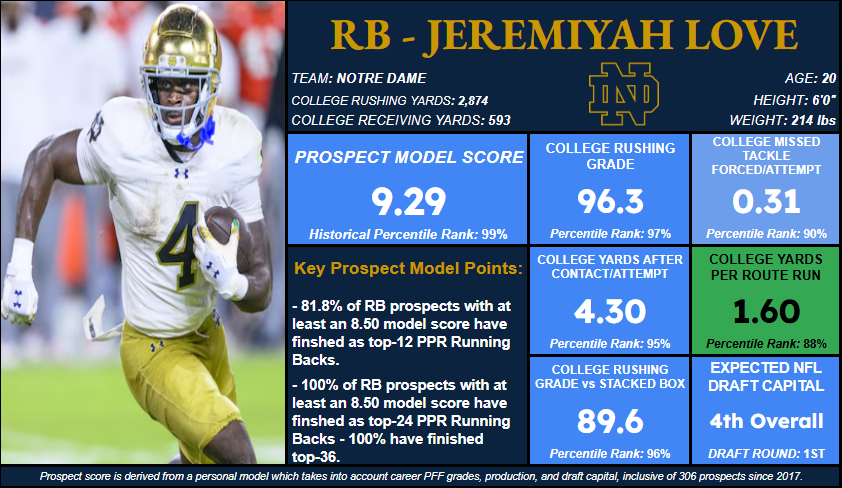
- Love is the top consensus back in this class, and the model reflects that with an elite score, making him just the fourth running back to score above 9.00 since 2017.
- Of the three previous running backs to score over 9.00, two (Bijan Robinson and Travis Etienne) have been top-three overall fantasy finishers at their position in the NFL and have repeated as top-12 scorers across multiple seasons.
- The lone outlier is currently Ashton Jeanty, who has just one season under his belt at the next level and finished as RB13 in Year 1 – just outside that ideal top-12 mark.
- Love, as a potential top-10 pick and scoring as well as he did thanks to elite metrics, joins a bucket of players who scored higher than 8.50, where all have finished as at least top-24 fantasy options and 82% have finished top-12 so far.
- Love checks the boxes of everything we’re looking for in an elite running back prospect, including 90th-plus percentile marks in missed tackles forced per attempt, yards after contact per attempt and career rushing grades in specific situations.
- Love is also no slouch as a receiving back, earning a very strong 1.60 yards per route run for his career on 74 career targets since 2023 while also earning a strong 79.2 career receiving grade.
- Love should be considered locked into the 1.01 for dynasty rookie drafts, regardless of landing spot, as his overall value is unlikely to decrease from now until rookie draft time.
Jadarian Price, Notre Dame
- Consensus draft capital: 46th overall
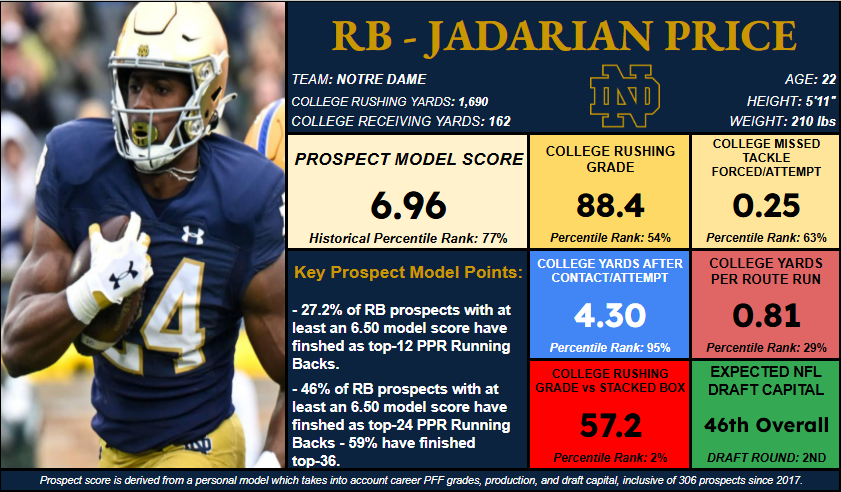
- Unlike his Notre Dame teammate, Price doesn’t boast as impressive a prospect profile as Love, though he’s still a potential Day 2 pick in the NFL draft, which will put him on most fantasy radars.
- While Price stands out in his rushing yards after contact per attempt for his career, though he doesn’t stand out as a back who is particularly impressive relative to his peers in most other metrics.
- While his 88.4 career rushing grade sounds good as a surface-level number, it’s a common mark to reach for NFL draft-eligible prospects and an expected outcome for legitimate prospects.
- Price also struggled significantly against stacked boxes in his college career, earning one of the worst marks among all prospects since 2017.
- While that rushing grade versus eight-plus man boxes is just one number, among the 27 past running back prospects to score lower than the 10th percentile in that regard, only one (James Cook) has found top-12 success in the NFL.
- Cook can be a good example to point to, but he also scored slightly higher in the prospect model and cracked the second-round of the NFL draft – though can still be viewed as an outlier overall as a prospect himself.
- Ideally, Price lands in a situation where he’ll have a shorter path to snaps in the NFL, but those opportunities are few and far between most years, especially for Round 3 picks who haven’t earned their spot yet and Price, who has little experience as a receiver.
- Price will be a fringe top-10 pick in rookie drafts, though based on a lot of his underlying metrics and prospect score, he’ll likely come outside that range for me with some better bets to pivot to instead.
Jonah Coleman, Washington
- Consensus draft capital: 92nd overall
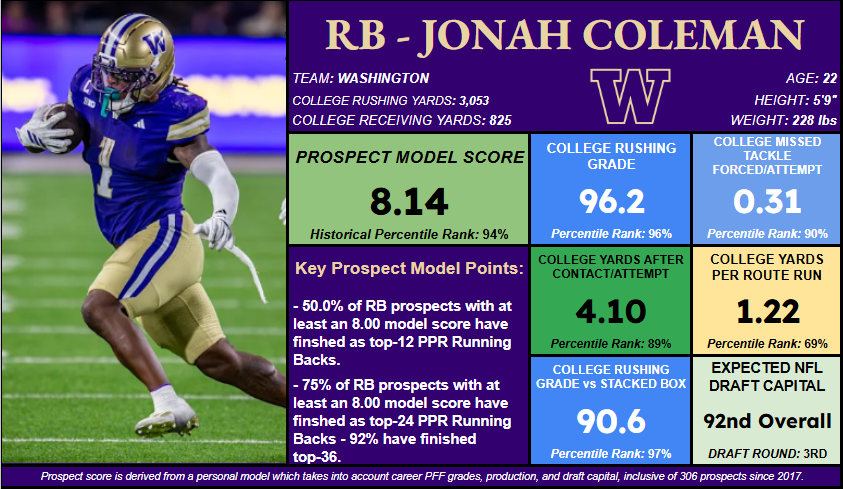
- Coleman has been a fringe second-to-third-round pick in mock drafts, which can move him up or down in model score depending on where he ultimately ends up come draft day.
- As of this pre-combine data, he’s being mocked as an early third-rounder, as is the rest of this top-five, though he is clearly the best of that bunch.
- Coleman stands out as one of the best pure runners in this year’s class, earning no worse than an 86.7 rushing grade across each of the past four seasons at both Arizona (2022-2023) and Washington (2024-2025).
- As a result, Coleman has racked up over 3,000 career rushing yards at an efficient 5.5 yards per carry for his career.
- While Coleman’s hit rate bucket is still strong, as 50% of a possible 24 past running back prospects achieved top-12 success so far and 92% finished no worse than top-36, if teams invest an early second-round pick in him, his chances will increase.
- There’s plenty of time for Coleman to improve his standing, either with a strong combine or teams naturally moving him up their boards given the lack of high-end backfield prospects outside of him and Love.
- It wouldn’t be a surprise to ultimately see Coleman land in the second round of the NFL draft, and while there are potentially wide receivers who should go higher in rookie drafts, he’ll at least be in contention as an early first-round pick in rookie drafts this year.
Emmett Johnson, Nebraska
- Consensus draft capital: 111th overall
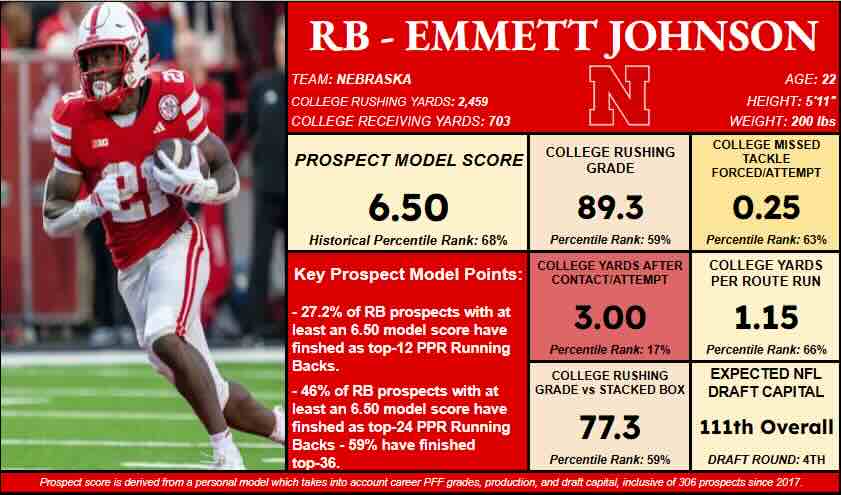
- He boasts a more well-rounded profile for his college career, including getting enough work as a receiver to make him an above-average prospect in that regard.
- Johnson was a one-year starter at the college level, which kept many of his numbers in check; however, his performance as a starter this past year was impressive.
- Johnson’s 1,451 rushing yards during the college regular season were the second-best mark in the Power-Four conferences, improving his rushing grade to an 88.1 – both up from his previous career bests of 597 rushing yards and a 78.3 rushing grade.
- Johnson’s work as a receiver can be a key to his potential fantasy success, and what helps separate him from the previously mentioned Jadarian Price.
- Depending on the landing spot, having experience and mild success as a receiver in his college career could help get him on the field quicker than someone like Price, who has just 15 receptions in his entire college career. In comparison, Johnson averaged 31 receptions per season for his three-year career.
- Johnson will likely be a fringe top-12 rookie draft pick, depending on your league and his landing spot, though as of now, he’s someone I’d rather draft than Price, who is being mocked ahead of him.
Nicholas Singleton, Penn State
- Consensus draft capital: 123rd overall
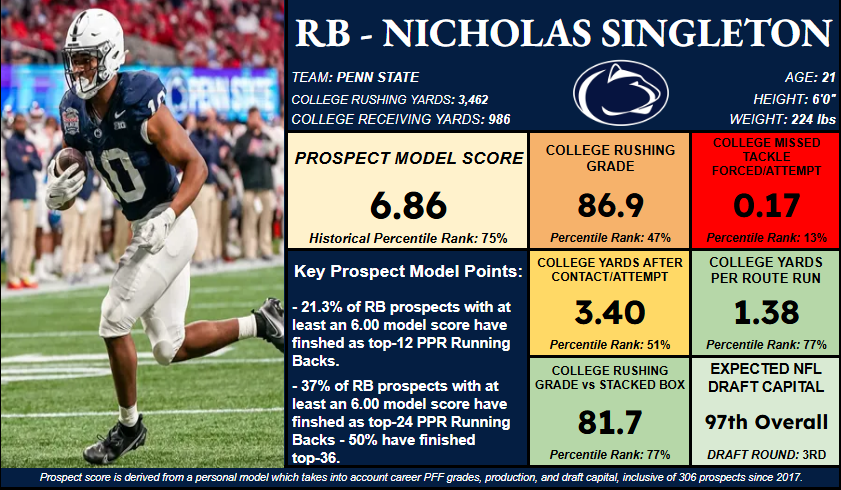
- Where Singleton fails to really rise above the rest is as a runner, delivering average to below-average career marks in most key categories for the model.
- Specifically, Singleton’s 0.17 career missed tackles forced per attempt mark, which puts him in the bottom 15th percentile among all prospects since 2017.
- Among the 56 total running backs in the bottom 15th percentile for that metric, only one (Tarik Cohen) cracked the top-12 PPR finishers for his position in his NFL career, and only did so once (2018) and never again.
- There were also three more among those 56 that finished top-24 (Phillip Lindsay, Darrel Williams, and Isiah Pacheco) who also never repeated that feat in their careers.
- It’s a concerning metric to struggle in to say the least, and if he were to be drafted on Day 2, he’d be the only past running back prospect in the model to get drafted that high who also finished his college career with a 0.17 missed tackles forced per attempt mark or worse.
- Singleton can find some fantasy value in the NFL, though that will likely come from a hefty receiving role, and maybe he can improve and earn a larger role beyond that.
- For now, this isn’t a player we should be investing too heavily in during our rookie drafts, and is likely more of a mid-second-round pick at best.

 © 2026 PFF - all rights reserved.