
- Bhayshul Tuten‘s rising ADP just ran into Chris Rodriguez: Rodriguez returned to practice in full pads Monday and had the highlight play of the day, reopening a backfield competition that had been drifting Tuten's way.
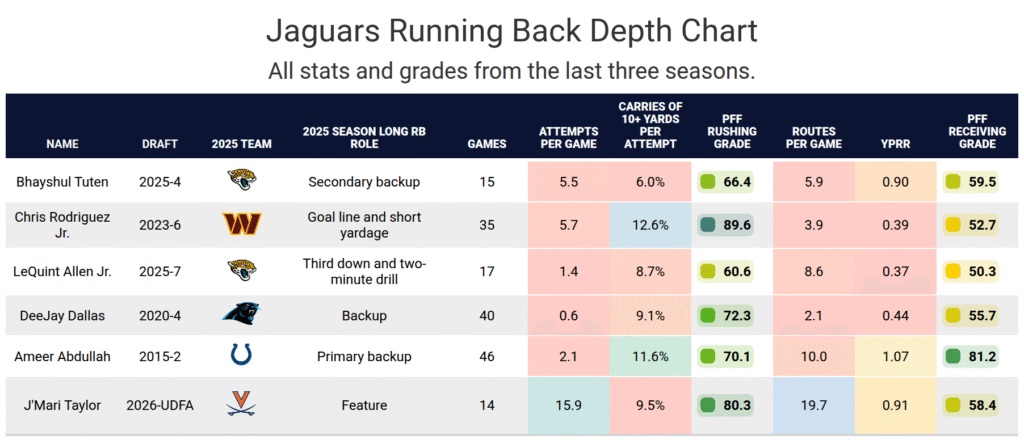
- The Jacksonville Jaguars are set up for a three-man rotation with no clear separation: Tuten, Rodriguez and LeQuint Allen are strong in the same statistical areas, which leaves a wide range of possible snap splits.
- Get more from PFF+ for less: PFF+ is now $9.99 per month or $99.99 per year, with access to PFF+ content and tools, fantasy and betting resources, the Mock Draft Simulator and more — all at a new lower price.

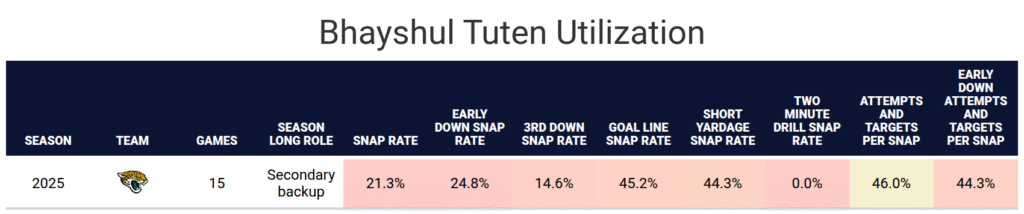
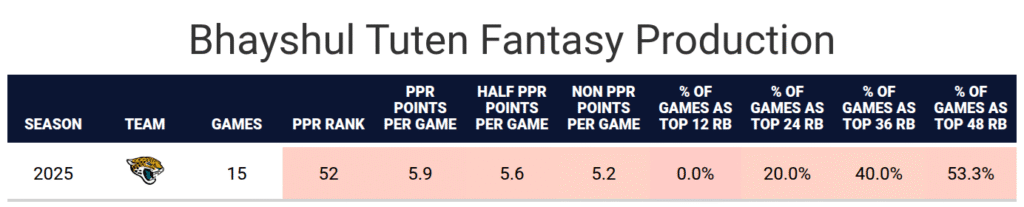
Tuten was a fourth-round selection by Jacksonville in 2025, landing in a crowded backfield with Travis Etienne and Tank Bigsby. It grew more competitive when seventh-round rookie LeQuint Allen won the third-down job. In Week 1, Tuten played just four snaps, the fewest of the four backs. Jacksonville then traded Bigsby after that game, letting Tuten spend the rest of the season as the early-down backup to Etienne.
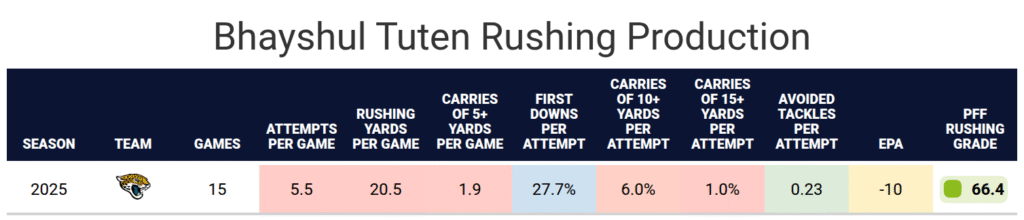
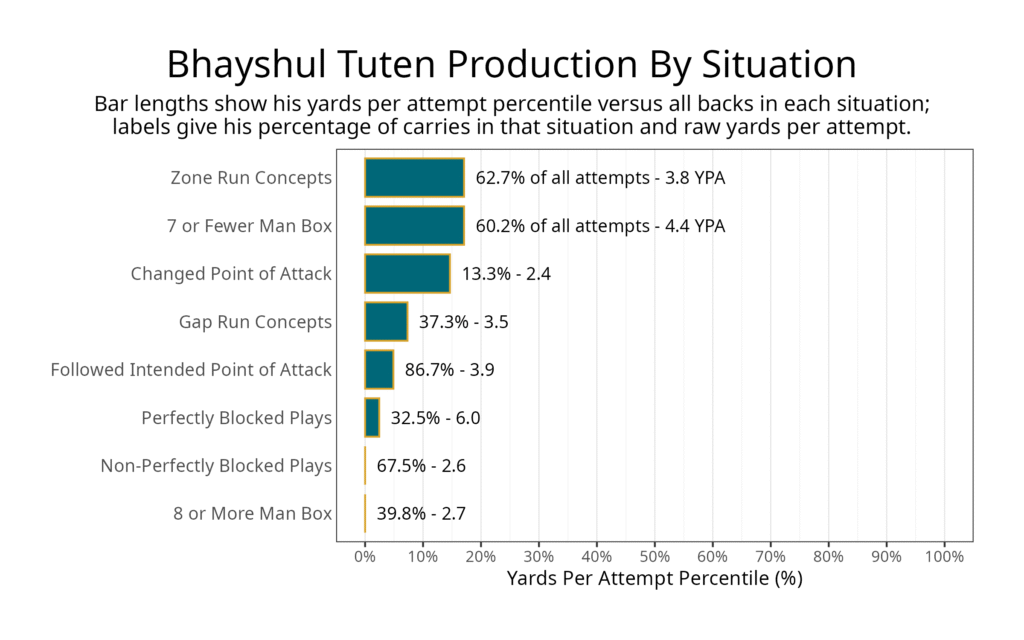
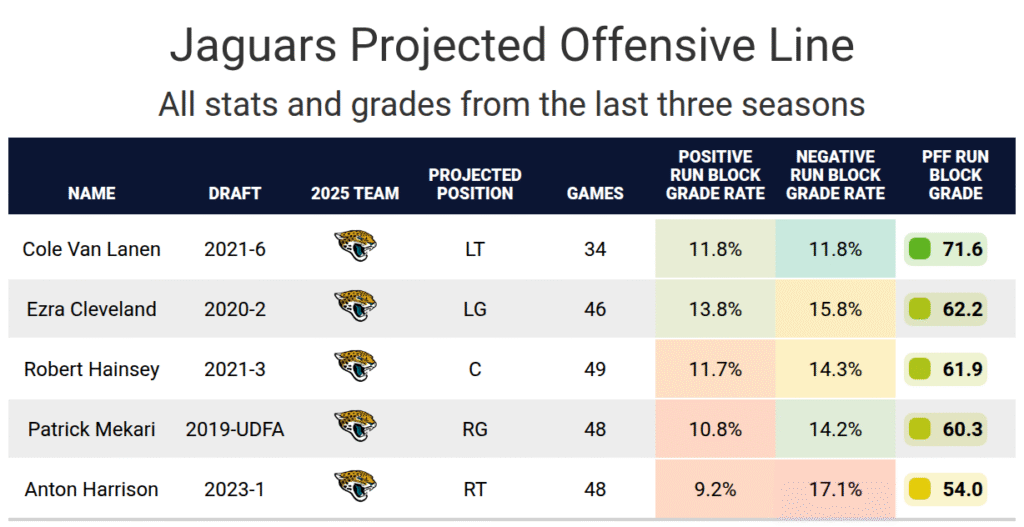
Tuten's only game with double-digit carries was a Week 11 blowout against the Los Angeles Chargers. He finished the season with 83 carries for 307 yards and five touchdowns and added 10 catches for 79 yards and two touchdowns. His yards before contact per carry was a notably low 0.5, second-worst among running backs with at least 75 carries. Backs from the same offense usually post similar marks there, but Etienne was at 1.2, which suggests better run-blocking could lift Tuten's efficiency. The newcomer also posted a high 3.2 yards after contact per carry, tied for 13th, converted first downs at a strong 27.7% clip, ninth-best, and ranked 10th with 0.22 avoided tackles per attempt.
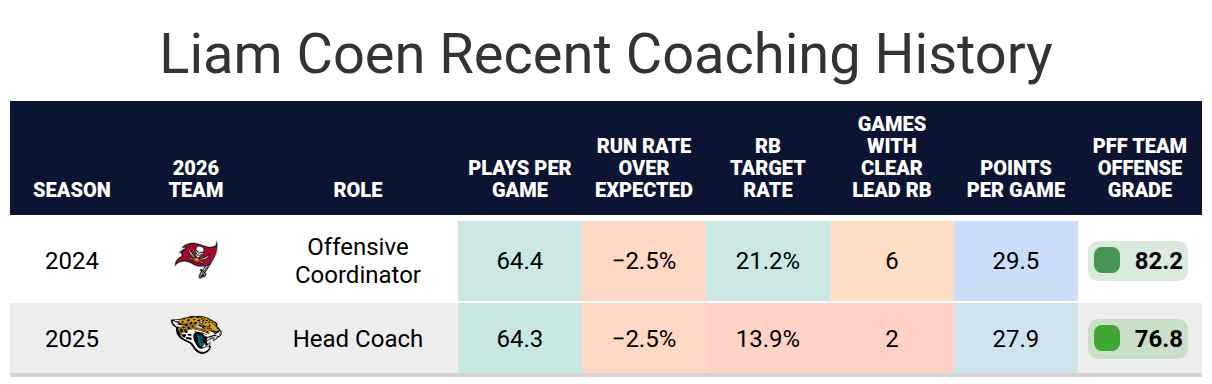
The Jaguars did not re-sign Etienne, instead adding free agent Chris Rodriguez. Rodriguez is a similarly low-volume, high-efficiency back. He was better in yards after contact per attempt (3.5) and first-down rate (28.6%) and just behind in avoided tackles per carry (0.21). Rodriguez also worked with Liam Coen for a season at Kentucky. They are strong in the same statistical areas but are different backs: Tuten is a smaller, speedy runner, while Rodriguez is bigger and still fast for his size.
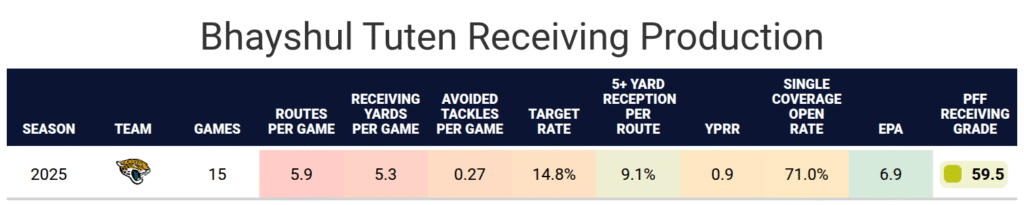
All signs point to some kind of three-man rotation between Tuten, Rodriguez and Allen. Tuten is widely expected to be the best fantasy option of the three, since Rodriguez has shown minimal promise as a receiver and Allen isn't expected to run much. However, just because they might not be worth starting in fantasy leagues doesn't mean they can't be a major thorn in Tuten's fantasy production.
There is a wide range of outcomes within that rotation, though. Everyone could land near a one-third split, or Tuten could play 60% of the snaps with the other two at 20% each. It is also possible Rodriguez becomes the primary early-down back and Allen the primary passing-down back, with Tuten backing up both. In that case, Tuten would play more than the 21.3% of snaps he saw last season, but perhaps not by much.
Allen has rotated significantly with Tuten through the start of training camp. Tuten's ADP had been on the rise with Rodriguez injured, but he returned to practice in full pads on Monday and had the highlight play of the day.
Tuten is currently being drafted as a low-end RB2, but there is serious risk at that price. There is a real chance no one in this backfield can be trusted on a weekly basis. With the talent at quarterback, receiver and tight end, Jacksonville could be a pass-first team. The three-man rotation splits carries among backs with similar profiles, featuring no large quality gap between the top option and the next.
You can find more statistics and information on Tuten’s past performance, his competition for touches and how much his teammates and coaches will help or hurt him below.
Footnotes
- Statistics in tables and charts were chosen based on their ability to predict future fantasy performance on a per-game or per-opportunity basis or to describe the player relative to others at the same position.
- “Opportunities” are defined as passing dropbacks, rushing attempts and routes run as a receiver.
- Numbers are provided either by season or based on the past three years. For rookies, only college statistics are included. For non-rookies, only NFL statistics are considered, regardless of whether they played in college within the previous three years.
- As college competition is easier than NFL competition, most rookies are likely to see a decline from their historical numbers.
- Only FBS data is considered for college players and comparisons.
- Kneel-downs are removed from rushing data to provide cleaner quarterback rushing rate statistics.
- The table colors in this article range from blue (indicating good/high) to red (indicating bad/low).
- All percentiles and color codings compare the given player to others with a high sample of opportunities. Generally, the cutoff is one-third of the possible opportunities in the sample. If a player does not meet the threshold, they are still included in the comparison, though their results may appear better or worse than expected due to the smaller, less predictive sample size.
- Information on utilization classifications and their importance can be found here for running backs, wide receivers and tight ends.

 © 2026 PFF - all rights reserved.