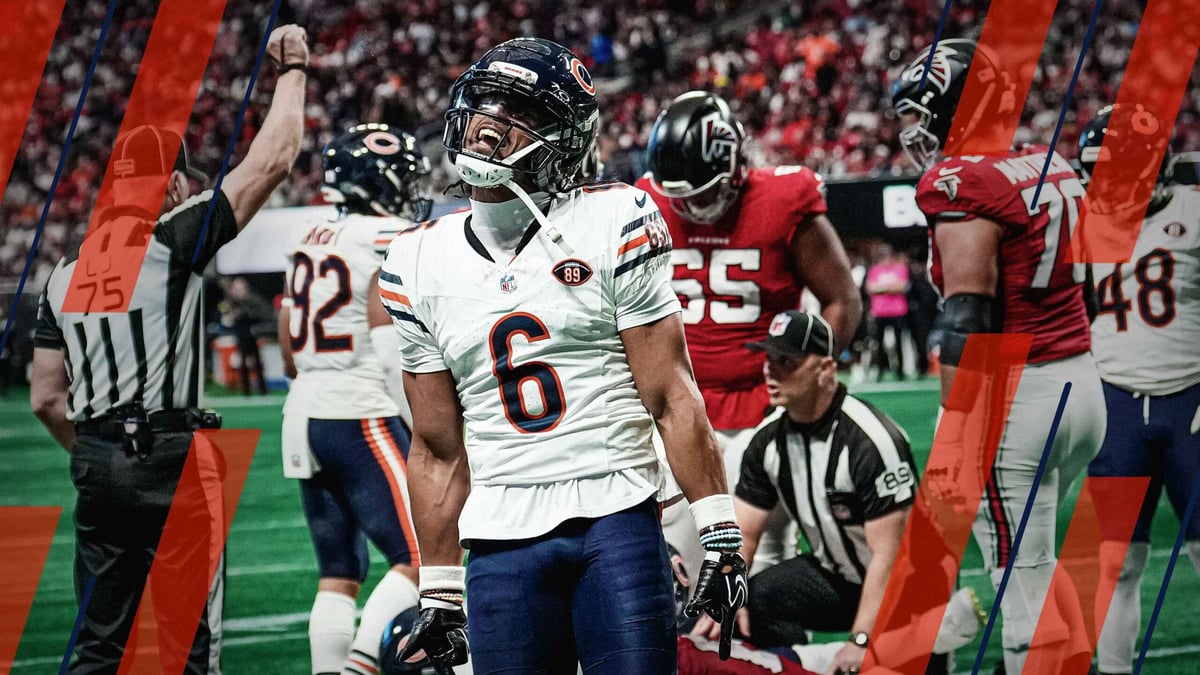
- One of the best performances by a Bears defender in the last two decades: Kyler Gordon‘s initial 95.3 overall PFF grade is the best by a Chicago defensive player since 2006.
- An explosion in the slot: Gordon racked up three sacks on three pressures and added another stop against the run.
- Changing the complexion of Chicago's defense: With Gordon in the lineup, the Bears augmented both their dime and blitz rates in Week 6.

After the Bears’ lopsided defeat 31-7 against the rival Packers in Week 5, questions had started to mount. Not only did Chicago’s offense endure one of its toughest all-around performances under Ben Johnson, but its defense was absolutely gashed against Green Bay’s high-flying offense.
Entering Week 6 at 3-2 and facing the upstart Falcons on the road — down edge rusher Montez Sweat due a suspension, no less — the Bears were considered slight favorites to prevail, although it was easy to see reason for concern. After all, the Falcons’ offensive talent is trying for even the league’s top defenses, let alone one without much proven talent or consistent results.
However, once cornerback Kyler Gordon stepped onto the field for the first time in 2026, the entire tenor changed for the Bears on that side of the ball.
Gordon was absolute dynamite in his return from a calf injury that had sidelined him for the first five contests of 2026. Appearing on only 17 defensive snaps — with the first coming in the second quarter — Gordon produced a career-best outing, finishing with an initial 95.3 overall PFF grade.
If that mark seems significant, it’s because it is. Gordon’s Week 6 grade currently slots as the second-highest by any defensive player in a game this season, minimum 15 snaps — trailing only Browns linebacker Quincy Williams’ 95.7 mark last week. Additionally, it would be the best by a Chicago defender since Ricky Manning in 2006 (95.5), just edging Buster Skrine’s 92.5 grade in 2019. In many senses, it’s one of the best single-game performances by a Bears defender in two decades.
Highest single-game PFF grade for defensive player in 2026 (min. 15 snaps)
| Player | Team | Position | Week | Overall PFF Grade | Snaps |
|---|---|---|---|---|---|
| Quincy Williams | Browns | LB | 5 | 95.7 | 64 |
| Kyler Gordon | Bears | CB | 6 | 95.3* | 17 |
| Genesis Smith | Chargers | S | 3 | 95.1 | 42 |
| Nick Herbig | Steelers | EDGE | 2 | 93.9 | 29 |
| Trent McDuffie | Rams | CB | 2 | 93.9 | 58 |
The primary method by which Gordon made his presence felt was as a havoc-creator in the slot. Gordon rushed the passer on nine of his 17 snaps, generating three pressures in that span, per initial review. All of them were sacks, and two knocked the ball away from Falcons quarterback Michael Penix Jr. Gordon’s acceleration and direct path to the quarterback proved highly cumbersome for whoever guarded him along Atlanta’s protection — and even when Gordon couldn’t get home, he still forced either quick or less accurate throws.
Likewise, Gordon only played two snaps against the run, but even that turned out to be productive. One of Gordon’s run plays involved knifing through the C gap, blowing up running back Brian Robinson Jr. on a third down that lost yardage prior to a fourth-down stop.
In coverage, Gordon was also largely effective. Gordon finished with a 64.8 PFF coverage mark, in part due to allowing a bit of separation on a crosser that involved some disruption in the secondary. However, he was targeted one time on a pass that was never ultimately completed. The 6-foot Gordon had few issues matching up in isolated settings with the 6-foot-4 Drake London, holding his own on the inside by leveraging his physicality.
Although Gordon played under 37% of Chicago’s defensive snaps, his performance made a certifiable impact in the Bears limiting Atlanta’s potent offense. The Bears finished with -0.178 EPA per play allowed, the third-best mark of any defense in Week 6. Dennis Allen’s group also sat in the top six in success rate (38.2%), first downs surrendered (12) and explosive plays permitted (6).
Click here to subscribe to PFF+
From a more holistic standpoint, Gordon’s return also signified a notable philosophy shift for Allen and Chicago’s defensive structure. Against the Falcons, the Bears ran a dime look on 21.8% of their snaps, good for 12 plays total. In Weeks 1-5, Chicago deployed six or more defensive backs on 15 snaps altogether.
Having more defensive backs on the field definitely worked in the Bears’ favor. On those 12 plays, the Bears allowed just 2.1 yards per play, and only three were deemed successful. Whether or not Gordon was on the field in those packages, the results were overarchingly strong for Allen, who consistently mugged the line of scrimmage to create confusion and rush Penix in the pocket.
Along similar lines, Allen was more aggressive with his blitz calls in Week 6. The Bears ran a blitz on 23 of those 46 defensive snaps, marking their most in a game all season by a fair margin. In terms of affecting the quarterback, Allen’s 53.8% pass blitz rate was also fairly elevated to his 36.0% season average entering Sunday — although that latter mark still sat 11th among other defenses.
With Gordon back in the lineup, several new dimensions are unlocked for the Bears’ once-maligned defense. Allen now has a highly disruptive player against both the pass and run who forces offenses to alter their protection plans, not to mention a defensive back that can hold up in coverage. From a play-calling standpoint, Gordon enables the Bears to blitz more and match faster, more explosive offenses with lighter personnel.
Whether or not the Bears’ single-game defensive trends continue will be fascinating to watch, and Gordon himself must stay healthy — after all, he played just 213 snaps in 2025. However, efforts like his in Week 6 are eye-opening for what Chicago’s defense can look like over the rest of 2026, a unit aiming to complement a high-ceiling offense on a team vying for a second straight NFC North crown.

 © 2026 PFF - all rights reserved.