- Justin Herbert is giving the ball away more than any other quarterback: Herbert's 6.7% turnover-worthy play rate is not only the highest in the NFL, but also one of the most elevated rates through five weeks since 2016.
- Untenable surroundings, yet again: The Chargers rank 30th in offensive grade excluding quarterbacks, facing another subpar offensive line, lackluster receivers and an ineffective run game.
- Reasons for optimism moving forward: Herbert has maintained accuracy and low-probability completions while mixing in big gains on the ground.
Click here to subscribe to PFF Pro — $199.99 a year
An avalanche of annual coaching hires naturally spurs optimism for teams to adapt and take the NFL by storm. Arguably no name shined brighter in that scrum this summer than Mike McDaniel, the former Dolphins head coach who was lured west to call plays for the Chargers.
With McDaniel — consistently one of the sport’s top offensive play-callers — and a revamped offensive line, optimism abounded for quarterback Justin Herbert. After all, Herbert has earned at least a 77.9 overall PFF grade in every season of his career, finding individual success by transcending poor blocking and/or stale schemes.
It was easy to envision a glimmering 2026 campaign for Herbert working with a mastermind like McDaniel, the latter of whom has never possessed raw talent in a quarterback like this before. Instead, the exact opposite has happened.
The Chargers sit at 0-5 through the first five games of the season, left standing as one of three winless franchises — accompanied by the not-so-secretly tanking Dolphins and the still-cataclysmic Titans. Los Angeles’ offense is dead last in EPA per play, 30th in success rate and 31st in scoring drive rate, with the year getting off to a downright nightmarish beginning.
Herbert himself has shouldered much of the blame, and for good reason. He’s earned a 41.7 overall PFF grade, the second-worst among 40 quarterbacks with at least 45 dropbacks this year.
What’s behind Herbert’s uncharacteristically awful start, and how worried should we be moving forward? Leveraging both advanced PFF metrics as well as tape takeaways paints a broad picture, one suggesting both a more reckless player but one mired in an atrocious situation.
After breaking in as the sixth overall pick in 2020, it didn’t take long for Herbert to make an impression across the league. His rocket-launcher arm, physical play style and pinpoint accuracy rendered him clearly one of the league’s top 10 quarterbacks, a player regularly lauded more by analytics and those appreciating his film. After all, his 90.8 PFF passing grade from 2020-25 ranks seventh.
In addition to his own attributes, Herbert found success by not putting the ball in harm’s way. Over his first six seasons, Herbert never exceeded a 2.6% turnover-worthy play rate, committing a maximum of 16 such plays over the course of a full season only twice in his career.
However, things have taken a turn for the worst in 2026. Herbert has already accrued 13 turnover-worthy plays over just 179 dropbacks. His 6.7% turnover-worthy play rate not only leads the league, but also puts him in rarely bad company over the last 11 years.
Highest turnover-worthy play rate through Week 5, 2016-26 (min. 150 dropbacks)
| Player | Season | Turnover-Worthy Play % |
|---|---|---|
| Carson Palmer | 2016 | 8.0% |
| Justin Herbert | 2026 | 6.7% |
| Jalen Hurts | 2024 | 6.7% |
| Carson Wentz | 2020 | 6.4% |
| Mac Jones | 2023 | 6.3% |
| DeShone Kizer | 2017 | 6.3% |
Consider this: Over the entirety of the 2022-25 campaigns, Herbert played 66 games, three of which featured three-plus turnover-worthy plays. Through just five games in 2026, he already has four such outings with that many mistakes.
Interceptions can be very luck-driven, but for Herbert — who already is up to seven picks — they tend to reflect a passer making questionable decisions. Several of his attempts have simply not read defenders’ leverage, including sometimes throwing right into the very area in which a defensive back has been. Other throws have been far too late, allowing defenders to recover and make a play on the ball.
Moreover, five of Herbert’s 13 turnover-worthy plays are fumbles. The Chargers quarterback has had ball security issues over recent seasons, including coughing up the pigskin six or more times in three of the previous four years. This time around, Herbert has had particular difficulty hanging on when taking a sack or being pressured.
What also hasn’t worked in Herbert’s favor is crumbling under the biggest moments. Nine of his 13 turnover-worthy plays have come in the fourth quarter alone, leading the NFL by a whopping four through the early going. Several of Herbert’s interceptions or fumbles have indubitably played a large role in the Chargers remaining winless despite mounting comebacks or having a chance to tie the game on a final possession.
The benefit of a stat like turnover-worthy plays is that it generally isolates a quarterback’s self-inflicted problems from the rest of the aspects on the field. But in Herbert’s case, it’s almost impossible to ignore how bad his ecosystem has been yet again.
Last season, Herbert was pressured not only more than any other passer from a volume standpoint, but also at the league’s highest rate. Much of the same refrain has echoed in 2026, as the Chargers are effectively already down to four backup offensive linemen starting going into Week 6. In turn, Herbert has been pressured on 45.8% of his dropbacks — the second-highest mark of any qualified quarterback.
What’s especially staggering is how quickly rushers have disrupted Chargers plays. More specifically, Herbert has been under duress within 2.5 seconds on 54 dropbacks through five games, tied for the second-most of any quarterback. Essentially, almost no other quarterback has as little time to settle into the pocket, let alone even get a throw off, as Herbert.
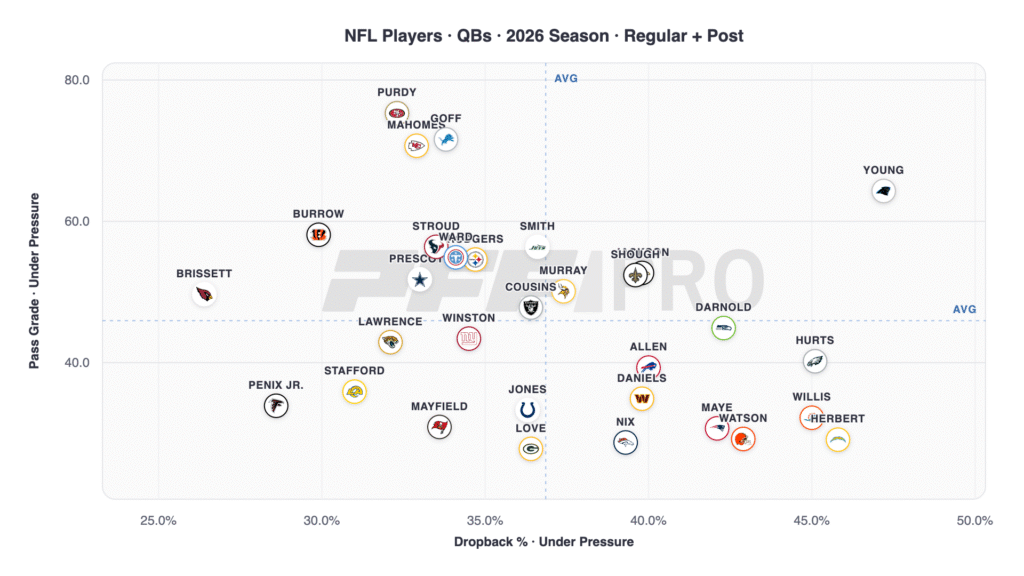
The Chargers’ offensive line has climbed all the way to an astronomical 25th in overall PFF grade so far, and the unit’s woes are well-documented. But what isn’t receiving adequate coverage is how bad Los Angeles’ weapons have been.
The Chargers own the 32nd-ranked team PFF receiving grade through Week 5. Only one Charger — Ladd McConkey — has registered a 70.0-plus receiving mark, and only two players are above 2.00 yards per route run. Naturally, McConkey has played just 142 snaps while battling through multiple injuries.
Watching McDaniel’s offense on tape reveals a group that struggles to separate or even come down with the ball. The data backs that up: Herbert has had zero receivers open on 39 dropbacks, tied for the fourth-most in the league. The Chargers have also dropped seven passes, and their collective 5% drop rate is the eighth-highest in the NFL.
Even though McDaniel is touted for his run game, that aspect has also not yet taken off in 2026. The Chargers sit 27th in rushing EPA per play and 21st in rushing success rate. While Los Angeles has shown a capacity to rip off explosive runs, the team has also regularly been stuffed, putting the entire offense behind the sticks and into long third downs.
Altogether, the Chargers own the third-worst offensive PFF grade, excluding quarterbacks. Very few if any quarterbacks can find even a modicum of success in those kinds of environments, but Herbert is generally one. After all, Los Angeles ranked 31st in that same grade in 2025, and that didn’t get in the way of his excellence.
There are clear areas of regression for Herbert this season beyond just his propensity to give the ball away. His deep ball has not been as pinpoint, with his 40.7 deep PFF passing grade placing 37th out of 38 quarterbacks. Similarly, Herbert has developed somewhat of a tendency to drift in the pocket, bypassing open receivers by shifting his vision while simultaneously making himself more vulnerable to giveaways under pressure.
But at the same time, the stats and film both indicate that the laser-sharp Herbert of the past six seasons is still definitely around.
Herbert has still delivered the low-probability throws that led to his acclaim, often landing several in a contest in 2026. His 3.8% big-time throw rate is right on par with his 2025 mark, ranking 15th among qualifiers this season. Whether perfectly threading the needle in a hole shot in zone coverage or layering the ball right over a defender, Herbert is certainly capable of executing the almost robotic passes we’re accustomed to seeing.
Additionally, Herbert’s accuracy hasn’t really waned at all. While his 21.9% uncatchable inaccurate pass rate is tied for the ninth-highest, he ties for 10th in overall accuracy rate and even owns the third-best plus accurate throw mark.
Watching Herbert also emphasizes his capabilities with his legs. While Herbert boasts just a 63.0 PFF rushing grade, he’s ripped off five explosive runs already, tied for the sixth-most among signal-callers. Herbert’s seven missed tackles forced are also third, and he’s averaged 5.08 yards after contact per attempt. Whether scrambling to escape the heat or even on designed runs, Herbert is still a physical runner that’s tough to bring down.
So, how do we reconcile Herbert’s holistically bad season with his surroundings and occasional bright spots?
In general, it seems as though Herbert is trying to carry the entire weight of the Chargers offense on his shoulders. Almost each of his fumbles has come due to extending the play under pressure, trying to find an open receiver downfield — and likely attempting a pass that has a very low probability of being completed, even for throwers in his echelon.
Much of the same can be said about Herbert forcing the issue on throws, seemingly trying to generate chunk plays by any means necessary for a unit that has seldom gained them via either the air or ground. That doesn’t excuse Herbert being late on a read or not correctly interpreting coverage, but it likely at least offers an explanation of him trying to force the issue.
Some of Herbert’s calamities can also probably be tied to adjusting to McDaniel’s offense. In the past — particularly in Miami — McDaniel’s system was predicted on getting the ball out fast and maximizing yards after the catch, especially over the middle. Some of Herbert’s turnover-worthy plays could potentially be tied to following McDaniel’s suggested reads, and thereby not adjusting once a snap plays out.
It was always going to be fascinating to see how Herbert’s play style meshed with McDaniel’s approach, and there hasn’t been a consistent happy medium so far. Herbert has held the ball for longer and largely thrown downfield more than previous passers under McDaniel.
Notable quarterbacks under Mike McDaniel
| Metric | Justin Herbert, 2026 | Tua Tagovailoa, 2023 | Jimmy Garoppolo, 2021 |
|---|---|---|---|
| Average time to throw | 2.96 | 2.34 | 2.56 |
| Average depth of target | 9.1 | 8.1 | 7.6 |
| Deep pass % | 10.5% | 11.3% | 7.6% |
| % of dropbacks >2.5 seconds | 57.9% | 37.5% | 48.4% |
The problem for the Chargers is that they’re rapidly running out of time to right the ship. Los Angeles stares down a plausible 0-6 start after facing the Chiefs in Kansas City as part of the league’s toughest remaining schedule. Any further losses run the risk of firings, with McDaniel likely the first to be either removed or demoted.
In the long term, Los Angeles has reportedly held firm on wanting to keep Herbert around — after all, the quarterback has three additional years left on his five-year, $262.5 million contract extension. The franchise’s commitment to Herbert will presumably be tested both during the trade deadline and the offseason, where teams will offer a war chest of first-round picks and other assets to try to acquire the talent.
Assuming the Chargers hold on to Herbert in at least the short term, the goal should be to try to correct some of the scar tissue that’s been built to start 2026. It’s understandable why Herbert may feel over-aggressive or likely to try to withstand sacks, because that’s what he’s become accustomed to this season (and before). However, his efforts to be superhuman have also significantly decreased the team’s win probability — and put him in never-before-seen territory.
The short-term outlook for Herbert and the Chargers is bleak, with more offensive line injuries and voids combining with a lack of proven skill-position talent. However, based on what we’ve seen from Herbert in previous seasons — and at times in 2026 — he’s easily capable of returning to elite status in short order if he can correct unforced errors.

 © 2026 PFF - all rights reserved.