- Get PFF+ for 40% off: Use promo code BLACKFRIDAY to unlock the PFF Player Prop Tool, Premium Stats, fantasy dashboards, the PFF Mock Draft Simulator, industry-leading fantasy rankings and much more — everything you need to win your season.

Last year, I introduced a new framework for understanding wide receiver play, quarterback decision-making and offensive potential. This framework relies on an XGBOOST model and PFF’s impressive collection of route-level data. Using machine learning and this breadth of PFF data, we can create models with the goal of predicting where a target should go on a given play.
The resulting metrics, Share of Predicted Targets and Share of Predicted Air Yards, are both more stable than their “actual” counterparts.
Week 12 Recap
- Parker Washington: 7 targets – 23.33% target share
- Isaiah Williams: 0 targets (route percentage dropped by 50+% in Week 12)
- Khalil Shakir: 10 targets – 32.26% target share
- Kyle Pitts: 5 targets – 25.00% target share
Overall, a great week for the model. On a list of non-superstars, it identified three players that had Week 12 target shares above 20%! All three finished with a Week 12 target share above their season average.
Potential Breakouts: Week 13
These are players who were open far more often than they were targeted in Week 12. In general, players who show up on this list see an uptick in targets per route run and target share relative to both themselves and all players with similar target shares.
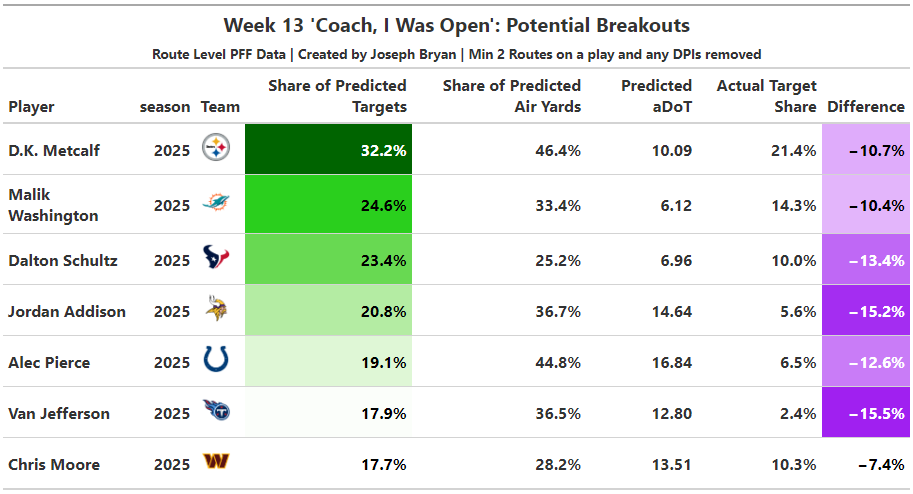
We reviewed in the Week 12 “Route Based Heroes” article that D.K. Metcalf had a dream matchup against the Chicago Bears, and it looks like he was constantly open. He should have earned substantially more targets.
Defensive EPA Capture Rate
Last week, we discussed my new predicted EPA model and how we can use it to analyze quarterbacks. How well the offensive system supports their quarterback, and how well the quarterback facilitates their offense. We can also look at it in the inverse by viewing predicted EPA and capture rate through the eyes of the defense.
The two main metrics I want to discuss are potential EPA per attempt allowed and EPA capture rate allowed.
Potential EPA per attempt allowed gives us an idea of how much available EPA is on the field for the opposing offense. The higher this number, the more EPA is available on the field.
EPA capture rate allowed grants us a look at how well opposing offenses are capturing that available EPA. The lower this number, the more that defenses that do not let offenses seize that open EPA.
When the defense is both not allowing a high potential EPA and forcing a low capture rate, it becomes truly elite — as we have seen with the Houston Texans and Los Angeles Rams this season.
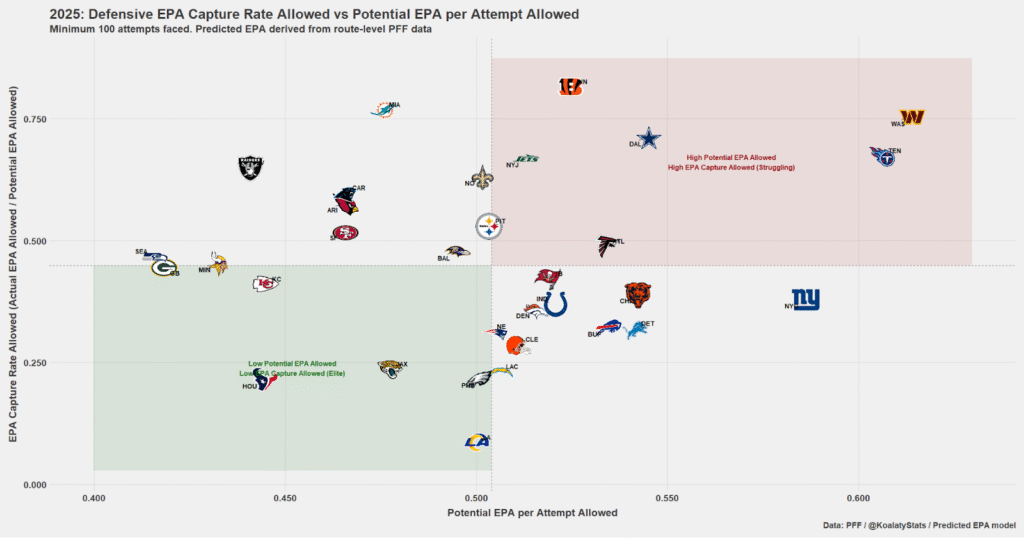
One of the most interesting points I found while sifting through the data was about how well defenses are suppressing offenses this season. Since 2019, when this data begins, six of the top 11 defenses in potential EPA per attempt allowed are from the 2025 season.
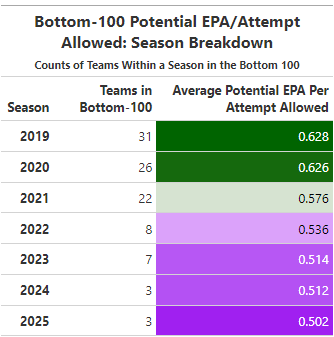
In 2025, the worst defense in potential EPA per attempt allowed, the Washington Commanders, ranks as the 50th-worst single-season defense since 2019. Only three defenses this season — Commanders, Titans and Giants — are in the bottom 100 since 2019. Moreover, the average potential EPA a defense is facing in 2025 is the lowest it has been in the dataset.
This is just a new way of understanding how the shift to a more zone-heavy, two-high shell approach has changed the game of football. It really emphasizes why defenses are playing this way and how this shell strategy is the quickest way to limit the available EPA for an offense.
PFF”s Seth Galina wrote about how two-high defenses were poised to take over the NFL back in March 2021. The following season, we saw the most drastic change in potential EPA allowed per attempt since 2019.
Week 12 “Coach, I Was Open” Review
First this week, I want to look at a spectacular play from both Jameis Winston and Wan’Dale Robinson, where Robinson does not end up getting targeted. It is the fourth quarter with 5:36 left on the clock. The New York Giants are winning 27-24, and it’s third-and-17. A conversion here is priceless.
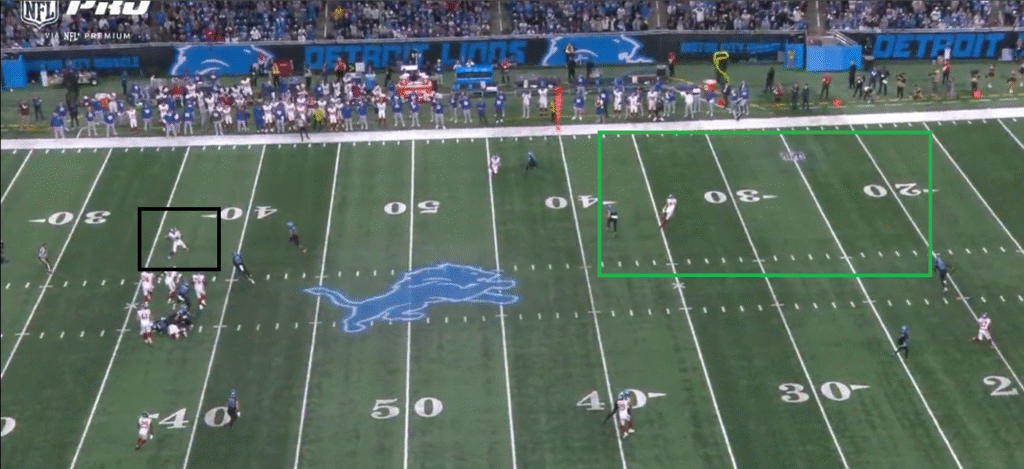
Robinson is running a post route against man coverage and creates fantastic separation, earning himself a +1.5 play-level PFF grade. But as Robinson is getting open, Winston is being smothered by Al-Quadin Muhammad, resulting in no target for Robinson. However, Robinson does in fact break free from this pressure.
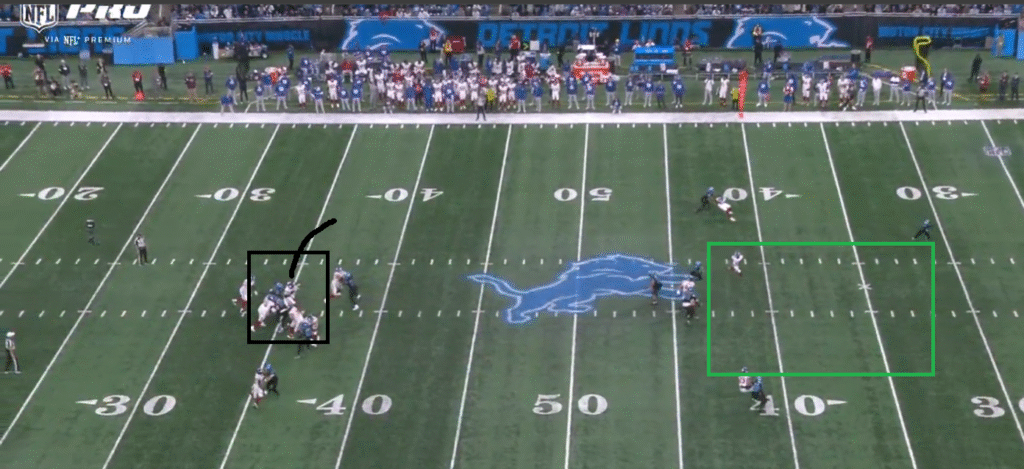
After avoiding the sack attempt and rolling out to his left, Winston finds a wide open Theo Johnson for a gain of 39 yards. This gives the Giants the opportunity to score a touchdown with less than 3 minutes remaining while already leading by three points (27-24). Had the Giants been able to punch the ball in to end this drive, that might have been the play of the game.

 © 2026 PFF - all rights reserved.