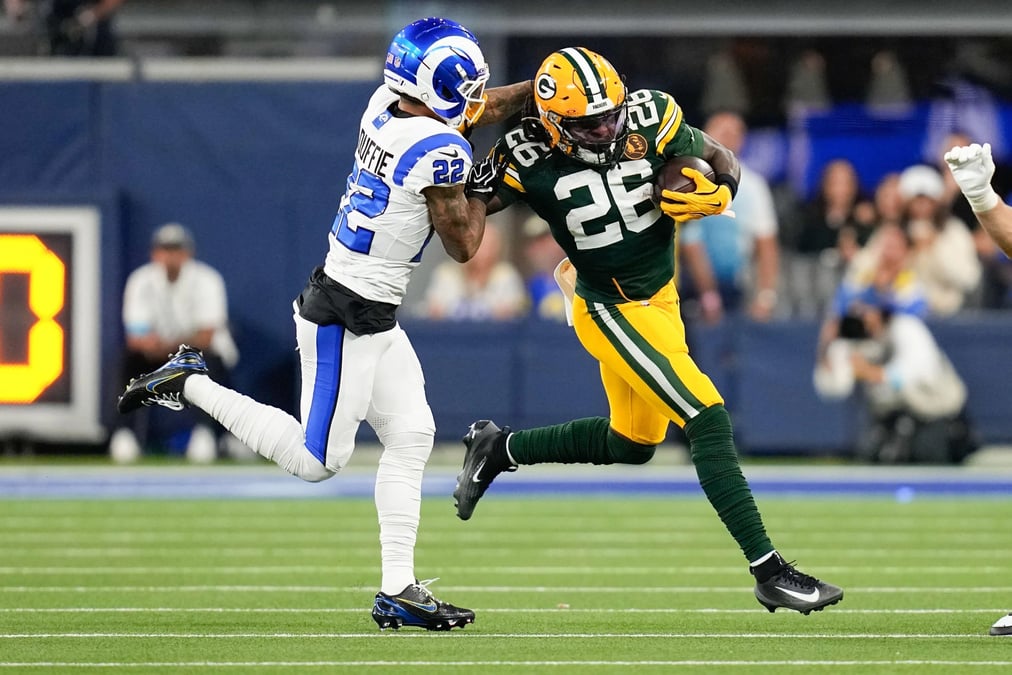
- Bad offensive lines are nearly impossible to overcome: While the Packers can theoretically take advantage of cold home games late, their lowest-ranked offensive line renders their run game moot.
- Recent success may not translate later on: While Chiefs running back Emmett Johnson has starred, the return of Kenneth Walker III puts a damper on his fantasy ceiling.
- Be cognizant of game times and spreads: More games are played on irregular days during the fantasy playoffs, adding another item to managers' plates.
In most leagues, the fantasy playoffs run from Week 15 through Week 17. That's when managers start circling soft opponents on the schedule.
But a matchup is only worth what a player can take from it, and that depends on his offensive line, his role, how sustainable his production is and even when his games kick off. Using PFF grades and expected fantasy points through Week 11, here are three ways a good-looking playoff schedule can let you down.
Editor’s Note: This article was written prior to the Packers’ Week 12 game vs. the Rams.
Trap 1: A soft opponent can't fix a bad offensive line
On paper, Green Bay's run is about as fantasy-title-friendly as it gets. The Packers host Miami in Week 15, visit Chicago on Christmas Day in Week 16 and host Houston on Monday night in Week 17. A warm-weather team coming to Lambeau Field in December is the kind of game managers circle.
The problem is up front. When you weigh each lineman's grade by his snaps, Green Bay's offensive line owns the lowest PFF run-blocking grade (50.3) and the worst PFF pass-blocking grade (50.5) in the league. It has also allowed 133 pressures, second only to Baltimore's 139.
That shows up in the backfield. Kaleb Johnson is averaging 4.1 yards per carry. MarShawn Lloyd is averaging 2.7, has a 47.1 PFF offensive grade and has scored 60.7 fantasy points against 71.9 expected. A favorable opponent doesn't create running lanes that this line hasn't been opening all season.
The Packers’ passing game also brings its own volatility. Matthew Golden leads the team with 99 targets, but he has dropped 11 passes (a 15.9% drop rate) and has scored 173.9 fantasy points against 193.6 expected. Christian Watson has gone the other way: He has produced 916 yards on a 15.2-yard average depth of target and has outscored his expected points by 41.8. In late-December weather at Lambeau and Soldier Field, a deep-ball profile like Watson's is hard to count on.
Dallas shows the flip side. The Cowboys‘ offensive line has the league's best PFF run-blocking grade (77.9); that is what drives Javonte Williams‘ value, not his 4.0 yards per carry. Williams leads all running backs with 24 carries inside the 5-yard line and has 11.6 expected rushing touchdowns, more than any back in the league. Dallas visits the Rams, then hosts Jacksonville and the Giants, and Williams doesn't need an easy opponent to score. His line does the work.
Trap 2: Don't mistake a hot streak for a good matchup
Some of the most trusted names on playoff rosters are scoring well above what their usage supports. A good matchup can hide that, but it can't change it.
Jaxon Smith-Njigba is the biggest example. He is scoring 26.3 points per game against an expected 18.4 for a season-long surplus of 78.4 points. Make no mistake, he's elite: His 93.8 PFF receiving grade and 3.81 yards per route run are each the best in the league. Seattle's schedule (at Philadelphia on a Saturday, home against the Rams on Christmas Day, then at Carolina) won't scare anyone. But managers should project him for 18-to-20 points, not 26, and plan their other lineup spots accordingly.
Emmett Johnson is a sharper trap. He has outscored his expected points by 40.8 (120.2 actual against 79.4 expected), largely because of 345 receiving yards on plays expected to produce about 150. His 129.5 elusive rating is outstanding, but he shares the backfield with Kenneth Walker III. Walker boasts a 91.7 PFF offensive grade and averages 24.6 points per game. If Johnson's receiving production falls back toward expectation, he is closer to a 7.9-point player than a reliable flex, no matter how inviting home dates with New England and San Francisco look.
Nico Collins fits the pattern, too. He has six touchdowns against 3.2 expected, and the Texans‘ offensive line ranks near the bottom in pass-blocking (56.0) with 126 pressures allowed. Houston goes to Philadelphia on Christmas Eve and to Green Bay on Monday night in Week 17. Collins' 87.0 PFF receiving grade makes him a weekly start, but the touchdown rate is likely to cool.

Trap 3: The calendar is part of the matchup
The 2026 playoff weeks are crowded with off-day games that can catch managers out.
Week 15 opens with the 49ers visiting the Chargers on Thursday and includes two Saturday games: Seahawks at Eagles and Bears at Bills. Week 16 opens with Houston at Philadelphia on Thursday, Dec. 24, followed by three Christmas Day games on Friday (Green Bay at Chicago, Buffalo at Denver and the Rams at Seattle).
Four Week 16 games still have no date or time, so check your lineup lock each day. Moreover, Week 17 kicks off with the Ravens at the Bengals on Thursday, Dec. 31, and ends with Texans at Packers on Monday, Jan. 4. If your championship roster leans on Texans or Packers players, you won't know where you stand until the final game of the week.
Short weeks also mean thinner injury information. Puka Nacua‘s earliest return is Week 15 against Dallas, and the Rams then have a short week before Christmas Day in Seattle. Even if he's activated, managers shouldn't assume a full workload straight away.
The bottom line: Before you trust a playoff matchup, check the line, the expected points and the kickoff time. A good opponent is a bonus, not the reason to start someone.

 © 2026 PFF - all rights reserved.