- Matt Ryan absorbed the most contact in the PFF era: Ryan recorded 1,588 contact events across 10,126 dropbacks, the highest total in the 20-year sample.
- Peyton Manning avoided contact at a historic rate: Manning's 9.01% career contact rate was the lowest among qualifying quarterbacks in the sample.
- Quarterback contact reached a new high in 2025: NFL passers were contacted on 15.42% of dropbacks last season, the highest rate in the 20 seasons of PFF data.
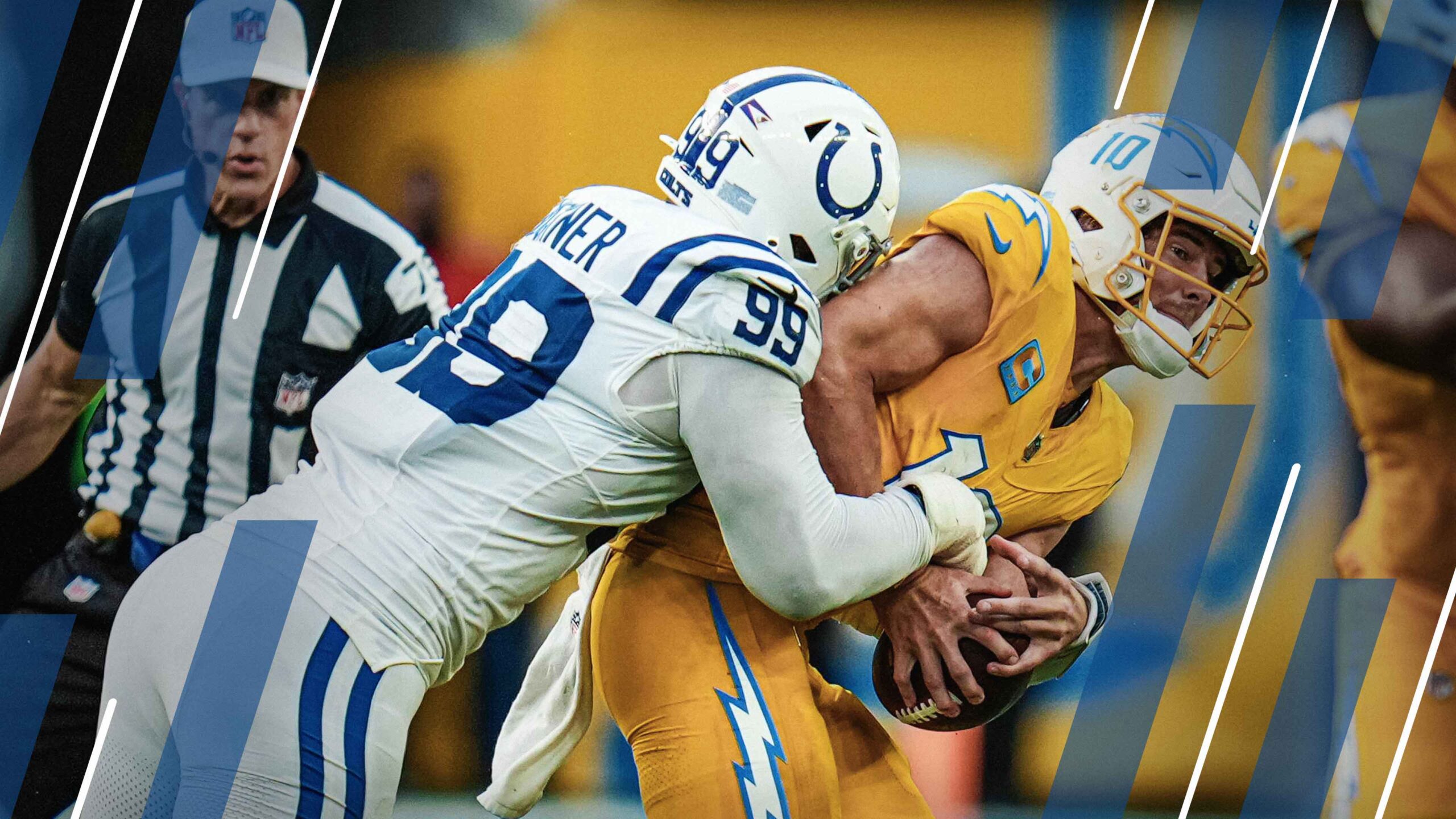
- Justin Herbert endured a historic level of contact in 2025: Herbert was contacted 149 times on 691 dropbacks . His 8.76 contact events per game led all full-season starters.
- Get more from PFF+ for less: PFF+ is now $9.99 per month or $99.99 per year, with access to PFF+ content and tools, fantasy and betting resources, the Mock Draft Simulator and more — all at a new lower price.

Football is a violent game, one in which contact is unavoidable and the punishment that comes with it is simply part of the job.
Every player who steps onto an NFL field will absorb some of it, though the amount — and the frequency with which it arrives — can look very different depending on where they line up. Quarterbacks, of course, live at the far end of that spectrum.
Entire offenses are designed to keep the passer upright and as far away from contact as possible. Linemen are paid to absorb the rush of defenders hell-bent on annihilating the player who just dropped back to throw. Running backs are asked to step in front of blitzers, even when they are hopelessly overmatched. Receivers have to separate quickly enough to give the quarterback somewhere to go with the football. So, in short, almost everyone around the quarterback is asked to take on some form of punishment so that the quarterback himself doesn’t have to.
And that protection matters a whole lot over the course of a career.
Quarterbacks who consistently stay upright give themselves a chance to play for as long as their performance allows. Those who spend years absorbing sacks and hits are asked to survive a different kind of life — not one in which they can simply trust their talent and play with freedom, but one spent fighting the urge to watch the rush, stay true to their mechanics and continue playing the position the way they always have, even as the pressure around them threatens to change it.
With 20 seasons of PFF data now available, we set out to measure just how much punishment quarterbacks have endured across the PFF era — who has absorbed the most contact, who has been hit and sacked at the highest rates and who has managed to stay clean for long stretches at a time.
Different kinds of contact, and how they are defined
PFF analysts chart every player on every play, with dozens and dozens of data points collected on any given snap. For pass rushing situations, analysts chart sacks, hits and hurries, among a multitude of other data points.
A hit is recorded when the quarterback is knocked to the ground, while a hurry is charged when pressure forces the quarterback off his initial dropback spot, whether that means scrambling away from pressure or making even a slight adjustment at the top of his drop.
PFF also charts a hit-as-thrown, which captures contact that occurs as the quarterback releases the football and disrupts the throw. Unlike a traditional hit, that contact does not have to put the quarterback on the ground. Even something as slight as a jersey tug can qualify if it affects the pass.
How a contact event is defined: For this study, a contact event (C/E) is any instance in which the quarterback was sacked, knocked to the ground or contacted in a way that disrupted the throwing motion. That means the calculation incorporates sacks, hits and hits as thrown.
One play, one event … usually: A play can receive both the hit and hit-as-thrown tags. This counts as one contact event because the tags describe the same contact: The quarterback is hit as he throws and knocked to the ground.
Sacks work differently. A play tagged as both a sack and a hit can count as two contact events because they represent separate instances of contact. This most commonly happens on a strip sack, when the quarterback is hit once to cause the sack or fumble and then hit again afterward.
That means one play can produce two contact events. Career totals therefore reflect the number of distinct times a quarterback was contacted, not simply the number of plays on which contact occurred.
Clean streaks: A streak is the number of consecutive dropbacks a quarterback took without a contact event. Career streaks run continuously across games, seasons and teams; a play producing any contact ends the run. Average streak is the mean clean run between contact events.
63,229 instances of contact
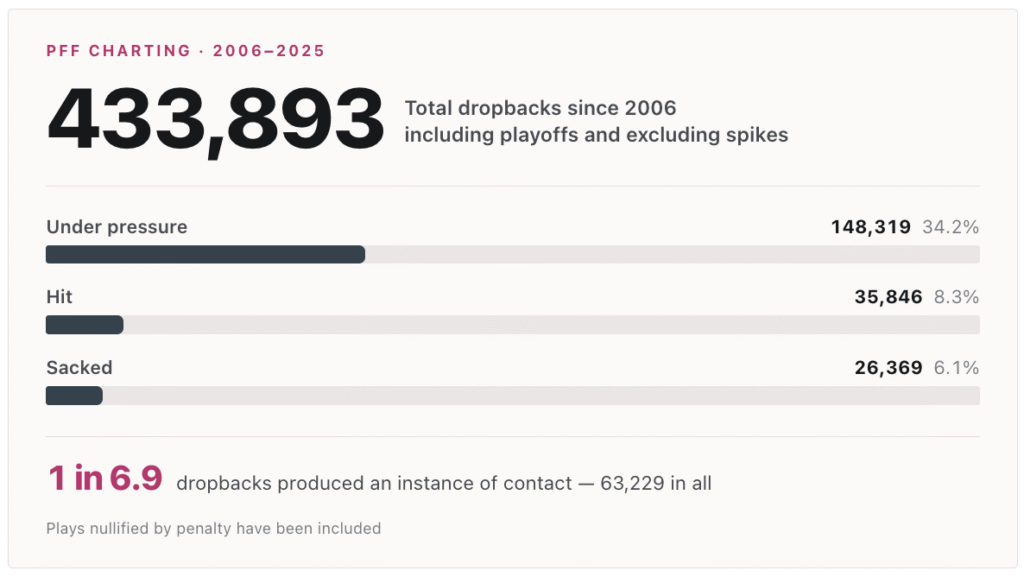
Over the last 20 NFL seasons, including the postseason, PFF has charted 433,893 dropbacks — excluding spikes and including plays nullified by penalty — and recorded 63,229 separate instances of contact. That works out to one every 6.86 dropbacks, or 14.57% of the time a quarterback dropped back to pass.
Sacks accounted for 26,369 of those contact events (41.7%), with hits and hits-as-thrown accounting for the other 36,860.
The latter two categories significantly overlap. On 3,840 plays, the same contact qualified as both a hit and a hit as thrown. Another 1,014 produced a hit-as-thrown without a hit — the jersey tugs and glancing contact that disrupted the throw without putting the quarterback on the ground.
There were also 413 plays that produced two separate contact events: a sack and an additional hit, most commonly on strip sacks.
And the rate of contact has not fallen. Quarterbacks were contacted on 13.29% of dropbacks in 2006, compared with 15.42% in 2025 — the highest rate in the 20-year sample and equivalent to one contact event every 6.48 dropbacks. Pressure followed the same trajectory, climbing from 34.43% in 2006 to a sample-high 37.12% in 2025.
Percentage of dropbacks that resulted in a contact event (C/E)
Excludes spikes; includes plays nullified by penalty
Contact-Event Totals: Matt Ryan absorbed more than anyone
Longtime Atlanta Falcon and 2016 NFL MVP Matt Ryan absorbed 1,588 contact events across 244 games, the most of any quarterback in the sample. He leads Russell Wilson by 36 despite a contact rate three percentage points lower because Ryan logged 1,816 more dropbacks.
That is the important distinction at the top of the list: Career contact totals measure longevity as much as exposure. Tom Brady ranks third among passers in the sample with 1,492 contact events across 12,319 dropbacks — the largest workload of any quarterback — despite a 12.11% contact rate that sits below the league average.
Drew Brees ranks 11th with 1,053 events but was contacted on just 10.23% of his dropbacks, the fourth-lowest rate among quarterbacks with at least 1,500 career dropbacks.
NFL Quarterbacks: Most contact events (C/E) since 2006
| Quarterback | Games | Dropbacks | C/E | C/E % | C/E Per Game |
|---|---|---|---|---|---|
| Matt Ryan | 244 | 10,126 | 1,588 | 15.68 | 6.51 |
| Russell Wilson | 222 | 8,310 | 1,552 | 18.68 | 6.99 |
| Tom Brady | 292 | 12,319 | 1,492 | 12.11 | 5.11 |
| Aaron Rodgers | 283 | 11,391 | 1,455 | 12.77 | 5.14 |
| Matthew Stafford | 252 | 10,552 | 1,419 | 13.45 | 5.63 |
| Philip Rivers | 255 | 9,740 | 1,281 | 13.15 | 5.02 |
| Ben Roethlisberger | 240 | 9,728 | 1,216 | 12.5 | 5.07 |
| Joe Flacco | 223 | 8,726 | 1,194 | 13.68 | 5.35 |
| Kirk Cousins | 179 | 6,908 | 1,104 | 15.98 | 6.17 |
| Ryan Tannehill | 158 | 5,745 | 1,064 | 18.52 | 6.73 |
| Drew Brees | 245 | 10,295 | 1,053 | 10.23 | 4.3 |
| Eli Manning | 222 | 8,690 | 1,027 | 11.82 | 4.63 |
| Patrick Mahomes | 147 | 6,547 | 954 | 14.57 | 6.49 |
| Jared Goff | 161 | 6,292 | 936 | 14.88 | 5.81 |
| Carson Palmer | 156 | 6,188 | 930 | 15.03 | 5.96 |
| Alex Smith | 172 | 6,336 | 922 | 14.55 | 5.36 |
| Ryan Fitzpatrick | 159 | 5,827 | 881 | 15.12 | 5.54 |
| Dak Prescott | 146 | 5,963 | 867 | 14.54 | 5.94 |
| Cam Newton | 153 | 5,619 | 785 | 13.97 | 5.13 |
| Andy Dalton | 180 | 6,754 | 757 | 11.21 | 4.21 |
| Carson Wentz | 102 | 4,200 | 753 | 17.93 | 7.38 |
| Josh Allen | 142 | 5,651 | 747 | 13.22 | 5.26 |
| Jay Cutler | 155 | 5,765 | 736 | 12.77 | 4.75 |
| Andrew Luck | 94 | 4,271 | 733 | 17.16 | 7.8 |
| Derek Carr | 170 | 6,641 | 710 | 10.69 | 4.18 |
Excludes spikes; includes plays nullified by penalty. Minimum 1,500 career dropbacks.
Contact-Event Rate: Josh McCown took frequent punishment
Josh McCown sits at the extreme end of the rate table, as he was contacted on 21.05% of his 2,171 career dropbacks — more than once every five times he dropped back to pass. Robert Griffin III, Justin Fields and David Garrard sit just behind him, each above 19.7%.
But the further down the career workload column you travel, the harder those kinds of contact rates are to find. Of the 10 quarterbacks with the highest rates in the sample, only two made it beyond 5,000 career dropbacks: Russell Wilson (18.68%) and Ryan Tannehill (18.52%).
The highest contact rates are easy to find. Finding quarterbacks who endured them over thousands upon thousands of dropbacks is much harder.
NFL Quarterbacks: highest percentage of dropbacks that resulted in contact
| Quarterback | Dropbacks | C/E | C/E Rate % | Dropbacks per C/E |
|---|---|---|---|---|
| Josh McCown | 2,171 | 457 | 21.05 | 4.75 |
| Robert Griffin III | 1,602 | 325 | 20.29 | 4.93 |
| Justin Fields | 1,816 | 362 | 19.93 | 5.02 |
| David Garrard | 2,444 | 483 | 19.76 | 5.06 |
| Russell Wilson | 8,310 | 1,552 | 18.68 | 5.35 |
| Michael Vick | 2,447 | 457 | 18.68 | 5.35 |
| Ryan Tannehill | 5,745 | 1,064 | 18.52 | 5.4 |
| Daniel Jones | 3,333 | 617 | 18.51 | 5.4 |
| Jacoby Brissett | 2,749 | 507 | 18.44 | 5.42 |
| Nick Foles | 2,628 | 481 | 18.3 | 5.46 |
| Carson Wentz | 4,200 | 753 | 17.93 | 5.58 |
| Deshaun Watson | 3,129 | 558 | 17.83 | 5.61 |
| Bryce Young | 1,763 | 306 | 17.36 | 5.76 |
| Geno Smith | 3,807 | 655 | 17.21 | 5.81 |
| Andrew Luck | 4,271 | 733 | 17.16 | 5.83 |
| Kurt Warner | 2,109 | 361 | 17.12 | 5.84 |
| Chad Henne | 2,340 | 393 | 16.79 | 5.95 |
| Justin Herbert | 4,217 | 696 | 16.5 | 6.06 |
| Joe Burrow | 3,624 | 594 | 16.39 | 6.1 |
| Jameis Winston | 3,902 | 637 | 16.32 | 6.13 |
Excludes spikes; includes plays nullified by penalty. Minimum 1,500 career dropbacks.
Contact-Event Rate: No prizes for guessing the top spot
For those familiar with QB pressure data, Peyton Manning sitting at the top end of the table should come as little surprise.
Manning was long the standard for keeping pressure from becoming a sack, rarely allowing a pressured dropback to end with him on the ground. The contact data tells much the same story. His 9.01% contact rate is the lowest among the 83 qualifiers in this sample, with the gap between Manning and second-place Kyler Murray (9.53%) the largest at the top of the table.
NFL Quarterbacks: lowest percentage of dropbacks that resulted in contact
| Quarterback | Dropbacks | C/E | C/E Rate % | Dropbacks per C/E |
|---|---|---|---|---|
| Peyton Manning | 6,229 | 561 | 9.01 | 11.1 |
| Kyler Murray | 3,601 | 343 | 9.53 | 10.5 |
| Tua Tagovailoa | 2,859 | 284 | 9.93 | 10.07 |
| Drew Brees | 10,295 | 1,053 | 10.23 | 9.78 |
| Derek Carr | 6,641 | 710 | 10.69 | 9.35 |
| Vince Young | 1,637 | 177 | 10.81 | 9.25 |
| Andy Dalton | 6,754 | 757 | 11.21 | 8.92 |
| Baker Mayfield | 4,960 | 563 | 11.35 | 8.81 |
| Jalen Hurts | 3,340 | 394 | 11.8 | 8.48 |
| Eli Manning | 8,690 | 1,027 | 11.82 | 8.46 |
| Kyle Orton | 2,637 | 315 | 11.95 | 8.37 |
| Marc Bulger | 1,895 | 227 | 11.98 | 8.35 |
Excludes spikes; includes plays nullified by penalty. Minimum 1,500 career dropbacks.
Contact events per game: The Andrew Luck stat
Looking at contact on a per-game basis reframes the picture again, and no quarterback stands out more than Andrew Luck.
Luck absorbed 733 contact events across 94 games, including the playoffs, at an average of 7.80 per game — the highest of any qualifying quarterback in the sample. He took 197 sacks and 519 hits across 4,271 career dropbacks. In all, 45% of Luck’s pressured dropbacks ended with him being contacted in some form.
Carson Wentz, Deshaun Watson, Daniel Jones, Josh McCown and Justin Herbert follow on the per-game table, each having averaged more than seven contact events per game.
NFL Quarterbacks: Most Contact events per game since 2006
| Quarterback | Games | Dropbacks | C/E | C/E Per Game |
|---|---|---|---|---|
| Andrew Luck | 94 | 4,271 | 733 | 7.80 |
| Carson Wentz | 102 | 4,200 | 753 | 7.38 |
| Deshaun Watson | 76 | 3,129 | 558 | 7.34 |
| Daniel Jones | 85 | 3,333 | 617 | 7.26 |
| Josh McCown | 64 | 2,171 | 457 | 7.14 |
| Justin Herbert | 98 | 4,217 | 696 | 7.10 |
| Russell Wilson | 222 | 8,310 | 1552 | 6.99 |
| Joe Burrow | 85 | 3,624 | 594 | 6.99 |
| David Garrard | 70 | 2,444 | 483 | 6.90 |
| Ryan Tannehill | 158 | 5,745 | 1064 | 6.73 |
| Sam Bradford | 83 | 3,398 | 548 | 6.60 |
| Bryce Young | 47 | 1,763 | 306 | 6.51 |
| Matt Ryan | 244 | 10,126 | 1588 | 6.51 |
| Nick Foles | 74 | 2,628 | 481 | 6.50 |
| Patrick Mahomes | 147 | 6,547 | 954 | 6.49 |
Excludes spikes; includes plays nullified by penalty. Minimum 1,500 career dropbacks.
The cleanest run belongs to Jay Cutler
The longest clean streak in 20 years of PFF charting belongs to one of the quarterbacks least likely to be associated with staying free from pressure.
Jay Cutler went 99 consecutive dropbacks without a contact event across three games in November and December 2008. That sits in stark contrast to the rest of his career: In total, Cutler absorbed 736 contact events at a 12.77% rate, with three separate seasons above 16%.
But that record-setting stretch came during his final season in Denver, behind an offensive line anchored by rookie Ryan Clady, who earned a 73.3 pass-blocking grade in his first year in the league.
Cutler was contacted on just 5.09% of his dropbacks during that 2008 season, averaging 2.19 contact events per game. His next-lowest rate in a full season was 9.66%, with 3.29 contact events per game.
Cutler was traded to Chicago the following April, and the numbers changed almost immediately. His contact rate climbed to 13.45% in 2009 and 17.14% in 2010, and he never again finished a season below 9.0%.
NFL quarterbacks: Most snaps played between contact events
| Quarterback | Career Dropbacks | Career C/E rate % | Longest clean streak | When |
|---|---|---|---|---|
| Jay Cutler | 5,765 | 12.77 | 99 | 2008, Wk 12–14 |
| Tom Brady | 12,319 | 12.11 | 86 | 2012, Wk 7–10 |
| Josh Allen | 5,651 | 13.22 | 82 | 2024, Wk 1–4 |
| Drew Brees | 10,295 | 10.23 | 81 | 2007, Wk 11–13 |
| Marcus Mariota | 3,036 | 14.53 | 77 | 2017, Wk 2–6 |
| Peyton Manning | 6,229 | 9.01 | 73 | 2013, Div–SB |
| Cam Newton | 5,619 | 13.97 | 73 | 2014, Wk 13–16 |
| Tua Tagovailoa | 2,859 | 9.93 | 71 | 2022, Wk 9–12 |
| Aaron Rodgers | 11,391 | 12.77 | 68 | 2008, Wk 10–12 |
| Eli Manning | 8,690 | 11.82 | 66 | 2010, Wk 7–10 |
| Kyler Murray | 3,601 | 9.53 | 66 | 2021, Wk 15–17 |
| Matt Cassel | 3,174 | 15.09 | 64 | 2010, Wk 10–11 |
| Baker Mayfield | 4,960 | 11.35 | 64 | 2018, Wk 15–17 |
| Kyle Orton | 2,637 | 11.95 | 63 | 2011 Wk 17 – 2013 Wk 17 |
| Andy Dalton | 6,754 | 11.21 | 62 | 2013, Wk 13–15 |
| Derek Carr | 6,641 | 10.69 | 61 | 2017, Wk 7–8 |
| Chad Henne | 2,340 | 16.79 | 60 | 2009, Wk 13–14 |
| Joe Flacco | 8,726 | 13.68 | 58 | 2015, Wk 2–3 |
| Jalen Hurts | 3,340 | 11.8 | 57 | 2023, Wk 14–16 |
| Blaine Gabbert | 1,910 | 14.82 | 56 | 2018 Wk 16 – 2020 Wk 16 |
For all the attention paid to clean streaks, the “perfect game” is something closer to a statistical anomaly.
Of the 11,356 quarterback games in the sample in which a QB dropped back at least 10 times, just 180 (1.59%) ended without a single contact event. Raise the threshold to games with 25-plus dropbacks, and the number falls to 99 out of 10,196 games (less than 1%).
Peyton Manning managed the “perfect game” more than anyone, finishing eight games without being contacted. Derek Carr, Baker Mayfield and Drew Brees each did it seven times.
At the other end of the spectrum, 23 qualifying quarterbacks have never had a contactless outing. No one has gone longer than Matthew Stafford, who has taken at least one hit in each of his 251 qualifying games (10-plus dropbacks). Jared Goff is next at 161, followed by Ryan Tannehill at 157.
Single-Season Results: Andrew Luck's 2014 and Justin Herbert's 2025
Luck’s 2014 campaign set the single-season volume record, as he suffered 156 contact events across 19 games. Kirk Cousins’ 2022 and Patrick Mahomes’ 2024 rank second and third, with Luck’s 2013 fourth — giving Luck three of the eight most punishing seasons in the sample.
By rate, though, Justin Herbert’s 2025 is the modern outlier. He absorbed 149 contact events on 691 dropbacks — a 21.56% rate, or 8.76 per game. More strikingly, 2025 marked Herbert’s sixth consecutive season above 13%, with his contact rate climbing in each of the past three.
NFL quarterbacks: most contact events in a season
| Quarterback | Season | Games | Dropbacks | C/E | C/E Rate % | C/E PER GAME |
|---|---|---|---|---|---|---|
| Andrew Luck | 2014 | 19 | 855 | 156 | 18.25 | 8.21 |
| Kirk Cousins | 2022 | 18 | 781 | 153 | 19.59 | 8.5 |
| Patrick Mahomes | 2024 | 19 | 823 | 150 | 18.23 | 7.89 |
| Andrew Luck | 2013 | 18 | 784 | 149 | 19.01 | 8.28 |
| Justin Herbert | 2025 | 17 | 691 | 149 | 21.56 | 8.76 |
| Joe Burrow | 2021 | 20 | 796 | 146 | 18.34 | 7.3 |
| Deshaun Watson | 2018 | 17 | 726 | 145 | 19.97 | 8.53 |
| Andrew Luck | 2012 | 17 | 805 | 144 | 17.89 | 8.47 |
| Russell Wilson | 2019 | 18 | 739 | 142 | 19.22 | 7.89 |
| Matt Ryan | 2019 | 15 | 731 | 139 | 19.02 | 9.27 |
| Matt Ryan | 2021 | 17 | 652 | 138 | 21.17 | 8.12 |
| Patrick Mahomes | 2023 | 20 | 898 | 137 | 15.26 | 6.85 |
| Russell Wilson | 2020 | 17 | 733 | 136 | 18.55 | 8 |
| Kurt Warner | 2008 | 20 | 799 | 135 | 16.9 | 6.75 |
| Russell Wilson | 2015 | 18 | 695 | 135 | 19.42 | 7.5 |
Minimum 300 dropbacks in the season.
The biggest contact totals, naturally, require quarterbacks to stay on the field. All 15 of the highest-volume seasons came in seasons in which the quarterback recorded at least 600 dropbacks. And that's why we look at contact-event rate.
NFL quarterbacks: highest contact-event rates in a season
| Quarterback | Season | Dropbacks | C/E | C/E Rate % | C/E Per game |
|---|---|---|---|---|---|
| Josh McCown | 2014 | 401 | 109 | 27.18 | 9.91 |
| Will Levis | 2023 | 308 | 80 | 25.97 | 8.89 |
| Nick Foles | 2015 | 377 | 94 | 24.93 | 8.55 |
| J.J. McCarthy | 2025 | 310 | 76 | 24.52 | 7.60 |
| Ryan Tannehill | 2018 | 342 | 82 | 23.98 | 7.45 |
| Michael Vick | 2012 | 432 | 101 | 23.38 | 10.1 |
| Brandon Weeden | 2013 | 315 | 72 | 22.86 | 9.00 |
| Nick Mullens | 2020 | 365 | 83 | 22.74 | 8.30 |
| Josh McCown | 2015 | 356 | 80 | 22.47 | 10.00 |
| Nick Mullens | 2018 | 312 | 70 | 22.44 | 8.75 |
| Carson Wentz | 2020 | 543 | 120 | 22.1 | 10.00 |
| Russell Wilson | 2022 | 612 | 135 | 22.06 | 9.00 |
| JaMarcus Russell | 2009 | 303 | 66 | 21.78 | 5.50 |
| David Garrard | 2009 | 612 | 132 | 21.57 | 8.25 |
| Justin Herbert | 2025 | 691 | 149 | 21.56 | 8.76 |
Minimum 300 dropbacks in the season.
Josh McCown’s 2014 sits comfortably at the top, with contact on 27.18% of his 401 dropbacks — more than one in every four — while Will Levis in 2023 is the only other quarterback to clear 25%. Justin Herbert’s 2025 stands out for a different reason: his 21.56% rate came across 691 dropbacks, the largest workload anywhere on the list.
NFL quarterbacks: lowest contact-event rates in a season
| Quarterback | Season | Dropbacks | C/E | C/E Rate % | C/E Per game |
|---|---|---|---|---|---|
| Jay Cutler | 2008 | 688 | 35 | 5.09% | 2.19 |
| Derek Carr | 2016 | 641 | 41 | 6.40% | 2.73 |
| Tua Tagovailoa | 2024 | 458 | 33 | 7.21% | 3.00 |
| Tom Brady | 2021 | 879 | 68 | 7.74% | 3.58 |
| Ben Roethlisberger | 2016 | 671 | 52 | 7.75% | 3.06 |
| Andy Dalton | 2015 | 463 | 36 | 7.78% | 2.77 |
| Vince Young | 2009 | 306 | 24 | 7.84% | 2.00 |
| Peyton Manning | 2009 | 748 | 59 | 7.89% | 3.11 |
| Peyton Manning | 2010 | 746 | 59 | 7.91% | 3.47 |
| Peyton Manning | 2014 | 705 | 56 | 7.94% | 3.29 |
| Drew Brees | 2007 | 704 | 57 | 8.10% | 3.56 |
| Kyler Murray | 2020 | 666 | 54 | 8.11% | 3.38 |
| Drew Brees | 2011 | 836 | 68 | 8.13% | 3.78 |
| Tyler Thigpen | 2008 | 502 | 41 | 8.17% | 2.93 |
| Peyton Manning | 2013 | 857 | 70 | 8.17% | 3.68 |
Minimum 300 dropbacks in the season.
Eleven of the 15 lowest-rate seasons came on more than 600 dropbacks, led by Tom Brady’s 879 in 2021 and Peyton Manning’s 857 in 2013. But nobody came close to Jay Cutler in 2008. He was contacted just 35 times on 688 dropbacks, a 5.09% rate — the only qualifying season in the sample below 6%.
The 2025 NFL Season: The most contact of any season on record
League-wide contact rate climbed to 15.42% in 2025, the highest mark in the 20-year sample. Pressure rate also peaked at 37.12%.
NFL quarterbacks: most contact events in 2025
| Quarterback | G | Dropbacks | C/E | C/E Rate % | C/E Per game |
|---|---|---|---|---|---|
| Justin Herbert | 17 | 691 | 149 | 21.56 | 8.76 |
| Drake Maye | 21 | 797 | 128 | 16.06 | 6.10 |
| Jared Goff | 17 | 646 | 119 | 18.42 | 7.00 |
| Cam Ward | 17 | 659 | 116 | 17.60 | 6.82 |
| Jacoby Brissett | 13 | 580 | 115 | 19.83 | 8.85 |
| Patrick Mahomes | 14 | 634 | 112 | 17.67 | 8.00 |
| Geno Smith | 15 | 555 | 111 | 20.00 | 7.40 |
| Matthew Stafford | 20 | 793 | 104 | 13.11 | 5.20 |
| Dak Prescott | 17 | 709 | 103 | 14.53 | 6.06 |
| Trevor Lawrence | 18 | 721 | 98 | 13.59 | 5.44 |
| Bryce Young | 17 | 624 | 96 | 15.38 | 5.65 |
| Josh Allen | 18 | 676 | 90 | 13.31 | 5.00 |
| Bo Nix | 18 | 769 | 87 | 11.31 | 4.83 |
| Sam Darnold | 20 | 656 | 86 | 13.11 | 4.30 |
| C.J. Stroud | 16 | 601 | 86 | 14.31 | 5.38 |
Minimum 300 dropbacks in the season.
Herbert ranked first among his peers in total contact events and had the highest rate among full-season starters. J.J. McCarthy was higher at 24.52%, but on just 310 dropbacks.
Baker Mayfield finished with the lowest contact rate of any 2025 qualifier at 10.16%, narrowly ahead of Tua Tagovailoa at 10.58%.
Pressure comes first, contact comes second
The PFF dataset lets us take this a step further by identifying every pressured dropback, which splits contact into two questions: how often is a quarterback put under pressure, and what happens to him once he is?
Across the 20 seasons, passers were pressured on roughly 34% of dropbacks. Of those 148,319 pressured plays, 17.7% ended in a sack, and 24.6% produced a hit or hit-as-thrown. On 57.7% of pressured dropbacks, the quarterback escaped untouched.
Most pressure converted into contact (2006-2025)
| Quarterback | Pressured Dropbacks | P-to-sack % | P-to-contact % |
|---|---|---|---|
| David Garrard | 885 | 18.53 | 54.58 |
| Josh McCown | 875 | 19.66 | 52.23 |
| Robert Griffin III | 626 | 22.04 | 51.92 |
| Kurt Warner | 696 | 13.51 | 51.87 |
| Chad Henne | 760 | 20.53 | 51.71 |
| Nick Foles | 937 | 14.73 | 51.33 |
| Ryan Tannehill | 2,082 | 21.09 | 51.10 |
| Carson Wentz | 1,490 | 19.53 | 50.54 |
| Joe Burrow | 1,185 | 22.11 | 50.13 |
| Jimmy Garoppolo | 767 | 21.38 | 47.85 |
| Matt Hasselbeck | 1,008 | 20.83 | 47.42 |
| Sam Bradford | 1,166 | 17.32 | 47.00 |
| Daniel Jones | 1,335 | 19.33 | 46.22 |
| Matt Cassel | 1,037 | 20.93 | 46.19 |
Share of pressured dropbacks that produced a contact event. Minimum 1,500 career dropbacks.
David Garrard sits at the top, as 54.58% of his pressured dropbacks ended in contact, meaning he was hit or sacked more often than he escaped pressure untouched. Josh McCown and Robert Griffin III are the only others touching 52%.
But the table also shows why sacks tell only part of the story. Kurt Warner was sacked on just 13.51% of his pressured dropbacks, the lowest rate of anyone above, yet 51.87% still ended with him taking contact. Nick Foles shows much the same pattern, as he generated a 14.73% pressure-to-sack rate but a 51.33% pressure-to-contact rate. So, both were relatively good at getting the ball away before pressure became a sack, but they were much less successful at getting away untouched.
least pressure converted into contact (2006-2025)
| Quarterback | Pressured DBs | P-to-sack % | P-to-contact % |
|---|---|---|---|
| Kyler Murray | 1,095 | 19.18 | 31.32 |
| Jalen Hurts | 1,236 | 16.91 | 31.88 |
| Vince Young | 524 | 16.79 | 33.78 |
| Peyton Manning | 1,637 | 10.69 | 34.27 |
| Derek Carr | 2,065 | 15.79 | 34.38 |
| Lamar Jackson | 1,483 | 18.41 | 34.59 |
| Colin Kaepernick | 875 | 20.80 | 35.31 |
| Tua Tagovailoa | 796 | 18.84 | 35.68 |
| Josh Allen | 2,084 | 13.29 | 35.84 |
| Jay Cutler | 2,034 | 16.42 | 36.18 |
| Baker Mayfield | 1,555 | 20.71 | 36.21 |
| Eli Manning | 2,830 | 14.56 | 36.29 |
| Brock Purdy | 740 | 13.38 | 36.35 |
| Josh Freeman | 881 | 13.05 | 36.44 |
Share of pressured dropbacks that produced a contact event. Minimum 1,500 career dropbacks.
Kyler Murray has turned pressure into contact less often than any qualifier, at 31.32% compared with the league average of 42.63%. Jalen Hurts is second at 31.88%, while Lamar Jackson ranks sixth at 34.59%. And for Hurts and Jackson, it is not because they avoid pressure: both have been pressured more often than the league average.
Nor are they especially good at avoiding sacks once pressured. Murray, Hurts and Jackson all have pressure-to-sack rates close to the league average. The difference is the hits. When they escape a sack, they are far more likely to escape contact altogether.
Final thoughts
There is no way to play quarterback in the NFL without getting hit. Over a long enough career, the sacks pile up, the hits arrive and even the best-protected passers eventually end up on the ground.
But 20 years of data shows just how different that punishment can look from one quarterback to another. Some spend their careers taking contact every five dropbacks. Others can go twice as long between hits. Some are excellent at avoiding pressure in the first place, while others survive by making sure pressure never touches them once it arrives. And sometimes, as Andrew Luck’s career shows, a quarterback simply absorbs an extraordinary amount of it.
What has not happened is for the punishment to disappear. The NFL has spent two decades changing rules, offenses have become quicker and more sophisticated, and protecting quarterbacks has never been more important. Yet in 2025, quarterbacks were contacted on 15.42% of their dropbacks, the highest rate of the PFF era.
The position may be better protected than any other on the field. It still comes with a price.

 © 2026 PFF - all rights reserved.