- Christian McCaffrey wins a highly competitive backfield debate: McCaffrey edged out legendary power backs Jonathan Stewart and DeAngelo Williams for the starting role by generating more total receiving yardage than the two combined while maintaining matching ground efficiency.
- Taylor Moton stands as the lone active offensive anchor: Highlighting a period of heavy roster turnover for the franchise, the reliable right tackle finished as the only active player on the current Panthers roster to secure a starting spot on the all-star team.
- Chris Gamble headlines a heavily contested secondary group: Gamble locked down the top cornerback spot on the strength of a class-leading 87.1 PFF grade over 5,650 snaps, while a tight cluster of 15 defensive backs made the remaining spots incredibly close.

As part of PFF's celebration of 20 years of NFL data, we're building an All-Star team for every franchise, highlighting the best players at each position from the PFF era. This installment turns to the Carolina Panthers.
PFF's database dates back to the 2006 NFL season, providing a unique lens for evaluating and comparing players across eras. More details on the methodology used to construct these teams are available at the bottom of the page.
Offense
- QB: Cam Newton (2011-2021)
- HB: Christian McCaffrey (2017-2022)
- WR: Steve Smith Sr. (2006-2013)
- WR: Kelvin Benjamin (2014-2017)
- Slot WR: DJ Moore (2018-2022)
- TE: Greg Olsen (2011-2019)
- TE: Jeff King (2006-2010)
- LT: Jordan Gross (2006-2013)
- LG: Andrew Norwell (2014-2017)
- C: Ryan Kalil (2007-2017)
- RG: Trai Turner (2014-2019)
- RT: Taylor Moton (2017-2025)
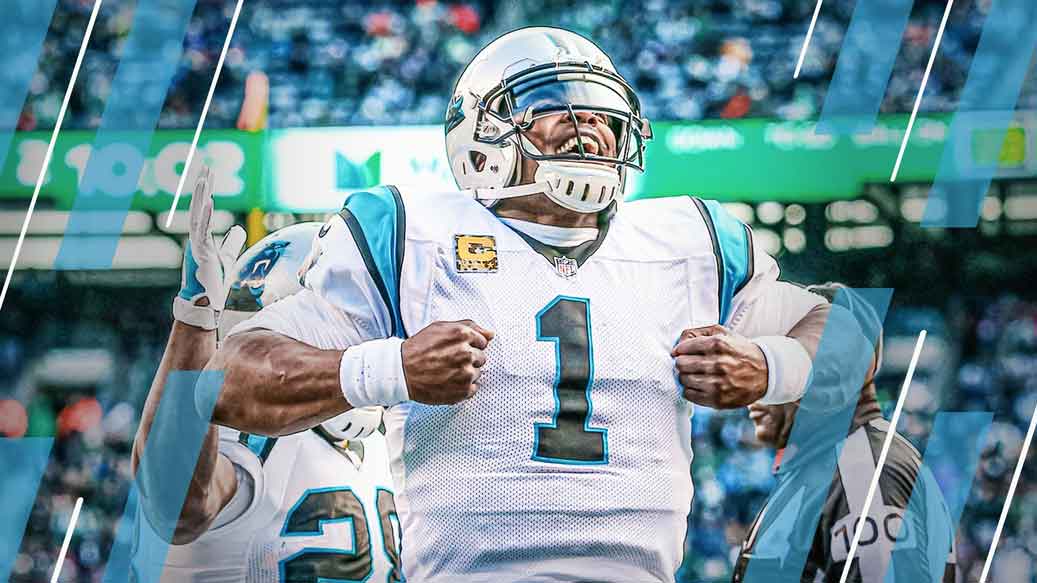
Cam Newton led the Panthers to the league's highest-scoring offense in 2015, but surprisingly, only half of Carolina's All-PFF offense came from that team. Steve Smith Sr. and Jordan Gross were among the most obvious selections, and both were key contributors on the Panthers' 2005 NFC Championship team, which predates the PFF era. Christian McCaffrey and DJ Moore emerged later but were ultimately traded away. Taylor Moton was the only active Panther to make the roster and the only current player who came close.
The closest position battle was at running back, where Christian McCaffrey edged out Jonathan Stewart and DeAngelo Williams. While Stewart and Williams played more games for Carolina, McCaffrey produced more receiving yardage than the two combined. Stewart and Williams held the advantage in rushing volume, but all three backs were similarly efficient on the ground. McCaffrey's receiving production ultimately gave him the edge for the spot.
Defense
- DI: Kawann Short (2013-2020)
- DI: Derrick Brown (2020-2025)
- ED: Charles Johnson (2007-2017)
- ED: Julius Peppers (2006-2009, 2017-2018)
- LB: Luke Kuechly (2012-2019)
- LB: Thomas Davis Sr. (2006-2016)
- SLB: Shaq Thompson (2015-2024)
- CB: Chris Gamble (2006-2012)
- CB: Ken Lucas (2006-2008)
- Slot CB: Richard Marshall (2006-2010)
- S: Tre Boston (2014-2016, 2019-2020)
- S: Chris Harris (2007-2009)
Carolina fielded some great defenses early in the PFF era, but the unit hasn't reached those heights in recent seasons. This roster reflects that reality, as more than half of the All-PFF defense comes from the 2007 team. Shaq Thompson and Derrick Brown are the only defenders from the last five seasons to make the cut.
The front seven would give any offense problems, led by Hall of Famers Luke Kuechly and Julius Peppers. Most of the remaining players also performed at a Pro Bowl level during their Panthers careers. Unfortunately, many of them peaked at different points across the 20-year period.
The secondary proved much more difficult to assemble. Chris Gamble was the clear choice, playing 5,650 snaps — the most by any Panthers defensive back in the PFF era — while also earning the highest grade at 87.1. Beyond him, the competition was extremely tight. Fifteen different defensive backs logged at least 2,500 snaps for Carolina, with most earning grades between 67.0 and 79.0. The battle for the final cornerback spot was especially close, as Josh Norman, Mike Jackson, Captain Munnerlyn and Jaycee Horn all finished within a few grading points of one another.

Methodology
Selections were based on normalized PFF grades adjusted by season. To balance peak performance and longevity, only a player's five best seasons with a franchise from 2006-25 were considered. Any season with an overall PFF grade below 60.0 was excluded, ensuring that strong years helped a player's case while weaker seasons were not held against him. Postseason play was included, though all seasons were capped at a 16-game equivalent to maintain consistency across eras. At each position, the player with the highest score under this methodology earned the spot.
Each team consists of 12 offensive and 12 defensive players. Because 11 personnel and nickel defense were the league's most common alignments over the past two decades, those personnel groupings served as the foundation for every roster. Teams received either a second tight end or a fullback, depending on whether they used more 12- or 21-personnel. Defensively, teams received either a third interior defender or a third linebacker depending on whether they primarily operated from a 3-4 or 4-3 front.
Players who logged significant snaps at multiple positions during their tenure with a franchise were eligible at either spot. In most cases, those players were assigned to the position where they provided the greatest value, though their versatility occasionally influenced the final roster construction.
Unlike some All-Pro teams that group offensive linemen by position type, these rosters were built according to where players actually lined up. If a team's two best tackles both played exclusively on the left side, only the top left tackle was selected. One of the three wide receivers and one of the five defensive backs was also required to have significant slot experience. In a 4-3 defense, one linebacker needed experience at the Sam linebacker position, while in a 3-4 defense, one defensive tackle needed experience at nose tackle.
When multiple players are listed at the same position, the first name represents the top selection. Players designated as slot wide receiver, slot cornerback, nose tackle or Sam linebacker were selected specifically for those roles rather than as the third-best player within their broader position group.

 © 2026 PFF - all rights reserved.