
- Unlock your edge with PFF+: Access Premium Stats, dominate fantasy with in-season tools and projections and make smarter bets with the new PFF Player Prop Tool. Get 25% off your PFF+ annual subscription with code PFFFANTASYPODCAST25.
Estimated Reading Time: 7 minutes

Fantasy and DFS enthusiasts, bettors and analysts often rely on a wide array of statistics and models to gain a competitive edge. These range from basic box score stats to advanced metrics available in PFF's Premium Stats 2.0 and models like Josh Hermsmeyer‘s Buy Low model and WOPR (Weighted Opportunity Rating).
There is always room for new insights and analyses to help bettors and fantasy managers refine their strategies. That’s why I developed a new metric that offers several advantages over WOPR. Click here for an in-depth explanation of the model, my process and its advantages.
Quick Refresher
Using a Predicted Targets model, in conjunction with route-level PFF data, we can create two very stable and predictive metrics: Share of Predicted Targets and Share of Predicted Air Yards.
We can combine these and create a Predicted WOPR metric that is both more stable and predictive than Actual WOPR.
PWOPR = (1.5 * Share of Predicted Targets) + (.7 * Share of Predicted Air Yards)
Furthermore, we can compare this to the players’ Actual WOPR and Actual Fantasy Points to predict potential breakout players in upcoming weeks.
From the 2019-2024 seasons: Roughly 35% of players that appear on this list will score a TD in the following week. That is a raw 12.4% increase from a random with above a median WOPR. Below is last week’s data.
Week 2 Recap
- DeVonta Smith: Was two yards short of scoring a TD – 9.3 PPR Points
- Emeka Egbuka: Scored a TD – 12.9 PPR Points
- D.K. Metcalf: Scored a TD – 11 PPR Points
- Alec Pierce: Was +600 on sportsbooks to hit 60-plus yards. Caught four of five targets, with the only incompletion being a red zone target. Pierce was also wide open for another touchdown, but Daniel Jones scrambled (check out my weekly “Coach, I Was Open” article here for more information on that) – 10.8 PPR Points
- Tre Tucker: 8 Targets – 4.9 PPR Points
- Xavier Legette: Had eight targets for -2 yards. Very happy at predicting this opportunity, but the results could have been better – .8 PPR Points
- Cedric Tillman: 7 targets and a TD – 10.2 PPR Points
- Tyquan Thornton: Had one deep shot TD and should have had two – 13.9 PPR Points
- Demario Douglas: Only one target – 1.8 PPR Points
Week 3 Potential Breakouts
As a quick refresher on how regression-to-the-mean models work: A player’s fantasy points per game (FPpG) are projected based on their three-week PWOPR average (explained more here). For this week’s projections, only two weeks of 2025 data is available and is used accordingly.
PWOPR is significantly more stable than FPpG and serves as a stronger indicator of future performance. To help identify potential breakout candidates, the residual is calculated by subtracting a player’s predicted FPpG from their actual FPpG. Players with a strong PWOPR and a residual of -3.0 or lower are included on this list. Players remain on the list until one of the following conditions is met:
- They fulfill their PWOPR potential with a big game
- Their PWOPR decreases to match their expected FPpG
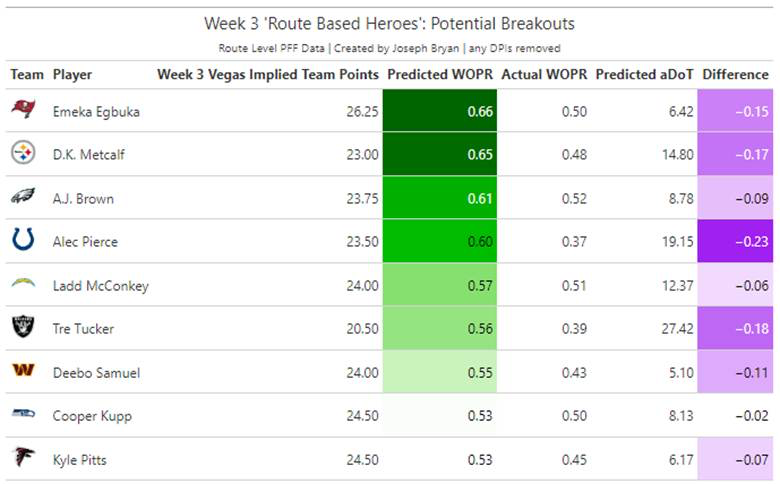
In this section, I want to focus on five players from the list and what kind of matchups they are entering in Week 3.
Emeka Egbuka makes another appearance this week, as he continues to lead the Buccaneers in PWOPR. Egbuka does not have a stellar PFF receiving grade (63.3) but has been getting consistent work, running the most routes on the entire team. The No. 1 way to score fantasy points is to be on the field.
Egbuka and the Bucs face the Jets this week, who have run the fourth-most Cover 1 in the NFL. Cover 1 has a tendency to create a wider range of outcomes and make the game far more skill- or matchups-based. The Jets have an awesome corner in Sauce Gardner (86.8 PFF coverage grade), who will likely be covering Mike Evans the majority of the game.
Egbuka will likely draw one of the other two New York corners, who have not had stellar years so far. This could create some priority 1-on-1s if Tampa’s offensive line can hold up. The Jets have the 11th-worst PFF pass-rush grade, although the Bucs field the eighth-worst PFF pass-block grade and are enduring some big injuries along the offensive line.
Alec Pierce draws a very interesting matchup in the Tennessee Titans. The Titans hold the sixth-best team PFF coverage grade and have one of the most diversified defensive coverage schemes in the NFL. They do run Cover 2 at the sixth-highest rate (20.4% of the time), but no other coverages are in the top 10.
The best cornerback on the Titans is Roger McCreary (78.1 PFF coverage grade), and he lines up in the slot roughly 80% of the time. Meanwhile, Pierce lines up wide more than any Colts receiver, giving him a better matchup with either L'Jarius Sneed — who recorded a 30.1 PFF coverage grade last week — or Jarvis Brownlee Jr. — who compiled a 56.2 coverage mark in Week 2. Both of these would be a great matchup for Pierce if they ever end up in a single-coverage situation.
Ladd McConkey gets a strong opportunity against the Broncos, who run the second-most Cover 1 in the NFL. McConkey has not faced a lot of Cover 1 this season. So far in 2025, he has only had seven receiving snaps versus Cover 1. Over the larger sample size of 2024, McConkey was the 13th-best WR in the NFL against Cover 1 by PFF receiving grade, minimum 10 targets.
So far, the Broncos possess the seventh-worst team PFF coverage grade. Pat Surtain II has name recognition but has earned a 51.7 PFF coverage grade on the season. If the Broncos continue to run a heavy man-coverage scheme, McConkey should be able to take full advantage of it, no matter who he is lined up against.
Deebo Samuel opposes a Raiders team that runs the highest rate of Cover 3 in the NFL (52%). The Raiders have the sixth-best team tackling PFF grade, which is something to check when Samuel is being discussed. Samuel has not been particularly good against Cover 3 over the last two seasons (64.6 PFF receiving grade in 2024 and a 63.0 PFF receiving grade in 2025). This doesn’t mean he cannot break out, but it will be an uphill battle, especially if Jayden Daniels is not playing.
Kyle Pitts might be my favorite play of the week. Pitts put up the best PWOPR of his career last week and, through two weeks of the season, has firmly taken over as the second-best receiving option on the Falcons. Pitts currently holds the best PFF grade on the team as a receiver (74.3).
Tight ends have a base target rate of 19% against any random coverage. More specifically, tight ends possess a 23% target rate against Cover 3. The Panthers run Cover 3 at the third-highest rate in the NFL and have the fourth-worst team PFF pass-rush grade. This season, too, the Panthers rank as the second-worst team by PFF coverage grade against tight ends.
As always, not every player on this list will deliver, but several will likely exceed their average PPR from the past three weeks. A few could even have explosive games.

 © 2026 PFF - all rights reserved.