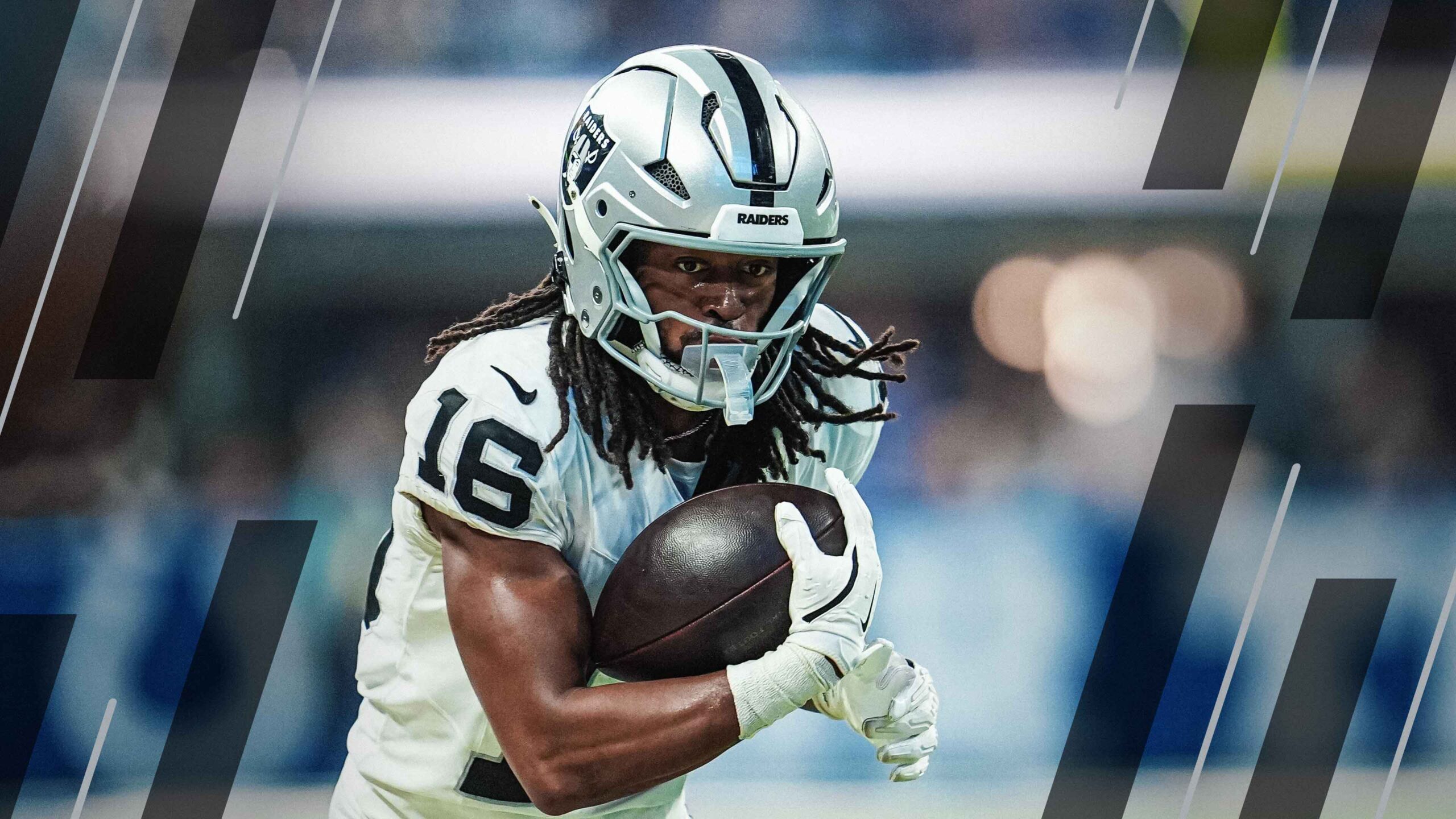
- We assume that players traded midseason are poised to take on bigger roles, but is that true? In our sample, only three of nine qualifying players saw more touches per game once they were traded.
- There are exceptions both ways: Kenyan Drake in 2019 is the shining example of a player getting a role increase post-trade, but there are also the cautionary tales of Golden Tate in 2018 and Chase Claypool in 2022.
- Unlock your edge with PFF+: Access Premium Stats, dominate fantasy with in-season tools and projections and make smarter bets with the new PFF Player Prop Tool. Get 25% off your PFF+ annual subscription with code PFFFANTASYPODCAST25.
Estimated Reading Time: 10 minutes

NFL trade deadline day can be league-shifting with just one or two deals. Just imagine if X, formerly known as Twitter, was around when the Herschel Walker trade went down. Pre-season pretenders suddenly realize they’re contenders and flip picks for players, while teams that went into the campaign with high aspirations fall flat and decide it’s time for a reset.
With so much action comes so much reaction, the wildest of which often takes place in fantasy football trade circles. This very author traded a first-round pick and two second-rounders for Kadarius Toney after his move from the New York Giants to the Kansas City Chiefs.
There is a very binary analysis when a player, particularly a skill-position player, is traded. A team gave up assets midseason for player X, thus, they must want to feature player X very heavily in their offense. Player X, therefore, is about to become a fantasy megastar.
But exactly how true is that? Does a midseason trade mean an automatic uptick in fantasy production? Let's find out.
Since 2015, there have been 26 deadline deals just involving offensive skill-position players. These range from the handy (Calvin Ridley from the Atlanta Falcons to the Jacksonville Jaguars in 2022) to the almost meaningless, but maybe there’s a chance they get more touches, meaning you can flip them for something, anything, like Ty Montgomery being traded from the Green Bay Packers to the Baltimore Ravens in 2018.
This year, several skill-position players switched teams: Jakobi Meyers, Rashid Shaheed, Adonai Mitchell and John Metchie III.
We won’t be naming all 26 players flipped. Instead, we're analyzing 10 of the most high-profile names that were moved at the deadline and using them as the control group for what to expect in terms of fantasy production post-trade.
- TE Vernon Davis (2015): San Francisco 49ers to Denver Broncos
- RB Jay Ajayi (2017): Miami Dolphins to Philadelphia Eagles
- WR/TE Kelvin Benjamin (2017): Carolina Panthers to Buffalo Bills
- QB Jimmy Garoppolo (2017): New England Patriots to San Francisco 49ers (deal was done the day before the deadline)
- WR Golden Tate (2018): Detroit Lions to Philadelphia Eagles
- WR Demaryius Thomas (2018): Denver Broncos to the Houston Texans
- RB Kenyan Drake (2019): Miami Dolphins to Arizona Cardinals
- RB Zack Moss (2022): Buffalo Bills to Indianapolis Colts
- TE T.J. Hockenson (2022): Detroit Lions to Minnesota Vikings
- WR Chase Claypool (2022): Pittsburgh Steelers to Chicago Bears
Before being traded, the 10 names listed above averaged 62.31 PPR points from Weeks 1-8 on their original teams. Post-trade, they averaged 73.61 for the rest of the season with their new teams. The evidence shows a marginal season-long increase, though there are some exceptions in both directions.
Kenyan Drake, for example, logged 56.8 PPR points through the first eight weeks of the 2019 season with the Miami Dolphins, ranking as the RB41 overall — barely a streamable asset. After his move to the desert, Drake was the RB4 from Week 9 onward, behind only Ezekiel Elliott, Derrick Henry and Christian McCaffrey.
His 156.4 PPR points across eight games (average above 19 points) made him an RB1 option, a miraculous turnaround, considering how low his stock was before the trade. Drake stepped into a workhorse role in Arizona with David Johnson’s production nosediving and Chase Edmonds being unable to shoulder the load. Drake averaged almost 19 touches a game with the Cardinals, a huge bump from the 11 touches a game he was seeing in Miami.
It helped that the Cardinals ran the ball much more than the Dolphins. Through the first eight weeks of the 2019 season, the Dolphins ranked dead last in rush attempts (144), while the Cardinals placed 15th (206). Ironically, the Dolphins ran the ball more after Drake’s trade, and the Cardinals logged an identical 206 carries — 11 fewer than Miami from Week 9 onward. The difference was in EPA per play. The Cardinals ranked third with 0.088 EPA per rush, and the Dolphins ranked 29th with -0.141 EPA per rush.
On the opposite end of this spectrum is Golden Tate. When suiting up for the Lions in the 2018 season, the wide receiver logged 117.9 points, a 16.8-point average across his seven games played, which landed him as the WR15. After his switch to the Eagles, he was the WR53, averaging 7.8 points per game.
Tate was one of the key drivers of the Lions' offense that season. His 62 targets were the third most on the team for the entire year, even though he departed with half of the campaign yet to play. Of Lions with at least 20 targets that season, Tate ranked second in passer rating when targeted, with quarterback Matthew Stafford logging a 105.4 mark.
When the former Seattle Seahawk got to Philadelphia, he found himself part of a crowded pass catcher room, led by tight end Zach Ertz, who paced the team in targets (154), Alshon Jeffery and Nelson Agholor (90 targets each). It meant that Tate was often reduced to being the third or fourth option in passing concepts. While his PFF overall grade didn’t suffer much (69.3 in Detroit compared to 67.0 in Philadelphia), his targets, yards, touchdowns and yards per route run all fell.
Touches are the lifeblood of fantasy production. Let's take a look at the average number of touches per game pre- and post-trade, excluding Jimmy Garoppolo, as he is a quarterback and thus touched the ball on every snap once he moved to the 49ers.
| Player | Touches/Game Pre-Trade | Touches/Game Post-Trade |
| Vernon Davis | 3.0 | 2.2 |
| Jay Ajayi | 21.7 | 11.4 |
| Kelvin Benjamin | 4.0 | 2.6 |
| Golden Tate | 6.7 | 3.8 |
| Demaryius Thomas | 4.5 | 3.2 |
| Kenyan Drake | 11.5 | 18.8 |
| Zack Moss | 4.8 | 10.0 |
| T.J. Hockenson | 3.7 | 6.0 |
| Chase Claypool | 5.1 | 2.1 |
For this sample, only three players saw a role increase post-trade: Drake, Moss and Hockenson, with their average number of touches as a group jumping from 6.6 to 11.6. The other six players fell from a combined average of 7.5 touches per game to 4.2.
It’s easy to get sucked into paying up for a freshly traded player in fantasy when assuming their role will hugely increase, especially if premium draft capital or a player was involved in the deal going the other way, as was the case when the Bears sent a second-round pick to acquire Claypool. However, many of the numbers simply don’t bear that out, so buyers beware. If you roster a player flipped at the deadline, take advantage of some naivety and cash in.


 © 2026 PFF - all rights reserved.