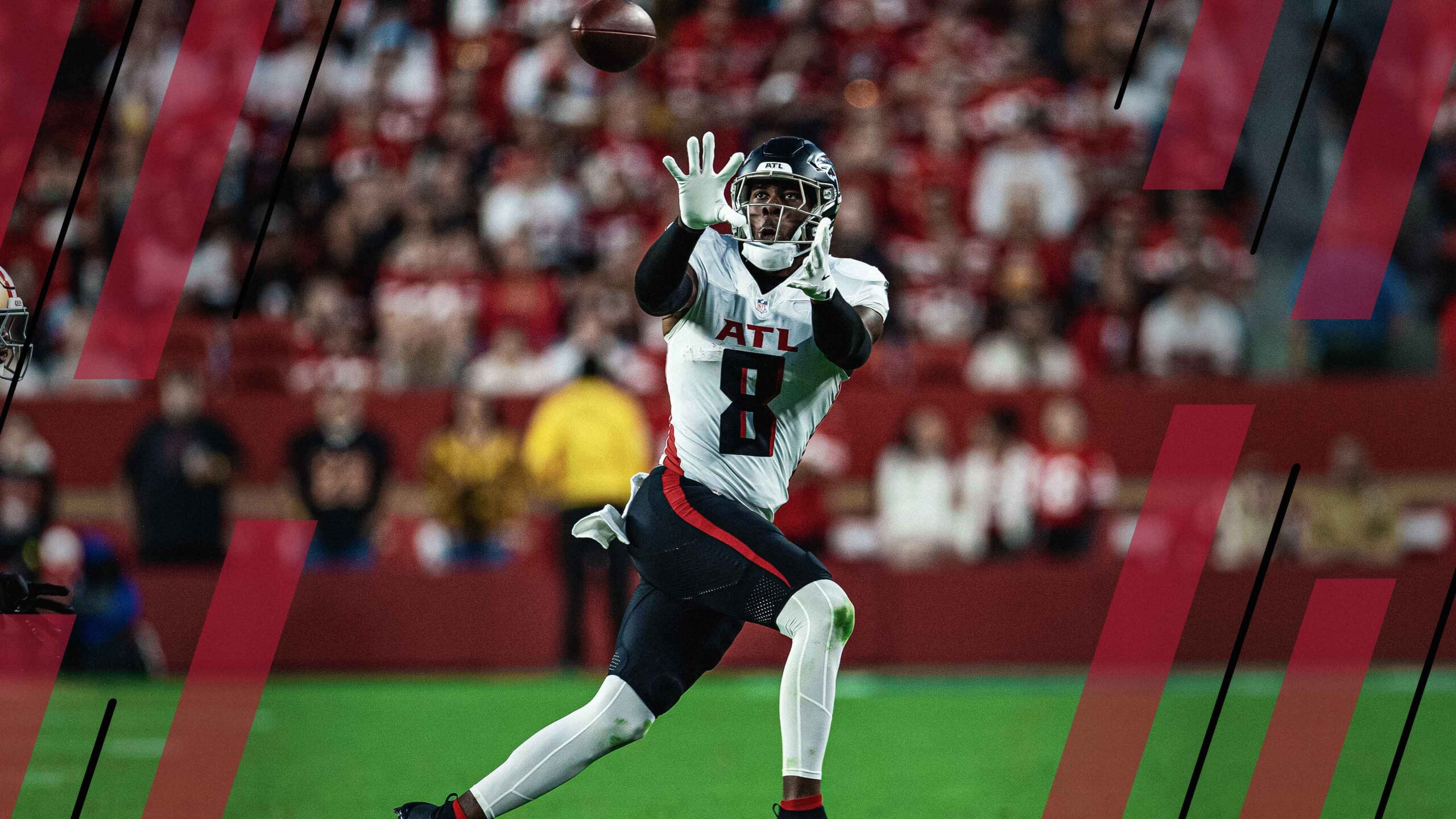
- What to do with Falcons tight end Kyle Pitts: Pitts is quietly putting together a solid 2025 season after several lackluster campaigns relative to his draft stock. At this point, it's best to hold on and hope he continues to get better.
- Is George Pickens a trustworthy dynasty asset? The Cowboys wideout excelled without CeeDee Lamb in the lineup, and he isn't even 25 years old yet. Hold onto him in dynasty formats.
- Unlock your edge with PFF+: Access Premium Stats, dominate fantasy with in-season tools and projections and make smarter bets with the new PFF Player Prop Tool. Get 25% off your PFF+ annual subscription with code PFFFANTASYPODCAST25.
Estimated Reading Time: 13 minutes

In dynasty fantasy football formats, you’re constantly assessing your roster. Whose stock is rising? Whose is falling? Who has been traded to a better situation? And what should you do with players in critical contract years?
Some players enter the final year of their deal as a declining force, others are in line for monster paydays and some are walking that tricky tightrope of their value being hugely impacted by said contract year.
Should you hold a player entering the final year of their contract? Should you flip them due to their market and unstable potential landing spot, or are they even a cuttable asset? Let’s break it down.
WR George Pickens
Pickens entered the 2025 season in a curious situation. The Steelers traded the former second-round pick to the Dallas Cowboys in the offseason, and he has thrived. Dak Prescott playing at an MVP-level has been a huge reason why Pickens owns the fifth-highest PFF receiving grade in the NFL (83.8). Only Puka Nacua, Jaxson Smith-Njigba, Ja’Marr Chase and Amon-Ra St. Brown have graded out higher. In fact, it's Pickens’ highest PFF receiving grade through eight weeks during his NFL career (minimum of 50 targets).
He has also already logged a career-high six touchdowns on the season, and with half of the campaign still to go, he is staring down his first double-digit touchdown season. But it’s not a case of Prescott propping up Pickens — far from it. When targeting the former Georgia Bulldog, Prescott has logged a 131.5 passer rating, the best rating for qualified wide receivers.
In fantasy formats, Pickens has often been a high-end WR2. He entered this season the same. PFF ranked him as the WR19 in fantasy entering the 2025 campaign, behind Brian Thomas Jr., Ladd McConkey, Tee Higgins and Davante Adams. And yet, with almost half of the season gone, Pickens is the overall WR3 in standard PPR scoring formats. Granted, CeeDee Lamb has been injured. Lamb recorded more than 100 receiving yards in Week 1, 2 and 7, and Pickens went for 3/30/0, 5/68/1 and 4/82/0 in those games.
It all averages out to exactly 12 PPR points per game with Lamb in the lineup, comfortably WR2 territory. But Pickens showed during his running mate’s absence that he could be an old-school, big-bodied alpha receiver, capable of having the passing attack run through him.
It’s a side that wasn’t always showcased during his time in Pittsburgh, which gives obvious cause for concern, but progress is seldom linear, and Pickens is still not even 25 years old.
Whether it’s in Dallas or elsewhere, he’s making a case for being the straw that stirs the drink in an offense.
Verdict: Keep
WR Jakobi Meyers
Meyers’ disgruntlement with the Las Vegas Raiders is well documented at this point. The wide receiver wanted a pay rise, didn’t get one and logged a trade request.
Meyers is the current WR48 in PPR formats, behind players like Tyquan Thornton and Elic Ayomanor. He is still featuring heavily in the Raiders' offense and has a healthy target share, but the plight of Pete Carroll and Chip Kelly’s unit means there’s a cause for concern for all of Las Vegas' offensive skill players.
Meyers is still a dependable player and a perfect WR3 for fantasy managers. Of players with at least 40 targets, he ranks eighth in slot snaps (133), and 39 of his 42 targets on the season have come from out of the slot. However, Meyers’ PFF receiving grade from that alignment (66.2) is tied with the Tennessee Titans‘ Calvin Ridley (66.2) and is lower than Chimere Dike (67.7). In fact, of 50 qualifying wide receivers, Meyers ranks 41st.
None of this is helped by the fact that the Raiders have the third-worst-graded passing offense (57.3). Only the Cleveland Browns and Minnesota Vikings rank worse. Couple that with Geno Smith’s dead-last 57.2 PFF passing grade (minimum of 200 dropbacks), and Meyers’ situation has been anything but ideal.
That’s bad for his contract prospects. One would imagine, if Meyers is indeed dealt before the trade deadline on Tuesday at 4 p.m. ET, he will be extra motivated to have a productive back half of the season to increase his value.
The verdict on him really depends on your situation. If you’re looking for depth, Meyers could be a perfect buy-low candidate in the hopes he gets traded elsewhere. The Steelers have been touted as a landing spot, which would be an instant upgrade — although that speaks more to the state of the Raiders' offense than the quality of the Steelers' attack. If you’re a team in a rebuild, you’re probably still looking to trade him, but only if he gets dealt, which will give him a slight bump in value.
Verdict: Trade (both for and away — but only if he gets traded from the Raiders)
TE Isaiah Likely
There are too many easy puns for Likely. Has his injury-marred season hurt his value on the open market? Likely. Would he thrive if given the chance to be a team’s primary tight end? Also likely.
The fourth-year tight end has improved every year he has been in the league and has shown flashes of elite, seam-ripping potential. But several factors have worked against him. First, his role is limited due to the presence of Mark Andrews. And even then, Zay Flowers and Rashod Bateman are Lamar Jackson’s earlier reads in passing concepts over Likely.
Second, the Ravens‘ offense has not been pass-heavy for the majority of Likely’s time in Baltimore. Even in 2023 and 2024, when the team started airing it out more often under offensive coordinator Todd Monken, Jackson’s 516 and 520 pass attempts ranked 16th in both seasons.
Even with those factors working against him, Likely was the eighth-highest-graded tight end in 2024 (75.6). His 9.5-yard average depth of target was the second highest in the NFL among tight ends (minimum of 60 targets), behind only teammate Mark Andrews (10.5). His seven receiving touchdowns were tied third at the position, and while his 603 receiving yards were slightly below average among qualifying tight ends, he did it all on 65 targets and 49 catches — both the third fewest among qualifying tight ends.
All of that culminated in a TE16 finish in standard PPR scoring in 2024, the high mark of Likely's career. That makes him a stash or a streaming option, rather than somebody you can count on week to week. However, the gap between himself and Tucker Kraft, who finished as the TE10 in 2024, was just 37.6 points. It’s not a lot of ground to make up to break into that TE1 range. Likely has the talent; he just needs the opportunity.
Verdict: This is entirely at odds, but if you’ve got Likely stashed away, hold him. If you’re looking for a buy-low asset, then he is somebody to target. Even if he stays with the Ravens, he could be the TE1, as the incumbent Andrews is also playing on the final year of his contract and was the subject of trade and cut rumors this offseason.
TE Cade Otton
Otton is part of a dynamic Tampa Bay Buccaneers passing attack. But he is also so far down the pecking order that it is hard to trust him in any fantasy format. Mike Evans, Emeka Egbuka, Chris Godwin, Rachaad White, Jalen McMillan and Bucky Irving spoil Baker Mayfield with passing options.
Otton’s high mark in fantasy came last season when he finished as the TE14 in standard PPR formats. However, a large portion of his production came in a three-game burst from Week 7 to 9, when he logged 25 catches for 258 yards and three touchdowns. His season stat line was 61 catches for 632 and four scores. So, doing some basic math, his numbers without that three-game explosion would have been 36 grabs for 374 yards and a single touchdown.
Otton has been a fine tight end. Serviceable. Dependable when called upon. But he is not going to win you your league. Truth be told, you could throw a late draft pick at a tight end in your rookie draft and find similar production — Harold Fannin Jr., anyone? Oronde Gadsden II?
Otton’s 57.1 PFF receiving grade is the second-worst mark among qualifying tight ends this season, and his 5.5 average target depth places him just 16th out of 22 players. To Otton’s credit, he has the most snaps among all tight ends (490), but his primary usage has been as an in-line player — 452 snaps, fourth most among tight ends — where 50% of the time the Buccaneers have called run plays.
Verdict: Cut. Otton is a really good real-life tight end. But for fantasy purposes, he’s a droppable asset. You can find guys on the waiver wire to stream with a similar output and upside, and you can throw late-round darts in drafts to find players with potentially higher ceilings.
TE Kyle Pitts
Several compelling players could have filled this final spot: Breece Hall, Kenneth Walker III, Jauan Jennings and Mike Evans, to name but a few. But what keep, trade, cut list would be complete without Kyle Pitts?
Pitts has tortured fantasy managers in all formats since he was the fourth overall selection in the 2021 draft. A 1,026-yard rookie season sent expectations sky high for the prospect who was viewed by many as a unicorn when he entered the league. Alas, much like seeing a vending machine in the middle of the desert, it has been a mirage (so far).
However, Pitts is quietly putting together a solid season in 2025. His 344 yards are the eighth most among tight ends, and his 46 targets are the sixth most. It’s an uptick from where he was at the same point last season, when he had 41 targets (though he had logged 411 yards and three scores).
The problem is his red-zone usage. Pitts has just six red-zone targets, the same number as the Steelers' Darnell Washington, who has seen just 14 targets on the season. Granted, Washington’s 6-foot-6, 264-pound frame lends itself to red-zone production, but Pitts is no small man. He, too, is 6-foot-6.
The second issue is his blocking chops. He has played 70 pass-blocking snaps and 693 run-blocking snaps in his career. Since Pitts entered the league, the Falcons have 2,101 rushing attempts, and Pitts has been involved as a run blocker on 33% of them. That discrepancy, coupled with the fact that his current 59.4 PFF run-blocking grade is a career high but still below average leaguewide, creates an offensive imbalance when he is on the field.
Verdict: Keep. You owe it to yourself to see this through to the bitter end. Pitts' 72.0 PFF overall grade is right in the middle for his NFL career to date. It's fitting that in his most important year for his future earnings as a pro, he is performing fine and at an average level. You might as well see if it gets better.


 © 2026 PFF - all rights reserved.