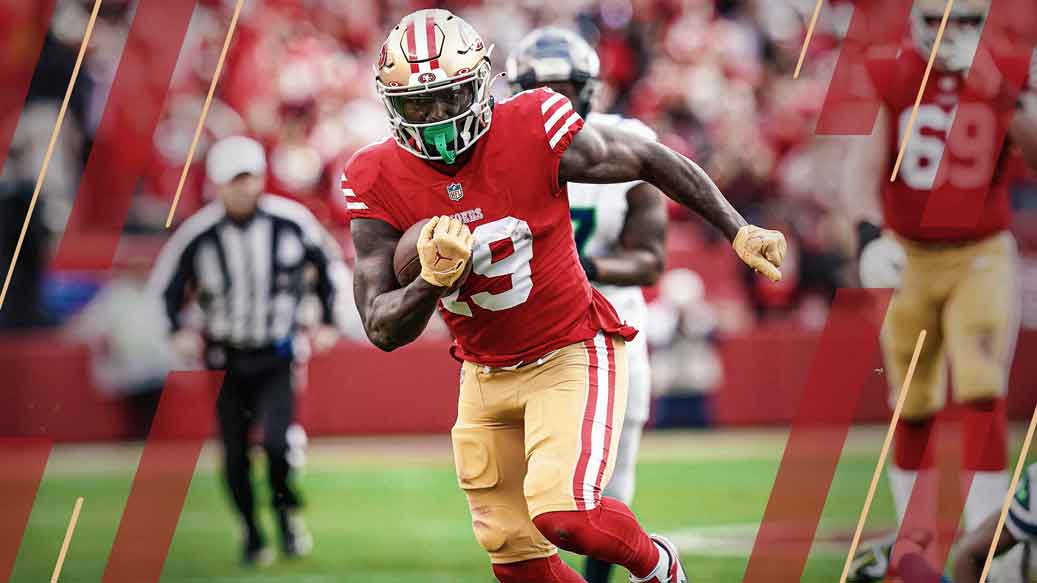
- Ricky Pearsall‘s surgery opens the door for Deebo Samuel‘s return: The San Francisco 49ers signed Samuel off the free-agent market once Pearsall's knee swelling resurfaced, and Pearsall's move to injured reserve leaves the Z role for Samuel.
- Samuel's posted top-10 receiver production, just in spurts rather than over a full season: Each of the last four years has featured a stretch of high-end production cut short by injury, which is why he lands in the mid-to-late rounds.
- Get more from PFF+ for less: PFF+ is now $9.99 per month or $99.99 per year, with access to PFF+ content and tools, fantasy and betting resources, the Mock Draft Simulator and more — all at a new lower price.

The 49ers selected Samuel in the second round of the 2019 NFL Draft, and his 2021 campaign was one of the most unique fantasy seasons in NFL history. Through the first nine weeks, he averaged 20.7 PPR points per game. His 882 receiving yards ranked second among wide receivers, and he averaged an absurd 18.0 yards per reception. Beginning in Week 10, San Francisco scaled back his role as a receiver and turned him into one of its primary ball carriers. Samuel averaged 6.2 yards per carry and nearly one rushing touchdown per game the rest of the way, producing 21.7 PPR points per game over that span, the fourth-highest mark among wide receivers.
Samuel's next three seasons followed a familiar pattern: stretches of high-end production interrupted by injuries. In 2022, he was the WR11 through the first seven weeks before a hamstring injury slowed him, and he later suffered MCL and ankle sprains. In 2023, he was the WR18 through five weeks before a shoulder injury sidelined him. He missed two games, eased back into the lineup for one week and then finished as the WR3 from Week 10 through the end of the season. He was the WR11 through two weeks in 2024 before the injuries piled up again. Samuel missed Week 3, and over the first two months of the season he appeared on the injury report with calf, wrist, rib and oblique injuries, as well as an illness. Rib and wrist injuries in January also cost him the final week of the season.
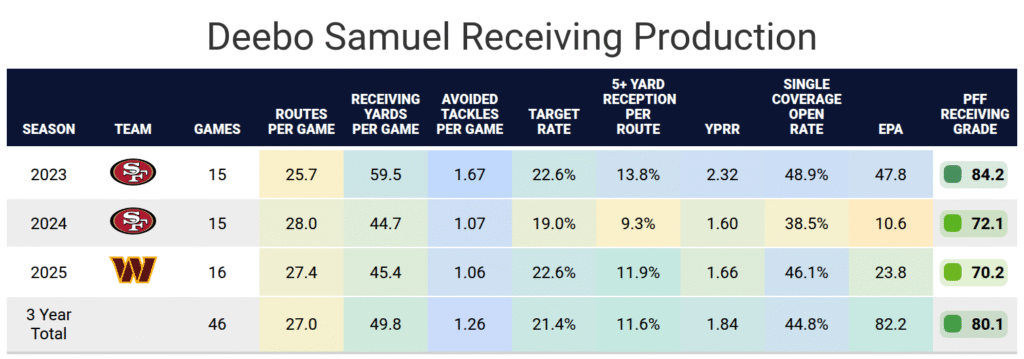
Samuel spent one season with the Washington Commanders after the 49ers were forced to make a difficult financial decision. He was the WR7 through the first five weeks, ranking seventh among wide receivers in receptions and second in rushing attempts. However, a heel injury landed him on the injury report throughout October, and by the time he returned to full health, Jayden Daniels was dealing with injuries of his own and missed much of the remainder of the season. Samuel ultimately finished 33rd among wide receivers in fantasy points per game at 11.8.
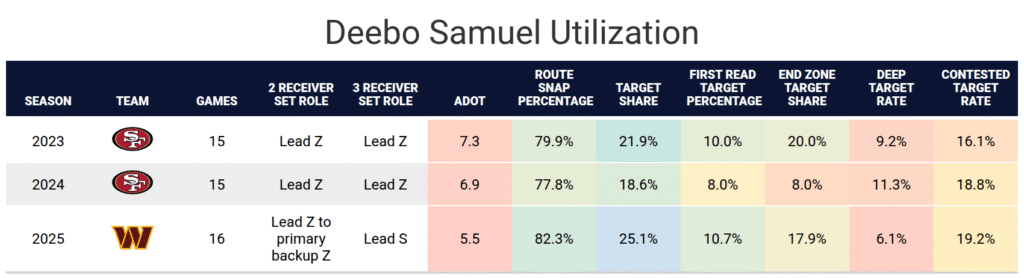
He spent most of the offseason as a free agent before returning to San Francisco after Ricky Pearsall's 2025 PCL injury led to lingering knee swelling. Pearsall was soon ruled out for surgery and placed on injured reserve, opening the door for Samuel to reclaim his familiar role at Z receiver. The 49ers had already added Mike Evans at X and Christian Kirk in the slot, leaving Samuel's path to playing time largely unchanged. They also spent a second-round pick on De'Zhaun Stribling, but in the practices between Pearsall's injury and Samuel's signing, veteran Demarcus Robinson filled in at Z. That suggests Stribling is more likely to compete for snaps with Evans or Kirk than with Samuel.
Samuel's level of play has declined over the past two seasons, though injuries have almost certainly contributed. The wear and tear may have caught up to him, and there is a chance he's no longer capable of producing as a consistent fantasy starter. Still, as long as he's healthy, San Francisco's offense gives him a chance to bounce back. The combination of Kyle Shanahan and Brock Purdy provides one of the league's most favorable environments, and Shanahan has already said he plans to use Samuel as a runner, raising his fantasy floor.
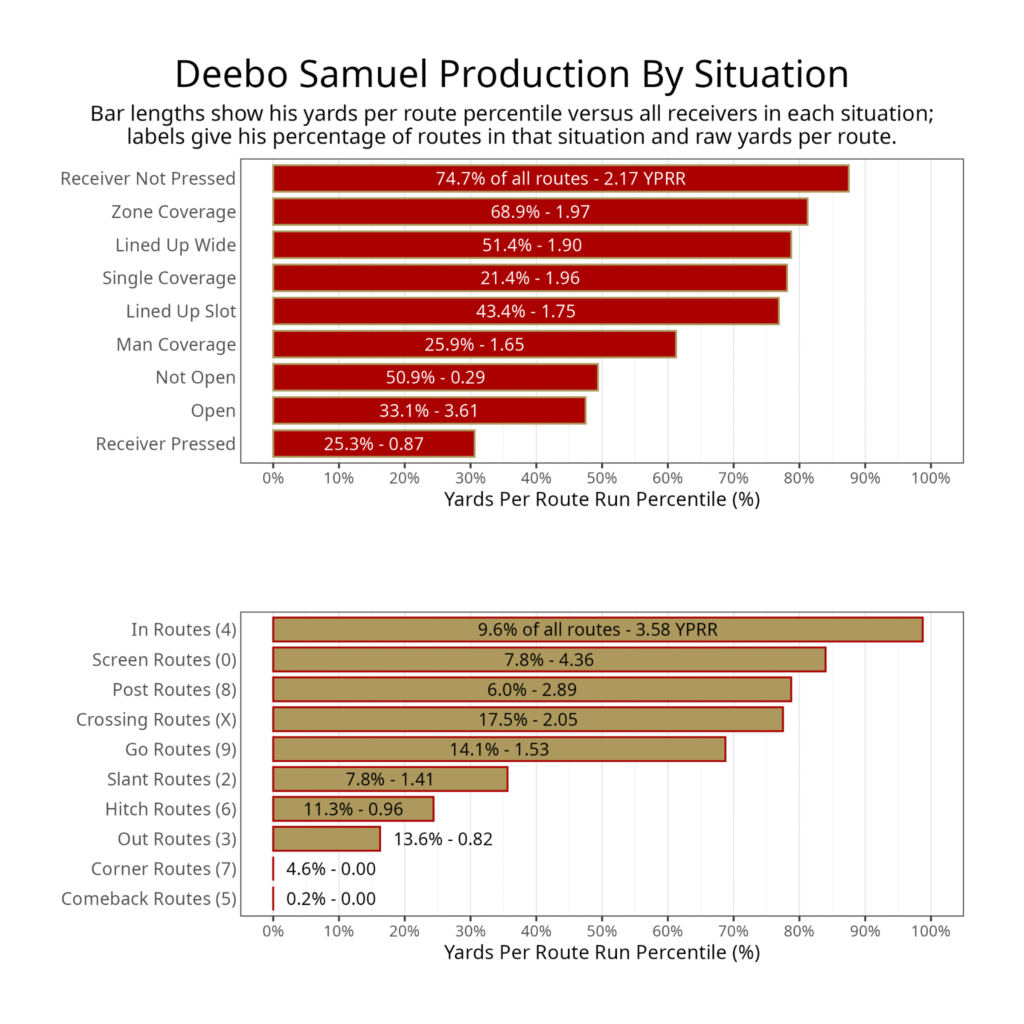
He is worthy of a mid-to-late-round pick. As usual, he should be a weekly fantasy starter if healthy, and health has always been the concern. You can find more statistics and information on his past performance, his competition for touches and how much his teammates and coaches will help or hurt him below.
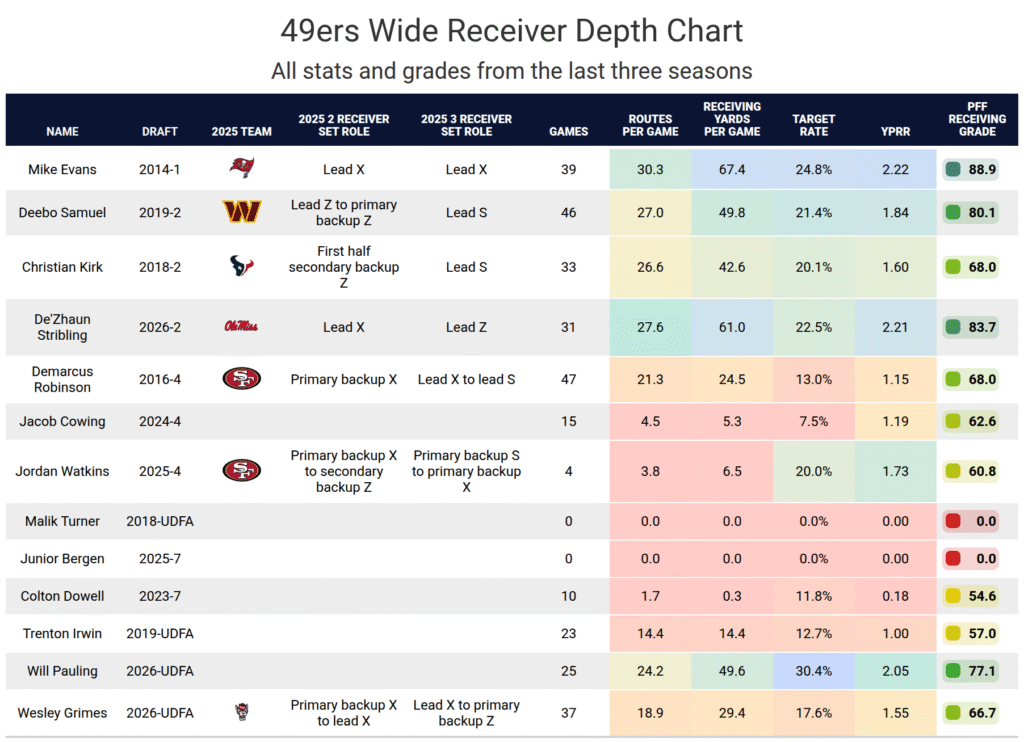
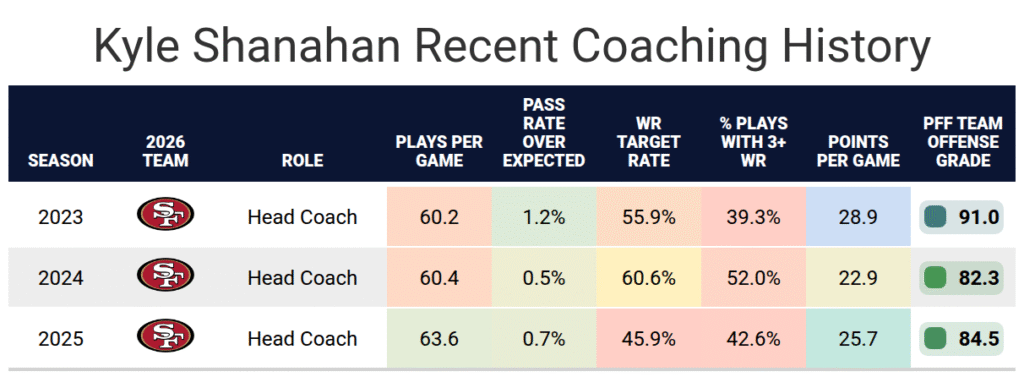
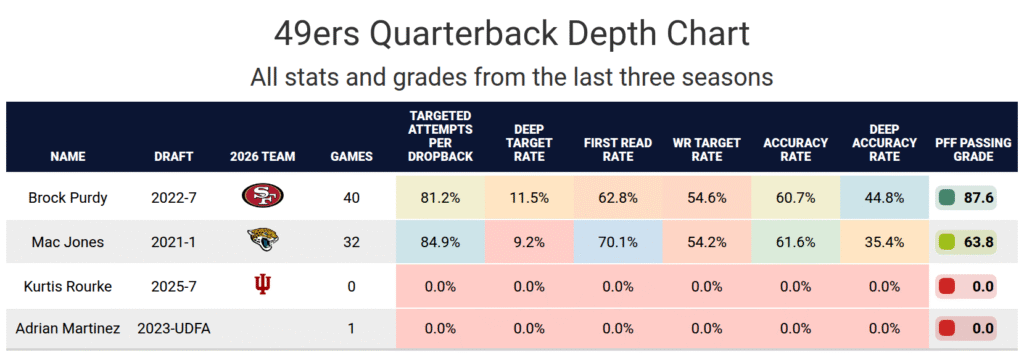
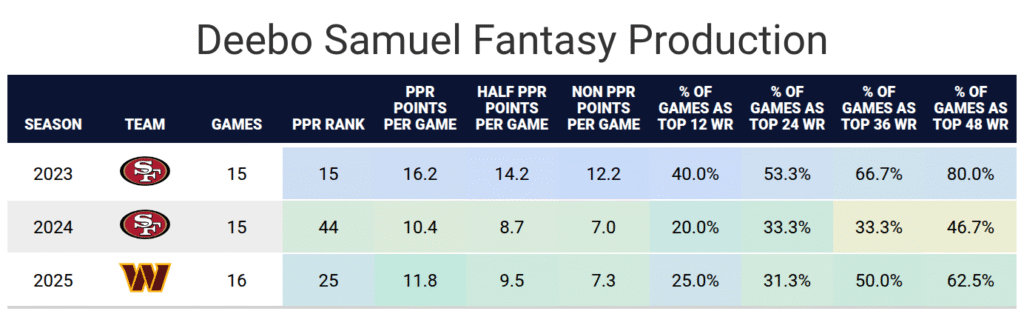
Footnotes
- Statistics in tables and charts were chosen based on their ability to predict future fantasy performance on a per-game or per-opportunity basis or to describe the player relative to others at the same position.
- “Opportunities” are defined as passing dropbacks, rushing attempts and routes run as a receiver.
- Numbers are provided either by season or based on the past three years. For rookies, only college statistics are included. For non-rookies, only NFL statistics are considered, regardless of whether they played in college within the previous three years.
- As college competition is easier than NFL competition, most rookies are likely to see a decline from their historical numbers.
- Only FBS data is considered for college players and comparisons.
- Kneel-downs are removed from rushing data to provide cleaner quarterback rushing rate statistics.
- The table colors in this article range from blue (indicating good/high) to red (indicating bad/low).
- All percentiles and color codings compare the given player to others with a high sample of opportunities. Generally, the cutoff is one-third of the possible opportunities in the sample. If a player does not meet the threshold, they are still included in the comparison, though their results may appear better or worse than expected due to the smaller, less predictive sample size.
- Information on utilization classifications and their importance can be found here for running backs, wide receivers and tight ends.

 © 2026 PFF - all rights reserved.